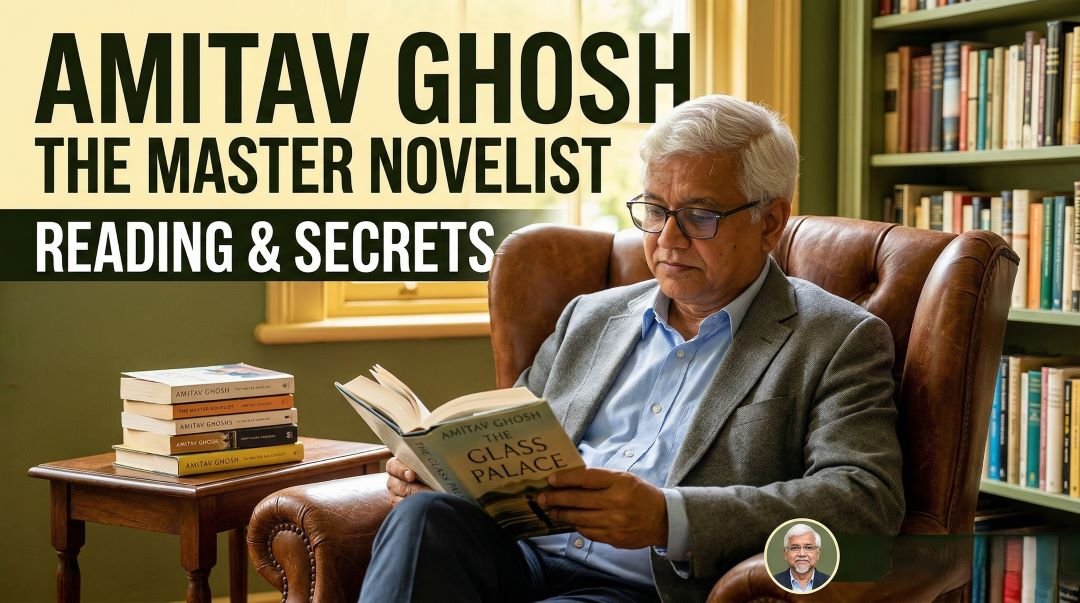
Today in this article we will discuss about the Amitav Ghosh Biography PDF and PPT Slides Download (.PPTX), Amitav Ghosh Biography, Books, Famous Works, Awards, The Great Derangement and Complete Literary Legacy so, There is a moment in almost every reader’s encounter with Amitav Ghosh when the full scope of what he is doing becomes clear – and it is a genuinely dizzying moment. Here is a novelist who moves with equal confidence between 12th-century Cairo, 19th-century Bengal, colonial Burma, the Sundarbans mangrove delta, and the opium trading houses of Canton. Here is an essayist who can trace a line of argument from the history of the nutmeg trade to the architecture of the current climate crisis with the rigour of a scholar and the clarity of a great storyteller. Here is one of the most important thinkers alive about the relationship between empire, ecology, and imagination – and he expresses that thinking in fiction and non-fiction of extraordinary literary quality.
Amitav Ghosh is, by almost any measure, the most significant Indian novelist of his generation writing in English. He has been writing for nearly forty years, has published more than a dozen books of fiction and non-fiction, has won the Sahitya Akademi Award, the Padma Vibhushan, the Prix Medici Etranger, the Arthur C. Clarke Award, the Commonwealth Writers Prize, and the Erasmus Prize. He has been shortlisted for the Man Booker Prize. He is regularly mentioned as a potential Nobel laureate. And in 2025, at the age of 68, he published Ghost-Eye – a novel that continues to push his imagination into new territory.
This comprehensive article covers everything about Amitav Ghosh – biography in English and Hindi, wife and family, education, books in order (fiction and non-fiction), famous works, the Ibis Trilogy, The Great Derangement summary, In an Antique Land, The Hungry Tide, Sea of Poppies, Gun Island, The Nutmeg’s Curse, Ghost-Eye (new book 2025), Nobel Prize and Booker Prize clarifications, Erasmus Prize, Sahitya Akademi Award, petrofiction, and his complete literary legacy.
Amitav Ghosh Biography Table
The table below provides every essential biographical fact about Amitav Ghosh – from his birth and education to his books, prizes, wife, and latest work:
| Biographical Detail | Information |
| Full Name | Amitav Ghosh |
| Date of Birth | 11 July 1956 |
| Born Place | Calcutta (Kolkata), West Bengal, India |
| Age (as of 2025) | 68 years |
| Nationality | Indian |
| Father | Shailendra Chandra Ghosh – a diplomat in the Indian Foreign Service; his diplomatic postings took the family to Bangladesh (then East Pakistan), Sri Lanka, and Iran during Amitav’s childhood |
| Wife | Deborah Baker – an American writer, editor, and biographer; she is the author of A Blue Hand (about Allen Ginsberg) and In Extremis: The Life of Laura Riding; they have been married since the 1980s |
| Family / Children | Two children – a son and a daughter |
| Education – School | The Doon School, Dehradun – India’s most prestigious boarding school |
| Education – Bachelor’s | BA in History – St. Stephen’s College, University of Delhi, 1976 |
| Education – Master’s | MA in Sociology – Delhi School of Economics, University of Delhi |
| Education – PhD | D.Phil. (PhD) in Social Anthropology – St. John’s College, Oxford University, UK; his doctoral fieldwork was conducted in Egypt – the experience that produced In an Antique Land |
| Profession | Novelist; essayist; journalist; social anthropologist; climate change writer; one of the most important Indian writers in English of his generation |
| Genre | Fiction: historical fiction, postcolonial fiction, literary fiction, science fiction elements; Non-Fiction: travel writing, history, anthropology, climate change essays, political essays |
| First Novel | The Circle of Reason (1986) – his debut novel, winner of the Prix Medici Etranger (France) |
| Most Famous Work | The Shadow Lines (1988) – won the Sahitya Akademi Award and the Ananda Puraskar; or Sea of Poppies (2008) – Booker Prize shortlisted, first volume of the Ibis Trilogy |
| The Ibis Trilogy | A major historical trilogy set in the world of the opium trade and the First Opium War (1839-42): Sea of Poppies (2008), River of Smoke (2011), Flood of Fire (2015) |
| Latest / New Book (2025) | Ghost-Eye (2025) – his most recent novel; themes of perception, memory, reincarnation, ecology, and the modern world’s perceptual crisis; published to significant critical discussion |
| Nobel Prize | Amitav Ghosh has NOT won the Nobel Prize. He is frequently mentioned as a strong candidate for the Nobel Prize in Literature, particularly given his prominence and his influential writing on climate change. As of 2025, he has not been awarded it. |
| Booker Prize | Amitav Ghosh has NOT won the Booker Prize, but has been shortlisted. Sea of Poppies (2008) was shortlisted for the Man Booker Prize. In 2001, he became the first Indian to win the Eurasian Regional Commonwealth Prize of the Commonwealth Writers Prize (for The Glass Palace). |
| Erasmus Prize | Won the Erasmus Prize 2024 – one of Europe’s most prestigious cultural prizes, awarded by the Dutch Praemium Erasmianum Foundation; given for his extraordinary contribution to European culture, society, and social science, particularly for his writing on climate change, colonialism, and globalisation |
| Sahitya Akademi Award | Won the Sahitya Akademi Award for The Shadow Lines (1990) – India’s most prestigious literary honour. He subsequently declined to attend the Sahitya Akademi’s events in 2015 in solidarity with writers who were returning their awards to protest the climate of intolerance in India. |
| Which Novel Won the Sahitya Akademi Award? | The Shadow Lines (1988) won the Sahitya Akademi Award (presented 1990) |
| Other Major Awards | Prix Medici Etranger (France, 1990 – for The Circle of Reason); Arthur C. Clarke Award for best science fiction (for The Calcutta Chromosome, 1997); Padma Vibhushan (2019, India’s second-highest civilian honour); Dan David Prize (2010); Jnanpith Award consideration; Lifetime Achievement awards from multiple institutions |
| The Great Derangement | His landmark non-fiction work on climate change (2016) – arguing that mainstream literary fiction has failed to adequately engage with the climate crisis; one of the most influential books on climate change and culture written in the 21st century |
| Petrofiction / Wild Fictions | ‘Petrofiction’ is a term Amitav Ghosh coined in a famous 1992 essay in The New Republic – referring to fiction that engages with the culture of oil and petroleum. ‘Wild Fictions’ is a concept developed in his later thinking about fiction and ecology. |
| Current Residence | He divides his time between Brooklyn (New York, USA) and India |
Amitav Ghosh Biography PDF and PPT Slides Download (.PPTX)
Who Is Amitav Ghosh? Why Is He So Important?
Amitav Ghosh was born on 11 July 1956 in Calcutta (now Kolkata), West Bengal, India. He is one of the most important Indian writers of the post-independence generation – a figure comparable to Salman Rushdie in the breadth of his literary ambition, though very different in sensibility and style. The University of Hyderabad’s critical biography describes him as ‘perhaps the most distinctive and influential writer to come out of India since Salman Rushdie.’
What makes Ghosh distinctive among his contemporaries is, above all, the range and depth of his intellectual concerns – and the consistency with which those concerns produce both brilliant fiction and important non-fiction. He is one of the very few writers alive who can claim to have made major contributions to literary fiction, to the theory of the novel, to the history of the Indian Ocean world, to the anthropology of Egypt, to the environmental humanities, and to the political debate about climate change.
He is famous as the author of The Shadow Lines – one of the defining novels about India’s Partition and its aftermath; of the Ibis Trilogy – the most ambitious work of historical fiction about the opium trade and the British Empire; of The Hungry Tide – a landmark work of ecological fiction; of The Great Derangement – the most influential book yet written about climate change and the imagination; and of The Nutmeg’s Curse – a brilliant argument about the connections between colonialism and the current ecological crisis.
Amitav Ghosh Biography: Early Life, Education and Family
Amitav Ghosh was born into a diplomatic family – his father, Shailendra Chandra Ghosh, was a member of the Indian Foreign Service. The father’s career took the family across South and Southeast Asia during Amitav’s childhood: he grew up in Bangladesh (then East Pakistan), Sri Lanka, and Iran, among other places. This peripatetic early life – moving between countries, languages, and cultures – gave him from the very beginning the cosmopolitan perspective and the fascination with border-crossing, translation, and cultural encounter that runs through all his subsequent work.
He attended The Doon School in Dehradun – India’s most prestigious boarding school, which has produced a remarkable number of India’s intellectual, political, and cultural elite. From there he went to St. Stephen’s College at the University of Delhi, where he studied History, graduating in 1976. He then took an MA in Sociology at the Delhi School of Economics before winning a place at Oxford University to study Social Anthropology – where he completed his D.Phil. at St. John’s College. His doctoral fieldwork took him to Lataifa, a village in the Nile Delta in Egypt – an experience that would eventually produce In an Antique Land.
Amitav Ghosh Wife and Family
Amitav Ghosh is married to Deborah Baker – an American writer, editor, and biographer. Deborah Baker is the author of A Blue Hand: The Beats in India (a biography of Allen Ginsberg) and In Extremis: The Life of Laura Riding – both well-regarded literary works in their own right. The couple have two children and divide their time between Brooklyn (New York) and India. Their marriage has been a long and stable one – a partnership of two literary intellectuals whose work frequently intersects.
Amitav Ghosh Books: Complete List in Order (Fiction and Non-Fiction)
Amitav Ghosh has published a substantial body of both fiction and non-fiction across nearly four decades of writing. Below is his complete bibliography in order – with full summaries of every major work:
| Year | Title | Summary / Detail |
| FICTION / NOVELS | ||
| 1986 | The Circle of Reason | His debut novel – set in rural Bengal, Calcutta, and North Africa; follows Alu, a weaver with an unusually large head, and his community’s migration across the world. Deeply influenced by magical realism and by the tradition of Bengali literature. Won the Prix Medici Etranger (France) – a remarkable achievement for a first novel. |
| 1988 | The Shadow Lines | His most celebrated early novel and winner of the Sahitya Akademi Award. A non-linear narrative exploring memory, nationalism, borders, and violence through the stories of two families – one in Calcutta and one in London – across the decades from the 1930s to the 1960s. Centres on the 1964 Hindu-Muslim riots that swept simultaneously through Dhaka and Calcutta. One of the most important Indian novels of the 20th century – a meditation on the fictional nature of national borders and the reality of human connection across them. Widely taught in universities worldwide. |
| 1992 | In an Antique Land | A unique hybrid work – part autobiography, part history, part travel writing, part social anthropology. Based on his doctoral fieldwork in a village in the Nile Delta in Egypt in the 1980s, and on his archival research into a medieval correspondence between an Indian trader in Egypt and his Jewish merchant associate. The 12th-century correspondence (discovered in the Cairo Geniza) is woven together with his own 20th-century experience of living in the same Egyptian village. One of his most praised and most unusual works. |
| 1995 | The Calcutta Chromosome | A genre-defying thriller combining elements of science fiction, mystery, and the supernatural. Set across three time periods – colonial Calcutta during Ronald Ross’s malaria research, late 20th-century New York, and a near-future world. Argues, daringly, that the discovery of the malaria parasite was secretly guided by a hidden Indian agency pursuing a project of counter-science. Won the Arthur C. Clarke Award for Best Science Fiction Novel (1997). |
| 2000 | The Glass Palace | A sweeping historical novel covering over a century of South and Southeast Asian history – from the fall of the Burmese kingdom in 1885 through two World Wars to Indian independence and beyond. Follows Rajkumar, an orphan boy who witnesses the British annexation of Burma and builds a teak fortune, and the Indian soldiers of the British Indian Army who served in Burma and Malaya. An epic of colonialism, memory, and the human cost of empire. Won the Commonwealth Writers Prize (Eurasian Region) – the first Indian writer to win that prize. |
| 2004 | The Hungry Tide | Set in the Sundarbans – the vast mangrove delta at the mouth of the Ganges, shared between India and Bangladesh, and one of the world’s most ecologically remarkable and dangerous regions. Follows Piya, an Indian-American marine biologist studying the Irrawaddy dolphin, and Fokir, a local fisherman who becomes her guide. Also involves Kanai, a Delhi-based translator. Explores the relationship between human survival and ecological preservation – particularly the tensions around the Marichjhapi massacre (1979), when thousands of Bengali refugees were expelled from a wildlife reserve. A landmark work of ecological fiction that anticipated the concerns of his later non-fiction on climate change. |
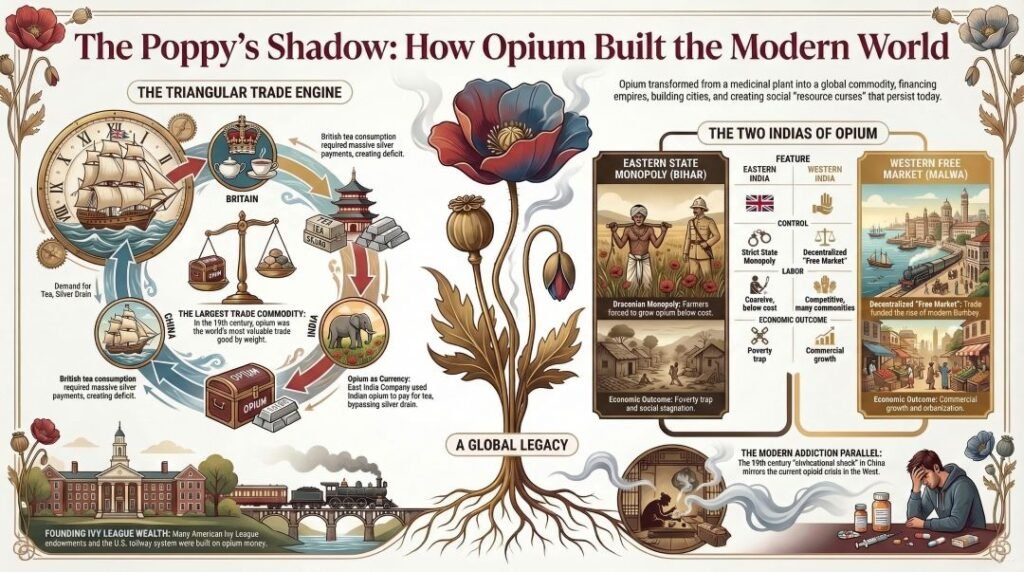
| 2008 | Sea of Poppies (Ibis Trilogy Vol. 1) | The first volume of the Ibis Trilogy – shortlisted for the Man Booker Prize 2008. Set in 1838-39 – the eve of the First Opium War. Centres on the Ibis, a converted slave ship sailing from Calcutta to Mauritius carrying indentured labourers (coolies) bound for the sugar plantations of the French colony. A vast, multi-perspectival narrative featuring characters from many social positions: a French-born opium merchant’s widow, a dispossessed raja, an American sailor, a female botanist, various Indian indentured workers. Explores the opium trade, the British Empire’s exploitation of Indian peasants, and the extraordinary multilingual culture of the Indian Ocean world. |
| 2011 | River of Smoke (Ibis Trilogy Vol. 2) | The second volume of the Ibis Trilogy. Moves the action to Canton (Guangzhou), China – in the months leading up to the First Opium War (1839). Centres on the trading world of Fanqui-town (the foreign merchants’ enclave in Canton) and the escalating conflict between the British opium traders and the Chinese authorities who are trying to stop the opium trade. A rich portrait of the cosmopolitan merchant world of 19th-century Canton. |
| 2015 | Flood of Fire (Ibis Trilogy Vol. 3) | The concluding volume of the Ibis Trilogy. Covers the First Opium War itself (1839-42) and its aftermath – the British military campaign that forced China to accept the opium trade and cede Hong Kong. Brings together the characters and storylines of the first two volumes. A monumental conclusion to one of the most ambitious historical fiction projects in Indian writing in English. |
| 2019 | Gun Island | A novel that weaves together ecology, migration, and mythology – following Deen Datta, a rare book dealer specialising in Bengali texts, who discovers an 18th-century shrine in the Sundarbans dedicated to Bon Bibi and the legend of the ‘Gun Merchant’ (Bonduki Sadagar). The trail leads him from the Sundarbans to Los Angeles to Venice – connecting a legend about a Bengali merchant who fled from a snake goddess with the contemporary crises of climate change and human migration. Explores how ancient myths encode ecological wisdom and how that wisdom speaks to our current moment. |
| 2022 | The Nutmeg’s Curse: Parables for a Planet in Crisis | A major work of non-fiction – part history, part ecological manifesto, part cultural critique. Starting from the history of the nutmeg – the spice for which the island of Run in the Banda archipelago was devastated by the Dutch and its indigenous inhabitants massacred – Ghosh traces the connections between colonial violence, the extraction of natural resources, and the current ecological crisis. Argues that the logic of terracide (the destruction of the Earth) is the continuation of the logic of genocide that drove European colonialism. One of his most important and most politically urgent works. |
| 2025 | Ghost-Eye | His most recent novel (2025). Explores themes of perception, memory, reincarnation, ecology, and the modern world’s perceptual crisis – described by Down To Earth as suggesting that ‘the modern world’s crisis is not only environmental or political, but perceptual.’ Reviewed extensively in Indian and international literary media in March 2025, with Frontline, Indian Express, and Esquire India all publishing major pieces on the novel. Continues his engagement with ecological themes from a new angle – the relationship between how we perceive the world and our capacity to act on its behalf. |
| NON-FICTION | ||
| 1992 | In an Antique Land (hybrid) | See above – classified as both fiction and non-fiction; a hybrid work of autobiography, history, and anthropology |
| 2000 | Countdown | A non-fiction account of the 1998 nuclear tests by both India and Pakistan – written from the perspective of communities living near the test sites on both sides of the border. A powerful piece of journalism on the human consequences of nuclear nationalism. |
| 2002 | The Imam and the Indian: Prose Pieces | A collection of essays and prose pieces – including his famous 1992 essay ‘Petrofiction’ (coining the term) and other essays on culture, literature, history, and travel. An important collection for understanding the development of his intellectual concerns. |
| 2016 | The Great Derangement: Climate Change and the Unthinkable | His landmark non-fiction work on climate change – based on the Berlin Family Lectures he delivered in 2015. Argues in three parts (Stories, History, Politics) that: (1) literary fiction has been catastrophically ill-equipped to imagine and narrate climate change; (2) the historical origins of the climate crisis lie in the fossil fuel economy built by colonialism; (3) the political solutions must come from Asia, which is both the most vulnerable region and the fastest-growing emitter. One of the most important and widely discussed books on climate change and culture of the 21st century. |
| 2021 | The Living Mountain (Introduction) | Introduction to a new edition of Nan Shepherd’s The Living Mountain – a landmark work of nature writing about the Cairngorms; Ghosh’s introduction places Shepherd’s work in the context of ecological literature and the climate crisis. |
| 2022 | The Nutmeg’s Curse | See above – non-fiction on colonialism, ecology, and the history of the nutmeg trade |
Which Amitav Ghosh Book Should I Read First?
This is one of the most frequently asked questions about his work, and the answer depends on your interests. For readers who want to start with his most celebrated and accessible novel, The Shadow Lines (1988) is the perfect entry point – it is relatively short, emotionally powerful, and introduces all his major themes (partition, borders, memory, nationalism) in a concentrated form. For readers interested in his historical fiction, Sea of Poppies (2008) – the first volume of the Ibis Trilogy – is the ideal starting point. For readers interested in ecology and the Sundarbans, The Hungry Tide (2004) is his most accessible ecological novel. For readers interested in his non-fiction, The Great Derangement (2016) is essential.
Amitav Ghosh Famous Works: Most Famous Books
Amitav Ghosh has written many celebrated books, but several stand out as his most famous and most widely read. Here is a guide to his most famous works:
1. The Shadow Lines (1988) – Most Famous Early Work
The Shadow Lines is widely considered Amitav Ghosh’s masterpiece of early career fiction and his most important contribution to the Indian novel. It is a non-linear narrative told by an unnamed narrator who reconstructs the intertwined histories of two families – one in Calcutta, one in London – across the decades from the 1930s to the 1960s. The novel’s central event is the 1964 Hindu-Muslim riots, which swept through both Dhaka and Calcutta simultaneously – a moment Ghosh uses to interrogate the idea of national borders: if riots happen simultaneously in two countries, what exactly does the border between them mean?
- Won the Sahitya Akademi Award (presented 1990) – which novel won Sahitya Akademi Award: The Shadow Lines
- Won the Ananda Puraskar – one of West Bengal’s most prestigious literary prizes
- Widely taught in Indian and international universities in courses on postcolonial literature, Partition, and the Indian novel
- Praised for its extraordinary non-linear structure, its meditation on memory and belonging, and its political intelligence
2. Sea of Poppies (2008) – Most Famous International Work
Sea of Poppies is the first volume of the Ibis Trilogy and the novel that brought Ghosh the widest international recognition. Shortlisted for the Man Booker Prize in 2008, it is set on the eve of the First Opium War (1839) and centres on the converted slave ship Ibis, sailing from Bengal to Mauritius with a diverse cargo of indentured labourers (coolies), convicts, and the various merchants, sailors, and passengers who crowd its decks.
- Shortlisted for the Man Booker Prize 2008
- One of his best-selling novels internationally – translated into many languages
- Celebrated for its extraordinary linguistic inventiveness – the novel uses English, Bengali, Bhojpuri, Laskari (a maritime creole), French, and Bhojpuri Hindi; Ghosh invented much of the Laskari vocabulary through research
- The novel’s historical research is exceptional – Ghosh spent years researching the opium trade, the indentured labour system, and the culture of the Indian Ocean world
3. The Glass Palace (2000)
A sweeping historical novel covering over a century of South and Southeast Asian history – from the British annexation of Burma in 1885 through two World Wars, Japanese occupation, and Indian independence. Follows multiple generations of the Chettiar family and the Burmese royal family through the upheavals of the colonial and post-colonial period. Won the Commonwealth Writers Prize (Eurasian Region) – making Ghosh the first Indian writer to win that prize.
4. The Hungry Tide (2004)
Set in the Sundarbans – the vast, dangerous, ecologically extraordinary mangrove delta at the mouth of the Ganges. Follows Piya, an Indian-American marine biologist, and Fokir, a local fisherman, as they search for the endangered Irrawaddy dolphin. Also explores the Marichjhapi massacre of 1979 – when the West Bengal government expelled thousands of Bengali Hindu refugees from a wildlife sanctuary in the Sundarbans, resulting in many deaths. A landmark work of ecological fiction that anticipated the concerns of The Great Derangement.
5. Gun Island (2019)
Set between the Sundarbans, Los Angeles, and Venice, Gun Island weaves together the legend of Bonduki Sadagar (the ‘Gun Merchant’ – a Bengali folk figure who fled from the snake goddess Manasa) with the contemporary crises of climate change and human migration. The title’s ‘Gun Island’ (Bundook Dweep in the Sundarbans) becomes a connecting thread that links a 17th-century myth, a contemporary rare book dealer, and refugees crossing the Mediterranean. One of his most accessible novels and his most direct engagement with the contemporary climate and migration crisis.
The Ibis Trilogy: Complete Reference Guide
The Ibis Trilogy is Amitav Ghosh’s most ambitious literary project – a three-volume historical novel covering the opium trade and the First Opium War (1839-42). It is named after the Ibis – a converted American slave ship that becomes the vessel through which the trilogy’s characters and storylines are connected. Here is a complete reference guide to all three volumes:
| Volume | Year | Key Details |
| Sea of Poppies (Vol. 1) | 2008 | Shortlisted for the Man Booker Prize 2008. Setting: 1838-39, aboard the Ibis (a converted slave ship) sailing from Bengal to Mauritius. Themes: opium trade, indentured labour, the British Empire’s exploitation of Indian peasants through poppy cultivation, the cosmopolitan Indian Ocean world. Language: uses a rich mix of English, Bengali, Bhojpuri, Laskari (a creole sailors’ language), and other languages – one of the most linguistically innovative novels in Indian fiction. |
| River of Smoke (Vol. 2) | 2011 | Setting: Canton (Guangzhou), China, 1838-39 – the months immediately before the First Opium War. Focus: the cosmopolitan world of Fanqui-town (the foreign merchants’ quarter in Canton); the confrontation between the Chinese authorities attempting to ban opium and the British merchants (backed by the British government) insisting on their right to trade it. New characters introduced including a Parsi merchant family from Bombay. |
| Flood of Fire (Vol. 3) | 2015 | Setting: The First Opium War (1839-42) and its aftermath. Brings together the characters and storylines from the first two volumes. The British military campaign – one of the most morally indefensible wars in the history of the British Empire, fought to force China to accept opium imports – is depicted with full historical and moral clarity. The signing of the Treaty of Nanking (1842) concludes the trilogy. |
Why the Ibis Trilogy Is Important
- It is the most comprehensive work of historical fiction about the British opium trade – one of the most morally indefensible enterprises in the history of the British Empire, through which Britain forced opium (grown by Indian peasants under compulsion) on China, addicting millions and going to war to defend the right to do so
- It recovers the history of indentured labour – the system through which millions of Indians (and others) were sent as virtual slaves to work on colonial plantations across the Indian Ocean world after the formal abolition of slavery
- It celebrates the extraordinary linguistic and cultural diversity of the Indian Ocean world – the Laskari creole, the mixing of Bengali, Bhojpuri, French, English, Cantonese, Parsi, and many other languages and cultures
- It is among the most linguistically innovative works of fiction in English of the 21st century
- It connects the history of the opium trade to contemporary issues of globalisation, migration, and the drug economy
The Great Derangement: Climate Change and the Unthinkable – Complete Summary
The Great Derangement (2016) is Amitav Ghosh’s most important non-fiction work and one of the most widely read books on climate change and culture published in the 21st century. Here is a complete reference guide – including the Part 1 summary that is frequently searched:
| Aspect | Detail |
| Full Title | The Great Derangement: Climate Change and the Unthinkable |
| Published | 2016 (University of Chicago Press / Allen Lane) |
| Origin | Based on the Berlin Family Lectures delivered at the Free University Berlin in 2015 |
| Part 1: Stories | Argues that literary fiction has catastrophically failed to engage with climate change – that the conventions of the realist novel (individual psychology, manageable scale, dramatic probability) make it structurally unable to narrate the scale and temporality of the climate crisis. Explores why climate change is ‘unthinkable’ within the dominant forms of contemporary literature. |
| Part 2: History | Traces the historical roots of the climate crisis in the fossil fuel economy – arguing that colonialism was the engine that created the fossil fuel economy and that the wealth accumulated by the West through colonialism was inseparable from the burning of coal and oil that produced the climate crisis. |
| Part 3: Politics | Argues that the political solutions to the climate crisis must come from Asia (particularly India and China) – both because Asia is the most vulnerable region and because the major political, philosophical, and religious traditions of Asia (Buddhism, Hinduism, Islam) offer resources for thinking about the relationship between humans and the non-human world that Western modernity has destroyed. |
| Central Argument | The ‘great derangement’ refers to the mental and imaginative failure of our age – our collective inability to think seriously about the climate crisis, to make it real to ourselves, to integrate it into our art, our politics, and our everyday consciousness. This is, he argues, a failure not just of will but of imagination. |
| The Great Derangement Summary Part 1 | Stories: Literary fiction is trapped in the conventions of ‘bourgeois realism’ – individual protagonists, psychological depth, dramatic plausibility – which cannot accommodate the uncanny, inhuman scale and temporality of climate change. Ghosh argues that genre fiction (science fiction, fantasy) has actually been more willing to engage with climate change than literary fiction. The ‘stories’ section argues that we need new forms of storytelling to address the climate crisis. |
| Significance | One of the most widely read, cited, and debated books on climate change and culture published in the 21st century; translated into numerous languages; taught in universities worldwide in courses on climate change, literature, postcolonialism, and environmental humanities; winner of multiple essay/non-fiction prizes |
The Great Derangement – Stories from the Great Derangement (Part 1 Summary)
The first part of The Great Derangement is titled ‘Stories’ and is the most widely discussed and most frequently taught section of the book. In it, Ghosh argues that the dominant form of contemporary literary fiction – the realist novel focused on individual psychology and everyday life – is structurally incapable of engaging with the climate crisis. The climate crisis is characterised by events that are simultaneously too large (planetary in scale), too slow (unfolding over centuries), and too strange (cyclones in unexpected places, species extinctions, glacial melting) to fit within the conventions of the realist novel. Ghosh calls this failure ‘the great derangement’ – a collective imaginative failure that is also a political failure, since we cannot act on what we cannot imagine.
He argues that genre fiction – science fiction, fantasy, cli-fi – has actually been more willing to engage with climate change than literary fiction. He also reflects on his own early encounter with extreme weather (a freak cyclone he witnessed in Delhi as a young man) and on why he was unable, at the time, to use that experience in his fiction – precisely because it was ‘too improbable’ for realist conventions.
The Nutmeg’s Curse: Parables for a Planet in Crisis – Summary
The Nutmeg’s Curse (2022) is Amitav Ghosh’s most recent major non-fiction work (before Ghost-Eye in 2025) and one of his most politically urgent. The book takes as its starting point the history of the nutmeg – a spice that was once, astonishingly, worth more than gold, and for which the island of Run in the Banda archipelago was destroyed by the Dutch East India Company in the early 17th century. The indigenous Bandanese people were massacred; their society was obliterated; the nutmeg trees were harvested by enslaved workers.
From this historical starting point, Ghosh traces a line of argument about the relationship between colonial violence (the massacre, the exploitation, the terraforming of landscapes for extraction) and the current ecological crisis. He argues that the logic of what he calls ‘terracide’ – the systematic destruction of the Earth – is the continuation, not the departure from, the logic of genocide that drove European colonialism. The book connects the 17th-century massacre in the Banda Islands to the 21st-century climate crisis through a sustained argument about the philosophy and politics of extraction.
Amitav Ghosh New Book 2025: Ghost-Eye
In 2025, Amitav Ghosh published Ghost-Eye – his most recent novel and one of his most unusual works. The novel explores themes of perception, memory, and reincarnation – engaging with the question of how we perceive the world and whether our perceptual limitations are at the root of the modern crisis.
- Down To Earth described Ghost-Eye as suggesting that ‘the modern world’s crisis is not only environmental or political, but perceptual’ – placing the novel in the tradition of Ghosh’s ecological thinking but approaching it from a new, more metaphysical angle
- The Indian Express published a major review noting how the novel uses the work of Ian Stevenson (the American psychiatrist who researched cases of children with apparent memories of previous lives) and the figure of a three-year-old who appears to have memories of a past existence
- Frontline Magazine published a critical piece titled ‘Why Amitav Ghosh’s Ghost-Eye Fails to Convince’ – raising questions about whether the novel’s ambition is fully realised; demonstrating that the book has generated the kind of serious critical debate that attends major literary work
- Esquire India described Ghosh as refusing to surrender in his quest for deeper understanding of humanity’s relationship with nature – characterising Ghost-Eye as a continuation of his long engagement with ecology and perception
- The novel is his most recent work as of March 2025 and represents his continuing development as a writer in his late sixties
Amitav Ghosh Nobel Prize, Booker Prize and Erasmus Prize – Clarifications
Has Amitav Ghosh Won the Nobel Prize?
No – as of 2025, Amitav Ghosh has not won the Nobel Prize in Literature. He is frequently mentioned as a strong potential candidate – given his literary stature, his international profile, his writing on climate change and colonialism, and the Nobel Committee’s recent inclination towards writers engaged with pressing global issues. However, the Nobel Prize has not yet been awarded to him. This is a common question because of his prominence.
Has Amitav Ghosh Won the Booker Prize?
No – Amitav Ghosh has not won the Man Booker Prize. He was shortlisted in 2008 for Sea of Poppies (the prize that year went to Aravind Adiga for The White Tiger). He has, however, won numerous other major prizes: the Sahitya Akademi Award (for The Shadow Lines), the Prix Medici Etranger (France), the Arthur C. Clarke Award, the Commonwealth Writers Prize, the Padma Vibhushan, and the Erasmus Prize. The absence of a Booker Prize is perhaps the most notable gap in an otherwise extraordinary record of literary recognition.
The Erasmus Prize 2024 – For Which Book?
The Erasmus Prize 2024 was awarded to Amitav Ghosh by the Praemium Erasmianum Foundation in the Netherlands – one of Europe’s most prestigious cultural prizes. The prize was not given for a single book but for his entire body of work – specifically for his extraordinary contribution to culture, society, and social science through his writing on climate change, colonialism, and globalisation. His Erasmus Prize speech has been widely circulated and discusses his views on the relationship between the ecological crisis and the history of colonialism.
Amitav Ghosh and Petrofiction: A Key Concept
One of Amitav Ghosh’s most significant intellectual contributions to literary criticism is the concept of ‘petrofiction’ – a term he coined in a famous 1992 essay published in The New Republic, titled ‘Petrofiction: The Oil Encounter and the Novel.’ The essay argued that despite the overwhelming importance of oil in shaping 20th-century politics, culture, and society, literary fiction had almost entirely failed to engage with the culture and politics of oil. He contrasted this with the abundance of fiction about other extractive industries and pointed to the absence of any major novel that placed oil – its extraction, its geopolitics, its social consequences – at its centre.
The essay is one of the most cited pieces of literary criticism by an Indian writer of the late 20th century and has shaped the academic field of ‘energy humanities’ and ‘petrofiction studies.’ The concept of petrofiction is directly connected to the concerns that would later produce The Great Derangement – both essays are about the failure of literary imagination to engage with the fossil fuel economy and its consequences.
Amitav Ghosh and In an Antique Land – The Egypt Connection
In an Antique Land (1992) is one of Amitav Ghosh’s most unusual and most praised works – a hybrid text that combines autobiography, travel writing, history, and social anthropology in a way that defies conventional genre classification. It is based on two overlapping investigations: his own experience as a young doctoral student living in Lataifa, a village in the Egyptian Nile Delta in the early 1980s; and his archival research into a 12th-century correspondence discovered in the Cairo Geniza (a remarkable archive of medieval documents) between an Indian trader named Bomma and his Jewish merchant associate Abraham Ben Yiju.
The two storylines – medieval and modern – illuminate each other in unexpected ways. The medieval Indian Ocean world that Bomma and Ben Yiju inhabited was extraordinarily cosmopolitan – a world of free movement, cultural exchange, and commercial connection that was later destroyed by European colonialism. Ghosh’s modern Egyptian village is constrained, suspicious, and bounded by national and religious identities that would have been unrecognisable to the medieval merchants. The book is, among other things, an elegy for the cosmopolitan world that colonialism destroyed.
Amitav Ghosh Awards: Complete List
| Award | Year | For / Detail |
| Prix Medici Etranger (France) | 1990 | The Circle of Reason – one of France’s most prestigious literary prizes for a foreign-language novel |
| Sahitya Akademi Award | 1990 | The Shadow Lines – India’s most prestigious literary honour; which novel won Sahitya Akademi Award = The Shadow Lines |
| Arthur C. Clarke Award | 1997 | The Calcutta Chromosome – for Best Science Fiction Novel; his most surprising prize, given that Ghosh is not primarily known as a science fiction writer |
| Commonwealth Writers Prize (Eurasian Region) | 2001 | The Glass Palace – first Indian writer to win the Eurasian Regional prize |
| Dan David Prize | 2010 | Tel Aviv University – for Past Dimension (awarded for his work on history and historical fiction) |
| Man Booker Prize Shortlist | 2008 | Sea of Poppies – shortlisted but did not win (note: he has not WON the Booker Prize) |
| Padma Vibhushan | 2019 | India’s second-highest civilian honour – awarded by the Government of India for exceptional and distinguished service to the nation |
| Erasmus Prize | 2024 | Awarded by the Praemium Erasmianum Foundation (Netherlands) – one of Europe’s most prestigious cultural prizes; given for his exceptional contribution to culture, society, and social science, particularly his writing on climate change, colonialism, and globalisation. The Erasmus Prize speech is available and has been widely discussed. |
| Nobel Prize | Not won | Amitav Ghosh has NOT won the Nobel Prize in Literature. He is frequently mentioned as a strong potential candidate, particularly for his work on climate change and colonialism. As of 2025, the Nobel Prize in Literature has not been awarded to him. |
| Booker Prize | Not won | Amitav Ghosh has NOT won the Man Booker Prize (despite being shortlisted for Sea of Poppies in 2008). This is a common misconception – he has won many other prizes but not the Booker. |
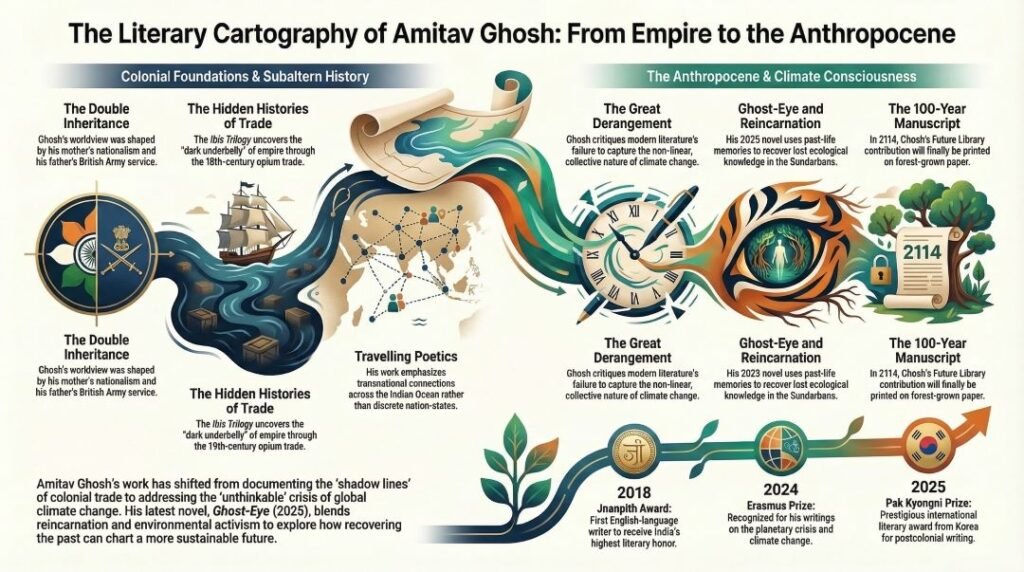
Amitav Ghosh Life Timeline
| Year | Key Event |
| 1956 | Born on 11 July in Calcutta (Kolkata), West Bengal, India, to a diplomat father (Shailendra Chandra Ghosh) |
| 1960s | Childhood spent across multiple countries due to his father’s diplomatic postings – Bangladesh (East Pakistan), Sri Lanka, Iran; this peripatetic early life gave him the cross-cultural perspective that defines his fiction |
| Early 1970s | Attended The Doon School, Dehradun – India’s most prestigious boarding school; developed his literary interests |
| 1976 | Graduated with BA in History from St. Stephen’s College, University of Delhi |
| Late 1970s | MA in Sociology from the Delhi School of Economics; then admitted to Oxford University to study social anthropology |
| 1980–82 | Doctoral fieldwork in Egypt – spent time in Lataifa, a village in the Nile Delta; this experience produced In an Antique Land; also began archival research in the Cairo Geniza documents |
| 1982 | Received D.Phil. (PhD) in Social Anthropology from St. John’s College, Oxford |
| 1980s | Married Deborah Baker (American writer and editor); began teaching and journalistic work |
| 1986 | Published The Circle of Reason – debut novel; won Prix Medici Etranger (France, 1990) |
| 1988 | Published The Shadow Lines – his breakthrough novel; won Sahitya Akademi Award and Ananda Puraskar |
| 1992 | Published In an Antique Land; published the famous essay ‘Petrofiction’ in The New Republic – coining the term; worked as a journalist in the early 1990s covering international events including the Gulf War |
| 1995 | Published The Calcutta Chromosome – genre-defying thriller; won Arthur C. Clarke Award for Best Science Fiction (1997) |
| 2000 | Published The Glass Palace – sweeping historical novel of Burma; won Commonwealth Writers Prize (Eurasian Region, 2001) |
| 2004 | Published The Hungry Tide – set in the Sundarbans; a landmark work of ecological fiction |
| 2008 | Published Sea of Poppies (Ibis Trilogy Vol. 1) – shortlisted for the Man Booker Prize 2008 |
| 2010 | Won the Dan David Prize (Tel Aviv University) |
| 2011 | Published River of Smoke (Ibis Trilogy Vol. 2) |
| 2015 | Published Flood of Fire (Ibis Trilogy Vol. 3) – completing the Ibis Trilogy; delivered Berlin Family Lectures on climate change |
| 2016 | Published The Great Derangement: Climate Change and the Unthinkable – his landmark non-fiction work on climate crisis and imagination; became one of the most widely read books on climate change worldwide |
| 2019 | Published Gun Island; awarded Padma Vibhushan (India’s second-highest civilian honour) |
| 2022 | Published The Nutmeg’s Curse: Parables for a Planet in Crisis – on colonialism, ecology, and the nutmeg trade |
| 2024 | Won the Erasmus Prize – one of Europe’s most prestigious cultural prizes |
| 2025 | Published Ghost-Eye – his most recent novel; widely reviewed in Indian and international literary media in March 2025 |
Amitav Ghosh Writing Style and Themes
Amitav Ghosh’s writing style is distinctive among Indian novelists writing in English – characterised by extraordinary historical and anthropological depth, linguistic plurality, political seriousness, and a particular sensitivity to ecology and environment that has grown stronger with each successive book.
Key Elements of His Writing Style
- Historical scope: He writes across vast stretches of time – from the 12th century (In an Antique Land) to the 19th century (Ibis Trilogy) to the present (Gun Island, Ghost-Eye) – with equal confidence and equal historical rigour
- Linguistic plurality: His fiction is one of the most linguistically diverse in contemporary Indian writing – he incorporates Bengali, Hindi, Bhojpuri, Arabic, Cantonese, Laskari, Parsi, and many other languages into his English prose, reflecting the actual linguistic diversity of the historical worlds he depicts
- Ecological vision: From The Hungry Tide onwards, ecology and environment have been at the centre of his imaginative concerns; his fiction and non-fiction increasingly engage with the relationships between human beings, non-human life, and the planetary systems that sustain them
- Anthropological intelligence: His Oxford training in social anthropology gives his fiction a distinctive capacity to inhabit social worlds from the inside – to show how a society works, how it is organised, what it assumes
- Political engagement: He is deeply engaged with the politics of empire, colonialism, and globalisation – but his political engagement is always expressed through story and historical analysis rather than polemicism
- Genre boundary crossing: He moves comfortably between historical fiction, science fiction, thriller, travel writing, anthropology, and political essay – often within a single work
10 Lines About Amitav Ghosh for Students
- Amitav Ghosh was born on 11 July 1956 in Calcutta (Kolkata), West Bengal, India, to a diplomat father; his childhood was spent across multiple countries due to his father’s diplomatic postings.
- He was educated at The Doon School (Dehradun), St. Stephen’s College Delhi (BA History, 1976), Delhi School of Economics (MA Sociology), and Oxford University (D.Phil. Social Anthropology).
- He is married to Deborah Baker, an American writer and biographer; they have two children and divide their time between Brooklyn and India.
- His most celebrated early novel is The Shadow Lines (1988) – which won the Sahitya Akademi Award; it is one of the most important Indian novels about Partition and the nature of national borders.
- His most ambitious work is the Ibis Trilogy – Sea of Poppies (2008, Booker Prize shortlisted), River of Smoke (2011), and Flood of Fire (2015) – a sweeping historical epic about the opium trade and the First Opium War.
- His landmark non-fiction work The Great Derangement (2016) argues that literary fiction has failed to engage with the climate crisis and examines the historical and political roots of the ecological emergency.
- He coined the term ‘petrofiction’ in a famous 1992 essay about fiction and the oil economy – a concept that has shaped the academic field of energy humanities.
- His major awards include the Sahitya Akademi Award, the Prix Medici Etranger (France), the Arthur C. Clarke Award, the Commonwealth Writers Prize, the Padma Vibhushan (2019), and the Erasmus Prize (2024).
- He has NOT won the Nobel Prize or the Booker Prize – though he was shortlisted for the Booker for Sea of Poppies in 2008 and is frequently mentioned as a Nobel candidate.
- His most recent novel, Ghost-Eye (2025), explores perception, memory, ecology, and reincarnation – continuing his engagement with the relationship between how we see the world and our capacity to respond to its crises.
Amitav Ghosh Short Biography (Profile / Biodata)
Amitav Ghosh (born 11 July 1956, Calcutta) is an Indian novelist, essayist, and social anthropologist – one of the most important Indian writers in English of his generation. Son of a diplomat, he was educated at The Doon School, St. Stephen’s College Delhi, and Oxford University (D.Phil., Social Anthropology). He is married to American writer Deborah Baker; they have two children. His major works include The Shadow Lines (1988, Sahitya Akademi Award), In an Antique Land (1992), The Calcutta Chromosome (1995, Arthur C. Clarke Award), The Glass Palace (2000, Commonwealth Writers Prize), The Hungry Tide (2004), the Ibis Trilogy (Sea of Poppies 2008, River of Smoke 2011, Flood of Fire 2015), The Great Derangement (2016), Gun Island (2019), The Nutmeg’s Curse (2022), and Ghost-Eye (2025). He coined the term ‘petrofiction’ (1992) and is among the world’s leading writers on climate change and colonialism. He has won the Padma Vibhushan (2019) and the Erasmus Prize (2024) and has been shortlisted for the Man Booker Prize but has not won either the Booker or the Nobel Prize.
Read also: Arundhati Roy Biography PDF and PPT Slides Download (.PPTX)
Conclusion: Amitav Ghosh’s Enduring Significance
Amitav Ghosh is one of those rare writers whose work matters in more than one register simultaneously. As a novelist, he has produced works of extraordinary literary quality – The Shadow Lines, the Ibis Trilogy, The Hungry Tide – that have changed what Indian fiction in English can do and what it can imagine. As an essayist and thinker, he has produced The Great Derangement and The Nutmeg’s Curse – works that have genuinely changed the conversation about climate change, colonialism, and the imagination in ways that will be felt for decades.
And in Ghost-Eye (2025), at the age of 68, he is still pushing forward – still asking new questions, still refusing to rest on the extraordinary reputation he has built. That combination – literary excellence and intellectual urgency, historical depth and ecological foresight, the ambition of a scholar and the imagination of a great storyteller – is what makes Amitav Ghosh not just important to Indian literature but essential to contemporary world literature.
Final Quick Reference – Amitav Ghosh Key Facts
- Full Name: Amitav Ghosh
- Born: 11 July 1956 – Calcutta (Kolkata), West Bengal, India
- Age (2025): 68 years
- Father: Shailendra Chandra Ghosh – Indian Foreign Service diplomat
- Wife: Deborah Baker – American writer and biographer
- Family: Two children
- Education: Doon School; St. Stephen’s College Delhi (BA History); Delhi School of Economics (MA); Oxford University (D.Phil. Social Anthropology)
- First Novel: The Circle of Reason (1986)
- Most Famous Works: The Shadow Lines (1988); Sea of Poppies (2008); The Great Derangement (2016); In an Antique Land (1992); The Hungry Tide (2004)
- Ibis Trilogy: Sea of Poppies (2008) + River of Smoke (2011) + Flood of Fire (2015)
- Latest Book 2025: Ghost-Eye
- Sahitya Akademi Award: The Shadow Lines (1990)
- Nobel Prize: NOT won (frequently mentioned as candidate)
- Booker Prize: NOT won (shortlisted for Sea of Poppies, 2008)
- Erasmus Prize: WON – 2024 (for entire body of work)
- Other Awards: Prix Medici Etranger; Arthur C. Clarke Award; Commonwealth Writers Prize; Padma Vibhushan (2019)
- Key Concept: ‘Petrofiction’ – coined in 1992 essay
- The Great Derangement: 2016 – on climate change and imagination; Part 1 ‘Stories’ argues literary fiction has failed to engage with climate change
- Books on ecology: The Hungry Tide; Gun Island; The Nutmeg’s Curse; The Great Derangement; Ghost-Eye
- Books in antique land: In an Antique Land (1992) – Egypt, 12th century, Cairo Geniza
- Genre: Historical fiction; postcolonial fiction; ecological fiction; non-fiction essays; social anthropology
- Which book to read first: The Shadow Lines (for Indian history/Partition); Sea of Poppies (for historical fiction); The Hungry Tide (for ecology); The Great Derangement (for non-fiction)