Today we have shared the PPT, PDF and Notes of The Tragedy of King Lear by William Shakespeare and The Tragedy of King Lear PPT Slides & PDF Study Material Download so, As we know, The Tragedy of King Lear is one of the greatest tragedies written by William Shakespeare, believed to have been composed around 1603–1606. This profound and emotionally powerful drama explores themes of authority, family, betrayal, madness, and human suffering. Set in ancient Britain, the play follows King Lear, who decides to divide his kingdom among his daughters based on their expressions of love, a decision that leads to devastating consequences. Through intense dramatic conflict, unforgettable characters, and deep philosophical insight, the play examines pride, loyalty, justice, and the fragility of human relationships. Whether performed on stage or studied in classrooms, King Lear continues to move audiences with its timeless exploration of power, loss, and the painful journey toward self-realization and truth.
Table of Contents
The Tragedy of King Lear by William Shakespeare PPT SLIDES | .PPTX
The Tragedy of King Lear (Table)
Here’s a complete table for “The Tragedy of King Lear”:
| Aspect | Description |
|---|---|
| Title | The Tragedy of King Lear |
| Playwright | William Shakespeare |
| Genre | Tragedy |
| Date of Composition | Estimated to be between 1603 and 1606 |
| Setting | Britain (various locations including the castles of Lear, Gloucester, and Albany) |
| Main Characters | King Lear, Goneril, Regan, Cordelia, Gloucester, Edgar, Edmund, Kent, Fool, Albany, Cornwall |
| Plot Overview | The play follows the aging King Lear who decides to divide his kingdom among his three daughters based on their declarations of love for him. However, his two eldest daughters, Goneril and Regan, betray him, leading to his descent into madness and eventual tragedy. The subplot involves the Earl of Gloucester and his sons Edgar and Edmund, who experience their own familial betrayals and conflicts. |
| Key Themes | Power and authority, filial ingratitude, madness and sanity, the nature of love and loyalty |
| Significance | “King Lear” is one of Shakespeare’s greatest tragedies, renowned for its powerful portrayal of human suffering, moral complexity, and exploration of themes related to power and family dynamics. It is often regarded as one of his most profound works. |
| Notable Lines | – “Nothing will come of nothing: speak again.” (Act 1, Scene 1) – “How sharper than a serpent’s tooth it is / To have a thankless child!” (Act 1, Scene 4) – “As flies to wanton boys are we to th’ gods; / They kill us for their sport.” (Act 4, Scene 1) |
| Adaptations | “King Lear” has been adapted into various stage productions, film adaptations, and television adaptations. Notable adaptations include the film directed by Grigori Kozintsev (1971), stage productions by the Royal Shakespeare Company, and modern reinterpretations by various theater companies. |
This table provides a comprehensive overview of various aspects of “The Tragedy of King Lear,” including its background, plot, characters, themes, significance, notable lines, and adaptations.
A Complete Guide to “The Tragedy of King Lear”
“The Tragedy of King Lear” is one of William Shakespeare’s most renowned and emotionally resonant plays, exploring themes of power, family, betrayal, and the human condition. This tragic masterpiece delves into the complexities of human relationships and the consequences of pride and folly. In this comprehensive guide, we will delve into the plot, characters, themes, and historical context of “King Lear.”
Plot Summary: The play begins with King Lear’s decision to divide his kingdom among his three daughters based on their declarations of love for him. When his youngest daughter, Cordelia, refuses to flatter him, Lear banishes her and divides the kingdom between his other two daughters, Goneril and Regan. However, Lear soon discovers the folly of his actions as Goneril and Regan betray him, leading to his descent into madness and the unraveling of his kingdom. Meanwhile, Gloucester, another nobleman, faces a similar fate as he is betrayed by his illegitimate son, Edmund. The play culminates in tragedy as Lear and Cordelia, reconciled but too late, meet their deaths.
Characters:
- King Lear: The aging king whose hubris and misguided decisions lead to his downfall.
- Cordelia: Lear’s virtuous and loyal daughter, who is unfairly disinherited.
- Goneril and Regan: Lear’s deceitful daughters, whose ambition and treachery contribute to his demise.
- Edmund: Gloucester’s illegitimate son, who schemes to usurp his father’s position.
- Gloucester: A nobleman who is deceived by his sons and ultimately blinded for his loyalty to Lear.
Themes:
- Power and Authority: “King Lear” explores the corrupting influence of power and the consequences of misrule, as Lear’s tyrannical behavior leads to chaos and destruction.
- Betrayal and Deception: The play depicts the treachery and deceit that occur within families and among individuals, highlighting the fragility of trust and loyalty.
- Madness and Sanity: Madness is a recurring motif in “King Lear,” reflecting the characters’ psychological turmoil and the breakdown of social order.
- Filial Piety: The theme of filial piety is central to the play, as Lear’s relationship with his daughters and Gloucester’s relationship with his sons are tested and ultimately shattered.
- Redemption and Forgiveness: Despite the tragic outcome, “King Lear” offers moments of redemption and reconciliation, suggesting the possibility of forgiveness and redemption even in the face of despair.
Historical Context: Written in the early 17th century, “King Lear” reflects the political and social upheaval of Shakespeare’s time, including concerns about monarchial authority, familial relationships, and the nature of power. The play is also influenced by earlier literary works, including the legend of King Leir and the medieval tradition of tragedy.
Conclusion: “The Tragedy of King Lear” remains a timeless masterpiece that continues to captivate audiences with its profound insights into the human condition. Through its richly drawn characters, intricate plot, and enduring themes, “King Lear” invites readers and audiences to confront fundamental questions about power, betrayal, and the search for meaning in a chaotic world.
Plot Overview
| Act | Scene | Summary |
|---|---|---|
| Act 1 | Scene 1 | King Lear plans to divide his kingdom among his three daughters, Goneril, Regan, and Cordelia, based on their declarations of love for him. However, Cordelia refuses to flatter him as her sisters do, causing Lear to disown her and divide his kingdom between Goneril and Regan. |
| Scene 2 | The Earl of Gloucester’s illegitimate son, Edmund, schemes to discredit his legitimate half-brother, Edgar, and claim his inheritance. | |
| Act 2 | Scene 1 | Lear grows increasingly frustrated with Goneril and Regan’s treatment of him and decides to stay with his other daughter, Cordelia. Meanwhile, Goneril and Regan conspire against Lear and plot to strip him of his power and authority. |
| Scene 2 | Edmund manipulates his father, Gloucester, into believing that Edgar is plotting against him. As a result, Gloucester vows to punish Edgar and pledges allegiance to Edmund. | |
| Act 3 | Scene 1 | Lear experiences a mental breakdown as he is subjected to mistreatment by Goneril and Regan. He wanders the countryside with his Fool, encountering Edgar disguised as a madman. |
| Scene 2 | Gloucester learns of Edgar’s supposed betrayal and is tricked by Edmund into believing that Edgar is a traitor. | |
| Act 4 | Scene 1 | Cordelia leads a French invasion to restore her father’s throne, while Lear and his allies prepare for battle against Goneril and Regan. |
| Scene 2 | Edgar reveals his true identity to Gloucester and saves him from Edmund’s treachery. | |
| Act 5 | Scene 1 | The forces of Lear, Cordelia, and the French face off against those of Goneril, Regan, and Edmund. Tragedy ensues as Cordelia is captured and Lear dies of grief upon her death. |
| Scene 2 | Edmund repents of his actions and attempts to undo the wrongs he has committed, but it is too late. Goneril and Regan both die, and Edmund is mortally wounded in a duel with Edgar. | |
| Scene 3 | Lear is reunited with Cordelia, but their reunion is short-lived as Cordelia is hanged by Goneril’s orders. Lear dies of heartbreak, and Albany takes control of the kingdom. |
This table provides a comprehensive overview of the plot of “The Tragedy of King Lear,” summarizing each act and scene to give readers a clear understanding of the play’s progression.
Also read: Macbeth by William Shakespeare PPT Download (.pptx)
Key Characters
| Character | Description |
|---|---|
| King Lear | The aging king of Britain who makes the tragic decision to divide his kingdom among his daughters based on their flattery. Lear’s inability to see through false displays of affection leads to his downfall and descent into madness. |
| Cordelia | Lear’s youngest daughter, who refuses to flatter him like her sisters. Despite her genuine love for her father, Cordelia’s honesty leads to her disinheritance. She remains loyal to Lear throughout the play and ultimately leads a French invasion to restore his throne. |
| Goneril | Lear’s eldest daughter, who cunningly manipulates her father for her own gain. Goneril’s ambition and cruelty drive much of the conflict in the play, as she conspires with her sister Regan to undermine Lear’s authority and seize power for themselves. |
| Regan | Lear’s second daughter, who shares Goneril’s ambition and ruthlessness. Regan collaborates with Goneril to mistreat Lear and eventually turns against her own husband, the Duke of Cornwall, in favor of the villainous Edmund. |
| Edmund | The illegitimate son of the Earl of Gloucester, who schemes to undermine his legitimate half-brother, Edgar, and seize power for himself. Edmund’s machinations drive much of the subplot involving Gloucester’s family and contribute to the overall tragedy of the play. |
| Edgar | The legitimate son of the Earl of Gloucester, who is falsely accused of plotting against his father. Edgar goes into hiding as “Poor Tom,” a madman, to escape Edmund’s machinations. Throughout the play, Edgar serves as a foil to Edmund and ultimately helps defeat him. |
| Earl of Gloucester | A nobleman loyal to King Lear, who is deceived by his illegitimate son, Edmund, into believing false accusations against his legitimate son, Edgar. Gloucester’s story serves as a parallel to Lear’s, as he too experiences betrayal and suffers a tragic downfall. |
| The Fool | King Lear’s loyal jester, who provides comic relief and serves as Lear’s confidant and advisor. The Fool’s sharp wit and insightful commentary highlight the folly of Lear’s decisions and the chaos unfolding within the kingdom. |
| Kent | A loyal nobleman and adviser to King Lear, who is banished by Lear for defending Cordelia. Kent disguises himself and serves Lear faithfully throughout the play, demonstrating unwavering loyalty and devotion to his king. |
| Albany | The husband of Goneril, who initially sides with his wife in mistreating Lear but later expresses remorse for his actions. Albany ultimately opposes Goneril and Regan’s tyranny and seeks to restore order and justice to the kingdom. |
This table provides descriptions of the key characters in “The Tragedy of King Lear,” outlining their roles and significance within the play’s narrative and themes.
Themes
| Theme | Description |
|---|---|
| Madness and Sanity | The theme of madness and sanity is central to the play, as King Lear’s descent into madness mirrors the chaos and turmoil within the kingdom. The characters’ struggles with their own sanity reflect the breakdown of order and morality in society. |
| Filial Ingratitude | King Lear’s tragic mistake in misjudging his daughters’ loyalty leads to themes of filial ingratitude. Lear’s rejection of Cordelia, his loyal daughter, and his subsequent mistreatment by Goneril and Regan highlight the betrayal and ingratitude of family members. |
| Power and Authority | The play explores the corrupting influence of power and authority, as characters like Lear, Goneril, and Regan misuse their positions to manipulate and mistreat others. The struggle for power and the abuse of authority contribute to the tragic consequences unfolding in the kingdom. |
| Nature vs. Civilization | “King Lear” juxtaposes the natural world with the artificial constructs of civilization, highlighting the conflict between primal instincts and social norms. The storm on the heath and Lear’s retreat into the wilderness symbolize the characters’ return to a state of nature. |
| Justice and Injustice | Themes of justice and injustice pervade the play, as characters face the consequences of their actions and decisions. The injustices suffered by characters like Lear, Cordelia, and Gloucester reflect the moral chaos and disorder that result from the abuse of power and betrayal. |
| Redemption and Forgiveness | Despite the tragedy that unfolds, “King Lear” offers glimpses of redemption and forgiveness. Characters like Gloucester and Lear experience moments of self-awareness and remorse, suggesting the possibility of redemption even in the face of overwhelming despair and suffering. |
This table provides an overview of the central themes explored in “The Tragedy of King Lear,” highlighting the play’s examination of madness, filial ingratitude, power, nature, justice, redemption, and forgiveness.
Significance
| Aspect | Significance |
|---|---|
| Literary | “The Tragedy of King Lear” is considered one of William Shakespeare’s greatest works and is renowned for its complex characters, intricate plot, and profound exploration of human nature. It is widely studied and celebrated for its themes of power, madness, and filial loyalty. |
| Cultural | The play has had a significant cultural impact, influencing literature, theater, and art for centuries. Its themes and characters continue to resonate with audiences worldwide, making it a timeless classic that offers insights into the human condition and the complexities of familial relationships. |
| Psychological | “King Lear” delves into the depths of the human psyche, portraying the psychological effects of betrayal, madness, and existential despair. The character of Lear, in particular, undergoes a profound psychological transformation, offering a compelling study of mental breakdown and resilience. |
| Theatrical | The play’s dramatic intensity and emotional depth make it a favorite among theater practitioners and audiences alike. Its scenes of betrayal, reconciliation, and tragedy provide rich material for actors, directors, and designers, allowing for diverse interpretations and creative adaptations on the stage. |
| Philosophical | “King Lear” raises profound philosophical questions about the nature of power, justice, and the human condition. It prompts audiences to reflect on issues of morality, fate, and the search for meaning in a world marked by suffering and uncertainty, making it a perennial source of philosophical inquiry. |
This table outlines the significance of “The Tragedy of King Lear” across literary, cultural, psychological, theatrical, and philosophical dimensions, highlighting its enduring impact and relevance in the world of literature and beyond.
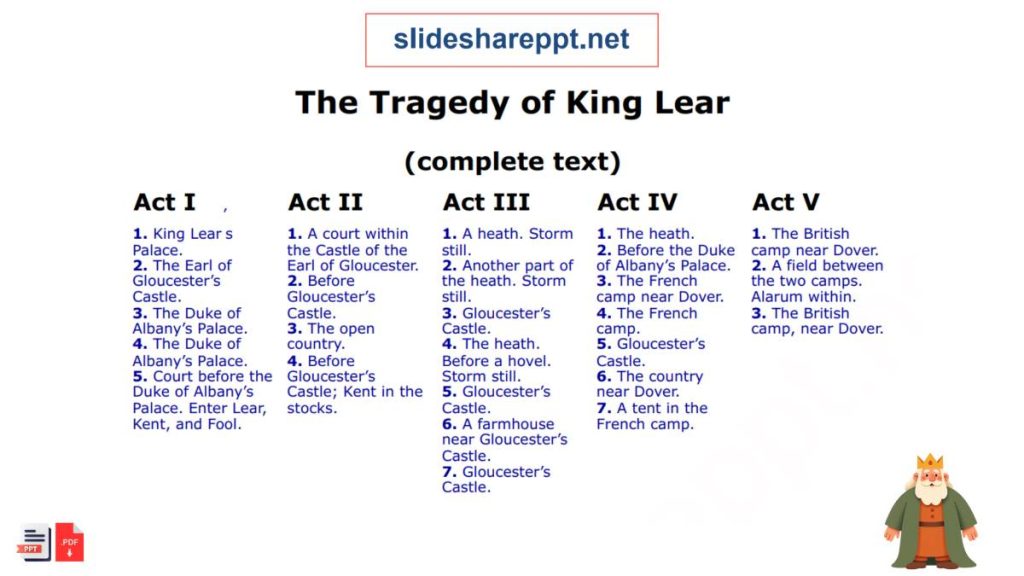
Note: The complete Text PDF Link is at the end of the PowerPoint slides (go to the last PPT Slide)
Act and Scene Summary
Here’s a summary table of each act and scene in Shakespeare’s “The Tragedy of King Lear”:
| Act | Scene | Summary |
|---|---|---|
| Act 1 | Scene 1 | King Lear decides to divide his kingdom among his three daughters, Goneril, Regan, and Cordelia, based on their professions of love for him. Cordelia, refusing to engage in flattery, is disinherited, while Goneril and Regan receive portions of the kingdom. Meanwhile, the Earl of Gloucester’s illegitimate son, Edmund, schemes to discredit his legitimate brother, Edgar, and claim his inheritance. |
| Scene 2 | Edmund successfully manipulates his father, Gloucester, into believing that Edgar is plotting against him. Lear decides to stay alternately with Goneril and Regan, but his daughters soon grow tired of his presence and mistreat him. Meanwhile, Kent is banished for defending Cordelia, disguising himself to serve Lear faithfully. | |
| Act 2 | Scene 1 | Lear’s mistreatment continues as Goneril and Regan conspire to undermine his authority. Gloucester is deceived by Edmund into believing that Edgar is plotting against him, leading to Edgar’s flight into hiding. |
| Scene 2 | Edmund manipulates his father further, convincing him of Edgar’s treachery. Gloucester vows to seek revenge against Edgar, while Lear, Kent, and the Fool endure mistreatment at Goneril’s hands. | |
| Act 3 | Scene 1 | Lear, descending into madness, wanders the countryside with his Fool and encounters Edgar disguised as “Poor Tom,” a madman. Meanwhile, Goneril plots with Edmund to undermine Lear’s authority, while Regan begins to develop feelings for Edmund. |
| Scene 2 | Gloucester’s attempts to help Lear fail, leading to his capture by Goneril’s soldiers. Edgar resolves to help his father, while Regan and Cornwall demonstrate their cruelty by blinding Gloucester. | |
| Act 4 | Scene 1 | Cordelia leads a French invasion to restore Lear’s throne, while Edgar guides the blinded Gloucester towards safety. Goneril and Regan vie for Edmund’s affections, setting the stage for a confrontation between Lear’s forces and those of his treacherous daughters. |
| Scene 2 | Gloucester is reunited with Lear, who has descended further into madness. Regan and Cornwall are killed, and Goneril’s cruelty is revealed as she conspires with Edmund against her own husband. | |
| Act 5 | Scene 1 | The forces of Lear, Cordelia, and the French face off against those of Goneril, Regan, and Edmund. Tragedy ensues as Cordelia is captured, Lear dies of grief, and Edmund is mortally wounded in a duel with Edgar. |
| Scene 2 | Edmund repents of his actions but dies shortly after. Goneril, unable to live with the consequences of her treachery, takes her own life. Lear is reunited with Cordelia but is devastated by her death. | |
| Scene 3 | Lear dies of heartbreak, and Albany assumes control of the kingdom. |
This table provides a detailed summary of each act and scene in Shakespeare’s “The Tragedy of King Lear,” outlining the key events and developments in the play’s plot.
Characters Descriptions and Roles
This table provides descriptions of the key characters in “The Tragedy of King Lear,” outlining their roles and significance within the play’s narrative and themes.
| Character | Description | Role |
|---|---|---|
| King Lear | The aging king of Britain who decides to divide his kingdom among his daughters, leading to tragic consequences. Lear’s descent into madness and subsequent realization of his mistakes drive much of the play’s action. | Protagonist; his decisions and actions set the stage for the unfolding tragedy. |
| Cordelia | Lear’s youngest daughter, known for her honesty and loyalty. Cordelia refuses to flatter her father as her sisters do, leading to her disinheritance. Despite this, she remains devoted to Lear and leads an army to his aid in the later acts. | Symbolizes honesty, integrity, and filial loyalty; represents a contrast to her scheming sisters. |
| Goneril | Lear’s eldest daughter, who manipulates her father for her own gain. Goneril’s ambition and cruelty drive much of the conflict in the play as she conspires with her sister Regan to seize power. | Antagonist; her betrayal and mistreatment of Lear contribute to the tragic events of the play. |
| Regan | Lear’s second daughter, who shares her sister Goneril’s ambition and ruthlessness. Regan collaborates with Goneril to mistreat Lear and schemes to further their own interests. | Antagonist; her cruelty and betrayal contribute to the tragic events of the play. |
| Edmund | The illegitimate son of the Earl of Gloucester, who schemes to undermine his legitimate half-brother, Edgar, and seize power for himself. Edmund’s machinations drive much of the subplot involving Gloucester’s family. | Antagonist; his manipulation and treachery contribute to the chaos and tragedy of the play. |
| Edgar | The legitimate son of the Earl of Gloucester, who is falsely accused of plotting against his father. Edgar goes into hiding as “Poor Tom,” a madman, to escape Edmund’s schemes. Throughout the play, Edgar serves as a foil to Edmund and ultimately helps defeat him. | Protagonist; his journey from victim to avenger mirrors the larger themes of the play. |
| The Earl of Gloucester | A nobleman loyal to King Lear, who is deceived by his illegitimate son, Edmund, into believing false accusations against his legitimate son, Edgar. Gloucester’s story serves as a parallel to Lear’s, as he too experiences betrayal and suffers a tragic downfall. | Represents the consequences of misplaced trust and the theme of blindness, both literal and metaphorical. |
| The Fool | King Lear’s loyal jester, who provides comic relief and serves as Lear’s confidant and advisor. The Fool’s sharp wit and insightful commentary highlight the folly of Lear’s decisions and the chaos unfolding within the kingdom. | Provides commentary on the action and serves as a voice of reason amidst the madness of the court. |
| Kent | A loyal nobleman and adviser to King Lear, who is banished for defending Cordelia. Kent disguises himself and serves Lear faithfully throughout the play, demonstrating unwavering loyalty and devotion to his king. | Symbolizes loyalty and integrity; serves as a protector and guide to Lear. |
| Albany | The husband of Goneril, who initially sides with his wife in mistreating Lear but later expresses remorse for his actions. Albany ultimately opposes Goneril and Regan’s tyranny and seeks to restore order and justice to the kingdom. | Represents the forces of morality and justice; contrasts with the villainous actions of Goneril and Regan. |
Summary
“The Tragedy of King Lear” by William Shakespeare unfolds amidst the backdrop of political intrigue, familial strife, and moral decay. The play follows the aging King Lear, who decides to divide his kingdom among his three daughters, Goneril, Regan, and Cordelia, based on their professions of love for him. However, Cordelia refuses to flatter him as her sisters do, leading Lear to disinherit her and divide his kingdom between Goneril and Regan.
As Lear’s decision sets in motion a series of tragic events, the kingdom plunges into chaos and betrayal. Goneril and Regan quickly reveal their true colors, exploiting their newfound power to mistreat Lear and drive him into madness. Meanwhile, Gloucester’s illegitimate son, Edmund, manipulates his father and brother, Edgar, in a ruthless bid for power.
Amidst the turmoil, Lear’s loyal followers, including Kent and the Fool, remain by his side, offering counsel and support. Edgar, disguised as “Poor Tom,” witnesses the suffering of his father, Gloucester, who falls victim to Edmund’s machinations.
As Lear grapples with his descent into madness and the consequences of his folly, Cordelia leads a French invasion to restore her father’s throne. Battles ensue, alliances shift, and tragedy strikes as Cordelia is captured, Lear dies of grief, and Edgar confronts and defeats Edmund.
Ultimately, the play concludes with a sense of profound loss and reconciliation. Lear, reunited with Cordelia, faces the devastating consequences of his actions before succumbing to heartbreak. Goneril, Regan, and Edmund meet their fates, while Albany assumes control of the kingdom, vowing to restore order and justice.
“The Tragedy of King Lear” offers a profound exploration of themes such as power, betrayal, madness, and redemption. Through its complex characters and tragic narrative, Shakespeare’s masterpiece continues to captivate audiences with its timeless depiction of the human condition and the consequences of unchecked ambition and familial strife.
Facts
Here’s a table outlining various facts about Shakespeare’s “The Tragedy of King Lear”:
| Fact | Description |
|---|---|
| Author | “The Tragedy of King Lear” is a play attributed to William Shakespeare, likely composed between 1603 and 1606. It is considered one of Shakespeare’s greatest tragedies. |
| Genre | The play is classified as a tragedy, featuring themes of betrayal, madness, and familial conflict. |
| Sources | The plot of “King Lear” is believed to be derived from various historical and legendary sources, including Geoffrey of Monmouth’s “Historia Regum Britanniae” and earlier versions of the King Leir legend. |
| Setting | The play is set in Britain, although the exact time period is unspecified. |
| Characters | “King Lear” features a diverse cast of characters, including King Lear himself, his daughters Goneril, Regan, and Cordelia, Gloucester and his sons Edmund and Edgar, as well as supporting characters like Kent, the Fool, and Albany. |
| Themes | Major themes explored in the play include the nature of power, the consequences of folly, the fragility of familial relationships, and the complexities of human nature. |
| Structure | “King Lear” is divided into five acts, each containing multiple scenes. The play follows a traditional structure for Shakespearean tragedies, with rising action, a climax, and a resolution. |
| Language and Style | The language of “King Lear” is characterized by its poetic richness and complexity. The play features some of Shakespeare’s most memorable speeches and soliloquies, exploring themes of madness, suffering, and redemption through vivid imagery and metaphor. |
| Reception | The reception of “King Lear” has varied over time, with some critics praising its exploration of human nature and others finding fault with its unresolved ending and tragic themes. Despite initial mixed reviews, the play has since come to be regarded as one of Shakespeare’s greatest works. |
| Adaptations | “King Lear” has been adapted into various forms, including stage productions, films, operas, and novels. These adaptations often reinterpret the play’s themes and characters to reflect contemporary concerns and artistic visions. |
| Cultural Impact | The play’s themes and characters continue to resonate with audiences worldwide, making “King Lear” a timeless classic that remains relevant in discussions of power, betrayal, and the human condition. |
This table provides an overview of key facts and aspects related to Shakespeare’s “The Tragedy of King Lear,” including its authorship, genre, sources, themes, reception, and cultural impact.
Key Quotes and Lines
Below is a table featuring key quotes and lines from Shakespeare’s “The Tragedy of King Lear”:
| Quote | Context |
|---|---|
| “Nothing will come of nothing.” | Spoken by King Lear to Cordelia when she refuses to flatter him as her sisters do, emphasizing Lear’s belief that love and loyalty should be expressed verbally. |
| “How sharper than a serpent’s tooth it is to have a thankless child!” | King Lear expresses his anguish and betrayal upon realizing the ingratitude of his daughters, Goneril and Regan, who have mistreated him after he divided his kingdom among them. |
| “The gods are just, and of our pleasant vices / Make instruments to plague us.” | Spoken by Gloucester, reflecting on the consequences of his own actions and the belief that divine justice punishes humanity for its flaws and vices. |
| “I am a man / More sinned against than sinning.” | Lear speaks these words in despair, acknowledging the injustices he has suffered at the hands of his daughters and the world, while also recognizing his own flaws and mistakes. |
| “When we are born, we cry that we are come / To this great stage of fools.” | Gloucester reflects on the inherent folly and suffering of human existence, likening life to a theatrical performance where everyone plays their part. |
| “As flies to wanton boys are we to the gods; / They kill us for their sport.” | Gloucester speaks these words after being blinded by Cornwall, lamenting the cruel and arbitrary nature of fate and divine intervention. |
| “Nothing can come of nothing: speak again.” | Lear demands Cordelia to speak again and declare her love for him after she refuses to flatter him like her sisters, illustrating Lear’s inability to understand genuine love and the consequences of his actions. |
| “O, reason not the need! Our basest beggars / Are in the poorest thing superfluous.” | Lear speaks these words upon realizing the suffering of the homeless and destitute during a storm, expressing empathy and regret for his past decisions and privileges. |
| “The worst is not / So long as we can say, ‘This is the worst.'” | Edgar, disguised as “Poor Tom,” offers these words of comfort to Gloucester, suggesting that even in the depths of despair, there is hope and the possibility of endurance. |
| “I am a man / More sinned against than sinning.” | Lear speaks these words in despair, acknowledging the injustices he has suffered at the hands of his daughters and the world, while also recognizing his own flaws and mistakes. |
These quotes represent some of the most memorable lines from “The Tragedy of King Lear,” encapsulating the play’s themes of betrayal, suffering, and the human condition.
Q&A
Q: Who is the protagonist of “The Tragedy of King Lear”?
- A: The protagonist of “The Tragedy of King Lear” is King Lear himself. The play follows his journey from a powerful monarch to a broken and humbled old man, exploring themes of power, pride, and the consequences of his decisions.
Q: What leads to the conflict between King Lear and his daughters?
- A: The conflict arises when King Lear decides to divide his kingdom among his three daughters based on their professions of love for him. Cordelia, his youngest and most beloved daughter, refuses to flatter him as her sisters do, leading to her disinheritance and the subsequent mistreatment of Lear by his other daughters, Goneril and Regan.
Q: How does madness play a role in the play?
- A: Madness is a prominent theme in “The Tragedy of King Lear,” particularly in Lear’s descent into madness as he grapples with the consequences of his actions and the betrayal of his daughters. The character of Edgar also feigns madness as “Poor Tom” to escape his enemies and aid his father, Gloucester.
Q: What is the significance of the character Cordelia?
- A: Cordelia represents honesty, integrity, and unconditional love amidst the deceit and betrayal of her sisters. Despite being disinherited by her father, Cordelia remains loyal to Lear and ultimately leads an army to his aid, symbolizing redemption and forgiveness in the face of adversity.
Q: How does the play end?
- A: The play ends tragically with the deaths of several major characters, including King Lear, Cordelia, Goneril, Regan, and Edmund. Lear dies of grief upon discovering Cordelia’s death, while Albany assumes control of the kingdom in the aftermath of the chaos and bloodshed.
These questions and answers provide insights into key aspects of “The Tragedy of King Lear,” including its characters, themes, and dramatic resolution.