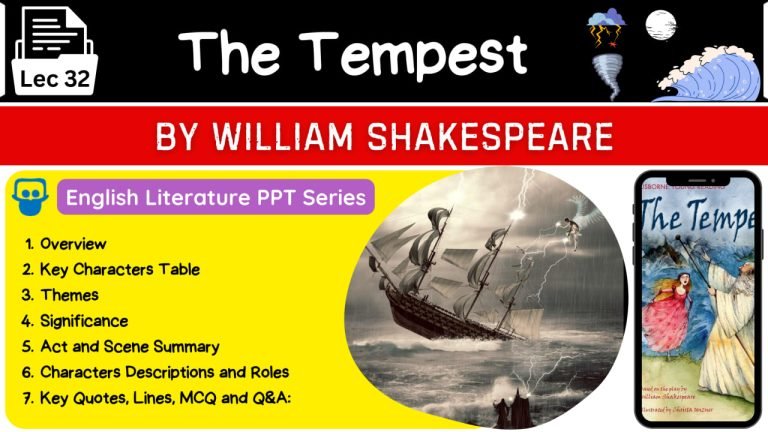
Today we have shared the Notes and PPT of William Shakespeare’s famous play The Tempest by William Shakespeare PPT Download .PPTX or The Tempest PPT Slides & PDF Study Material Download. As we know, The Tempest is one of Shakespeare’s most celebrated late plays, believed to have been written around 1610–1611. This enchanting drama blends magic, adventure, and deep philosophical themes, making it a favorite among students and literature lovers. Set on a mysterious island, the story follows Prospero, a powerful magician and the rightful Duke of Milan, who uses his wisdom and supernatural abilities to seek justice, reconciliation, and personal closure. Through memorable characters, dramatic events, and poetic storytelling, The Tempest explores themes of power, forgiveness, betrayal, and the transformative force of compassion. Whether performed on stage or studied in classrooms, The Tempest continues to captivate audiences with its timeless lessons on humanity, redemption, and the beauty of new beginnings.
Table of Contents
The Tempest by William Shakespeare PPT Download (.pptx)
The Tempest
Here’s a complete table for “The Tempest”:
| Aspect | Description |
|---|---|
| Title | The Tempest |
| Playwright | William Shakespeare |
| Genre | Romance, tragicomedy |
| Date of Composition | Estimated to be between 1610 and 1611 |
| Setting | A remote island |
| Main Characters | Prospero, Miranda, Ariel, Caliban, Ferdinand, Alonso, Antonio, Sebastian, Gonzalo, Stephano, Trinculo |
| Plot Overview | The play centers around Prospero, the exiled Duke of Milan, who uses his magical powers to conjure a tempest, shipwrecking his enemies on a remote island where he has been living with his daughter, Miranda. As the stranded characters navigate the island’s mysteries, themes of forgiveness, redemption, and the nature of power are explored. |
| Key Themes | Power and control, forgiveness and reconciliation, illusion vs reality, the transformative power of art and language |
| Significance | “The Tempest” is one of Shakespeare’s final plays and is celebrated for its imaginative and lyrical language, as well as its exploration of themes related to colonialism, authority, and human nature. It is often interpreted as Shakespeare’s farewell to the stage. |
| Notable Lines | – “We are such stuff / As dreams are made on, and our little life / Is rounded with a sleep.” (Act 4, Scene 1) – “What’s past is prologue.” (Act 2, Scene 1) – “O brave new world, / That has such people in’t!” (Act 5, Scene 1) |
| Adaptations | “The Tempest” has been adapted into various stage productions, film adaptations, and television adaptations. Notable adaptations include the film directed by Julie Taymor (2010), stage productions by the Royal Shakespeare Company, and modern reinterpretations by various theater companies. |
This table provides a comprehensive overview of various aspects of “The Tempest,” including its background, plot, characters, themes, significance, notable lines, and adaptations.
A Complete Guide: The Tempest
Introduction: William Shakespeare’s “The Tempest” stands as one of the most enduring and enigmatic works in the literary canon. First performed in 1611, this play continues to captivate audiences with its rich themes, complex characters, and masterful storytelling. Exploring concepts of power, colonialism, and the human condition, “The Tempest” remains as relevant today as it was over four centuries ago. In this comprehensive guide, we delve into the intricacies of Shakespeare’s final masterpiece, offering insight into its plot, characters, themes, and enduring legacy.
Plot Overview: “The Tempest” unfolds on a remote island where Prospero, the rightful Duke of Milan, resides with his daughter Miranda. Prospero, a powerful magician, conjures a storm to shipwreck his usurping brother Antonio and the King of Naples, Alonso, who betrayed him years earlier. Stranded on the island, the shipwreck survivors encounter various inhabitants, including the airy spirit Ariel and the deformed slave Caliban. Through magic and manipulation, Prospero orchestrates a series of events aimed at restoring his rightful place and securing his daughter’s future. The play culminates in forgiveness, reconciliation, and the renunciation of magic as Prospero prepares to return to civilization.
Key Characters:
- Prospero: The protagonist of “The Tempest,” Prospero is a complex figure driven by his desire for revenge and eventual redemption. As a master manipulator and magician, he holds sway over the island’s inhabitants but ultimately learns the power of forgiveness and mercy.
- Miranda: Prospero’s compassionate and naïve daughter, Miranda provides a sense of innocence amidst the intrigue of the island. Her love for Ferdinand, Alonso’s son, symbolizes the hope for a new beginning and reconciliation.
- Ariel: A spirit enslaved by Prospero, Ariel serves as his loyal servant and executes his magical commands. Despite his servitude, Ariel longs for freedom and ultimately earns his liberation through loyalty and service.
- Caliban: The monstrous son of the witch Sycorax, Caliban represents the colonized Other in “The Tempest.” Initially enslaved by Prospero, Caliban rebels against his master but ultimately recognizes the folly of his actions.
- Ferdinand: The son of Alonso, Ferdinand becomes enamored with Miranda upon their first encounter. His love for Miranda reflects themes of youthful passion and the transformative power of love.
Themes:
- Power and Control: “The Tempest” explores the dynamics of power and control through Prospero’s manipulation of the island’s inhabitants. His eventual relinquishment of power underscores the transient nature of authority.
- Colonialism and Otherness: Through the character of Caliban and the island’s status as a colonial outpost, Shakespeare interrogates notions of colonialism and the dehumanization of the Other.
- Forgiveness and Redemption: Central to the play’s resolution is the theme of forgiveness and redemption. Prospero’s decision to forgive his enemies and renounce his magic highlights the transformative power of mercy.
- Illusion versus Reality: Throughout “The Tempest,” characters grapple with the blurred lines between illusion and reality. Prospero’s magical machinations serve as a metaphor for the illusions that shape human perception.
Legacy: “The Tempest” continues to resonate with audiences and scholars alike, inspiring countless adaptations, reinterpretations, and critical analyses. Its themes of power, forgiveness, and the complexities of the human condition remain as relevant today as they were in Shakespeare’s time. From stage productions to film adaptations to literary reimaginings, “The Tempest” endures as a testament to Shakespeare’s enduring genius and the timeless allure of his work.
Conclusion: “The Tempest” stands as a masterpiece of Shakespearean drama, offering a rich tapestry of characters, themes, and dramatic intrigue. From its exploration of power and colonialism to its poignant themes of forgiveness and redemption, this play continues to captivate audiences with its universal truths and enduring relevance. As we navigate the tempests of our own lives, Shakespeare’s final masterpiece serves as a beacon of wisdom and insight, reminding us of the transformative power of forgiveness, the transient nature of power, and the enduring resilience of the human spirit.
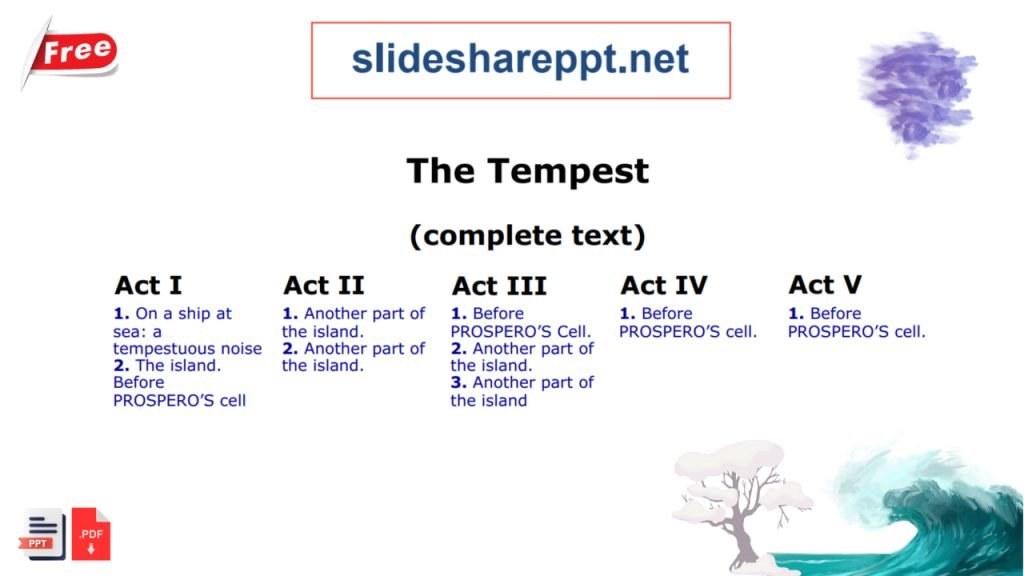
Note: The complete Text PDF Link is at the end of the PowerPoint slides (go to the last PPT Slide)
Plot Overview
Below is a comprehensive table outlining the plot overview of William Shakespeare’s “The Tempest”:
| Act | Scene | Summary |
|---|---|---|
| Act 1 | Scene 1 | A storm, conjured by Prospero, shipwrecks Alonso, the King of Naples, and his entourage including Prospero’s usurping brother Antonio, and Alonso’s son Ferdinand, on a remote island. |
| Scene 2 | Prospero reveals to Miranda the circumstances of their exile and his plans for revenge against those who wronged him. | |
| Act 2 | Scene 1 | Caliban, Prospero’s slave, conspires with Stephano and Trinculo to overthrow Prospero and seize control of the island. |
| Scene 2 | Ariel, Prospero’s spirit servant, foils Caliban’s plot and punishes him for his treachery. | |
| Act 3 | Scene 1 | Ferdinand encounters Miranda, and they fall in love. Prospero tests Ferdinand’s intentions by subjecting him to menial tasks. |
| Scene 2 | Alonso and his companions, believing Ferdinand to be dead, mourn their loss while Antonio and Sebastian plot to seize power. | |
| Act 4 | Scene 1 | Prospero stages a masque for Ferdinand and Miranda, celebrating their love. |
| Scene 2 | Ariel confronts the conspirators, disrupting their plot and leading them into madness. | |
| Act 5 | Scene 1 | Prospero confronts his enemies, forgives them, and renounces his magic. He prepares to return to Milan with Alonso’s blessing. |
| Scene 2 | Prospero frees Ariel and forgives Caliban before bidding farewell to the island. |
This table provides a structured overview of the key events that unfold throughout the five acts of “The Tempest,” summarizing the main plot points and character interactions in each scene.
Key Characters
Here’s a comprehensive table outlining the key characters in William Shakespeare’s “The Tempest”:
| Character | Description |
|---|---|
| Prospero | The rightful Duke of Milan and a powerful magician. Prospero orchestrates the events of the play to exact revenge on his usurping brother, Antonio. |
| Miranda | Prospero’s compassionate and naive daughter. Miranda falls in love with Ferdinand, symbolizing hope for reconciliation and a new beginning. |
| Ariel | A spirit enslaved by Prospero, Ariel serves as his loyal servant and executes his magical commands. Ariel longs for freedom and earns it through loyalty. |
| Caliban | The monstrous son of the witch Sycorax, Caliban is initially enslaved by Prospero. He rebels against his master but ultimately recognizes his folly. |
| Ferdinand | The son of Alonso, King of Naples. Ferdinand falls in love with Miranda and undergoes trials set by Prospero to prove his love and worthiness. |
| Alonso | The King of Naples. Alonso, along with his entourage, is shipwrecked on Prospero’s island due to the storm conjured by Prospero. |
| Antonio | Prospero’s usurping brother who betrayed him and seized the dukedom of Milan. Antonio’s treachery sets the events of the play in motion. |
| Sebastian | Alonso’s brother who conspires with Antonio to seize power. Sebastian is driven by ambition and lacks moral scruples. |
| Gonzalo | A loyal counselor to Alonso who helped Prospero and Miranda escape when they were exiled from Milan. Gonzalo represents wisdom and goodness. |
| Stephano | A drunken butler who, along with Trinculo, conspires with Caliban to overthrow Prospero. |
| Trinculo | A jester who, along with Stephano, conspires with Caliban to overthrow Prospero. |
This table provides a comprehensive overview of the main characters in “The Tempest,” highlighting their roles, relationships, and significance within the play.
Themes
Here’s a comprehensive table outlining the key themes in William Shakespeare’s “The Tempest”:
| Theme | Description |
|---|---|
| Power and Control | The play explores the dynamics of power and control through Prospero’s manipulation of the island’s inhabitants. Prospero’s eventual renunciation of power highlights its transient nature. |
| Colonialism and Otherness | Shakespeare interrogates notions of colonialism and the dehumanization of the Other through the character of Caliban and the island’s status as a colonial outpost. |
| Forgiveness and Redemption | Central to the play’s resolution is the theme of forgiveness and redemption. Prospero’s decision to forgive his enemies underscores the transformative power of mercy and reconciliation. |
| Illusion versus Reality | Characters grapple with the blurred lines between illusion and reality throughout the play. Prospero’s magical machinations serve as a metaphor for the illusions that shape human perception. |
| Nature versus Civilization | The contrast between the untamed nature of the island and the civilized world of Milan highlights themes of civilization versus nature and the consequences of disrupting the natural order. |
| Love and Compassion | The play explores the transformative power of love and compassion, particularly through the relationship between Miranda and Ferdinand, which symbolizes hope for reconciliation and renewal. |
| Freedom and Enslavement | Characters like Ariel and Caliban represent different forms of bondage and yearn for freedom. The play examines the nature of freedom and the consequences of enslavement, both physical and mental. |
This table provides a comprehensive overview of the main themes in “The Tempest,” highlighting their significance and relevance within the play.
Significance
Here’s a comprehensive table outlining the significance of William Shakespeare’s “The Tempest”:
| Aspect | Significance |
|---|---|
| Literary | “The Tempest” is considered one of Shakespeare’s most enigmatic and imaginative works. It showcases his mastery of language, characterization, and dramatic structure, offering a rich tapestry of themes and symbols that continue to captivate readers and audiences. |
| Historical | The play reflects the colonial mindset of Shakespeare’s time, with themes of power, control, and otherness prevalent throughout. It offers insights into the prevailing attitudes towards colonization, authority, and the marginalized “Other” during the Renaissance era. |
| Theatrical | “The Tempest” features elaborate stage effects and supernatural elements that would have dazzled Shakespeare’s original audiences. Its magical setting and fantastical elements provide ample opportunities for creative interpretation and staging, making it a favorite among directors and actors. |
| Philosophical | The play delves into profound philosophical themes such as forgiveness, redemption, illusion versus reality, and the nature of power. It prompts audiences to contemplate universal truths about human nature, morality, and the complexities of the human condition. |
| Cultural | “The Tempest” has inspired numerous adaptations, reinterpretations, and critical analyses across various art forms, including literature, theater, film, and music. Its enduring legacy underscores its cultural significance as a timeless masterpiece of world literature. |
| Educational | The play continues to be studied in classrooms worldwide for its rich language, complex characters, and thematic depth. It offers valuable insights into Shakespeare’s craft, as well as opportunities for interdisciplinary exploration of historical, philosophical, and cultural contexts. |
This table provides a comprehensive overview of the significance of “The Tempest” across various aspects, highlighting its enduring impact and relevance in literature, history, theater, philosophy, culture, and education.
Act and Scene Summary
Below is a table summarizing the acts and scenes of William Shakespeare’s “The Tempest”:
| Act | Scene | Summary |
|---|---|---|
| Act 1 | Scene 1 | A tempest shipwrecks Alonso, the King of Naples, and his entourage, including Prospero’s usurping brother Antonio and Alonso’s son Ferdinand, on a remote island. |
| Scene 2 | Prospero reveals to Miranda their past and his plans for revenge against those who wronged him. | |
| Act 2 | Scene 1 | Caliban conspires with Stephano and Trinculo to overthrow Prospero. |
| Scene 2 | Ariel interrupts Caliban’s plot and punishes him for his treachery. | |
| Act 3 | Scene 1 | Ferdinand encounters Miranda, and they fall in love. Prospero tests Ferdinand’s intentions by subjecting him to menial tasks. |
| Scene 2 | Alonso and his companions mourn Ferdinand’s supposed death while Antonio and Sebastian plot to seize power. | |
| Act 4 | Scene 1 | Prospero stages a masque for Ferdinand and Miranda, celebrating their love. |
| Scene 2 | Ariel interrupts the conspirators, disrupting their plot and leading them into madness. | |
| Act 5 | Scene 1 | Prospero confronts his enemies, forgives them, and renounces his magic. He prepares to return to Milan with Alonso’s blessing. |
| Scene 2 | Prospero frees Ariel and forgives Caliban before bidding farewell to the island. |
This table provides a structured summary of the events that occur in each act and scene of “The Tempest,” highlighting the progression of the plot throughout the play.
Characters Descriptions and Roles
Below is a table outlining the characters, their descriptions, and roles in William Shakespeare’s “The Tempest”:
| Character | Description | Role |
|---|---|---|
| Prospero | The rightful Duke of Milan, a powerful magician, and the protagonist of the play. | Orchestrates events on the island to exact revenge on his usurping brother, Antonio, and secure a future for his daughter, Miranda. |
| Miranda | Prospero’s compassionate and naive daughter, raised on the island. | Symbolizes innocence and hope, falls in love with Ferdinand, and serves as a catalyst for reconciliation between Prospero and his enemies. |
| Ariel | A spirit enslaved by Prospero, skilled in magic and loyal to his master. | Executes Prospero’s commands, serves as a messenger, and yearns for freedom. |
| Caliban | The monstrous son of the witch Sycorax, enslaved by Prospero after attempting to rape Miranda. | Represents the colonized Other and the consequences of colonization, seeks freedom and resents Prospero’s control over the island. |
| Ferdinand | The son of Alonso, King of Naples, and heir to the throne. | Falls in love with Miranda and undergoes trials set by Prospero to prove his love and worthiness. |
| Alonso | The King of Naples, who, along with his entourage, is shipwrecked on Prospero’s island. | Represents authority and power, mourns the supposed death of his son, Ferdinand, and undergoes trials orchestrated by Prospero. |
| Antonio | Prospero’s usurping brother, who seized control of the dukedom of Milan. | Betrays Prospero and aids in his exile, represents treachery and ambition, conspires with Sebastian to seize power. |
| Sebastian | Alonso’s brother, who conspires with Antonio to seize power. | Driven by ambition and lacks moral scruples, plots to kill Alonso and usurp his throne. |
| Gonzalo | A loyal counselor to Alonso, who aided Prospero and Miranda in their exile from Milan. | Represents wisdom and goodness, provides a contrast to the morally corrupt characters, and expresses optimism about their survival on the island. |
| Stephano | A drunken butler, who, along with Trinculo, conspires with Caliban to overthrow Prospero. | Represents the lower class and provides comic relief, seeks power and riches on the island. |
| Trinculo | A jester, who, along with Stephano, conspires with Caliban to overthrow Prospero. | Provides comic relief and a foil to Stephano, represents the folly of ambition and the lower class. |
This table offers a comprehensive overview of the main characters in “The Tempest,” detailing their descriptions and roles within the play.
Summary
“The Tempest” by William Shakespeare is a captivating play that unfolds on a remote island, where Prospero, the rightful Duke of Milan, resides with his daughter Miranda. Prospero, a powerful magician, conjures a tempest to shipwreck his usurping brother Antonio and the King of Naples, Alonso, who betrayed him years earlier. Stranded on the island, the shipwreck survivors encounter various inhabitants, including the airy spirit Ariel and the deformed slave Caliban.
Through magic and manipulation, Prospero orchestrates a series of events aimed at restoring his rightful place and securing his daughter’s future. Miranda, sheltered from the outside world, falls in love with Alonso’s son, Ferdinand, leading to trials set by Prospero to test Ferdinand’s intentions. Meanwhile, Antonio and Sebastian conspire to seize power, and Caliban plots with Stephano and Trinculo to overthrow Prospero.
As the play progresses, themes of power, colonialism, forgiveness, and redemption come to the forefront. Prospero grapples with his desire for revenge and his eventual realization of the power of forgiveness and mercy. Miranda and Ferdinand’s love symbolizes hope for reconciliation, while Ariel and Caliban yearn for freedom from Prospero’s control.
In the climactic final act, Prospero confronts his enemies, forgives them, and renounces his magic. He prepares to return to Milan with Alonso’s blessing, while Ariel is freed from servitude and Caliban is forgiven. The play concludes with Prospero delivering his famous epilogue, in which he asks the audience for forgiveness and bids farewell to his magical art.
“The Tempest” stands as a masterpiece of Shakespearean drama, exploring profound themes of power, forgiveness, and the human condition. Its rich characters, intricate plot, and timeless themes continue to captivate audiences and inspire interpretations across various art forms. As Prospero relinquishes his magic and embraces forgiveness, the play ultimately celebrates the transformative power of mercy and reconciliation.
Facts
Here’s a table outlining some key facts about William Shakespeare’s “The Tempest”:
| Fact | Description |
|---|---|
| Author | William Shakespeare wrote “The Tempest” around 1610–1611, making it one of his later plays and possibly his last solo work. |
| Genre | “The Tempest” is classified as a comedy, although it contains elements of romance, tragedy, and fantasy. |
| Setting | The play is set on a remote island, where Prospero, the rightful Duke of Milan, resides with his daughter Miranda and various other characters. |
| Main Characters | The main characters include Prospero, Miranda, Ariel, Caliban, Ferdinand, Alonso, Antonio, Sebastian, Gonzalo, Stephano, and Trinculo. |
| Themes | Key themes explored in “The Tempest” include power and control, colonialism and otherness, forgiveness and redemption, illusion versus reality, and the transformative power of love and compassion. |
| Source of Inspiration | Shakespeare may have drawn inspiration for “The Tempest” from various sources, including accounts of shipwrecks, colonization, and the emerging field of natural philosophy. |
| Influence and Adaptations | “The Tempest” has had a significant influence on literature, theater, and other art forms. It has been adapted into numerous stage productions, films, operas, ballets, and novels, and continues to inspire reinterpretations and adaptations around the world. |
| Language and Style | Shakespeare’s language in “The Tempest” is characterized by its poetic richness, intricate wordplay, and vivid imagery. The play also features elements of magic and supernatural phenomena, contributing to its fantastical atmosphere. |
| Reception and Critical Analysis | “The Tempest” has received both critical acclaim and scholarly attention. It has been praised for its imaginative storytelling, complex characters, and exploration of profound themes. However, it has also been subject to interpretations and debates regarding its portrayal of colonialism, power dynamics, and the character of Caliban. |
| Legacy | Despite its ambiguous ending and unresolved questions, “The Tempest” continues to be regarded as one of Shakespeare’s greatest works. Its enduring legacy lies in its exploration of universal themes, timeless characters, and the transformative power of forgiveness and reconciliation. |
This table provides an overview of some key facts surrounding Shakespeare’s “The Tempest,” highlighting its historical context, literary significance, themes, and legacy.
Also read: The Winter’s tale by William Shakespeare PPT Download | PPTX
Key Quotes and Lines
Here’s a table featuring some key quotes and lines from William Shakespeare’s “The Tempest”:
| Quote | Speaker | Context |
|---|---|---|
| “We are such stuff as dreams are made on, and our little life is rounded with a sleep.” | Prospero | Prospero reflects on the ephemeral nature of human existence, emphasizing the dreamlike quality of life. |
| “Hell is empty and all the devils are here.” | Ariel | Ariel describes the chaotic atmosphere created by the shipwreck and the presence of the shipwrecked characters on the island. |
| “What’s past is prologue.” | Antonio | Antonio suggests that past events have set the stage for future actions, implying that their previous actions have led to their current situation. |
| “O brave new world, that has such people in’t!” | Miranda | Miranda marvels at the sight of other humans besides her father, expressing wonder and excitement at the new world she encounters. |
| “Misery acquaints a man with strange bedfellows.” | Trinculo | Trinculo remarks on the unlikely companionship formed during the storm, suggesting that adversity brings people together in unexpected ways. |
| “What’s past is prologue.” | Prospero | Prospero suggests that the events of the past have led to the present circumstances, setting the stage for future actions. |
| “Be not afeard; the isle is full of noises, Sounds, and sweet airs, that give delight and hurt not.” | Caliban | Caliban reassures Stephano and Trinculo, describing the magical and mysterious nature of the island. |
| “Our revels now are ended. These our actors, As I foretold you, were all spirits and Are melted into air, into thin air:” | Prospero | Prospero reflects on the ephemeral nature of theatrical performances, comparing them to the transient nature of human existence. |
| “I would fain die a dry death.” | Stephano | Stephano expresses a preference for dying by dehydration rather than drowning, showcasing his humorous and cynical outlook on life. |
| “Full fathom five thy father lies; Of his bones are coral made; Those are pearls that were his eyes; Nothing of him that doth fade, But doth suffer a sea-change Into something rich and strange.” | Ariel | Ariel sings a song about Ferdinand’s father, who is believed to be dead, using imagery of the ocean to depict transformation and renewal. |
These quotes capture some of the memorable lines from “The Tempest,” showcasing Shakespeare’s poetic language and the play’s rich themes of illusion, transformation, and the human condition.
Q&A
Here’s a Q&A section on “The Tempest”:
What is the main theme of “The Tempest”?
- The main themes of “The Tempest” include power and control, forgiveness and redemption, colonialism and otherness, illusion versus reality, and the transformative power of love and compassion.
Who is the protagonist of “The Tempest”?
- The protagonist of “The Tempest” is Prospero, the rightful Duke of Milan, who orchestrates events on the island to secure his future and seek revenge against those who wronged him.
What role does Ariel play in “The Tempest”?
- Ariel is a spirit enslaved by Prospero, who serves as his loyal servant and executes his magical commands. Ariel’s abilities to manipulate the elements and shape events are crucial to Prospero’s plans.
How does “The Tempest” explore the theme of colonialism?
- “The Tempest” explores the theme of colonialism through the character of Caliban, a native of the island who is enslaved by Prospero. Caliban’s subjugation and treatment by Prospero reflect the colonial mindset prevalent during Shakespeare’s time.
What is the significance of the epilogue in “The Tempest”?
- The epilogue in “The Tempest” is delivered by Prospero and serves as a farewell to the audience. It reflects on the ephemeral nature of theatrical performances and suggests that the characters, like actors, will soon “melt into air” and vanish.
How does “The Tempest” explore the concept of forgiveness?
- “The Tempest” explores the concept of forgiveness through Prospero’s decision to forgive his enemies, including Antonio and Alonso. Prospero’s act of mercy highlights the transformative power of forgiveness and redemption.
What role does the setting of the island play in “The Tempest”?
- The island setting of “The Tempest” isolates the characters from the outside world and creates a magical and mysterious atmosphere. It serves as a stage for Prospero’s magical machinations and allows for themes of power, control, and transformation to unfold.
How does “The Tempest” end?
- “The Tempest” ends with Prospero forgiving his enemies, renouncing his magic, and preparing to return to Milan with Alonso’s blessing. The play concludes with Prospero delivering the epilogue, bidding farewell to his magical art.
What are some notable adaptations of “The Tempest”?
- Notable adaptations of “The Tempest” include stage productions, films, operas, ballets, and novels. Some notable adaptations include Julie Taymor’s film “The Tempest” (2010) and Margaret Atwood’s novel “Hag-Seed” (2016).
What makes “The Tempest” a timeless work of literature?
- “The Tempest” is considered a timeless work of literature due to its rich themes, complex characters, and poetic language. Its exploration of universal truths about power, forgiveness, and the human condition continues to resonate with audiences across generations.
These questions and answers provide insight into various aspects of “The Tempest,” from its themes and characters to its significance and adaptations.