Temple Architecture in India PPT Download
Today we will share the Complete Notes related to Temple Architecture in India PPT Download Slides and UPSC PDF Download, India is a land of diverse cultures, rich traditions, and a deep-rooted spiritual heritage. One of the most significant manifestations of this cultural richness is found in the exquisite temple architecture that dots the Indian landscape. From the ancient temples of Khajuraho to the majestic structures of South India, each temple is a testament to the fusion of spirituality and artistic brilliance. This article explores the evolution, features, and cultural significance of temple architecture in India.
Table of Contents
Temple Architecture in India
(PPT – Lec 7)
Note:-
- If you are viewing this PPT on your phone, please make it full screen and then view it. (Press: 3 dots in PPT, then Full Screen)
- If you have a problem while clicking on next, (Just tap) on the slide instead of clicking Next Botton.
- FOR A BETTER VIEW PRESS Ctrl + Shift + F ON A PC OR LAPTOP.
- Whatever is written in the PPT is different and whatever is written below is different.
UPSC Prelims PPT Bundle Product Details
(BUY ONLINE)
| Placement / Section | Details / Click To Action Text |
|---|---|
| Title | UPSC Prelims PPT Notes (BUNDLE) |
| Number of PPTs / Slides | 160+ PPTs |
| Delivery Method | Instant Access after Payment (Google Drive Folder) |
| Additional Info | Full UPSC Prelims Coverage, Study-Friendly PPT Format |
| Copyright / Ownership | Self-made Notes (slideshareppt.net) |
| Payment | Online Gateway – QR, CREDIT CARD, UPI etc… |
| Pricing / Purchase CTA |
Check Price & Buy (Redirects to Pricing Page) |
| Demo Link | View Sample Slides (Click to Open Demo) |
Temple Tapestry: An Architectural Odyssey Across North and South India
Here’s a table summarizing various styles of temple architecture in North and South India:
| Region | Style | Examples of Temples |
|---|---|---|
| North India | Nagara Style | – Khajuraho Temples |
| Pala & Sena Style | – Nalanda and Somapura Mahavihara | |
| Solanki Style | – Modhera Sun Temple | |
| – Rani Ki Vav (Stepwell) | ||
| – Sun Temple at Modhera | ||
| South India | Dravidian Style | – Brihadeeswarar Temple (Thanjavur) |
| Hoysala Style | – Chennakesava Temple (Belur) | |
| Odisha Style | – Lingaraja Temple (Bhubaneswar) | |
| Vesara Style | – Mallikarjuna Temple (Basaralu) | |
| Vijayanagara Style | – Virupaksha Temple (Hampi) | |
| Nayaka Style | – Meenakshi Temple (Madurai) |
This table provides an overview of the different temple styles in North and South India, along with examples of notable temples that showcase each architectural style.
Types of Temple Architecture in India
Here’s a table summarizing various types of temple architecture in India:
| Style of Temple Architecture | Region | Characteristics and Prominent Examples |
|---|---|---|
| Nagara Style | North India | – Towering spires (Shikharas) |
| – Kandariya Mahadeva Temple, Khajuraho | ||
| Dravidian Style | South India | – Pyramid-shaped towers (Vimanas) and large entrance towers (Gopurams) |
| – Brihadeshwara Temple, Thanjavur | ||
| Odisha Style | Odisha | – Curvilinear tower (Rekha Deula), sculpted walls, elaborate carvings |
| – Lingaraja Temple, Bhubaneswar | ||
| Solanki Style | Gujarat | – Circular halls, intricately carved walls, and domes |
| – Modhera Sun Temple, Gujarat | ||
| Khajuraho Style | Central India | – Intricate carvings, and sculptures depicting various aspects of life and divinity |
| – Lakshmana Temple, Khajuraho | ||
| Vesara Style | Deccan | – Combination of Nagara and Dravidian styles, unique fusion of features |
| – Mallikarjuna Temple, Pattadakal | ||
| Hoysala Style | Karnataka | – Star-shaped ground plan, intricate sculptures, lathe-turned pillars |
| – Chennakesava Temple, Belur | ||
| Pala & Sena Style | Bengal | – Terracotta decorations, square temples, unique blend of Hindu and Buddhist elements |
| – Somapura Mahavihara, Bangladesh | ||
| Vijayanagar Style | South India | – Large pillared halls, intricate carvings, monolithic pillars |
| – Virupaksha Temple, Hampi | ||
| Nayaka Style | Tamil Nadu | – Elaborate pillared halls, towering Gopurams, ornate sculptures |
| – Meenakshi Temple, Madurai |
This table provides an overview of different styles of temple architecture in India, highlighting their characteristics and prominent examples.
Temple Architecture in India: A Journey Through Styles and Schools
India, with its rich tapestry of cultures and traditions, boasts a diverse array of temples that stand as architectural marvels and spiritual sanctuaries. The evolution of temple architecture in India can be traced through various stages of development, each characterized by unique styles and schools. In this exploration, we delve into the Nagara and Dravidian styles, along with the diverse schools that have contributed to the magnificent temples scattered across the subcontinent.
Historical Evolution:
- Temple architecture in India has a long and diverse history that spans over several centuries. The earliest temples were built during the Gupta period (4th to 6th centuries) and were characterized by simple structures with basic designs. However, it was during the Chola, Pallava, and Chalukya dynasties (7th to 13th centuries) that temple architecture witnessed a significant evolution.
- The Dravidian style, predominant in South India, is known for its towering gopurams (entrance towers), intricate carvings, and colossal statues. The Brihadeeswarar Temple in Thanjavur and the Meenakshi Temple in Madurai are exemplary representations of the Dravidian architectural style.
- In contrast, the Nagara style, prevalent in North India, features a shikhara (spire) rising above the sanctum sanctorum and often incorporates ornate carvings and sculptures. The temples of Khajuraho, especially the Kandariya Mahadeva Temple, are iconic examples of the Nagara style.
Key Architectural Features:
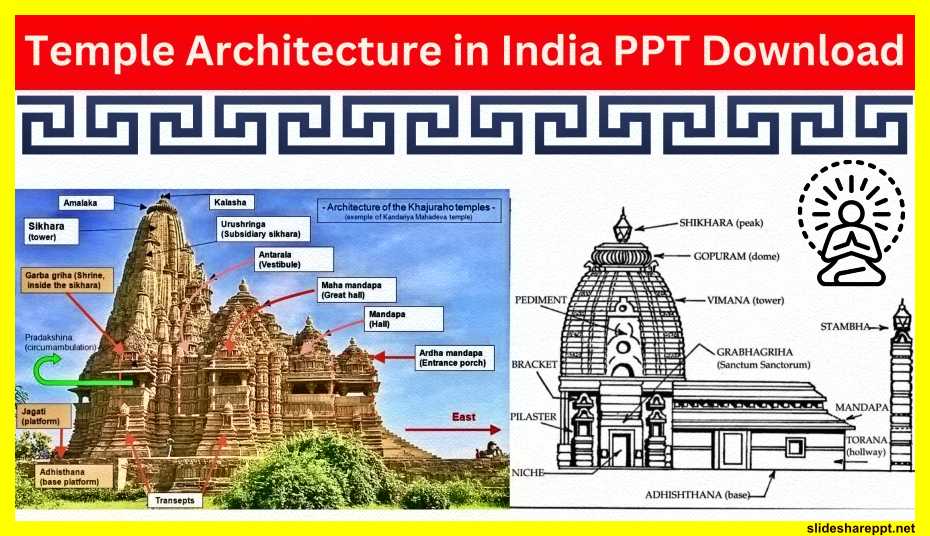
- Mandapa: The mandapa, or pillared hall, serves as the entrance to the main sanctum. It is often adorned with intricately carved pillars depicting mythological stories, deities, and celestial beings.
- Shikhara or Vimana: The shikhara, also known as vimana in the southern tradition, is the towering spire that crowns the main sanctum. Its design varies across regions, with the North Indian temples having a curvilinear shikhara and the South Indian temples featuring a pyramidal vimana.
- Garbhagriha: The innermost sanctum, known as the Garbhagriha, houses the main deity’s idol or lingam. Devotees offer their prayers and perform rituals in this sacred space.
- Gopuram: The entrance tower, or gopuram, is a prominent feature in South Indian temples. It is often elaborately decorated with sculptures, reliefs, and vibrant frescoes depicting religious narratives.
- Sculptures and Carvings: Temple architecture is characterized by its intricate sculptures and carvings, showcasing scenes from Hindu mythology, divine beings, and celestial dancers. The erotic sculptures at Khajuraho, though a small fraction, have gained international fame for their artistic expression.
Cultural and Spiritual Significance:
- Spiritual Hub: Temples in India serve as spiritual hubs where devotees seek solace, engage in worship, and participate in religious rituals. The architecture is designed to create a sense of awe and reverence.
- Cultural Heritage: These temples are not just places of worship but also repositories of India’s cultural heritage. They reflect the artistic achievements, craftsmanship, and societal values of the times in which they were built.
- Symbolism and Rituals: Every aspect of temple architecture is laden with symbolism, reflecting the cosmic order in Hindu philosophy. The rituals performed within these sacred spaces connect individuals with the divine and foster a sense of community.
Symbolism and Spirituality:
- Indian temple architecture is deeply rooted in spiritual and symbolic representations. The intricate carvings on temple walls depict mythological narratives, celestial beings, and scenes from epics like the Ramayana and Mahabharata. The alignment of temples with cardinal directions and their adherence to sacred geometry reflects a cosmic order, creating a sacred space for worship and meditation.
Preservation and Conservation:
- As custodians of India’s cultural legacy, efforts are being made to preserve and restore these architectural marvels. Organizations, both governmental and non-governmental, are working towards documentation, conservation, and maintenance of temples to ensure that future generations can continue to marvel at the grandeur of India’s temple architecture.
Stages of Development:
- Nagara Style: The Nagara style, predominant in North India, is characterized by its curvilinear spire or shikhara. The temples of this style typically have a square sanctum and a pillared hall known as the mandapa. The Nagara style further evolved into distinct schools, including the Odisha, Khajuraho, and Solanki schools.
- South Indian Temples: The South Indian style, or Dravidian style, flourished in the Deccan region. It is marked by its pyramidal vimana, intricately carved pillars, and towering entrance towers known as gopurams. The development of South Indian temples can be traced through various stages, with Mahabalipuram serving as a notable example.
Conclusion:
- The temples of India stand as a testament to the country’s rich history, spirituality, and artistic prowess. From the intricate carvings of Khajuraho to the monumental vimanas of Tamil Nadu, each temple tells a story of devotion, craftsmanship, and cultural evolution. As these architectural wonders continue to inspire awe, they reinforce the enduring connection between the divine, the artistic, and the human spirit, making them an integral part of India’s cultural heritage.
Evolution of Temple Architectural Styles: Unveiling the Stages of Development
Here’s a complete table summarizing the stages of development provided:
| Stage | Characteristics | Examples of Temples |
|---|---|---|
| STAGE 1 | Flat roof | Temple 17, Sanchi |
| Square shape | ||
| Portico on shallow pillars | ||
| On a low platform | ||
| Ex-Temple 17, Sanchi | ||
| STAGE 2 | A raised platform with an in-depth pillar | Ex-Parvati Temple, MP |
| 2 storeyed | ||
| Covered ambulatory | ||
| Ex Parvati Temple, MP | ||
| STAGE 3 | Shikharas | Ex-Dashavtar Temple |
| Low, Square | ||
| Panchayatan style | ||
| Gave rise to Nagara style | ||
| Ex-Dashavtar Temple | ||
| STAGE 4 | Main shrine rectangular | Ex-Ter Temple, Sholapur |
| STAGE 5 | Circular | |
| Shallow rectangular projection |
This table provides a breakdown of each stage of development, highlighting the key characteristics associated with each stage and providing examples of temples that exemplify those characteristics.
Styles of Temple Architecture
- Nagara School: The Nagara school, rooted in the Nagara style, is characterized by its emphasis on verticality and intricate carvings. Prominent examples include the temples of Khajuraho and those built by the Solanki rulers in Gujarat.
- Odisha School: The Odisha school, known for its unique architectural features such as the beehive-shaped towers, can be witnessed in temples like the Lingaraja Temple in Bhubaneswar and the Sun Temple at Konark.
- Khajuraho School: Khajuraho, famous for its group of temples adorned with intricate sculptures, represents the Khajuraho school. These temples showcase exceptional artistry and depict various aspects of life, including the renowned Kandariya Mahadeva Temple.
- Solanki School: The Solanki school, associated with the Solanki dynasty in Gujarat, is recognized for its stepped wells and intricately carved temples. The Modhera Sun Temple is a prime example of this school.
Temple Architectural Kaleidoscope: Styles, Regions, and Notable Examples
Here’s a complete table summarizing the various styles of temple architecture provided:
| Style | Region | Characteristics and Notable Examples |
|---|---|---|
| NAGARA | North India | Curvilinear spire (Shikhara) |
| Square sanctum and pillared hall (Mandapa) | ||
| Prominent in North Indian temples | ||
| Notable Example: Khajuraho Temples | ||
| DRAVIDA | South India | Pyramidal Vimana |
| Elaborate entrance towers (Gopurams) | ||
| Predominant in Southern temples | ||
| Notable Examples:
Brihadeeswarar Temple (Thanjavur) Meenakshi Temple (Madurai) |
||
| Odisha | Odisha | Beehive-shaped towers |
| Emphasis on intricately carved deities and animals | ||
| Unique regional style | ||
| Notable Examples:
Lingaraja Temple (Bhubaneswar) Sun Temple at Konark |
||
| Solanki | Gujarat | Intricate carvings and stepped wells |
| Prominent during the Solanki dynasty | ||
| Notable Example: Modhera Sun Temple | ||
| Vijayanagar | South India | Continuation of Dravidian style |
| Elaborate pillared halls (Raya Gopurams) | ||
| Flourished during the Vijayanagara Empire | ||
| Notable Example: Virupaksha Temple (Hampi) | ||
| Nayaka | South India | Intricately carved pillars and halls |
| Ornate architecture with profuse carvings | ||
| Notable Example: Meenakshi Amman Temple (Madurai) | ||
| Khajuraho | Central India | Intricate and explicit sculptures |
| Famous for erotic carvings | ||
| Represents the Khajuraho School | ||
| Notable Examples:
Kandariya Mahadeva Temple Lakshmana Temple |
||
| VESARA | Deccan | A blend of Nagara and Dravida styles |
| Unique regional synthesis | ||
| Notable Example: Mallikarjuna Temple (Basaralu) | ||
| HOYSALA | Karnataka | Star-shaped platforms |
| Intricately carved sculptures and friezes | ||
| Prominent during the Hoysala dynasty | ||
| Notable Examples:
Chennakesava Temple (Belur) Hoysaleswara Temple (Halebidu) |
||
| PALA & SENA | Bengal | Contributions to temple architecture |
| Notable Examples:
Nalanda and Somapura Mahavihara (Nalanda) |
This table provides an overview of various temple architectural styles, detailing their characteristics, regions of prominence, and notable examples.
Elements of Eternity: Unveiling the Architecture of Nagara Style Temples
Here’s a complete table summarizing the various elements associated with Nagara Style temple architecture:
| Elements | Description |
|---|---|
| Latina/Rekha Prasad | Vertical spire or tower |
| Phamsana | Sloping roof |
| Valabhi | Circular wall at the base of the shikhara |
| Entry images | Decorative sculptures or reliefs at the entrance |
| Shikhara | Tapering spire above the sanctum |
| Panchayatan Style | Five shrines arranged around a central shrine |
| Amlak | Circular ribbed motif at the top of the shikhara |
| Vahana | Vehicle or mount of the deity, often located outside the sanctum |
| Pradakshina path | circumambulatory path around the sanctum |
| Crucified Ground plan | Rectangular or square layout with projections at the corners |
| Sanctum Sanctorum | Innermost sacred chamber housing the main deity |
| Jagati | Raised platform or terrace around the temple |
| Boundary wall | Enclosure around the temple complex |
| Mandapa | Pillared hall typically used for gatherings and rituals |
| Gopuram | Elaborate entrance tower often with intricate sculptures |
| Water | Presence of water tanks or reservoirs for ritual purposes |
This table provides a breakdown of various components associated with Nagara-style temple architecture, encompassing the structure, layout, and decorative elements that contribute to the overall design.
Sacred Symphony: Exploring the Architectural Harmony of Temple Components
Here’s a complete table summarizing the different parts of a temple provided:
| Part | Description |
|---|---|
| Garbhagriha (inside) | Innermost sanctum where the main deity is enshrined |
| Kalasha | Decorative finial or pot atop the shikhara |
| Amalaka | Circular ribbed motif often found on the top of the shikhara |
| Shikhara | Tower or spire rising above the sanctum |
| Urushikhara | Tower with a rounded top or bulbous shape |
| Antarala | Vestibule or antechamber leading to the garbhagriha |
| Mahamandapa | Large pillared hall for congregational gatherings |
| Mandapa | Pillared hall, often used for rituals and ceremonies |
| Garbhagraha mandapa | Extension of the mandapa leading to the garbhagriha |
| Ardhamandapa | Front hall or porch before the main mandapa |
| Pradhakshina patha | circumambulatory path around the Garbhagriha |
| Jagati (raised platform) | Raised platform or terrace around the temple |
| Adhisthana (basement) | The architectural base or platform of the temple |
| Steps | Staircase leading to the entrance of the temple |
This table provides a breakdown of various components that make up different parts of a temple, ranging from the inner sanctum to external features like the raised platform and steps.
Exploring the Architectural Essence: Latina, Phamsana, and Valabhi in the Nagara School
Here’s a complete table summarizing the elements associated with the Nagara School and specifically focusing on Latina, Phamsana, and Valabhi, including Valabhi temples in North India:
| Nagara School | Elements |
|---|---|
| Latina | Vertical spire or tower |
| Phamsana | Sloping roof |
| Valabhi | Circular wall at the base of the shikhara |
| Valabhi Temples in North India | Temples following the Valabhi style in North India |
This table provides a concise overview of the key elements associated with the Nagara School, with a specific focus on Latina, Phamsana, and Valabhi, including Valabhi temples in North India.
Sacred Elegance: Unveiling the Distinctive Elements of the Odisha School of Temple Architecture
Here’s a complete table summarizing the elements associated with the Odisha School, including features like Bhoga, Natya, Sun Temple, Jagannath Temple, Mandira, Ground plan, Lingraj Temple, Boundary, Jagmohan, Rekhadeuls, and Exterior Wall decoration:
| Odisha School | Elements |
|---|---|
| Bhoga | Offering or food associated with worship |
| Natya | Dance or theatrical performance |
| Sun Temple | Prominent temple in Konark, Odisha |
| Jagannath Temple | Iconic temple in Puri, Odisha |
| Mandira | General term for a temple or shrine |
| Ground Plan – Square | Square-shaped layout |
| Lingraj Temple | Famous Shiva temple in Bhubaneswar |
| Boundary | Enclosure around the temple complex |
| No Pillars | Absence of pillars in certain parts of the temple |
| Wall | Architectural boundary or structure |
| Jagmohan | Hall or assembly area in front of the sanctum |
| Rekhadeuls | Vertical projections or spires in temple architecture |
| Exterior Wall – Decorated | Ornamentation on the outer walls of the temple |
This table provides an overview of the key elements associated with the Odisha School, encompassing architectural features, temples, and terms unique to this style.
Eternal Allure: Unraveling the Khajuraho School’s Architectural Marvels and Erotic Themes
Here’s a complete table summarizing the elements associated with the Khajuraho School, including themes, materials, temple styles, notable temples (Kandariya Mahadeva Temple, Lakshman Temple), and architectural features:
| Khajuraho School | Elements |
|---|---|
| Theme | Erotic sculptures and depictions |
| Panchayatan style | Five shrines arranged around a central shrine |
| Material | Primarily constructed using sandstone |
| Jain Temples | Notable examples include Parsvnath Temple, Ghantai Temple |
| Style | Chandel style, named after the Chandel dynasty |
| Notable Temples | Kandariya Mahadeva Temple, Lakshman Temple |
| Both Walls Decorated | Elaborate carvings on both interior and exterior walls |
| North East Facing | Orientation of some temples towards the North East |
| Antarala | Vestibule or antechamber leading to the garbhagriha |
| 3 Chambers | Presence of three chambers in certain temples |
| Very High Platform | Elevated base or platform for the temples |
| Urushringa | Tapering spire or tower above the sanctum |
| Garbhagriha V Mandapa | Innermost sanctum and pillared hall |
| Ardhamandapa | Front hall or porch before the main mandapa |
This table provides an overview of key elements associated with the Khajuraho School, encompassing themes, materials, temple styles, notable examples, and specific architectural features.
Splendor in Simplicity: A Comprehensive Look at the Solanki School of Temple Architecture
Here’s a complete table summarizing the elements associated with the Solanki School, including features like miniature versions of stairs, torana, notable temples (Modhera Sun Temple, Dilwara Jain Temples – Mt Abu, Jain Temple of Ranakpur, Ambaji Temple of Gujarat, Ajitnath Jain Temple at Tarang, Bhadreshwar Jain Temple), and architectural characteristics:
| Solanki School | Elements |
|---|---|
| Miniature Version on Stairs | Small-scale representations on staircase |
| Torana | Decorative archway or gateway |
| Notable Temples | Modhera Sun Temple, Dilwara Jain Temples (Mt Abu), Jain Temple of Ranakpur, Ambaji Temple of Gujarat, Ajitnath Jain Temple at Tarang, Bhadreshwar Jain Temple |
| Surya Kund | Stepped tank or reservoir associated with solar deities |
| Walls – No Carving | Absence of intricate carvings on the walls |
| East Facing | Temples oriented towards the East |
| Circular Halls | Pillared halls with circular layouts |
| Garbhagriha Connected to Mandapa | Inner sanctum connected to a pillared hall |
This table provides an overview of key elements associated with the Solanki School, including features, notable temples, and specific architectural characteristics.
Sacred Splendors: A Journey Through Prominent Nagara Temples
Here’s a complete table summarizing the information about prominent Nagara temples, including Alchi Monastery, Lhot Sava Cha Khang, Somnath Temple, Bhadrachalan Temple, and Tirupati Temple:
| Prominent Nagara Temples | Location | Characteristics and Significance |
|---|---|---|
| ALCHI MONASTERY | Indus Buddhist Centre, Ladakh | 5 shrines with wall paintings |
| LHOT SAVA CHA KHANG | Kinnaur region in Himachal Pradesh | Located in the Kinnaur region |
| SOMNATH TEMPLE | Veraval in Gujarat | 1st among the 12 Jyotirlingas, reconstructed in Maru-Gurjara style during Sardar Vallabhbhai Patel’s time |
| BHADRACHALAN TEMPLE | Bhadrachalam, Telangana | Constructed by Bhakt Ramadas, dedicated to Lord Rama |
| Also known as Sree Seetha Ramachandra Swamy Shrine | ||
| TIRUPATI TEMPLE | Tirumala, Rayalaseema, Andhra Pradesh | Located on Venkata Hill |
| Associated with Vaishnavism |
This table provides an overview of prominent Nagara temples, highlighting their locations, key characteristics, and historical or religious significance.
Evolutionary Phases: Unveiling the Stages of South Indian Temple Architecture
Here’s a complete table summarizing the stages of South Indian temples associated with the Mahendra Group, Narasimha Group, Rajasimha Varman Group, and Nandivarman Group:
| South Indian Temples – Stages | Characteristics | Notable Examples |
|---|---|---|
| Mahendra Group | 1. Rock-cut temple,
2. Temple Mandapa |
Not specified in the provided information |
| Narasimha Group | 1. Mandapas are divided into separate rocks,
2. Biggest Ratha, 3. Smallest ratha |
Not specified in the provided information |
| Rajasimha Varman Group | 1. Real structural temples,
2. Inclining pyramidal tower called Vimana, 3. Ex Shore Temple at Mahabalipuram; Kailashnath Temple at Kanchipuram |
Shore Temple at Mahabalipuram, – Kailashnath Temple at Kanchipuram |
| Nandivarman Group | 1. Temples smaller in size,
2. Similar to Dravidian style, 3. Ex Vaikunth Perumal Temple at Kanchipuram |
Vaikunth Perumal Temple at Kanchipuram |
This table provides an overview of the different stages of South Indian temples, including key characteristics and notable examples associated with each group.
South Indian Temples – Stages
Mahabalipuram: Mahabalipuram, a UNESCO World Heritage site, is a treasure trove of rock-cut temples and monolithic sculptures. The Pallava rulers contributed significantly to the architectural legacy of Mahabalipuram.
Here’s a complete table summarizing the features and elements associated with South Indian Temples in Mahabalipuram:
| South Indian Temples – Mahabalipuram | Features and Elements |
|---|---|
| Ratha Temples | Unique monolithic temple chariots carved from single stones |
| Rock Cut Caves | Caves carved out of rock to create temple-like structures |
| Pandava Rathas | A group of monolithic rock-cut temples representing the Pandavas from Mahabharata |
| 1. Varaha Cave Temple | Cave temple dedicated to Varaha, the boar incarnation of Lord Vishnu |
| 2. Krishna Cave Temple | Cave temple dedicated to Lord Krishna |
| 3. Panchapandava Cave Temple | Cave temple representing the five Pandava brothers |
| 4. Mahishasuramardini Mandapa | Cave temple depicting the goddess Durga slaying the buffalo demon Mahishasura |
| Open Air Rock Reliefs | Large rock carvings in the open depicting various mythological scenes |
| Descent of Ganges/ Arjuna’s Penance | Prominent rock relief depicting Arjuna’s Penance and the descent of the Ganges |
| Bhagiratha’s Penance | Another significant rock relief illustrating the penance of Bhagiratha |
| Shore Temple Complex | Complex of temples located on the shores, dedicated to Lord Shiva |
| Notable for its architectural beauty and coastal setting |
This table provides an overview of the various features and elements associated with South Indian Temples in Mahabalipuram, including ratha temples, rock-cut caves, open-air rock reliefs, and the Shore Temple Complex.
Architecture at Mahabalipuram
- Dravidian Style: The Dravidian style, synonymous with the southern part of India, is characterized by its pyramid-shaped towers, intricate carvings, and grandiose entrances. The Brihadeeswarar Temple in Thanjavur stands as a towering testament to Dravidian architecture.
- Chola Sculpture: The Chola dynasty made indelible contributions to temple sculpture, with their intricate carvings adorning the walls of temples. The Nataraja, depicting Lord Shiva in a cosmic dance posture, is a quintessential Chola sculpture.
- Bronze: Bronze casting reached its zenith during the Chola period, producing iconic bronze sculptures of deities like Nataraja and Ardhanarishvara.
- Vijayanagar School: The Vijayanagar school, prominent during the Vijayanagara Empire, continued the legacy of Dravidian architecture. The Virupaksha Temple in Hampi is an exemplar of the Vijayanagar style.
- Nayaka School: The Nayaka school, succeeding the Vijayanagar period, is known for its intricately carved pillars and elaborately decorated halls.
- Vesara School: Combining features of both Nagara and Dravidian styles, the Vesara school is evident in temples like the Mallikarjuna Temple in Basaralu.
- Hoysala School: The Hoysala school, characterized by its star-shaped platforms and ornate sculptures, is showcased in temples like the Chennakesava Temple in Belur.
- Pala & Sena School: The Pala and Sena schools in Bengal contributed to temple architecture with examples like the Nalanda and Somapura Mahavihara.
Sculpting Divinity: Elements of the Majestic Dravidian Style in Temple Architecture
Here’s a complete table summarizing the elements associated with the Dravidian Style, with a focus on the Panchayatan style, Chola rulers, and the Brihadeshwara Temple in Tanjore:
| Dravidian Style | Elements |
|---|---|
| Panchayatan Style | The temple layout with five shrines arranged around a central shrine |
| Chola Rulers | Dynasty is known for its significant contributions to Dravidian temple architecture |
| Water | Presence of water features for ritual purposes |
| Brihadeshwara Temple | Located in Tanjore, Tamil Nadu |
| Entry Figures | Decorative sculptures or reliefs at the entrance of the temple |
| Gopuram | Elaborate entrance tower with intricate sculptures |
| Antarala | Vestibule or antechamber leading to the sanctum |
| Vimana | Tower or spire above the sanctum |
| High Boundary Walls | Enclosure around the temple complex |
This table provides an overview of various elements associated with the Dravidian Style, with a specific focus on the Panchayatan style, Chola rulers, and the Brihadeshwara Temple in Tanjore.
Celestial Choreography: Exploring the Symbolism of Chola Sculpture in Nataraja’s Tandava Dance
Here’s a complete table summarizing the details associated with Chola Sculpture, specifically focusing on the Nataraja – Tandava dance posture:
| Chola Sculpture | Features and Symbolism |
|---|---|
| Nataraja – Tandava Dance Posture | Dynamic dance pose of Lord Shiva, symbolizing the cosmic dance of creation, preservation, and destruction (Tandava) |
| Bronze | Material commonly used for creating Chola sculptures |
| Hair Symbolizing Ganges River | Flowing hair represents the Ganges River descending from the heavens to the earth |
| Drum: Beating of Creation Rhythm | Symbolizes the rhythmic sound of creation |
| Ring of Fire | Represents the divinity of creation, symbolizing the births and deaths of the world |
| Crown and Moon | Constant attributes of Lord Shiva, symbolizing his divine identity |
| Snake: Cosmic Energy | The snake around the neck symbolizes the cosmic energy |
| Lotus Flower: Heart of Devouts | Lotus flower held in hand symbolizes the purity and devotion of the devotees’ hearts |
| Demon Dwarf: Ego and Ignorance | Represents man’s ego and ignorance, defeated by Shiva, symbolizing the triumph of true wisdom |
| Flame: Destruction and Renewal | Flame in hand signifies the destruction of the world for its renewal |
| Clothing from Defeated Leopard | Lord Shiva wears clothing made from the skin of the defeated leopard |
This table provides a detailed overview of the various elements, symbolism, and attributes associated with Chola Sculpture, particularly focusing on the Nataraja-Tandava dance posture.
Cosmic Symphony: Decoding the Profound Symbolism in Nataraja’s Tandava Dance Posture
Here’s the expanded table with additional elements associated with the Nataraja–Tandava dance posture:
| Nataraja – Tandava Dance Posture | Features and Symbolism |
|---|---|
| Dynamic Dance Pose | Represents the cosmic dance of Lord Shiva, known as Tandava |
| Creation, Preservation, Destruction | Symbolizes the three fundamental aspects of the cosmic cycle: creation, preservation, and destruction |
| Bronze Sculpture | Typically crafted in bronze, a common material for Chola sculptures |
| Flowing Hair: Ganges River | Flowing locks symbolize the Ganges River descending from the heavens to the earth |
| Drum in Hand: Beating of Creation Rhythm | Signifies the rhythmic sound of creation and the cosmic order |
| Ring of Fire | Represents the divinity of creation, symbolizing the births and deaths of the world |
| Crown and Moon | Constant attributes of Lord Shiva, signifying his divine identity |
| Snake Around Neck: Cosmic Energy | Symbolizes the cosmic energy and Lord Shiva’s control over it |
| Lotus Flower in Hand: Devotion and Purity | Represents the purity and devotion of the hearts of the devotees |
| Demon Dwarf Underfoot: Triumph Over Ego and Ignorance | Depicts Lord Shiva triumphing over the demon dwarf, symbolizing the triumph of true wisdom |
| Flame in Hand: Destruction and Renewal | Signifies the destruction of the world for its renewal |
| Clothing from Defeated Leopard | Wears clothing made from the skin of a defeated leopard, symbolizing Lord Shiva’s dominance over nature |
| Human Skull: Symbol of Mortality | Represents the transient nature of life and mortality |
| Crescent Moon | Symbol of time and Lord Shiva’s control over it |
| Kundalini Shakti | Represents the dormant spiritual energy in every individual |
| Srishti (Creation) | Symbolizes the act of creation |
| Damaru-Hasta Mudra | Holding a small drum, representing the cosmic sound and rhythm |
| Abhay Mudra | The gesture of assurance and protection |
| Sthiti (Protection) | Symbolizes the aspect of protection in the cosmic cycle |
| Tirobhava (Beyond Existence) | Represents the state beyond existence, dissolution into the formless |
| Anugraha (Blessings/Liberation) | The gesture of blessing and liberation |
| GajaHasta Bhujangatrasita Karana | Pose with an elephant hand and dancing on a snake, symbolizing Lord Shiva’s control over nature |
| Lotus | Symbol of purity and spiritual awakening |
| Nataraja | Literal translation: “The King of Dance” |
| Ganga Datura metel. | River Ganga flowing from Lord Shiva’s hair and holding Datura metel. flowers |
| Prabha Mandala | A radiant circular aura surrounds Lord Shiva during the dance |
| Third Eye (The Triune) | Represents the inner eye of wisdom and perception |
| Agni or Fire | Symbol of transformation and purification through fire |
| Vinasa or Samhara (Annihilation) | Symbolizes the cosmic process of destruction and dissolution |
| Apasmara: The Inner Demon | Represents ignorance and the triumph of knowledge and wisdom |
| And Inner Evil | Symbolizes the conquest over inner evils and negativities |
This comprehensive table provides an in-depth look at the various elements and symbolism associated with the Nataraja-Tandava dance posture in Chola sculpture.
Architectural Tapestry: Unveiling the Majesty of the Vijayanagar School
Here’s a complete table summarizing the information about the Vijayanagar School, including features, notable rulers (Krishnadeva Raya), combined architectural elements, and specific temples:
| Vijayanagar School | Features and Notable Examples |
|---|---|
| 1 Mandapas | The presence of one or more pillared halls in the temple structure |
| Krishnadeva Raya | Notable ruler associated with the Vijayanagar School of Architecture |
| Combined Features | Integration of architectural elements from Chola, Hoysala, Pandyas, Indo-Islamic style of Bijapur, Chalukyas, and secular buildings |
| 2 Garbhagriha | Temples with two sanctum sanctorum or inner sanctums |
| Highly Decorated Temples | Ornate and elaborate decoration on temple structures, known for intricate details |
| Gopuram | Elaborate entrance tower with intricate sculptures |
| Monolithic Rock Pillars | Pillars carved from a single stone, showcasing intricate craftsmanship |
| Notable Temples | Vittalswami Temple, Lotus Mahal, Virupaksha Temple in Hampi, Raghunatha Temple in Hampi |
| Rock Cut Idol of Narasimha on Shesha near Hampi | Carved rock idol depicting Narasimha on Shesha (the serpent) near Hampi |
| High Enclosure Walls – Supernatural Horses | Walls surrounding the temple complex with depictions of supernatural horses |
This table provides an overview of the key features and notable examples associated with the Vijayanagar School of Architecture, highlighting its unique combination of various architectural styles and the richness of decoration in its temples.
Splendors of Nayaka Architecture: Exploring the Artistry of Temples in South India
Here’s a complete table summarizing the information about the Nayaka School, including key features, associated elements, and notable temples:
| Nayaka School | Features and Notable Examples |
|---|---|
| Amman Shrine | A shrine dedicated to the goddess Amman (a form of the Divine Mother) |
| Madurai School | Architectural style associated with the city of Madurai |
| Similar Architecture | Resemblance in architectural features with Dravidian style |
| Dravidian Style | Architectural style characterized by pyramid-shaped towers (Gopuram), pillared halls, and intricate sculptures |
| 16th – 18th c AD | Flourished during the 16th to 18th centuries AD |
| Prakarms | Outer precincts or pathways surrounding the main temple structure |
| Gopuram | Ornate entrance tower with intricate sculptures and detailed artwork |
| Pillared Hall, Musical Column | Structures with rows of pillars, often featuring musical columns |
| Meenakshi Temple, Madurai | One of the prominent temples associated with Nayaka School, dedicated to Meenakshi (Sundareshwar Ti) |
| Sri Ranganath Swami Temple, Srirangam | Another notable temple showcasing Nayaka School architecture, located in Srirangam |
| Water Tanks | Tanks or reservoirs associated with temple complexes for ritual purposes |
This table provides an overview of the Nayaka School, highlighting its key features, and architectural elements, and mentioning notable temples like Meenakshi Temple in Madurai and Sri Ranganath Swami Temple in Srirangam.
Vesara Marvels: Journey Through the Architectural Splendors of Karnataka
Here’s a complete table summarizing the information about the Vesara School, including key features, associated temples, ruling dynasties, and notable examples:
| Vesara School | Features and Notable Examples |
|---|---|
| Durga Temple at Aihole | Temple located in Aihole showcasing Vesara School architecture |
| Ladkhan Temple at Aihole | Another temple in Aihole reflecting the characteristics of the Vesara style |
| Later Chalukya Rulers | Chalukya rulers of Badami and Kalyani associated with the Vesara School |
| Karnataka School | Style of architecture prevalent in the Karnataka region |
| Vesara Style | Architectural style featuring Vishra Vimana, mandapa, open ambulatory passageway, and intricate carvings on pillars, doorways, and ceilings |
| Rashtrakutas (750-983 AD) | Dynasty associated with Vesara School, notable example: Kailash Temple at Ellora |
| Kailash Temple at Ellora | Prominent temple showcasing Vesara School architecture, located in Ellora |
| Hoysala Dynasty (1050-1300 AD) | Dynasty associated with Vesara School, notable examples include temples at Halebid, Belur, etc. |
This table provides an overview of the Vesara School, highlighting its key features, associated temples, ruling dynasties, and significant examples such as the Kailash Temple at Ellora and the temples in Halebid and Belur associated with the Hoysala dynasty.
Hoysala Marvels: Unraveling the Architectural Splendor of Karnataka’s Temples
Here’s a complete table summarizing the information about the Hoysala School, including key features, notable temples, materials used, time period, and location:
| Hoysala School | Features and Notable Examples |
|---|---|
| Notable Temples | Hoysaleshwara Temple at Halebid, Vijayanagar Temple at Belur, Channa Keshava Temple at Somnathpura |
| Materials Used | Soft soapstone (Chlorite Schist) for carving and grey sandstone for construction |
| Time Period | Flourished from 1050 to 1300 AD |
| Location | Primarily located in Karnataka, near Mysore |
| Jagati | The raised platform serving as the base for the temple structure |
| Decoration | Elaborate and intricate decorative elements, characteristic of Hoysala artistry |
| Multiple Shrines | Presence of several shrines arranged around a central pillared hall |
| Stellate Plan | Star-shaped ground plan often used in Hoysala temples |
This table provides an overview of the Hoysala School, highlighting its key features, notable temples, materials used, time period, and geographical location.
Cultural Synthesis: Pala & Sena School’s Architectural Tapestry in Bengal
Here’s a complete table summarizing the information about the Pala & Sena School, including key features, cultural influences, and architectural aspects:
| Pala & Sena School | Features and Characteristics |
|---|---|
| Cultural Background | Palas associated with Buddhist Mahayana tradition, primarily in the Bengal region |
| Architectural Influence | Architecture influenced by both Pala and Sena cultures |
| Senas | Associated with Hinduism and known for the construction of Hindu temples dedicated to various Hindu gods |
| Pala & Sena Region | Prominent in the Bengal region of India |
| Religious Affiliation | Palas with a focus on Buddhist Mahayana tradition; Senas with a focus on Hinduism |
| Architectural Blend | Synthesis of architectural elements from both Pala and Sena cultures |
This table provides a brief overview of the Pala & Sena School, emphasizing its cultural background, religious affiliations, and the architectural blend influenced by both Pala and Sena traditions.
Pala Patronage: Legacy of Monastic Marvels and Educational Eminence
Here’s a complete table summarizing the information about the monuments under Pala rulers, including notable structures and universities:
| Monuments Under Pala Rulers | Notable Structures and Universities |
|---|---|
| Pala Rulers | The Pala dynasty was influential in the Indian subcontinent, and they patronized significant cultural and educational developments |
| Somapura Mahavihara | Monastery located in Bangladesh, showcasing Pala’s architectural influence |
| Universities | Nalanda, Jagaddala, Odantapuri, Vikramshila – Prominent Buddhist universities supported and patronized by the Pala rulers |
| Nalanda University | An ancient seat of learning and one of the oldest universities in the world, flourished under Pala’s patronage |
This table provides an overview of the monuments under Pala rulers, highlighting the Somapura Mahavihara monastery and the renowned Buddhist universities like Nalanda, Jagaddala, Odantapuri, and Vikramshila that flourished during the Pala dynasty’s rule.
Sena Splendor: Architectural Brilliance and Temples of Bengal
Here’s a complete table summarizing the information about the monuments under Sena rulers, including architectural features and notable temples:
| Monuments Under Sena Rulers | Architectural Features and Notable Temples |
|---|---|
| Sena Rulers | The Sena dynasty, rulers of Bengal, left a significant architectural legacy |
| Sloping Roof (Bangla Roof) | A prominent architectural feature characterized by a distinctive sloping roof, commonly known as the Bangla roof |
| Dhakeshwari Temple, Bangladesh | A notable temple in Bangladesh showcasing the Sena architectural style |
| Siddhavesvara Mahadeva Temple
at Barakar |
Another significant temple reflecting the architectural influence of the Sena rulers |
| Temples around Vishnupur | Temples in the Vishnupur region known for their architectural richness under Sena patronage |
| Highly Lustrous | Characterized by the glossy and lustrous appearance of the architectural elements |
| Materials Used | Construction involved the use of burnt bricks, clay terracotta bricks, stone, and metal |
| Stone + Metal Used | The combination of stone and metal used in the construction of these temples |
This table provides an overview of the monuments under the Sena rulers, emphasizing the architectural features, notable temples, and the materials used in their construction.
Temples Outside India
- Temples In Kashmir: The temples in Kashmir, such as the Martand Sun Temple, exemplify the unique blend of Hindu and Kashmiri architectural styles.
- SUN Temples In India: Sun temples, dedicated to the solar deity, are scattered across India. The Konark Sun Temple in Odisha is a remarkable example, with its intricate carvings and wheel-shaped design.
- Famous Universities of Ancient India: Beyond temples, ancient India was home to renowned universities like Nalanda and Takshashila, contributing significantly to the fields of education, art, and culture.
Here’s a complete table summarizing information about temples outside India, including their locations, architectural features, and historical context:
| Temples Outside India | Location | Architectural Features and Historical Context |
|---|---|---|
| Preah Vihear Temple, Cambodia | Cambodia | Symbolically represents mythological Mt. Meru |
| UNESCO’s World Heritage Site | ||
| Built by Khmer kings, notably Suryavarman I | ||
| Dispute between Thailand & Cambodia, ICJ ruling in favor of Cambodia in 1962 | ||
| Aditya Sun Temple of Multan, Pakistan | Pakistan | Mentioned by historian Herodotus, Huan Tsang & Persian geographer Al-Istakhri |
| Angkor Wat, Cambodia | Cambodia | World’s largest Hindu temple |
| Built by Suryavarman II, architecture close to Chola architecture | ||
| Katas Raj Temple, Pakistan | Pakistan | Ancient temple dedicated to Shiva |
| Reflects the Kashmiri architectural style of the Varma and Karkota dynasties | ||
| Pashupatinath Temple, Kathmandu, Nepal | Nepal | Significant Hindu temple in Kathmandu |
| Holds cultural and religious importance in Nepal | ||
| Prambanan Temple, Java-Indonesia | Java, Indonesia | Largest Hindu temple in Indonesia |
| Dedicated to Trimurti gods, built by Sanjaya kings of Mataram or Medang Kingdom in the 9th century AD, worshippers of Shiva | ||
| Munneswaram Temple, Sri Lanka | Sri Lanka | Important Hindu temple in Sri Lanka |
| Holds cultural and religious significance in Sri Lanka |
This table provides an overview of various temples located outside India, highlighting their locations, architectural features, and historical contexts.
Kashmiri Temples: Architectural Marvels and Historical Splendor
Here’s a complete table summarizing information about temples in Kashmir, including notable structures, dynasties, architectural features, and historical context:
| Temples in Kashmir | Notable Structures and Locations | Architectural Features and Historical Context |
|---|---|---|
| Martand Sun Temple | Built during the Karakota and Utpala dynasties | Located in Anantnag, Kashmir |
| Temples at Avantipora, such as Avantiswami Temple | ||
| Avantiswami Temple, Avantipora | Located in Avantipora, Kashmir | Exhibits cellular layout with an enclosed courtyard |
| Features a straight-edged pyramidal roof, column walls, and triangular pediments | ||
| Pandrethan Temple, Near Srinagar | Dedicated to Vishnu | Exhibits a cellular layout with more number of steps |
| Built-in the 10th century AD |
This table provides an overview of temples in Kashmir, focusing on notable structures such as the Martand Sun Temple and Avantiswami Temple, their locations, architectural features, and historical context.
Radiant Splendors: Sun Temples Across India
Here’s a complete table summarizing the information about Sun Temples in India, including their locations, architectural features, and historical context:
| Sun Temples in India | Location | Architectural Features and Historical Context |
|---|---|---|
| Suryanaar Kovil, Kumbakonam (Tamil Nadu) | Tamil Nadu | Dravidian style architecture |
| Navagraha shrine with a 5-layered gopuram | ||
| Surya Pahar Temple, Goalpara, Assam | Assam | Also known as Suryanarayan Swamy Temple |
| Martand Sun Temple, Kashmir | Kashmir | Notable Sun Temple in Kashmir, historical significance |
| Modhera Sun Temple, Gujarat | Gujarat | Located in Arasavalli, Andhra Pradesh |
| Associated with the Kalinga king, features a granite idol holding a lotus | ||
| Brahmanya Dev Temple, Unao (Madhya Pradesh) | Madhya Pradesh | Located in Unao, Madhya Pradesh |
| Associated with Konark Sun Temple, built by King Narasimhadeva I | ||
| Dakshinaarka Temple, Gaya, Bihar | Bihar | Associated with King Prataparuda of Warangal, features a granite idol in Persian attire |
| Navalakha Temple, Ghumli, Gujarat | Gujarat | Located in Ghumli, Gujarat |
| Exhibits Solanki & Maru-Gurjara style architecture, east-facing, on a large platform with Surya Kund |
This table provides an overview of various Sun Temples in India, highlighting their locations, architectural features, and historical context.
Academic Legacies of Ancient India: Prominent Universities and Their Teachings
Here’s a complete table summarizing information about famous universities of ancient India, including their locations, associated rulers, teachings, and historical context:
| Famous Universities of Ancient India | Location | Associated Rulers, Teachings, and Historical Context |
|---|---|---|
| Pushpagiri Vihara & Lalitagiri University | Odisha | Associated with the King Pallavas during the Kalinga period, teachings of Buddhism, Hinduism, and Jainism |
| Ranchipuram University | Odisha | Flourished during the Kalinga period under the rule of King Pallavas, teachings of all three religions |
| Odantapuri | Bihar | Associated with Pala King Gopala, destroyed by Bhaktiyar Khilji, known for Buddhist teachings |
| Sharada Peetha | Advaita Pok, Karnataka | Located in Karnataka, teachings of all three religions (Buddhism, Hinduism, and Jainism) |
| Jagaddala University | Bengal | Associated with Pala-Rampala, Vajrayana school, teachings of Buddhism, Vedic scriptures, astronomy, and logic |
| Vikramshila | Bihar | Associated with Pala King Dharampala, teachings include Vajrayana, Vedas, astronomy, and logic |
| Valabhi | Gujarat | Associated with Huen Tsang, teachings of both Hinayana and Mahayana, visited by the Chinese pilgrim Huen Tsang |
| Nalanda University | Bihar | Associated with scholars Aryabhatta, Huen Tsang, Nagarjuna, taught all three Buddhist teachings |
| Taxila | Pakistan | Associated with Kautilya, where Arthashastra was written, notable scholars Charaka, Panini, Ivaka, and Prasenajit |
This table provides an overview of various famous universities in ancient India, highlighting their locations, associated rulers, teachings, and historical contexts.
Conclusion:
- The temples of India, with their diverse styles and architectural schools, serve as living testimonials to the country’s rich cultural and spiritual heritage. From the intricate carvings of Khajuraho to the majestic gopurams of South India, each temple tells a story of devotion, craftsmanship, and artistic brilliance. As these sacred structures continue to stand the test of time, they beckon visitors from around the world to witness the grandeur and spirituality that define Indian temple architecture.
Also Read: Gupta Art and Architecture PPT Slides