Space Technology UPSC Notes
Today we have shared Notes related to Space Technology UPSC Notes, Space, the final frontier, has long captivated humanity’s imagination. Over the years, space technology has evolved into a realm of extraordinary advancements, enabling us to explore the cosmos, understand celestial bodies, and harness the vast potential of outer space. This article embarks on a comprehensive journey through the various facets of space technology, from the intricate dance of satellites in different orbits to the powerful propulsion systems propelling spacecraft into the depths of the universe.
Table of Contents
Space Technology UPSC Notes
(PPT Lec 16)
Important:-
- If you are viewing this PPT on your phone, please make it full screen and then view it. (Press: 3 dots in PPT, then Full Screen)
- If you have a problem while clicking on next, (Just tap) on the slide instead of clicking Next Botton.
- FOR A BETTER VIEW PRESS Ctrl + Shift + F ON A PC OR LAPTOP.
- Whatever is written in the PPT is different and whatever is written below is different.
UPSC Prelims PPT Bundle Product Details
(BUY ONLINE)
| Placement / Section | Details / Click To Action Text |
|---|---|
| Title | UPSC Prelims PPT Notes (BUNDLE) |
| Number of PPTs / Slides | 160+ PPTs |
| Delivery Method | Instant Access after Payment (Google Drive Folder) |
| Additional Info | Full UPSC Prelims Coverage, Study-Friendly PPT Format |
| Copyright / Ownership | Self-made Notes (slideshareppt.net) |
| Payment | Online Gateway – QR, CREDIT CARD, UPI etc… |
| Pricing / Purchase CTA | Check Price & Buy (Redirects to Pricing Page) |
| Demo Link | View Sample Slides (Click to Open Demo) |
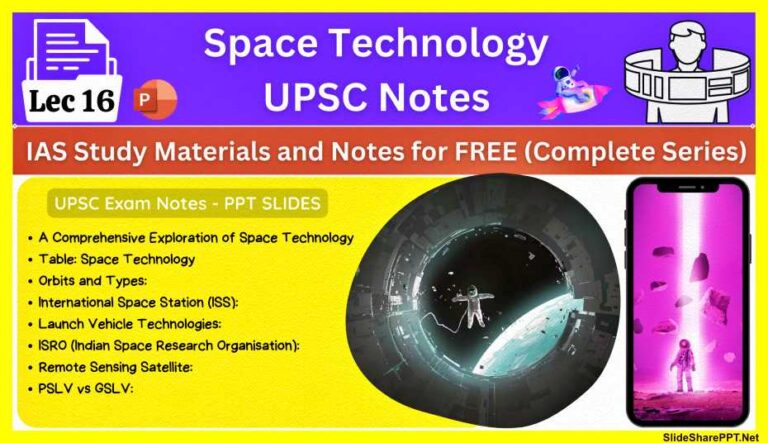
Navigating the Cosmos: A Comprehensive Exploration of Space Technology
Space technology is a frontier that has captivated human imagination for centuries, and has evolved into a sophisticated field encompassing various aspects such as orbits, propulsion systems, launch vehicles, and an array of satellites. In this article, we delve into the intricacies of space technology, exploring the orbit satellites traverse, the propulsion systems that propel them, and the diverse applications of satellites in modern space exploration.
- Orbits and Types: Spacecrafts can follow different orbital paths. Two fundamental types are elliptical and circular orbits, each serving distinct purposes in space missions.
- Movement of Satellites: Satellites exhibit specific movements such as geosynchronous, geostationary, and sun-synchronous orbits, each offering unique advantages for communication, Earth observation, and scientific research.
- Orbits based on Height: Satellites operate at different altitudes, including Low Earth Orbit (LEO), Medium Earth Orbit (MEO), and High Earth Orbit (HEO), each presenting specific advantages based on the mission’s objectives.
- International Space Station (ISS): The ISS stands as a testament to international collaboration in space exploration, serving as a microgravity and space environment research laboratory.
- Hohmann Transfer Orbit: A specific orbital maneuver used to transfer a spacecraft between two circular orbits, optimizing fuel efficiency.
- Lagrange Points: Points in space where the gravitational forces of two large bodies, such as the Earth and the Moon, balance the centrifugal force felt by a smaller object, enabling stable positions for satellites.
- Launch Vehicle Technologies: Various technologies, including expendable (ELV) and reusable (RLV) launch vehicles, propel spacecraft into space.
- Propulsion System: Propulsion systems vary, encompassing non-air breathing, semi-cryogenic, and cryogenic systems, each tailored for specific mission requirements.
- Air Breathing: Technologies like scramjet and ramjet utilize the Earth’s atmosphere for propulsion, enhancing efficiency during atmospheric flight.
- Propellants: The substances used for rocket propulsion, including solid and liquid propellants, each with distinct characteristics and applications.
- Types of Launch Vehicles: Expendable launch vehicles (ELV) are designed for one-time use, while reusable launch vehicles (RLV) can be recovered and reused for multiple missions.
- ISRO (Indian Space Research Organisation): India’s space agency, ISRO, has played a pivotal role in space exploration, satellite deployment, and interplanetary missions.
- ISRO’s Launch Vehicles: ISRO boasts a rich history of launch vehicles, from historical achievements to operational vehicles and ambitious plans for the future.
- Sounding Rockets: Essential for scientific research, sounding rockets carry instruments into space for brief periods to collect data.
- PSLV vs GSLV: A comparison of two prominent ISRO launch vehicles, the Polar Satellite Launch Vehicle (PSLV) and the Geosynchronous Satellite Launch Vehicle (GSLV).
- Rohini Series: India’s first satellite series, contributing significantly to the nation’s space capabilities.
- Jet Engine: A critical component of air-breathing propulsion systems, jet engines play a crucial role in atmospheric flight.
- Ramjet: A type of air-breathing engine that relies on supersonic airflow for combustion.
- Scramjet: An advanced air-breathing engine designed for hypersonic flight, capable of reaching speeds several times the speed of sound.
- Satellites: Artificial satellites serve diverse purposes, including resource mapping, communication, and Earth observation.
- Resource Mapping Satellite: Satellites equipped with advanced sensors for mapping and monitoring Earth’s natural resources.
- Communication Satellite: Satellites facilitating global communication networks and broadcasting services.
- GSAT Series: The GSAT series of communication satellites was developed by ISRO to enhance telecommunication and broadcasting services.
- Telescopes: Space-based telescopes enable astronomers to observe celestial objects with unprecedented clarity.
- Remote Sensing Satellite: Satellites equipped with sensors to capture data about Earth’s surface and atmosphere for various applications.
- RISAT Series: Radar Imaging Satellite series, designed for all-weather, day-and-night Earth observation.
- EMISAT Series: The Electronic Intelligence Satellite series, focuses on electronic surveillance and reconnaissance.
- Bhuvan ISRO: ISRO’s geoportal, Bhuvan, offers satellite imagery and maps for diverse applications, including disaster management and urban planning.
- INSAT Series: The Indian National Satellite System, provides meteorological, search and rescue, and communication services.
- VSAT Series: Very Small Aperture Terminals, a technology used in satellite communication for broadband internet and network connectivity.
- Indian Remote Sensing Satellite: Satellites are dedicated to capturing high-resolution images and data for applications like agriculture, forestry, and disaster management.
Conclusion: As we navigate the vast cosmos, the strides made in space technology have not only expanded our understanding of the universe but also facilitated practical applications for life on Earth. From the intricacies of orbital mechanics to the development of cutting-edge launch vehicles and versatile satellites, space technology continues to propel us towards new frontiers of knowledge and exploration.
Table: Space Technology
The table includes various aspects of space technology, but you can customize it based on your specific needs and the depth of information you require. Here’s a simple example:
| Category | Subcategory | Examples | Description and Notable Features |
|---|---|---|---|
| Launch Vehicles | Rockets | Falcon 9, Atlas V, Soyuz, Delta IV | Reliable launch systems with varying payload capacities. |
| Space Shuttles | Space Shuttle, Buran | Manned spacecraft capable of both launch and landing. | |
| Satellites | Earth Observation | Landsat, Copernicus, RADARSAT | Collects data for environmental monitoring and mapping. |
| Communication | Intelsat, Inmarsat, GPS satellites | Provides global communication and navigation services. | |
| Navigation | GPS, Galileo, GLONASS | Satellite constellations for precise global positioning. | |
| Space Probes | Planetary Exploration | Voyager, Mars Rovers (e.g., Perseverance) | Explores planets and celestial bodies within the solar system. |
| Space Telescopes | Hubble Space Telescope, James Webb Space Telescope | Observatories providing detailed views of distant galaxies. | |
| Space Stations | Manned | International Space Station (ISS), Mir | Orbital platforms for scientific research and international cooperation. |
| Unmanned | Tiangong, Salyut | Automated stations conducting experiments in microgravity. | |
| Space Exploration | Lunar Missions | Apollo Program, Lunar Gateway | Human and robotic missions to explore Earth’s Moon. |
| Mars Missions | Mars Rover Missions (e.g., Perseverance) | Probes and rovers studying the Martian surface and atmosphere. | |
| Space Research | Telescopes | Ground-Based Telescopes, Space Telescopes | Instruments for astronomical observations from Earth and orbit. |
| Space Laboratories | ISS Laboratories (e.g., Destiny, Columbus) | Microgravity research and experimentation aboard the ISS. | |
| Propulsion Systems | Chemical Propulsion | Liquid Rocket Engines, Solid Rocket Boosters | Traditional engines for launch vehicles and boosters. |
| Ion Propulsion | Dawn spacecraft, Deep Space 1 | Efficient electric propulsion systems for deep space missions. | |
| Spacecraft Components | Avionics | Guidance Systems, Onboard Computers | Advanced electronics for navigation and control. |
| Thermal Control | Radiators, Heat Shields | Systems to regulate temperatures in the harsh space environment. | |
| Life Support Systems | Oxygen Generation, Waste Recycling | Sustain life for astronauts during extended missions. | |
| Space Industry | Commercial Launch | SpaceX, Blue Origin, Arianespace | Private companies providing launch services to various payloads. |
| Satellite Manufacturing | Boeing, Lockheed Martin, Northrop Grumman | Major companies involved in the design and construction of satellites. | |
| Space Agencies | National | NASA, ESA, Roscosmos, CNSA, ISRO etc. | Government organizations leading space exploration efforts. |
| International | European Space Agency (ESA), ISS Partners | Collaborative efforts in space exploration and scientific research. |
Read the Previous Post: Nuclear Technology and Nano Technology