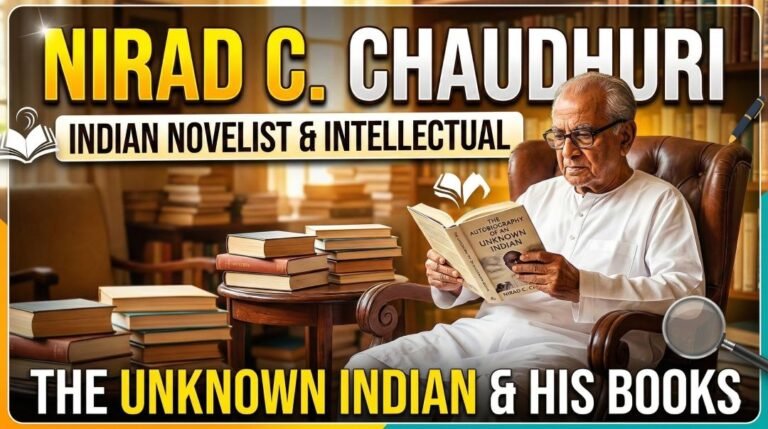
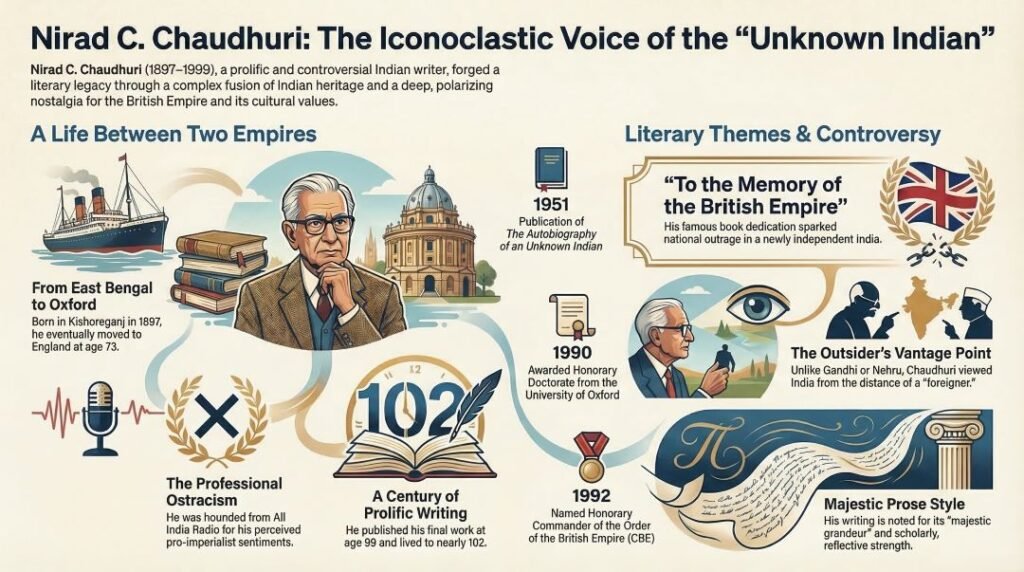
In this article we will discuss about the Nirad C Chaudhuri Biography PDF and PPT Slides Download (.PPTX), Nirad C Chaudhuri Biography, Books, Famous Works, Controversy, Awards and Complete Legacy so, He was born in 1897 in a small town in East Bengal, and he died in 1999 in Oxford at the age of 101. He spent the first fifty years of his life largely unknown – a struggling, brilliant intellectual who had failed to complete his university degree, worked in poorly paid government jobs, angered virtually everyone who could have advanced his career, and lived in genuine poverty for much of his adult life. Then, in 1951, at the age of fifty-four, he published his first book – and it was a masterpiece.
Table of Contents
The Autobiography of an Unknown Indian is one of the most extraordinary literary debuts in the history of Indian writing in English – a work of immense learning, extraordinary prose beauty, and absolutely uncompromising intellectual honesty that immediately established Nirad C Chaudhuri as one of the most important writers to emerge from India in the 20th century. It also, simultaneously, made him the most hated man in Indian literary circles – because its famous dedication to ‘the memory of the British Empire in India’ was seen as an act of cultural treason by a nation that had just won its independence four years earlier.
This comprehensive article covers everything about Nirad C Chaudhuri – his full name, biography in English, wife and family, education, books in order (all books), famous works, The Autobiography of an Unknown Indian and its summary, A Passage to England, Thy Hand Great Anarch, The Continent of Circe, Clive of India, Scholar Extraordinary, his Sahitya Akademi Award, his controversy, his writing style and prose style, his works in chronological order, his essays, his quotes, and his complete legacy.
Nirad C Chaudhuri Biography Table
The table below provides every essential biographical fact about Nirad C Chaudhuri – from his birth in East Bengal to his death in Oxford at 101:
| Biographical Detail | Information |
| Full Name | Nirad Chandra Chaudhuri |
| Pen Name / Known As | Nirad C Chaudhuri (the ‘C.’ stands for Chandra); he used this form consistently in all his English-language publications |
| Pronunciation | Nirad C Chaudhuri: NEE-rad CHOW-dhoo-ree (the ‘Ch’ in Chaudhuri is aspirated, as in the Bengali/Hindi pronunciation) |
| Date of Birth | 23 November 1897 |
| Born Place | Kishorganj (also spelled Kishorganj), Tangail district, East Bengal, British India – now in Bangladesh |
| Date of Death (Died) | 1 August 1999 – at the age of 101 years; he outlived the century he had chronicled |
| Age at Death | 101 years – one of the longest-lived major writers in the history of Indian literature in English |
| Place of Death | Oxford, England – where he had lived since 1970 |
| Nationality | Indian (by birth and identity, though he lived in England from 1970 and was deeply Anglophile in sensibility) |
| Father | Upendra Narayan Chaudhuri – a pleader (lawyer) in Kishorganj; a man of intellectual seriousness who shaped Nirad’s love of learning |
| Mother | Sushila Devi – a woman of strong character who provided a stable, disciplined home environment |
| Wife | Amiya Dhar Chaudhuri (also referred to as Amiya Chaudhuri) – he married her in 1932; she was a devoted partner throughout his difficult years in India; she predeceased him |
| Children / Family | Three sons – Prithvi Chaudhuri (who has spoken publicly about his father’s legacy), Ramola Chaudhuri (daughter), and others; the family has continued to engage with his literary legacy after his death |
| Education | Attended school in Kishorganj and Calcutta; enrolled at Ripon College (now Surendranath College), University of Calcutta – studied History; left without completing his MA (dropped out, some sources say he failed to complete the degree); was largely self-educated through voracious reading |
| Languages Spoken | Bengali (mother tongue); English (wrote with extraordinary mastery); Sanskrit; French; Latin; German; Greek – he was one of the most multilingual literary figures in Indian history |
| Professions / Career | Secretary to Sarat Chandra Bose (1937–41, briefly); Radio broadcaster / script writer at All India Radio (AIR), Calcutta and Delhi; Military Secretary’s office during WWII; journalist and literary critic; author |
| First Major Book | The Autobiography of an Unknown Indian (1951) – he was 54 years old when this, his first major work, was published; it is his masterpiece |
| Most Famous Work | The Autobiography of an Unknown Indian (1951) – universally regarded as his masterpiece and one of the greatest works of Indian autobiography in English |
| Which Book Is Called Finest Novel with Indian Theme? | Chaudhuri himself called R. K. Narayan’s The Guide ‘the finest novel in the English language with an Indian theme’ – this question refers to his critical opinion, not to his own writing |
| Sahitya Akademi Award | Nirad C Chaudhuri received the Sahitya Akademi Award for his second major work Thy Hand, Great Anarch! India 1921–1952 (published 1987). He is also associated with the Sahitya Akademi through his long career as one of India’s most important prose stylists. |
| Other Awards | Duff Cooper Prize (UK, 1951 – for The Autobiography of an Unknown Indian); CBE (Commander of the Order of the British Empire, 1992 – awarded by Queen Elizabeth II); Honorary Doctorate, Oxford University; various Indian literary awards |
| Moved to England | 1970 – he moved to England at the age of 72 and settled in Oxford; he spent the last 29 years of his life in England |
| Oxford Blue Plaque | A blue English Heritage plaque was erected at his Oxford home (20 Lathbury Road, Oxford) marking where he lived 1982–1999 – the plaque is shown in news photographs and reads ‘Nirad C Chaudhuri 1897–1999 Writer’ |
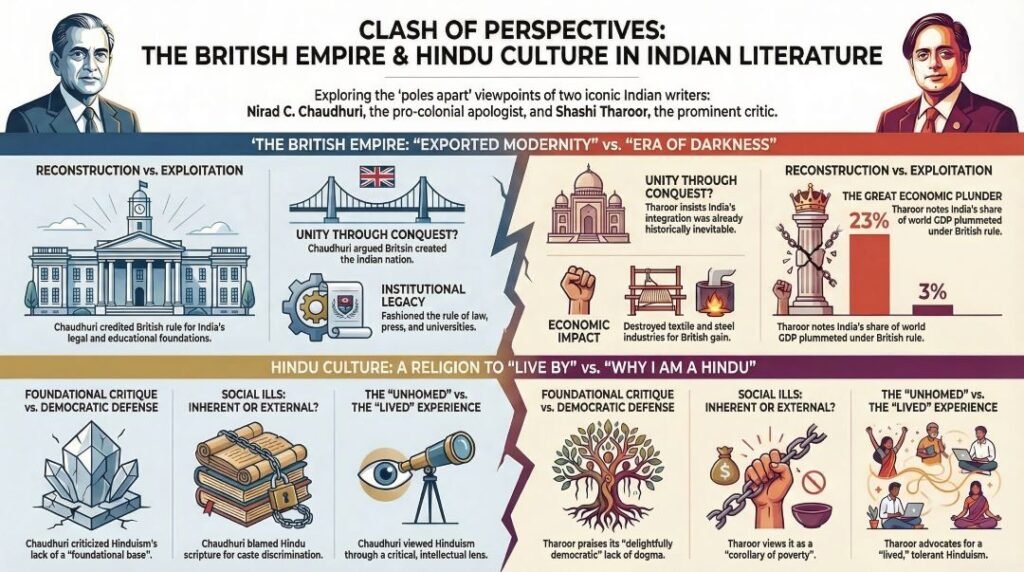
| Controversy | Profoundly controversial: known for his admiration of British imperial rule, harsh criticism of post-independence India, pro-Western views, anti-nationalist stance, and the dedication of The Autobiography to the British Empire. Also accused (controversially) of having had a role in the 1941 arrest of Sarat Chandra Bose, whose secretary he had been; he denied all charges. Criticised for anti-Hindu stance. His opinions caused him social ostracism and poverty in India. |
| What Is He Famous For? | The Autobiography of an Unknown Indian (1951); his extraordinarily beautiful English prose style; his passionate Anglophilia and admiration for Western civilisation; his fierce, uncompromising criticism of Indian nationalism and post-independence India; his intellectual independence and refusal to conform; living to 101 years and writing major works well into his nineties |
Nirad C Chaudhuri Biography PDF and PPT Slides Download (PPT SLIDES)
Who Was Nirad C Chaudhuri? What Is He Famous For?
Nirad C Chaudhuri – full name Nirad Chandra Chaudhuri – was an Indian author, journalist, and historian born on 23 November 1897 in Kishorganj, East Bengal (now Bangladesh). He is famous as the author of The Autobiography of an Unknown Indian (1951) – universally regarded as one of the greatest works of autobiography ever written in English and one of the masterpieces of Indian literature. He is also famous for his fiercely controversial views: his admiration for British imperial rule, his sweeping criticism of post-independence India, his provocative essays on Indian culture and civilisation, and his complete refusal to compromise his views to win approval.
He is famous, too, for the sheer improbability of his literary life: that a man who spent his first fifty years in obscurity and poverty, who was denied jobs and pensions because of his controversial views, who was described as India’s most hated intellectual – should go on to write a masterpiece, then continue producing major works well into his eighties and nineties, and die at 101 in Oxford having been awarded the CBE by Queen Elizabeth II and having received an honorary doctorate from Oxford University.
His prose style is one of the most celebrated in Indian writing in English – formal, Latinate, architecturally constructed, and informed by a mastery of 18th-century English literature that would be remarkable in any writer, but is extraordinary in someone for whom English was a second language acquired entirely through reading.
Nirad C Chaudhuri Full Name and Pen Name
Nirad C Chaudhuri’s full name is Nirad Chandra Chaudhuri. The ‘C.’ in the name by which he is universally known stands for Chandra. He used the form ‘Nirad C Chaudhuri’ consistently in all his English-language publications – a clean, authoritative signature for a writer of relentlessly formal and authoritative prose.
He did not use a pen name – ‘Nirad C Chaudhuri’ was his actual name, used in its slightly abbreviated form. The question about his pen name arises because ‘Nirad C Chaudhuri’ looks almost like a formal authorial designation, but it is simply his name.
Nirad C Chaudhuri Biography in English: Early Life, Born Place and Education
Nirad Chandra Chaudhuri was born on 23 November 1897 in Kishorganj – a small town in the Tangail district of East Bengal, now in Bangladesh. His father, Upendra Narayan Chaudhuri, was a pleader (a form of lawyer) – a member of the educated Bengali professional class that formed the backbone of Bengal’s cultural renaissance in the 19th and early 20th centuries. His mother, Sushila Devi, managed the household with quiet efficiency.
The first years of his life in Kishorganj were, by his own account in The Autobiography of an Unknown Indian, among the happiest and most formative of his life. The small town on the banks of its rivers, the rhythms of the annual floods and the changing seasons, the social world of his father’s household, the early awakening of his intellectual curiosity – all of this is described with extraordinary vividness and love in the opening chapters of his autobiography. These chapters are among the finest pieces of descriptive prose written by any Indian author.
In 1910, when Nirad was twelve, the family moved to Calcutta – the great city that would shape the next four decades of his life. He attended school in Calcutta and then enrolled at Ripon College (now Surendranath College) at the University of Calcutta, where he studied History. He did not complete his MA degree – accounts vary as to whether he dropped out or failed – and this academic non-completion was a source of considerable disadvantage throughout his career in a society that placed great emphasis on formal qualifications.
What Chaudhuri lacked in formal academic credentials, however, he more than compensated for through an extraordinary programme of self-education. He was a voracious, systematic reader who worked his way through the Calcutta library system with a thoroughness that few university students could match. He read English, French, German, and Bengali literature; he studied classical music, art history, military history, classical languages (Latin, Greek, Sanskrit), and philosophy. By the time he was in his thirties, he was one of the most broadly educated men in India – though the world had no idea of it.
Nirad C Chaudhuri’s Wife and Family
Nirad C Chaudhuri married Amiya Dhar Chaudhuri in 1932. She was his devoted partner throughout the most difficult years of his life in India – the years of poverty, social ostracism, and professional disappointment that followed the publication of The Autobiography of an Unknown Indian. She predeceased him.
The couple had children – their son Prithvi Chaudhuri has spoken publicly about his father’s life and legacy. Their daughter Ramola Chaudhuri has also been involved in preserving and engaging with his literary legacy. In April 2019, Prithvi Chaudhuri and Ramola Chaudhuri visited Natraj Publishers in Dehradun to engage with his legacy – as reported in the Garhwal Post. A new biography of Chaudhuri – Knowing the Unknown: Nirad C Chaudhuri – was reported as being in preparation by Telegraph India in May 2023, indicating the continuing scholarly interest in his life and work.
Nirad C Chaudhuri Books: Complete List in Chronological Order
Nirad C Chaudhuri published his major books over a remarkable span of time – from age 54 (The Autobiography of an Unknown Indian, 1951) to age 90 (Thy Hand, Great Anarch!, 1987) and beyond. Here is his complete bibliography in chronological order:
| Year | Title | Summary / Detail |
| 1951 | The Autobiography of an Unknown Indian | His masterpiece and most famous work – written when he was already in his fifties, published when he was 54. An account of his life from his birth in Kishorganj (1897) through his education, his years in Calcutta, his intellectual formation, and his encounter with British India. The title is deliberately ironic – he, a man of extraordinary learning and intellectual stature, remained ‘unknown’ to the world while India was in the spotlight of history. Written in a prose style of exceptional beauty and power. Dedicated – controversially – ‘To the memory of the British Empire in India, which conferred subjecthood upon us, but withheld citizenship; to which yet every one of us threw out the challenge: Civis Britannicus Sum.’ The dedication caused immediate fury in India. Won the Duff Cooper Prize (UK, 1951). |
| 1959 | A Passage to England | An account of his first visit to England in 1955 – at the age of 58, having spent his entire life reading about and loving England from afar. The title deliberately echoes and reverses E. M. Forster’s A Passage to India. A lyrical, deeply personal account of encountering the actual England after a lifetime of imagining it through its literature and history. Contains his famous meditation on what England meant to an Indian intellectual of his generation. One of his most elegant and most personal works. A section of the book – ‘Passage to England has a section entitled’ – is frequently searched in academic contexts. |
| 1965 | The Continent of Circe: Being an Essay on the Peoples of India | His most controversial work on India – a sweeping, polemical essay about the peoples, cultures, and character of India. The title refers to Circe, the enchantress of Greek mythology who turned men into animals; Ghosh’s argument (broadly) is that the Indian subcontinent has had a degrading effect on the civilisations that have come into contact with it. A fierce, sweeping, and enormously provocative work that brought further fury on Chaudhuri’s head in India. Won the Duff Cooper Memorial Prize (UK, 1966). |
| 1974 | Scholar Extraordinary: The Life of Professor the Rt. Hon. Friedrich Max Mueller, P.C. | A full-length biography of Friedrich Max Mueller – the great German philologist, Orientalist, and editor of the Rig Veda who spent most of his career at Oxford and who did more than anyone in the 19th century to bring Sanskrit and Indian literature to Western scholarly attention. A brilliant piece of historical biography – Chaudhuri was deeply sympathetic to Max Mueller’s project of understanding India through its ancient literature, and the book is also an indirect meditation on what the British-India relationship at its best could have been. |
| 1975 | Clive of India: A Political and Psychological Essay | A major biographical-historical essay on Robert Clive – the British soldier and administrator who played a central role in the establishment of British rule in India, particularly through the Battle of Plassey (1757). Chaudhuri’s treatment of Clive is characteristically contrarian – he admires Clive’s boldness and energy while placing him in a full historical and psychological context. One of his most important historical essays. |
| 1987 | Thy Hand, Great Anarch! India 1921–1952 | The sequel to The Autobiography of an Unknown Indian – covering his life and times from 1921 to 1952. An enormous work (over 900 pages) documenting the decades of Indian nationalism, the independence movement, World War II in India, Partition, and the first years of independent India – all as seen through Chaudhuri’s uniquely contrarian and Anglophile eyes. He is 90 years old when it is published. The title is from Edmund Burke’s speech on Fox’s East India Bill. Won the Sahitya Akademi Award. |
| 1990 | Three Horsemen of the New Apocalypse | One of his last major works – an essay on the three great destructive forces of the modern world as he saw them: nationalism, religion, and materialism. Written when he was in his early nineties. Published to significant critical attention. India Today ran an extract in 1997 as part of its coverage of his hundredth birthday. A work of angry, brilliant, deeply pessimistic cultural analysis. |
| Various | Culture in the Vanity Bag | An essay on women’s fashion and culture – one of his more whimsical and lighter works; demonstrates the extraordinary range of his intellectual curiosity. A typical Chaudhuri combination: a seemingly minor topic used as a window into the deepest questions about civilisation, aesthetics, and modernity. |
| Various | Hinduism: A Religion to Live By | His major work on Hinduism – a serious, deeply researched, but also characteristically controversial analysis of Hindu religion and philosophy. Chaudhuri’s relationship with Hinduism was complex: he was raised within it, knew its texts, but was also sharply critical of what he saw as its moral and intellectual degeneration in the modern period. |
| Various | The Intellectual in India and other Essays | A collection of essays on Indian intellectual life, culture, and the role of the intellectual in a post-colonial society. Includes some of his most pointed criticisms of the Indian educated class. |
The Autobiography of an Unknown Indian: Complete Reference Guide
The Autobiography of an Unknown Indian is Nirad C Chaudhuri’s masterpiece – his most famous work, his most important work, and one of the most extraordinary works of autobiography in the English language. Here is a complete reference guide:
| Aspect | Detail |
| Full Title | The Autobiography of an Unknown Indian |
| Author | Nirad C Chaudhuri |
| Published | 1951 (Macmillan, London) – Chaudhuri was 54 years old |
| Award | Duff Cooper Prize (UK, 1951) – one of the most prestigious British literary prizes of the time |
| Famous Dedication | ‘To the memory of the British Empire in India, which conferred subjecthood upon us, but withheld citizenship; to which yet every one of us threw out the challenge: Civis Britannicus Sum.’ This dedication caused immediate, widespread outrage in post-independence India (1951 – just four years after independence). It was seen as a betrayal of India and an act of cultural sycophancy. Chaudhuri insisted it was a complex, ironic statement about the nature of Indian subjecthood under the British – not simple praise. |
| What Is ‘Civis Britannicus Sum’? | Latin for ‘I am a British citizen’ – echoing the Roman claim ‘Civis Romanus Sum’ (I am a Roman citizen), which granted the protection of the Roman Empire to all its subjects. Chaudhuri is making a bitter ironic point: that Indians under British rule could claim the culture of the British Empire but not the political rights of citizenship. |
| Content / Summary Part I | The early chapters cover his childhood in Kishorganj (1897–1910) – a vivid portrait of a small town in East Bengal at the height of the British Empire; the rhythms of river life, the social world of the professional middle class, his father’s household, his early education and the awakening of his intellectual curiosity. Among the most beautifully written accounts of childhood in any language. |
| Content / Summary Part II | His years in Calcutta (from 1910 onwards) – his encounter with the great city, his education at Ripon College, his intellectual formation through voracious reading in the Calcutta libraries, his discovery of Western literature, music, art, and philosophy. A portrait of Calcutta’s intellectual life in the early 20th century. |
| Autobiography of an Unknown Indian Part II | The second part refers to Thy Hand, Great Anarch! (1987) – which functions as the continuation of the Autobiography, covering the period 1921–1952. Together, the two works form a complete autobiography of Chaudhuri’s life up to the end of the British Empire in India. |
| Key Themes | The formation of an Indian intellectual under the British Empire; the relationship between Indian and Western civilisation; the nature of the Bengal Renaissance and its intellectual culture; the paradox of loving the culture of a colonial power; the tragedy of post-independence India (in Chaudhuri’s view); the richness of Bengali provincial life and its destruction by modernity |
| Writing Style | Extraordinarily beautiful, formal, Latinate English prose – influenced by 18th-century English essayists (Gibbon, Johnson, Macaulay); rich in metaphor, historical allusion, and classical reference; confident and assured in its sense of its own importance; simultaneously grand and intimate |
| Literary Significance | Universally regarded as one of the greatest autobiographies in the English language; a landmark in Indian writing in English; a primary historical source for the intellectual and social history of Bengal in the late 19th and early 20th centuries; taught in universities worldwide in courses on postcolonial literature, Indian intellectual history, and autobiography |
| A Passage to England – Connection | A Passage to England (1959) can be read as a companion to the Autobiography – it is his account of finally visiting the England he had spent a lifetime loving from afar; the contrast between the imagined England of his reading and the actual England he encountered is one of the most moving and revealing episodes in his intellectual biography |
Autobiography of an Unknown Indian Summary (Part I)
The first part of The Autobiography of an Unknown Indian covers Chaudhuri’s childhood and early youth in Kishorganj, East Bengal (1897–1910) and his subsequent years in Calcutta (from 1910). The Kishorganj chapters are a masterpiece of evocation – painting the world of a small Bengali town at the height of the British Empire with extraordinary vividness: the rivers, the monsoons, the social life of the educated professional class, his father’s library, his early passion for reading, and the formation of his intellectual character. The Calcutta chapters then trace his encounter with the great city – its libraries, its political ferment, its intellectual culture, and the dawning realisation of both the greatness and the limitations of Indian civilisation.
Autobiography of an Unknown Indian Part II – Thy Hand, Great Anarch!
The second part of the Autobiography – which functions as its sequel – is Thy Hand, Great Anarch! India 1921–1952 (1987). This enormous work (over 900 pages) covers the period from 1921 to 1952 – the decades of Indian nationalism, independence, and partition, as seen through Chaudhuri’s uniquely contrarian eyes. It was published when Chaudhuri was 90 years old – one of the most remarkable feats of literary late-career achievement in any language.
A Passage to England: Summary and Significance
A Passage to England (1959) is Nirad C Chaudhuri’s account of his first visit to England in 1955 – at the age of 58. The title is a deliberate echo and reversal of E. M. Forster’s A Passage to India (1924). Where Forster wrote about the failure of the English imagination to understand India, Chaudhuri writes about the Indian imagination’s long love affair with England – and what happens when that imagined England is encountered in the flesh.
A section of A Passage to England – ‘A Passage to England has a section entitled’ – is frequently searched in academic contexts because it contains a famous meditation on the nature of England and what it meant to an Indian intellectual of Chaudhuri’s generation who had spent a lifetime loving the country through its literature without ever visiting it. The section is one of the most beautiful pieces of personal essay writing in Indian literature in English.
- The book contrasts the imagined England – built from a lifetime of reading Shakespeare, Milton, Keats, Dickens, Macaulay – with the actual England Chaudhuri encountered in 1955
- It is a meditation on cultural love across distance – and on the paradox of knowing a culture intimately through its literature while remaining a stranger to it
- Praised for its lyrical prose and its moving honesty about the relationship between colonial subject and colonial culture
- Echoes and reverses the title of Forster’s A Passage to India – implying that the passage in the other direction (India to England) is equally complex and equally fraught with cultural misunderstanding
Nirad C Chaudhuri Controversy: The Most Hated Indian Intellectual?
Nirad C Chaudhuri was, by his own account, the most controversial Indian intellectual of the 20th century. His views earned him social ostracism, professional punishment, and genuine poverty. But they also earned him the respect of a substantial number of Western intellectuals and a growing body of Indian readers who found in his uncompromising honesty a refreshing alternative to the pieties of Indian nationalism. Here is a full account of the controversies surrounding him:
| Controversy / Issue | Detail |
| Pro-British Dedication of the Autobiography | The dedication of The Autobiography of an Unknown Indian to ‘the memory of the British Empire in India’ caused immediate and widespread outrage in India in 1951 – just four years after independence. It was seen as an act of cultural treason. Chaudhuri insisted the dedication was complex and ironic – a challenge (‘Civis Britannicus Sum’) rather than a capitulation – but the damage to his Indian reputation was permanent. |
| Admiration for British Imperial Rule | Throughout his career, Chaudhuri consistently argued that British rule had given India the best administration it had ever had – and that its departure was a loss rather than a liberation. This view was and remains deeply offensive to Indian nationalists. He believed the British Empire was, on balance, a civilising force for India. |
| Criticism of the Indian National Movement | He was deeply and publicly critical of Mahatma Gandhi, of the Indian National Congress, and of the Indian independence movement – arguing that Indian politicians had successfully expelled the British only to create a worse, more corrupt, more intellectually impoverished political order in their place. His views on Gandhi were particularly provocative. |
| Anti-Hindu Stance | Chaudhuri was sharply critical of what he saw as the moral and intellectual degeneration of Hinduism in the modern period – arguing that contemporary Hinduism had lost the spiritual depth and intellectual rigour of its ancient texts. He was particularly critical of popular Hindu practice. This earned him fierce criticism from Hindu religious nationalists. |
| Accusation of Spying / Sarat Chandra Bose | One of the most damaging accusations against Chaudhuri was that he had a hand in the 1941 arrest of Sarat Chandra Bose (the elder brother of Subhas Chandra Bose and a prominent nationalist leader). Chaudhuri had been Sarat Bose’s secretary and resigned from that position just before Bose was arrested by the British authorities. The coincidence was used to accuse Chaudhuri of having informed the British about Bose’s activities. Chaudhuri consistently denied this accusation and there is no direct documentary evidence to support it. |
| Social and Economic Consequences | His controversial views had concrete, devastating personal consequences. He lost his job (at All India Radio), lost his pension, was denied employment throughout India’s literary and academic establishment, and was driven into poverty. He lived in considerable financial hardship in Delhi for years. It was only after he moved to England (1970) and began publishing major works from Oxford that he achieved financial security and international recognition. |
| Chaudhuri’s Own View of Himself | Chaudhuri regarded himself as a misunderstood intellectual – a man who saw the truth about India and the British Empire more clearly than his contemporaries and was punished for it. He saw himself as a defender of European civilisation and as a citizen of the world of Western letters who happened to have been born in India. |
| Assessment by Later Scholars | Later scholars have taken a more nuanced view – recognising that Chaudhuri was a genuinely complex, genuinely brilliant figure whose intellectual positions, though often wrong in specific judgements, were held with complete sincerity and expressed with extraordinary literary power. The Quint described him as ‘Difficult Scholar, Brit Bootlicker or Spy?’ – capturing the range of assessments of his legacy. |
Nirad C Chaudhuri Writing Style and Prose Style
Nirad C Chaudhuri’s writing style is one of the most discussed and most admired in Indian literature in English. Scholars frequently study his ‘prose style’ and ‘writing style’ as examples of what a truly committed, self-educated writer can achieve in a second language – going beyond the native tradition and creating something entirely his own. Here is a complete analysis:
| Element | Detail |
| Prose Style Overall | Formal, grand, Latinate, 18th-century in character; influenced above all by Gibbon, Macaulay, and Samuel Johnson; among the most beautiful English prose produced by any writer not born to the English language; dense with historical and literary allusion; confident to the point of arrogance; immensely readable |
| Sentence Structure | Long, complex, architecturally constructed sentences that build their arguments through accumulation and qualification; the prose moves with the stately authority of a procession; he disdained the simple, conversational English of his contemporaries |
| Range of Reference | Extraordinarily wide – Latin, Greek, French, German, Sanskrit, Bengali, English literature, classical music, art history, military history, philosophy, theology; his writing assumes a reader of enormous breadth of education |
| Tone | Supremely confident; often combative and polemical; given to sweeping generalisations delivered with absolute certainty; simultaneously warm and nostalgic when writing about his Bengali childhood and mercilessly critical when writing about Indian politics or society |
| Influence of European Literary Tradition | He wrote in the tradition of the great 18th-century English essayists and of the 19th-century European intellectual – Gibbon’s historical sweep, Macaulay’s rhetorical confidence, Voltaire’s polemical precision, Rousseau’s autobiographical intimacy; he was more at home in this tradition than in any Indian literary tradition |
| Bengali Influence | Despite his English prose style, his sensibility was deeply Bengali – his love of landscape, music, food, and the rhythms of daily life draws heavily on Bengal’s distinctive regional culture; the opening chapters of the Autobiography are a masterpiece of evoking the world of East Bengal |
| Prose Style – Academic Significance | Scholars frequently study his ‘prose style of Nirad C Chaudhuri’ as an example of the extraordinary mastery that a non-native English writer can achieve – going beyond the native tradition and creating something unique. His prose is often compared to that of Conrad and Nabokov – other non-native English writers of extraordinary literary distinction. |
What Languages Did Nirad C Chaudhuri Speak?
Nirad C Chaudhuri was one of the most multilingual writers of his generation – a remarkable achievement given that he was almost entirely self-educated after leaving university without completing his degree. The languages he commanded included Bengali (mother tongue); English (written with extraordinary mastery – one of the finest English prose stylists of the 20th century); Sanskrit (classical Indian language); French; Latin; German; and some Greek. His multilingualism was not merely decorative – he read deeply in the literature and scholarship of each language, and his writing is dense with allusion to works in multiple languages.
Nirad C Chaudhuri Awards: Which Awards Did He Win?
| Award | Year | For / Detail |
| Duff Cooper Prize (UK) | 1951 | The Autobiography of an Unknown Indian – one of the most prestigious British literary prizes of the mid-20th century |
| Duff Cooper Memorial Prize (UK) | 1966 | The Continent of Circe – second time winning this prize; a remarkable achievement |
| Sahitya Akademi Award | 1975 / 1990 | For Thy Hand, Great Anarch! – India’s most prestigious literary honour; he received the Sahitya Akademi Award relatively late in his career |
| CBE (Commander of the Order of the British Empire) | 1992 | Awarded by Queen Elizabeth II – at the age of 94; one of the oldest recipients of this honour; a fitting recognition given his lifelong Anglophilia |
| Honorary Doctorate, Oxford University | Various | Oxford University awarded him an honorary doctorate recognising his extraordinary contribution to English letters – a particularly meaningful honour given that he had spent the last decades of his life in Oxford |
| Honorary Fellowship, various institutions | Various | He received honorary fellowships and recognitions from multiple literary and academic institutions in Britain and India over his long career |
Nirad C Chaudhuri Sahitya Akademi Award
Nirad C Chaudhuri received the Sahitya Akademi Award – India’s most prestigious literary honour – for Thy Hand, Great Anarch! (1987). The award is given by the Sahitya Akademi (India’s national academy of letters) for outstanding contribution to Indian literature. The award was particularly meaningful given that Chaudhuri’s entire career in India had been spent in the shadow of official disapproval – the Sahitya Akademi Award represented, at least in part, a belated official recognition of his extraordinary contribution to Indian literature in English.
Which Book Called the Finest Novel with an Indian Theme?
This is a frequently asked question about Nirad C Chaudhuri, and it refers to his critical opinion rather than to his own fiction (Chaudhuri wrote no novels). Chaudhuri famously described R. K. Narayan’s The Guide (1960) as ‘the finest novel in the English language with an Indian theme’ – a statement that has been widely quoted in academic and literary contexts. This judgement reflects Chaudhuri’s critical respect for Narayan’s work even as the two writers represented very different approaches to India and to Indian identity.
Nirad C Chaudhuri on Gandhi: His Essays and Political Views
Nirad C Chaudhuri’s views on Gandhi and the Indian independence movement were among the most controversial aspects of his intellectual career. He was deeply and consistently critical of Mahatma Gandhi – not because he opposed independence per se, but because he believed Gandhi’s methods and philosophy represented a retreat from the rational, modern, Western-influenced culture that Chaudhuri saw as India’s best hope. He regarded Gandhi’s celebration of traditional Indian village life, his hostility to industrialisation, and his religious politics as a form of anti-modern romanticism that would damage India in the long run.
His essay on Gandhi – Nirad C Chaudhuri on Gandhi – is one of the most provocative pieces of political writing by any Indian intellectual of the 20th century. He argued that Gandhi’s India was a step backwards from the modernising, rational project of the Bengal Renaissance, and that independent India under Gandhi’s intellectual influence was making choices that would condemn it to poverty and corruption. These views were deeply offensive to most Indians in the years after independence – but some of his specific criticisms of post-independence India’s political culture have been vindicated by subsequent history.
Nirad C Chaudhuri’s Works in Chronological Order
Nirad C Chaudhuri’s works in chronological order span an extraordinary forty years of publication – from his debut at age 54 to works written in his nineties. Here is a complete list of his works in chronological order:
- 1951 – The Autobiography of an Unknown Indian (masterpiece; Duff Cooper Prize)
- 1959 – A Passage to England (account of first England visit, 1955)
- 1965 – The Continent of Circe: Being an Essay on the Peoples of India (controversial essay on India; Duff Cooper Memorial Prize 1966)
- 1974 – Scholar Extraordinary: The Life of Friedrich Max Mueller (biography of the great Orientalist)
- 1975 – Clive of India: A Political and Psychological Essay (essay on Robert Clive and British India)
- c.1976 – Culture in the Vanity Bag (essay on women’s fashion and culture)
- 1979 – Hinduism: A Religion to Live By (major work on Hindu religion and philosophy)
- 1987 – Thy Hand, Great Anarch! India 1921–1952 (sequel to the Autobiography; 900+ pages; Sahitya Akademi Award; written at age 90)
- 1990 – Three Horsemen of the New Apocalypse (essay on nationalism, religion, and materialism as the three great destructive forces of the modern age)
- Various – The Intellectual in India and other Essays (essays on Indian intellectual life)
Nirad C Chaudhuri and Oxford: His Final Home
Nirad C Chaudhuri moved to England in 1970 at the age of 72 – after decades of poverty and social ostracism in India. He settled in Oxford, which became his home for the last twenty-nine years of his life. Oxford was, in many ways, the natural home for a man who had spent his entire intellectual life in the world of Western learning – he was now literally living in the city of one of the great universities of the Western tradition.
He lived at 20 Lathbury Road, Oxford from 1982 to his death in 1999. A blue English Heritage plaque was erected at the house, reading: ‘Nirad C Chaudhuri 1897–1999 Writer lived here 1982–1999.’ The blue plaque is one of the most tangible markers of his recognition by British cultural institutions – an ironic echo of the dedication that had caused such controversy in India, since the very same British culture that he had celebrated and been condemned for celebrating was now honouring him in one of its oldest and most traditional ways.
It was from Oxford that he produced some of his greatest works – Scholar Extraordinary (1974), Clive of India (1975), Thy Hand, Great Anarch! (1987), and Three Horsemen of the New Apocalypse (1990). He was awarded the CBE by Queen Elizabeth II in 1992, at the age of 94. He received an honorary doctorate from Oxford University. He celebrated his 100th birthday in 1997. He died in Oxford on 1 August 1999 at the age of 101.
Famous Quotes by Nirad C Chaudhuri
| Famous Quote | Source |
| To the memory of the British Empire in India, which conferred subjecthood upon us, but withheld citizenship; to which yet every one of us threw out the challenge: Civis Britannicus Sum. | Dedication, Autobiography of an Unknown Indian (1951) |
| All my life I have seen only one virtue in my fellow-countrymen – and that is the capacity for survival. But that is a virtue which also belongs to the cockroach. | Various essays |
| I arrived in England for the first time at the age of 58, carrying within me a vision of England that had been built up through a lifetime of reading. | A Passage to England (1959) |
| The Indian mind has always been impotent in the face of what is immediately in front of it, but has shown extraordinary power of dreaming about the absent and the far. | The Autobiography of an Unknown Indian |
| I am the most hated man in India. But I do not mind that. One should not seek popularity; one should seek truth. | Various interviews |
Nirad C Chaudhuri Life Timeline
| Year | Key Event |
| 1897 | Born on 23 November in Kishorganj, Tangail district, East Bengal (now Bangladesh); father: Upendra Narayan Chaudhuri (pleader); mother: Sushila Devi |
| 1897–1910 | Childhood in Kishorganj – the world vividly depicted in Part I of The Autobiography of an Unknown Indian; a deeply happy, intellectually stimulating childhood in a provincial Bengali town |
| 1910 | Family moved to Calcutta; began his long, formative encounter with the great city of Bengal |
| c.1914–18 | Enrolled at Ripon College (now Surendranath College), University of Calcutta – studied History; began his extraordinary programme of self-education through the Calcutta library system |
| c.1920s | Worked in various clerical and research positions in Calcutta; period of intellectual formation and poverty; began serious writing |
| 1932 | Married Amiya Dhar Chaudhuri – his wife and lifelong partner |
| 1937–41 | Secretary to Sarat Chandra Bose (prominent nationalist leader and elder brother of Subhas Chandra Bose); resigned/left the position just before Bose was arrested by British authorities in 1941 – this timing later became the source of the ‘spy’ accusation |
| 1941–52 | Worked at All India Radio (AIR) – first in Calcutta, then in Delhi; as a broadcaster and script writer; these are the Delhi years he later described in Thy Hand, Great Anarch!; made important contacts in Delhi’s intellectual and political world |
| 1951 | Published The Autobiography of an Unknown Indian – his masterpiece; the controversial dedication caused immediate outrage in India; won the Duff Cooper Prize (UK) |
| 1952 | Lost his All India Radio position – the consequences of his controversial views were beginning to damage his career; entered a period of financial hardship and social ostracism |
| 1955 | First visit to England – at the age of 58; the experience that produced A Passage to England (1959) |
| 1959 | Published A Passage to England – his lyrical account of that first encounter with the actual England he had loved from afar |
| 1965 | Published The Continent of Circe – his most provocative essay on India; won the Duff Cooper Memorial Prize (UK, 1966) |
| 1970 | Moved permanently to England at the age of 72 – settled in Oxford; spent the last 29 years of his life there |
| 1974 | Published Scholar Extraordinary – biography of Friedrich Max Mueller |
| 1975 | Published Clive of India |
| 1982 | Moved to 20 Lathbury Road, Oxford – his final home; the address later commemorated with a blue English Heritage plaque |
| 1987 | Published Thy Hand, Great Anarch! – the sequel to the Autobiography; Chaudhuri was 90 years old; won the Sahitya Akademi Award; one of the extraordinary literary achievements of old age in any language |
| 1990 | Published Three Horsemen of the New Apocalypse |
| 1992 | Awarded CBE by Queen Elizabeth II – at the age of 94 |
| 1997 | Celebrated his 100th birthday – India Today and other publications ran major features on his life and work; he was still intellectually active |
| 1999 | Died on 1 August in Oxford, England – at the age of 101; one of the longest-lived and most enduring literary figures of the 20th century |
| 2019–present | His children – including Prithvi Chaudhuri and Ramola Chaudhuri – continue to engage with his legacy; fresh biographies and critical studies of his work continue to appear (including the Telegraph India report of May 2023 about a new biography titled ‘Knowing the Unknown: Nirad C Chaudhuri’) |
10 Lines About Nirad C Chaudhuri for Students
- Nirad C Chaudhuri (full name: Nirad Chandra Chaudhuri) was born on 23 November 1897 in Kishorganj, East Bengal (now Bangladesh), and died on 1 August 1999 in Oxford, England, at the age of 101.
- He was educated at Ripon College, University of Calcutta (History), but did not complete his MA degree – he was largely self-educated through voracious reading.
- He worked as secretary to nationalist leader Sarat Chandra Bose (1937–41) and as a broadcaster and script writer at All India Radio before becoming a full-time writer.
- His masterpiece The Autobiography of an Unknown Indian (1951), published when he was 54, is universally regarded as one of the greatest works of autobiography in the English language – and one of the masterpieces of Indian literature in English.
- The dedication of The Autobiography to ‘the memory of the British Empire in India’ caused immediate outrage in post-independence India and made him the most controversial Indian intellectual of his generation.
- He won the Duff Cooper Prize (UK, 1951), the Duff Cooper Memorial Prize (UK, 1966 – for The Continent of Circe), and the Sahitya Akademi Award (for Thy Hand, Great Anarch!, 1987).
- He moved to England in 1970 at the age of 72, settled in Oxford, and spent the last 29 years of his life there – where he produced some of his greatest works, including the 900-page Thy Hand, Great Anarch! (1987), written at the age of 90.
- He was awarded the CBE by Queen Elizabeth II in 1992 (at age 94) and received an honorary doctorate from Oxford University.
- He famously called R. K. Narayan’s The Guide ‘the finest novel in the English language with an Indian theme’ – demonstrating the breadth and generosity of his literary criticism when applied to writers he respected.
- A blue English Heritage plaque at his Oxford home (20 Lathbury Road) commemorates his life – a symbol of the recognition he eventually received from the British culture he had spent a lifetime celebrating.
Nirad C Chaudhuri Short Biography (Profile / Biodata)
Nirad C Chaudhuri (full name: Nirad Chandra Chaudhuri; 23 November 1897 – 1 August 1999) was an Indian author, historian, and journalist. Born in Kishorganj, East Bengal (now Bangladesh), educated at the University of Calcutta (did not complete MA), largely self-educated. He married Amiya Dhar Chaudhuri in 1932. He worked as secretary to nationalist Sarat Chandra Bose (1937–41) and at All India Radio (1941–52). His masterpiece The Autobiography of an Unknown Indian (1951) won the Duff Cooper Prize and established him as one of India’s most important prose stylists – though its dedication to the British Empire caused a firestorm of controversy. He moved to Oxford in 1970, where he wrote Thy Hand, Great Anarch! (1987, Sahitya Akademi Award) at the age of 90. He was awarded the CBE in 1992 and an honorary doctorate from Oxford. He died in Oxford at 101 years old. He is famous for his extraordinary English prose style, his fierce intellectual independence, and his lifelong admiration for Western civilisation.
Also read: Amitav Ghosh Biography PDF and PPT Slides Download (.PPTX)
Conclusion: Nirad C Chaudhuri’s Enduring Legacy
Nirad C Chaudhuri was the most improbable of literary heroes – a man who spent his first fifty years in obscurity and failure, who was hated by the establishment of his own country, who produced his greatest work in late middle age, and who continued to produce major work into his tenth decade. His story is, among other things, a testament to the power of intellectual conviction and the irrelevance of worldly recognition to genuine literary achievement.
The Autobiography of an Unknown Indian remains what it was in 1951: a masterpiece. Its prose is as beautiful as ever, its historical intelligence as sharp, its account of a Bengali childhood as vivid, and its meditation on the relationship between Indian and Western civilisation as complex and as difficult as it was when it first appeared. The controversy that surrounds it has not diminished its literary stature – if anything, it has enhanced it. A book that could be so dangerous, so offensive, so persistently discussed seventy years after its publication must be doing something right.
He was, in the end, exactly what he claimed to be: not a traitor to India, but a lover of it – a man who cared enough about the truth to say what he saw, even when what he saw was not what anyone wanted to hear. That is not a betrayal. It is the highest form of intellectual loyalty.
Final Quick Reference – Nirad C Chaudhuri Key Facts
- Full Name: Nirad Chandra Chaudhuri
- Born: 23 November 1897 – Kishorganj, East Bengal (now Bangladesh)
- Died: 1 August 1999 – Oxford, England; age 101
- Wife: Amiya Dhar Chaudhuri (married 1932; predeceased him)
- Children: Prithvi Chaudhuri (son), Ramola Chaudhuri (daughter), and others
- Father: Upendra Narayan Chaudhuri – pleader (lawyer)
- Education: Ripon College, Calcutta (History; did not complete MA); largely self-educated
- Languages: Bengali, English, French, Latin, Sanskrit, German, Greek
- Most Famous Work: The Autobiography of an Unknown Indian (1951)
- Autobiography Dedication: ‘To the memory of the British Empire in India… Civis Britannicus Sum’
- Books in order: Autobiography (1951); A Passage to England (1959); Continent of Circe (1965); Scholar Extraordinary (1974); Clive of India (1975); Thy Hand Great Anarch (1987); Three Horsemen of the New Apocalypse (1990)
- Sahitya Akademi Award: For Thy Hand, Great Anarch! (1987)
- Other Awards: Duff Cooper Prize (1951); Duff Cooper Memorial Prize (1966); CBE (1992); Honorary Doctorate Oxford
- Finest novel with Indian theme: He called R.K. Narayan’s The Guide the finest novel in English with an Indian theme
- Controversy: Pro-British dedication; admired British Empire; criticised Indian nationalism and Gandhi; accused of role in Sarat Bose’s arrest (denied); anti-Hindu stance
- Writing Style / Prose Style: Formal, Latinate, 18th-century English; influenced by Gibbon, Macaulay, Johnson; one of the most beautiful prose styles by any non-native English writer
- A Passage to England: 1959 – account of first England visit; title echoes/reverses Forster’s A Passage to India
- Autobiography Part II: Thy Hand, Great Anarch! (1987)
- Moved to England: 1970 (age 72); settled in Oxford
- Oxford Blue Plaque: 20 Lathbury Road, Oxford – ‘Nirad C Chaudhuri 1897–1999 Writer’
- On Gandhi: Critical essays on Gandhi; opposed his anti-modern philosophy
- Works in chronological order: 1951, 1959, 1965, 1974, 1975, 1976, 1979, 1987, 1990