MISCELLANEOUS Art and Culture UPSC
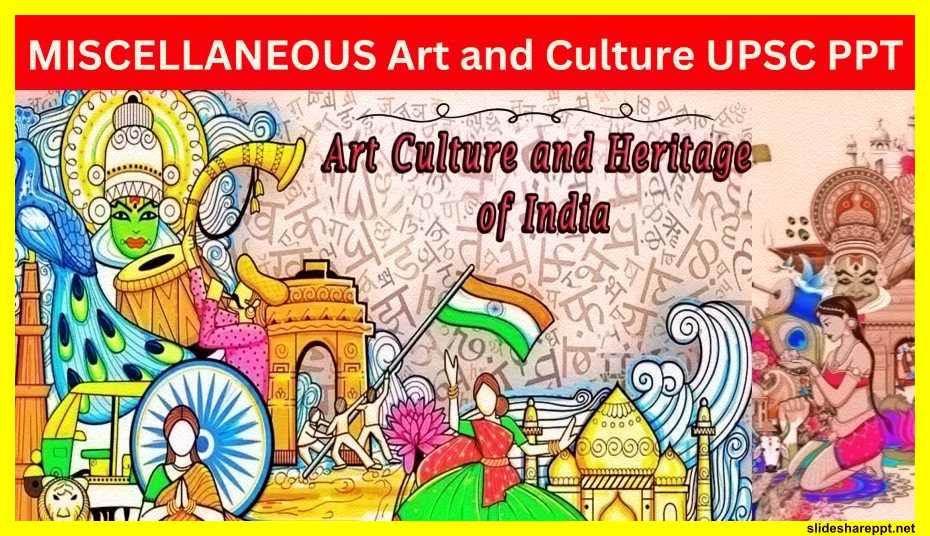
Today we will share the Complete Notes related to MISCELLANEOUS Art and Culture UPSC PPT Slides Download and UPSC PDF Download, Art and culture are the vibrant threads that weave the fabric of human existence, reflecting the diversity, creativity, and richness of societies across the globe. In this exploration of miscellaneous art and culture, we delve into various aspects that highlight the intricate tapestry of human expression.
Table of Contents
MISCELLANEOUS Art and Culture UPSC
(PPT – Lec 12)
Note:-
- If you are viewing this PPT on your phone, please make it full screen and then view it. (Press: 3 dots in PPT, then Full Screen)
- If you have a problem while clicking on next, (Just tap) on the slide instead of clicking Next Botton.
- FOR A BETTER VIEW PRESS Ctrl + Shift + F ON A PC OR LAPTOP.
- Whatever is written in the PPT is different and whatever is written below is different.
UPSC Prelims PPT Bundle Product Details
(BUY ONLINE)
| Placement / Section | Details / Click To Action Text |
|---|---|
| Title | UPSC Prelims PPT Notes (BUNDLE) |
| Number of PPTs / Slides | 160+ PPTs |
| Delivery Method | Instant Access after Payment (Google Drive Folder) |
| Additional Info | Full UPSC Prelims Coverage, Study-Friendly PPT Format |
| Copyright / Ownership | Self-made Notes (slideshareppt.net) |
| Payment | Online Gateway – QR, CREDIT CARD, UPI etc… |
| Pricing / Purchase CTA |
Check Price & Buy (Redirects to Pricing Page) |
| Demo Link | View Sample Slides (Click to Open Demo) |
Exploring the Rich Tapestry of Miscellaneous Art and Culture
Art and culture are intricate threads that weave through the fabric of human existence, embodying diverse expressions of creativity, belief systems, and societal values. In this exploration of miscellaneous aspects of art and culture, we delve into the realms of Sufism, the Bhakti movement, diverse festivals, and the literary landscapes spanning the Vedic to Post-Gupta periods.
Sufism: A Journey into Spiritual Depth
Sufism, a mystical and liberal form of Islam, reflects an intense devotion and love for God. Sufis assimilate an outlook that embraces simplicity, inner purity, and self-discipline. The Pir-Murid relationship, the concept of Wahdat-ul-Wujud (Unity of Being), and spiritual practices like Fana, Zikr-tauba, and Sama are integral to Sufi traditions. The Khanqah, a monastic organization, serves as a center for spiritual development and community.
- Various Sufi orders, such as the Chishti, Suhrawardi, Firdausi, Qadiri, Kubrawiyya, and Naqshbandi, illustrate the diverse paths within Sufism. These orders differ in their approaches, from the liberal outlook of the Chishti order to the disciplined nature of the Naqshbandi order. Notable figures like Khwaja Abdul Chisti, Sheikh Shihab-ud-din Suhrawardi, and Sheikh Abdul Qadir Jilani played pivotal roles in shaping Sufi traditions.
Below is a comprehensive table summarizing key aspects of Sufism:
| Aspect | Description |
|---|---|
| Definition | A mystical and liberal form of Islam emphasizing intense devotion, love for God, and spiritual exploration. |
| Outlook | Assimilatory in their approach, often embracing simplicity, inner purity, and self-discipline. |
| Spiritual Practices | Fana (annihilation of the ego), Zikr-tauba (remembrance and repentance), Sama (spiritual music and dance). |
| Pir-Murid Relationship | Mentor-disciple relationship, emphasizing guidance, spiritual mentorship, and self-discipline. |
| Concepts | Wahdat-ul-Wujud (Unity of Being), Emphasizing the oneness of God and creation. |
| Khanqah | Monastic organization or retreat where Sufis gather for spiritual development and community. |
| Sufi Orders | Chishti, Suhrawardi, Firdausi, Qadiri, Kubrawiyya, Naqshbandi, etc. |
| Notable Figures | Khwaja Abdul Chisti, Sheikh Shihab-ud-din Suhrawardi, Sheikh Abdul Qadir Jilani, Mir Sayyid Ali Hamadani, etc. |
| Practices and Rituals | Pas-i-Anfas (control of breath), meditation, Chilla (spiritual retreat). |
| Literature | Maktubat and Malfuzat (writings and discourses) authored by Sufi scholars. |
| Values | Emphasis on love, humility, and unity; often transcending religious and cultural boundaries. |
This table provides a structured overview of the fundamental aspects of Sufism, encapsulating its spiritual practices, organizational structures, and key figures.
Bhakti Movement: The Path of Devotion
The Bhakti movement, characterized by single-minded intense devotion to God, transcends religious boundaries. Rejecting caste distinctions and rituals, Bhakti saints emphasize a direct relationship between God and man through love and worship. Prominent saints like Ramananda, Kabir, Ravidas, Chaitanya, Mirabai, Tulsidas, and Surdas propagated Bhakti ideals across different regions of India. Their compositions, such as the bhajans and poems, continue to resonate with spiritual seekers.
Below is a comprehensive table summarizing key aspects of the Bhakti Movement:
| Aspect | Description |
|---|---|
| Definition | A devotional movement emphasizing single-minded intense devotion to a personal deity, transcending rituals. |
| Core Beliefs | Rejection of caste distinctions; emphasis on equality and universal brotherhood. |
| Forms of Worship | Intense devotion to God through love, worship, and personal connection; minimal emphasis on rituals. |
| Founding Principles | Condemnation of idolatry; belief in direct communion with the divine without intermediaries. |
| Guru-Shishya Tradition | The central role of the relationship between the spiritual teacher (Guru) and the disciple (Shishya). |
| Use of Local Languages | Rejection of classical languages; use of local languages for preaching to reach a wider audience. |
| Saguna Bhakti | Worship of a personal deity with attributes and forms (e.g., Lord Rama, Lord Krishna). |
| Nirguna Bhakti | Worship of the formless, attributeless divine, emphasizing the essence of God beyond physical forms. |
| Prominent Bhakti Saints | Ramananda, Kabir, Ravidas, Dadu Dayal, Guru Nanak, Chaitanya, Mirabai, Tulsidas, Surdas, Sankaradeva, etc. |
| Literary Contributions | Composition of bhajans, poems, and scriptures that express devotional sentiments and philosophical ideas. |
| Relevance Across Regions | Spread across India with regional variations and expressions; unifying force during times of social change. |
This table provides a structured overview of the fundamental aspects of the Bhakti Movement, encapsulating its beliefs, practices, and key figures.
Festivals: A Mosaic of Cultural Celebrations
Festivals provide a window into the cultural diversity of humanity. From the Khan festival in Arunachal Pradesh to the Holi celebrations in rural Maharashtra, each festival reflects unique traditions, rituals, and beliefs. Kavadi Attam in Kerala, Medaram Jatara in Telangana, and the Hornbill Festival in Nagaland showcase the rich tapestry of cultural expressions across regions.
Here’s the information organized into three columns: Festival, Description, and Significance/Celebration.
| Festival | Description | Significance/Celebration |
|---|---|---|
| Diwali | Festival of lights celebrated by Hindus, Jains, and Sikhs. | Victory of light over darkness, knowledge over ignorance, and good over evil. Lighting diyas, exchanging gifts, fireworks. |
| Holi | The Hindu spring festival is known as the “Festival of Colors.” | Celebrates spring, the triumph of good over evil. Colorful powders, water balloons, festive foods, and community celebrations. |
| Eid-ul-Fitr | Islamic festival marking the end of Ramadan, the holy month of fasting. | Celebrates breaking the fast, gratitude, and unity among Muslims. Special prayers, feasting, giving to charity. |
| Christmas | Christian festival commemorating the birth of Jesus Christ. | Celebrates love, peace, and goodwill. Church services, exchanging gifts, feasting, and festive decorations. |
| Navratri | Hindu festival dedicated to the worship of the goddess Durga. | Symbolizes the triumph of good over evil. Nine nights of dance, music, fasting, and worship, especially in Gujarat. |
| Hanukkah | Jewish festival of lights, Commemorating the miracle of the oil in the Temple. | Marks the rededication of the Second Temple in Jerusalem. Lighting the menorah, playing dreidel, and festive foods. |
| Chinese New Year | Lunar New Year is celebrated by Chinese communities worldwide. | Marks the beginning of the Chinese lunar calendar. Dragon and lion dances, family reunions, feasting, and ceremonies. |
| Easter | Christian festival celebrating the resurrection of Jesus Christ. | Symbolizes new life and hope. Church services, egg hunts, festive meals, and the Easter Bunny. |
| Deepavali/Diwali | The Hindu festival of lights is celebrated by various communities. | Symbolizes victory of light over darkness and knowledge over ignorance. Lighting oil lamps, decorating homes, and exchanging gifts. |
| Songkran | Thai New Year’s festival is known for its water fights and cleansing rituals. | Marks the end of the dry season and the beginning of the rainy season. Water fights, parades, temple visits, ceremonies. |
| Harvest Festivals | Celebrations across cultures mark the harvest season. | Expresses gratitude for a successful harvest. Feasting, agricultural rituals, and community celebrations, e.g., Thanksgiving. |
| Ganesh Chaturthi | Hindu festival dedicated to Lord Ganesha, the elephant-headed deity. | Celebrates the birth of Ganesha, the remover of obstacles. Installing idols, prayers, cultural events, and immersion ceremonies. |
| Ramadan | Islamic holy month of fasting, introspection, and prayer. | Commemorates the first revelation of the Quran to Prophet Muhammad. Fasting, prayers, nightly Tarawih prayers, Iftar feasts. |
| Oktoberfest | German beer festival held annually in Munich and various locations worldwide. | Celebrates Bavarian culture with traditional beer and food. Beer tents, traditional music, food, and cultural festivities. |
| Kumbh Mela | Hindu pilgrimage festival held at four sacred riverbanks in India. | Significant religious gatherings for ritualistic bathing and prayers. Mass pilgrimages, ceremonial bathing, and cultural events. |
| Cherry Blossom Festival | Japanese festival celebrating the blooming of cherry blossoms. | Symbolizes the fleeting nature of beauty and the arrival of spring. Viewing cherry blossoms, picnics, and cultural performances. |
| Raksha Bandhan | Hindu festival celebrating the bond between brothers and sisters. | Symbolizes the protection brothers offer to their sisters. Tying protective threads, gift exchange, and festive rituals. |
| Khan Festival (Arunachal Pradesh) | Celebrated by the Pochury tribe in Arunachal Pradesh. | Honors the deity Khan with traditional songs, dances, and rituals. Traditional songs, rituals, and cultural performances. |
| Kavadi Attam (Kerala) | A Tamil Hindu festival celebrated in Kerala, prominently during the festival of Thaipusam. | Devotees carry Kavadi, a semi-circular wooden structure, and perform various rituals. Colorful processions, body piercings, and dances. |
| Medaram Jatara (Telangana) | One of the largest tribal festivals in the world, celebrated by the Koya tribe in Telangana. | Dedicated to the goddess Saralamma and involves singing traditional songs. Massive gatherings, traditional songs, tribal dances, and rituals. |
| Hornbill Festival (Nagaland) | Celebrated by various tribes in Nagaland to promote intercultural harmony and showcase the state’s cultural heritage. | Showcases Naga traditions, folk dances, indigenous crafts, and traditional games. Cultural performances, traditional music, tribal dances. |
This section highlights the diversity of festivals, offering a glimpse into unique traditions and cultural expressions across different regions of India.
Literature: A Chronicle of Human Thought
Literature serves as a timeless repository of human thought and creativity. From the Vedic Age to the Gupta Period, authors like Kalidasa, Vishakadatta, Vatsyayana, and Banabhatta contributed significantly to the literary landscape. Their works, ranging from dramas like Abhijnana Shakuntalam to treatises like Kamasutra, offer insights into philosophical, political, and cultural dimensions.
Here’s an overview of various literary contributions, authors, and works from different periods:
| Literature Period | Authors and Works | Major Contributions and Themes |
|---|---|---|
| Vedic Age | Rigveda, Yajurveda, Samaveda, Atharvaveda | Sacred hymns and rituals, focused on spiritual and cosmological aspects of life. |
| Post-Vedic Age | Aranyakas, Upanishads | Philosophical texts exploring the nature of reality, self, and the ultimate truth (Brahman). |
| Mauryan Age | Arthashastra (Kautilya) | Treatise on statecraft, politics, and economics by Chanakya (Kautilya). |
| Post-Gupta to Early Medieval Age | Bhavabhuti, Kalidasa (Abhijnana Shakuntalam, Meghaduta), Bhattasvamin (Pratipada-Panchika) | Classical Sanskrit dramas and literature, depicting love, philosophy, and political narratives. |
| Gupta Period | Aryabhatta (Aryabhattiyam), Varahamihira (Brihatsamhita), Kalidasa (Ritusamhara, Kumarasambhava) | Significant contributions to astronomy, mathematics, poetry, and literature during the Gupta dynasty. |
| Post-Gupta to Early Medieval Age | Vatsyayana (Kamasutra), Banabhatta (Kadambari, Harshacharita) | Exploration of human behavior, political intrigue, and poetic narratives during this transitional period. |
| Sangam Literature | Tolkappiyar (Tolkappiyam), Manimekalai, Silapaddigaram | Tamil poetry reflects love, war, and cultural nuances. Classified into Puram (external) and Agam (internal) themes. |
| Post-Gupta to Early Medieval Age | Amarasimha (Amarakosha), Vishakhadatta (Mudrarakshasa), Bhasa (Svapnavasavadattam) | Lexicography, Sanskrit dramas, and plays with historical and mythological themes. |
| Literature of Post-Gupta and Early Medieval Age | Haribhadra Suri (Yogashastra), Hemachandra (Rajatarangini), Sushruta (Sushruta Samhita) | Jain philosophical texts, historical narratives, and contributions to medicine and surgery. |
| Literature During the Vedic Age | Alvars (Nalayira Divyaprabandham), Nayanars (Tirumarai) | Devotional hymns and poetry dedicated to Lord Vishnu (Alvars) and Lord Shiva (Nayanars). |
| Bhakti Movement | Ramananda, Kabir, Mirabai, Tulsidas (Ramcharit Manas), Surdas, Guru Nanak | Bhakti saints who emphasized single-minded devotion to God, rejected caste distinctions and used local languages for preaching. |
| Bhakti Saints | Ramanuja (Vishishtadwaitavada), Madhavacharya (Dwaitvad), Vallabhacharya (Shuddhadwaita), Chaitanya | Philosophical contributions within the Bhakti movement, emphasizing devotion to specific deities and divine love. |
| Sufism | Various Orders (Chisthi, Suhrawardi, Qadiri, Kubrawiyya, Naqshbandi), Mystic Poets (Rumi, Hafez) | Mystical Islamic philosophy emphasizing love, devotion, and unity with God. Sufi orders and practices like Zikr and Sama. |
This table provides a glimpse into the rich literary heritage spanning different periods and cultural contexts. Each era and movement contributed unique perspectives, themes, and forms of expression to the diverse tapestry of world literature.
Sangam Literature: Poetry of Love and War
Sangam literature, originating in ancient Tamil Nadu, presents a unique blend of classical poetry. The Sangams, chaired by eminent figures like Agastya and Tolkappiyar, produced timeless works such as Manimekalai, Silapaddigaram, and Tolkappiyam. These compositions encapsulate the spirit of the times, exploring themes of love, war, and societal norms.
Sangam literature refers to a collection of Tamil-language poems and works that were composed during the Sangam period in ancient South India. The term “Sangam” refers to assemblies or academies of poets and scholars who patronized literature. The Sangam literature is particularly associated with the Tamil country, and it is divided into two categories based on the themes explored in the poems: Puram and Agam.
Sangam Literature Overview:
- Period: The Sangam literature was composed during the Sangam period, estimated to be between 300 BCE and 300 CE.
- Classification: The Sangam poems are categorized into two main groups based on their themes:
- Puram: These poems deal with external aspects of life, including war, politics, and the relationships between kings and their subjects.
- Agam: These poems focus on internal aspects, primarily the theme of love and personal emotions.
Major Sangam Works and Themes:
| Sangam Literature | Major Works | Themes |
|---|---|---|
| First Sangam | Agastya | Agatiyyam, Paripadal, Mridukugu: These poems are lost, and their content is known only through references. |
| Second Sangam | Tolkappiyar | Tolkappiyam: A comprehensive work on Tamil grammar and poetics, providing guidelines for different types of poetry. |
| Third Sangam | Nakkirar | Silapaddigaram: A classic work that weaves a narrative around love, betrayal, and justice. It is one of the Five Great Epics of Tamil literature. |
Key Characteristics:
- Oral Tradition: Many of these poems were orally transmitted before being compiled in written form.
- Themes of Love and War: The Sangam literature beautifully captures the essence of love, both human and divine, as well as the heroism and valor associated with war and the ancient Tamil way of life.
- Cultural Insights: The poems provide valuable insights into the social, cultural, and economic conditions of ancient Tamil society.
- Five Great Epics: Silapaddigaram is considered one of the Five Great Epics (Aimperumkappiyangal) of Tamil literature, alongside Manimekalai, Cilappatikaram, Valayapathi, and Jivaka-Chintamani.
Sangam literature remains a significant cultural and literary treasure, offering a window into the rich heritage of ancient Tamil civilization.
In conclusion,
- The miscellaneous aspects of art and culture presented here are but a glimpse into the vast and intricate tapestry of human expression. From the spiritual depths of Sufism to the poetic landscapes of Sangam literature, these cultural facets contribute to the richness and diversity that define the human experience.
- As we navigate through the miscellaneous realms of art and culture, it becomes evident that the human experience is a mosaic, woven together by threads of spirituality, devotion, and celebration. Sufism’s mystical journey, the universal appeal of the Bhakti Movement, and the vibrant tapestry of festivals all contribute to the rich cultural heritage that defines us as a diverse and interconnected global society. Exploring these facets invites us to appreciate the beauty and depth of human expression that transcends boundaries and unites us in our shared humanity.
Also read: Indian Classical Dances Art and Culture UPSC PPT Slides