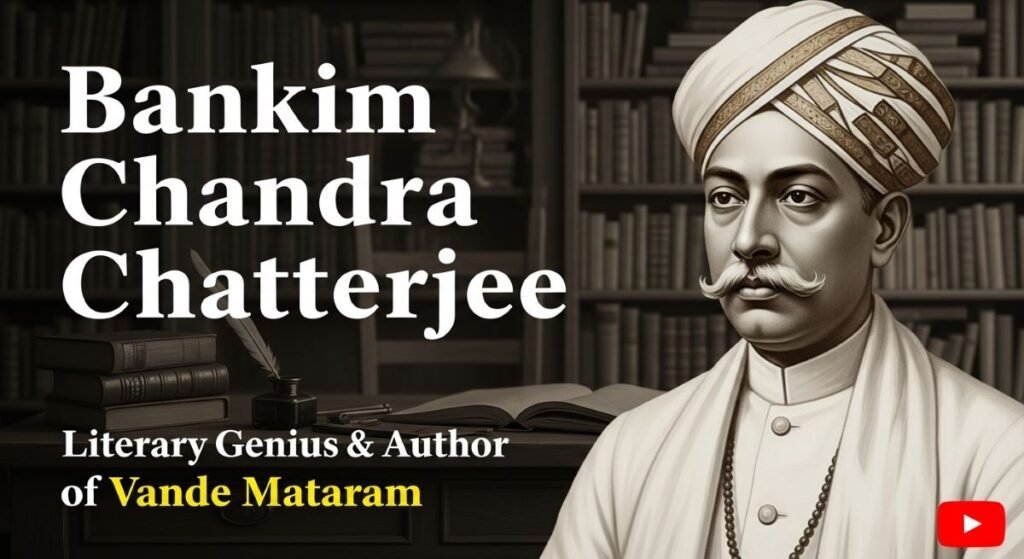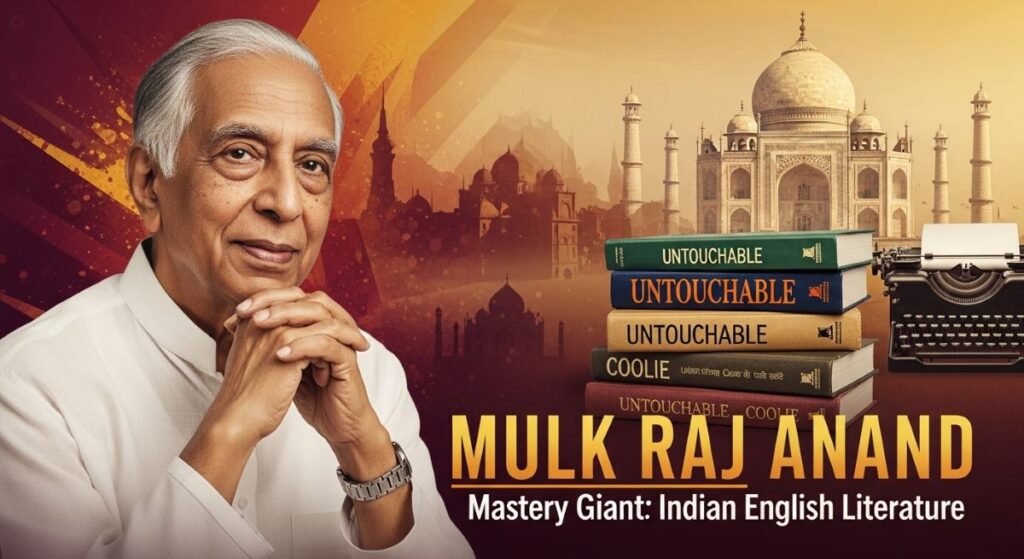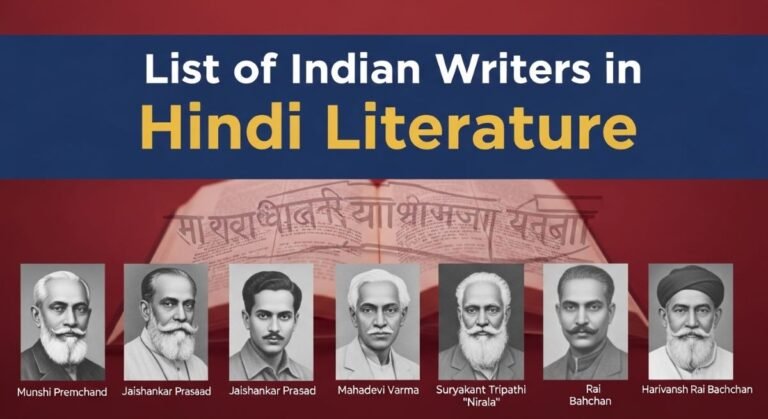
Today in this article we will discuss about the List of Indian Writers in Hindi Literature with PDF, PPT and Infographic so, Hindi literature is one of the richest and most enduring literary traditions in the world. From ancient scriptures to modern novels, Indian writers in Hindi literature have shaped the cultural, social, and philosophical identity of the nation. Whether you are a student, a literary enthusiast, or simply looking for a list of famous Hindi writers and their books, this comprehensive guide covers everything you need to know and In this article, we bring you a complete list of Indian writers in Hindi literature, including famous Hindi writers and their books, old Hindi writers names, 10 Hindi writers names commonly studied in schools, and a special section on famous female writers of Hindi literature.
Table of Contents
A Brief Introduction to Hindi Literature
Hindi literature, known as ‘Hindi Sahitya‘, spans more than a thousand years. It has evolved through several distinct periods, each contributing unique voices, themes, and genres. The journey of Hindi literature began with devotional poetry and evolved through epic narratives, social realism, nationalism, and contemporary literary movements.
The writers of Hindi literature have not only contributed to Indian culture but have also influenced literature at the global level. Their works explore themes of love, spirituality, social justice, gender equality, and national identity.
Famous Hindi Writers: Detailed Profiles
1. Munshi Premchand (1880-1936)
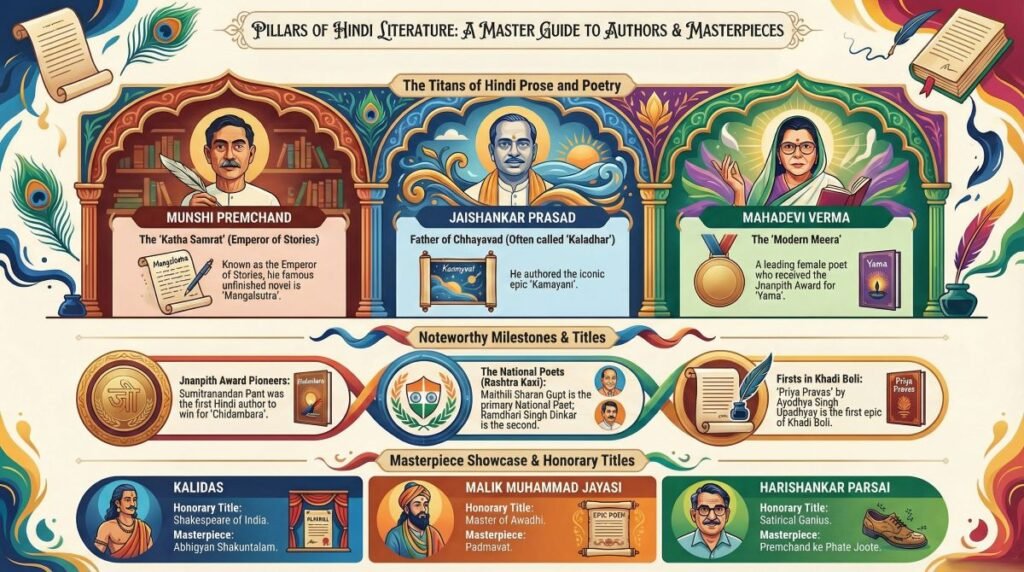
Munshi Premchand is widely regarded as the father of modern Hindi and Urdu fiction. One of the most celebrated old Hindi writers in Indian literature, he wrote with extraordinary compassion about the lives of ordinary people, farmers, women, and the oppressed.
- Godan – His masterpiece novel depicting the struggles of Indian peasants.
- Gaban – A gripping story of middle-class aspirations and moral decline.
- Nirmala – A powerful critique of the dowry system in India.
- Kafan, Poos ki Raat, Idgah – Some of his most iconic short stories.
2. Jaishankar Prasad (1889-1937)
Jaishankar Prasad was a towering figure of the Chhayavad movement in Hindi literature. He was a poet, playwright, and fiction writer whose work blended romanticism with Indian philosophy and cultural heritage.
- Kamayani – His magnum opus, an epic poem considered a cornerstone of Hindi poetry.
- Chandragupta – A celebrated historical play.
- Aansoo, Lahar, Jharna – Famous poetry collections.
3. Phanishwar Nath Renu (1921-1977)
Phanishwar Nath Renu is celebrated for bringing the rural dialect and folk culture of Bihar into mainstream Hindi literature. He pioneered the ‘aanchalik’ or regional literary style.
- Maila Aanchal – His debut novel and one of the most significant works of post-independence Hindi literature.
- Partti Parikatha – Another landmark regional novel.
- Mare Gaye Gulfam – A short story later adapted into the Bollywood film Teesri Kasam.
4. Mahadevi Verma (1907-1987)
Mahadevi Verma is one of the most iconic famous female writers of Hindi literature. Known as the ‘Modern Meera’ for her devotional and mystical poetry, she was a leading figure of the Chhayavad movement and a passionate social reformer.
- Yama – A celebrated poetry collection that won the Jnanpith Award.
- Neerja, Sandhyageet – Famous early poetry works.
- Smriti ki Rekhayein, Ateet ke Chalchitra – Autobiographical prose sketches.
5. Bharatendu Harishchandra (1850-1885)
Bharatendu Harishchandra is rightly called the ‘Father of Modern Hindi Literature.’ He introduced modern prose, journalism, and drama to Hindi literature, transforming it into a language accessible to the common people.
- Andher Nagari – A satirical play exposing social and political injustice.
- Bharat Durdasha – A play lamenting the condition of India under colonial rule.
10 Hindi Writers Name: A Quick Reference List
Students and readers frequently search for 10 Hindi writers names for school projects and competitive exams. Here is a quick reference list you must know:
- Munshi Premchand – Father of modern Hindi fiction.
- Jaishankar Prasad – Pioneer of Chhayavad poetry and drama.
- Mahadevi Verma – Famous female poet and social reformer.
- Sumitranandan Pant – Poet laureate of nature and humanism.
- Suryakant Tripathi ‘Nirala’ – Rebel poet of the Chhayavad movement.
- Bharatendu Harishchandra – Father of modern Hindi literature.
- Phanishwar Nath Renu – Pioneer of regional Hindi fiction.
- Hazari Prasad Dwivedi – Scholar, novelist, and literary critic.
- Dharamvir Bharati – Author, poet, and playwright.
- Amrita Pritam – Celebrated across Hindi and Punjabi literature.
Also read: List of Indian Writers in English Literature PDF (.PPTX)
Famous Female Writers of Hindi Literature
The contribution of women to Hindi literature deserves special recognition. From Mirabai’s Bhakti songs to Mannu Bhandari’s feminist fiction, women have shaped Hindi Sahitya with power and grace.
Amrita Pritam (1919-2005)
Amrita Pritam was one of the most celebrated female voices in Indian literature. The first woman to win the Sahitya Akademi Award, she explored love, loss, feminism, and the tragedy of Partition.
- Pinjar – Her most celebrated novel.
- Kagaz te Canvas – Her autobiography.
Mannu Bhandari (1931-2021)
Mannu Bhandari was one of the defining voices of the Nai Kahani movement. She wrote with clarity about the conflicts faced by middle-class Indian women.
- Aapka Bunti – Her landmark novel about a child caught between divorcing parents.
- Mahabhoj – A powerful political novel.
Old Hindi Writers Name: Classical Period Voices
The classical period of Hindi literature is a treasure trove of spiritual and devotional genius. Kabirdas challenged caste discrimination through his dohas. Tulsidas authored the Ramcharitmanas. Mirabai’s devotional songs to Krishna are sung across India to this day. Surdas composed the Sursagar in devotion to Lord Krishna. These old Hindi writers remain the bedrock of the tradition.
Famous Hindi Writers and Their Books PDF: Where to Find Them
Readers looking for famous Hindi writers and their books PDF download can explore these trusted resources: Hindisamay.com for a free digital archive, Kavitakosh.org for poetry, Sahitya Akademi’s digital archives, and Internet Archive (archive.org) for public domain Hindi books.
Why Hindi Literature Matters Today?
Hindi is spoken by more than 600 million people worldwide. From the Bhakti poetry of Kabir and Mirabai that challenged social hierarchies centuries ago, to the contemporary fiction of Uday Prakash that interrogates modern India, Hindi literature reflects the aspirations, contradictions, and dreams of its people. Reading the works of famous Hindi writers and their books is not just a literary exercise. It is a way to understand India itself, its diversity, its history, and its soul.
List of Indian Writers in Hindi Literature (PPT 178 SLIDES)
Table 1: Major Indian Writers – Novelists (Complete List)
The table below provides a comprehensive reference of major Indian novelists, their languages, notable novels, and key awards or literary contributions. This list includes all 21 writers from the original reference and has been expanded with 9 additional celebrated novelists.
| No. | Writer Name | Born – Died | Language | Notable Novel(s) | Award / Key Note |
| 1 | Bankim Chandra Chatterjee | 1838-1894 | Bengali / English | Anandamath, Durgeshnandini, Devi Chaudhurani | Father of Bengali novel; wrote Vande Mataram |
| 2 | Mulk Raj Anand | 1905-2004 | English | Untouchable, Coolie, The Village | Pioneer of Indian English novel; Padma Bhushan |
| 3 | R. K. Narayan | 1906-2001 | English | Swami and Friends, The Guide, Malgudi Days | Sahitya Akademi Award; AC Benson Medal |
| 4 | Raja Rao | 1908-2006 | English | Kanthapura, The Serpent and the Rope | Sahitya Akademi Award; Neustadt Prize |
| 5 | Kamala Markandaya | 1924-2004 | English | Nectar in a Sieve, A Silence of Desire | Notable for portraying Indian village life |
| 6 | Manohar Malgaonkar | 1913-2010 | English | A Bend in the Ganges, The Princes | Historical fiction specialist |
| 7 | Khushwant Singh | 1915-2014 | English | Train to Pakistan, I Shall Not Hear the Nightingale | Padma Vibhushan; acclaimed journalist |
| 8 | Ruskin Bond | b. 1934 | English | The Room on the Roof, A Flight of Pigeons | Padma Shri & Padma Bhushan; Sahitya Akademi Award |
| 9 | Anita Desai | b. 1937 | English | Clear Light of Day, In Custody, Fasting, Feasting | 3× Booker Prize shortlist; Sahitya Akademi Award |
| 10 | Kiran Desai | b. 1971 | English | The Inheritance of Loss, Hullabaloo in the Guava Orchard | Man Booker Prize 2006 |
| 11 | Arundhati Roy | b. 1961 | English | The God of Small Things, The Ministry of Utmost Happiness | Man Booker Prize 1997 |
| 12 | Amitav Ghosh | b. 1956 | English | The Shadow Lines, The Hungry Tide, Sea of Poppies | Jnanpith Award 2018; Sahitya Akademi Award |
| 13 | Nirad C. Chaudhuri | 1897-1999 | English | The Autobiography of an Unknown Indian | Duff Cooper Prize; lived to 101 |
| 14 | Jhumpa Lahiri | b. 1967 | English | The Namesake, The Lowland, Interpreter of Maladies | Pulitzer Prize 2000 (short stories) |
| 15 | Arun Joshi | 1939-1993 | English | The Foreigner, The Strange Case of Billy Biswas | Sahitya Akademi Award |
| 16 | Bharti Mukherjee | 1940-2017 | English | Jasmine, The Tiger’s Daughter, Desirable Daughters | National Book Critics Circle Award (USA) |
| 17 | Vikram Seth | b. 1952 | English / Hindi | A Suitable Boy, An Equal Music, The Golden Gate | Sahitya Akademi Award; Padma Shri |
| 18 | Shashi Deshpande | b. 1938 | English | That Long Silence, The Dark Holds No Terrors | Sahitya Akademi Award; Padma Shri |
| 19 | G. V. Desani | 1909-2000 | English | All About H. Hatterr | Pioneering experimental Indian English novel |
| 20 | Nayantara Sahgal | b. 1927 | English | Rich Like Us, A Time to Be Happy | Sahitya Akademi Award; returned award in 2015 protest |
| 21 | U. R. Ananthamurthy | 1932-2014 | Kannada | Samskara, Bharathipura, Avasthe | Jnanpith Award; Sahitya Akademi Award |
| 22 | Salman Rushdie | b. 1947 | English | Midnight’s Children, The Satanic Verses, Shame | Booker Prize 1981; Booker of Bookers |
| 23 | Rohinton Mistry | b. 1952 | English | Such a Long Journey, A Fine Balance, Family Matters | 3× Booker shortlist; Giller Prize |
| 24 | Chetan Bhagat | b. 1974 | English | Five Point Someone, 2 States, Half Girlfriend | Best-selling contemporary Indian novelist |
| 25 | Devdutt Pattanaik | b. 1970 | English | Myth = Mithya, Jaya, Sita | Prolific mythologist-novelist; Padma Shri |
| 26 | Sudha Murty | b. 1950 | English / Kannada | Dollar Bahu, House of Cards, Wise and Otherwise | Padma Bhushan; Sahitya Akademi Award |
| 27 | Shobhaa De | b. 1948 | English | Socialite Evenings, Starry Nights, Sultry Days | Pioneered bold Indian fiction for popular audiences |
| 28 | Amish Tripathi | b. 1974 | English | The Immortals of Meluha, The Secret of the Nagas | Best-selling mythological fiction series |
| 29 | Upamanyu Chatterjee | b. 1959 | English | English, August; The Mammaries of the Welfare State | Sahitya Akademi Award |
| 30 | Mahasweta Devi | 1926-2016 | Bengali | Hajar Churashir Maa, Aranyer Adhikar | Jnanpith Award; Magsaysay Award; Padma Vibhushan |
Table 2: Major Indian Writers – All Genres (Complete Reference Table)
This second table covers major Indian writers across all genres including poetry, fiction, drama, devotional literature, and English-language writing. It spans from the classical Bhakti era to contemporary times and covers Hindi, Bengali, Kannada, Punjabi, Urdu, and English literary traditions.
| No. | Writer Name | Born – Died | Language | Genre | Famous Work(s) | Award / Recognition |
| 1 | Rabindranath Tagore | 1861-1941 | Bengali | Poetry / Fiction | Gitanjali, Gora, Ghare Baire | Nobel Prize in Literature 1913 |
| 2 | Munshi Premchand | 1880-1936 | Hindi / Urdu | Fiction / Short Story | Godan, Gaban, Nirmala, Kafan | Father of Modern Hindi Fiction |
| 3 | Jaishankar Prasad | 1889-1937 | Hindi | Poetry / Drama | Kamayani, Chandragupta, Aansoo | Pillar of Chhayavad movement |
| 4 | Mahadevi Verma | 1907-1987 | Hindi | Poetry / Prose | Yama, Neerja, Smriti ki Rekhayein | Jnanpith Award; Padma Vibhushan |
| 5 | Sumitranandan Pant | 1900-1977 | Hindi | Poetry | Pallav, Chidambara, Gunjan | Jnanpith Award; Sahitya Akademi Award |
| 6 | Suryakant Tripathi Nirala | 1899-1961 | Hindi | Poetry / Fiction | Ram ki Shakti Puja, Saroj Smriti | Pioneer of free verse in Hindi |
| 7 | Dharamvir Bharati | 1926-1997 | Hindi | Fiction / Poetry / Drama | Gunahon ka Devta, Andha Yug | Padma Shri; editor of Dharmayug |
| 8 | Hazari Prasad Dwivedi | 1907-1979 | Hindi | Fiction / Criticism | Banabhatta ki Aatmakatha | Padma Bhushan; Sahitya Akademi Award |
| 9 | Shrilal Shukla | 1925-2011 | Hindi | Satire / Fiction | Raag Darbari | Jnanpith Award; Sahitya Akademi Award |
| 10 | Phanishwar Nath Renu | 1921-1977 | Hindi | Regional Fiction | Maila Aanchal, Partti Parikatha | Padma Shri; Pioneer of Aanchalik literature |
| 11 | Nirmal Verma | 1929-2005 | Hindi | Fiction | Ve Din, Ek Chithara Sukh | Jnanpith Award; Sahitya Akademi Award |
| 12 | Krishna Sobti | 1925-2019 | Hindi | Feminist Fiction | Mitro Marjani, Zindaginama | Jnanpith Award; Sahitya Akademi Award |
| 13 | Mannu Bhandari | 1931-2021 | Hindi | Fiction / Short Story | Aapka Bunti, Mahabhoj | Sahitya Akademi Award; Vyas Samman |
| 14 | Amrita Pritam | 1919-2005 | Punjabi / Hindi | Poetry / Fiction | Pinjar, Kagaz te Canvas | Sahitya Akademi Award; Padma Vibhushan |
| 15 | Ismat Chughtai | 1915-1991 | Urdu | Short Story / Fiction | Lihaaf, Terhi Lakeer | Sahitya Akademi Award; groundbreaking feminist voice |
| 16 | Kabirdas | c.1440-1518 | Hindi (Awadhi) | Devotional Poetry | Bijak, Kabir Dohe | Founder of Bhakti mystic poetry tradition |
| 17 | Tulsidas | 1532-1623 | Hindi (Awadhi) | Epic Poetry | Ramcharitmanas, Vinay Patrika | Greatest Hindi poet of Bhakti era |
| 18 | Mirabai | 1498-1547 | Hindi / Rajasthani | Devotional Poetry | Mira Bai Padavali | Icon of female Bhakti devotion |
| 19 | Surdas | 1478-1583 | Braj Bhasha | Devotional Poetry | Sursagar, Sur Saravali | Blind poet; celebrated Krishna devotee |
| 20 | Bharatendu Harishchandra | 1850-1885 | Hindi | Poetry / Drama / Prose | Andher Nagari, Bharat Durdasha | Father of Modern Hindi Literature |
| 21 | Harivansh Rai Bachchan | 1907-2003 | Hindi | Poetry | Madhushala, Madhubala, Agneepath | Sahitya Akademi Award; Padma Bhushan |
| 22 | Ramdhari Singh Dinkar | 1908-1974 | Hindi | Poetry | Rashmirathi, Urvashi, Kurukshetra | Jnanpith Award; Padma Bhushan; National Poet |
| 23 | Mohan Rakesh | 1925-1972 | Hindi | Drama / Fiction | Aadhe Adhure, Ashadh Ka Ek Din | Pioneer of Nai Kahani & modern Hindi theatre |
| 24 | Rajendra Yadav | 1929-2013 | Hindi | Fiction / Criticism | Ek Inch Muskaan, Sara Akash | Editor of Hans; champion of Dalit literature |
| 25 | Uday Prakash | b. 1952 | Hindi | Fiction / Poetry | Tirich, Paul Gomra ka Scooter | Sahitya Akademi Award |
| 26 | Vikram Seth | b. 1952 | English / Hindi | Novel / Poetry | A Suitable Boy, The Golden Gate | Sahitya Akademi Award; Padma Shri |
| 27 | Arundhati Roy | b. 1961 | English | Fiction / Non-fiction | The God of Small Things | Man Booker Prize 1997 |
| 28 | Amitav Ghosh | b. 1956 | English | Historical Fiction | The Shadow Lines, Sea of Poppies | Jnanpith Award 2018 |
| 29 | Salman Rushdie | b. 1947 | English | Magical Realism | Midnight’s Children | Booker Prize 1981 |
| 30 | R. K. Narayan | 1906-2001 | English | Fiction | The Guide, Malgudi Days | Sahitya Akademi Award; AC Benson Medal |
| 31 | Mahasweta Devi | 1926-2016 | Bengali | Fiction / Activism | Hajar Churashir Maa | Jnanpith Award; Magsaysay Award |
| 32 | U. R. Ananthamurthy | 1932-2014 | Kannada | Fiction | Samskara, Bharathipura | Jnanpith Award |
| 33 | Girish Karnad | 1938-2019 | Kannada | Drama | Tughlaq, Hayavadana, Naga-Mandala | Jnanpith Award; Padma Vibhushan |
| 34 | Jhumpa Lahiri | b. 1967 | English | Fiction | The Namesake, The Lowland | Pulitzer Prize 2000 |
| 35 | Kiran Desai | b. 1971 | English | Fiction | The Inheritance of Loss | Man Booker Prize 2006 |
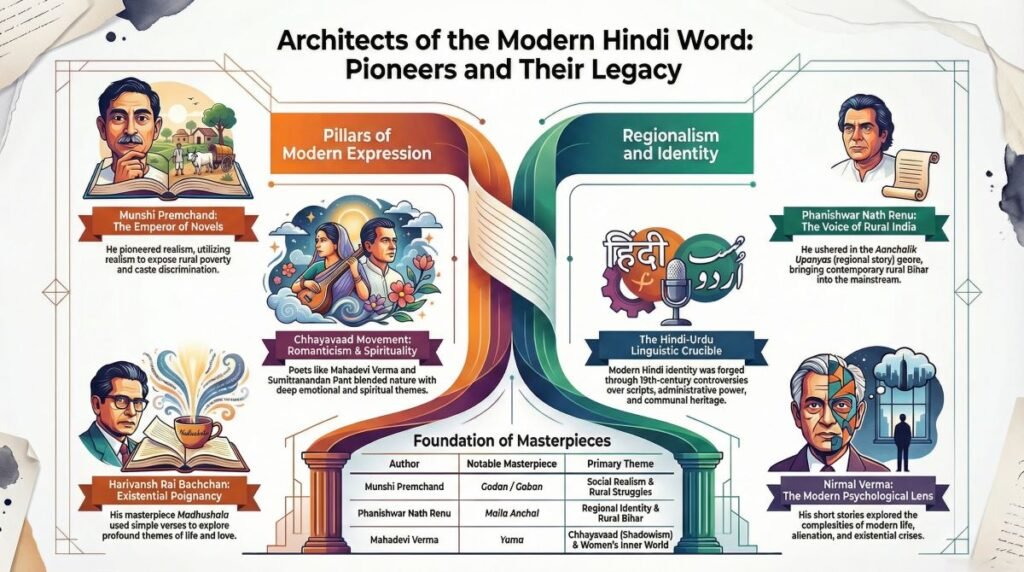
Beyond the Anglophone: 5 Surprising Truths About the Literature That Built India
For the global reader, the map of Indian literature is often drawn exclusively in English. We call this the “Anglophone synecdoche”-a reductive mental shortcut where the vibrant works of authors writing in English are taken to represent the entirety of a subcontinent’s dizzying literary soul. While Indian English writing possesses undeniable energy, it is merely a single thread in a vast, ancient tapestry.To grasp the true Indian cultural landscape, one must step into the “Bhasha” tradition-the mother-tongue domains of Hindi, Bengali, Urdu, Odia, and many others. Before colonial administration began “dialectizing” these tongues into neat, separate boxes, India existed in a state of polyglot fluidity. These are not “fractions of languages” but a powerhouse of diversity. By looking beyond the English-speaking surface, we unveil the counter-intuitive histories of the writers who actually constructed the Indian identity from the ground up.
1. The “Emperor” Was a Pragmatist: Premchand’s Strategic Script Switch
Munshi Premchand is revered as the Upanyas Samrat (Emperor of Novels), the architect of Indian realism. However, his transition from writing in Urdu to Hindi was not merely an artistic epiphany; it was a calculated commercial and communal strategy. In the early 20th century, Urdu speakers held a virtual monopoly on government offices and the sophisticated literary market. This was the era of the “Mughalbandi” legacy, where status was measured by “plying the pen backwards” in Persian-inflected Urdu. Yet, as linguistic scripts became polarized, Premchand found himself hit by the cold reality of the market. His Urdu novel Bazar-a-Husn (The Brothel) failed to find an Urdu publisher, a crisis that necessitated its transformation into the Hindi Sevasadan. Realizing that the publishing tides were shifting toward the Devnagari script, he wrote in 1915:”I am now practicing writing in Hindi as well. Urdu will no longer do… Has any Hindu ever made a success of writing in Urdu that I will? “By embracing Hindi, Premchand didn’t just find a publisher; he found a way to bridge the gap between social realism and a burgeoning national audience, using works like Godan and Gaban to voice the struggles of the common man.
2. The “Soiled Linen” of the Soul: How Phanishwar Nath Renu Voiced the Rural Heart
If Premchand established the modern novel, Phanishwar Nath Renu revolutionized it. Renu was the pioneer of Aanchalik Upanyas (the regional story), a genre that brought the unvarnished, “soiled” reality of rural India into the mainstream. Renu’s masterpiece, Maila Anchal (The Soiled Linen), is widely considered the most significant Hindi novel after Premchand’s Godan . However, Renu provided a “revolutionary” shift; where earlier realism was often idealized, Renu offered a gritty, detailed portrait of his native Bihar. His perspective was deeply rooted in his identity as a member of the Mandal community-an under-privileged social group. His dedication to the “backward and the deprived” was both literary and fiercely political; he famously returned his Padma Sri award in 1970 to protest the Internal Emergency. Through Renu, the “regional voice” became a central pillar of Indian modernity.
3. Language as an “Administrative Accident”: The Great Linguistic Battlefield
One of the most surprising truths of Indian history is that the “poisonous politics” of linguistic identity was often a result of British administrative convenience rather than organic cultural drift. This is what scholars call the “Wall of Words. “In the 19th century, colonial officials doubled as philologists, deciding which languages were “independent” and which were mere “dialects.” This was often fueled by “print capitalism”-the urgent bureaucratic need to create standardized textbooks for schools and courts. In a move that conflated religion with language, officials like Lord Macaulay assumed that Hindu law must be tied to Sanskrit and Muslim law to Arabic. This administrative “Satanic vigilance” over borders forced communal wedges between languages like Hindi, Urdu, and Odia. In Odisha, for instance, Odia writers had to fight a desperate battle against officials who claimed their language was merely a corruption of Bengali.
4. The Architects of Interiority: Mahadevi Verma and the Chhayavaad Movement
While the mid-century was dominated by the “external realism” of social struggle, a parallel movement was exploring the inner landscape of the spirit. This was Chhayavaad (Shadowism), and its most luminous figure was Mahadevi Verma. Verma’s work was pioneering because it shifted the gaze away from the socio-economic focus of Premchand toward the spiritual struggles and “inner world” of women. Her collection Yama is a landmark of this era, celebrated for its lyrical beauty and emotional depth. By capturing the existential quests of the individual soul, Verma proved that the Bhasha tradition was as capable of sophisticated psychological interiority as it was of gritty social commentary.
5. Modernity’s Loneliness: Nirmal Verma and the Psychological Crisis
As the national psyche shifted after independence, the focus of Bhasha literature moved from the communal “soiled linen” of the village to a more solitary, urban crisis. This was the era of the Nayi Kahani (New Story) movement, led by figures like Nirmal Verma. Verma’s work represented a departure from the struggle for “bread” to a struggle for “meaning.” He focused on the urban middle class, articulating the intricacies of modern alienation and the existential loneliness that accompanies a rapidly changing world. Verma bridged the gap between traditional Indian sensibilities and the global 20th-century psychological crisis, showing that Indian regional languages could perfectly articulate the most complex nuances of modern life.
The Living Tradition
The history of Hindi and Bhasha literatures reveals a vibrant powerhouse of diversity that has survived colonial bureaucracy, commercial pressures, and the “Satanic vigilance” of modern borders. These stories are not stagnant relics; they are evolving traditions that demand to be read. The importance of translation in reclaiming this voice cannot be overstated. Without it, we lose the “inner world” of Mahadevi Verma and the “rural heart” of Renu to the silence of the archives. As we move forward, we must ask: In a world that increasingly speaks English for business, what essential parts of our human identity are we losing by not reading the stories written in our own mother tongues?
Conclusion
This comprehensive guide and the two detailed tables cover centuries of Indian literary genius. From old Hindi writers’ names rooted in the Bhakti tradition to modern masters of fiction and poetry, Indian literature is a living tradition that continues to inspire readers across generations.
Whether you are searching for a list of Indian writers in Hindi literature PDF, researching famous Hindi writers and their books, or exploring famous female writers of Hindi literature, the profiles and tables in this article offer a thorough and reliable reference. By exploring the writers listed here, you are not just reading literature. You are connecting with the heartbeat of India.
Note: This article is written for informational and educational purposes. All information is based on verified literary sources and historical records.