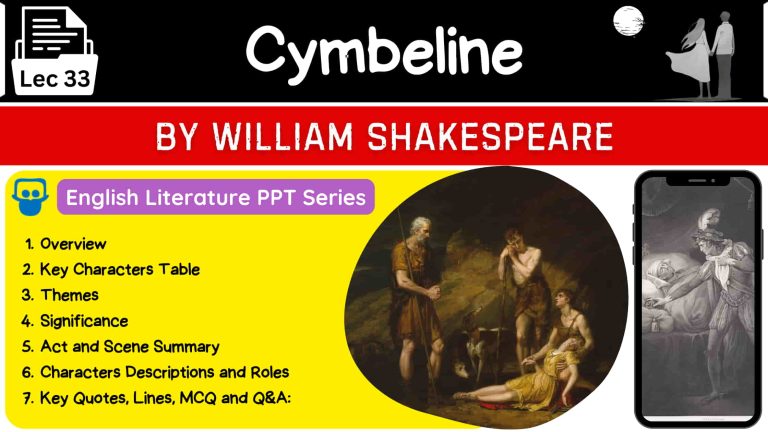
Today we have shared the Notes of William Shakespeare’s famous play Cymbeline by William Shakespeare PPT Download or Cymbeline .PPTX Slides & PDF Study Material Download. As we know, Cymbeline is one of Shakespeare’s later romances, believed to have been written around 1609–1610. This fascinating play combines elements of drama, romance, and adventure, offering a rich story filled with love, betrayal, disguise, and unexpected twists. Set in ancient Britain and Rome, the play follows Princess Imogen, whose loyalty and courage are tested through trials of deception, separation, and political conflict. Through powerful characters and dramatic storytelling, Cymbeline explores themes of forgiveness, identity, honor, and reconciliation. Whether performed on stage or studied in classrooms, Cymbeline continues to engage audiences with its emotional depth, timeless themes, and enduring message of truth and redemption.
Table of Contents
Cymbeline by William Shakespeare PPT Download | .PPTX (LEC – 33)
About Cymbeline
Here’s a complete table for “Cymbeline”:
| Aspect | Description |
|---|---|
| Title | Cymbeline |
| Playwright | William Shakespeare |
| Genre | Romance, tragicomedy |
| Date of Composition | Estimated to be between 1608 and 1611 |
| Setting | Ancient Britain |
| Main Characters | Cymbeline, Imogen, Posthumus Leonatus, Iachimo, Queen, Cloten, Belarius, Guiderius, Arviragus, Pisanio |
| Plot Overview | The play follows the story of Imogen, the virtuous daughter of King Cymbeline, who secretly marries Posthumus Leonatus, a gentleman of low birth. Posthumus is banished, and Imogen’s fidelity is tested by various plots and misunderstandings orchestrated by the villainous Iachimo. The play also involves political intrigue, battles, and reconciliations, culminating in a series of revelations and resolutions. |
| Key Themes | Loyalty and betrayal, deception and disguise, the redemptive power of love, forgiveness and reconciliation |
| Significance | “Cymbeline” is one of Shakespeare’s lesser-known plays, characterized by its complex plot, diverse characters, and blend of romance and adventure. It is often regarded as a late romance, sharing thematic similarities with other plays of the genre. |
| Notable Lines | – “Fear no more the heat o’ the sun, / Nor the furious winter’s rages.” (Act 4, Scene 2) – “What’s mine is yours, and what is yours is mine.” (Act 5, Scene 5) – “Pardon’s the word to all.” (Act 5, Scene 5) |
| Adaptations | “Cymbeline” has been adapted into various stage productions, film adaptations, and television adaptations. Notable adaptations include the film directed by Elijah Moshinsky (1982), stage productions by the Royal Shakespeare Company, and modern reinterpretations by various theater companies. |
This table provides a comprehensive overview of various aspects of “Cymbeline,” including its background, plot, characters, themes, significance, notable lines, and adaptations.
A Complete Guide to Shakespeare’s “Cymbeline”
William Shakespeare’s “Cymbeline” is a complex and captivating play that often flies under the radar when compared to his more famous works like “Hamlet” or “Romeo and Juliet.” However, within its intricate plot lies a tale of love, betrayal, and redemption that continues to resonate with audiences centuries after its creation. Let’s delve into this lesser-known gem and uncover its themes, characters, and enduring significance.
Plot Summary: “Cymbeline” is a tragicomic romance set in ancient Britain during the Roman invasion. At its core, the play revolves around the trials faced by its titular character, King Cymbeline, and his family. The plot weaves together multiple storylines, including the love between Princess Imogen (Cymbeline’s daughter) and Posthumus Leonatus, a commoner of noble birth. Their secret marriage incites jealousy in Imogen’s stepmother, the Queen, who schemes to separate them.
Amidst these personal dramas, political tensions escalate between Britain and Rome. Cymbeline refuses to pay tribute to the Roman Emperor, prompting a military confrontation. Meanwhile, Imogen, disguised as a boy, flees the court after falsely accused of infidelity by Posthumus, who is manipulated by the villainous Iachimo. The narrative twists and turns as characters navigate deception, mistaken identities, and the consequences of their actions.
Ultimately, “Cymbeline” concludes with reconciliation and forgiveness. Good triumphs over evil, and the play ends with marriages, restorations, and a newfound harmony between Britain and Rome.
Themes:
Appearance vs. Reality: Throughout “Cymbeline,” characters grapple with deception and illusion. From Iachimo’s false wager to Imogen’s disguise as a boy, the play explores the contrast between outward appearances and inner truths.
Loyalty and Betrayal: Loyalty is tested repeatedly in “Cymbeline,” particularly in the relationships between Imogen and Posthumus, and between Cymbeline and his subjects. Betrayal, whether driven by jealousy, ambition, or misunderstanding, serves as a catalyst for much of the conflict in the play.
Redemption and Forgiveness: Despite the characters’ flaws and mistakes, “Cymbeline” ultimately advocates for redemption and forgiveness. Characters like Posthumus and Iachimo find redemption through remorse and acts of kindness, emphasizing the transformative power of forgiveness.
Gender Roles: The play challenges traditional gender roles, especially through the character of Imogen. She defies expectations by displaying courage, intelligence, and agency, subverting stereotypes of passive female characters typical of Shakespeare’s era.
Key Characters:
- King Cymbeline: The aging king of Britain, torn between his pride, his love for his children, and his duty as a ruler.
- Princess Imogen (Innogen): Cymbeline’s virtuous daughter, who faces adversity with resilience and grace.
- Posthumus Leonatus: Imogen’s husband, who struggles with jealousy and insecurity, leading to tragic consequences.
- Queen (unnamed): Cymbeline’s treacherous second wife, driven by ambition and jealousy.
- Iachimo: A cunning Italian nobleman who tests Posthumus’s faith in Imogen through deceitful means.
Significance and Reception: “Cymbeline” is often regarded as one of Shakespeare’s problem plays, defying easy categorization due to its blend of genres and themes. While it was not as popular during Shakespeare’s time compared to his other works, “Cymbeline” has seen a resurgence of interest in recent years.
Modern adaptations and reinterpretations have highlighted the play’s timeless themes and complex characters, cementing its status as a literary classic. Its exploration of love, betrayal, and forgiveness continues to resonate with audiences, ensuring that “Cymbeline” remains an enduring piece of Shakespearean literature.
In conclusion, “Cymbeline” may not enjoy the same level of fame as some of Shakespeare’s other plays, but its rich tapestry of characters, themes, and intricate plotlines make it a compelling and rewarding work for those willing to explore its depths. From its exploration of human nature to its commentary on power and authority, “Cymbeline” continues to captivate and inspire audiences around the world.
Plot Overview
Below is a comprehensive table outlining the plot overview of William Shakespeare’s “Cymbeline”:
| Act | Scene | Summary |
|---|---|---|
| 1 | 1 | Cymbeline, King of Britain, refuses to pay tribute to the Roman Emperor. He is angered by the marriage of his daughter, Imogen, to Posthumus Leonatus, a commoner of noble birth. |
| 1 | 2 | Posthumus is banished, and Imogen is left at court. The villainous Iachimo wagers that he can seduce Imogen and falsely claims to have succeeded. Posthumus, enraged by jealousy, plots Imogen’s murder. |
| 2 | 1 | Imogen, disguised as a boy named Fidele, sets out to find Posthumus, who has fled to Rome. Meanwhile, the Queen plans to poison Cymbeline’s second wife and secure the throne for her son, Cloten. |
| 3 | 1 | Imogen, still disguised, encounters Belarius and his two sons, who were banished by Cymbeline years ago. Cloten pursues Imogen, intending to marry her and claim the throne. |
| 3 | 2 | Posthumus encounters Iachimo in Rome and learns of Imogen’s innocence. He regrets his actions and vows to atone for his sins. |
| 3 | 3 | Imogen discovers Cloten’s body, killed by one of Belarius’s sons. She mourns him, believing him to be Posthumus, and takes a sleeping potion given to her by the Queen. |
| 4 | 1 | Imogen, presumed dead, is placed beside Posthumus, who is captured by the Romans. Belarius and his sons reveal their true identities to Cymbeline. |
| 4 | 2 | Imogen awakens beside the decapitated body of Cloten and wanders into the forest. She encounters Lucius, the Roman general, and his soldiers, who mistake her for a boy and enlist her help. |
| 4 | 3 | Posthumus, disguised as a British soldier, fights bravely for the Romans and encounters Imogen. He reveals his identity to her, and they reconcile. |
| 5 | 1 | Belarius’s sons rescue Cymbeline from the Romans, and peace is restored between Britain and Rome. Imogen’s true identity is revealed, and she reunites with her family. |
| 5 | 2 | Posthumus receives a pardon from Cymbeline and is reunited with Imogen. Iachimo confesses his deceit and is forgiven. The play ends with multiple marriages and a sense of reconciliation. |
This table provides a structured overview of the play’s progression, allowing readers to grasp the intricacies of the plot at a glance.
Key Characters
Here’s a table outlining the key characters in William Shakespeare’s “Cymbeline”:
| Character | Description |
|---|---|
| King Cymbeline | The aging king of Britain, torn between his pride, his love for his children, and his duty as a ruler. |
| Princess Imogen | Cymbeline’s virtuous daughter, who faces adversity with resilience and grace. |
| Posthumus Leonatus | Imogen’s husband, a nobleman of common birth. He struggles with jealousy and insecurity, leading to tragic consequences. |
| Queen | Cymbeline’s treacherous second wife, driven by ambition and jealousy. She schemes to separate Imogen from Posthumus and secure the throne for her son, Cloten. |
| Iachimo | A cunning Italian nobleman who tests Posthumus’s faith in Imogen through deceitful means. He wagers that he can seduce Imogen and falsely claims to have succeeded. |
| Cloten | The Queen’s son, arrogant and foolish, who pursues Imogen with intentions of marriage. |
| Belarius | A banished lord who kidnaps Cymbeline’s sons and raises them in the wilderness. He plays a pivotal role in the eventual reconciliation between Britain and Rome. |
| Guiderius and Arviragus | Belarius’s sons, raised in exile. They eventually prove instrumental in rescuing Cymbeline and restoring peace between Britain and Rome. |
This table provides a concise overview of the main characters in “Cymbeline,” highlighting their roles and relationships within the play.
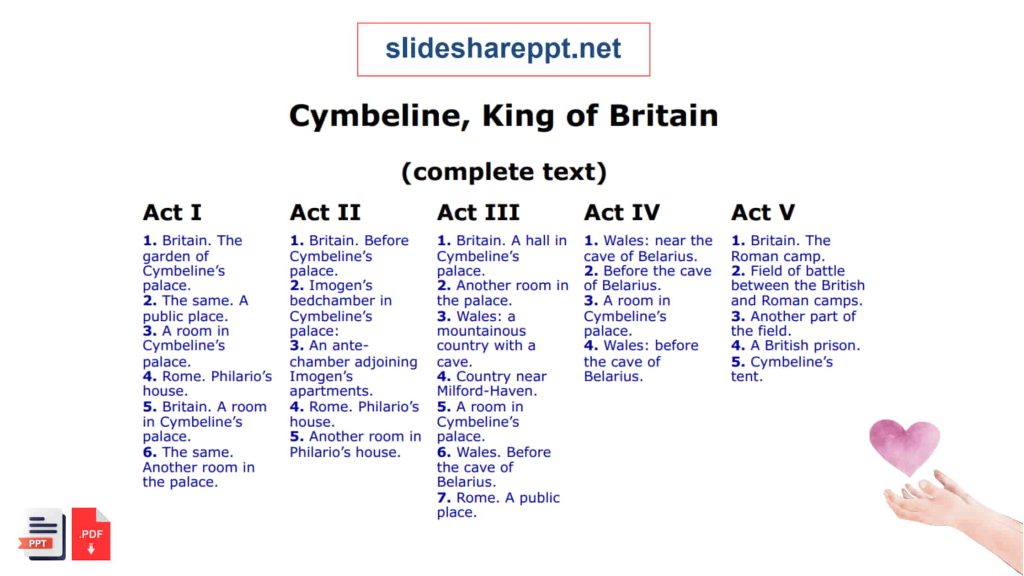
Note: The complete Text PDF Link is at the end of the PowerPoint slides (go to the last PPT Slide)
Themes
Here’s a table outlining the key themes in William Shakespeare’s “Cymbeline”:
| Theme | Description |
|---|---|
| Appearance vs. Reality | Characters grapple with deception and illusion throughout the play, highlighting the contrast between outward appearances and inner truths. |
| Loyalty and Betrayal | Loyalty is tested repeatedly, particularly in relationships between characters, while betrayal serves as a catalyst for much of the conflict in the play. |
| Redemption and Forgiveness | The play advocates for redemption and forgiveness, portraying characters who find redemption through remorse and acts of kindness. |
| Gender Roles | “Cymbeline” challenges traditional gender roles, especially through the character of Imogen, who defies expectations by displaying courage and agency. |
This table provides a concise overview of the main themes explored in “Cymbeline,” highlighting the play’s complex exploration of human nature and society.
Significance
Here’s a table outlining the significance of William Shakespeare’s “Cymbeline”:
| Significance | Description |
|---|---|
| Genre-blending | “Cymbeline” is often classified as a tragicomedy or romance, blending elements of both genres. Its mixture of tragic and comedic elements challenges traditional genre boundaries, making it a unique and intriguing work within Shakespeare’s repertoire. |
| Exploration of complex themes | The play delves into a variety of themes, including loyalty, betrayal, forgiveness, and the nature of appearances versus reality. Through its multifaceted characters and intricate plot, “Cymbeline” offers rich material for exploration and interpretation, providing audiences with a thought-provoking examination of human nature and societal norms. |
| Subversion of gender roles | “Cymbeline” features a strong female protagonist, Imogen, who defies traditional gender expectations by displaying courage, intelligence, and agency. Her character challenges stereotypes of passive female roles prevalent in Shakespeare’s era, contributing to the play’s enduring relevance and appeal to modern audiences. |
| Lesser-known gem | While not as widely performed or studied as some of Shakespeare’s more famous works, such as “Hamlet” or “Romeo and Juliet,” “Cymbeline” has garnered increased attention in recent years. Its complex plot, compelling characters, and exploration of timeless themes have led to a renewed appreciation for the play among scholars, directors, and audiences alike. |
| Modern adaptations and reinterpretations | “Cymbeline” has been the subject of numerous adaptations and reinterpretations in various artistic mediums, including film, theater, and literature. These adaptations often recontextualize the play’s themes and characters, demonstrating its enduring relevance and adaptability to different cultural contexts and artistic visions. |
| Contributions to Shakespearean canon | While “Cymbeline” may not enjoy the same level of recognition as some of Shakespeare’s more celebrated works, its contribution to the Shakespearean canon is undeniable. The play showcases Shakespeare’s versatility as a playwright and his ability to craft compelling narratives that resonate with audiences across generations, ensuring its place among the diverse and enduring body of work produced by the Bard. |
| Exploration of political and social dynamics | Set against the backdrop of ancient Britain during the Roman invasion, “Cymbeline” explores political tensions and power struggles between nations. The play also delves into the dynamics of family relationships and societal hierarchies, offering insights into the complexities of human interactions and the consequences of ambition and betrayal. |
This table provides a comprehensive overview of the significance of “Cymbeline,” highlighting its genre-blending nature, exploration of complex themes, subversion of gender roles, and enduring appeal to audiences and scholars alike.
Act and Scene Summary
Here’s a table summarizing each act and scene in William Shakespeare’s “Cymbeline”:
| Act | Scene | Summary |
|---|---|---|
| 1 | 1 | King Cymbeline of Britain refuses to pay tribute to the Roman Emperor. He is angered by the secret marriage of his daughter, Imogen, to Posthumus Leonatus, a commoner of noble birth. |
| 1 | 2 | Posthumus is banished, and Imogen is left at court. The villainous Iachimo wagers that he can seduce Imogen and falsely claims to have succeeded. Posthumus, enraged by jealousy, plots Imogen’s murder. |
| 2 | 1 | Imogen, disguised as a boy named Fidele, sets out to find Posthumus, who has fled to Rome. Meanwhile, the Queen plans to poison Cymbeline’s second wife and secure the throne for her son, Cloten. |
| 3 | 1 | Imogen, still disguised, encounters Belarius and his two sons, who were banished by Cymbeline years ago. Cloten pursues Imogen, intending to marry her and claim the throne. |
| 3 | 2 | Posthumus encounters Iachimo in Rome and learns of Imogen’s innocence. He regrets his actions and vows to atone for his sins. |
| 3 | 3 | Imogen discovers Cloten’s body, killed by one of Belarius’s sons. She mourns him, believing him to be Posthumus, and takes a sleeping potion given to her by the Queen. |
| 4 | 1 | Imogen, presumed dead, is placed beside Posthumus, who is captured by the Romans. Belarius and his sons reveal their true identities to Cymbeline. |
| 4 | 2 | Imogen awakens beside the decapitated body of Cloten and wanders into the forest. She encounters Lucius, the Roman general, and his soldiers, who mistake her for a boy and enlist her help. |
| 4 | 3 | Posthumus, disguised as a British soldier, fights bravely for the Romans and encounters Imogen. He reveals his identity to her, and they reconcile. |
| 5 | 1 | Belarius’s sons rescue Cymbeline from the Romans, and peace is restored between Britain and Rome. Imogen’s true identity is revealed, and she reunites with her family. |
| 5 | 2 | Posthumus receives a pardon from Cymbeline and is reunited with Imogen. Iachimo confesses his deceit and is forgiven. The play ends with multiple marriages and a sense of reconciliation. |
This table provides a structured summary of the plot progression in each act and scene of “Cymbeline,” allowing readers to grasp the narrative arc and key events of the play.
Characters Descriptions and Roles
Here’s a table detailing the characters, their descriptions, and roles in William Shakespeare’s “Cymbeline”:
| Character | Description | Role |
|---|---|---|
| King Cymbeline | The aging king of Britain, torn between his pride, his love for his children, and his duty as a ruler. | Central figure in the political and familial conflicts; struggles with decision-making and maintaining authority over his kingdom. |
| Princess Imogen | Cymbeline’s virtuous daughter, who faces adversity with resilience and grace. | Protagonist; caught in the midst of familial conflict and political intrigue; embodies loyalty, love, and integrity. |
| Posthumus Leonatus | Imogen’s husband, a nobleman of common birth. He struggles with jealousy and insecurity, leading to tragic consequences. | Tragic hero; driven by love and loyalty, but easily manipulated by others; undergoes a journey of self-discovery and redemption. |
| Queen | Cymbeline’s treacherous second wife, driven by ambition and jealousy. She schemes to separate Imogen from Posthumus and secure the throne for her son, Cloten. | Antagonist; orchestrates much of the deception and betrayal in the play; represents ambition and the corrupting influence of power. |
| Iachimo | A cunning Italian nobleman who tests Posthumus’s faith in Imogen through deceitful means. He wagers that he can seduce Imogen and falsely claims to have succeeded. | Villain; manipulates events to serve his own interests; symbolizes deceit and the consequences of unchecked ambition. |
| Cloten | The Queen’s son, arrogant and foolish, who pursues Imogen with intentions of marriage. | Foil to Posthumus; represents arrogance and entitlement; serves as a source of comic relief but also contributes to the play’s darker themes. |
| Belarius | A banished lord who kidnaps Cymbeline’s sons and raises them in the wilderness. He plays a pivotal role in the eventual reconciliation between Britain and Rome. | Catalyst for the resolution of the political conflict; provides guidance and protection to Cymbeline’s sons; represents loyalty and redemption. |
| Guiderius and Arviragus | Belarius’s sons, raised in exile. They eventually prove instrumental in rescuing Cymbeline and restoring peace between Britain and Rome. | Symbolize innocence and honor; contribute to the play’s exploration of identity and the consequences of societal expectations. |
This table provides a comprehensive overview of the main characters in “Cymbeline,” detailing their descriptions and roles within the context of the play.
Summary
Summary of William Shakespeare’s “Cymbeline”:
Set in ancient Britain during the Roman invasion, “Cymbeline” follows the tumultuous reign of King Cymbeline and the trials faced by his family amidst political turmoil and personal betrayals. At the heart of the narrative lies the forbidden love between Princess Imogen, Cymbeline’s virtuous daughter, and Posthumus Leonatus, a nobleman of common birth.
The play begins with Cymbeline’s refusal to pay tribute to the Roman Emperor, sparking tensions between Britain and Rome. Meanwhile, Imogen and Posthumus secretly marry, enraging the Queen, who schemes to separate them and secure the throne for her son, Cloten. Manipulated by the villainous Iachimo, Posthumus becomes consumed by jealousy and falsely accuses Imogen of infidelity.
Imogen, disguised as a boy named Fidele, embarks on a journey to find Posthumus, encountering Belarius and his banished sons along the way. Cloten pursues Imogen, intending to marry her and claim the throne. Amidst the chaos, Posthumus learns of Imogen’s innocence and vows to atone for his sins.
As the plot unfolds, misunderstandings escalate, leading to mistaken identities, betrayals, and tragic consequences. Imogen, believed to be dead, is placed beside Posthumus, who is captured by the Romans. However, through a series of twists and turns, the truth is eventually revealed, and peace is restored between Britain and Rome.
In the end, forgiveness and reconciliation prevail. Posthumus receives a pardon, and Imogen is reunited with her family. Iachimo confesses his deceit and is forgiven. The play concludes with multiple marriages and a sense of harmony, underscoring themes of redemption, loyalty, and the transformative power of love.
Despite its complex plot and lesser-known status among Shakespeare’s works, “Cymbeline” continues to captivate audiences with its rich tapestry of characters, themes, and intricate storytelling. It remains a timeless exploration of human nature, morality, and the enduring quest for redemption and forgiveness.
Also read: The Tempest by William Shakespeare PPT Download | .PPTX
Facts
Here’s a table of interesting facts about William Shakespeare’s “Cymbeline”:
| Fact | Description |
|---|---|
| Classification as a “problem play” | “Cymbeline” is often categorized as one of Shakespeare’s “problem plays,” a term coined by scholars to describe works that defy traditional genre classifications. It blends elements of tragedy, comedy, and romance, making it difficult to categorize definitively. This genre ambiguity adds to the play’s complexity and enduring appeal. |
| Inspiration from historical sources | The character of Cymbeline is loosely based on a legendary British king mentioned by ancient historians such as Geoffrey of Monmouth. Shakespeare drew inspiration from various historical sources, including Holinshed’s Chronicles, to create the setting and characters of the play. However, he took artistic liberties with the narrative, weaving together historical events and fictional elements. |
| Unconventional structure | “Cymbeline” features a sprawling narrative with multiple plotlines and subplots, resulting in a complex and at times convoluted structure. Unlike Shakespeare’s more tightly structured tragedies or comedies, “Cymbeline” defies conventional storytelling conventions, presenting a diverse array of characters and themes that intersect and intertwine throughout the play. |
| Rarely performed compared to other Shakespearean works | Despite its literary merits, “Cymbeline” is performed less frequently than some of Shakespeare’s more famous plays, such as “Hamlet” or “Romeo and Juliet.” Its complex plot, lengthy runtime, and challenging themes make it less accessible to modern audiences and theaters. However, the play has experienced a resurgence of interest in recent years, with notable productions and adaptations revitalizing its popularity. |
| Influence on later literature and adaptations | “Cymbeline” has left a lasting impact on literature and popular culture, inspiring numerous adaptations, retellings, and reinterpretations in various artistic mediums. From novels and operas to films and stage productions, the play’s themes of love, betrayal, and redemption continue to resonate with audiences worldwide, ensuring its enduring legacy in the canon of English literature. |
| Notable performances and adaptations | Over the years, “Cymbeline” has been staged by renowned theater companies and performed by celebrated actors. Notable adaptations include a 2014 production by the Royal Shakespeare Company and a 2015 film adaptation directed by Michael Almereyda, which transposes the setting to modern-day America. These adaptations showcase the play’s enduring relevance and versatility in different cultural and artistic contexts. |
| Exploration of gender roles and female empowerment | “Cymbeline” challenges traditional gender roles, particularly through the character of Imogen, who defies societal expectations by displaying courage, intelligence, and agency. Her resilience in the face of adversity and her eventual triumph over adversity make her a symbol of female empowerment and autonomy, resonating with modern audiences and feminist interpretations of the play. |
This table highlights various intriguing aspects of “Cymbeline,” shedding light on its genre classification, historical inspiration, structural complexity, performance history, and cultural significance.
Key Quotes and Lines
Here’s a table featuring key quotes and lines from William Shakespeare’s “Cymbeline”:
| Quote | Context |
|---|---|
| “Fear no more the heat o’ the sun, Nor the furious winter’s rages;” | These lines are from the famous song sung by Guiderius over the supposed dead body of Imogen. It reflects on the inevitability of death and the peace that comes with it. |
| “Pardon’s the word to all.” | Cymbeline speaks this line in Act 5, Scene 5, signaling a theme of forgiveness and reconciliation that permeates the play’s resolution. |
| “O, for a horse with wings!” | Posthumus exclaims this line in Act 3, Scene 2, expressing his desire for swift action or escape from his troubles. |
| “I am not a day of season, for thou mayst see a sunshine and a hail in me at once.” | Imogen speaks this line in Act 4, Scene 2, reflecting on her own internal conflicts and the complexity of human emotions. |
| “The game is up.” | Iachimo utters this line in Act 5, Scene 5, signaling the end of his deceitful machinations and the beginning of his redemption. |
| “We’ll strive to please you every day.” | These lines are spoken by the characters collectively in Act 5, Scene 5, as they address the audience, signaling a desire to entertain and satisfy the viewers. |
| “To th’wicket thitherward, / I need must walk alone, send danger from the east / Unto the west, so honor cross it from the north to / What is’t?” | These lines, spoken by Imogen, are from Act 3, Scene 6, where she contemplates her own fate and the challenges she must face. |
These quotes capture the essence of key moments, themes, and characters in “Cymbeline,” showcasing Shakespeare’s mastery of language and his ability to convey complex emotions and ideas through dialogue.
Q&A
Q: What is the main plot of “Cymbeline”?
- A: “Cymbeline” follows the story of King Cymbeline of Britain and his family, particularly his daughter Imogen. The plot revolves around themes of love, betrayal, mistaken identities, and political intrigue amidst the Roman invasion of Britain.
Q: Who are the main characters in “Cymbeline”?
- A: The main characters include King Cymbeline, Princess Imogen, Posthumus Leonatus, the Queen, Iachimo, Cloten, Belarius, and his sons Guiderius and Arviragus.
Q: What genre does “Cymbeline” belong to?
- A: “Cymbeline” is often categorized as a tragicomedy or romance. It blends elements of tragedy and comedy, making it a challenging work to categorize definitively.
Q: What are some of the key themes in “Cymbeline”?
- A: Some key themes in “Cymbeline” include loyalty and betrayal, appearance versus reality, redemption and forgiveness, and the subversion of gender roles.
Q: How is “Cymbeline” different from Shakespeare’s other plays?
- A: “Cymbeline” is unique among Shakespeare’s works for its sprawling narrative, blending of genres, and complex plot structure. It also features a strong female protagonist in Imogen, who defies traditional gender roles.
Q: What is the significance of “Cymbeline” in Shakespeare’s canon?
- A: While not as well-known as some of Shakespeare’s other plays, “Cymbeline” offers a rich tapestry of characters, themes, and dramatic elements that contribute to its enduring appeal and significance in the literary canon.
Q: Are there any notable adaptations or performances of “Cymbeline”?
- A: Yes, “Cymbeline” has been adapted into various forms, including stage productions, films, and operas. Notable adaptations include a 2014 production by the Royal Shakespeare Company and a 2015 film directed by Michael Almereyda.