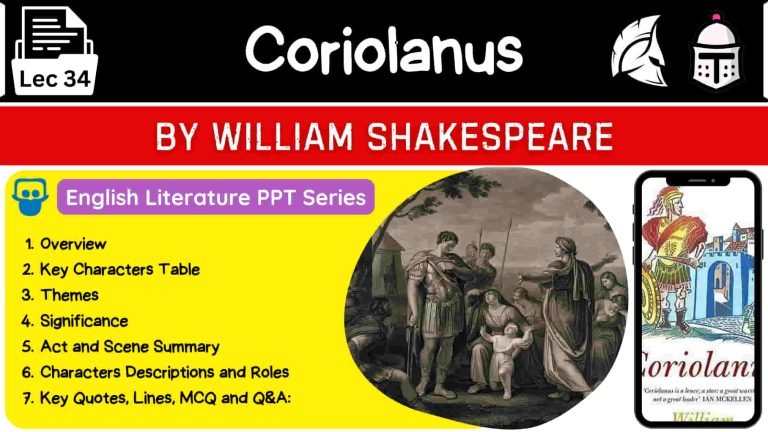
Today we have shared the PPT, PDF and Notes of William Shakespeare’s famous play Coriolanus by William Shakespeare PPT Download .PPTX or Coriolanus PPT Slides & PDF Study Material Download. As we know, Coriolanus is one of Shakespeare’s powerful tragedies, believed to have been written around 1607–1608. This intense political drama presents a compelling exploration of pride, power, loyalty, and the complex relationship between leaders and the people they serve. Set in ancient Rome, the play follows the life of Caius Marcius Coriolanus, a brilliant but arrogant military hero whose rigid principles and disdain for public opinion ultimately shape his rise and fall. Through strong characters, dramatic conflicts, and thought-provoking themes, Coriolanus offers deep insights into human nature, governance, and personal honor. Whether performed on stage or studied in classrooms, Coriolanus continues to captivate audiences with its timeless reflection on ambition, integrity, and the consequences of unbending pride.
Table of Contents
Coriolanus by William Shakespeare PPT Download | .PPTX (Lec-34)
Coriolanus
Here’s a complete table for “Coriolanus”:
| Aspect | Description |
|---|---|
| Title | Coriolanus |
| Playwright | William Shakespeare |
| Genre | Tragedy |
| Date of Composition | Estimated to be between 1605 and 1608 |
| Setting | Ancient Rome |
| Main Characters | Caius Martius (Coriolanus), Volumnia, Aufidius, Menenius, Cominius, Virgilia, Sicinius, Brutus |
| Plot Overview | The play follows the proud and uncompromising Roman general Coriolanus, whose military prowess earns him fame and adoration but also arouses jealousy and resentment among the Roman populace and political elite. Disillusioned and betrayed, Coriolanus turns against Rome and allies with its enemy, Aufidius of the Volscians, leading to tragic consequences for himself and his family. |
| Key Themes | Pride and arrogance, political manipulation, the conflict between individual integrity and societal expectations |
| Significance | “Coriolanus” is one of Shakespeare’s lesser-known tragedies, celebrated for its intense portrayal of its titular character and its exploration of themes related to power, pride, and political manipulation. It is often regarded as a challenging and thought-provoking work. |
| Notable Lines | – “I banish you! / And here remain with your uncertainty! Let every feeble rumor shake your hearts! / Your enemies, with nodding of their plumes, / Fan you into despair!” (Act 3, Scene 3) – “What’s the matter, you dissentious rogues, / That, rubbing the poor itch of your opinion, / Make yourselves scabs?” (Act 3, Scene 1) – “There is a world elsewhere.” (Act 3, Scene 3) |
| Adaptations | “Coriolanus” has been adapted into various stage productions, film adaptations, and television adaptations. Notable adaptations include the film directed by Ralph Fiennes (2011), stage productions by the Royal Shakespeare Company, and modern reinterpretations by various theater companies. |
This table provides a comprehensive overview of various aspects of “Coriolanus,” including its background, plot, characters, themes, significance, notable lines, and adaptations.
A Complete Guide to Shakespeare’s “Coriolanus”
William Shakespeare, renowned for his timeless plays, delves into political intrigue, human nature, and the complexities of power in his tragedy “Coriolanus.” Set in ancient Rome, the play follows the life of the proud and valiant Roman general Caius Marcius Coriolanus. Here’s a comprehensive guide to understanding this compelling work:
Background:
“Coriolanus” was likely written between 1605 and 1608, during the later part of Shakespeare’s career. It’s believed to be based on the Roman historian Plutarch’s biographies, specifically “Parallel Lives,” which chronicled the lives of notable figures, including Coriolanus.
Plot Summary:
The play opens with Rome in turmoil due to a famine, exacerbated by the hoarding of grain by the wealthy patricians. Amidst the unrest, Coriolanus emerges as a military hero, having defeated the Volscian army and taken the city of Corioles. His success propels him into the political arena, where he is urged to seek the consulship.
However, Coriolanus finds himself ill-suited for the complexities of politics. His disdain for the common people, whom he views with contempt as “the mutable, rank-scented many,” leads to his downfall. Manipulated by his enemies, particularly the tribunes Sicinius Velutus and Junius Brutus, Coriolanus is accused of treason and banished from Rome.
Exiled and bitter, Coriolanus seeks refuge with his former enemy, Aufidius, the Volscian general. Together, they plot to march on Rome and exact revenge. Despite the pleas of his mother, Volumnia, and his wife, Virgilia, Coriolanus remains steadfast in his resolve.
Themes:
Pride and Hubris: Coriolanus’s tragic flaw lies in his excessive pride and unwillingness to compromise. His rigid adherence to his principles ultimately leads to his downfall.
Manipulation and Politics: The play explores the manipulative nature of politics, as Coriolanus becomes a pawn in the hands of those seeking power.
Class Conflict: “Coriolanus” depicts the tensions between the aristocracy and the common people, highlighting the struggle for power and representation.
Identity and Loyalty: Coriolanus grapples with questions of identity and loyalty, torn between his allegiance to Rome and his personal ambitions.
Key Characters:
Caius Marcius Coriolanus: The protagonist, a skilled warrior whose disdain for the common people proves to be his tragic flaw.
Volumnia: Coriolanus’s mother, a formidable matriarch whose influence over her son is significant.
Aufidius: The Volscian general and Coriolanus’s enemy turned ally.
Virgilia: Coriolanus’s wife, whose quiet strength contrasts with her mother-in-law’s assertiveness.
Sicinius Velutus and Junius Brutus: Tribunes who manipulate public opinion against Coriolanus.
Adaptations and Influence:
“Coriolanus” has been adapted numerous times across various mediums. Notable adaptations include:
Ralph Fiennes directed and starred in a 2011 film adaptation, set in a modern-day militaristic society.
The play has been adapted for the stage by several theater companies, often exploring contemporary political themes.
“Coriolanus” continues to influence literature, film, and political discourse, with its exploration of power dynamics and the consequences of pride.
“Coriolanus” stands as a testament to Shakespeare’s profound understanding of human nature and the complexities of power. Through its exploration of pride, politics, and loyalty, the play remains relevant across centuries, inviting audiences to reflect on timeless themes. As Coriolanus himself declares, “What is the city but the people?” a poignant reminder of the interconnectedness of individuals within the fabric of society.
Plot Overview
Below is a structured table providing a comprehensive plot overview of William Shakespeare’s “Coriolanus”:
| Act | Scene | Summary |
|---|---|---|
| Act I | Scene 1 | Famine plagues Rome, leading to riots. Caius Marcius Coriolanus, a valiant Roman general, emerges victorious against the Volscian army in the city of Corioles, earning him the honorary title “Coriolanus.” Despite his military prowess, Coriolanus holds disdain for the common people. |
| Scene 2 | Encouraged by his ambitious mother Volumnia and other patricians, Coriolanus considers running for consulship. However, his contempt for the commoners and his inability to flatter them prove to be obstacles. | |
| Scene 3 | Coriolanus reluctantly seeks the support of the plebeians to gain their votes. Despite his efforts, he faces opposition from the tribunes Sicinius Velutus and Junius Brutus, who manipulate the populace against him. | |
| Act II | Scene 1 | Coriolanus’s bid for consulship is thwarted when the citizens, swayed by the tribunes, reject him. Embittered, Coriolanus condemns the fickleness of the masses and declares his disdain for democracy. |
| Scene 2 | Sicinius and Brutus plot to undermine Coriolanus further, seeking his banishment from Rome. | |
| Scene 3 | Coriolanus, accused of treason, stands trial before the Senate. Despite Volumnia’s impassioned plea, he refuses to retract his words, leading to his exile. | |
| Act III | Scene 1 | Banished from Rome, Coriolanus seeks refuge among the Volscians, Rome’s enemies. He encounters Aufidius, the Volscian general, and forms an alliance with him. |
| Scene 2 | Meanwhile, in Rome, the citizens begin to regret their decision to banish Coriolanus as they face external threats from the Volscians. | |
| Scene 3 | Volumnia, accompanied by Coriolanus’s wife Virgilia and their son, pleads with him to spare Rome from destruction. Despite their pleas, Coriolanus remains resolute in his decision to march on Rome. | |
| Act IV | Scene 1 | Coriolanus, leading the Volscian army, lays siege to Rome. However, he is persuaded to negotiate peace by the intercession of his family, particularly his mother Volumnia. |
| Scene 2 | Despite reaching a truce with Rome, Coriolanus’s alliance with the Volscians earns him the enmity of Aufidius, who conspires against him. | |
| Act V | Scene 1 | Coriolanus faces a dilemma when Aufidius accuses him of treachery. Despite his loyalty to Rome, Coriolanus is slain by Aufidius and his followers. |
| Scene 2 | In the aftermath of Coriolanus’s death, both Rome and the Volscians mourn the loss of the valiant warrior. |
This table provides a structured overview of the plot, broken down by acts and scenes, to aid in understanding the narrative progression of “Coriolanus.”
Characters
Below is a comprehensive table outlining the key characters in William Shakespeare’s “Coriolanus”:
| Character | Description |
|---|---|
| Caius Marcius Coriolanus | The protagonist of the play, Coriolanus is a skilled Roman general known for his bravery and military prowess. He holds deep disdain for the common people and struggles with his pride and inability to compromise, which ultimately leads to his downfall. |
| Volumnia | Coriolanus’s mother, Volumnia is a strong and influential woman who plays a significant role in her son’s life. She is ambitious for Coriolanus’s success and encourages his political ambitions, but her influence contributes to his downfall as well. |
| Aufidius | The general of the Volscians and Coriolanus’s primary enemy. Aufidius initially despises Coriolanus but later forms an alliance with him. However, he ultimately betrays Coriolanus out of jealousy and fear of his growing power. |
| Virgilia | Coriolanus’s wife, Virgilia is depicted as a dutiful and loyal wife. She contrasts with her mother-in-law, Volumnia, in her quiet and unassuming nature. Virgilia cares deeply for her husband and is devastated by the events that unfold throughout the play. |
| Sicinius Velutus | A tribune of Rome, Sicinius is one of Coriolanus’s primary adversaries. He manipulates public opinion against Coriolanus and plays a key role in his banishment from Rome. |
| Junius Brutus | Another tribune of Rome, Junius Brutus conspires with Sicinius to undermine Coriolanus’s political aspirations. He, too, plays a significant role in orchestrating Coriolanus’s downfall. |
| Menenius Agrippa | A Roman senator and friend of Coriolanus’s family, Menenius attempts to mediate between Coriolanus and the common people. He serves as a voice of reason and attempts to bridge the gap between the patricians and plebeians. |
| Cominius | A Roman general and mentor to Coriolanus, Cominius respects Coriolanus’s military skills but recognizes his flaws. He tries to guide Coriolanus and advises him throughout the play. |
| Titus Lartius | Another Roman general and ally of Coriolanus, Titus Lartius fights alongside Coriolanus in battles against the Volscians. |
| Young Martius | Coriolanus’s young son, named after his father. Though he has a minor role in the play, Young Martius serves as a reminder of Coriolanus’s familial ties and the consequences of his actions on his family. |
This table provides an overview of the key characters in “Coriolanus,” outlining their roles and relationships within the play.
Themes
Below is a comprehensive table outlining the key themes in William Shakespeare’s “Coriolanus”:
| Theme | Description |
|---|---|
| Pride and Hubris | The theme of pride and hubris is central to the character of Coriolanus. His excessive pride in his military accomplishments and disdain for the common people lead to his downfall. Coriolanus’s inability to compromise or adapt his behavior ultimately alienates him from those around him and contributes to his tragic fate. |
| Manipulation and Politics | The play explores the manipulative nature of politics, as characters like Sicinius Velutus and Junius Brutus exploit public opinion to further their own agendas. Coriolanus himself becomes a pawn in the political machinations of others, leading to his banishment from Rome and eventual demise. The play highlights the ways in which individuals use manipulation and deceit to gain power and influence. |
| Class Conflict | “Coriolanus” depicts the tensions between the patrician class, represented by characters like Coriolanus and his family, and the plebeians, who are marginalized and oppressed. The play explores the power dynamics between the aristocracy and the common people, highlighting the struggles for representation and social justice. |
| Identity and Loyalty | Coriolanus grapples with questions of identity and loyalty throughout the play. He struggles to reconcile his allegiance to Rome with his personal ambitions and desires for recognition. Additionally, Coriolanus’s loyalty to his family, particularly his mother Volumnia, influences his decisions and ultimately shapes his tragic fate. The play examines the complexities of loyalty and the conflicts that arise when personal and political allegiances collide. |
| Betrayal and Revenge | Betrayal and revenge are recurring motifs in “Coriolanus.” Coriolanus feels betrayed by the citizens of Rome, who banish him despite his military service. In turn, he seeks revenge against his former allies by joining forces with the Volscians to wage war against Rome. The play explores the cycle of betrayal and revenge, highlighting the destructive consequences of resentment and vindictiveness. |
This table provides a structured overview of the key themes present in “Coriolanus,” outlining their significance and relevance to the play’s narrative and characters.
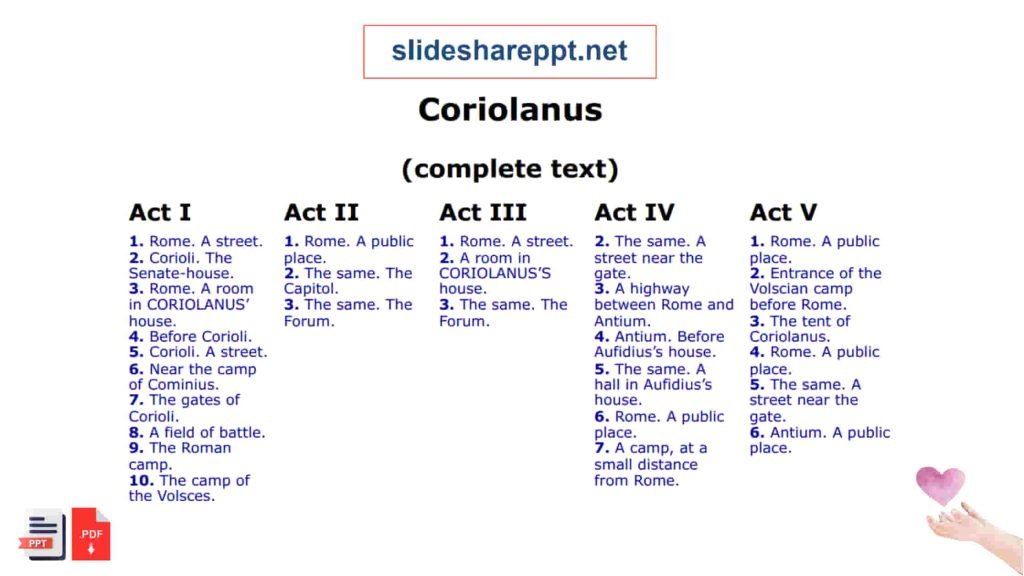
Note: The complete Text PDF Link is at the end of the PowerPoint slides (go to the last PPT Slide)
Significance
Below is a comprehensive table outlining the significance of William Shakespeare’s “Coriolanus”:
| Aspect | Significance |
|---|---|
| Historical Context | “Coriolanus” is significant for its portrayal of ancient Rome and its exploration of political themes relevant to Shakespeare’s time. The play reflects the social and political tensions of Elizabethan England, including issues of class conflict, political manipulation, and the struggle for power. It offers insights into the dynamics of political power and the consequences of pride and ambition. |
| Character Exploration | The character of Coriolanus is significant for its complexity and depth. Coriolanus embodies the tragic hero archetype, characterized by his noble qualities and fatal flaws. His pride, stubbornness, and inability to compromise lead to his downfall, making him a compelling and memorable character. Through Coriolanus, Shakespeare explores themes of pride, loyalty, and the consequences of unchecked ambition. |
| Political Allegory | “Coriolanus” is often interpreted as a political allegory, with its portrayal of Rome reflecting contemporary political realities. The play explores the tensions between the aristocracy and the common people, highlighting the struggle for power and representation. It offers insights into the manipulative nature of politics and the consequences of betraying one’s principles for personal gain. |
| Influence and Adaptations | “Coriolanus” has had a significant influence on literature, theater, and film. It has been adapted numerous times across various mediums, including stage productions, films, and novels. The play’s exploration of political intrigue, human nature, and the complexities of power continues to resonate with audiences and artists alike, making it a timeless work of literature with enduring cultural relevance. |
| Psychological Depth | The play’s exploration of psychological themes, such as pride, identity, and loyalty, adds depth and complexity to its characters and narrative. Through characters like Coriolanus, Volumnia, and Aufidius, Shakespeare delves into the intricacies of human nature, portraying the internal conflicts and moral dilemmas faced by individuals grappling with power, ambition, and personal integrity. |
This table provides an overview of the significance of “Coriolanus,” highlighting its historical context, character exploration, political allegory, influence and adaptations, and psychological depth.
Act and Scene Summary
Below is a comprehensive table summarizing each act and scene of William Shakespeare’s “Coriolanus”:
| Act | Scene | Summary |
|---|---|---|
| Act I | Scene 1 | Rome is plagued by famine, leading to riots. Caius Marcius Coriolanus, a valiant Roman general, emerges victorious against the Volscian army in the city of Corioles, earning him the honorary title “Coriolanus.” Despite his military prowess, Coriolanus holds disdain for the common people. |
| Scene 2 | Encouraged by his ambitious mother Volumnia and other patricians, Coriolanus considers running for consulship. However, his contempt for the commoners and his inability to flatter them prove to be obstacles. | |
| Scene 3 | Coriolanus reluctantly seeks the support of the plebeians to gain their votes. Despite his efforts, he faces opposition from the tribunes Sicinius Velutus and Junius Brutus, who manipulate the populace against him. | |
| Act II | Scene 1 | Coriolanus’s bid for consulship is thwarted when the citizens, swayed by the tribunes, reject him. Embittered, Coriolanus condemns the fickleness of the masses and declares his disdain for democracy. |
| Scene 2 | Sicinius and Brutus plot to undermine Coriolanus further, seeking his banishment from Rome. | |
| Scene 3 | Coriolanus, accused of treason, stands trial before the Senate. Despite Volumnia’s impassioned plea, he refuses to retract his words, leading to his exile. | |
| Act III | Scene 1 | Banished from Rome, Coriolanus seeks refuge among the Volscians, Rome’s enemies. He encounters Aufidius, the Volscian general, and forms an alliance with him. |
| Scene 2 | Meanwhile, in Rome, the citizens begin to regret their decision to banish Coriolanus as they face external threats from the Volscians. | |
| Scene 3 | Volumnia, accompanied by Coriolanus’s wife Virgilia and their son, pleads with him to spare Rome from destruction. Despite their pleas, Coriolanus remains resolute in his decision to march on Rome. | |
| Act IV | Scene 1 | Coriolanus, leading the Volscian army, lays siege to Rome. However, he is persuaded to negotiate peace by the intercession of his family, particularly his mother Volumnia. |
| Scene 2 | Despite reaching a truce with Rome, Coriolanus’s alliance with the Volscians earns him the enmity of Aufidius, who conspires against him. | |
| Act V | Scene 1 | Coriolanus faces a dilemma when Aufidius accuses him of treachery. Despite his loyalty to Rome, Coriolanus is slain by Aufidius and his followers. |
| Scene 2 | In the aftermath of Coriolanus’s death, both Rome and the Volscians mourn the loss of the valiant warrior. |
This table provides a structured summary of each act and scene in “Coriolanus,” aiding in understanding the narrative progression of the play.
Also read: Cymbeline by William Shakespeare PPT Download | .PPTX
Characters Descriptions and Roles
Below is a comprehensive table detailing the characters, their descriptions, and their roles in William Shakespeare’s “Coriolanus”:
| Character | Description | Role |
|---|---|---|
| Caius Marcius Coriolanus | A skilled and valiant Roman general known for his military prowess. Coriolanus holds disdain for the common people and struggles with his pride and inability to compromise, which ultimately leads to his downfall. He is the protagonist of the play. | Protagonist; tragic hero |
| Volumnia | Coriolanus’s mother, a strong and influential woman who plays a significant role in her son’s life. Ambitious for Coriolanus’s success, Volumnia encourages his political ambitions, but her influence contributes to his downfall as well. | Influential matriarch; motivator of Coriolanus |
| Aufidius | The general of the Volscians and Coriolanus’s primary enemy. Initially despising Coriolanus, Aufidius later forms an alliance with him. However, he ultimately betrays Coriolanus out of jealousy and fear of his growing power. | Primary antagonist; eventual betrayer of Coriolanus |
| Virgilia | Coriolanus’s wife, depicted as a loyal and dutiful woman. Virgilia contrasts with her mother-in-law, Volumnia, in her quiet and unassuming nature. She deeply cares for her husband and is devastated by the events that unfold throughout the play. | Symbol of domesticity; source of emotional support for Coriolanus |
| Sicinius Velutus | A tribune of Rome who manipulates public opinion against Coriolanus and plays a key role in his banishment from Rome. | Antagonist; manipulator of public sentiment |
| Junius Brutus | Another tribune of Rome who conspires with Sicinius to undermine Coriolanus’s political aspirations. | Antagonist; collaborator with Sicinius |
| Menenius Agrippa | A Roman senator and friend of Coriolanus’s family who attempts to mediate between Coriolanus and the common people. He serves as a voice of reason and tries to bridge the gap between the patricians and plebeians. | Mediator; voice of reason |
| Cominius | A Roman general and mentor to Coriolanus who respects his military skills but recognizes his flaws. Cominius tries to guide Coriolanus and advises him throughout the play. | Mentor; advisor |
| Titus Lartius | Another Roman general and ally of Coriolanus who fights alongside him in battles against the Volscians. | Ally; fellow soldier |
| Young Martius | Coriolanus’s young son, named after his father. Though he has a minor role in the play, Young Martius serves as a reminder of Coriolanus’s familial ties and the consequences of his actions on his family. | Symbol of legacy; reminder of familial bonds |
This table provides an overview of the characters in “Coriolanus,” detailing their descriptions and roles within the play.
Summary
Summary of “Coriolanus” by William Shakespeare:
“Coriolanus” unfolds against the backdrop of ancient Rome, a society torn apart by famine, political unrest, and class conflict. The play revolves around the proud and valiant Roman general Caius Marcius Coriolanus, whose military triumphs are overshadowed by his disdain for the common people.
In Act I, Rome is besieged by hunger, prompting riots among the citizens. Coriolanus emerges as a hero after leading the Roman forces to victory against the Volscian army in the city of Corioles. Despite his military prowess, Coriolanus struggles to gain the support of the plebeians for political office due to his contempt for the commoners.
Act II sees Coriolanus’s bid for consulship thwarted by the tribunes Sicinius Velutus and Junius Brutus, who manipulate public opinion against him. Accused of treason, Coriolanus stands trial before the Senate and is banished from Rome.
In Act III, Coriolanus seeks refuge among the Volscians, Rome’s enemies, where he forms an alliance with Aufidius, the Volscian general. Meanwhile, in Rome, the citizens begin to regret their decision to banish Coriolanus as they face external threats from the Volscians.
Act IV sees Coriolanus leading the Volscian army in a siege against Rome. However, he is persuaded to negotiate peace by the intercession of his family, particularly his mother Volumnia. Despite reaching a truce with Rome, Coriolanus’s alliance with the Volscians earns him the enmity of Aufidius, who conspires against him.
In Act V, Coriolanus faces accusations of treachery from Aufidius. Despite his loyalty to Rome, Coriolanus is slain by Aufidius and his followers. His death leaves both Rome and the Volscians mourning the loss of the valiant warrior.
“Coriolanus” is a tragic exploration of pride, politics, and the consequences of unchecked ambition. Through its complex characters and gripping narrative, the play offers insights into the complexities of human nature and the perils of power.
Facts
Below is a table detailing various interesting facts about William Shakespeare’s “Coriolanus”:
| Facts | Details |
|---|---|
| Date of Composition | “Coriolanus” is believed to have been written between 1605 and 1608, making it one of Shakespeare’s later works. |
| Source Material | Shakespeare likely based “Coriolanus” on Plutarch’s biographies, particularly the life of the Roman leader Gaius Marcius Coriolanus, as depicted in “Parallel Lives.” |
| Title | The play is named after its protagonist, Caius Marcius Coriolanus, who earns the honorary title “Coriolanus” after his military victory in the city of Corioles. |
| Political Allegory | “Coriolanus” is often interpreted as a political allegory, reflecting the social and political tensions of Shakespeare’s time. The play explores themes of class conflict, manipulation, and the consequences of political ambition, offering insights into the dynamics of power and governance. |
| Lack of Adaptations | Despite its compelling characters and themes, “Coriolanus” is one of Shakespeare’s lesser-adapted plays. It has fewer film adaptations and stage productions compared to some of his more popular works like “Romeo and Juliet” or “Hamlet.” |
| Tragic Hero | Coriolanus is considered a tragic hero, characterized by his noble qualities and fatal flaws. His excessive pride and unwillingness to compromise ultimately lead to his downfall, a common trope in Shakespearean tragedy. |
| Ralph Fiennes’ Adaptation | Actor Ralph Fiennes directed and starred in a film adaptation of “Coriolanus” released in 2011. The film sets the story in a modern-day militaristic society and received critical acclaim for its bold interpretation of the play. |
| Gender-Bending Performances | Throughout history, actors have often taken on gender-bending roles in productions of “Coriolanus.” Due to the lack of significant female roles in the play, actresses have portrayed male characters, and male actors have played female roles, challenging traditional gender norms in theater. |
| Influence on Political Thought | “Coriolanus” has been studied for its insights into political theory and governance. Scholars have analyzed the play’s depiction of power dynamics, political manipulation, and the role of the populace in shaping political outcomes, drawing parallels to contemporary political systems and debates. |
| Critical Reception | “Coriolanus” received mixed reviews during Shakespeare’s time, but it has since been reevaluated and praised for its complex characters and exploration of political themes. Today, it is considered one of Shakespeare’s major tragedies and is regularly studied and performed in theaters around the world. |
| Notable Quotes | “What is the city but the people?” – This famous line from “Coriolanus” reflects the protagonist’s disdain for the common people and encapsulates the play’s exploration of class conflict and political power. |
This table provides a collection of interesting facts about Shakespeare’s “Coriolanus,” ranging from its composition and source material to its adaptations and critical reception.
Key Quotes and Lines
Below is a table featuring key quotes and lines from William Shakespeare’s “Coriolanus,” along with their significance:
| Quote | Speaker | Context |
|---|---|---|
| “O, a kiss / Long as my exile, sweet as my revenge!” | Coriolanus | Coriolanus speaks to his ally Aufidius, expressing his desire for vengeance against Rome. |
| “There is a world elsewhere.” | Coriolanus | Coriolanus speaks these words to his mother Volumnia, suggesting that his destiny lies outside of Rome. |
| “I banish you!” | Coriolanus | Coriolanus exclaims this to the Roman citizens after being banished from Rome. |
| “What’s the matter, you dissentious rogues, / That, rubbing the poor itch of your opinion, / Make yourselves scabs?” | Menenius Agrippa | Menenius addresses the common people of Rome, criticizing their rebellious behavior and likening them to irritants on the body politic. |
| “You common cry of curs! whose breath I hate / As reek o’ th’ rotten fens, whose loves I prize / As the dead carcasses of unburied men / That do corrupt my air.” | Coriolanus | Coriolanus addresses the common people, expressing his disgust for them and comparing them to foul odors and decaying corpses. |
| “He that will give good words to thee will flatter / Beneath abhorring. What would you have, you curs, / That like nor peace nor war?” | Coriolanus | Coriolanus speaks to the citizens of Rome, accusing them of being fickle and indecisive in their desires. |
| “I have lived to see inherited my very wishes, / And the buildings of my fancy.” | Volumnia | Volumnia speaks proudly of her son’s achievements and their fulfillment of her own desires. |
| “What’s gone and what’s past help / Should be past grief.” | Volumnia | Volumnia counsels Virgilia to move on from grief over past losses and focus on the future. |
These quotes capture the essence of “Coriolanus” by highlighting key themes such as pride, politics, class conflict, and familial relationships, while also showcasing the complexity of the characters and their motivations.
Q&A
Q: What is “Coriolanus” about?
A: “Coriolanus” is a tragedy by William Shakespeare that centers around the proud and valiant Roman general, Caius Marcius Coriolanus. The play explores themes of pride, politics, and the consequences of unchecked ambition as Coriolanus’s disdain for the common people leads to his downfall.
Q: Who is the protagonist of “Coriolanus”?
A: The protagonist of “Coriolanus” is Caius Marcius Coriolanus himself. He is a skilled and courageous Roman general whose pride and inability to compromise ultimately lead to his tragic fate.
Q: What is the significance of the title “Coriolanus”?
A: The title “Coriolanus” refers to the protagonist’s honorary title, earned after his military victory in the city of Corioles. It highlights his military prowess and distinguishes him as a central figure in the play.
Q: What are some major themes in “Coriolanus”?
A: Some major themes in “Coriolanus” include pride and hubris, manipulation and politics, class conflict, identity and loyalty, and betrayal and revenge.
Q: How does “Coriolanus” reflect Shakespeare’s political views?
A: “Coriolanus” reflects Shakespeare’s skepticism toward democracy and his belief in the dangers of mob rule. The play explores the manipulative nature of politics and the consequences of betraying one’s principles for personal gain.
Q: What are some memorable quotes from “Coriolanus”?
A: Memorable quotes from “Coriolanus” include:
- “O, a kiss / Long as my exile, sweet as my revenge!” – Coriolanus
- “There is a world elsewhere.” – Coriolanus
- “What’s the matter, you dissentious rogues, / That, rubbing the poor itch of your opinion, / Make yourselves scabs?” – Menenius Agrippa
Q: How has “Coriolanus” been adapted over time?
A: “Coriolanus” has been adapted into various forms, including stage productions, films, and novels. Notable adaptations include a film directed by Ralph Fiennes in 2011 and modernized stage productions that explore contemporary political themes.
These questions and answers provide insights into various aspects of “Coriolanus,” offering a deeper understanding of the play and its significance.