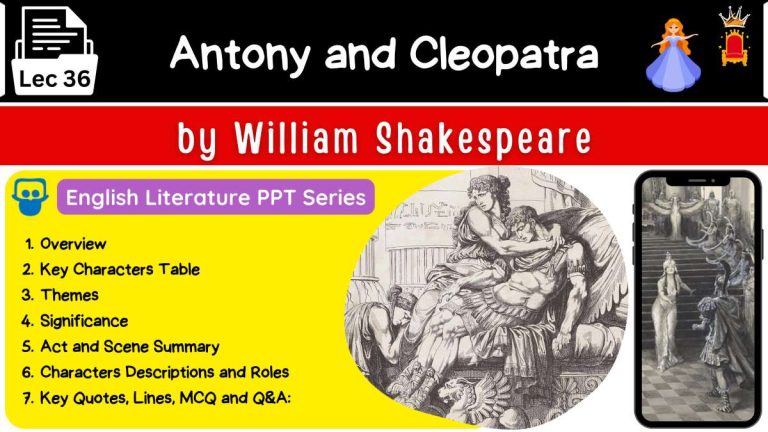
Today we have shared the Notes of William Shakespeare’s famous play Antony and Cleopatra PPTX Slides & PDF Study Material Download. As we know, Antony and Cleopatra is one of Shakespeare’s greatest tragedies, believed to have been written around 1606–1607. This magnificent historical drama presents a powerful tale of love, ambition, and political conflict set against the backdrop of the Roman Empire and ancient Egypt. The play follows the passionate relationship between Mark Antony, a Roman general, and Cleopatra, the Queen of Egypt, whose intense bond challenges loyalty, duty, and honor. Through grand characters, dramatic battles, and poetic storytelling, the play explores themes of power, desire, identity, and the clash between personal emotion and public responsibility. Whether performed on stage or studied in classrooms, Antony and Cleopatra continues to captivate audiences with its emotional depth, timeless romance, and tragic vision of love and downfall.
Table of Contents
Antony and Cleopatra by William Shakespeare PPT Download (.pptx)
Antony and Cleopatra
Here’s a complete table for “Antony and Cleopatra”:
| Aspect | Description |
|---|---|
| Title | Antony and Cleopatra |
| Playwright | William Shakespeare |
| Genre | Tragedy, historical drama |
| Date of Composition | Estimated to be between 1606 and 1607 |
| Setting | Rome, Alexandria, and various locations in the Roman Empire |
| Main Characters | Mark Antony, Cleopatra, Octavius Caesar, Octavia, Enobarbus, Charmian, Iras, Pompey, Lepidus, Agrippa |
| Plot Overview | The play depicts the tumultuous love affair between Mark Antony, a Roman general, and Cleopatra, the Queen of Egypt. Their relationship is tested by political intrigue and betrayal as Antony’s allegiance shifts between his duty to Rome and his passion for Cleopatra. The play culminates in the decisive Battle of Actium and the tragic deaths of Antony and Cleopatra. |
| Key Themes | Love and politics, honor and duty, ambition and power, the clash of cultures |
| Significance | “Antony and Cleopatra” is one of Shakespeare’s lesser-known tragedies, celebrated for its epic scope, rich language, and complex portrayal of its titular characters. It offers a vivid depiction of the ancient world and explores timeless themes of love, power, and mortality. |
| Notable Lines | – “Age cannot wither her, nor custom stale / Her infinite variety.” (Act 2, Scene 2) – “My salad days, / When I was green in judgment, cold in blood.” (Act 1, Scene 5) – “Let Rome in Tiber melt, and the wide arch / Of the ranged empire fall! Here is my space.” (Act 1, Scene 1) |
| Adaptations | “Antony and Cleopatra” has been adapted into various stage productions, film adaptations, and television adaptations. Notable adaptations include the film directed by Charlton Heston (1972), stage productions by the Royal Shakespeare Company, and modern reinterpretations by various theater companies. |
This table provides a comprehensive overview of various aspects of “Antony and Cleopatra,” including its background, plot, characters, themes, significance, notable lines, and adaptations.
A Complete Guide: Antony and Cleopatra
William Shakespeare’s “Antony and Cleopatra” is a tragic play that unfolds against the backdrop of the Roman Empire’s struggle for power and the legendary romance between the Roman general Mark Antony and the Egyptian queen Cleopatra. Set in the first century BC, the play explores themes of love, loyalty, ambition, and the clash of cultures.
Plot Overview:
“Antony and Cleopatra” follows the tumultuous relationship between Mark Antony, one of the triumvirs ruling Rome, and Cleopatra, the queen of Egypt. Despite their passionate love for each other, their relationship is fraught with political intrigue and conflict. As Antony’s allegiance is torn between his duty to Rome and his love for Cleopatra, he faces opposition from his fellow triumvir Octavius Caesar, who seeks to consolidate power and maintain control over the Roman Empire.
The play spans several years and depicts Antony and Cleopatra’s journey from the height of their love and power to their eventual downfall. Despite their efforts to defy the odds and carve out a future together, their romance ultimately leads to tragedy as they are caught in the web of political intrigue and betrayal.
Key Characters:
Mark Antony: A Roman general and one of the triumvirs ruling Rome. Antony is torn between his love for Cleopatra and his duty to Rome, leading to internal conflict and ultimately his downfall.
Cleopatra: The queen of Egypt, Cleopatra is a powerful and seductive figure who captivates Antony with her charm and beauty. Her passionate love for Antony drives much of the plot.
Octavius Caesar: The ambitious and calculating nephew of Julius Caesar, Octavius Caesar is determined to consolidate power and assert his authority over Rome. He becomes Antony’s rival and ultimately emerges victorious.
Enobarbus: Antony’s loyal friend and advisor, Enobarbus serves as a voice of reason and conscience throughout the play. However, he ultimately betrays Antony and dies of guilt.
Charmian and Iras: Cleopatra’s attendants and confidantes, Charmian and Iras provide support and companionship to Cleopatra, often offering insight into her character.
Themes:
Love and Passion: The passionate love between Antony and Cleopatra is a central theme of the play, driving much of the action and conflict. Their romance is portrayed as intense and all-consuming, transcending political boundaries and societal norms.
Power and Politics: “Antony and Cleopatra” explores the struggle for power and dominance among political leaders, particularly Antony, Octavius Caesar, and Cleopatra. The play delves into the complexities of political alliances, betrayal, and ambition.
Identity and Loyalty: Characters in the play grapple with questions of identity and loyalty, torn between personal desires and duty to their respective nations. Antony’s struggle to reconcile his Roman identity with his love for Cleopatra serves as a central conflict.
Mortality and Legacy: The play confronts themes of mortality and the legacy one leaves behind. Antony and Cleopatra are acutely aware of their mortality and the fleeting nature of life, reflecting on their legacies and the impact of their actions.
Significance:
“Antony and Cleopatra” is celebrated for its complex characters, rich language, and exploration of timeless themes. It offers a nuanced portrayal of love, power, and the complexities of human nature, making it a compelling and enduring work of literature.
Adaptations:
“Antony and Cleopatra” has been adapted into various forms, including stage productions, films, operas, and novels. Notable adaptations include the 1963 film directed by Joseph L. Mankiewicz, starring Richard Burton and Elizabeth Taylor, and numerous stage productions featuring acclaimed actors in the title roles.
In conclusion, “Antony and Cleopatra” remains a captivating exploration of love, power, and the human condition. With its memorable characters, evocative language, and timeless themes, the play continues to resonate with audiences and inspire generations of readers, scholars, and artists.
Plot Overview
Below is a complete table summarizing the plot overview of William Shakespeare’s “Antony and Cleopatra”:
| Act | Scene | Summary |
|---|---|---|
| Act 1 | Scene 1 | The play opens with Roman triumvirs Antony, Octavius Caesar, and Lepidus discussing their plans to divide the Roman Empire. Antony receives a message from Cleopatra, the queen of Egypt, and decides to return to Egypt, leaving his wife Fulvia behind in Rome. |
| Scene 2 | Cleopatra learns of Antony’s departure and is initially angered but eventually forgives him. Meanwhile, Pompey, a rival of the triumvirs, plots to challenge their authority and seize power in Rome. | |
| Act 2 | Scene 1 | Antony and Cleopatra reunite in Egypt and revel in their love for each other. However, news arrives of Pompey’s growing threat, prompting Antony to return to Rome to address the political situation. |
| Scene 2 | In Rome, tensions escalate between Antony and Octavius Caesar, leading to the formation of an alliance between Antony, Octavius, and Lepidus to defeat Pompey. Antony marries Octavius’s sister Octavia to solidify the alliance, but his heart remains with Cleopatra. | |
| Act 3 | Scene 1 | Antony and Octavius Caesar prepare for war against Pompey, but their alliance is strained by Antony’s continued infatuation with Cleopatra. |
| Scene 2 | Antony receives news of his wife Fulvia’s death and returns to Egypt to reunite with Cleopatra. Meanwhile, Octavius Caesar grows increasingly wary of Antony’s loyalty and begins to view him as a threat to his own power. | |
| Act 4 | Scene 1 | Antony and Cleopatra revel in their love and prepare for war against Octavius Caesar. However, their forces suffer a crushing defeat at the Battle of Actium, and Antony’s alliance with Cleopatra is shattered. |
| Scene 2 | Antony confronts Cleopatra over her perceived betrayal, but they reconcile and prepare to face Octavius Caesar’s forces together. | |
| Act 5 | Scene 1 | Octavius Caesar’s forces besiege Alexandria, and Antony’s forces are defeated. Believing Cleopatra to be dead, Antony takes his own life in a moment of despair. |
| Scene 2 | Cleopatra mourns Antony’s death and resolves to die rather than be taken captive by Octavius Caesar. She arranges to have an asp (snake) brought to her, using its venom to end her own life. | |
| Scene 3 | Cleopatra dies by the bite of the asp, ending her life on her own terms. Octavius Caesar arrives too late to save her and is left to contemplate the consequences of his victory. |
This table provides a comprehensive summary of the plot of Shakespeare’s “Antony and Cleopatra,” detailing the major events and developments in each act and scene.
Key Characters
Below is a comprehensive table outlining the key characters in William Shakespeare’s “Antony and Cleopatra”:
| Character | Description |
|---|---|
| Mark Antony | A Roman general and one of the triumvirs ruling Rome. Antony is torn between his duty to Rome and his passionate love for Cleopatra, the queen of Egypt. His relationship with Cleopatra drives much of the plot and ultimately leads to his downfall as he becomes embroiled in political conflict with Octavius Caesar. Antony is portrayed as a complex character grappling with questions of loyalty, identity, and mortality. |
| Cleopatra | The queen of Egypt, Cleopatra is a powerful and seductive figure who captivates Antony with her charm and beauty. She is portrayed as passionate and fiercely independent, willing to defy societal norms and risk everything for her love with Antony. Cleopatra’s relationship with Antony is at the heart of the play, and her character embodies themes of love, power, and the clash of cultures. Her tragic end symbolizes the fleeting nature of human existence and the consequences of defying fate. |
| Octavius Caesar | The ambitious and calculating nephew of Julius Caesar, Octavius Caesar is determined to consolidate power and assert his authority over Rome. He becomes Antony’s rival and ultimately emerges victorious in their political conflict. Octavius Caesar is portrayed as shrewd and manipulative, willing to do whatever it takes to achieve his goals. His rise to power underscores the theme of political ambition and the ruthless nature of Roman politics. |
| Enobarbus | Antony’s loyal friend and advisor, Enobarbus serves as a voice of reason and conscience throughout the play. He is torn between his loyalty to Antony and his admiration for Octavius Caesar’s power. Enobarbus ultimately betrays Antony out of a sense of self-preservation, but he is consumed by guilt and dies of remorse. Enobarbus’ character provides insight into the complexities of loyalty, friendship, and moral ambiguity in the world of the play. |
| Charmian and Iras | Cleopatra’s attendants and confidantes, Charmian and Iras provide support and companionship to Cleopatra throughout the play. They are loyal to Cleopatra and offer insight into her character and motivations. Charmian and Iras serve as symbols of female camaraderie and solidarity, highlighting the importance of friendship and companionship in Cleopatra’s life. Their devotion to Cleopatra underscores her influence and charisma as a leader and queen. |
| Pompey | A rival of the triumvirs ruling Rome, Pompey seeks to challenge their authority and seize power for himself. He represents a threat to Antony and Octavius Caesar’s rule and serves as a catalyst for the political conflict that unfolds throughout the play. Pompey’s character embodies themes of ambition, rivalry, and the struggle for dominance in the ancient world. His actions contribute to the destabilization of the Roman Empire and the eventual downfall of Antony and Cleopatra. |
This table provides an overview of the key characters in “Antony and Cleopatra,” highlighting their roles, motivations, and significance within the play’s narrative and themes.
Themes
Below is a comprehensive table outlining the major themes in William Shakespeare’s “Antony and Cleopatra”:
| Theme | Description |
|---|---|
| Love and Passion | Love and passion are central themes in “Antony and Cleopatra,” driving much of the plot and character development. The passionate love affair between Antony and Cleopatra transcends political boundaries and societal norms, serving as a powerful force that shapes their actions and decisions. Their intense love for each other is portrayed as all-consuming and transformative, but ultimately leads to tragedy as they struggle to reconcile their personal desires with their responsibilities to their respective nations. |
| Power and Politics | Power and politics play a prominent role in the play, reflecting the political turmoil and struggles for dominance in the ancient world. Characters vie for power and influence, forming alliances, and engaging in political maneuvering to achieve their goals. The clash between Antony, Octavius Caesar, and Cleopatra highlights the complexities of political ambition and the consequences of wielding power in a world driven by ambition, rivalry, and betrayal. |
| Loyalty and Betrayal | Loyalty and betrayal are recurring themes in “Antony and Cleopatra,” as characters grapple with conflicting allegiances and shifting loyalties. Antony’s loyalty to Cleopatra conflicts with his duty to Rome, leading to internal conflict and betrayal by his own followers. Similarly, Enobarbus’s betrayal of Antony underscores the moral ambiguity of loyalty and the devastating consequences of betraying one’s friends and principles. |
| Identity and Self-Perception | Characters in the play struggle with questions of identity and self-perception, torn between their personal desires and societal expectations. Antony grapples with his Roman identity and his love for Cleopatra, while Cleopatra navigates the complexities of being a powerful queen in a patriarchal society. The characters’ perceptions of themselves and others shape their actions and relationships, highlighting the fluidity of identity and the tension between personal and public roles. |
| Mortality and Fate | Mortality and fate are recurring motifs in “Antony and Cleopatra,” as characters confront the fleeting nature of life and the inevitability of death. Antony and Cleopatra are acutely aware of their mortality and the transience of human existence, reflecting on their legacies and the impact of their actions. The play explores the tension between free will and fate, suggesting that human choices are ultimately shaped by larger forces beyond their control. |
This table provides an overview of the major themes explored in “Antony and Cleopatra,” highlighting the complex interplay of love, power, loyalty, identity, and mortality in Shakespeare’s tragic masterpiece.
Significance
Below is a comprehensive table outlining the significance of William Shakespeare’s “Antony and Cleopatra”:
| Significance | Description |
|---|---|
| Historical Context | “Antony and Cleopatra” offers a window into the political landscape of ancient Rome and Egypt, providing insights into the power struggles, alliances, and rivalries that shaped the ancient world. The play is set against the backdrop of historical events such as the rise of Octavius Caesar and the Battle of Actium, offering a dramatized portrayal of key figures and events from antiquity. |
| Exploration of Love and Passion | Shakespeare explores the complexities of love and passion in “Antony and Cleopatra,” depicting the intense and transformative nature of Antony and Cleopatra’s relationship. Their passionate love affair transcends political boundaries and societal norms, serving as a driving force that shapes their actions and ultimately leads to tragedy. The play’s portrayal of love continues to resonate with audiences, offering timeless insights into the human experience. |
| Political Intrigue and Ambition | “Antony and Cleopatra” delves into the intricacies of political intrigue and ambition, highlighting the power struggles, alliances, and betrayals that characterize the ancient world. The play explores themes of power, loyalty, and betrayal as characters vie for dominance and navigate the complexities of political alliances in a world driven by ambition and rivalry. |
| Complexity of Characters | The characters in “Antony and Cleopatra” are richly developed and multifaceted, embodying a range of conflicting emotions, motivations, and desires. Antony and Cleopatra are portrayed as complex individuals grappling with questions of love, loyalty, and identity, while supporting characters such as Enobarbus and Octavius Caesar offer nuanced insights into the human condition. The depth and complexity of the characters contribute to the play’s enduring appeal and relevance. |
| Tragic Elements | As a tragedy, “Antony and Cleopatra” explores themes of love, power, and mortality, culminating in the downfall of its titular protagonists. The play depicts the tragic consequences of Antony and Cleopatra’s love affair, as they are torn apart by political conflict and ultimately meet a tragic end. Their deaths serve as a poignant reminder of the fleeting nature of life and the inevitability of fate. |
This table provides an overview of the significance of “Antony and Cleopatra,” highlighting its exploration of historical events, themes of love and passion, political intrigue, complexity of characters, and tragic elements.
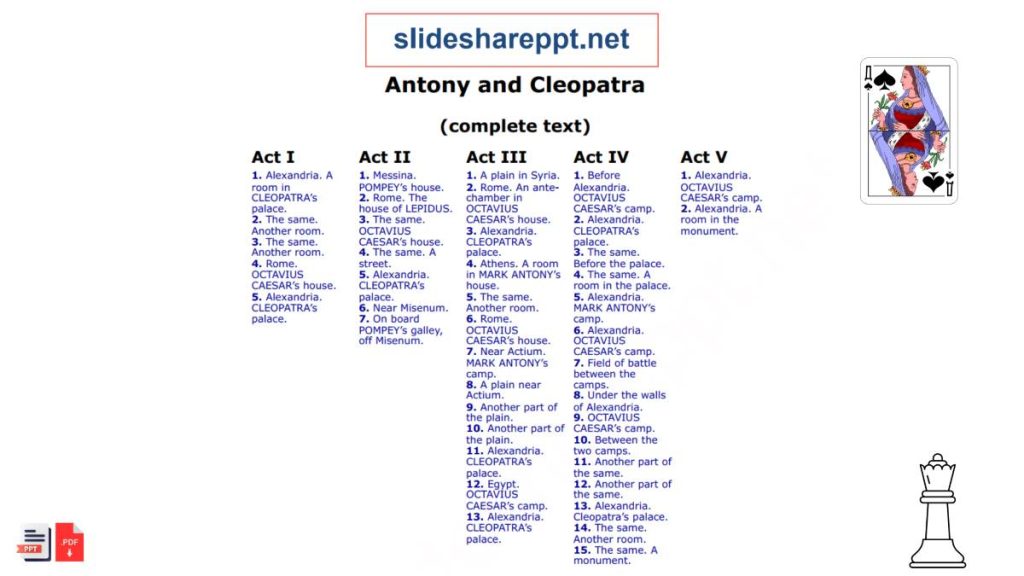
Note: The complete Text PDF Link is at the end of the PowerPoint slides (go to the last PPT Slide)
Act and Scene Summary
Below is a table summarizing the acts and scenes of William Shakespeare’s “Antony and Cleopatra”:
| Act | Scene | Summary |
|---|---|---|
| Act 1 | Scene 1 | The play opens with Roman triumvirs Antony, Octavius Caesar, and Lepidus discussing their plans to divide the Roman Empire. Antony receives a message from Cleopatra, the queen of Egypt, and decides to return to Egypt, leaving his wife Fulvia behind in Rome. |
| Scene 2 | Cleopatra learns of Antony’s departure and is initially angered but eventually forgives him. Meanwhile, Pompey, a rival of the triumvirs, plots to challenge their authority and seize power in Rome. | |
| Act 2 | Scene 1 | Antony and Cleopatra reunite in Egypt and revel in their love for each other. However, news arrives of Pompey’s growing threat, prompting Antony to return to Rome to address the political situation. |
| Scene 2 | In Rome, tensions escalate between Antony and Octavius Caesar, leading to the formation of an alliance between Antony, Octavius, and Lepidus to defeat Pompey. Antony marries Octavius’s sister Octavia to solidify the alliance, but his heart remains with Cleopatra. | |
| Act 3 | Scene 1 | Antony and Octavius Caesar prepare for war against Pompey, but their alliance is strained by Antony’s continued infatuation with Cleopatra. |
| Scene 2 | Antony receives news of his wife Fulvia’s death and returns to Egypt to reunite with Cleopatra. Meanwhile, Octavius Caesar grows increasingly wary of Antony’s loyalty and begins to view him as a threat to his own power. | |
| Act 4 | Scene 1 | Antony and Cleopatra revel in their love and prepare for war against Octavius Caesar. However, their forces suffer a crushing defeat at the Battle of Actium, and Antony’s alliance with Cleopatra is shattered. |
| Scene 2 | Antony confronts Cleopatra over her perceived betrayal, but they reconcile and prepare to face Octavius Caesar’s forces together. | |
| Act 5 | Scene 1 | Octavius Caesar’s forces besiege Alexandria, and Antony’s forces are defeated. Believing Cleopatra to be dead, Antony takes his own life in a moment of despair. |
| Scene 2 | Cleopatra mourns Antony’s death and resolves to die rather than be taken captive by Octavius Caesar. She arranges to have an asp (snake) brought to her, using its venom to end her own life. | |
| Scene 3 | Cleopatra dies by the bite of the asp, ending her life on her own terms. Octavius Caesar arrives too late to save her and is left to contemplate the consequences of his victory. |
This table provides a summary of the acts and scenes in “Antony and Cleopatra,” outlining the major events and developments that occur throughout the play.
Characters Descriptions and Roles
Below is a comprehensive table outlining the key characters, their descriptions, and roles in William Shakespeare’s “Antony and Cleopatra”:
| Character | Description | Role |
|---|---|---|
| Mark Antony | A Roman general and one of the triumvirs ruling Rome. Antony is torn between his duty to Rome and his passionate love for Cleopatra, the queen of Egypt. His relationship with Cleopatra drives much of the plot and ultimately leads to his downfall as he becomes embroiled in political conflict with Octavius Caesar. Antony is portrayed as a complex character grappling with questions of loyalty, identity, and mortality. | Protagonist; central character torn between love and duty |
| Cleopatra | The queen of Egypt, Cleopatra is a powerful and seductive figure who captivates Antony with her charm and beauty. She is portrayed as passionate and fiercely independent, willing to defy societal norms and risk everything for her love with Antony. Cleopatra’s relationship with Antony is at the heart of the play, and her character embodies themes of love, power, and the clash of cultures. Her tragic end symbolizes the fleeting nature of human existence and the consequences of defying fate. | Protagonist; central character whose love for Antony drives the plot |
| Octavius Caesar | The ambitious and calculating nephew of Julius Caesar, Octavius Caesar is determined to consolidate power and assert his authority over Rome. He becomes Antony’s rival and ultimately emerges victorious in their political conflict. Octavius Caesar is portrayed as shrewd and manipulative, willing to do whatever it takes to achieve his goals. His rise to power underscores the theme of political ambition and the ruthless nature of Roman politics. | Antagonist; Caesar’s ambition and rivalry with Antony drive the plot |
| Enobarbus | Antony’s loyal friend and advisor, Enobarbus serves as a voice of reason and conscience throughout the play. He is torn between his loyalty to Antony and his admiration for Octavius Caesar’s power. Enobarbus ultimately betrays Antony out of a sense of self-preservation, but he is consumed by guilt and dies of remorse. Enobarbus’ character provides insight into the complexities of loyalty, friendship, and moral ambiguity in the world of the play. | Confidante and advisor to Antony; provides perspective on the consequences of Antony’s actions |
| Charmian and Iras | Cleopatra’s attendants and confidantes, Charmian and Iras provide support and companionship to Cleopatra throughout the play. They are loyal to Cleopatra and offer insight into her character and motivations. Charmian and Iras serve as symbols of female camaraderie and solidarity, highlighting the importance of friendship and companionship in Cleopatra’s life. Their devotion to Cleopatra underscores her influence and charisma as a leader and queen. | Attendants to Cleopatra; offer support and companionship |
| Pompey | A rival of the triumvirs ruling Rome, Pompey seeks to challenge their authority and seize power for himself. He represents a threat to Antony and Octavius Caesar’s rule and serves as a catalyst for the political conflict that unfolds throughout the play. Pompey’s character embodies themes of ambition, rivalry, and the struggle for dominance in the ancient world. His actions contribute to the destabilization of the Roman Empire and the eventual downfall of Antony and Cleopatra. | Antagonist; challenges the authority of Antony and Caesar |
| Octavia | The sister of Octavius Caesar, Octavia is married to Antony as part of a political alliance between Antony and Octavius Caesar. Despite her marriage to Antony, Octavia is portrayed as virtuous and honorable, serving as a pawn in the political machinations of the men around her. Octavia’s character highlights the role of women in shaping political alliances and the challenges they face in a male-dominated society. | Symbolizes the political alliances between Antony and Caesar |
| Lepidus | A member of the triumvirate ruling Rome, Lepidus is initially allied with Antony and Octavius Caesar but is eventually sidelined and removed from power by Octavius Caesar. Lepidus serves as a minor character in the play, representing the shifting alliances and political intrigue that characterize the Roman Empire during this period. | Member of the triumvirate; serves as a minor character |
| Ventidius | A Roman general loyal to Antony, Ventidius is mentioned briefly in the play as one of Antony’s trusted allies. He is sent by Antony to confront the Parthians but is ultimately defeated and captured. Ventidius’s character serves to highlight Antony’s reliance on his military commanders and the challenges he faces in maintaining his power in the face of external threats. | Loyal general to Antony; symbolizes Antony’s reliance on his military |
This table provides a comprehensive overview of the key characters in “Antony and Cleopatra,” highlighting their descriptions, roles, and significance within the play’s narrative and themes.
Summary
“Antony and Cleopatra” by William Shakespeare is a tragic play that unfolds against the backdrop of political intrigue, love, and betrayal in ancient Rome and Egypt. The story follows the passionate love affair between the Roman general Mark Antony and the Egyptian queen Cleopatra, as well as the political conflict that arises between Antony and his rival, Octavius Caesar.
The play opens with Antony, Octavius Caesar, and Lepidus forming a triumvirate to rule Rome. Antony receives a message from Cleopatra, prompting him to return to Egypt, where he falls deeply in love with her. However, their relationship is threatened by political tensions and Antony’s duty to Rome.
As Antony’s allegiance is divided between his love for Cleopatra and his responsibilities in Rome, Octavius Caesar grows increasingly wary of Antony’s loyalty. Tensions escalate, leading to a confrontation between the two leaders. Meanwhile, Pompey, a rival of the triumvirs, challenges their authority and seeks to seize power in Rome.
Despite their efforts to maintain their relationship, Antony and Cleopatra’s love is tested by political conflict and betrayal. Antony’s marriage to Octavius Caesar’s sister, Octavia, further complicates matters, as he struggles to balance his personal desires with his duty to Rome.
The climax of the play occurs at the Battle of Actium, where Antony and Cleopatra suffer a crushing defeat at the hands of Octavius Caesar’s forces. Believing Cleopatra to be dead, Antony takes his own life in despair. Cleopatra, mourning Antony’s death, resolves to die rather than be taken captive by Octavius Caesar. She arranges to have an asp (snake) brought to her, using its venom to end her own life.
“Antony and Cleopatra” concludes with the tragic deaths of its titular protagonists, highlighting the fleeting nature of human existence and the consequences of defying fate. The play explores themes of love, power, loyalty, and mortality, offering a nuanced portrayal of the complexities of human relationships and the tumultuous political landscape of ancient Rome and Egypt.
Also read: Pericles The Prince of Tyre by William Shakespeare (.pptx)
Facts
Below is a table outlining some key facts about William Shakespeare’s “Antony and Cleopatra”:
| Facts | Description |
|---|---|
| Author | Written by William Shakespeare, “Antony and Cleopatra” is believed to have been composed between 1606 and 1607, making it one of Shakespeare’s later works. |
| Genre | “Antony and Cleopatra” is classified as a tragedy, combining elements of historical drama, romance, and political intrigue. The play explores themes of love, power, loyalty, and mortality. |
| Setting | The play is set in the first century BC, primarily in Rome and Egypt. The story unfolds against the backdrop of political conflict and power struggles between the Roman Empire and the Egyptian kingdom. |
| Source Material | Shakespeare drew inspiration for “Antony and Cleopatra” from historical accounts of the Roman Empire, including the lives of Mark Antony, Cleopatra, and Octavius Caesar. The play is also influenced by earlier works such as Plutarch’s “Lives of the Noble Greeks and Romans.” |
| Structure | “Antony and Cleopatra” is divided into five acts, each consisting of multiple scenes. The play spans several years and depicts the tumultuous relationship between Antony and Cleopatra, as well as the political conflicts that arise between Rome and Egypt. |
| Historical Accuracy | While “Antony and Cleopatra” is based on historical events and figures, Shakespeare took liberties with the narrative for dramatic purposes. The play offers a fictionalized portrayal of its characters and their relationships. |
| Reception and Legacy | “Antony and Cleopatra” received mixed reviews upon its initial performance, but it has since become recognized as one of Shakespeare’s great tragedies. The play continues to be staged and studied worldwide for its rich language, complex characters, and exploration of timeless themes. |
| Adaptations and Influences | The play has been adapted into various forms, including stage productions, films, operas, and novels. Notable adaptations include the 1963 film directed by Joseph L. Mankiewicz, starring Richard Burton and Elizabeth Taylor. |
| Notable Quotations | “Age cannot wither her, nor custom stale her infinite variety.” – Enobarbus, Act 2, Scene 2 |
| “The breaking of so great a thing should make a greater crack.” – Antony, Act 4, Scene 12 |
This table provides an overview of some key facts about “Antony and Cleopatra,” including its authorship, genre, setting, source material, structure, historical accuracy, reception, adaptations, notable quotations, and more.
Key Quotes and Lines
Below is a table featuring key quotes and lines from William Shakespeare’s “Antony and Cleopatra”:
| Quote | Speaker | Context |
|---|---|---|
| “Age cannot wither her, nor custom stale her infinite variety.” | Enobarbus | Enobarbus describes Cleopatra’s timeless beauty and allure, highlighting her ability to captivate those around her despite the passage of time. |
| “The breaking of so great a thing should make a greater crack.” | Antony | Antony reflects on the significance of his fractured relationship with Cleopatra, acknowledging the profound impact of their separation on the world around them. |
| “My salad days, when I was green in judgment, cold in blood.” | Cleopatra | Cleopatra reminisces about her youth and naivety, acknowledging her past mistakes and immaturity compared to her current experiences and wisdom. |
| “I am dying, Egypt, dying.” | Antony | Antony speaks these words as he contemplates his impending death, lamenting the loss of his former glory and power as he succumbs to defeat. |
| “Give me my robe, put on my crown; I have Immortal longings in me.” | Cleopatra | Cleopatra prepares to take her own life, expressing her desire to die as a queen and maintain her dignity and regal bearing even in death. |
| “Noblest of men, woo’t die? Hast thou no care of me?” | Cleopatra | Cleopatra pleads with Antony to reconsider his decision to take his own life, expressing her love and desperation to be with him even in death. |
| “I have lived long enough. My way of life is fallen into the sere, the yellow leaf.” | Antony | Antony reflects on the passage of time and the decline of his once-powerful status, acknowledging that he has lived a full life and is now ready to face his inevitable demise. |
| “The crown o’ the earth doth melt. My lord!” | Messenger | The messenger delivers news of Antony’s defeat, signaling the collapse of his power and the impending end of his reign as a ruler. |
| “The odds is gone, And there is nothing left remarkable beneath the visiting moon.” | Antony | Antony reflects on his loss of fortune and power, recognizing that he has nothing left to lose and that his fate is now sealed. |
| “I am fire and air; my other elements I give to baser life.” | Cleopatra | Cleopatra compares herself to the elements of fire and air, symbolizing her ethereal and untamed nature as she prepares to take her own life. |
| “Eternity was in our lips and eyes, bliss in our brows’ bent, none our parts so poor but was a race of heaven.” | Cleopatra | Cleopatra reflects on the transcendent nature of her love with Antony, describing their union as a divine and heavenly experience beyond mortal comprehension. |
These quotes capture some of the most memorable and impactful lines from “Antony and Cleopatra,” illustrating the themes of love, power, mortality, and the human condition explored throughout the play.
Q&A
Q: What is the historical context of “Antony and Cleopatra”?
- A: “Antony and Cleopatra” is set during the first century BC and is based on the historical events surrounding the Roman Empire and the Egyptian kingdom. It explores the political turmoil and power struggles between Rome and Egypt, as well as the personal relationships and conflicts of its titular protagonists, Mark Antony and Cleopatra.
Q: What are the major themes in “Antony and Cleopatra”?
- A: Some of the major themes in “Antony and Cleopatra” include love and passion, power and politics, loyalty and betrayal, identity and self-perception, and mortality and fate. The play explores these themes through the tumultuous relationship between Antony and Cleopatra, as well as the broader political landscape of ancient Rome and Egypt.
Q: How does Shakespeare portray the character of Cleopatra?
- A: Shakespeare portrays Cleopatra as a powerful and seductive figure who captivates Antony with her charm and beauty. She is depicted as passionate and fiercely independent, willing to defy societal norms and risk everything for her love with Antony. Cleopatra’s character embodies themes of love, power, and the clash of cultures, and her tragic end symbolizes the fleeting nature of human existence.
Q: What role does Octavius Caesar play in the play?
- A: Octavius Caesar serves as Antony’s rival and ultimately emerges victorious in their political conflict. He is portrayed as ambitious and calculating, willing to do whatever it takes to consolidate power and assert his authority over Rome. Octavius Caesar’s rise to power underscores the theme of political ambition and the ruthless nature of Roman politics.
Q: How does “Antony and Cleopatra” end?
- A: “Antony and Cleopatra” ends tragically with the deaths of its titular protagonists. Antony takes his own life after being defeated in battle, believing Cleopatra to be dead. Cleopatra, mourning Antony’s death, resolves to die rather than be taken captive by Octavius Caesar. She arranges to have an asp (snake) brought to her, using its venom to end her own life. The play concludes with Octavius Caesar arriving too late to save Cleopatra, left to contemplate the consequences of his victory.