This article accompanies the SSC Geography Lakes in India PPT (LEC #28) – Serial #106 of the Complete Foundation Batch for All SSC Exams PPT Series on slideshareppt.net. With 116 slides in bilingual Hindi + English format, this PPT covers Indian lakes – freshwater, saltwater, coastal lagoons, crater lakes, and high-altitude lakes – in complete depth, aligned to the SSC exam pattern.
Lakes in India is a compact, high-yield topic for SSC CGL, SSC CHSL, SSC MTS, SSC GD Constable, and RRB Group D – generating questions on largest lakes, lake types, associated rivers, Ramsar sites, and state-wise lake facts. From the largest freshwater lake (Wular) and the largest saltwater lake (Chilika) to the famous Dal Lake and the floating national park on Loktak Lake, India’s lakes offer a rich set of direct exam questions.
PPT Overview
| Detail | Information |
| Lecture Number | LEC #28 (Geography Series) |
| Serial Number in Complete Batch | #106 |
| Subject | Geography – Lakes in India (भारत के झील) |
| Series Name | Complete Foundation Batch for All SSC Exams (PPT Series) |
| Total Slides | 116 PPT Slides |
| File Size | 34 MB |
| Language | Hindi + English (Bilingual) |
| Format Available | Google Slides & Google Drive (PDF also available) |
| Website | www.slideshareppt.net |
| Target Exams | SSC CGL, SSC CHSL, SSC MTS, SSC GD Constable, RRB Group D |
| Suitable For | Students (self-study & marathon revision) and Teachers (classroom use) |
SSC Geography Lakes in India PPT (LEC #28)
Note: Above is PPT in GOOGLE SLIDES (HTML AND IFRAME COMBINATION) and if you wish to download the Complete SSC series (PPT slides), visit this Link – REDIRECT PAGE.
Lakes in India – Overview and Classification
A lake is a body of relatively still water enclosed by land, formed through various geological processes – tectonic activity, glaciation, volcanic action, or river deposition. India has an extraordinary diversity of lakes: high-altitude glacial lakes in the Himalayas, large freshwater lakes in the Northern Plains and Deccan Plateau, saltwater lakes in the desert and coastal regions, backwater lagoons along the coasts, and volcanic crater lakes in the south. For SSC exams, lakes are most frequently tested on the basis of: largest lake, saltwater vs freshwater distinction, which lake is in which state, Ramsar-listed lakes, and special ecological features. The classification of Indian lakes broadly follows their origin and water type: freshwater lakes, saltwater/brackish lakes, coastal lagoons, high-altitude lakes, and ox-bow/floodplain lakes.
Lake Classification in India – Master Overview Table
| Type | How Formed | Key Examples in India | SSC Relevance |
| Freshwater Lakes | Fed by rivers, rainfall, or glaciers; water flows in and out | Wular (J&K), Loktak (Manipur), Kolleru (AP), Dal (J&K), Naini (Uttarakhand), Bhimtal (UK) | Wular = largest freshwater lake in India; Loktak has floating national park; Dal = famous tourist lake |
| Saltwater / Saline Lakes | Enclosed basins with no outflow; evaporation concentrates salts; or ancient sea remnants | Sambhar (Rajasthan), Pangong Tso (Ladakh), Tso Moriri (Ladakh), Lonar (Maharashtra) | Sambhar = largest inland saltwater lake in India; Pangong = famous strategic lake on India-China LAC |
| Coastal Lagoons (Brackish) | Coastal bars/spits trap sea water; mix of fresh and salt water | Chilika (Odisha), Pulicat (AP-TN border), Vembanad (Kerala), Ashtamudi (Kerala) | Chilika = largest coastal lagoon + first Ramsar site in India; Vembanad = longest lake in India |
| High-Altitude Glacial Lakes | Formed by glacial action – moraine dams or glacial scouring; fed by meltwater | Pangong Tso (Ladakh), Tso Moriri (Ladakh), Tso Kar (Ladakh), Gurudongmar (Sikkim), Tsomgo (Sikkim) | Pangong Tso became famous globally after 2020 Galwan standoff; Gurudongmar = one of world’s highest lakes |
| Volcanic / Crater Lakes | Formed in volcanic craters or calderas | Lonar (Maharashtra) – only hyper-velocity meteorite crater lake in basaltic rock in Asia | Lonar Lake = unique; formed by meteorite impact ~50,000 years ago |
| Ox-bow / Floodplain Lakes | Formed when a meander of a river is cut off | Numerous small lakes in Ganga-Brahmaputra floodplains; Kanwar Lake (Bihar) | Common in Bihar and Assam; called ‘Chaur’ in Bihar; flood-dependent ecosystems |
| Man-made / Reservoir Lakes | Created by dams for irrigation, power, and water supply | Govind Sagar (Bhakra, HP), Indira Sagar (Narmada, MP), Nagarjuna Sagar (Krishna, Telangana) | Govind Sagar = largest reservoir in India by area; often asked in dam-related questions |
Major Freshwater Lakes of India – Complete Reference Table
| Lake | State / UT | Area (approx.) | River / Source | Key SSC Facts |
| Wular Lake | Jammu & Kashmir | ~189–260 sq km (varies seasonally) | Jhelum River flows through it | Largest freshwater lake in India; on Jhelum River; in Kashmir Valley; Ramsar Convention site; once one of Asia’s largest lakes; threatened by siltation |
| Dal Lake | Jammu & Kashmir (Srinagar) | ~18 sq km (reduced from original ~25 sq km) | Mountain streams; no major river inlet | Most famous lake in India; Srinagar’s identity; houseboats; shikara rides; floating gardens (Rad); water chestnuts; threatened by encroachment and pollution |
| Loktak Lake | Manipur | ~287 sq km (varies) | Manipur River and tributaries | Largest freshwater lake in Northeast India; famous for phumdis (floating biomass islands); Keibul Lamjao National Park (world’s only floating national park) is on it; Sangai (brow-antlered deer) found here; Ramsar site |
| Bhimtal Lake | Uttarakhand (Nainital district) | ~2.3 sq km | Small streams | Largest natural lake in Uttarakhand; larger than Naini Lake; has an island in the middle with an aquarium |
| Naini Lake (Nainital Lake) | Uttarakhand (Nainital) | ~3 sq km | Fed by springs and rainfall | Famous hill station lake; Nainital is named after it; ‘Naini’ means lake; considered a crescent-moon-shaped lake |
| Kolleru Lake | Andhra Pradesh | ~308 sq km (original; now reduced) | Between Krishna and Godavari rivers | Largest freshwater lake in India (by some classifications); between Krishna and Godavari delta; Ramsar Convention site; major bird sanctuary; under threat from illegal fish farms |
| Sasthamkotta Lake | Kerala (Kollam district) | ~3.75 sq km | Rainfall and springs | Largest freshwater lake in Kerala; source of drinking water; unique chemistry – self-purifying due to bacterial action |
| Mansar Lake | Jammu & Kashmir (Samba district) | Small pilgrimage lake | Springs | Sacred lake; pilgrimage site; near Surinsar Lake (twin lakes of Surinsar-Mansar) |
| Surinsar Lake | Jammu & Kashmir | Small lake | Springs | Part of Surinsar-Mansar Ramsar site; twin lake with Mansar |
| Hokera Wetland | Jammu & Kashmir (near Srinagar) | ~13.75 sq km | Connected to Kashmir Valley drainage | Ramsar site; feeds into Dal Lake area; important for wintering waterbirds |
Major Saltwater and Brackish Lakes of India
| Lake | State / UT | Type | Area | Key SSC Facts |
| Sambhar Lake | Rajasthan (Jaipur-Nagaur-Ajmer districts) | Saltwater (endorheic – no outflow) | ~190–230 sq km (varies) | Largest inland saltwater lake in India; major salt production centre; Ramsar Convention site; flamingos and migratory birds; located in Thar Desert region |
| Pangong Tso | Ladakh (partly in China-Tibet) | Saltwater / Brackish (high altitude) | ~700 sq km total (45% in India, 55% in China) | Famous high-altitude lake on India-China border; became globally famous after the 2020 Galwan Valley standoff; at ~4,350 m altitude; changes colour (blue-green-grey); part of the 3 Idiots film setting; Line of Actual Control (LAC) passes through it |
| Tso Moriri | Ladakh | Saltwater (high-altitude endorheic) | ~120 sq km | Ramsar site; high-altitude lake (~4,522 m); one of the highest Ramsar sites in the world; black-necked crane habitat |
| Tso Kar | Ladakh | Saltwater (white lake) | ~20 sq km | White Lake (tso kar = white lake) – white because of salt deposits on shore; near Tso Moriri; black-necked crane habitat; at ~4,530 m altitude |
| Lonar Lake | Maharashtra (Buldhana district) | Saline + Alkaline (unique) | ~1.13 sq km (lake); ~3.9 sq km (crater) | Only hyper-velocity meteorite impact crater lake in India (and Asia) on basaltic rock; formed ~50,000 years ago; unique alkaline chemistry; Ramsar site; unique microbial life; NASA studied it as Mars analog |
| Didwana Lake | Rajasthan (Nagaur district) | Saltwater | ~10 sq km | Salt production; near Sambhar; another saline lake of Rajasthan |
| Kuchaman Lake | Rajasthan (Nagaur district) | Saltwater | Small | Salt production in Rajasthan |
| Pulicat Lake | Andhra Pradesh – Tamil Nadu border | Brackish coastal lagoon | ~250–460 sq km (seasonal) | 2nd largest brackish water coastal lagoon in India (after Chilika); flamingo habitat; Sriharikota (ISRO) island separates it from Bay of Bengal |
Coastal Lagoon Lakes of India
| Lake / Lagoon | State | Area | Water Type | Key SSC Facts |
| Chilika Lake | Odisha | ~1,100 sq km (varies) | Brackish (saltwater + freshwater) | Largest coastal lagoon in India; largest brackish water lake in Asia; India’s first Ramsar Convention site (1981); Irrawaddy dolphin habitat; largest wintering site for migratory birds in Indian subcontinent; flamingos; Nalbana Island inside it is core bird sanctuary |
| Vembanad Lake | Kerala | ~2,033 sq km | Brackish | Longest lake in India (~96 km long); part of Kerala Backwaters; Nehru Trophy Boat Race held on it; Kuttanad (below sea-level farming) nearby; Vembanad-Kol Wetland is largest Ramsar site in India by area |
| Pulicat Lake | AP-TN border | ~250–460 sq km | Brackish | 2nd largest coastal lagoon; Sriharikota (ISRO launch pad) on barrier island; flamingo habitat |
| Ashtamudi Lake | Kerala (Kollam) | ~61 sq km | Brackish | Second largest lake in Kerala (after Vembanad); 8-armed shape (ashta = 8, mudi = arm); Ramsar site; Kollam city on its banks; houseboat tourism |
| Kayamkulam Lake | Kerala | ~63 sq km | Brackish | Part of Kerala backwaters network |
| Sasthamkotta Lake | Kerala (Kollam) | ~3.75 sq km | Freshwater | Largest freshwater lake in Kerala; self-purifying; Ramsar site |
High-Altitude Lakes of India
| Lake | State / UT | Altitude | Area | Key SSC Facts |
| Pangong Tso | Ladakh (partly China) | ~4,350 m | ~700 sq km total | Most famous high-altitude lake in India; on India-China LAC; 2020 border standoff; changes colour; not a Ramsar site |
| Tso Moriri | Ladakh | ~4,522 m | ~120 sq km | Ramsar site; black-necked crane; highest Ramsar site in India |
| Tso Kar | Ladakh | ~4,530 m | ~20 sq km | White lake (salt deposits); black-necked crane; Ramsar site (as part of Tso Kar Wetland Complex) |
| Gurudongmar Lake | Sikkim (North Sikkim) | ~5,183 m | ~118 sq km | One of the highest lakes in the world; sacred to Buddhists and Sikhs (Guru Nanak is said to have blessed it); partially frozen most of year |
| Tsomgo Lake (Changu Lake) | Sikkim (East Sikkim) | ~3,780 m | ~1 sq km | Famous tourist lake near Gangtok; on the Gangtok-Nathu La route; considered sacred; migratory birds visit in summer |
| Roopkund Lake | Uttarakhand (Chamoli) | ~5,029 m | Very small (~1 acre) | Mystery Lake – skeletons of hundreds of people found here (from ~800 CE ritual pilgrimage caught in hailstorm); called the Skeleton Lake; trekking destination |
| Hemkund Sahib Lake | Uttarakhand (Chamoli) | ~4,329 m | ~5 hectares | Sacred Sikh pilgrimage site; Gurudwara Hemkund Sahib on its banks; open only May-October; in Valley of Flowers National Park region |
| Devtal Lake (Dev Tal) | Uttarakhand | ~4,175 m | Small | Source of Gomti River; near Tawaghat |
| Nako Lake | Himachal Pradesh (Kinnaur) | ~3,662 m | ~1 sq km | Sacred lake near Tibet border; apple orchards nearby |
| Suraj Tal | Himachal Pradesh (Baralacha La) | ~4,883 m | Small | Source of Bhaga River (tributary of Chenab); near Baralacha La pass; sacred lake |
Ramsar Convention Wetland Sites – Indian Lakes
| Ramsar Site | State | Lake Type | Year | Key SSC Facts |
| Chilika Lake | Odisha | Coastal lagoon (brackish) | 1981 | India’s FIRST Ramsar site; largest coastal lagoon in India; Irrawaddy dolphin |
| Keoladeo Ghana (Bharatpur) | Rajasthan | Marsh and wetland (not a typical lake) | 1981 | One of India’s first 2 Ramsar sites (1981); UNESCO World Heritage Site; major bird sanctuary; Siberian cranes wintered here |
| Wular Lake | J&K | Freshwater lake | 1990 | Largest freshwater lake in India; on Jhelum River |
| Sambhar Lake | Rajasthan | Saline lake | 1990 | Largest inland saltwater lake in India; major salt production |
| Harike Wetland | Punjab | River confluence wetland | 1990 | At confluence of Beas and Sutlej rivers; Harike Barrage creates this wetland; source of Indira Gandhi Canal |
| Loktak Lake | Manipur | Freshwater lake with phumdis | 1990 | Largest freshwater lake in NE India; world’s only floating national park (Keibul Lamjao); Sangai deer |
| Kolleru Lake | Andhra Pradesh | Freshwater lake | 2002 | Between Krishna and Godavari deltas; largest freshwater lake by some measures |
| Deepor Beel | Assam (near Guwahati) | Freshwater lake / beel | 2002 | Guwahati’s only Ramsar site; elephant corridor; important wetland |
| Pong Dam Lake | Himachal Pradesh | Reservoir | 2002 | Pong Dam on Beas River; migratory waterfowl in winter |
| Tso Moriri | Ladakh | High-altitude saltwater lake | 2002 | Highest Ramsar site in India; black-necked crane |
| Ashtamudi Wetland | Kerala | Backwater estuary | 2002 | Kollam backwater system |
| Sasthankotta Lake | Kerala | Freshwater lake | 2002 | Largest freshwater lake in Kerala; Kollam district |
| Vembanad-Kol Wetland | Kerala | Coastal lagoon / backwater | 2002 | Largest Ramsar site in India by area; includes Vembanad Lake (longest lake in India); Nehru Trophy Boat Race |
| Bhoj Wetland | Madhya Pradesh (Bhopal) | Man-made reservoir | 2002 | Upper and Lower Bhopal lakes; water supply for Bhopal |
| Surinsar-Mansar | J&K | Twin freshwater lakes | 2005 | Pilgrimage lakes in Jammu region |
| Ropar Wetland | Punjab | River floodplain wetland | 2002 | On Sutlej River; Ropar headworks |
| Nalsarovar | Gujarat | Seasonal saline lake | 2012 | Largest bird sanctuary in Gujarat; flamingo and migratory birds |
| Lonar Lake | Maharashtra | Meteorite crater lake (saline) | 2020 | Only hyper-velocity meteorite crater lake in basalt in Asia |
| Tso Kar Wetland Complex | Ladakh | High-altitude salt lake | 2020 | Black-necked crane habitat; extremely high altitude |
| Pangong Tso (partial) | Ladakh | High-altitude saline lake | Not yet Ramsar | On LAC; disputed with China; most famous lake in recent news |
Famous Lakes – Special Feature Reference
Dal Lake – Kashmir’s Jewel
| Parameter | Detail |
| Location | Srinagar, Jammu & Kashmir – ‘Jewel in the Crown of Kashmir’ |
| Area | ~18 sq km (originally ~25 sq km; reduced by encroachment and siltation) |
| Type | High-altitude urban lake; freshwater (though slightly polluted now) |
| Key Features | Houseboats (about 1,000+); Shikara (traditional wooden boat) rides; floating markets; floating gardens (called ‘Rad’ – islands of matted vegetation used for vegetable cultivation) |
| Tourism | Most photographed lake in India; huge tourism draw for Srinagar; backdrop of many Bollywood films |
| Threats | Severe encroachment; siltation; untreated sewage; weed infestation (aquatic weeds covering large portion); Government and National Mission for Clean Ganga-type programmes |
| Island | Char Chinar – small island with four Chinar trees in the middle of Dal Lake; iconic landmark |
| SSC Key Facts | Srinagar; houseboat; Shikara; floating gardens (Rad); Char Chinar island; urban lake under severe ecological threat |
Loktak Lake – Northeast India’s Pride
| Parameter | Detail |
| Location | Manipur (Bishnupur and Churachandpur districts) |
| Area | ~287 sq km (varies seasonally) |
| Type | Freshwater; largest lake in Northeast India |
| Phumdis | Heterogeneous masses of floating biomass (soil, vegetation, organic matter) that float on the lake’s surface; unique feature; can support human habitation |
| Keibul Lamjao National Park | Located on the phumdis of Loktak Lake; world’s only floating national park; habitat of the endangered Sangai (brow-antlered deer / Manipur’s State Animal) |
| Sangai Deer | Eld’s deer subspecies unique to Manipur; listed as endangered; lives exclusively on the phumdis of Loktak Lake; Manipur’s State Animal |
| Ramsar Site | Designated Ramsar Convention wetland in 1990 |
| Threats | Ithai Barrage on Manipur River has raised water levels, threatening phumdis and the Sangai |
| SSC Key Facts | Largest lake in NE India; phumdis; Keibul Lamjao (floating NP); Sangai deer; Manipur |
Pangong Tso – The Strategic Lake
| Parameter | Detail |
| Location | Eastern Ladakh; extends into Tibet (China) |
| Area | ~700 sq km total; ~45% in India, ~55% in China |
| Altitude | ~4,350 m above sea level |
| Length | ~134 km long; ~5 km wide (maximum) |
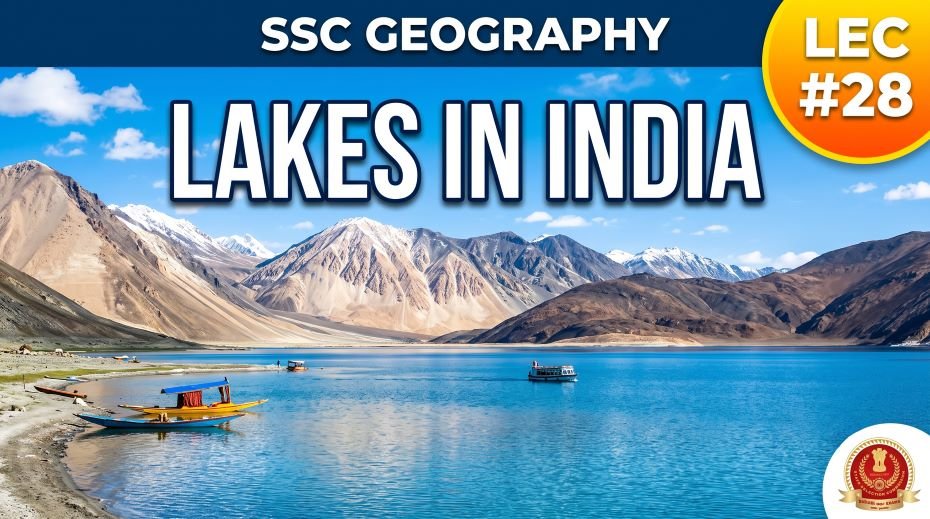
| Type | High-altitude endorheic (no outflow) saltwater lake |
| Colour | Changes from brilliant blue to green to grey depending on time of day, season, weather |
| Military Significance | Line of Actual Control (LAC) passes through the lake; India controls the north bank and part of south bank; China controls most of the north bank’s ‘fingers’ (rocky promontories); Finger 4-8 area was the site of India-China standoff in 2020 |
| 2020 Galwan/Pangong Standoff | Indian and Chinese troops face-off along Pangong’s north bank (Finger 4-8 area) – led to prolonged disengagement talks |
| Film Connection | The climax of Bollywood film ‘3 Idiots’ (2009) was filmed here; made Pangong Tso globally famous as a tourist destination |
| Nearest town | Leh (~160 km by road); Spangmik village on the south bank |
| SSC Key Facts | On India-China LAC; divided between India and China; 2020 standoff; famous from 3 Idiots; 4,350 m altitude; endorheic saltwater |
Lonar Lake – The Meteorite Crater Lake
| Parameter | Detail |
| Location | Buldhana district, Maharashtra |
| Type | Saline and alkaline meteorite impact crater lake |
| Crater age | ~50,000 years old (formed by a meteorite impact) |
| Significance | Only hyper-velocity meteorite impact crater in basaltic rock in India (and Asia); one of only 4 such craters in the world |
| Chemistry | Unique – both saline and alkaline (high pH ~10-11); has unique microbial communities adapted to extreme conditions |
| NASA Study | NASA studied the microbial life at Lonar as a potential analog for life on Mars (similar high-pH, mineral-rich environment) |
| Ramsar Site | Designated Ramsar site in 2020 |
| Wildlife | Flamingos, crocodiles, various bird species; unique algae and bacteria |
| SSC Key Facts | Maharashtra; meteorite crater; ~50,000 years old; saline + alkaline; Ramsar site 2020; NASA studied it; only such crater in basalt in Asia |
Man-Made Reservoir Lakes (Important Dams)
| Reservoir / Lake | Dam | River | State | Key SSC Fact |
| Govind Sagar | Bhakra Dam | Sutlej | Himachal Pradesh | Largest reservoir in India by volume; named after Guru Gobind Singh |
| Indira Sagar | Indira Sagar Dam | Narmada | Madhya Pradesh | Largest reservoir in India by storage capacity; on Narmada |
| Nagarjuna Sagar | Nagarjuna Sagar Dam | Krishna | Telangana | One of the largest masonry dams in world; Nagarjunakonda island submerged |
| Shivaji Sagar (Koyna) | Koyna Dam | Koyna (tributary of Krishna) | Maharashtra | Koyna Dam reservoir; Maharashtra’s largest hydroelectric project |
| Rihand Reservoir (Govind Vallabh Pant Sagar) | Rihand Dam | Rihand (tributary of Son) | Uttar Pradesh | Largest reservoir in Uttar Pradesh; supplies water to Singrauli industrial area |
| Pong Dam Lake | Pong Dam | Beas | Himachal Pradesh | Ramsar site; major wintering ground for migratory waterfowl |
| Tungabhadra Reservoir | Tungabhadra Dam | Tungabhadra (tributary of Krishna) | Karnataka | Shared between Karnataka and AP; major irrigation source |
Quick Fact Table – Lakes in India for SSC Exams
| Question / Fact | Answer |
| Largest freshwater lake in India | Wular Lake – Jammu & Kashmir (on Jhelum River) |
| Largest freshwater lake in India (alternate claim) | Kolleru Lake – Andhra Pradesh (between Krishna and Godavari) |
| Largest inland saltwater lake in India | Sambhar Lake – Rajasthan |
| Largest coastal lagoon in India | Chilika Lake – Odisha |
| Largest brackish water lake in Asia | Chilika Lake – Odisha |
| Longest lake in India | Vembanad Lake – Kerala (~96 km long) |
| Largest lake in Northeast India | Loktak Lake – Manipur |
| Largest freshwater lake in Kerala | Sasthamkotta Lake – Kollam district |
| India’s first Ramsar site (1981) | Chilika Lake – Odisha |
| Largest Ramsar site in India by area | Vembanad-Kol Wetland – Kerala |
| World’s only floating national park | Keibul Lamjao National Park – on Loktak Lake, Manipur |
| Sangai deer (brow-antlered deer) found in | Loktak Lake phumdis – Manipur |
| Phumdis are associated with | Loktak Lake – floating biomass islands |
| Most famous lake on India-China LAC | Pangong Tso – Ladakh |
| Pangong Tso – what % is in India? | ~45% in India; ~55% in China (Tibet) |
| Altitude of Pangong Tso | ~4,350 m above sea level |
| Film that made Pangong Tso famous | 3 Idiots (2009) – climax scene filmed here |
| Only meteorite crater lake in India | Lonar Lake – Buldhana district, Maharashtra |
| Lonar Lake unique chemistry | Both saline and alkaline (pH ~10-11); unique microbial life |
| Lonar Lake became Ramsar site in | 2020 |
| Char Chinar island is in which lake? | Dal Lake – Srinagar, J&K |
| Floating gardens (Rad) are in which lake? | Dal Lake – Srinagar |
| Nehru Trophy Boat Race is held on | Vembanad Lake – Alappuzha, Kerala |
| Kuttanad (below sea-level farming) is near | Vembanad Lake – Kerala |
| Sriharikota (ISRO) is on barrier island of | Pulicat Lake – AP-TN border |
| Harike Barrage is source of | Indira Gandhi Canal (Rajasthan Canal); at Beas-Sutlej confluence |
| Highest lake in India (trekking fame) | Roopkund Lake – Uttarakhand (~5,029 m) – Skeleton Lake |
| Gurudongmar Lake is sacred to | Buddhists and Sikhs (Guru Nanak legend); North Sikkim; ~5,183 m |
| Largest reservoir by storage capacity in India | Indira Sagar – Narmada, MP |
| Tsomgo Lake (Changu) is in which state? | Sikkim – on Gangtok to Nathu La route |
ALSO READ: SSC Geography Climate of India PPT (LEC #27)
PYQ:
Q1: What is the difference between Wular Lake and Kolleru Lake, both claimed as the largest freshwater lake?
This is a genuine ambiguity in Indian geography that frequently trips up SSC aspirants. Wular Lake in J&K (on the Jhelum River) is officially recognised by most sources as the largest freshwater lake in India, with a surface area that can expand to around 260 sq km during flood seasons. Kolleru Lake in Andhra Pradesh (between the Krishna and Godavari rivers) is sometimes cited as larger, particularly in older textbooks, with figures of up to 308 sq km. The confusion arises because both lakes fluctuate significantly in size with the seasons, and different surveys capture them at different water levels. For SSC exam purposes, the standard accepted answer is: Wular Lake (J&K) = largest freshwater lake in India. Kolleru is listed as a Ramsar site and large freshwater lake, and may be mentioned as the largest in some states specifically.
Q2: What makes Loktak Lake unique compared to other Indian lakes?
Loktak Lake in Manipur is unique primarily because of its phumdis – heterogeneous floating masses of vegetation, soil, and organic matter that cover significant portions of the lake’s surface. These floating islands are so substantial that they can support human settlements, and the largest phoomdi mass hosts the Keibul Lamjao National Park – the world’s only floating national park. The park is the sole natural habitat of the Sangai (brow-antlered deer), one of the world’s most endangered deer species endemic to Manipur. The Ithai Barrage on the Manipur River, built for the Loktak Hydroelectric Project, has raised the lake’s water level and damaged the phumdis, threatening the Sangai’s habitat – creating a conflict between hydroelectric development and biodiversity conservation that is a frequently referenced environmental management case study.
Q3: Why has Pangong Tso become strategically important and globally famous?
Pangong Tso, a high-altitude endorheic lake stretching ~134 km in eastern Ladakh at ~4,350 m altitude, became globally famous from two very different directions: a Bollywood film and a military standoff. The climax of the 2009 blockbuster ‘3 Idiots’ was filmed at Pangong Tso, showcasing its extraordinary blue-green colour-changing waters and making it one of the most sought-after tourist destinations in India. Militarily, the lake sits directly on the Line of Actual Control (LAC) between India and China – approximately 45% of the lake is under Indian control and 55% under Chinese control. In 2020, Indian and Chinese troops engaged in a serious standoff along the northern bank of the lake (Finger 4-8 area), with temporary construction of military infrastructure on both sides, leading to months of diplomatic and military negotiations before partial disengagement. This combination of scenic beauty, ecological significance, and strategic location makes Pangong Tso one of the most multifaceted geography topics in the SSC syllabus.
Q4: What is special about Lonar Lake that makes it scientifically significant?
Lonar Lake in Buldhana district of Maharashtra is extraordinary for multiple reasons. It is the world’s only known hyper-velocity meteorite impact crater in basaltic rock – all other meteorite crater lakes of similar scale worldwide are in granite or other crystalline rock, while Lonar is uniquely situated in the ancient Deccan Traps basalt. The impact is estimated to have occurred approximately 50,000 years ago, and the lake’s water has developed a unique dual chemistry – both saline and highly alkaline (pH around 10-11) – which has given rise to microbial communities unlike those found anywhere else on Earth. NASA has studied these microorganisms because the high-pH, mineral-rich, anaerobic conditions in parts of the lake are analogous to what scientists hypothesize may have existed on Mars. The lake was designated a Ramsar Convention wetland site in 2020, and it is a protected national geo-heritage monument.
Q5: Why is Chilika Lake considered India’s most important coastal wetland?
Chilika Lake in Odisha is India’s most important coastal wetland for several interconnected reasons. It is the largest coastal lagoon in India (~1,100 sq km) and the largest brackish water ecosystem in Asia. It was the first site in India to be designated under the Ramsar Convention on Wetlands of International Importance (in 1981). The lake hosts an extraordinary concentration of biodiversity – it is the largest wintering site for migratory waterfowl in the Indian subcontinent, with over a million birds arriving each winter from Central Asia, Siberia, and other distant origins. It is also one of the very few places in India where the Irrawaddy dolphin is found. Ecologically, it functions as a nursery for marine species and supports the livelihoods of hundreds of thousands of fisherfolk. Conservation efforts at Chilika are coordinated by the Chilika Development Authority, and the lake’s ecological health has improved significantly since the early 2000s after restoration work.
Q6: What is the ecological significance of high-altitude lakes in Ladakh?
The high-altitude lakes of Ladakh – Pangong Tso (~4,350 m), Tso Moriri (~4,522 m), Tso Kar (~4,530 m), and others – are ecologically significant as rare high-altitude wetland ecosystems that support unique biodiversity adapted to extreme cold, low oxygen, high UV radiation, and saline conditions. Tso Moriri and Tso Kar are Ramsar Convention wetlands recognised for their role as nesting and breeding habitat for the black-necked crane (Grus nigricollis) – a rare and endangered bird that nests only at high altitude in Central Asia and Tibet. The lakes also support bar-headed geese, Brahminy ducks, and other high-altitude waterbirds. Ecologically, these are endorheic (closed) basins – water flows in but does not flow out, concentrating salts over time. Climate change poses a significant threat to these lakes through changing precipitation patterns and potential increased evaporation.
Q7: What is the Nehru Trophy Boat Race and why is Vembanad Lake significant?
The Nehru Trophy Boat Race is India’s most famous snake boat race, held annually on Vembanad Lake at Alappuzha (Alleppey) in Kerala. It features chundan vallams – traditional Keralan snake boats measuring up to 130 feet long and powered by up to 100 oarsmen rowing in unison to traditional songs. The race was first held in 1952 on the suggestion of Prime Minister Jawaharlal Nehru, who was fascinated by the snake boats, and has been held every August since. Vembanad Lake itself is the largest lake in Kerala and the longest lake in India (~96 km), forming the backbone of the famous Kerala Backwaters network. The lake is a Ramsar-listed wetland (as the Vembanad-Kol Wetland – the largest Ramsar site in India by area), and its southern end, Kuttanad, is famous for paddy cultivation conducted below sea level – one of the few places in the world where this is done.
Rapid Revision Cheat Sheet – Lakes in India
| Topic | Key Point |
| Largest freshwater lake | Wular Lake – J&K (on Jhelum River) |
| Largest inland saltwater lake | Sambhar Lake – Rajasthan |
| Largest coastal lagoon | Chilika Lake – Odisha |
| Largest brackish lake in Asia | Chilika Lake – Odisha |
| Longest lake in India | Vembanad Lake – Kerala (~96 km) |
| Largest lake in NE India | Loktak Lake – Manipur |
| Largest freshwater lake in Kerala | Sasthamkotta Lake – Kollam |
| India’s first Ramsar site (1981) | Chilika Lake – Odisha |
| Largest Ramsar site in India | Vembanad-Kol Wetland – Kerala |
| World’s only floating national park | Keibul Lamjao – on Loktak Lake, Manipur |
| Sangai deer habitat | Phumdis of Loktak Lake, Manipur |
| Phumdis | Floating biomass islands – unique to Loktak Lake |
| Pangong Tso | India-China LAC; 45% India/55% China; 4,350 m; 2020 standoff; 3 Idiots film |
| Lonar Lake | Meteorite crater; Maharashtra; Ramsar 2020; saline+alkaline; NASA studied |
| Chilika Lake highlights | Irrawaddy dolphins; migratory birds (1 million+); first Ramsar site; Nalbana Island |
| Dal Lake features | Srinagar; houseboats; Shikara; floating gardens (Rad); Char Chinar island |
| Vembanad highlights | Nehru Trophy Boat Race; Kuttanad; Ramsar; longest lake |
| Gurudongmar Lake | North Sikkim; ~5,183 m; sacred to Buddhists and Sikhs |
| Roopkund Lake | Uttarakhand; ~5,029 m; Skeleton Lake; hundreds of ancient skeletons found |
| Tsomgo/Changu Lake | Sikkim; ~3,780 m; on Gangtok-Nathu La route; tourist lake |
| Tso Moriri | Ladakh; ~4,522 m; Ramsar; black-necked crane |
| Tso Kar | Ladakh; ~4,530 m; White Lake; Ramsar; black-necked crane |
| Sriharikota (ISRO) is on | Barrier island separating Pulicat Lake from Bay of Bengal |
| Harike wetland | Punjab; Beas-Sutlej confluence; source of Indira Gandhi Canal |
| Ashtamudi Lake | Kerala; 8-armed shape; Ramsar; Kollam |
| Govind Sagar reservoir | Bhakra Dam on Sutlej, HP – largest reservoir by volume in India |
| Indira Sagar reservoir | Narmada, MP – largest reservoir by storage capacity |
| Kolleru Lake | AP; between Krishna and Godavari deltas; Ramsar; freshwater |
| Sambhar Lake Ramsar | Rajasthan; 1990; saline; flamingos; salt production |
| Serial number of this PPT | #106 in the Complete Foundation Batch |
Conclusion
Lakes in India is a topic where precise facts yield consistent marks – the largest, longest, first Ramsar site, floating national park, and special geological features are all directly and repeatedly tested in SSC and RRB papers. The critical anchor facts are: Wular = largest freshwater lake; Sambhar = largest inland saltwater lake; Chilika = largest coastal lagoon and first Ramsar site; Vembanad = longest lake; Loktak = NE India’s largest with floating NP; Pangong Tso = strategic LAC lake; Lonar = meteorite crater.
The SSC Geography Lakes in India PPT (LEC #28), Serial #106, available at slideshareppt.net in bilingual Hindi + English format across 116 slides, gives you the complete visual companion for this topic. Study the classification table, the Ramsar sites table, and the special features of each major lake. Use the Rapid Revision Cheat Sheet in your final week. This topic reliably delivers 2–4 marks per SSC or RRB paper.