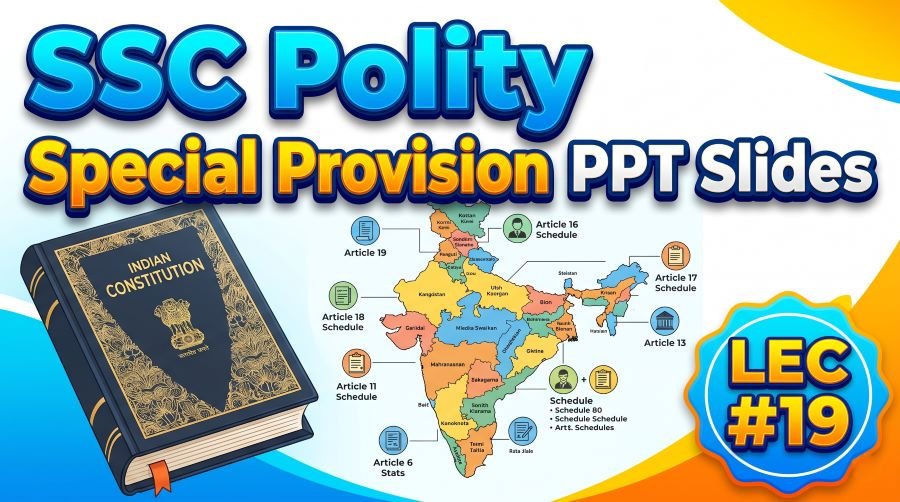
This article covers SSC Polity Special Provisions PPT Slides (LEC #19), (विशेष प्रावधान), part of the Complete Foundation Batch PPT Series at slideshareppt.net. This lecture covers Part XXI of the Constitution (Articles 369–392), the special provisions for certain states under Articles 371–371J, Emergency provisions, Fundamental Duties, Official Language provisions, and the 5th and 6th Schedules. These are consistently tested in SSC CGL, CHSL, CPO, and MTS exams – questions on Article 370 (abrogated), Article 371A (Nagaland), state-wise special provisions, and Emergency provisions appear every year.
SSC Polity Special Provisions PPT Slides (LEC #19)
Note: Above is PPT in GOOGLE SLIDES (HTML AND IFRAME COMBINATION) and if you wish to download the Complete SSC series (PPT slides), Simply visit this redirect page – REDIRECT PAGE.
1. Part XXI – Temporary, Transitional and Special Provisions
Part XXI of the Indian Constitution (Articles 369–392) contains provisions that were originally temporary or transitional in nature. Over time, some have lapsed while others have become permanent fixtures, especially the special provisions for certain states.
Article
Subject
Article 369
Temporary power to Parliament to make laws with respect to certain matters in State List as if they were in Concurrent List (lapsed)
Article 370
Special provisions for J&K – ABROGATED on 5 August 2019 by Presidential Order
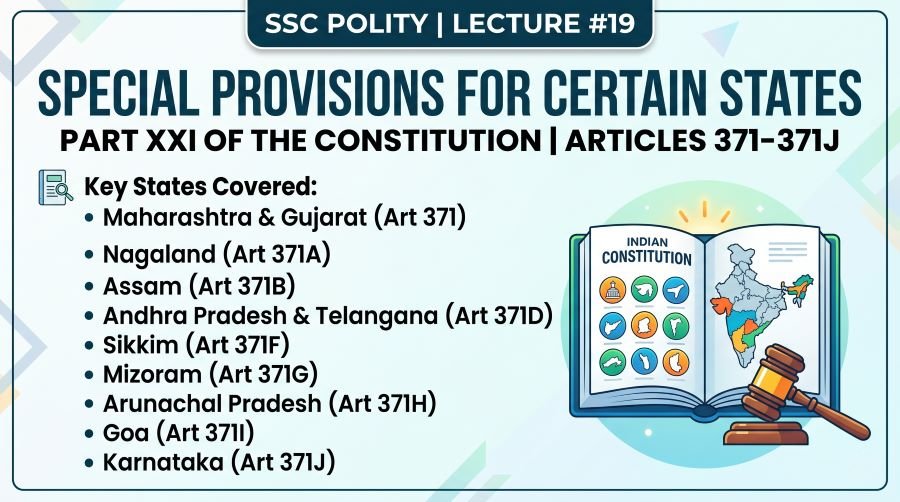
Article 371 to 371J
Special provisions for certain states (Maharashtra, Gujarat, Nagaland, Assam, Manipur, AP/Telangana, Sikkim, Mizoram, Arunachal Pradesh, Goa, Karnataka)
Article 372
Continuance of existing laws and their adaptation
Article 373
Power of President to make order in respect of persons under preventive detention
Article 374
Provisions as to judges of Federal Court and proceedings pending in Federal Court (transitional – lapsed)
Article 375
Courts, authorities, officers to continue to function
Article 376
Provisions as to Judges of High Courts (transitional)
Article 377
Provisions as to Comptroller and Auditor-General of India (transitional)
Article 378
Provisions as to Public Service Commissions (transitional)
Article 392
Power of President to remove difficulties (transitional)
2. Article 370 – Special Status of J&K (Abrogated)
Article 370 was placed in Part XXI as a ‘temporary provision’ – its heading said ‘Temporary provisions with respect to the State of Jammu and Kashmir’
It gave J&K a special autonomous status: Union Parliament could only legislate on Defence, Foreign Affairs, Finance, and Communications without state concurrence
J&K had its own Constitution (adopted 1956), its own flag, and its own citizenship
5 August 2019: Presidential Order (C.O. 272) effectively abrogated Article 370
J&K Reorganisation Act 2019 passed: J&K bifurcated into two Union Territories – J&K (with legislature) and Ladakh (without legislature)
Supreme Court upheld abrogation in December 2023 (Dr. S. Maqbool Case); directed elections to J&K assembly by September 2024
Article 35A (which gave J&K power to define ‘permanent residents’) also ceased to exist after abrogation
3. Special Provisions for Certain States – Articles 371 to 371J
Articles 371 to 371J provide special protections and provisions for certain states to preserve their unique regional, tribal, cultural, and historical characteristics. These are NOT separatist provisions – they operate within the framework of the Indian Union.
Article
State(s)
Special Provision
Added By / Year
Article 371
Maharashtra and Gujarat
President may establish separate development boards for Vidarbha, Marathwada (in Maharashtra) and Saurashtra, Kutch (in Gujarat); equitable allocation of funds and opportunities in education and public employment
Original Constitution 1950; reworded by 7th Amendment 1956
Article 371A
Nagaland
Acts of Parliament do NOT apply to Nagaland with respect to: Naga customary law and procedure; ownership and transfer of land and its resources; without prior resolution of State Assembly accepting that law
13th Amendment Act 1962
Article 371B
Assam
President may provide for constitution and functions of a committee of the Assembly consisting of members from Tribal Areas
22nd Amendment Act 1969
Article 371C
Manipur
President may provide for a committee of members of Legislative Assembly from Hill Areas; special responsibility of Governor for proper functioning of such committee
27th Amendment Act 1971
Article 371D
Andhra Pradesh (now also Telangana)
Equitable opportunities and facilities to people of different parts of the state in public employment and education; President may provide for local cadres; administrative tribunal for state services
32nd Amendment Act 1973
Article 371E
Andhra Pradesh
Parliament may by law provide for establishment of a university in Andhra Pradesh
32nd Amendment Act 1973
Article 371F
Sikkim
Rights and interests of Sikkim’s population to be protected; existing laws to continue; Governor has special responsibilities
36th Amendment Act 1975 – when Sikkim became 22nd state
Article 371G
Mizoram
Acts of Parliament do NOT apply to Mizoram with respect to: Mizo customary law and procedure; ownership and transfer of land and its resources; without prior resolution of State Assembly
53rd Amendment Act 1986
Article 371H
Arunachal Pradesh
Governor has special responsibility with respect to law and order; Governor acts in individual judgment in discharge of this responsibility
55th Amendment Act 1986
Article 371I
Goa
Minimum strength of the Goa Legislative Assembly shall be 30 members (though current actual strength is 40)
56th Amendment Act 1987
Article 371J
Karnataka
President may provide for establishment of a separate development board for Hyderabad-Karnataka region; equitable opportunities in public employment and education for people of that region
98th Amendment Act 2012
Key Points on Special Provisions
Articles 371A (Nagaland) and 371G (Mizoram) give the strongest protection – Parliament’s laws on customary law and land do not apply without prior State Assembly resolution
Article 371F (Sikkim) was added by 36th Amendment 1975 when Sikkim merged with India
Article 371J (Karnataka) is the most recently added – 98th Amendment 2012
Article 371D (Andhra Pradesh) extends to Telangana after the AP Reorganisation Act 2014
These provisions cannot be amended easily – they protect minority/tribal interests within states
4. Fifth and Sixth Schedules – Scheduled and Tribal Areas
Feature
Fifth Schedule
Sixth Schedule
Article
Article 244(1)
Article 244(2) and Article 275(1)
Applicable to
Scheduled Areas in states other than Assam, Meghalaya, Tripura, Mizoram
Tribal Areas in Assam, Meghalaya, Tripura, Mizoram
Autonomous District Councils: elected + nominated; can make laws on specified subjects
Governor’s power
Can direct that a law of Parliament/State Legislature shall not apply or apply with modifications to Scheduled Area
ADCs can make laws on land management, forests, use of waterways, agriculture, money lending; require Governor’s assent
President’s role
Can increase/decrease Scheduled Areas; direct that a state is not a Scheduled Area state
Can alter boundaries of autonomous districts
Autonomous District Councils (ADCs) – Sixth Schedule
ADCs are the key feature of the Sixth Schedule – they have legislative, executive, and judicial powers
ADCs can make laws on: land management, forests, use of waterways, regulation of shifting cultivation, establishment of village administration, money lending, social customs
Laws made by ADCs require assent of the Governor
ADC Courts can try cases involving tribals; appeal to HC
Important ADCs: Bodoland Territorial Council (Assam), Garo Hills ADC (Meghalaya), Mizo District Council, Tripura Tribal Areas ADC
5. Emergency Provisions – Articles 352, 356, 360
Type
Article
Grounds
Declaration By
Approval
Duration
Effect
National Emergency
352
War, external aggression, armed rebellion
President on written advice of Union Cabinet
Both Houses: 2/3 majority of members present + voting AND majority of total membership; within 1 month
6 months at a time; extendable
Art 19 suspended; Centre legislates on State List; fundamental rights curtailed
President’s Rule (State Emergency)
356
Failure of constitutional machinery in state; Governor’s report
President
Both Houses by simple majority within 2 months
Maximum 3 years (6 months at a time)
State legislature dissolved/suspended; Centre controls state; Governor is agent of Centre
Financial Emergency
360
Financial stability or credit of India or any state threatened
President
Both Houses by simple majority within 2 months
No maximum limit; continues as long as approved
Centre can reduce salaries of all government servants including judges; state money bills need President’s assent
National Emergency – Key Facts for SSC
Article 352 – National Emergency can be proclaimed due to: War, External Aggression, Armed Rebellion
44th Amendment 1978 changed ‘internal disturbance’ to ‘Armed Rebellion’ (much harder to invoke)
44th Amendment 1978 also required written recommendation of Cabinet (not just PM) before President can proclaim
Both Houses must approve within 1 month by special majority (2/3 of present + voting AND majority of total membership)
Lok Sabha can pass resolution by simple majority to revoke National Emergency
SSC Polity Special Provisions PPT Slides (LEC #19)
6. Fundamental Duties – Part IV-A, Article 51A
Fundamental Duties were added to the Indian Constitution by the 42nd Constitutional Amendment 1976 on the recommendation of the Swaran Singh Committee. Originally 10 duties; an 11th was added by the 86th Amendment 2002.
Duty No.
Fundamental Duty (Article 51A)
(a)
Abide by the Constitution and respect its ideals and institutions, the National Flag and the National Anthem
(b)
Cherish and follow the noble ideals which inspired our national struggle for freedom
(c)
Uphold and protect the sovereignty, unity and integrity of India
(d)
Defend the country and render national service when called upon to do so
(e)
Promote harmony and the spirit of common brotherhood amongst all the people of India transcending religious, linguistic and regional or sectional diversities; renounce practices derogatory to the dignity of women
(f)
Value and preserve the rich heritage of our composite culture
(g)
Protect and improve the natural environment including forests, lakes, rivers, and wildlife; have compassion for living creatures
(h)
Develop the scientific temper, humanism, and the spirit of inquiry and reform
(i)
Safeguard public property and abjure violence
(j)
Strive towards excellence in all spheres of individual and collective activity so that the nation constantly rises to higher levels of endeavour and achievement
(k)
Provide opportunities for education to his child or ward between the age of 6 and 14 years (added by 86th Amendment 2002)
Key Facts on Fundamental Duties
Added by: 42nd Amendment 1976 (duties a to j); 86th Amendment 2002 (duty k)
Recommended by: Swaran Singh Committee (1976)
Part: Part IV-A of the Constitution
Article: Article 51A
Nature: Non-justiciable – cannot be enforced through courts
Inspired by: Article 29(1) of the Constitution of the USSR (Soviet Union)
Verma Committee (1999): identified laws implementing Fundamental Duties
7. Official Language Provisions – Part XVII (Articles 343–351)
Article
Subject
Article 343
Official language of Union – Hindi in Devanagari script; numerals – international form of Indian numerals; English to continue for 15 years (then extended by Parliament)
Article 344
Commission and Committee of Parliament on official language
Article 345
Official languages of a State – state can adopt any language in 8th Schedule or Hindi
Article 346
Official language for communication between states and between states and Union
Article 347
Special provision for language spoken by substantial proportion of population of a state
Article 348
Language to be used in SC and HCs; Acts and Bills – English; but state can use state language with Governor’s assent
Article 349
Special procedure for enactment of certain laws related to language
Article 350
Right to submit representations for redress of grievances in any language
Article 350A
Provision for instruction in mother tongue at primary stage
Article 350B
Special Officer for Linguistic Minorities – appointed by President
Article 351
Directive for development of the Hindi language
Key Points on Official Language
Hindi in Devanagari script is the official language of the Union (Article 343) – NOT the national language
English was to be used for 15 years from 1950 (till 1965); but Parliament extended its use by the Official Languages Act 1963
English continues to be used for official purposes of the Union alongside Hindi
States can adopt any of the 22 languages in 8th Schedule or Hindi as their official language
Article 350B – Special Officer for Linguistic Minorities appointed by President; investigates matters relating to linguistic minorities; reports to President who places it before Parliament
8th Schedule currently has 22 official languages; originally had 14 (1950)
8. Comptroller and Auditor General (CAG) – Article 148
CAG is a constitutional post under Article 148
Appointed by President of India; serves as guardian of public finances
CAG audits accounts of Union Government, State Governments, and all bodies receiving grants from Government
CAG reports submitted to President (Union) and Governors (States); laid before respective legislatures
Removed same as SC judge – address by both Houses + President’s order
CAG cannot hold further office under Central or State government after retirement
CAG’s salary charged to Consolidated Fund of India – non-votable
Public Accounts Committees (Parliament and States) examine CAG’s audit reports
Current CAG (2024): Girish Chandra Murmu (appointed August 2020)
9. NITI Aayog and Other Key Constitutional / Statutory Bodies