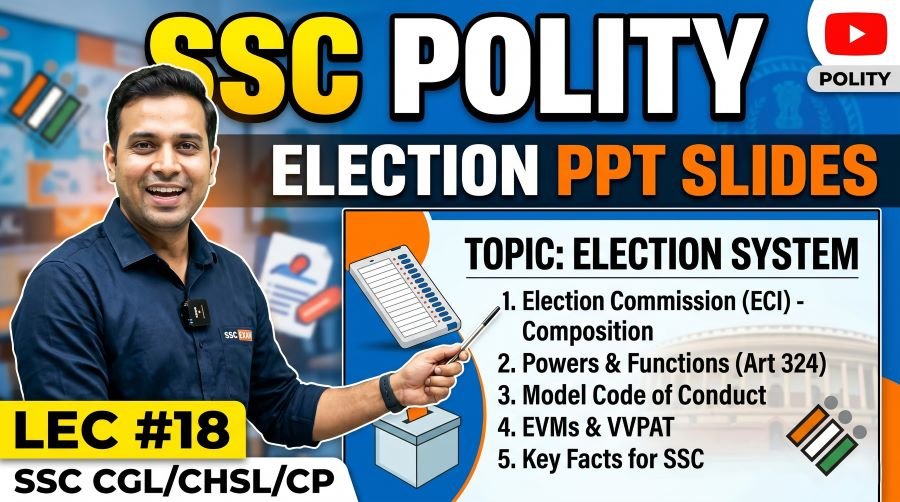
This article covers SSC Polity Election PPT Slides (LEC #18) – Election (चुनाव), part of the Complete Foundation Batch PPT Series at slideshareppt.net. Elections and the Election Commission are among the most frequently tested topics in SSC CGL, CHSL, CPO, and MTS exams. Questions are asked on Article 324, composition of ECI, CEC appointment and removal, types of elections, voting age (61st Amendment), FPTP vs STV, Model Code of Conduct, EVMs, political party recognition, and disqualification of candidates.
Note: Above is PPT in GOOGLE SLIDES (HTML AND IFRAME COMBINATION) and if you wish to download the Complete SSC series (PPT slides), Simply visit this redirect page – REDIRECT PAGE.
1. Elections in India – Introduction
India is the world’s largest democracy; conducts the largest elections in the world
Elections are the foundation of democratic governance – citizens choose their representatives
The Indian Constitution provides for Universal Adult Franchise (Article 326) – every citizen above 18 years has the right to vote
Part XV of the Constitution (Articles 324–329) deals with Elections
The Election Commission of India (ECI) is the independent constitutional body that oversees all elections
National Voters’ Day: 25 January (anniversary of ECI’s establishment in 1950)
2. Key Constitutional Articles – Elections
Article
Subject
Article 324
Superintendence, direction and control of elections vested in Election Commission
Article 325
No person to be ineligible for inclusion in electoral rolls on grounds of religion, race, caste or sex
Article 326
Elections to Lok Sabha and State Assemblies on basis of adult suffrage; minimum voting age 18 years
Article 327
Power of Parliament to make provisions with respect to elections to legislatures
Article 328
Power of State Legislatures to make provisions with respect to elections to such legislature
Article 329
Bar on courts to interfere with electoral matters (except election petition under law made by Parliament)
Article 243K
State Election Commission for Panchayat elections
Article 243ZA
State Election Commission for Municipality elections
Article 54
Election of President by Electoral College
Article 66
Election of Vice President by both Houses of Parliament
Article 80
Election of Rajya Sabha members by elected MLAs
Article 81
Election of Lok Sabha members by direct election
3. Election Commission of India – Article 324
Feature
Details
Constitutional Article
Article 324
Nature
Constitutional body; independent of Legislature and Executive
Same as removal of a Supreme Court judge – address by both Houses of Parliament (2/3 majority + majority of total membership) + President’s order
Removal of EC
On recommendation of CEC; by President; cannot be removed arbitrarily (91st Amendment 2023 – now same as CEC)
Salary charged to
Consolidated Fund of India (non-votable)
Headquarters
Nirvachan Sadan, Ashoka Road, New Delhi
First CEC of India
Sukumar Sen (1950–1958)
Current CEC (2024)
Rajiv Kumar (appointed 2022; term till 2025)
Chief Election Commissioner and Other Election Commissioners (Appointment, Conditions of Service and Term of Office) Act 2023
Changed appointment process – now Search Committee + Appointment Committee (PM + Leader of Opposition + Cabinet Minister nominated by PM)
Independence of Election Commission
CEC cannot be removed except by the same procedure as removal of a Supreme Court judge – provides strong security of tenure
Salary and service conditions of CEC and ECs charged to Consolidated Fund of India – not subject to Parliamentary vote
Service conditions of CEC and ECs cannot be varied to their disadvantage after appointment
The ECI operates independently of the Central and State governments
Courts cannot interfere in electoral matters during the election process (Article 329); only election petitions allowed after results
Chief Election Commissioner and Other ECs (Appointment) Act 2023
Passed in December 2023 by Parliament – new law for appointment of CEC and ECs
Appointment Committee: Prime Minister (Chair) + Leader of Opposition in Lok Sabha + one Cabinet Minister nominated by PM
Search Committee: Cabinet Secretary + 2 senior Secretaries to Government of India – prepares a panel of 5 names
Supreme Court in Anoop Baranwal Case (2023) had directed that ECs should be appointed by a committee including CJI; this Act replaced CJI with a Cabinet Minister
4. Functions of the Election Commission of India
Function
Details
Superintendence of elections
Overall control and direction over elections to Parliament, state legislatures, and offices of President and VP
Preparation of electoral rolls
Prepares and periodically revises electoral rolls for Lok Sabha, Rajya Sabha, and state assemblies
Delimitation of constituencies
Works with Delimitation Commission; notifies delimitation orders
Recognition of political parties
Recognises national and state parties; allots election symbols
Model Code of Conduct (MCC)
Enforces MCC from date of announcement of elections till results; ensures level playing field
Indirect; Proportional Representation by Single Transferable Vote
Election Commission of India
Vice President of India
Both Houses of Parliament (elected + nominated)
Indirect; Proportional Representation by Single Transferable Vote
Election Commission of India
Panchayat elections
Registered voters in that panchayat area
Direct election
State Election Commission
Municipality elections
Registered voters in that municipal ward
Direct election
State Election Commission
FPTP vs STV – Key Difference
FPTP (First Past The Post): candidate with highest number of votes wins; used for Lok Sabha and State Assembly elections; simple and fast but may not reflect proportional preference
STV (Single Transferable Vote / Proportional Representation): voter ranks candidates in preference order; used for President, VP, Rajya Sabha, Vidhan Parishad elections; ensures proportional representation
6. Universal Adult Franchise and Voting Age
Article 326 provides for election to Lok Sabha and State Assemblies on the basis of adult suffrage
Every person who is a citizen of India and is not less than 18 years of age is entitled to be registered as a voter
No person shall be ineligible on grounds of religion, race, caste, sex, or any of them (Article 325)
Disqualification grounds: non-residence, unsound mind, crime, corrupt or illegal practice
Amendment
Year
Change
61st Constitutional Amendment
1988
Reduced voting age from 21 years to 18 years (Article 326)
Original Constitution (1950)
1950
Voting age was 21 years
Representation of the People Act 1950
1950
Governed preparation of electoral rolls; voting age 21
Representation of the People Act 1951
1951
Governs conduct of elections; disqualifications; election disputes
7. Model Code of Conduct (MCC)
The Model Code of Conduct is a set of guidelines issued by the Election Commission of India
It is NOT statutory – based on ECI’s constitutional authority under Article 324
Comes into force from the date of announcement of the election schedule
Remains in force till the date of declaration of results
MCC applies to: political parties, candidates, and the ruling government at Centre and State
Under MCC: government cannot announce new schemes, make new appointments, use government machinery for campaigning
Candidates cannot bribe voters, use caste/religion for votes, use government resources
ECI can issue notices, warnings, and recommend prosecution for MCC violations
8. Electronic Voting Machines (EVM) and VVPAT
EVM – Electronic Voting Machine
Introduced to replace paper ballot boxes and reduce electoral malpractice
Pilot testing: 1982 in Paravur constituency, Kerala (70 polling booths)
Used in all constituencies nationally from 2004 General Elections onwards
EVM consists of two units: Ballot Unit (at polling booth) + Control Unit (with Presiding Officer)
EVM is standalone – not connected to internet; cannot be hacked remotely
Manufactured by: Bharat Electronics Limited (BEL) and Electronics Corporation of India Limited (ECIL)
VVPAT – Voter Verifiable Paper Audit Trail
Attached to EVM; prints a paper slip showing the party symbol and candidate name for whom the vote was cast
Voter can verify their vote was correctly recorded; slip automatically drops into sealed box
Pilot testing: 2013 in Noksen constituency, Nagaland
Implemented in all polling stations nationally from 2019 General Elections
VVPAT slips are counted in case of disputes or random verification
9. Recognition of Political Parties
Category
Criteria for Recognition
Benefits
National Party
Wins 2% of seats in Lok Sabha from at least 3 states; OR gets 6% of valid votes in 4 or more states + wins 4 LS seats; OR wins 10 LS seats
Reserved election symbol throughout India; VVIP security; office space; broadcast time on Doordarshan/AIR
State Party
Gets 6% of valid votes in the state + wins 2 seats in assembly; OR wins 3% of seats or 3 seats in state assembly
Reserved election symbol in that state; office space in state
Registered (Unrecognised) Party
Registered with ECI but not fulfilling above criteria
Can use a symbol but not reserved; no other special benefits
Current National Parties in India (2024)
Bharatiya Janata Party (BJP)
Indian National Congress (INC)
Bahujan Samaj Party (BSP)
Communist Party of India (Marxist) – CPI(M)
National People’s Party (NPP)
Aam Aadmi Party (AAP)
Note: Number of national parties changes based on election performance; ECI periodically reviews recognition
10. Delimitation of Constituencies
Delimitation = redrawing of boundaries of electoral constituencies based on population changes
Delimitation Commission: statutory body constituted by Parliament under Delimitation Act
Members: Retired SC judge (Chairman) + CEC + State Election Commissioner of concerned state
Delimitation Commission’s orders have force of law; cannot be challenged in any court
Delimitations done in: 1952, 1963, 1973, 2002 (based on 2001 census; used for 2008 elections)
Article 82 – After every census, Parliament shall readjust the allocation of seats and delimitation of constituencies
After 84th Amendment 2001: delimitation of constituencies frozen till after 2026 to not penalise states for population control
Next delimitation: after 2026 (based on post-2026 census)
11. Disqualification of Candidates and Members
Ground
Provision
Conviction with 2+ years imprisonment
Representation of People Act 1951 (Section 8); disqualified for 6 years after release
Corrupt practices at elections
RPA 1951 (Section 8A); disqualified for 6 years
Dismissed from government service for corruption
RPA 1951
Interest in government contracts
RPA 1951
Failure to lodge election expense accounts
RPA 1951
Anti-Defection Law (10th Schedule)
Voluntarily giving up party membership; voting against party whip
Office of profit
Article 102 / 191 – holding office of profit under Centre or State Government
Unsound mind / insolvency
Article 102 / 191
Lily Thomas Case (2013) – Landmark SC Judgment
SC held: Section 8(4) of RPA 1951 (which allowed convicted MPs/MLAs to continue till appeal decided) is unconstitutional
Now: if an MP/MLA is convicted with 2+ years sentence, disqualification is immediate – no protection during appeal period
This judgment was based on Article 102(1)(e) and Article 191(1)(e) read with RPA 1951
SSC Polity Election PPT Slides (LEC #18)
12. Election Commission of India vs State Election Commission
Lok Sabha, Rajya Sabha, State Assemblies, President, VP
Panchayats and Municipalities in that state
Appointment
CEC and ECs appointed by President
State Election Commissioner appointed by Governor
Removal
CEC: same as SC judge; ECs: on CEC’s recommendation
Same as HC judge
Salary charged to
Consolidated Fund of India
Consolidated Fund of State
Relationship
National body; independent of states
State body; independent of state government
Model Code of Conduct
Enforced for all elections under ECI
Not formally applicable
13. Election Petitions and Disputes
After declaration of election results, a person can challenge the election by filing an election petition
Election petition for Lok Sabha and State Assembly: filed in the High Court within 45 days of declaration of results
High Court can declare election void; order fresh elections; or declare another candidate elected
Appeal from HC: to Supreme Court
Election of President and VP: disputes decided by Supreme Court (Article 71)
Article 329 – Bar on courts: no court shall question the validity of any law relating to delimitation OR question election of any person to Parliament or State Legislature except by election petition as provided in law
14. Quick Revision Fact Table – Elections
Fact
Detail
Election Commission established
25 January 1950 – celebrated as National Voters’ Day since 2011
Article 324
Vests superintendence of elections in Election Commission
First CEC of India
Sukumar Sen (1950–1958)
Multi-member ECI
Became multi-member in 1989; originally single-member (only CEC)
Voting age reduced to 18
61st Constitutional Amendment 1988; effective for 1989 General Elections
Universal Adult Franchise
Article 326; every citizen 18+ can vote regardless of caste, religion, sex, literacy
FPTP System
First Past The Post – candidate with most votes wins; used for LS and Vidhan Sabha
STV System
Single Transferable Vote – used for President, VP, RS, Vidhan Parishad elections
Model Code of Conduct
Not statutory – enforced by ECI’s moral authority; comes into force from election announcement
EVM introduced
Pilot tested 1982 (Paravur, Kerala); used nationally from 2004
VVPAT introduced
Pilot 2013 (Noksen, Nagaland); full implementation from 2019 General Elections
Total Lok Sabha seats
543 (currently; max 552 possible)
Total Rajya Sabha seats
245 (233 elected + 12 nominated)
Total State Assembly seats (approximate)
4,120+ across all states and UTs with legislature
Election petition
Filed in High Court within 45 days of declaration of result (RPA 1951)
Delimitation Commission
Statutory body; constituted by Parliament; last delimitation done for 2008 elections; next after 2026
NOTA option
None of the Above option introduced in 2013 by ECI
Anti-defection – EC’s role
ECI advises President/Governor on disqualification of MPs/MLAs under Art 103/192
Proxy voting
Allowed for service voters (NRI voters since 2011 can enrol but physically vote)
CEC appointment (post-2023 Act)
Search Committee recommends; Appointment Committee: PM + Leader of Opposition + one Cabinet Minister nominated by PM