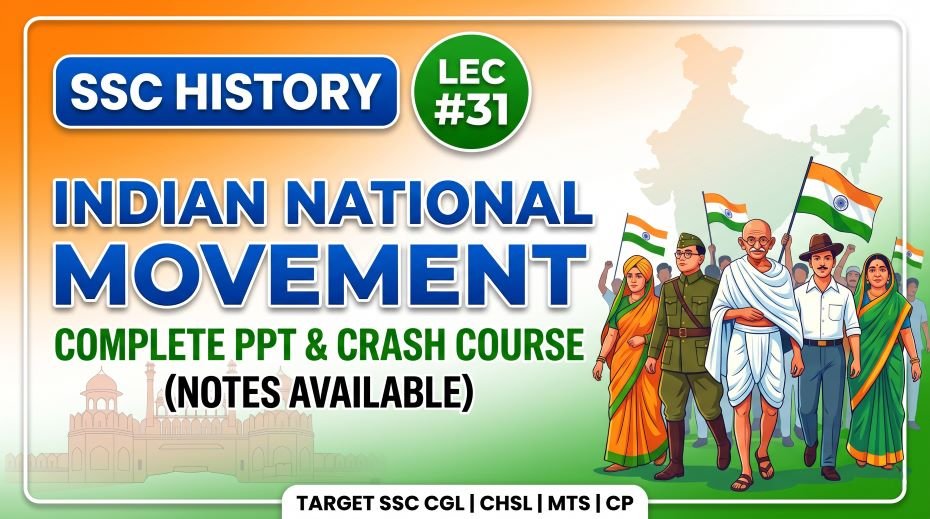
So, this is Lecture 31 (SSC History Indian National Movements PPT (LEC #31)) of the Complete Foundation Batch for All SSC Exams – PPT Series by SlidesharePPT. This is the single largest lecture in the entire History series – covering Modern Indian History: Indian National Movement (भारतीय राष्ट्रीय आंदोलन) from the founding of INC in 1885 to Indian Independence on August 15, 1947. With 403 slides and 105 MB of content, this is the most comprehensive PPT on India’s freedom struggle available for SSC preparation.
In this article, you will find a complete study guide built around the 403-slide PPT – including a 56-entry master timeline, all six phases of the national movement, detailed Swadeshi Movement notes, Khilafat + Non-Cooperation Movement breakdown, all major constitutional proposals from Morley-Minto (1909) to the Mountbatten Plan (1947), a complete Road to Independence section (1942–1947), Podcast-style Q&A on the most confusing topics, and 30 practice MCQs with answers. This chapter alone accounts for 15 to 20 direct MCQs in almost every SSC CGL, SSC CHSL, SSC MTS, SSC GD Constable, and RRB Group D paper.
The PPT slides are embedded below – self-made, regularly updated, and fully ready for online and offline classroom use. Whether you are a teacher running a regular batch or a full marathon revision session before exams, or a student doing last-minute SSC preparation, you can view and navigate all 403 slides directly on any device – no download needed.
Section 1: PPT Resource Overview
| PPT RESOURCE OVERVIEW – LEC #31 | |
| Complete Foundation Batch for All SSC Exams | History PPT Series | Indian National Movement – 403 Slides | |
| Lecture Title | Indian National Movement (भारतीय राष्ट्रीय आंदोलन) |
| Lecture Number | Lecture 31 (LEC #31) |
| Serial Number | #56 in the Complete Foundation Batch PPT Series |
| Total Slides | 403 PPT Slides – LARGEST lecture in the entire History series |
| File Size | 105 MB |
| Subject | Modern Indian History |
| Series Name | Complete Foundation Batch for All SSC and Other Competitive Exams (PPT SERIES) |
| Target Exams | SSC CGL | SSC CHSL | SSC MTS | SSC GD Constable | RRB Group D | UPSC Prelims | State PSC |
| Topics Covered | Swadeshi Movement → Partition of Bengal → Morley-Minto → Lucknow Pact → Rowlatt Act → Jallianwala Bagh → Non-Cooperation + Khilafat → Simon Commission → Civil Disobedience → Round Table Conferences → Communal Award + Poona Pact → GoI Act 1935 → Cripps Mission → Quit India → Cabinet Mission → Partition → Independence 1947 |
| Key Events | Partition of Bengal (1905) → Jallianwala Bagh (1919) → Dandi March (1930) → Quit India (1942) → Direct Action Day (1946) → Independence (Aug 15, 1947) |
| Difficulty Level | Moderate – high volume but very pattern-based; movements + dates + leaders repeat every year |
| Recommended Study | 4 to 5 days (first read) | 1 to 2 days (revision using tables) |
| PPT Source | slideshareppt.net |
| Best Combined With | LEC #29 (INC) + LEC #30 (Political Associations) – all three together = complete Modern Indian History |
| Exam Tip: 15–20 direct MCQs from National Movements – the single largest question source in SSC Modern History | |
SSC History Indian National Movements PPT (LEC #31)
Note: Above is (HTML AND IFRAME COMBINATION) and if you wish to download the Complete SSC series (PPT slides), Simply visit this redirect page – REDIRECT PAGE.
Section 2: Master Timeline – Indian National Movement (1885–1947)
56 key events in chronological order. Revise this table daily in the final 2 weeks before your exam – it covers the majority of SSC Modern History MCQs.
| Year | Event | Details & SSC Significance |
| 1885 | INC Founded – Bombay | A.O. Hume; W.C. Bonnerjee first president; moderate phase begins; 72 delegates |
| 1893 | Gandhi goes to South Africa | Stays 21 years; develops satyagraha; returns January 9, 1915 |
| 1905 | Partition of Bengal – Oct 16 | Lord Curzon; Hindu-Muslim divide; triggers Swadeshi Movement; biggest political mistake |
| 1905 | Swadeshi Movement begins | Boycott British goods; use Indian goods; bonfire of foreign cloth; Tilak leads in Maharashtra; Aurobindo + Bipin Pal in Bengal |
| 1906 | Muslim League founded – Dhaka | Nawab Salimullah + Aga Khan; separate Muslim political organization |
| 1906 | ‘Swaraj’ first demanded at INC – Calcutta | Dadabhai Naoroji presiding; historic session |
| 1907 | Surat Split – INC divides | Moderates vs Extremists; Tilak expelled; INC weakened till 1916 |
| 1909 | Morley-Minto Reforms | Separate Muslim electorates introduced for first time; Indian Councils Act 1909 |
| 1911 | Partition of Bengal ANNULLED | Delhi Durbar; King George V; Bengal reunited; capital shifted to Delhi |
| 1915 | Gandhi returns to India – Jan 9 | Observes India for 1 year as Gokhale advised; Champaran 1917 is first action |
| 1916 | Lucknow Pact – INC + Muslim League | Tilak + Jinnah; joint demands; Hindu-Muslim unity moment; INC reunites Moderates + Extremists |
| 1916 | Home Rule League – Tilak (April) + Besant (Sept) | Mass political agitation for self-government |
| 1917 | Champaran Satyagraha | Gandhi’s first satyagraha in India; tinkathia indigo system; Bihar |
| 1917 | Montagu Declaration | British promise ‘responsible government’; first official acknowledgment |
| 1918 | Kheda Satyagraha | Gandhi + Patel; Gujarat; revenue remission; Patel’s political debut |
| 1918 | Ahmedabad Mill Strike | Gandhi’s first fast; mill workers’ wage demand; Ambalal Sarabhai |
| 1919 | Rowlatt Act – March | No jury, no appeal; Gandhi calls first nationwide hartal April 6, 1919 |
| 1919 | Jallianwala Bagh – April 13 | Brigadier Dyer; 379+ killed (official); 1000+ (nationalist count); Amritsar |
| 1919 | Montagu-Chelmsford Reforms / GoI Act 1919 | Dyarchy in provinces; limited self-government |
| 1920 | Non-Cooperation Movement – Aug 1 | Gandhi launches; boycott schools, courts, foreign cloth; return titles; Khilafat linked; 2 crore participants |
| 1920 | Khilafat Movement | Muhammad Ali + Shaukat Ali; support for Ottoman Caliph; Hindu-Muslim cooperation peak |
| 1922 | Chauri Chaura – Feb 4 | Police station burned; 22 policemen killed; Gandhi withdraws NCM |
| 1922 | Swarajist Party | C.R. Das + Motilal Nehru; enter legislatures after NCM withdrawal |
| 1924 | Gandhi presides – Belgaum INC session | Gandhi’s only INC presidential session |
| 1927 | Simon Commission announced | All-white; INC boycotts; ‘Simon Go Back’; Lala Lajpat Rai lathi-charged |
| 1928 | Nehru Report | Motilal Nehru committee; first Indian-drafted constitutional proposals; Jinnah rejects some clauses |
| 1928 | Lala Lajpat Rai dies – Nov 17 | From injuries sustained in police lathi charge during Simon Commission protest |
| 1928 | Bardoli Satyagraha | Vallabhbhai Patel; revenue hike cancelled; Patel = ‘Sardar’ |
| 1929 | Lahore INC – Purna Swaraj – Dec 31 | Jawaharlal Nehru presiding; complete independence declared; Jan 26, 1930 = first Independence Day |
| 1930 | Dandi March – Mar 12 to Apr 6 | Gandhi; 241 miles; 24 days; 78 volunteers; salt made at Dandi; Civil Disobedience Movement (CDM) begins |
| 1930 | First Round Table Conference – Nov | INC absent (Gandhi in jail); British + princes + ML; no agreement |
| 1931 | Gandhi-Irwin Pact – Mar 5 | CDM suspended; Gandhi to attend 2nd RTC; political prisoners released |
| 1931 | Bhagat Singh + Sukhdev + Rajguru hanged – Mar 23 | Lahore Central Jail; HSRA heroes; mass outrage across India |
| 1931 | Karachi INC Session | Vallabhbhai Patel presides; Fundamental Rights resolution; Gandhi-Irwin Pact ratified |
| 1931 | Second RTC – Sept to Dec | Gandhi attends alone for INC; communal deadlock; returns empty-handed; CDM resumed |
| 1932 | Communal Award – Aug 16 | Ramsay MacDonald; separate electorates for Dalits; Gandhi fasts in prison |
| 1932 | Poona Pact – Sept 24 | Gandhi + Ambedkar; reserved seats in joint electorates instead of separate; Gandhi ends fast |
| 1932 | Third RTC – Nov to Dec | INC absent; results in GoI Act 1935 |
| 1935 | Government of India Act | Provincial Autonomy; Federal structure (never implemented); RBI; Federal Court; Burma separated |
| 1937 | Provincial elections – Congress wins 8 of 11 | Congress forms governments; Muslim League performs poorly; Jinnah plans separate strategy |
| 1939 | Congress governments resign – Oct | Viceroy declared India at war without consulting Indian leaders; all Congress govts resign |
| 1940 | Pakistan Resolution – Lahore – Mar 23 | Muslim League formally demands separate Muslim homeland; ‘Two-Nation Theory’ adopted |
| 1940 | August Offer | Viceroy Linlithgow; offers expanded Executive Council + Constituent Assembly after war; INC rejects |
| 1940-41 | Individual Satyagraha | Symbolic token protest; Vinoba Bhave = first; Nehru = second |
| 1942 | Cripps Mission – Mar to Apr | Dominion status after war + Constituent Assembly; INC rejects – ‘post-dated cheque on failing bank’ (Gandhi) |
| 1942 | Quit India Movement – Aug 8-9 | ‘Do or Die’; Gandhi arrested immediately; Aruna Asaf Ali hoists flag; JP Narayan goes underground |
| 1943 | Bengal Famine | 2-3 million dead; Linlithgow’s response inadequate; massive suffering |
| 1944 | Gandhi-Jinnah Talks – fail | Gandhi released (poor health); meetings with Jinnah; no formula agreed |
| 1945 | Simla Conference – Wavell | Attempt to form Executive Council; Jinnah demands parity for League; fails |
| 1945 | INA Trials – Red Fort | Shah Nawaz Khan + Sehgal + Dhillon; INC provides defence; massive public sympathy |
| 1946 | Cabinet Mission Plan – Mar | Three-tier federation; INC accepts with reservations; Jinnah initially accepts then rejects |
| 1946 | Direct Action Day – Aug 16 | Muslim League calls; Great Calcutta Killings; 5,000+ deaths; partition inevitable |
| 1946 | Interim Government – Sept | Nehru heads; League eventually joins but refuses cooperation |
| 1946 | Royal Indian Navy Mutiny – Feb | Indian sailors mutiny; INA spirit; accelerates British departure decision |
| 1947 | Mountbatten Plan – June 3 | Partition of India announced; Indian Independence Act; two dominions |
| 1947 | Indian Independence – Aug 15 | India becomes independent; Pakistan Aug 14; last Viceroy = Mountbatten; first PM = Nehru; first GG of India = Mountbatten (then Rajagopalachari) |
Section 3: Six Phases of the National Movement
Organizing the movement into phases helps answer ‘which phase’ and ‘which method’ questions. Know the leaders, methods, and outcomes of each phase.
| Phase | Period | Name | Key Leaders | Main Methods/Events | Outcome |
| Phase 1: Early Nationalism | 1885–1905 | Moderate Phase | W.C. Bonnerjee, Dadabhai Naoroji, G.K. Gokhale, Pherozeshah Mehta | Petitions, speeches, press campaigns; believed in British justice; demanded administrative reform; INC annual sessions; Drain of Wealth theory | Limited results; educated public opinion; built organizational base; no mass participation |
| Phase 2: Assertive Nationalism | 1905–1919 | Extremist + Swadeshi Phase | Bal Gangadhar Tilak, Lala Lajpat Rai, Bipin Chandra Pal, Aurobindo Ghosh | Swadeshi + boycott of British goods; mass agitation; Surat Split (1907); Lucknow Pact (1916); Home Rule (1916) | First mass politics; common people involved; revolutionary terrorism alongside; INC becomes more assertive |
| Phase 3: Gandhian Era – Phase 1 | 1919–1929 | Non-Cooperation + Khilafat | Gandhi, Mohammad Ali, Shaukat Ali, C.R. Das, Motilal Nehru | Non-Cooperation Movement (1920–22); Khilafat linked; Hindu-Muslim unity peak; Chauri Chaura withdrawal (1922) | Largest mass movement yet; Hindu-Muslim cooperation; BUT withdrawal controversial; Swarajist Party after NCM |
| Phase 4: Gandhian Era – Phase 2 | 1930–1934 | Civil Disobedience | Gandhi, Jawaharlal Nehru, Vallabhbhai Patel, Subhas Bose | Dandi March (1930); Salt Satyagraha; CDM; Gandhi-Irwin Pact (1931); Round Table Conferences; Communal Award + Poona Pact | Women’s mass participation; international attention; GoI Act 1935 as partial British response |
| Phase 5: Constitutional Phase | 1935–1939 | Provincial Autonomy | Nehru, Gandhi, Congress Working Committee | GoI Act 1935 implemented; provincial elections 1937; Congress forms governments; Muslim League’s poor showing changes Jinnah’s strategy | Congress governance experience; Muslim League plots separate strategy; WW2 changes everything |
| Phase 6: Final Push | 1939–1947 | Quit India + Independence | Gandhi, Nehru, Patel, Bose (separately), Jinnah | Cripps Mission (1942); Quit India (1942); INA; Cabinet Mission (1946); Direct Action Day; Partition + Independence | British finally leave; partition tragedy; India and Pakistan created August 14–15, 1947 |
Section 4: Swadeshi Movement – Detailed Notes
The Swadeshi Movement (1905–11) was India’s first true mass movement. Every aspect from trigger to annulment is covered here.
| Aspect | Date / Year | Details & SSC Significance |
| Trigger | October 16, 1905 | Partition of Bengal by Lord Curzon became effective; Bengal divided into East Bengal + Assam (Muslim majority) and Bengal + Bihar + Orissa (Hindu majority) |
| First Protest | October 16, 1905 – Raksha Bandhan | Hindus and Muslims of Calcutta tied rakhi on each other’s wrists to protest the partition; Rabindranath Tagore led the procession; became a day of national mourning |
| Boycott of British Goods | 1905 onwards | Foreign cloth, shoes, sugar burned publicly; Manchester cloth and Liverpool salt boycotted; Indian merchants refused to import British goods |
| Swadeshi (Own Country) Goods | 1905 onwards | Indians encouraged to buy Indian-made goods; mills, factories for Indian goods promoted; nationalistic economic consciousness |
| National Education | 1905–06 | National Council of Education (Bengal) founded by Satish Chandra Mukherjee + Arabindo Ghosh; national schools and colleges outside government control; later became Jadavpur University |
| Bengal National College | 1906 | Calcutta; Aurobindo Ghosh as Principal; alternative to government colleges; students boycotted government colleges |
| Song ‘Amar Sonar Bangla’ | 1905 | Composed by Rabindranath Tagore as protest against Partition; later became national anthem of Bangladesh |
| ‘Vande Mataram’ as slogan | 1905–07 | From Bankim Chandra’s Anandamath; became the rallying cry of Swadeshi movement; popularized by Aurobindo + Lajpat Rai |
| Partition Annulled | October 12, 1911 | Announced at Delhi Durbar (December 1911); Swadeshi movement’s greatest political victory; Lord Hardinge II; capital also shifted to Delhi |
| INC Response | Calcutta Session 1906 | Dadabhai Naoroji presides; INC officially endorses Swadeshi + Boycott + National Education + Swaraj – the four-point programme |
| Extremist Role | 1905–1907 | Tilak in Maharashtra; Lajpat Rai in Punjab; Bipin Pal + Aurobindo in Bengal; used Swadeshi to push for more radical politics; led to Surat Split 1907 |
Section 5: Khilafat Movement and Non-Cooperation – Detailed Table
The combined Khilafat + NCM (1920–22) was the largest mass movement India had seen till that point. Know every detail – especially Chauri Chaura and Gandhi’s withdrawal.
| Event | Date | Details & SSC Significance |
| Background – Khilafat | 1919–20 | After WW1, Ottoman Empire (Turkey) defeated; British proposed to dismantle the Caliphate (Khilafat); Indian Muslims saw the Caliph as the religious head of all Sunni Muslims globally |
| Khilafat Committee formed | 1919 | Muhammad Ali + Shaukat Ali (Ali Brothers) formed All India Khilafat Committee; demanded British preserve the Caliphate; approached Gandhi for support |
| Gandhi links Khilafat + NCM | 1920 | Gandhi saw Khilafat as opportunity for Hindu-Muslim unity; supported Muslim grievance; linked Non-Cooperation Movement with Khilafat agitation |
| NCM launched | August 1, 1920 | Gandhi launches Non-Cooperation Movement; INC Calcutta special session + Nagpur session adopt it; Khilafat support makes it truly Hindu-Muslim united movement |
| NCM Programme | 1920–22 | Surrender British titles and honours; boycott civil services, police, courts, legislative councils; boycott foreign cloth and goods; national schools and panchayats instead |
| Scale of NCM | 1920–22 | 2 crore (20 million) participants; Rs 1.5 crore raised; thousands of students left government schools; lawyers suspended practice; FIRST truly mass movement |
| Khilafat ends | 1924 | Mustafa Kemal Ataturk abolishes the Caliphate (Turkey); Khilafat cause disappears; Muslim-INC cooperation weakens; Hindu-Muslim riots follow |
| Chauri Chaura | February 4, 1922 | Gorakhpur, UP; mob burns police station; 22 policemen killed; Gandhi withdraws entire NCM immediately |
| Gandhi’s justification | 1922 | A non-violent movement cannot be continued if there is violence anywhere in the country – Gandhi’s reasoning for withdrawing NCM after Chauri Chaura |
| Criticism of withdrawal | 1922 | Nehru (in jail): ‘A shock from which we never recovered’; C.R. Das: Withdrawal was wrong; Subhas Bose: Greatest political blunder; movement was at peak |
| Result of NCM | 1922–24 | NCM withdrawn; Gandhi arrested March 1922; sentenced 6 years (released 1924 for health); Swarajist Party formed by C.R. Das + Motilal Nehru; INC split on strategy |
Section 6: Key Constitutional Proposals – Complete Reference
Every major constitutional proposal from Morley-Minto (1909) to Mountbatten Plan (1947). Know which ones were implemented and which failed.
| Plan / Act / Reform | Year | Status | Key Provisions | SSC Significance |
| Morley-Minto Reforms | 1909 | Indian Councils Act 1909 | Separate Muslim electorates – first time; Indians in Executive Council (S.P. Sinha – first Indian); more Indians in councils | Separate electorates = seed of partition; S.P. Sinha = first Indian in Executive Council – directly asked in SSC |
| Montagu-Chelmsford Reforms | 1919 | Government of India Act 1919 | Dyarchy in provinces (reserved + transferred subjects); bicameral legislature at centre; direct elections; franchise extended | Dyarchy at provincial level; INC rejected as inadequate; first direct elections in India |
| Nehru Report | 1928 | NOT enacted | First Indian-drafted constitutional proposals; dominion status; fundamental rights; no separate electorates (controversial); Motilal Nehru committee | Jinnah proposed 14 points in response; rejected Nehru Report; Hindu-Muslim divide deepens |
| Jinnah’s 14 Points | 1929 | NOT enacted | Muslim League’s constitutional demands in response to Nehru Report; separate electorates; 1/3 Muslim seats in Central Legislature; Punjab + Bengal as Muslim majority provinces | Showed widening gap between INC and League; directly leads to Muslim League hardening |
| Communal Award | 1932 | Partial – replaced by Poona Pact | Ramsay MacDonald; separate electorates for Muslims, Sikhs, Christians, Dalits, Anglo-Indians; Gandhi fasted against Dalit separate electorates | Replaced for Dalits by Poona Pact (Sept 24, 1932) – Gandhi + Ambedkar agreement; rest of Communal Award remained |
| Government of India Act | 1935 | Partially implemented (1937) | Provincial Autonomy (implemented 1937); Federal structure (NEVER implemented – princes refused); Dyarchy at centre (never); RBI; Federal Court; Burma separated | Most comprehensive act; 321 sections; Provincial Autonomy actually used 1937–39; called ‘parent of Indian Constitution’ |
| August Offer | 1940 | NOT accepted by INC | Viceroy Linlithgow; expanded Executive Council + Constituent Assembly after war; reserved defence portfolio for British | INC rejected as inadequate; Jinnah welcomed giving Muslim League veto power clause |
| Cripps Mission | 1942 | Failed | Dominion status after WW2 + Constituent Assembly; Indian provinces could opt out; Gandhi = ‘post-dated cheque on failing bank’; Nehru + Azad also rejected | Complete failure; triggered Quit India Movement 1942 |
| Wavell Plan / Simla Conference | 1945 | Failed | Executive Council with Congress + League representation; Jinnah insisted all Muslim seats for League; Wavell couldn’t break deadlock | Last attempt before Cabinet Mission; failure shows impossibility of Congress-League cooperation |
| Cabinet Mission Plan | 1946 | Partly implemented | Three-tier federation (Union + Groups + Provinces); no separate Pakistan; Constituent Assembly; INC accepts with reservations; Jinnah initially accepts then rejects | Last realistic chance to keep India united; failure makes partition inevitable |
| Mountbatten Plan | 1947 | Implemented – Indian Independence Act 1947 | Partition of India; two dominions (India + Pakistan); provinces choose; princely states can join either; Independence August 14-15, 1947 | India and Pakistan become independent; Mountbatten stays as first GG of India; Jinnah becomes first GG of Pakistan |
Section 7: Road to Independence (1942–1947)
The final phase – from Quit India to August 15, 1947. Every event here is directly asked in SSC.
| Event | Date | Details & SSC Significance |
| Quit India Movement | Aug 8–9, 1942 | Gandhi’s ‘Do or Die’ speech at Gowalia Tank, Bombay; ‘Quit India’ resolution passed; Gandhi arrested SAME NIGHT; Congress leadership jailed; Aruna Asaf Ali hoists INC flag at Gowalia Tank; JP Narayan + Ram Manohar Lohia + Sucheta Kripalani go underground; ‘August Revolution’ – leaderless uprisings across India |
| Underground Leadership | 1942–43 | JP Narayan escaped from Hazaribagh Jail (November 1942); Ram Manohar Lohia organized; Usha Mehta ran secret Congress Radio in Bombay; Sucheta Kripalani organized women; Biju Patnaik flew clandestine missions |
| Bengal Famine | 1943 | 2–3 million dead in Bengal; wartime requisitioning of rice + cyclone + rice export = manmade + natural disaster; Churchill refused Australian grain offer; Linlithgow’s callous response |
| INA Trials | 1945–46 | Red Fort, Delhi; Shah Nawaz Khan + P.K. Sehgal + G.S. Dhillon tried for treason; INC defends (Nehru, Bhulabhai Desai, Tej Bahadur Sapru); massive public sympathy; British retreat from harsh sentences |
| Royal Indian Navy Mutiny | Feb 18–23, 1946 | Indian ratings of Royal Indian Navy mutinied in Bombay; INA spirit; spread to other ports; 20,000 sailors; Gandhi condemned it (non-violence); but it showed British could no longer trust Indian military |
| Cabinet Mission | March–June 1946 | Lord Pethick-Lawrence + Stafford Cripps + A.V. Alexander visit India; propose three-tier federation; INC accepts with reservations; Jinnah accepts then rejects; failure makes partition inevitable |
| Direct Action Day | August 16, 1946 | Muslim League calls; Calcutta killings; 5,000+ dead in Calcutta in 4 days; spread to Noakhali (Bengal), Bihar; communal violence accelerates partition logic |
| Interim Government | September 2, 1946 | Nehru heads interim government; League eventually joins (October); Liaquat Ali Khan becomes Finance Minister; uses it to obstruct Congress; parallel government in effect |
| Attlee’s Announcement | February 20, 1947 | British PM Clement Attlee announces British will leave India by June 1948; appoints Mountbatten as last Viceroy |
| Mountbatten Plan | June 3, 1947 | Partition of India; two dominions – India + Pakistan; provinces choose; Boundary Commission (Radcliffe Award) draws borders; both INC and ML accept |
| Indian Independence Act | July 18, 1947 | British Parliament; creates India + Pakistan as independent dominions; August 14–15, 1947 as independence dates; Viceroy becomes Governor-General in each |
| Independence | August 14–15, 1947 | Pakistan independent August 14 (Jinnah = first GG); India independent August 15 (Nehru = first PM; Mountbatten = first GG; Rajendra Prasad = first President of Constituent Assembly) |
Section 8: Important Aspects – Civil Disobedience Movement
Dandi March – Complete SSC Facts
- Started: March 12, 1930 – Sabarmati Ashram, Ahmedabad
- Ended at Dandi: April 6, 1930 – Gandhi picks up salt from the sea
- Distance: 241 miles (approximately 385 km)
- Duration: 24 days
- Volunteers: 78 selected marchers accompanied Gandhi
- Significance: Chose salt because it affected ALL Indians equally – the poorest paid the British salt tax
- Gandhi arrested: May 5, 1930 at Dandi – Dharasana raid led by Sarojini Naidu
- 60,000+ jailed across India by end of 1930 during CDM
- Webb Miller (US journalist) reports on Dharasana raid shocked the world
Gandhi-Irwin Pact (March 5, 1931) – What Was Agreed
- CDM suspended (not withdrawn – suspended)
- Gandhi agrees to attend Second Round Table Conference as sole INC representative
- British agree to: release political prisoners (not those convicted of violence); allow coastal communities to make salt; restore confiscated property (partially)
- British did NOT agree to: Swaraj, repeal of Rowlatt Act, inquiry into police atrocities
- Criticism: Bhagat Singh + Rajguru + Sukhdev hanged March 23, 1931 – 18 days after the pact; Congress did not secure their release; caused anger
Section 9: Podcast Q&A – Most Frequently Confused Topics
| # | Question | Expert Answer – Exam-Focused |
| Q1 | What was the Swadeshi Movement and what were its four main planks? | The Swadeshi Movement (1905–11) was triggered by Lord Curzon’s Partition of Bengal (effective October 16, 1905). It was the first mass national movement that went beyond petitions and touched ordinary Indians. The INC at its Calcutta session (1906) formally adopted four planks: (1) Swadeshi – use of Indian-made goods; buying Indian products over British ones; promoting Indian industries; (2) Boycott – refusing to buy, use, or sell British manufactured goods; burning foreign cloth publicly; (3) National Education – establishing national schools and colleges outside British control; Bengal National College (Aurobindo as Principal) founded; later became Jadavpur University; (4) Swaraj – self-governance; Dadabhai Naoroji used the word ‘Swaraj’ at the Calcutta INC session (1906) for the first time in INC history. The Swadeshi Movement achieved its primary goal: the Partition of Bengal was annulled in 1911 (announced at Delhi Durbar). It also created the first generation of mass nationalist politics in India, bringing students and common people into the freedom struggle for the first time. |
| Q2 | Why did Gandhi link the Khilafat Movement with Non-Cooperation? Was it a mistake? | Gandhi linked the Khilafat Movement with NCM in 1920 for one strategic reason: Hindu-Muslim unity. The Khilafat issue (saving the Ottoman Caliphate) was a genuine Muslim religious grievance after WW1. Gandhi saw this as an opportunity to build Hindu-Muslim solidarity – essential for a united independence struggle. Gandhi argued: ‘If we can get Hindu-Muslim unity on this issue, we can win Swaraj within a year.’ The combined movement in 1920–22 was indeed the largest mass movement India had seen – 2 crore participants, Hindu-Muslim cooperation at its peak, Ali Brothers + Gandhi working together. Critics argued it was a mistake because: (1) It gave Islamic religious identity a central role in Indian nationalist politics – a dangerous precedent; (2) When Ataturk abolished the Caliphate in 1924, the Khilafat cause disappeared and Hindu-Muslim riots broke out immediately, showing the cooperation was built on temporary religious common interest, not deeper unity; (3) It may have contributed to the eventual Muslim League’s success in creating a religious-based political identity. SSC tip: Khilafat launched by Muhammad Ali + Shaukat Ali (Ali Brothers); Gandhi supported it; movement ended when Turkey abolished Caliphate (1924). |
| Q3 | What exactly happened at Jallianwala Bagh? Give all SSC-critical details. | The Jallianwala Bagh Massacre occurred on April 13, 1919 (Baisakhi day) in Amritsar, Punjab. Key facts: (1) Context: Rowlatt Act had been passed in March 1919; Gandhi’s April 6 hartal had been violated by some violence; British declared martial law in Amritsar; (2) What happened: A large crowd (approximately 15,000–20,000) had gathered in Jallianwala Bagh (an enclosed garden with narrow entrance) for a public meeting in violation of the curfew; Brigadier Reginald Edward Harry Dyer arrived with 90 Gurkha and Baluchi troops + 2 armoured cars (couldn’t enter the narrow lane); WITHOUT any warning ordered troops to open fire; firing continued for 10–15 minutes; 1,650 rounds fired; (3) Casualties: Official figure – 379 killed, 1,200 wounded; nationalist estimate – 1,000+ killed; the well in the garden had 120 bodies in it; (4) Aftermath: Dyer was ordered to resign by the Hunter Commission (1919–20); General Dyer returned to Britain – some British praised him; Rs 26,000 raised for him; Indian anger intensified; Rabindranath Tagore returned his knighthood; (5) Revenge: Udham Singh killed Michael O’Dwyer (Punjab Lt. Governor in 1919) in London in 1940. SSC MCQ: ‘Jallianwala Bagh massacre date?’ → April 13, 1919. ‘Who ordered firing?’ → Brigadier Dyer. ‘Who returned knighthood in protest?’ → Rabindranath Tagore. |
| Q4 | What was the Civil Disobedience Movement? How was it different from Non-Cooperation? | Civil Disobedience Movement (CDM) launched in 1930 differed from NCM (1920) in three important ways: Method: NCM = refuse to cooperate (boycott, non-participation); CDM = actively break unjust British laws. Scale: CDM included Dandi March (salt law breaking), forest law violation, revenue non-payment – specific illegal acts. Participation: CDM saw massive women’s participation for the first time – Kasturba Gandhi, Sarojini Naidu, Kamala Nehru, Aruna Asaf Ali all arrested. Timeline: Dandi March (March 12 to April 6, 1930) → Gandhi makes salt at Dandi → CDM spreads → Gandhi arrested May 5, 1930 → 60,000 jailed by end of 1930 → First RTC (Nov 1930) without INC → Gandhi-Irwin Pact (March 5, 1931) → CDM suspended → Gandhi attends Second RTC (fails) → CDM resumed 1932 → Communal Award + Poona Pact → CDM formally withdrawn 1934. Key CDM facts for SSC: Gandhi arrested: May 5, 1930 at Dandi; Dharasana Salt Works raid: Sarojini Naidu led 2,500 volunteers after Gandhi’s arrest; journalist Webb Miller’s report shocked the world; CDM suspended by Gandhi-Irwin Pact (March 5, 1931). |
| Q5 | What was the Cabinet Mission Plan (1946) and why did it fail? | The Cabinet Mission (March–June 1946) was Britain’s last serious attempt to transfer power to a united India. Sent by PM Attlee, it comprised Lord Pethick-Lawrence, Sir Stafford Cripps, and A.V. Alexander. The Plan proposed: (1) A three-tier federal structure: All-India Union (defence, foreign affairs, communications), Groups of Provinces (A: Hindu-majority; B: Muslim-majority northwest; C: Muslim-majority east Bengal + Assam), and Individual Provinces with all other powers; (2) NO separate Pakistan – Muslim-majority areas would have Group autonomy within India; (3) Constituent Assembly to draft constitution; (4) Interim Government immediately. INC response: Accepted the plan but with reservations – especially on ‘compulsory grouping’ of provinces. Jinnah/League: Initially accepted (June 6, 1946) – saw Group B and C as embryonic Pakistan; then REJECTED (July 29) when Congress signalled provinces could choose groups freely. Why it failed: INC and League interpreted the plan differently; neither could agree on the grouping mechanism; Jinnah felt the plan was being diluted. Consequence: Failure led directly to Direct Action Day (August 16, 1946) and the decision for partition. |
| Q6 | What are the important ‘firsts’ in Indian National Movement that SSC tests directly? | SSC frequently asks ‘first’ facts from the national movement. Complete list: (1) First mass movement in India = Swadeshi Movement (1905–11); (2) Gandhi’s first satyagraha in India = Champaran (1917); (3) Gandhi’s first fast = Ahmedabad Mill Strike (1918); (4) First nationwide hartal by Gandhi = April 6, 1919 (against Rowlatt Act); (5) Word ‘Swaraj’ first used at INC = 1906 Calcutta session (Naoroji); (6) ‘Purna Swaraj’ declared = December 31, 1929, Lahore session (Nehru); (7) First Independence Day (celebrated) = January 26, 1930; (8) First Round Table Conference without INC = 1930; (9) First woman to lead a major satyagraha = Sarojini Naidu (Dharasana, 1930); (10) First Indian PM = Jawaharlal Nehru; (11) First Indian GG of free India = C. Rajagopalachari (after Mountbatten); (12) India’s independence = August 15, 1947; (13) Pakistan’s independence = August 14, 1947; (14) First GG of Pakistan = Muhammad Ali Jinnah; (15) Aruna Asaf Ali hoisted INC flag on Aug 9, 1942 = Quit India Movement. |
Section 10: 30 High-Frequency MCQs with Answers
Based on previous SSC CGL, CHSL, MTS, and GD Constable papers. Target: 27+ correct.
| # | Question | Answer |
| 01 | Partition of Bengal was announced by whom and when? | Lord Curzon – effective October 16, 1905 |
| 02 | Swadeshi Movement’s four main planks were? | Swadeshi + Boycott + National Education + Swaraj |
| 03 | ‘Swaraj’ was first used at INC in which year? | 1906 – Calcutta session – Dadabhai Naoroji presiding |
| 04 | Partition of Bengal was annulled in which year? | 1911 – Delhi Durbar – Lord Hardinge II |
| 05 | Khilafat Movement was launched by? | Muhammad Ali + Shaukat Ali (Ali Brothers) – 1919–20 |
| 06 | NCM was launched on? | August 1, 1920 – Gandhi |
| 07 | How many participants in Non-Cooperation Movement? | Approximately 2 crore (20 million) – largest mass movement till 1920 |
| 08 | Chauri Chaura incident was on? | February 4, 1922 – 22 policemen killed – Gandhi withdrew NCM |
| 09 | Jallianwala Bagh massacre – date, who ordered? | April 13, 1919 – Brigadier Reginald Dyer ordered firing |
| 10 | How many rounds fired at Jallianwala Bagh? | 1,650 rounds – official death toll 379; nationalist estimate 1,000+ |
| 11 | Who returned knighthood in protest of Jallianwala Bagh? | Rabindranath Tagore |
| 12 | Who killed Michael O’Dwyer to avenge Jallianwala Bagh? | Udham Singh – in London, 1940 |
| 13 | Rowlatt Act (1919) was passed under which Viceroy? | Lord Chelmsford |
| 14 | Dandi March started on which date? | March 12, 1930 – from Sabarmati Ashram, Ahmedabad |
| 15 | Gandhi reached Dandi and made salt on? | April 6, 1930 |
| 16 | Gandhi was arrested during CDM on? | May 5, 1930 – at Dandi |
| 17 | Dharasana Salt Works raid was led by? | Sarojini Naidu (after Gandhi’s arrest) – 2,500 volunteers |
| 18 | Gandhi-Irwin Pact was signed on? | March 5, 1931 – CDM suspended; Gandhi to attend 2nd RTC |
| 19 | Purna Swaraj was declared at? | Lahore INC session – December 31, 1929 – Nehru presiding |
| 20 | January 26, 1930 significance? | First Independence Day celebration – 1 year after Purna Swaraj declaration |
| 21 | Communal Award (1932) was announced by? | Ramsay MacDonald – British PM |
| 22 | Poona Pact (1932) was between? | Gandhi and B.R. Ambedkar – reserved seats instead of separate electorates for Dalits |
| 23 | Government of India Act 1935 – main implemented feature? | Provincial Autonomy (implemented from 1937 elections) |
| 24 | Cripps Mission (1942) was rejected by Gandhi as? | ‘A post-dated cheque on a failing bank’ |
| 25 | Quit India Movement was launched on? | August 8–9, 1942 – ‘Do or Die’ speech by Gandhi |
| 26 | Who hoisted INC flag at Gowalia Tank during Quit India? | Aruna Asaf Ali |
| 27 | Direct Action Day (August 16, 1946) was called by? | Muslim League – Jinnah – led to Great Calcutta Killings |
| 28 | Cabinet Mission (1946) was sent by? | British PM Clement Attlee – Pethick-Lawrence + Cripps + Alexander |
| 29 | India became independent on? | August 15, 1947 – first PM = Nehru; first GG = Mountbatten |
| 30 | First Indian Governor-General of free India? | C. Rajagopalachari (Rajaji) – after Mountbatten (June 1948) |
Also read: SSC History Political and other Associations PPT (LEC #30)
Section 11: Rapid Revision – Last-Day Cheat Sheet
Key Dates – Non-Negotiable
- Oct 16, 1905 = Partition of Bengal | 1906 Calcutta INC = Swaraj first demanded
- 1907 = Surat Split | 1909 = Morley-Minto (separate electorates)
- 1911 = Partition of Bengal annulled + Delhi capital | 1916 = Lucknow Pact
- 1917 = Champaran (Gandhi’s first) | Apr 13, 1919 = Jallianwala Bagh
- Aug 1, 1920 = NCM launched | Feb 4, 1922 = Chauri Chaura | NCM withdrawn
- Dec 31, 1929 = Purna Swaraj (Lahore) | Jan 26, 1930 = first Independence Day
- Mar 12, 1930 = Dandi March starts | Apr 6, 1930 = salt made | CDM begins
- Mar 5, 1931 = Gandhi-Irwin Pact | Mar 23, 1931 = Bhagat Singh hanged
- Aug 16, 1932 = Communal Award | Sept 24, 1932 = Poona Pact
- 1935 = GoI Act | 1937 = Congress wins 8 provinces
- Aug 8–9, 1942 = Quit India | Aug 16, 1946 = Direct Action Day
- Aug 15, 1947 = India Independent | Aug 14 = Pakistan Independent
Gandhi’s Movements – Quick Memory
- Champaran 1917 → Kheda 1918 → Ahmedabad Mill 1918 → Rowlatt 1919
- NCM 1920 → CDM 1930 → Individual Satyagraha 1940 → Quit India 1942
Constitutional Acts – Implemented vs Failed
- IMPLEMENTED: Morley-Minto 1909 (separate electorates) | GoI Act 1919 (dyarchy) | GoI Act 1935 Provincial Autonomy (1937)
- FAILED/REJECTED: Nehru Report 1928 | Cripps Mission 1942 | Cabinet Mission 1946
- REPLACED: Communal Award 1932 (Dalit electorates replaced by Poona Pact)
Firsts in National Movement
- First mass movement = Swadeshi (1905) | First Gandhi satyagraha in India = Champaran (1917)
- First nationwide hartal = Apr 6, 1919 | First woman major satyagraha leader = Sarojini Naidu (Dharasana 1930)
- First Indian PM = Nehru | First Indian GG = C. Rajagopalachari
Conclusion
The Indian National Movement (LEC #31) is the crowning chapter of SSC Modern Indian History – the story of how India won its freedom. At 403 slides, it is the most comprehensive PPT in the series. This guide compresses that into nine focused tables covering every movement, phase, constitutional proposal, and key date. Combined with LEC #29 (INC) and LEC #30 (Political Associations), you have complete coverage of Modern Indian History. Master the Master Timeline, the Six Phases table, the Constitutional Proposals table, and the 30 MCQs – and Modern Indian History will be your strongest section in any SSC exam.
Tags: Indian National Movement SSC | Swadeshi Movement | Partition of Bengal | Jallianwala Bagh | Non-Cooperation Movement | Khilafat Movement | Civil Disobedience Movement | Dandi March | Quit India Movement | Cabinet Mission | Communal Award Poona Pact | Gandhi Satyagraha | Purna Swaraj | Indian Independence 1947 | Rowlatt Act | Simon Commission | SSC CGL History | Modern Indian History | Foundation Batch PPT Series | Bharat Rashtriya Andolan