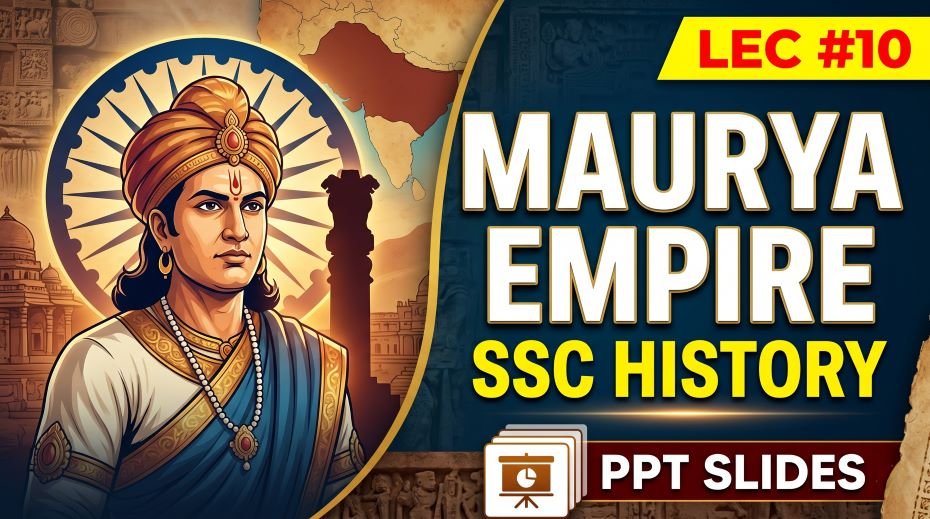
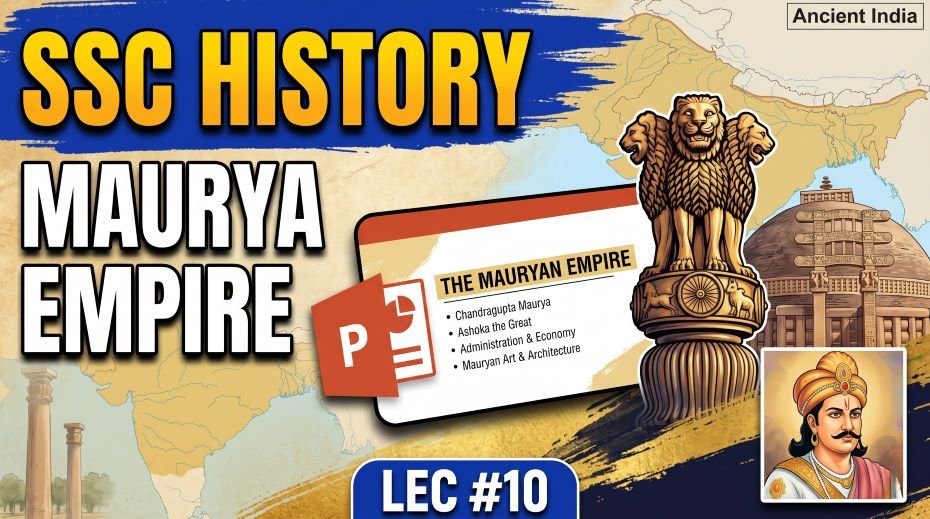
Today we will share SSC History Maurya Empire PPT Slides (LEC #10), The most detailed SSC guide on the Maurya Empire – based on History LEC #10 PPT Slides with 193 slides and 91 MB. Covers Chandragupta Maurya, Chanakya’s Arthashastra, Megasthenes’ Indica, Bindusara, Ashoka’s Kalinga War, all Rock and Pillar Edicts, Maurya administration, art, economy, and 40+ high-frequency MCQs for SSC CGL, CHSL, MTS, CPO, Railways NTPC, and UPSC Prelims.
The Maurya Empire (321–185 BC) is arguably the single most important topic in all of SSC Ancient History. It is the first pan-Indian empire, the period of India’s greatest ancient ruler (Ashoka), and the source of India’s National Emblem. SSC CGL, SSC CHSL, SSC MTS, and SSC CPO papers collectively ask 5–8 questions from the Maurya Empire chapter in every single exam cycle.
This article is built around the SSC History Maurya Empire PPT Slides – Lecture #10 – the largest in the Complete Foundation Batch PPT Series, with 193 slides and 91 MB of content (Serial Number #35, available free at slideshareppt.net). No other chapter in this series has this volume – a reflection of how important the Maurya Empire is for SSC exams.
From Chandragupta Maurya’s dramatic rise in 321 BC, to the political genius of Chanakya and the Arthashastra, to Bindusara’s southward expansion, to the transformation of Ashoka after the Kalinga War – and covering every edict, every pillar, every administration detail, and every art masterpiece – this guide gives you everything.
About the PPT Slides
| Detail | Information |
| Series Name | Complete Foundation Batch for All SSC and Other Exams (PPT Series) |
| Subject | History – Maurya Empire / Mauryan Empire (मौर्य साम्राज्य) |
| Lecture Number | Lecture #10 |
| Total PPT Slides | 193 PPT Slides – largest in the series |
| File Size | 91 MB |
| Serial Number | #35 |
| Period Covered | 321 BC to 185 BC (Maurya Dynasty) + Context from 327 BC |
| Best For | SSC CGL, CHSL, MTS, CPO, GD, Railways NTPC, UPSC Prelims, State PSCs |
| Source Website | slideshareppt.net |
SSC History Maurya Empire PPT Slides (LEC #10)
Note: If you wish to download the entire SSC series (PPT slides), simply visit this redirect page. –REDIRECT PAGE
Complete Timeline Table: Maurya Empire – All Key Dates
Memorise this table. The Maurya Empire timeline is the most date-dense topic in SSC Ancient History. Every row below has produced at least one SSC MCQ in the last decade.
| Year (BC) | Event | Key Person / Detail | Significance |
| ~327 BC | Alexander’s invasion of India begins through Khyber Pass | Alexander the Great | Creates political vacuum in northwest India; context for Chandragupta’s rise |
| ~326 BC | Battle of Hydaspes – Alexander vs King Porus | Alexander defeats Porus (Paurava King) | Despite victory, Alexander impressed by Porus’s bravery; restored his kingdom |
| ~326 BC | Alexander’s army refuses to cross the Beas River | Fear of Nanda army (Dhana Nanda) | Alexander forced to turn back; political vacuum created |
| ~323 BC | Alexander dies in Babylon | Alexander | Leaves his generals to divide his empire; Seleucus takes the east |
| ~321 BC | Chandragupta Maurya overthrows Dhana Nanda (last Nanda king) | Chandragupta Maurya + Chanakya | Founding of the Maurya Empire – first pan-Indian empire |
| ~321–305 BC | Chandragupta expands northwest – drives out Greek governors | Chandragupta Maurya | Unifies northwest India with the Gangetic empire |
| ~305 BC | Chandragupta defeats Seleucus Nicator | Chandragupta Maurya | Treaty: Chandragupta gets Arachosia, Gedrosia, Paropamisadae; gives 500 elephants; Seleucus gives daughter |
| ~305–297 BC | Megasthenes serves as Greek ambassador at Pataliputra | Megasthenes (sent by Seleucus) | Writes Indica – primary Greek source on Maurya India |
| ~300 BC | Chanakya (Kautilya) compiles the Arthashastra | Chanakya / Kautilya / Vishnugupta | 15-book treatise on statecraft, economics, military, espionage |
| ~298 BC | Chandragupta abdicates throne, converts to Jainism | Chandragupta Maurya + Bhadrabahu (Jain saint) | Goes to Shravanabelagola; dies by Sallekhana (Jain fasting ritual) |
| ~298–273 BC | Bindusara’s reign – southward expansion of Maurya Empire | Bindusara (Amitraghata) | Expands empire deep into South India; maintains Greek diplomatic ties |
| ~273 BC | Ashoka wins war of succession and becomes Emperor | Ashoka (Priyadarshi) | Reportedly killed 99 brothers to become Emperor; called Chandashoka in early reign |
| ~265 BC | Ashoka conducts Digvijaya – pre-Kalinga conquests | Ashoka | Early phase of aggressive military expansion |
| ~261 BC | Kalinga War – Ashoka’s last and most devastating war | Ashoka vs Kalinga (Odisha) | Reports: 1 lakh killed, 1.5 lakh deported; turns Ashoka to Buddhism |
| ~260 BC | Ashoka converts to Buddhism; becomes disciple of monk Upagupta | Ashoka + Upagupta | Transformation from Chandashoka to Dharmashoka |
| ~259 BC | Ashoka first visits Bodh Gaya; begins Dhammayatras (religious tours) | Ashoka | Replaces hunting tours (Viharyatras) with religious pilgrimages |
| ~257 BC | Ashoka appoints Dhamma Mahamattas (officers of righteousness) | Ashoka | Special officers placed across empire to implement Dhamma |
| ~256 BC | Ashoka begins engraving Major Rock Edicts across the empire | Ashoka | 14 groups of Major Rock Edicts at 8 locations |
| ~250 BC | Third Buddhist Council at Pataliputra | Ashoka (patron) + Moggaliputta Tissa (presided) | Finalised the Tripitaka (three baskets of Buddhist scriptures); resolved doctrinal disputes |
| ~250 BC | Ashoka sends Buddhist missions abroad | Ashoka – son Mahendra + daughter Sanghamitra to Sri Lanka | Also sent missions to Syria, Egypt, Macedonia, Cyrene, Epirus |
| ~249 BC | Ashoka visits Lumbini – birthplace of Buddha; exempts from taxes | Ashoka | Lumbini Pillar Inscription records this; tax reduced to 1/8 from usual 1/4 |
| ~247 BC | Ashoka begins engraving Major Pillar Edicts | Ashoka | 7 groups of Major Pillar Edicts on polished sandstone pillars |
| ~232 BC | Ashoka dies | Ashoka | Empire rapidly declines after his death |
| ~232–185 BC | Rapid decline of Maurya Empire – multiple weak rulers | Dasharatha, Samprati, Shalishuka, Devavarman, Shatadhanvan, Brihadratha | Six weak emperors in ~47 years; empire fragments |
| ~185 BC | Pushyamitra Shunga assassinates last Maurya emperor Brihadratha | Pushyamitra Shunga | Maurya Empire ends; Shunga dynasty begins |
Part I: Chandragupta Maurya (321–298 BC) – The Empire’s Architect
Chandragupta Maurya is one of the most extraordinary figures in world history. A young man of uncertain but possibly humble origins, he built India’s first pan-Indian empire – stretching from the Himalayas to the tip of South India, and from Afghanistan in the west to Bangladesh in the east – in just over two decades.
Origins and Early Life
- The exact origin of Chandragupta Maurya is debated. Buddhist and Jain sources suggest he was from the Moriya (Maurya) clan of the Shakyas – the same clan as Gautama Buddha.
- Greek sources (through Plutarch and Justin) suggest that he was of humble or common birth.
- According to tradition, Chanakya (then a professor at Taxila) noticed young Chandragupta’s extraordinary military and leadership potential and took him as his student.
- Chandragupta and Chanakya reportedly witnessed Alexander’s withdrawal from India (326 BC), recognising the political opportunity it created.
Rise to Power – Overthrowing the Nanda Dynasty
- Chandragupta and Chanakya raised an army using the political and military tactics described in the Arthashastra.
- They first tried to invade Magadha directly but initially failed – learning from this, they adopted guerrilla tactics, building a base in the western provinces first.
- Around 321 BC, Chandragupta overthrew Dhana Nanda (the last Nanda king) and captured Pataliputra, establishing the Maurya Empire.
- He then rapidly expanded the empire in all directions from this power base.
Defeating Seleucus Nicator (305 BC) – The Pivotal Treaty
After Alexander’s death in 323 BC, his general Seleucus I Nicator took control of the eastern portion of Alexander’s empire (Persia and beyond). Around 305 BC, Seleucus attempted to recover Alexander’s Indian territories. Chandragupta defeated him decisively.
| Treaty Term | Detail |
| Territory given to Chandragupta | Arachosia (Southern Afghanistan), Gedrosia (Balochistan), Paropamisadae (Hindu Kush region), Aria (Western Afghanistan) |
| What Chandragupta gave Seleucus | 500 war elephants – which Seleucus used to defeat Antigonus at the Battle of Ipsus in 301 BC |
| Matrimonial Alliance | Seleucus gave his daughter (possibly Helena) in marriage to Chandragupta (or a Maurya prince – exact terms debated) |
| Ambassador Sent | Seleucus sent Megasthenes as his ambassador to Chandragupta’s court at Pataliputra |
| Significance | Largest territorial gain in Maurya history through a single treaty; gave Chandragupta control of entire northwest India up to Afghanistan |
SSC Exam Tip: Chandragupta gave 500 elephants to Seleucus. Seleucus gave vast northwest territories to Chandragupta. Megasthenes was sent as Greek ambassador. These three facts are individually tested in SSC papers multiple times.
Chandragupta’s Abdication and Death
- In approximately 298 BC, Chandragupta Maurya abdicated his throne in favour of his son Bindusara.
- He converted to Jainism under the influence of the great Jain saint Bhadrabahu.
- He left Pataliputra with Bhadrabahu and a large group of Jain monks, travelling south to Shravanabelagola in present-day Karnataka.
- At Shravanabelagola, Chandragupta performed Sallekhana – the Jain practice of voluntarily fasting unto death – and died.
- The Chandragiri Hill at Shravanabelagola has inscriptions commemorating this event, and is a major Jain pilgrimage site today.
SSC Exam Tip: Chandragupta died at Shravanabelagola (Karnataka) by Sallekhana after adopting Jainism under Bhadrabahu. Both location and method of death are frequently asked.
Part II: Chanakya (Kautilya / Vishnugupta) and the Arthashastra
Chanakya stands alongside the great political thinkers of the ancient world – comparable to Aristotle in Greece, Confucius in China, or Machiavelli in Renaissance Italy. He was simultaneously a professor, a political strategist, a diplomat, an economist, and the architect of India’s greatest ancient empire.
Who Was Chanakya?
- Born in Taxila (in the Gandhara Mahajanapada) around 375 BC, he was a professor of economics and political science at Taxila University.
- He is known by three names: Chanakya (his personal name), Kautilya (a gotra/clan name or pen name – possibly meaning ‘crooked’ or ‘cunning’), and Vishnugupta (his formal name).
- According to tradition, he was humiliated at the court of the Nanda king and vowed to destroy the Nanda dynasty – a vow he fulfilled through Chandragupta.
- He served as Chandragupta’s Prime Minister (Mahamantri / Pradhan Mantri) and was the real power behind the throne for much of the early Maurya period.
- After Chandragupta’s abdication, Chanakya served briefly under Bindusara before retiring.
The Arthashastra – Content and Structure
The Arthashastra is one of the greatest works of political and economic philosophy produced anywhere in the ancient world. Written in Sanskrit, it is a comprehensive manual of governance covering virtually every aspect of running a state.
| Feature | Detail |
| Author | Chanakya (Kautilya / Vishnugupta) |
| Language | Sanskrit |
| Structure | 15 Books (Adhikaranas), 150 Chapters (Prakaranas), 180 Sections (Prakarana-prakarana), 6,000 Shlokas (verses) |
| Date of Composition | Approximately 300 BC (during Chandragupta’s reign or shortly after) |
| Rediscovery | 1905 AD – discovered as a manuscript by R. Shamasastry at the Oriental Research Institute (Government Oriental Library), Mysore |
| First Published | 1909 AD – R. Shamasastry published the first English translation |
| Topics Covered (Book 1–2) | The King’s conduct; duties of ministers and officials; organisation of departments; city and countryside administration |
| Topics Covered (Book 3–4) | Laws and justice; treatment of criminals; civil and criminal law; investigation of crimes |
| Topics Covered (Book 5–9) | Revenue collection; state treasury; wages; trade regulations; agriculture; mines and factories; forest products |
| Topics Covered (Book 10–14) | Military organisation; types of warfare; siege warfare; use of secret agents (spies); psychological warfare; use of fire and elephants |
| Topics Covered (Book 15) | The methodology and science of statecraft |
| Famous Concept | Saptanga Theory – the seven elements of a state: Raja (King), Amatya (Ministers), Janapada (Territory), Durga (Fort), Kosha (Treasury), Danda (Army), Mitra (Ally) |
| Spy System | Describes an elaborate network of secret agents (Gupta-Char system) – male and female spies placed in every part of the empire including the royal household |
| Mandala Theory | Foreign policy concept: your neighbour is your natural enemy; your neighbour’s neighbour is your natural friend – the circle of states principle |
| City Administration | Pataliputra was governed by a city council of 30 members divided into 6 boards of 5 each, managing commerce, industry, foreigners, population records, trade, and manufactured goods |
SSC Exam Tip – The Five Most Tested Arthashastra Facts:
- Author = Chanakya / Kautilya / Vishnugupta (all three names may be used in questions)
- 15 Books (Adhikaranas) – number of books is a common MCQ
- Rediscovered in 1905 AD by R. Shamasastry at Mysore – both year and name are tested
- Saptanga Theory – seven elements of a state – frequently asked as ‘who gave the Saptanga theory’
- Mandala Theory – ‘your neighbour is your enemy, your neighbour’s neighbour is your friend’ – tested as a political science concept
Part III: Megasthenes and the Indica
Megasthenes is the single most important foreign source for the Maurya Empire. His observations give us the outsider’s view of what ancient India looked like at its most powerful and organised.
| Aspect | Detail |
| Identity | Greek ambassador sent by Seleucus Nicator to Chandragupta Maurya’s court |
| Period of Residence | ~305–297 BC at Pataliputra |
| Work Written | Indica – a detailed descriptive account of Maurya India |
| Status of Original | The original Indica is lost; survives only in fragments quoted by later Greek and Roman writers – Arrian, Strabo, Diodorus Siculus, and Pliny the Elder |
| Description of Pataliputra | Described the city as 9 miles long and 1.5 miles wide, surrounded by a wooden palisade with 570 towers and 64 gates; protected by a deep moat (ditch) around it |
| City Administration | Said the city was governed by a committee of 30 officials in 6 boards of 5 – managing markets, manufactures, registration of births and deaths, trade, foreigners, and public works |
| Social Description | Described Indian society as divided into seven ‘castes’ or occupational groups: philosophers, farmers, shepherds/hunters, artisans, soldiers, inspectors, councillors |
| No Slavery | Megasthenes notably stated there was no slavery in India – though Indian sources contradict this; historians believe he may have confused the Indian slave system with the Greek system |
| Army | Described Chandragupta’s army as having 600,000 infantry, 30,000 cavalry, 9,000 war elephants, and 8,000 war chariots – the largest army in the ancient world |
| Justice System | Said crimes in India were few; contracts were honoured without written records; people were honest |
| Agriculture | Described fertile Indian soil, two crops per year, and the absence of famine in India during his time |
| Rivers | Described the Ganga and its tributaries in detail; noted the Ganga was the greatest river he had encountered |
SSC Exam Tip: Megasthenes = Greek ambassador of Seleucus = visited Chandragupta’s court = wrote Indica = described Pataliputra’s administration = no slavery claim = army of 600,000. These six facts individually appear as MCQs. The ‘no slavery’ observation is especially distinctive.
Part IV: Bindusara (298–273 BC) – The Southern Conqueror
Bindusara is the second Maurya emperor and the least-studied of the three great Mauryas (Chandragupta, Bindusara, Ashoka). But for SSC exams, knowing his unique facts is essential because he generates specific, targeted questions.
| Aspect | Detail |
| Full Name | Bindusara |
| Indian Title | Amitraghata – meaning ‘slayer of enemies’ or ‘destroyer of foes’ |
| Greek Title | Amitrochates or Allitrochaides (Greek transliteration of Amitraghata) |
| Military Achievement | Expanded the Maurya Empire significantly southward into the Deccan; reportedly conquered 16 states in the south |
| Diplomatic Connections | Maintained active diplomatic relations with the Seleucid Empire in Syria (under Antiochus I) |
| Famous Diplomatic Story | Bindusara requested Antiochus I to send him: (1) sweet wine, (2) dried figs, (3) a philosopher (sophist). Antiochus sent wine and figs but replied that philosophers were not for sale in Greece – a famous anecdote |
| Ptolemaic Connection | Also had diplomatic contact with Ptolemy II Philadelphus of Egypt, who sent an ambassador named Dionysius to his court |
| Religion | Associated with the Ajivika sect – a fatalistic philosophical school contemporary with Buddhism and Jainism |
| Administration | Appointed Ashoka as Viceroy of Ujjain (Avanti) and his son Susima as Viceroy of Taxila |
| Death | Died around 273 BC, after which a war of succession began among his sons |
SSC Exam Tip: Bindusara = Amitraghata (Indian title) = Amitrochates (Greek title) = requested philosopher from Antiochus. All three facts appear in SSC papers. His Greek title is a favourite ‘identify this ruler from their title’ MCQ.
Part V: Ashoka the Great (273–232 BC) – The Philosopher Emperor
Emperor Ashoka stands apart from virtually all other rulers in world history. He was not only the ruler of India’s greatest ancient empire, but also a man who, after witnessing the devastation of war, chose to abandon conquest forever and dedicate his reign to ethics, welfare, and peace. H.G. Wells called him ‘the greatest of all kings.’
Early Reign and War of Succession
- Ashoka was the son of Bindusara and his queen Subhadrangi (or Dharma). He was not the crown prince – his elder brother Susima was the designated heir.
- When Bindusara died (~273 BC), a brutal war of succession followed among the Maurya princes.
- Ashoka reportedly killed 99 of his brothers (with only one, Vitashoka or Tissa, being spared) to secure the throne – though historians treat this figure as exaggerated tradition.
- There was a gap of about 4 years between Bindusara’s death and Ashoka’s formal coronation (~269 BC), due to this succession war.
- In his early years as emperor, Ashoka was aggressive and continued military expansion – earning the epithet Chandashoka (Fierce Ashoka or Cruel Ashoka).
The Kalinga War (~261 BC) – The Turning Point of History
The Kalinga War is one of the most consequential events in ancient world history. It transformed the character of an empire and gave the world one of its earliest examples of a ruler publicly renouncing violence.
| Aspect | Detail |
| Year | ~261 BC – approximately 8 years into Ashoka’s reign |
| Enemy | Kalinga – a prosperous, independent coastal kingdom (modern Odisha) |
| Why Kalinga? | Kalinga controlled the important eastern sea trade routes; Kalinga was also a matter of pride – it had defeated Ashoka’s grandfather’s attempt to conquer it |
| Result | Magadha (Ashoka) won; Kalinga was devastated |
| Human Cost (per Ashoka’s own 13th Rock Edict) | 150,000 people deported; 100,000 killed in battle; many more died from injury, disease, and starvation |
| Ashoka’s Reaction | Ashoka was filled with profound remorse (Anushochhami) upon seeing the scale of death and suffering – a reaction he himself recorded in his 13th Major Rock Edict |
| Consequences | Ashoka converted to Buddhism; adopted Dhamma; abandoned Digvijaya (conquest by force); replaced it with Dhammavijaya (conquest by righteousness) |
| Rock Edict XIII | The most important edict – describes Kalinga War and Ashoka’s remorse in his own words; a unique document of royal self-reflection in ancient history |
| Transformation | From Chandashoka (Cruel Ashoka) to Dhammashoka or Dharmashoka (Righteous Ashoka); also called Priyadarshi (beloved of gods) and Devanampiya (beloved of the gods) in edicts |
SSC Exam Tip: Kalinga War = 261 BC = Ashoka = Odisha = 1 lakh killed = 1.5 lakh deported (from Rock Edict XIII) = Chandashoka became Dharmashoka. This set of facts generates more SSC questions than any other single event in ancient Indian history.
Ashoka’s Dhamma – The Code of Ethical Governance
Ashoka’s Dhamma (Sanskrit: Dharma) was not Buddhism per se, but a secular ethical code that he promoted to all his subjects, regardless of their religion. It was designed to create a moral, harmonious, and welfare-oriented society.
- Dhamma was based on the concept of non-violence (Ahimsa) in personal and state conduct.
- It included: obedience to parents, elders, teachers, and Brahmins; charitable giving; truth-speaking; kindness to servants and dependents; gentleness toward animals and living beings.
- Ashoka prohibited animal sacrifice at religious festivals and reduced the number of animals killed for food in the royal kitchen (his edicts mention that previously thousands of animals were killed daily – he reduced this to two peacocks and one deer, and eventually aimed for zero).
- He promoted religious tolerance – saying all religious sects have genuine merit and should respect each other.
- He replaced his hunting tours (Viharyatras) with Dhammayatras – tours to visit holy places, meet common people, and listen to their needs.
- He appointed special officers called Dhamma Mahamattas (Officers of Righteousness) across the empire whose sole job was to promote Dhamma and monitor its implementation.
- He made Dhamma accessible to all by inscribing it on rocks and pillars in people’s local languages and scripts.
SSC Exam Tip: Dhamma Mahamattas = special Dhamma officers appointed by Ashoka. Ashoka’s Dhamma was NOT Buddhism – it was a secular ethical code. The distinction between Dhamma (Ashoka’s ethical code) and Buddhism (a religion) is a conceptual SSC question.
Ashoka’s Edicts – Complete Reference
Ashoka’s edicts are the primary source of our knowledge about him. They are the first major inscriptions in Indian history and were written in the local language and script of each region, making them accessible to common people. Ashokan inscriptions were first deciphered by James Prinsep in 1837 AD.
CATEGORY 1: MAJOR ROCK EDICTS (14 Groups)
| Rock Edict Number | Key Content / Message | Notable Location |
| Rock Edict I | Prohibition of animal sacrifice at festivals; reduction of animals killed in royal kitchen | Shahbazgarhi (KP, Pakistan), Mansehra (KP, Pakistan), Girnar (Gujarat), Kalsi (Uttarakhand), Dhauli (Odisha), Jaugada (Odisha), Sopara (Maharashtra), Yerragudi (Andhra Pradesh) |
| Rock Edict II | Medical facilities for humans and animals; planting of medicinal herbs; digging of wells along roads | Same 8 locations (all 14 edicts found together at these sites) |
| Rock Edict III | Respect for Brahmin priests and monks; generosity; obedience to parents; Rajjukas to tour provinces every 5 years | Same 8 locations |
| Rock Edict IV | Impact of Dhamma on society; reduction in violence and killing; righteousness spreading | Same 8 locations |
| Rock Edict V | Appointment of Dhamma Mahamattas (Officers of Righteousness) – the most distinctive administrative innovation | Same 8 locations |
| Rock Edict VI | Ashoka’s commitment to the welfare of all beings; availability to receive petitions at all times; importance of quick decision-making | Same 8 locations |
| Rock Edict VII | Desire for tolerance among all sects; all religious groups should live in harmony | Same 8 locations |
| Rock Edict VIII | Ashoka’s first Dhammayatra to Bodh Gaya; gives up Viharyatras (hunting tours) | Same 8 locations |
| Rock Edict IX | Condemnation of meaningless ceremonies and rituals; importance of real Dhamma over superstitions | Same 8 locations |
| Rock Edict X | Ashoka’s desire for the welfare of all beings; renunciation of desire for fame and glory | Same 8 locations |
| Rock Edict XI | Gifts of Dhamma are the best gifts; analysis of what constitutes a true gift | Same 8 locations |
| Rock Edict XII | Religious tolerance – all sects should honour each other; condemns blind devotion to one’s own sect and criticism of others | Same 8 locations |
| Rock Edict XIII | The Kalinga War and Ashoka’s remorse; conversion to Buddhism; Dhammavijaya instead of Digvijaya; mentions sending missions to Greek kings Antiochus, Ptolemy, Antigonus, Magas, Alexander | Same 8 locations (NOT found at Dhauli and Jaugada – replaced by Separate Rock Edicts there) |
| Rock Edict XIV | Variation in length of edicts due to regional needs; purpose of all edicts | Same 8 locations |
CATEGORY 2: MINOR ROCK EDICTS
- Shorter inscriptions that appear at more locations than the Major Rock Edicts.
- Describe Ashoka’s personal conversion to Buddhism – ‘more than two and a half years ago I became a lay Buddhist disciple; but for one year I was not very zealous.’
- Important locations: Maski (Karnataka) – this edict is the ONLY one where Ashoka refers to himself by his personal name ‘Ashoka’ (most edicts only say ‘Priyadarshi’ or ‘Devanampiya’); also at Brahmagiri (Karnataka), Siddapur, Jatinga Rameshvara, Bhabru/Bairat (near Jaipur).
SSC Exam Tip: The Maski Rock Edict is crucial – it is the ONLY inscription where Ashoka uses his own name ‘Ashoka’. In all other edicts he uses Priyadarshi or Devanampiya Piyadasi. This fact is frequently tested.
CATEGORY 3: SEPARATE ROCK EDICTS (Kalinga Edicts)
- Found only at Dhauli and Jaugada in Odisha – the former Kalinga region.
- Replace Major Rock Edicts XIII and XIV in this region – because Rock Edict XIII describes the Kalinga War and its devastation; Ashoka chose not to display this in front of the Kalinga people themselves.
- These edicts are addressed specifically to the Rajjukas (officers) of Kalinga, instructing them to treat the people of Kalinga with kindness and as their own children.
- Show Ashoka’s special sensitivity toward the Kalinga people – whom he had conquered and devastated.
CATEGORY 4: MAJOR PILLAR EDICTS (7 Groups)
| Pillar Edict | Content | Key Pillar Location |
| Pillar Edict I | The basis of Dhamma – its principles | Delhi-Topra Pillar (originally at Topra, Haryana – moved to Delhi by Firuz Shah Tughlaq) |
| Pillar Edict II | What is Dhamma? | Delhi-Meerut Pillar (originally at Meerut) |
| Pillar Edict III | Condemnation of faults – anger, pride, jealousy, haste | Lauriya Araraj (Bihar) |
| Pillar Edict IV | Duties of Rajjukas (revenue and administrative officers) | Lauriya Nandangarh (Bihar) – has the Ashoka Pillar with a lion capital |
| Pillar Edict V | Release of prisoners; list of animals protected from killing | Rampurwa (Bihar) – has a bull capital |
| Pillar Edict VI | Summary of all Dhamma policies; Ashoka’s accessibility to all people | Allahabad Pillar (Prayagraj) – most important; also contains Samudragupta’s prashasti and Jahangir’s inscriptions |
| Pillar Edict VII | Description of all Dhamma measures taken; request for posterity to uphold Dhamma | Allahabad Pillar and Delhi-Topra Pillar |
CATEGORY 5: MINOR PILLAR EDICTS
- Sarnath Pillar – has the famous Lion Capital (four lions back-to-back on a circular abacus showing four animals – elephant, horse, bull, lion – separated by Dharma Chakras). The Dharma Chakra from this pillar appears in the centre of India’s National Flag. The Lion Capital became India’s National Emblem adopted on 26 January 1950.
- Sanchi Pillar – Schism Edict: orders that monks or nuns who cause a split (schism) in the Sangha should be expelled from the monastery; found at Sanchi, Sarnath, and Allahabad.
- Lumbini Pillar – records Ashoka’s pilgrimage to Lumbini (Buddha’s birthplace) in the 20th year of his reign; states that the village of Lumbini was exempted from taxes (reduced from 1/4 to 1/8 of produce).
- Nigalisagar Pillar – records that Ashoka enlarged the stupa of the earlier Buddha Konakamana in his 14th regnal year.
SSC Exam Tip: Sarnath Lion Capital = India’s National Emblem. Dharma Chakra from Sarnath pillar = centre of India’s National Flag. Lumbini Pillar = Ashoka exempted Lumbini from taxes. All three are very frequently tested SSC facts.
Scripts and Languages of Ashoka’s Edicts
| Region | Script Used | Language | Examples |
| Most of India (east, west, south, central) | Brahmi | Prakrit (Pali dialect) | All 8 Major Rock Edict sites except the two below |
| Northwest India (Gandhara region) | Kharosthi | Prakrit | Shahbazgarhi and Mansehra (both in modern Pakistan) |
| Afghanistan – Kandahar | Greek script + Aramaic script | Greek and Aramaic languages | Kandahar Bilingual Rock Edict – in both Greek and Aramaic |
| Afghanistan – Taxila area | Aramaic | Aramaic | Taxila inscription |
SSC Exam Tip: Brahmi script was read from LEFT to RIGHT. Kharosthi was read from RIGHT to LEFT. The direction of reading is a favourite SSC tricky question. Ashokan inscriptions first deciphered by James Prinsep in 1837 AD – this year is also tested.
Third Buddhist Council (~250 BC)
| Aspect | Detail |
| Year | ~250 BC (17th year of Ashoka’s reign) |
| Place | Pataliputra – Ashoka’s capital |
| Patron | Emperor Ashoka |
| President (Presided By) | Moggaliputta Tissa (Mogaliputta Tissa) |
| Key Outcome 1 | Compiled and finalised the Abhidhamma Pitaka – the third basket of Buddhist scriptures; completing the Tripitaka |
| Key Outcome 2 | Settled disputes between different Buddhist schools; purified the Sangha by expelling monks with wrong views |
| Key Outcome 3 | Resolved that Theravada (Sthaviravada) is the orthodox form of Buddhism |
| Key Outcome 4 | Decided to send Buddhist missions to nine different regions of the world |
| Missions Sent | Sri Lanka (Mahendra + Sanghamitra); Burma (Myanmar); Thailand; Cambodia; Nepal; Kashmir and Gandhara; Greece; Egypt; and Central Asia |
SSC Exam Tip: Third Buddhist Council = Pataliputra = Ashoka (patron) = Moggaliputta Tissa (presided) = ~250 BC. All four facts are individually and collectively tested in SSC papers every year.
Part VI: Maurya Empire Administration – Complete Structure
The Maurya Empire had the most sophisticated and elaborate administrative system in the ancient world. Our primary sources are Chanakya’s Arthashastra and Megasthenes’ Indica.
Central Administration
| Position / Department | Function / Detail |
| Raja (Emperor) | Supreme authority; appointed ministers; commanded army; dispensed justice; toured provinces |
| Mantri Parishad (Council of Ministers) | Advisory body to the king; major policy decisions taken in consultation |
| Amatya (Ministers) | Senior officials heading specific departments; appointed based on merit and character tests |
| Mantrin (Prime Minister / Chief Minister) | Chanakya served this role under Chandragupta; highest executive officer |
| Purohita (Chief Priest) | Religious advisor to the king; conducted royal rituals |
| Senapati (Commander-in-Chief) | Head of the armed forces; controlled all military operations |
| Yuvaraja (Crown Prince) | Heir apparent; often appointed as provincial viceroy for training |
| Rajjukas | Land measurement officers; also had judicial powers over rural areas; promoted by Ashoka’s edicts |
| Yuktas | Revenue and administrative officials at the district level |
| Pradeshikas | District-level administrative officers – equivalent to modern District Collectors |
| Sthanikas | Officers below Pradeshikas – sub-district level |
| Gramika (Village Headman) | Lowest level of administration – managed village affairs |
| Dhamma Mahamattas | Created by Ashoka – special officers exclusively for promoting Dhamma; a unique Ashokan innovation |
| Stri-Adhyaksha (Superintendent of Women) | Department managing women in the royal household and female workers |
| Antapala (Border Governor) | Officers managing frontier regions and border security |
Provincial Administration – The Four Vice-royalties
The Maurya Empire was divided into four major provinces (Chakras), each governed by a Viceroy (usually a prince of the royal family):
| Province | Capital | Viceroy (Historical Examples) | Modern Region |
| Northern Province (Uttarapath) | Taxila | Ashoka (as Viceroy under Bindusara); Sushima (under Bindusara) | Punjab, NWFP, Afghanistan |
| Western Province (Dakshinapath / Avanti) | Ujjain | Ashoka (as Viceroy under Bindusara) | Gujarat, Rajasthan, Madhya Pradesh |
| Eastern Province (Core Magadha) | Pataliputra | Directly administered by the Emperor | Bihar, West Bengal, parts of UP |
| Southern Province (Dakshinapatha) | Suvarnagiri (Golden Mountain – near Kurnool, AP) | Arishtasena (under Ashoka) | Karnataka, Andhra Pradesh, Tamil Nadu region |
Military Organisation of the Maurya Empire
The Maurya Empire maintained the largest and most organised army in the ancient world. According to Megasthenes’ Indica:
| Military Branch | Strength (per Megasthenes) | Organisation |
| Infantry | 600,000 soldiers | Basic fighting force; spearmen, archers, swordsmen |
| Cavalry | 30,000 horsemen | Mounted warriors; cavalry charges were key in open battle |
| War Chariots | 8,000 chariots | Each chariot carried 2 warriors + a driver; used for battlefield charges |
| War Elephants | 9,000 elephants | The decisive arm of Maurya military; elephants could break infantry lines and destroy fortifications |
| Navy | Maintained a river navy | Controlled the Ganga river system; used for supply and troop movement |
The army was managed by a six-board committee of 30 officials (like the city administration), overseeing: infantry, cavalry, war chariots, war elephants, navy, and transport/commissariat.
Revenue and Economic System
- The primary source of state revenue was land tax (Bhaga) – typically 1/4 to 1/6 of agricultural produce.
- Other revenues: customs duties on trade goods, income from state-owned factories and mines, taxes on artisans and traders, income from forests and pasture lands.
- The Arthashastra describes a large number of state-owned enterprises: mines, textile factories, shipyards, and trading posts – making the Maurya state a major economic actor, not just a revenue collector.
- A special official called the Sitadhyaksha managed state agricultural lands directly farmed by the state using bonded labourers.
- The Akaradhyaksha managed mines; the Panyadhyaksha managed trade; the Sulkadhyaksha managed customs.
- Sanyuktadhyaksha = Superintendent of the treasury – managed the state treasury (Kosha).
Part VII: Maurya Art and Architecture – India’s First Stone Architecture
The Maurya Empire marks a watershed moment in Indian art history – the transition from wooden and mud-brick construction to permanent stone architecture. This shift is called the ‘Stone Revolution’ of Indian art.
Maurya Pillars
The Ashokan Pillars are among the finest works of monolithic stone sculpture in world history. Each pillar was carved from a single block of light-coloured Chunar sandstone (quarried near Varanasi), polished to a mirror-like finish using a technique so refined that modern craftsmen cannot replicate it.
| Pillar Location | Capital (Animal Figure) | Key Inscription / Significance |
| Sarnath (Varanasi, UP) | Four lions back-to-back on a circular abacus | Most famous; became India’s National Emblem; Dharma Chakra on abacus became the chakra in India’s National Flag |
| Lauriya Nandangarh (Bihar) | Single lion | Well-preserved with complete lion capital |
| Rampurwa (Bihar) | Bull | Two pillars found here – one with lion, one with bull capital |
| Sanchi (Madhya Pradesh) | Four lions (damaged) | Has Schism Edict about expelling monks who cause splits in Sangha |
| Delhi-Topra Pillar | Originally had lion capital (now at Indian Museum, Kolkata) | Moved from Topra (Haryana) to Delhi by Firuz Shah Tughlaq in 14th century; has all 7 Pillar Edicts |
| Delhi-Meerut Pillar | Originally from Meerut | Also moved to Delhi by Firuz Shah Tughlaq; significant as a military trophy |
| Allahabad (Prayagraj) | No animal capital (plain shaft) | Has 6 Pillar Edicts + Samudragupta’s Allahabad Prashasti + Jahangir’s inscription = three different historical periods on one pillar |
| Lumbini Pillar (Nepal) | No capital (plain shaft) | Records Ashoka’s pilgrimage to Buddha’s birthplace; in modern Nepal |
| Nigalisagar (Nepal) | No capital | Records enlargement of Konakamana Buddha’s stupa |
Maurya Stupas
- Ashoka is traditionally credited with building 84,000 Buddhist stupas across the empire (a symbolic number representing the 84,000 teachings of the Buddha).
- The Sanchi Stupa (also called the Great Stupa at Sanchi, Madhya Pradesh) is the most famous Ashokan stupa – now a UNESCO World Heritage Site.
- The Sanchi Stupa was originally a simple hemispherical mound built by Ashoka. Later, the Shunga dynasty added the magnificent carved gateways (Toranas).
- Other important stupas built or enlarged by Ashoka: Bodh Gaya Stupa (Mahabodhi Temple complex), Sarnath Stupa (Dhamek Stupa), Nalanda Stupa, Taxila Stupa.
- Ashoka also opened the original eight stupas built over the Buddha’s relics (at Rajagriha, Vaishali, Kapilavastu, Allakappa, Ramagrama, Vethadvipa, Pava, and Kushinara) and redistributed the relics into his 84,000 new stupas.
Rock-Cut Architecture – Barabar Caves
- The Barabar Caves (Jehanabad district, Bihar) are the earliest surviving rock-cut caves in India – cut during Ashoka’s reign.
- There are seven caves in the Barabar and Nagarjuni Hills.
- The caves were donated by Ashoka and his grandson Dasharatha to the Ajivika sect of monks – NOT to Buddhists, which shows Ashoka’s genuine religious tolerance.
- The interiors of the caves have a high mirror-like polish (same technology as Ashokan Pillars).
- The Lomas Rishi Cave has a beautifully carved arch entrance – the earliest example of the ‘Chaitya arch’ motif in Indian architecture.
SSC Exam Tip: Barabar Caves = earliest rock-cut caves in India = Ashoka period = donated to Ajivika monks (not Buddhist monks). The fact that these were given to the Ajivika sect is a distinctive, frequently tested detail.
Pataliputra Palace and City
- Megasthenes described the palace of Chandragupta at Pataliputra as surpassing the Persian royal palaces at Susa and Ecbatana in splendour.
- The palace was built primarily of wood – the ‘Wooden Palace’ of Pataliputra – later destroyed by fire.
- Archaeological excavations at Pataliputra (modern Patna) have revealed massive wooden palisades, stone columns, and remains consistent with Megasthenes’ descriptions.
- The Maurya wooden palace was replaced in later periods; the Didarganj Yakshi (a beautiful polished sandstone sculpture from the Maurya period, found near Patna) shows the quality of Maurya sculpture.
Part VIII: Decline of the Maurya Empire
The Maurya Empire’s decline after Ashoka (232 BC) was one of the most rapid collapses of a great empire in history. Within 47 years of Ashoka’s death, the entire empire had fragmented.
Causes of Decline
| Cause | Explanation |
| Weak Successors | Six emperors ruled in 47 years after Ashoka – none had his administrative ability or political vision |
| Division of Empire | After Ashoka’s death, the empire reportedly split between his son Kunala (western provinces) and grandson Dasharatha (eastern provinces) – weakening central authority |
| Military Weakness – Ahimsa Policy | Ashoka’s promotion of non-violence (Ahimsa) is often cited as reducing military preparedness; while oversimplified, it reflects the shift in imperial priorities |
| Economic Strain | Maintaining an empire of this size required enormous revenue; the cost of Ashoka’s welfare programmes, Buddhist missions, and pillar/stupa construction strained the treasury |
| Brahmanical Reaction | Ashoka’s promotion of Buddhism and ban on animal sacrifice alienated the Brahmin priesthood; the Shunga dynasty’s Brahmin founder (Pushyamitra) represented this reaction |
| External Threats | Bactrian Greeks (Indo-Greeks) invaded the northwest; Pushyamitra Shunga had to fight them from the west while managing internal rebellion |
| Rise of Local Powers | Provincial governors took advantage of weak central rule to declare independence – Kalinga declared independence, as did kingdoms in the south and west |
| Assassination of Last Maurya | Brihadratha (last Maurya emperor) was assassinated in 185 BC by his own commander-in-chief Pushyamitra Shunga during a military parade – a palace coup |
Rulers After Ashoka
| Ruler | Period (BC) | Key Fact |
| Kunala (or Mahendra) | ~232 BC onwards | Ashoka’s son; reportedly blind; took western provinces |
| Dasharatha | ~232–224 BC | Ashoka’s grandson; took eastern provinces; donated Nagarjuni Caves to Ajivika monks |
| Samprati | ~224–215 BC | Ashoka’s grandson (son of Kunala); supporter of Jainism – sometimes called the ‘Ashoka of Jainism’ |
| Shalishuka | ~215–202 BC | Described as wicked in Puranas; empire shrinking |
| Devavarman | ~202–195 BC | Short reign; empire fragmenting |
| Shatadhanvan | ~195–187 BC | Further loss of provinces |
| Brihadratha | ~187–185 BC | Last Maurya emperor; killed by his general Pushyamitra Shunga in 185 BC |
Part IX: High-Frequency SSC MCQs – Maurya Empire Chapter
These 40 questions represent the most consistently repeated MCQs from this chapter across SSC CGL, CHSL, MTS, CPO, GD, and Railway NTPC papers over the past decade.
| Question | Correct Answer | SSC Exam Reference |
| Who founded the Maurya Empire and in which year? | Chandragupta Maurya in 321 BC | SSC CGL 2015–2023 (every year) |
| Who was Chandragupta Maurya’s mentor and Prime Minister? | Chanakya (also known as Kautilya and Vishnugupta) | SSC CGL 2015, 2018, 2021, SSC CHSL 2019 |
| What did Chandragupta give Seleucus in the 305 BC treaty? | 500 war elephants | SSC CGL 2017, SSC CHSL 2020, SSC CPO 2021 |
| Who was the Greek ambassador at Chandragupta’s court? | Megasthenes (sent by Seleucus Nicator) | SSC CGL 2016, 2019, 2022 |
| What did Megasthenes write? | Indica | SSC CGL 2016, SSC CHSL 2018, SSC MTS 2020 |
| Who wrote the Arthashastra? | Chanakya (Kautilya / Vishnugupta) | SSC CGL 2014–2023 (appears virtually every exam) |
| Into how many books is the Arthashastra divided? | 15 Books (Adhikaranas) | SSC CGL 2018, SSC CHSL 2021 |
| When and by whom was the Arthashastra rediscovered? | 1905 AD by R. Shamasastry (at Oriental Research Institute, Mysore) | SSC CGL 2019, SSC CPO 2022 |
| What is the Saptanga Theory? | The seven elements of a state: King, Ministers, Territory, Fort, Treasury, Army, Ally – given by Chanakya | SSC CGL 2020, SSC CHSL 2021 |
| Where did Chandragupta Maurya die and how? | Shravanabelagola (Karnataka) by Sallekhana (Jain fasting unto death) | SSC CGL 2017, SSC CHSL 2020 |
| Under which Jain saint did Chandragupta Maurya convert? | Bhadrabahu | SSC CHSL 2019, SSC MTS 2021 |
| What was Bindusara’s Indian title? | Amitraghata (slayer of enemies) | SSC CGL 2017, SSC CHSL 2020, SSC MTS 2022 |
| What was Bindusara’s Greek title? | Amitrochates (or Allitrochaides) | SSC CGL 2019, SSC CPO 2022 |
| What did Bindusara request Antiochus I to send him? | Sweet wine, dried figs, and a philosopher (Antiochus sent only wine and figs) | SSC CHSL 2021, SSC GD 2022 |
| In which year was the Kalinga War fought? | ~261 BC | SSC CGL 2014–2023 (most repeated ancient history date) |
| What is Kalinga’s modern name? | Odisha | SSC CGL 2016, SSC CHSL 2019, SSC MTS 2021 |
| Which Rock Edict describes the Kalinga War and Ashoka’s remorse? | Major Rock Edict XIII (13th) | SSC CGL 2019, SSC CHSL 2021 |
| Ashoka was also known by which titles? | Priyadarshi (beloved of gods) and Devanampiya Piyadasi (beloved of gods in Pali) | SSC CGL 2018, SSC CHSL 2020 |
| In which edict does Ashoka mention his own name ‘Ashoka’? | Maski Rock Edict (Minor Rock Edict at Maski, Karnataka) | SSC CGL 2020, SSC CPO 2022 |
| What script was used in most of Ashoka’s edicts? | Brahmi script | SSC CGL 2015, 2018, 2021, SSC CHSL 2020 |
| Which direction is Brahmi script read? | Left to Right | SSC CGL 2019, SSC MTS 2022 |
| What script is used in Ashoka’s northwestern edicts? | Kharosthi script (read right to left) | SSC CHSL 2018, SSC CPO 2021 |
| Who first deciphered Ashokan inscriptions and in what year? | James Prinsep in 1837 AD | SSC CGL 2017, 2020, SSC CHSL 2019 |
| What is the Sarnath Lion Capital? | Ashoka’s pillar capital with four lions back-to-back; became India’s National Emblem | SSC CGL 2014–2023 (appears every exam) |
| What was adopted from Ashoka’s Sarnath Pillar for India’s National Flag? | The Dharma Chakra (24-spoke wheel) at the centre of the National Flag | SSC CGL 2017, SSC CHSL 2019, 2021 |
| What is India’s National Emblem and when was it adopted? | Lion Capital of Ashoka (Sarnath); adopted 26 January 1950 | SSC CGL 2015, 2018, SSC MTS 2021 |
| Third Buddhist Council was held where, when, and under whose patronage? | Pataliputra; ~250 BC; Emperor Ashoka (presided by Moggaliputta Tissa) | SSC CGL 2016, 2019, SSC CHSL 2020 |
| Who presided over the Third Buddhist Council? | Moggaliputta Tissa | SSC CGL 2019, SSC CHSL 2021 |
| Ashoka sent whom to Sri Lanka to spread Buddhism? | Son Mahendra (Mahinda) and daughter Sanghamitra | SSC CGL 2017, SSC CHSL 2019, SSC GD 2022 |
| What are Dhamma Mahamattas? | Special officers appointed by Ashoka exclusively to promote Dhamma across the empire | SSC CHSL 2020, SSC CPO 2022 |
| The Lumbini Pillar records what specific event? | Ashoka’s visit to Lumbini (Buddha’s birthplace) + exemption of Lumbini from taxes | SSC CGL 2019, SSC MTS 2021 |
| Why are edicts XIII and XIV absent from Dhauli and Jaugada? | These Kalinga sites have Separate Rock Edicts instead – Ashoka did not display the Kalinga War edict in Kalinga itself | SSC CHSL 2021, SSC GD 2022 |
| What are the Barabar Caves and to whom were they donated? | Earliest rock-cut caves in India (Ashoka period, Bihar) – donated to the Ajivika sect | SSC CGL 2019, SSC CHSL 2021 |
| What is the Sanchi Stupa famous for? | Great Buddhist stupa in MP; originally built by Ashoka; famous gateways added later by Shunga dynasty; UNESCO World Heritage Site | SSC CGL 2016, 2019, SSC CHSL 2020 |
| Which pillar has all three – Ashokan edicts, Samudragupta’s inscription, and Jahangir’s inscription? | Allahabad Pillar (Prayagraj, Uttar Pradesh) | SSC CGL 2018, SSC CHSL 2021 |
| Who killed the last Maurya emperor and in which year? | Pushyamitra Shunga killed Brihadratha in 185 BC | SSC CGL 2017, SSC CHSL 2019, SSC MTS 2022 |
| Pataliputra was described as being on which two rivers? | Confluence of Ganga and Son (Sone) rivers – with Punpun also joining nearby | SSC CHSL 2019, SSC CPO 2021 |
| What is the Mandala Theory in the Arthashastra? | Your neighbour is your natural enemy; your neighbour’s neighbour is your natural friend – principle of foreign policy circles | SSC CGL 2020, SSC CHSL 2022 |
| The Maurya Empire’s four major provinces were governed from which capitals? | Taxila (North), Ujjain (West), Pataliputra (East/Core), Suvarnagiri (South) | SSC CGL 2021, SSC CPO 2022 |
| How many soldiers did Megasthenes say Chandragupta’s army had? | 600,000 infantry, 30,000 cavalry, 9,000 elephants, 8,000 chariots | SSC CHSL 2020, SSC GD 2022 |
Part X: Podcast Interview – Expert Q&A on the Maurya Empire
A 10-round expert dialogue that covers the Maurya Empire from multiple perspectives – conceptual, strategic, exam-focused, and historical.
| Speaker | Question / Statement | Answer / Explanation |
| Aspirant | Why does the Maurya Empire chapter have 193 PPT slides – more than any other chapter in this series? | Educator: Because the Maurya Empire is the most fact-dense chapter in SSC Ancient History. Every ruler (Chandragupta, Bindusara, Ashoka) has dozens of individually testable facts. Ashoka alone has 14 Major Rock Edicts, 7 Major Pillar Edicts, multiple Minor Edicts, 4 Buddhist missions, 3 Buddhist Councils, and a complete administrative system. If you add Chanakya’s Arthashastra (15 books, Saptanga Theory, Mandala Theory, Spy System) and Megasthenes’ Indica, you have more than enough for 193 slides and at least 8 SSC questions per exam. |
| Aspirant | I always get the three names of Chanakya confused in exam. How do I remember all three? | Educator: Think of it as one person with three identities. Chanakya is his family/personal name – named after his father Chanaka. Kautilya is his pen name as the author of Arthashastra – it means ‘cunning’ or ‘the crooked one’ reflecting his political philosophy (or possibly his gotra). Vishnugupta is his formal brahmin name. For SSC exams, all three names are used interchangeably in questions. Know that all three refer to the same person – Chandragupta’s mentor and Prime Minister. |
| Aspirant | There are so many Rock Edicts. How do I know which ones are most important for SSC? | Educator: Focus on numbers: 5, 12, and 13. Rock Edict V = Ashoka appointed Dhamma Mahamattas (the unique administrative innovation). Rock Edict XII = Religious tolerance among all sects. Rock Edict XIII = The Kalinga War – Ashoka’s most personal and emotionally powerful edict; he describes the war and his remorse in his own words. Also remember the Maski Edict – the only one with his actual name ‘Ashoka’. And the Lumbini Pillar – because the tax exemption for Lumbini is a very specific, testable fact. |
| Aspirant | The Sarnath Lion Capital appears in almost every SSC paper. What exactly should I know about it? | Educator: Five things. One: It is the capital (top piece) of Ashoka’s pillar at Sarnath, near Varanasi. Two: It has four lions standing back-to-back on a circular abacus. Three: The abacus has four animals (elephant, horse, bull, lion) separated by four Dharma Chakras. Four: This Lion Capital became India’s National Emblem, officially adopted on 26 January 1950. Five: The 24-spoked Dharma Chakra from this pillar is the wheel at the centre of India’s National Flag. If asked about either the National Emblem or the National Flag’s wheel – the answer traces back to Ashoka’s Sarnath Pillar. |
| Aspirant | Why did Ashoka not put Edict XIII (about the Kalinga War) in Kalinga itself? | Educator: This is one of the most thoughtful things Ashoka did. Edict XIII describes how Ashoka’s forces killed 1 lakh people and deported 1.5 lakh in Kalinga. Displaying this in Kalinga itself – in front of the survivors and their descendants – would have been rubbing salt in their wounds. Instead, Ashoka replaced Edicts XIII and XIV in Kalinga (at Dhauli and Jaugada) with the Separate Rock Edicts, which are addressed directly to the people of Kalinga with messages of kindness and parental care. It shows remarkable emotional and political sensitivity. |
| Aspirant | Megasthenes said there was no slavery in India. Is that actually true? | Educator: No – Indian sources (including the Arthashastra itself) mention slavery as an institution in Maurya India. Historians believe Megasthenes was comparing the Indian system with the Greek system of slavery. In Greece, slaves had zero rights and could be bought, sold, tortured, and killed freely. In India, the Arthashastra required that slaves be treated humanely, could earn their freedom, and had some legal protections. So Megasthenes may have decided the Indian system was different enough from Greek slavery that he called it ‘no slavery.’ It is a matter of definition and cultural comparison, not factual error about existence of the institution. |
| Aspirant | What is the Mandala Theory and does it still apply today? | Educator: The Mandala Theory says: your immediate neighbour is naturally your enemy (because you share a border and compete for the same resources and influence), while your neighbour’s neighbour is naturally your friend (because you share a common interest in containing your mutual neighbour). Chanakya applied this in Chandragupta’s diplomatic strategy. And remarkably, many modern scholars of international relations argue it still describes real-world geopolitics. India’s relationship with China (neighbour, sometimes adversary) and its cultivation of ties with Vietnam, Japan, and Australia (China’s neighbours) is a contemporary example of the Mandala principle in action. |
| Aspirant | How should I remember the four locations of Buddhist missions that Ashoka sent? | Educator: The most important one for SSC is Sri Lanka – where Ashoka sent his own son Mahendra and daughter Sanghamitra. That makes it personal and memorable. For the other missions: he sent missions to the five Greek kings mentioned in Rock Edict XIII – Antiochus (Syria), Ptolemy (Egypt), Antigonus (Macedonia), Magas (Cyrene), and Alexander (Epirus). SSC sometimes asks: ‘Ashoka sent Buddhist missions to which countries’ – know Sri Lanka first, then the Greek kingdoms. Also know that Mahendra and Sanghamitra are credited with establishing Buddhism in Sri Lanka, where it flourishes to this day. |
| Aspirant | Why did such a great empire collapse so quickly after Ashoka’s death? | Educator: Empires of this geographic size are inherently difficult to maintain with ancient-era communications and transport. Ashoka’s empire lasted 136 years total (321–185 BC) which is actually quite long for its size. The rapid post-Ashoka decline was due to several compounding factors: no strong successor, division of the empire between heirs, the financial strain of Ashoka’s welfare programmes and building projects, the alienation of the Brahmin establishment, and simultaneous external pressure from the Bactrian Greeks in the northwest. When the centre weakens, the periphery breaks away – this is the classic pattern of large ancient empires. |
| Aspirant | Where can I find the complete 193-slide PPT for this chapter? | Educator: The SSC History Maurya Empire PPT Slides – Lecture #10 – is the largest and most detailed PPT in the Complete Foundation Batch series (Serial #35) available free at slideshareppt.net. With 193 slides, it covers every ruler, every edict, every pillar, the complete administration system, and every art and architecture detail you need for SSC. Pair it with this article and the 40 MCQ table, and you will be fully exam-ready for any question the Maurya Empire chapter can generate. |
How to Study This Chapter for Maximum SSC Marks
Step 1 – Timeline First (Day 1)
- Read the complete Timeline Table from 327 BC to 185 BC. Note the major milestones: 321 BC (empire founded), 305 BC (Seleucus treaty), 261 BC (Kalinga War), 250 BC (Third Buddhist Council), 232 BC (Ashoka dies), 185 BC (Maurya ends).
- These six dates alone can answer 6+ MCQs. Memorise them on Day 1.
Step 2 – Chandragupta and Chanakya Deep Study (Day 2)
- Read Part I (Chandragupta) and Part II (Chanakya / Arthashastra) thoroughly.
- Create flashcards for: three names of Chanakya, 15 books of Arthashastra, Shamasastry 1905, Saptanga Theory (7 elements), Mandala Theory, Seleucus treaty (500 elephants), Shravanabelagola / Bhadrabahu / Sallekhana.
Step 3 – Ashoka Deep Study (Day 3–4)
- Day 3: Kalinga War (261 BC, Odisha, Rock Edict XIII, Chandashoka to Dharmashoka), Dhamma policy, Dhamma Mahamattas, Buddhist missions, Third Buddhist Council (Pataliputra, 250 BC, Ashoka, Moggaliputta Tissa).
- Day 4: All Edict categories – 14 Major Rock Edicts (key ones: V, XII, XIII), Minor Rock Edicts (Maski), Separate Rock Edicts (Dhauli/Jaugada), 7 Pillar Edicts (Sarnath Lion Capital, Allahabad Pillar), Scripts (Brahmi = L to R, Kharosthi = R to L), James Prinsep 1837.
Step 4 – Administration and Art (Day 5)
- Study the Administration Table (Rajjukas, Pradeshikas, Dhamma Mahamattas), four provinces and capitals, military strength (Megasthenes’ numbers).
- Study Art: Pillars (Chunar sandstone, mirror polish, animal capitals), Stupas (Sanchi, UNESCO), Barabar Caves (earliest rock-cut, Ajivika monks), Pataliputra palace.
Step 5 – MCQ Sprint and Revision (Day 6–7)
- Solve all 40 MCQs in the table without looking at answers. Score yourself.
- For any area below 80%, revise that Part specifically.
- Final revision: Timeline Table + Dynasty Summary + Edict Quick Reference + five most important dates.
ALSO READ: SSC History Magadha Empire PPT Slides LEC #9
(FAQs)
Q1: What is the single most important fact about the Maurya Empire for SSC?
The Kalinga War (261 BC) and its aftermath – Ashoka’s conversion to Buddhism and adoption of Dhamma – is the most consequential event in Maurya history and the one most frequently tested. The associated facts (1 lakh killed, Rock Edict XIII, Chandashoka to Dharmashoka) generate the highest number of SSC questions from any single event.
Q2: How many Rock Edicts did Ashoka issue and where are they?
Ashoka issued 14 Major Rock Edicts (found at 8 locations), several Minor Rock Edicts (at locations like Maski and Bhabru), Separate Rock Edicts (at Dhauli and Jaugada in Odisha), 7 Major Pillar Edicts, and several Minor Pillar Edicts. The eight Major Rock Edict locations are: Shahbazgarhi, Mansehra, Girnar, Kalsi, Dhauli, Jaugada, Sopara, and Yerragudi.
Q3: What is the significance of the Allahabad Pillar for SSC?
The Allahabad (Prayagraj) Pillar is historically unique because it has inscriptions from three completely different historical periods: (1) Ashoka’s Pillar Edicts from ~247 BC; (2) Samudragupta’s Allahabad Prashasti (written by his court poet Harishena, describing his conquests) from ~350 AD; and (3) Jahangir’s inscription from the Mughal period. A single physical object connecting three great eras of Indian history.
Q4: What is Sallekhana and why is it important?
Sallekhana is a Jain practice of voluntarily fasting unto death – considered a spiritual path to liberation (Moksha). It is performed by deeply devout Jain ascetics when they are old, terminally ill, or feel they have accomplished their life’s purpose. Chandragupta Maurya performed Sallekhana at Shravanabelagola in Karnataka after abdicating his throne and adopting Jainism. This makes him remarkable – the only Indian emperor known to have died by voluntary religious fasting after renouncing his empire.
Q5: What is the difference between Chandashoka and Dharmashoka?
These are the two phases of Ashoka’s personality as described in Buddhist tradition. Chandashoka (Fierce/Cruel Ashoka) refers to his early phase as emperor – aggressive, militaristic, and ruthless in establishing power (including the war of succession). Dharmashoka (Righteous Ashoka) refers to his post-Kalinga War phase – when remorse over the war’s devastation led him to adopt Buddhism, non-violence, and welfare governance. The transformation from Chandashoka to Dharmashoka is the central narrative of Ashoka’s life and the reason he is called ‘the Greatest of Kings.’
Q6: Why are Ashokan Pillars made of Chunar sandstone?
The Chunar quarries (near Mirzapur/Varanasi, Uttar Pradesh) produced a distinctive fine-grained, buff-coloured sandstone that could be polished to an extraordinarily smooth, mirror-like finish. This polishing technique – sometimes called the Maurya polish – is unique and has not been successfully replicated by modern craftsmen. The quarries were conveniently located near Pataliputra (Patna) and accessible via the Ganga River, making transportation of the massive stone shafts feasible. Ashoka had pillars erected across the empire using this same Chunar sandstone, creating a visual unity to his message network.
Conclusion – Your Complete Revision Package for the Maurya Empire
The SSC History Maurya Empire PPT Slides – Lecture #10 – with its 193 slides and 91 MB is the most comprehensive resource in the entire Complete Foundation Batch series, and this article has matched that comprehensiveness in written form.
Your ultimate 10-point revision checklist for exam day:
- 321 BC: Chandragupta Maurya + Chanakya → Maurya Empire founded
- 305 BC: Chandragupta defeats Seleucus → 500 elephants for territories → Megasthenes arrives → Indica written
- ~300 BC: Arthashastra by Chanakya = 15 books = Saptanga + Mandala Theory = rediscovered 1905 by Shamasastry
- 298 BC: Chandragupta abdicates → Bhadrabahu → Jainism → Shravanabelagola → Sallekhana
- 298–273 BC: Bindusara = Amitraghata = Amitrochates = expanded south = philosopher request to Antiochus
- 261 BC: Kalinga War = Odisha = 1 lakh killed = Rock Edict XIII = Chandashoka → Dharmashoka
- ~257 BC: Dhamma policy = Ahimsa + tolerance + welfare = Dhamma Mahamattas appointed
- 250 BC: Third Buddhist Council = Pataliputra = Ashoka patron = Moggaliputta Tissa presided = Tripitaka finalised = Mahendra + Sanghamitra to Sri Lanka
- Edicts: Brahmi (L→R) = most edicts; Kharosthi (R→L) = NW edicts; Greek+Aramaic = Kandahar. James Prinsep deciphered in 1837. Maski = only edict with name ‘Ashoka’. Sarnath Lion Capital = National Emblem (26 Jan 1950) + Dharma Chakra = National Flag
- 185 BC: Pushyamitra Shunga kills Brihadratha → Maurya Empire ends → Shunga Dynasty begins