With the help of SSC History Mahajanapadas PPT Slides (LEC 8) – Master the 16 Mahajanapadas chapter with this comprehensive SSC-focused guide based on History LEC #8 PPT Slides. 65 slides | 20 MB | Serial #33. Covers all 16 Mahajanapadas, their capitals, rulers, dynasties of Magadha, Buddhist and Jain connections, Alexander’s invasion, and 25+ high-frequency MCQs for SSC CGL, CHSL, MTS, CPO, Railways NTPC, and UPSC Prelims.
When it comes to Ancient Indian History for SSC exams, the chapter on Mahajanapadas (महाजनपद) is one of the most reliable sources of marks. Questions from this chapter appear in virtually every SSC CGL, SSC CHSL, SSC MTS, SSC CPO, and Railway NTPC paper, because the facts are specific, clear, and easy to test in a multiple-choice format.
This article is a complete study companion for the SSC History Mahajanapadas PPT Slides – Lecture #8 – from the Complete Foundation Batch PPT Series (Serial Number #33) at slideshareppt.net. The PPT contains 65 slides and covers the Mahajanapadas topic from first principles – what they were, where they were located, which were the most powerful, and how Magadha rose to dominate all others.
From the 6th century BC when sixteen great kingdoms (Shodasha Mahajanapadas) dominated the Indian subcontinent, to the eventual supremacy of Magadha under the Haryanka, Shishunaga, and Nanda dynasties – every fact you need for your SSC exam is in this single guide.
Quick Facts: About the PPT Slides
| Detail | Information |
| Series Name | Complete Foundation Batch for All SSC and Other Exams (PPT Series) |
| Subject | History – Mahajanapadas (महाजनपद) |
| Lecture Number | Lecture #8 |
| Total PPT Slides | 65 PPT Slides |
| File Size | 20 MB |
| Serial Number | #33 |
| Era Covered | 6th Century BC to 4th Century BC (Ancient India) |
| Best For | SSC CGL, CHSL, MTS, CPO, GD, Railways NTPC, UPSC Prelims, State PSCs |
| Source Website | slideshareppt.net |
SSC History Mahajanapadas PPT Slides (LEC 8)
Note: If you wish to download the entire SSC series (PPT slides), simply visit this redirect page. –REDIRECT PAGE
Complete Timeline Table: Mahajanapadas Era – All Key Dates
This is the most critical table for your exam preparation. The Mahajanapadas period is rich in datable events that SSC examiners repeatedly use as MCQ sources.
| Period / Year (BC) | Event / Development | Key Person / Dynasty | Region / Kingdom |
| ~600 BC | Rise of the 16 Mahajanapadas begins – Second Urbanisation of India | Various tribal republics and kingdoms | Gangetic plains, North India |
| ~599 BC | Birth of Mahavira (Vardhamana) – founder of Jainism as we know it | Vardhamana Mahavira | Vaishali (Vajji Mahajanapada) |
| ~563 BC | Birth of Siddhartha Gautama (the Buddha) | Siddhartha Gautama | Lumbini (Kosala / later Nepal border) |
| ~544–492 BC | Reign of Bimbisara – first great king of Magadha (Haryanka Dynasty) | Bimbisara | Magadha |
| ~544 BC | Bimbisara annexes Anga – first major expansion of Magadha | Bimbisara | Magadha / Anga |
| ~527 BC | Mahavira attains Nirvana (Moksha) at Pawapuri | Vardhamana Mahavira | Pawapuri, Bihar |
| ~492–460 BC | Reign of Ajatashatru – Bimbisara’s son; most aggressive Magadha king | Ajatashatru (Kunika) | Magadha |
| ~483 BC | Mahaparinirvana of Gautama Buddha at Kushinagar | Gautama Buddha | Kushinagar (Malla Mahajanapada) |
| ~483 BC | First Buddhist Council held at Rajagriha | Mahakassapa (presided) | Rajagriha, Magadha |
| ~460 BC | Haryanka Dynasty ends; Shishunaga founds new dynasty | Shishunaga | Magadha |
| ~444–413 BC | Udayin (Udayabhadra) founds Pataliputra as Magadha capital | Udayin | Pataliputra (modern Patna) |
| ~413–345 BC | Shishunaga Dynasty rules Magadha | Shishunaga, Kalashoka | Magadha |
| ~383 BC | Second Buddhist Council held at Vaishali | Kalashoka (presided) | Vaishali, Vajji |
| ~345–321 BC | Nanda Dynasty rules Magadha – first non-Kshatriya rulers | Mahapadma Nanda and his 8 sons | Magadha (greatest extent) |
| ~327–325 BC | Alexander the Great’s invasion of India | Alexander (Macedonia) | Northwest India – Taxila, Hydaspes |
| ~326 BC | Battle of Hydaspes – Alexander vs Porus (Paurava kingdom) | Alexander vs King Porus | Punjab (near Jhelum River) |
| ~321 BC | Chandragupta Maurya overthrows Dhana Nanda (last Nanda king) | Chandragupta Maurya with Chanakya | Magadha – Maurya Empire begins |
What Are Mahajanapadas? Understanding the Concept
The word Mahajanapada (महाजनपद) is a Sanskrit compound of three parts:
- Maha (महा) – Great or Large
- Jana (जन) – People or Tribe
- Pada (पद) – Foot or Territory / Region
Together, Mahajanapada means ‘Great Realm of the People’ or ‘Great Kingdom’. These were the sixteen powerful and large territorial states that emerged in the Indian subcontinent – primarily in the Gangetic plains and surrounding regions – around the 6th century BC.
The Mahajanapadas are mentioned in two ancient Buddhist texts: the Anguttara Nikaya (a Pali Buddhist scripture) and the Mahavastu. The Anguttara Nikaya is the primary source that lists all sixteen Mahajanapadas by name.
Why Did the Mahajanapadas Arise? – The Second Urbanisation
- The first urbanisation of India occurred during the Indus Valley Civilisation (3300–1300 BC), which subsequently declined.
- The Mahajanapadas era (600–300 BC) represents India’s Second Urbanisation – a new phase of urban centres, trade, coinage, and organised political states.
- Key factors enabling this second urbanisation: use of iron tools and weapons, growth of agriculture in Gangetic plains, expansion of trade routes, rise of coinage (punch-marked coins / Ahata Sikka), and the philosophical revolution driven by Buddhism and Jainism.
- Iron technology was crucial – iron axes cleared the dense forests of the Gangetic plains for agriculture; iron ploughshares increased agricultural productivity; iron weapons gave military advantage.
- The use of punch-marked coins (Ahata Sikka or Karshapana) greatly facilitated long-distance trade between the Mahajanapadas.
SSC Exam Tip: The source naming all 16 Mahajanapadas is the Anguttara Nikaya (Buddhist text). Second Urbanisation = Mahajanapadas period. These are frequently tested SSC facts.
The 16 Mahajanapadas – Complete Reference Table
This is the single most important table in this chapter. Memorise the Mahajanapada names, their capitals, and their modern locations – these three columns generate the maximum number of SSC questions.
| S.No. | Mahajanapada | Capital City | Modern Location | Key Facts / SSC Notes |
| 1 | Kashi (काशी) | Varanasi | Varanasi, Uttar Pradesh | One of the oldest cities; on the banks of the Ganga; absorbed by Kosala |
| 2 | Kosala (कोशल) | Shravasti | Sahet-Mahet, Uttar Pradesh | Kingdom of King Prasenajit; Buddha spent many years here; also had Ayodhya as a city |
| 3 | Anga (अंग) | Champa | Bhagalpur / Munger, Bihar | Annexd by Bimbisara of Magadha; first conquest of Magadha |
| 4 | Magadha (मगध) | Rajagriha (later Pataliputra) | Patna / Rajgir, Bihar | Most powerful Mahajanapada; gave rise to Maurya Empire; capital shifted to Pataliputra by Udayin |
| 5 | Vajji (वज्जि) | Vaishali | Vaishali, Bihar | Confederacy / republic – not a monarchy; birthplace of Mahavira; strongest gana-sangha |
| 6 | Malla (मल्ल) | Kushinara & Pava | Deoria / Kushinagar, Uttar Pradesh | Buddha died (Mahaparinirvana) at Kushinara; Mahavira died at Pava |
| 7 | Chedi (चेदि) | Shaktimati | Bundelkhand, Madhya Pradesh | Modern Bundelkhand region; Shishupala (from Mahabharata) was from Chedi |
| 8 | Vatsa (वत्स) | Kaushambi | Near Allahabad (Prayagraj), UP | King Udayana was its famous ruler; Buddha visited Kaushambi |
| 9 | Kuru (कुरु) | Indraprastha | Delhi / NCR region | Legendary kingdom of the Mahabharata; Indraprastha = ancient Delhi |
| 10 | Panchala (पांचाल) | Ahichchhatra (N) / Kampilya (S) | Bareilly / Farrukhabad, UP | Divided into North and South Panchala; region associated with Drona (Mahabharata) |
| 11 | Matsya (मत्स्य) | Viratanagara | Jaipur region, Rajasthan | In the Rajasthan region; Pandavas spent their incognito year (agyatvas) here |
| 12 | Surasena (शूरसेन) | Mathura | Mathura, Uttar Pradesh | Birthplace of Krishna; capital Mathura is one of the holiest cities in India |
| 13 | Assaka (अस्मक / अश्मक) | Potana / Podana | Godavari valley, Maharashtra/Telangana | Only Mahajanapada located south of the Vindhyas; on the banks of the Godavari River |
| 14 | Avanti (अवन्ति) | Ujjain (N) & Mahishmati (S) | Madhya Pradesh | Divided into North Avanti (Ujjain) and South Avanti (Mahishmati); one of the four powerful states |
| 15 | Gandhara (गंधार) | Taxila (Takshashila) | Rawalpindi/Peshawar, Pakistan | Taxila was a great centre of learning; on the trade route to Central Asia; conquered by Persia |
| 16 | Kamboja (कम्बोज) | Rajapura / Hataka | Kashmir / Afghanistan border | Northwestern frontier region; famous for horses; people were known for martial tradition |
SSC Exam Tip – The Most Tested Facts from This Table:
- Assaka is the only Mahajanapada south of the Vindhyas (on the Godavari River).
- Magadha’s original capital was Rajagriha; Pataliputra was founded later by Udayin.
- Vajji (Vaishali) was a republic (gana-sangha), not a monarchy.
- Gandhara’s capital was Taxila – the famous ancient university city.
- Mathura (Surasena kingdom) = birthplace of Krishna; Vaishali (Vajji) = birthplace of Mahavira.
- Kushinara (Malla kingdom) = place of Buddha’s Mahaparinirvana.
Types of Mahajanapadas – Monarchies and Republics
Not all Mahajanapadas were monarchies. Some were republics (Gana-Sanghas or Gana-Rajyas), where power was shared among an elected assembly of members – a remarkably democratic system for the ancient world.
Monarchies (Rajya)
Most Mahajanapadas were hereditary monarchies, where a king (Raja) ruled by birthright. The most powerful among these were: Magadha, Kosala, Avanti, and Vatsa – often called the four great powers (Chaturmahajanapad) of the era.
Republics / Oligarchies (Gana-Sangha)
Several Mahajanapadas operated as republics governed by elected bodies or assemblies of nobles (ganapati or sangha members). These were:
- Vajji (Vaishali) – the most famous and powerful republic; a confederacy of eight clans, the most powerful being the Licchavis
- Malla – had two republic branches centred at Kushinara and Pava
- Shakya – the small republic where Siddhartha Gautama (the Buddha) was born; capital was Kapilavastu
- Koliya – neighbour and sometime rival of the Shakya republic
- Videha – in the Mithila region
- Licchavi – the most powerful clan within the Vajji confederacy
SSC Exam Tip: Vajji (Vaishali) is consistently called the world’s first republic in exam contexts. Buddha was from the Shakya republic (Kapilavastu); Mahavira was from the Licchavi/Vajji republic (Vaishali). This contrast is a very common SSC MCQ.
The Four Most Powerful Mahajanapadas
Among the sixteen Mahajanapadas, four emerged as the dominant powers – constantly competing with each other for supremacy. These four are extremely important for SSC exams.
| Kingdom | Capital | Location | Famous Rulers | Key SSC Facts |
| Magadha | Rajagriha → Pataliputra | South Bihar | Bimbisara, Ajatashatru, Mahapadma Nanda, Dhana Nanda | Most powerful; gave rise to Maurya and Gupta Empires; Bimbisara first great king |
| Kosala | Shravasti | Eastern UP | Prasenajit, Pasenadi | Buddha spent most of his teaching life here; Ayodhya was also in Kosala |
| Avanti | Ujjain / Mahishmati | Madhya Pradesh | Pradyota, Palaka | Divided into north (Ujjain) and south (Mahishmati); rivals of Magadha and Vatsa |
| Vatsa | Kaushambi | Near Prayagraj, UP | Udayana | Kaushambi was a prosperous trade city; Udayana was a famous king converted to Buddhism |
The Rise of Magadha – How One Kingdom Conquered All Others
The story of the Mahajanapadas is ultimately the story of how Magadha rose from one of sixteen states to the undisputed master of the entire Indian subcontinent. Understanding this rise is essential for SSC because questions on Magadha’s dynasties, rulers, and specific events are among the most frequently tested in the History section.
Geographical Advantages of Magadha
- Located between two mighty rivers – the Son (Sone) and the Ganga – providing natural defence and fertile agricultural land.
- Surrounded by hills and forests, giving it a natural defensive perimeter.
- Rich deposits of iron ore in the Chota Nagpur plateau region nearby, enabling Magadha to produce superior iron weapons and tools earlier than rivals.
- Control of the Ganga trade route gave Magadha enormous commercial wealth.
- Access to elephant forests in the surrounding hilly regions provided war elephants – a decisive military advantage in ancient India.
The Haryanka Dynasty – The First Great Dynasty of Magadha
The Haryanka Dynasty was the first historically significant ruling dynasty of Magadha. Its rulers set the empire on the path to greatness.
| Ruler | Period (BC) | Key Facts |
| Bimbisara | ~544–492 BC | First great king of Magadha; contemporary of both Buddha and Mahavira; expanded Magadha by annexing Anga; used matrimonial alliances strategically; established Rajagriha as capital; befriended the Buddha personally |
| Ajatashatru (Kunika) | ~492–460 BC | Son of Bimbisara; killed his father to ascend the throne; very aggressive military king; defeated both Kosala and the Vajji republic (Vaishali) using new weapons – a catapult (Mahashilakantaka) and a chariot with a swinging mace (Rathamushala); contemporary of Buddha’s later years and Mahaparinirvana |
| Udayin (Udayabhadra) | ~460–444 BC | Son of Ajatashatru; founded the new capital Pataliputra (modern Patna) at the confluence of the Ganga and Son rivers – a strategic and commercial masterstroke; Pataliputra remained India’s greatest city for centuries |
| Aniruddha, Munda, Nagadasaka | ~444–413 BC | Later Haryanka rulers; dynasty ended with Nagadasaka who was overthrown by his minister Shishunaga |
SSC Exam Tip: Bimbisara is the founder of Magadha’s greatness. Ajatashatru used a catapult and a rotating mace-chariot – two specific weapons that are often asked. Udayin founded Pataliputra. These three rulers generate the most MCQs from the Haryanka dynasty.
The Shishunaga Dynasty
The Shishunaga Dynasty came to power around 413 BC when the minister Shishunaga overthrew the last Haryanka king, Nagadasaka.
- Shishunaga’s greatest achievement was defeating and annexing Avanti, the long-standing rival of Magadha, which had resisted Magadha for over a century.
- His son Kalashoka (also called Kakavarna) transferred the capital briefly to Vaishali before returning to Pataliputra.
- The Second Buddhist Council was held at Vaishali during Kalashoka’s reign around 383 BC.
- The Shishunaga dynasty ended around 345 BC when it was overthrown by Mahapadma Nanda.
SSC Exam Tip: Shishunaga conquered Avanti. Second Buddhist Council = Vaishali = Kalashoka’s reign. Both facts are commonly tested.
The Nanda Dynasty – The Greatest Pre-Maurya Empire
The Nanda Dynasty (345–321 BC) represents the peak of Magadha’s power before the Maurya Empire. It was founded by Mahapadma Nanda, who overthrew the last Shishunaga ruler.
- Mahapadma Nanda was of low birth (non-Kshatriya background – possibly a barber’s son according to some sources) and is described in ancient texts as Ekarat – the sole sovereign.
- He was the first ruler in Indian history to build a truly pan-Indian empire, defeating all other Kshatriya kings and annexing their kingdoms.
- Ancient texts call Mahapadma Nanda Sarvakshatrantaka – destroyer of all Kshatriyas.
- The Nanda dynasty had nine kings: Mahapadma Nanda and his eight sons. The last Nanda king was Dhana Nanda (also called Agrammes or Xandrames in Greek records).
- Dhana Nanda had a massive army – ancient sources mention 200,000 infantry, 20,000 cavalry, 2,000 war chariots, and 3,000 to 6,000 war elephants. This army size deterred Alexander’s troops from advancing further into India.
- Dhana Nanda was reputed to be extremely wealthy but also cruel and unpopular.
- Chandragupta Maurya, with the strategic guidance of Chanakya (Kautilya), overthrew Dhana Nanda in 321 BC and established the Maurya Empire – the first truly pan-Indian empire.
SSC Exam Tip: Mahapadma Nanda = first great Nanda king = Sarvakshatrantaka = non-Kshatriya. Dhana Nanda = last Nanda king = overthrown by Chandragupta Maurya in 321 BC. Both are very frequently tested.
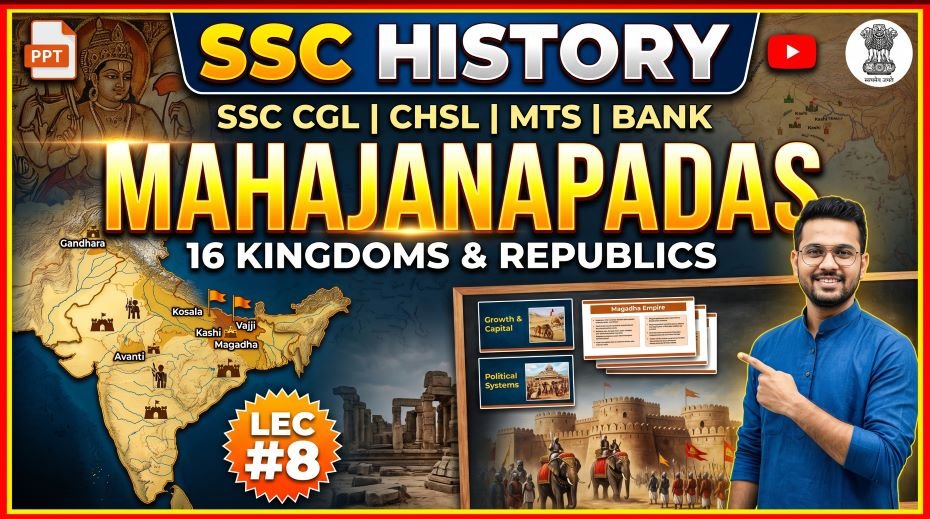
Dynasties of Magadha – Comparative Summary Table
| Dynasty | Period (BC) | Founder | Last Ruler | Capital | Key Achievement |
| Haryanka | ~544–413 BC | Bimbisara | Nagadasaka | Rajagriha → Pataliputra (by Udayin) | First great expansion; friendship with Buddha; Pataliputra founded |
| Shishunaga | ~413–345 BC | Shishunaga | Kalashoka | Rajagriha → Vaishali → Pataliputra | Defeated Avanti; 2nd Buddhist Council at Vaishali |
| Nanda | ~345–321 BC | Mahapadma Nanda | Dhana Nanda | Pataliputra | Largest pre-Maurya empire; greatest army; deterred Alexander; overthrown by Chandragupta |
| Maurya | 321–185 BC | Chandragupta Maurya | Brihadratha | Pataliputra | First pan-Indian empire; Ashoka’s era; peak of ancient India |
Mahajanapadas, Buddhism, and Jainism – The Religious Revolution
The Mahajanapadas period is inseparable from the religious revolution that gave birth to Buddhism and Jainism. Both movements arose in reaction to the rigid Vedic Brahmanical order and found their greatest support in the Gangetic Mahajanapadas.
Gautama Buddha and the Mahajanapadas
| Event | Place / Mahajanapada | Year (BC) | Key Fact |
| Birth of Siddhartha Gautama | Lumbini (Shakya republic, near Kapilavastu) | ~563 BC | Born to King Shuddhodana and Queen Mayadevi |
| Renunciation (Mahabhinishkramana / Great Departure) | Kapilavastu | ~534 BC | Left palace at age 29 in search of truth |
| Enlightenment (Nirvana / Bodhi) | Bodh Gaya (Magadha) | ~528 BC | Attained Enlightenment under the Bodhi Tree |
| First Sermon (Dhammachakkapavattana) | Deer Park, Sarnath (near Varanasi, Kashi) | ~528 BC | Preached to five disciples; set the Dhamma-Chakra in motion |
| Teaching period | Kosala, Magadha, Vajji – most of life spent here | 528–483 BC | Wandered and taught throughout Gangetic Mahajanapadas |
| Mahaparinirvana (Death) | Kushinara (Malla Mahajanapada) | ~483 BC | Died at age 80 at Kushinara (modern Kushinagar, UP) |
| First Buddhist Council | Rajagriha (Magadha) | ~483 BC | Presided by Mahakassapa; compiled Buddha’s teachings |
| Second Buddhist Council | Vaishali (Vajji Mahajanapada) | ~383 BC | Presided by Kalashoka; caused first split in Buddhism |
Vardhamana Mahavira and the Mahajanapadas
| Event | Place / Mahajanapada | Year (BC) | Key Fact |
| Birth of Vardhamana Mahavira | Vaishali / Kundagrama (Vajji Mahajanapada) | ~599 BC | Born to Siddhartha (Kshatriya chief) and Trishala; 24th Tirthankara of Jainism |
| Renunciation | Vaishali | ~569 BC | Left home at age 30 after parents’ death |
| Attains Kevala-Jnana (Omniscience) | Jrimbhikagrama (near Vaishali) | ~527 BC | Attained omniscience at age 42 under a Sal tree |
| Teaching period | Magadha, Mithila, Vaishali – Gangetic region | 527–527 BC | Spent 30 years teaching across the Mahajanapadas |
| Nirvana (Death) | Pawapuri (Malla / Magadha region, Bihar) | ~527 BC | Attained Nirvana at Pawapuri, Bihar; a major Jain pilgrimage site today |
SSC Exam Tip: Buddha born at Lumbini (Shakya), Enlightenment at Bodh Gaya (Magadha), First Sermon at Sarnath (Kashi), Death at Kushinara (Malla). Mahavira born at Vaishali (Vajji), Nirvana at Pawapuri. These four Buddha locations are among the most repeated SSC facts in Ancient History.
The Buddhist Councils – All Four, for Complete Coverage
| Council | Year (BC/AD) | Place | Presided By | Patron King | Key Outcome |
| First Buddhist Council | ~483 BC | Rajagriha (Saptaparni Cave) | Mahakassapa | Ajatashatru (Magadha) | Compiled Sutta Pitaka (Ananda) and Vinaya Pitaka (Upali) |
| Second Buddhist Council | ~383 BC | Vaishali | Sabbakami | Kalashoka (Magadha) | Dispute over monastic rules; first split in Buddhism – Theravada vs Mahasanghika |
| Third Buddhist Council | ~250 BC | Pataliputra | Moggaliputta Tissa | Ashoka (Maurya) | Compiled Abhidhamma Pitaka; finalized Tripitaka; sent missions abroad |
| Fourth Buddhist Council | ~72 AD | Kundalvana, Kashmir | Vasumitra (presided); Ashvaghosha (VP) | Kanishka (Kushan Empire) | Divided Buddhism into Hinayana and Mahayana schools; compiled Mahavibhasha |
Alexander’s Invasion and Its Impact on the Mahajanapadas
Alexander the Great’s invasion of India (327–325 BC) came at the very end of the Mahajanapadas era, when the Nanda dynasty ruled Magadha. While Alexander never actually reached Magadha, his invasion had a profound indirect impact on Indian history.
Key Facts About Alexander’s Indian Campaign
- Alexander invaded India through the Khyber Pass in 327 BC, crossing through the Gandhara Mahajanapada (Taxila region).
- The ruler of Taxila, Ambhi (Omphis), submitted to Alexander and welcomed him – Taxila was a famous centre of learning and trade.
- The most famous battle was the Battle of Hydaspes (326 BC) – fought against King Porus (Paurava) on the banks of the Jhelum (Hydaspes) River.
- Despite defeating Porus, Alexander was so impressed by his bravery that he restored his kingdom and made him an ally.
- Alexander’s army refused to march further east after reaching the Beas (Hyphasis) River because they heard about the enormous army of the Nanda king Dhana Nanda.
- This refusal forced Alexander to turn back. He died in Babylon in 323 BC – just two years after leaving India.
- Alexander’s invasion created a political vacuum in northwest India, which Chandragupta Maurya quickly exploited to build his empire.
SSC Exam Tip: Battle of Hydaspes = 326 BC = Alexander vs Porus (King Purushottama / Paurava). Alexander impressed by Porus’s bravery – restored his kingdom. Alexander’s army refused to cross the Beas River. These are very commonly tested facts.
Economy, Trade, and Coinage in the Mahajanapadas Era
- The Mahajanapadas period saw the introduction of India’s first metallic coinage – punch-marked coins called Ahata Sikka or Karshapana.
- These coins were made of silver and copper, irregular in shape, and bore punched symbols (sun, hill, tree, animal motifs) rather than portrait images.
- The use of coinage revolutionised trade by replacing the barter system, enabling merchants to travel longer distances and conduct complex transactions.
- Major trade routes connected the Mahajanapadas: the Uttarapatha (northern route, from Taxila to Rajgriha and beyond) and the Dakshinapatha (southern route).
- Guild organisations called Shrenis (guilds of merchants and artisans) were very active during this period, providing collective finance and services.
- Taxila and Vaishali were major centres of commerce, attracting merchants from Persia, Central Asia, and Southeast Asia.
High-Frequency SSC MCQs: Mahajanapadas Chapter
These are the most consistently repeated questions from this chapter based on SSC CGL, CHSL, MTS, CPO, GD, and Railway NTPC previous year papers.
| Question | Correct Answer | SSC Exam Reference |
| How many Mahajanapadas were there in ancient India? | 16 (Sixteen) | SSC CGL 2015, 2018, SSC MTS 2020, 2022 |
| Which ancient text mentions all 16 Mahajanapadas? | Anguttara Nikaya (Buddhist Pali text) | SSC CGL 2017, SSC CHSL 2019, 2021 |
| Which is the only Mahajanapada located south of the Vindhyas? | Assaka (on the Godavari River) | SSC CGL 2018, SSC CHSL 2020, SSC MTS 2022 |
| What was the capital of the Magadha Mahajanapada? | Rajagriha (initially); later Pataliputra | SSC CGL 2016, SSC CHSL 2018 |
| Who founded the city of Pataliputra? | Udayin (son of Ajatashatru, Haryanka dynasty) | SSC CGL 2019, SSC CPO 2021 |
| Who was the first great king of Magadha? | Bimbisara (Haryanka dynasty) | SSC CGL 2017, SSC MTS 2021 |
| Bimbisara was a contemporary of which two great religious leaders? | Both Gautama Buddha and Mahavira | SSC CHSL 2019, SSC GD 2022 |
| Which weapon did Ajatashatru use to defeat Vaishali? | Mahashilakantaka (catapult) and Rathamushala (mace-chariot) | SSC CGL 2020, SSC CPO 2022 |
| Which Mahajanapada was a republic (gana-sangha)? | Vajji (Vaishali) – world’s first republic | SSC CGL 2015, 2017, 2021 (repeated) |
| Mahavira was born in which Mahajanapada? | Vajji (Vaishali – Kundagrama) | SSC CHSL 2018, SSC MTS 2021 |
| Buddha was born in which republic? | Shakya republic (Kapilavastu, Kosala region) | SSC CGL 2016, SSC CHSL 2020 |
| Where did Buddha attain Enlightenment? | Bodh Gaya, Magadha (under the Bodhi Tree) | SSC CGL 2014–2022 (repeated multiple times) |
| Buddha delivered his first sermon at which place? | Sarnath (Deer Park), near Varanasi – Kashi Mahajanapada | SSC CGL 2015, 2018, 2021 |
| Where did Buddha attain Mahaparinirvana? | Kushinara (Kushinagar) – Malla Mahajanapada | SSC CGL 2017, SSC CHSL 2019 |
| Where did Mahavira attain Nirvana? | Pawapuri, Bihar (Malla / Magadha region) | SSC CHSL 2020, SSC MTS 2021 |
| First Buddhist Council was held at? | Rajagriha, under King Ajatashatru’s patronage | SSC CGL 2016, SSC CPO 2021 |
| Second Buddhist Council was held at? | Vaishali, under King Kalashoka’s patronage | SSC CHSL 2019, SSC GD 2022 |
| Who founded the Nanda dynasty of Magadha? | Mahapadma Nanda | SSC CGL 2018, SSC CHSL 2021 |
| What title was given to Mahapadma Nanda? | Sarvakshatrantaka (destroyer of all Kshatriyas) and Ekarat (sole sovereign) | SSC CGL 2020, SSC CPO 2022 |
| Who was the last king of the Nanda dynasty? | Dhana Nanda (also called Agrammes in Greek records) | SSC CGL 2019, SSC CHSL 2022 |
| Who overthrew the last Nanda king? | Chandragupta Maurya (with Chanakya’s guidance) | SSC CGL 2015–2022 (most repeated transition fact) |
| Which dynasty conquered Avanti and absorbed it into Magadha? | Shishunaga dynasty (Shishunaga himself defeated Avanti) | SSC CHSL 2020, SSC MTS 2022 |
| Battle of Hydaspes (326 BC) was fought between whom? | Alexander the Great and King Porus (Paurava king) | SSC CGL 2017, SSC CHSL 2019, 2021 |
| Why did Alexander’s army stop at the Beas River? | Army refused to advance on hearing about the huge Nanda army of Dhana Nanda | SSC CGL 2019, SSC CPO 2021 |
| Capital of Gandhara Mahajanapada? | Taxila (Takshashila) – in modern Pakistan | SSC CGL 2016, SSC CHSL 2020 |
| What were punch-marked coins called in the Mahajanapada era? | Ahata Sikka or Karshapana | SSC CGL 2018, SSC MTS 2022 |
| What is the capital of Kosala Mahajanapada? | Shravasti | SSC CHSL 2019, SSC GD 2022 |
| Which Mahajanapada’s capital was Mathura? | Surasena | SSC CGL 2020, SSC CHSL 2022 |
Podcast Interview: Expert Q&A – Mahajanapadas Chapter Deep Dive
This Q&A section covers the chapter from multiple angles – conceptual clarity, memory strategies, exam-pattern analysis, and historical context.
| Speaker | Question / Statement | Answer / Explanation |
| Aspirant | Is it really necessary to memorise all 16 Mahajanapadas and their capitals? | Educator: Yes and no. You will not be asked to list all 16 – but you must be able to identify any one of them when asked. For SSC exams, the most important ones to know deeply are: Magadha (capital change from Rajagriha to Pataliputra), Vajji (republic, Vaishali, Mahavira’s birthplace), Kosala (Shravasti, Buddha’s favourite place), Malla (Kushinara – Buddha’s death), Gandhara (Taxila), and Assaka (only one south of Vindhyas). Know these six perfectly. |
| Aspirant | The dynasties of Magadha always confuse me. Haryanka, Shishunaga, Nanda – how do I remember the order? | Educator: Use the acronym HSN – Haryanka, Shishunaga, Nanda – then Maurya. Or remember: ‘Haryana Shristi Ne Maurya Banaya’ – it’s a memory hook for the order. Each dynasty has one or two key facts: Haryanka = Bimbisara and Ajatashatru and Pataliputra; Shishunaga = defeated Avanti; Nanda = Mahapadma Nanda, Dhana Nanda, defeated by Chandragupta. |
| Aspirant | Why is Vajji called the world’s first republic? Was it really democratic? | Educator: Vajji was a confederacy of eight clans governed by an elected assembly of representatives called the Licchavis – the dominant clan. The assembly voted on important decisions. By modern standards it was an oligarchy – only noble men participated, not all citizens. But in the context of 6th century BC, when most of the world was governed by absolute monarchies, the Vajji system of collective governance was remarkably advanced. That is why it is called the world’s first republic. |
| Aspirant | What is the most important single fact about Bimbisara for SSC? | Educator: That he was a contemporary of BOTH the Buddha and Mahavira – and he personally befriended the Buddha and supported his mission. SSC examiners love this because it connects political and religious history. Also know: Bimbisara annexed Anga (his first conquest), and he established Rajagriha as the Magadha capital. Three facts, one ruler. |
| Aspirant | Why do SSC papers ask about Ajatashatru’s weapons so often? | Educator: Because they are very specific, unusual, and memorable – exactly what MCQ writers love. Ajatashatru used a catapult (Mahashilakantaka – ‘great stone-throwing machine’) to hurl boulders at fortified cities, and a Rathamushala – a chariot with a rotating swinging mace attached – to scatter enemy troops. These were siege warfare innovations that gave him the edge over the fortified Vaishali republic. A 5th century BC catapult in India surprises many people, which is why it keeps getting asked. |
| Aspirant | Alexander never reached Magadha – so why do we study his invasion in this chapter? | Educator: Great question. Alexander’s invasion is important for three reasons: First, it gives us the earliest verified dates in Indian history – through Greek records, we can cross-check Indian timelines. Second, his confrontation with King Porus (Battle of Hydaspes 326 BC) is a famous event. Third, the political vacuum left by Alexander’s retreat allowed Chandragupta Maurya to rapidly unify northwest India and build his empire. Without Alexander’s withdrawal, the Maurya Empire might not have risen so quickly. |
| Aspirant | What is the difference between Nirvana (in Buddhism) and Nirvana in Jainism? | Educator: This is a very good conceptual question. In Buddhism, Nirvana means the extinguishing of desire and the cycle of rebirth – it is a state of perfect peace and liberation, not a place. In Jainism, Nirvana (also called Moksha) means the complete liberation of the soul from karma and the physical body. Both use the word, but with slightly different philosophical meanings. For SSC, what matters is: Buddha attained Nirvana at Bodh Gaya (alive); his final death is called Mahaparinirvana at Kushinara. Mahavira attained Nirvana (death) at Pawapuri. |
| Aspirant | What PPT resource would you recommend for this chapter? | Educator: The SSC History Mahajanapadas PPT Slides – Lecture #8 from the Complete Foundation Batch series at slideshareppt.net is one of the cleanest, most exam-focused resources for this chapter. It has 65 slides covering everything from the 16 Mahajanapada table to the dynasties of Magadha, Buddhist councils, and Alexander’s invasion – all in a visual, easy-to-retain format. It is free and well-structured for SSC revision. |
| Aspirant | Give me a 60-second revision summary of this entire chapter. | Educator: Here it is. 16 Mahajanapadas arose around 600 BC – listed in Anguttara Nikaya. Key ones: Magadha (most powerful), Vajji (republic, Vaishali), Kosala (Shravasti), Malla (Kushinara), Gandhara (Taxila), Assaka (only south of Vindhyas). Magadha dynasties: Haryanka (Bimbisara → Ajatashatru → Udayin founded Pataliputra) → Shishunaga (defeated Avanti) → Nanda (Mahapadma to Dhana Nanda) → Maurya (Chandragupta, 321 BC). Buddha: born Lumbini, Enlightenment Bodh Gaya, first sermon Sarnath, death Kushinara. Mahavira: born Vaishali, death Pawapuri. Alexander: 326 BC Battle of Hydaspes vs Porus. Done. |
also read: SSC History Vijayanagar and Bahmani Empire PPT Slides LEC #7
How to Study This Chapter for Maximum SSC Marks
Step 1 – Understand the Big Picture (Day 1)
- Read the Timeline Table once without memorising.
- Understand the basic sequence: 16 Mahajanapadas emerge → Magadha becomes dominant → Haryanka → Shishunaga → Nanda → Maurya.
- Locate the Mahajanapadas geographically – most are in the Gangetic plains (UP and Bihar).
Step 2 – Master the 16 Mahajanapadas Table (Day 2)
- Focus on: Name + Capital + Modern Location.
- Group them: Assaka (only southern one), Vajji (republic), Gandhara (Taxila, northwest), Magadha (Bihar, most powerful), Malla (Buddha died here), Surasena (Mathura/Krishna).
- Use the mnemonic: KAMA VAJJI KUU PAMSGK – the first letters of all 16.
Step 3 – Deep Study of Magadha Dynasties (Day 3)
- Memorise Haryanka rulers: Bimbisara → Ajatashatru → Udayin (HSN pattern).
- Key facts per ruler: Bimbisara (Anga + Buddha), Ajatashatru (catapult + Vaishali), Udayin (Pataliputra).
- Shishunaga: defeated Avanti; Kalashoka: 2nd Buddhist Council.
- Nanda: Mahapadma (Sarvakshatrantaka); Dhana Nanda (last, Alexander deterred, overthrown by Chandragupta).
Step 4 – Buddhist and Jain Events Table Revision (Day 4)
- Revise the four locations of Buddha: Lumbini → Bodh Gaya → Sarnath → Kushinara.
- Revise four Buddhist Councils: Rajagriha (Ajatashatru) → Vaishali (Kalashoka) → Pataliputra (Ashoka) → Kashmir (Kanishka).
- Mahavira: Vaishali (birth) → Pawapuri (Nirvana).
Step 5 – MCQ Practice and Rapid Revision (Day 5–7)
- Solve all 28 MCQs from the table above.
- Review Timeline Table and Comparative Dynasties Table.
- Target 95% accuracy – this chapter is highly learnable with focused effort.
(FAQs):
Q1: What does the word Mahajanapada mean?
Mahajanapada means ‘Great Realm of the People’ – Maha (great) + Jana (people) + Pada (territory). It refers to the sixteen large, powerful kingdoms and republics that dominated the Indian subcontinent around the 6th century BC.
Q2: Which text is the primary source for the 16 Mahajanapadas?
The Anguttara Nikaya, a Pali Buddhist scripture, is the primary ancient text that lists all sixteen Mahajanapadas by name. The Mahavastu (a Sanskrit Buddhist text) also mentions them.
Q3: Why was Magadha the most powerful Mahajanapada?
Magadha’s dominance came from a combination of geographical advantages (fertile land between Ganga and Son rivers, forest cover, natural defences), iron resources from the Chota Nagpur region, control of the Ganga trade route, access to war elephants, and a series of capable rulers starting from Bimbisara who made strategic conquests and alliances.
Q4: What is the significance of the founding of Pataliputra?
Pataliputra (modern Patna) was founded by Udayin (of the Haryanka dynasty) at the confluence of the Ganga and Son rivers. This location was strategically perfect for both trade and defence. Pataliputra became the capital of the Nanda Empire, the Maurya Empire, and the Gupta Empire – making it the nerve centre of Indian civilisation for nearly a thousand years.
Q5: What happened after Alexander left India?
Alexander’s departure (325 BC) left a power vacuum in northwest India. Chandragupta Maurya, with his mentor Chanakya (Kautilya), raised an army, defeated the Nanda king Dhana Nanda in 321 BC, and established the Maurya Empire. He then drove out Alexander’s remaining generals from the northwest and unified India from the Himalayas to the Deccan.
Q6: How are Buddhism, Jainism, and the Mahajanapadas connected?
Both Buddhism and Jainism arose during the Mahajanapadas period (~6th century BC) as reform movements challenging Vedic Brahmanical authority. Both their founders – Gautama Buddha and Vardhamana Mahavira – were born in Mahajanapada republics (Shakya and Vajji respectively). The merchant class of the Mahajanapadas, who were disadvantaged by the Brahmanical social order, became the strongest supporters of both religions. The patronage of kings like Bimbisara of Magadha helped Buddhism spread rapidly.
Conclusion – Your Complete Revision Package for Mahajanapadas
The SSC History Mahajanapadas PPT Slides – Lecture #8 – with its 65 slides is one of the most focused and effective study resources for this Ancient History chapter. This article has gathered every exam-relevant fact in one structured guide.
Your essential checklist before the exam:
- 16 Mahajanapadas – know every name, capital, and the special SSC fact for each
- Assaka = only south of Vindhyas; Vajji = republic; Gandhara = Taxila; Surasena = Mathura
- Magadha dynasties in order: Haryanka → Shishunaga → Nanda → Maurya
- Bimbisara (Anga + Buddha), Ajatashatru (catapult + Vaishali), Udayin (Pataliputra)
- Buddha: Lumbini → Bodh Gaya → Sarnath → Kushinara
- Mahavira: Vaishali (born) → Pawapuri (Nirvana)
- Four Buddhist Councils: Rajagriha → Vaishali → Pataliputra → Kashmir
- Alexander 326 BC: Battle of Hydaspes vs Porus; stopped at Beas River due to Nanda army
- 321 BC: Chandragupta Maurya overthrows Dhana Nanda – Mahajanapadas era ends
Download the PPT slides from slideshareppt.net, use this article for deep study, and practise the 28 MCQs every day in the final week. You will find this chapter one of your strongest areas in the SSC exam.