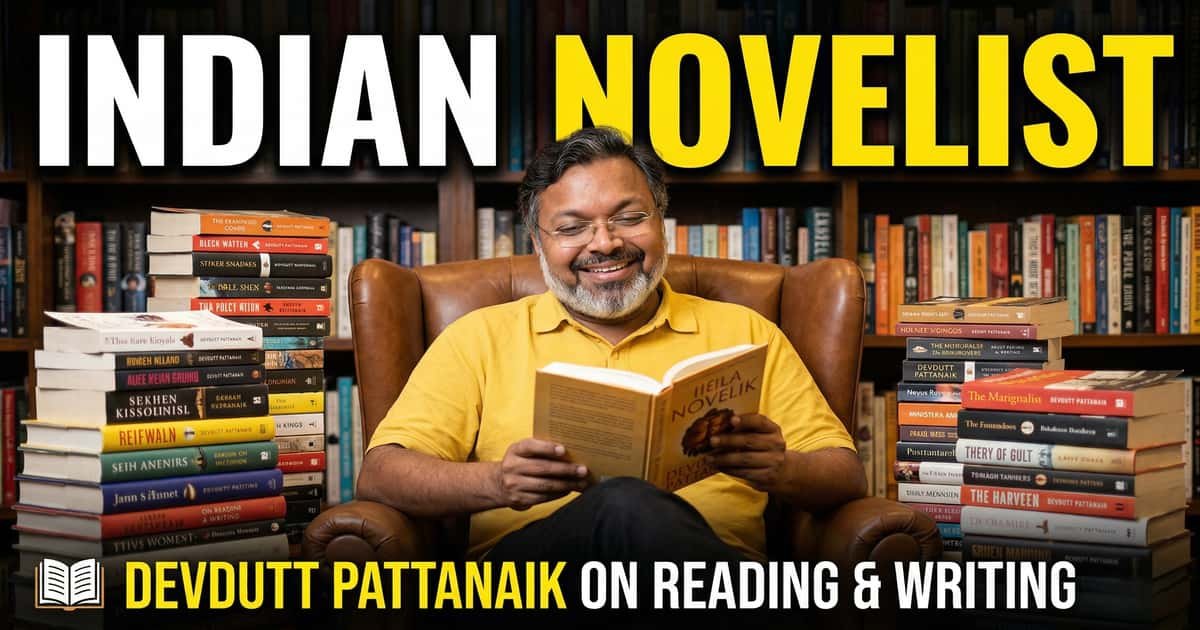
In this article we will discuss everything about Devdutt Pattanaik Biography PDF and PPT Slides Download – his biography, which state he is from, caste, is he married, wife or partner, family, whether he is LGBTQ, his view on religion, all books in English and in order including books on Shiva, books on Krishna, books on Ramayana, books for kids, latest books, net worth, best books, famous books, bibliography, book list, and his complete legacy as India’s most widely read, most widely followed, and most influential mythologist and writer on Indian mythology, religion, and culture.
Devdutt Pattanaik is a phenomenon in Indian intellectual and popular culture. He has written more than fifty books on Indian mythology, Hindu philosophy, and the relevance of ancient stories to modern life – and he has done so in a style that is accessible, visual, and deeply engaging to readers who might otherwise never have encountered the depth and richness of the Hindu mythological tradition. He is a doctor by training, a leadership consultant by career, an author and illustrator by vocation, and a mythologist by calling – and in combining all of these roles, he has created something genuinely new: a modern, secular, widely accessible interpretation of Indian mythology that has brought millions of readers into a living relationship with stories that were in danger of becoming merely academic.
He writes on the relevance of mythology in modern times, especially in areas of management, governance, and leadership. His distinctive approach – presenting mythology not as religious doctrine but as cultural stories that carry psychological and philosophical wisdom – has made him one of the most read and most followed public intellectuals in India.
Devdutt Pattanaik Biography Table (Biodata / Author Profile)
| Biographical Detail | Information |
| Full Name | Devdutt Pattanaik |
| Date of Birth | December 11, 1970 |
| Born Place | Chembur, Mumbai, Maharashtra, India – born and raised in Chembur, a suburb of Mumbai; the city’s cosmopolitan, multi-religious character shaped his early engagement with the diversity of Indian religious and cultural traditions |
| Which State Is Devdutt Pattanaik From? | He is from Maharashtra – specifically from Mumbai (Chembur). His family roots are in Odisha (his surname ‘Pattanaik’ is an Odia surname), but he was born and raised in Mumbai, Maharashtra, and identifies with both the Odia cultural heritage of his family and the cosmopolitan Mumbai world in which he grew up. |
| Caste | Devdutt Pattanaik is of the Karana caste – a Hindu caste from Odisha traditionally associated with scribes, accountants, and administrative service. He practises Hinduism. His caste background is relevant to his work in the sense that the Karana tradition has a long history of engagement with Sanskrit learning and with the management of records and texts – a tradition that resonates with his own career as an interpreter of ancient mythological texts. |
| Religion | Hindu – Devdutt Pattanaik practises Hinduism; he is deeply engaged with the Hindu philosophical and mythological tradition; his entire body of work is an exploration of that tradition from the perspective of a modern, educated, secular Indian. However, his view of religion is not orthodox or devotional – he approaches Hindu mythology as cultural stories rather than literal religious doctrine (see the section on his view on religion below). |
| What Is Devdutt Pattanaik’s View on Religion? | Pattanaik’s view on religion is distinctive and much discussed. He does not regard mythology as religious truth in the literal sense; he regards it as cultural stories – stories that a community tells itself to make sense of its existence, its values, and its relationship to the world. He argues that all religious stories, whether Hindu, Christian, Muslim, or otherwise, are ‘mithya’ (subjective truth) rather than ‘satya’ (objective truth) – they are true for the people who believe them, but they are not universal facts. This view makes him simultaneously a passionate defender of the Hindu mythological tradition and a secular interpreter who refuses to treat it as dogma. It has won him enormous respect from readers who want to engage with Hindu mythology without committing to religious orthodoxy, but it has also attracted criticism from those who feel he trivialises or distorts the tradition. |
| Is Devdutt Pattanaik LGBTQ? | Yes – Devdutt Pattanaik has publicly come out as gay. He spoke about his sexuality in interviews and in public forums, making him one of the most prominent Indian public figures to have come out. He has also written extensively about the representation of diverse sexualities and gender identities in Hindu mythology, arguing that the tradition has always contained a much more diverse understanding of gender and sexuality than the current social mainstream acknowledges. His book Shikhandi and Other Stories They Don’t Tell You (2014) is explicitly about LGBTQ+ representation in Indian mythological tradition. |
| Is Devdutt Pattanaik Married? | No – Devdutt Pattanaik has not married. He is gay and has spoken publicly about his sexuality. The question ‘Is Devdutt Pattanaik married?’ appears frequently in searches because many readers are curious about his personal life. He has a partner – searches for ‘Devdutt Pattanaik partner’ reflect this – but he has not formally married (also relevant given that same-sex marriage is not legally recognised in India). |
| Wife / Partner | Devdutt Pattanaik does not have a wife – he is gay. He has a long-term male partner. Searches for ‘Devdutt Pattanaik wife’ reflect a common misunderstanding; the correct question would be about his partner. He has spoken about his partner in interviews but maintains relative privacy about the details of his personal relationship. |
| Family | Devdutt Pattanaik was born into an Odia Hindu family settled in Mumbai. His parents were from Odisha and maintained an Odia cultural and religious home in Mumbai. His family background – the combination of Odia Brahmin/Karana tradition and the cosmopolitan Mumbai environment – shaped his early exposure to both the depth of the Hindu mythological tradition and the diversity of modern Indian urban life. |
| Education | MBBS – he completed a Bachelor of Medicine and Bachelor of Surgery (MBBS) degree from a medical college in Mumbai; he is a qualified medical doctor by training, though he has not practised medicine as a career for many years; his scientific and medical training is visible in the analytical, systematic approach he brings to the study of mythology |
| Career | He worked for approximately fifteen years in the pharmaceutical and healthcare industry – at companies including Sanofi and Quintiles – before transitioning fully to writing, speaking, and consulting. He was the Chief Belief Officer at Future Group (a major Indian retail corporation) – a unique corporate title that reflected his role in bringing mythological and cultural insights into corporate strategy and leadership thinking. He now works as a full-time author, illustrator, speaker, and leadership consultant. |
| Television | He hosted the television programme Devlok with Devdutt Pattanaik on Epic Channel (2015-2018) – a popular show in which he discussed Hindu mythology, stories, and their relevance to modern life; the show was one of the most watched educational programmes on Indian television and introduced his work to a vast new audience |
| Most Famous Books | Jaya: An Illustrated Retelling of the Mahabharata (2010); My Gita (2015); Myth=Mithya: A Handbook of Hindu Mythology (2006); Business Sutra: A Very Indian Approach to Management (2013); Sita: An Illustrated Retelling of the Ramayana (2013); 7 Secrets of the Goddess (2014); Shikhandi and Other Stories They Don’t Tell You (2014) |
| Net Worth | Devdutt Pattanaik’s net worth is estimated at approximately 5-10 crore Indian rupees as of 2024-2025 – derived from book royalties (more than fifty books published), speaking fees (he is one of India’s most sought-after corporate speakers on leadership and mythology), television and media work, consulting fees, and social media presence. These are estimates; precise figures are not publicly available. |
| Is Devdutt Pattanaik Good? | This question – ‘Is Devdutt Pattanaik good?’ – reflects the significant critical debate about his work. His admirers (and there are millions of them) say yes: he has made the Hindu mythological tradition accessible to a vast modern audience that would otherwise not have engaged with it; his books are engaging, visual, and thought-provoking; his retellings of the Mahabharata and Ramayana are genuinely illuminating. His critics argue that he oversimplifies complex texts, that his interpretations are sometimes idiosyncratic and not supported by the scholarly tradition, and that his approach of reading mythology through the lens of modern management and psychology distorts the texts. Both positions have merit; the answer depends on what you are looking for. |
Devdutt Pattanaik Biography PDF and PPT Slides Download (.PPTX)
Who Is Devdutt Pattanaik? What Is He Known For?
Devdutt Pattanaik is an Indian mythologist, author, illustrator, speaker, leadership consultant, and television personality, born on December 11, 1970, in Chembur, Mumbai. He is from Maharashtra (born and raised in Mumbai, with family roots in Odisha). He is known as India’s most prolific and most widely read writer on Indian mythology – having published more than fifty books that retell and interpret Hindu myths, epics, and philosophical traditions for modern audiences.
He is known for making the Hindu mythological tradition accessible and relevant – for presenting the Mahabharata, the Ramayana, the Puranas, and the stories of the major Hindu deities not as archaic religious texts but as living cultural stories that carry profound psychological, philosophical, and management wisdom. His approach – visual, accessible, intellectually engaging – has brought millions of readers to the Hindu mythological tradition who might otherwise have found it inaccessible.
He is also known for his distinctive view on religion: that all mythology is ‘mithya’ (subjective truth) rather than literal fact; that the value of religious stories lies in what they reveal about the cultures that tell them and the wisdom they carry, not in their literal truth. This view has made him simultaneously one of India’s most respected interpreters of Hindu mythology and one of its most controversial.
He is gay – he has publicly come out – and he has written about LGBTQ+ representation in Hindu mythology in Shikhandi and Other Stories They Don’t Tell You. He is not married. He lives in Mumbai and continues to write prolifically.
Devdutt Pattanaik Biography in English: Early Life, Born Place and Education
Devdutt Pattanaik was born on December 11, 1970, in Chembur – a suburb of Mumbai that sits on the eastern side of the city, overlooking Thane Creek. He was born into a Hindu family of Odia origin – his parents were from Odisha, and the surname ‘Pattanaik’ is a distinctively Odia surname, associated with the Karana caste traditionally employed in administrative and scribal roles. Growing up in Mumbai in an Odia Hindu household gave him the double formation that shapes all his work: the depth of the Hindu mythological and philosophical tradition that his family carried from Odisha, and the cosmopolitan, secular, modern Mumbai world that formed his intellectual sensibility.
He grew up in the India of the 1970s and 1980s – a period of significant social and economic change, in which the relationship between tradition and modernity was being actively negotiated in Indian families and Indian society. His early engagement with Hindu mythology – with the stories of the gods, the epics, the Puranas – was both a family inheritance and a personal passion, and it developed alongside a scientific and analytical training that would eventually shape his distinctive approach to interpreting those stories.
He studied medicine at a medical college in Mumbai, completing an MBBS degree. The choice of medicine – a rigorous scientific training – for someone who would go on to spend his career interpreting mythology is itself revealing: it shaped his analytical, systematic approach to mythological material and gave him a way of thinking about stories in terms of their psychological and philosophical function rather than their literal or devotional content.
After completing his medical degree, he worked in the pharmaceutical and healthcare industry for approximately fifteen years – at companies including Sanofi and Quintiles – before transitioning to writing, speaking, and consulting. During these years in the pharmaceutical industry, he began writing books on mythology in his spare time; his first book was published in 1996, and the response was sufficient to encourage him to continue.
Devdutt Pattanaik Caste and Which State He Is From
Devdutt Pattanaik’s caste is Karana – a Hindu caste from Odisha that has traditionally been associated with scribes, record-keepers, and administrative service. The Karana caste occupies an important position in Odia social history as the community that maintained the records and documents of temples, kingdoms, and administrative institutions over many centuries. This background in textual and administrative service – in the care and management of written records – resonates interestingly with Pattanaik’s career as an interpreter and populariser of ancient textual traditions.
He is from Maharashtra in the sense of having been born and raised in Mumbai, but his family roots are in Odisha, and he identifies with both the Odia cultural heritage of his family and the cosmopolitan Mumbai world in which he grew up. The question ‘Devdutt Pattanaik is from which state?’ therefore has two possible answers: he was born in Maharashtra (Mumbai), but his family’s cultural and ancestral roots are in Odisha. He himself engages with both Odia and broadly Hindu cultural traditions in his work.
Devdutt Pattanaik: Is He Married, Wife, Partner and LGBTQ
Devdutt Pattanaik is not married. He has publicly come out as gay – making him one of the most prominent Indian public figures to have done so – and he has a long-term male partner. Searches for ‘Is Devdutt Pattanaik married?’, ‘Devdutt Pattanaik wife’, ‘Devdutt Pattanaik partner’, and ‘Is Devdutt Pattanaik LGBTQ?’ all reflect the curiosity of readers about his personal life, which he has addressed openly in interviews and in his public persona.
His willingness to speak publicly about his sexuality is itself a significant act in the Indian context – India only decriminalised homosexuality (under Section 377 of the Indian Penal Code) in 2018, and social acceptance of gay identity remains contested. Pattanaik’s openness about his identity, combined with his scholarly and popular exploration of LGBTQ+ representation in Hindu mythology, has made him an important figure in Indian discussions of sexuality, gender, and religion.
He has written about the representation of diverse genders and sexualities in Hindu mythology in several of his books – most explicitly in Shikhandi and Other Stories They Don’t Tell You (2014), which explores the figures in Hindu mythology who do not conform to binary gender or sexuality norms: Shikhandi (the gender-fluid warrior of the Mahabharata), Arjuna’s transformation into Brihannala, various transgender and intersex figures in the Puranas, and the tradition of the hijra (the third gender) in Hindu culture. His argument is that the Hindu mythological tradition has always had a more diverse understanding of gender and sexuality than the social mainstream – shaped partly by Victorian-era British moral codes – currently acknowledges.
Devdutt Pattanaik’s View on Religion
One of the most frequently asked questions about Devdutt Pattanaik is about his view on religion – specifically, how a man who is so deeply engaged with Hindu mythology and so evidently knowledgeable about the Hindu philosophical tradition approaches the question of religious truth.
Pattanaik’s answer to this question is both simple and profound: he distinguishes between ‘satya’ (objective truth – facts that are true for everyone, everywhere, always) and ‘mithya’ (subjective truth – stories that are true for particular people, in particular contexts, from particular perspectives). He argues that all mythology – Hindu, Christian, Muslim, Buddhist, or otherwise – belongs to the category of mithya: it is not objectively, scientifically true; it is culturally true, psychologically true, and philosophically true for the people who tell it and live by it.
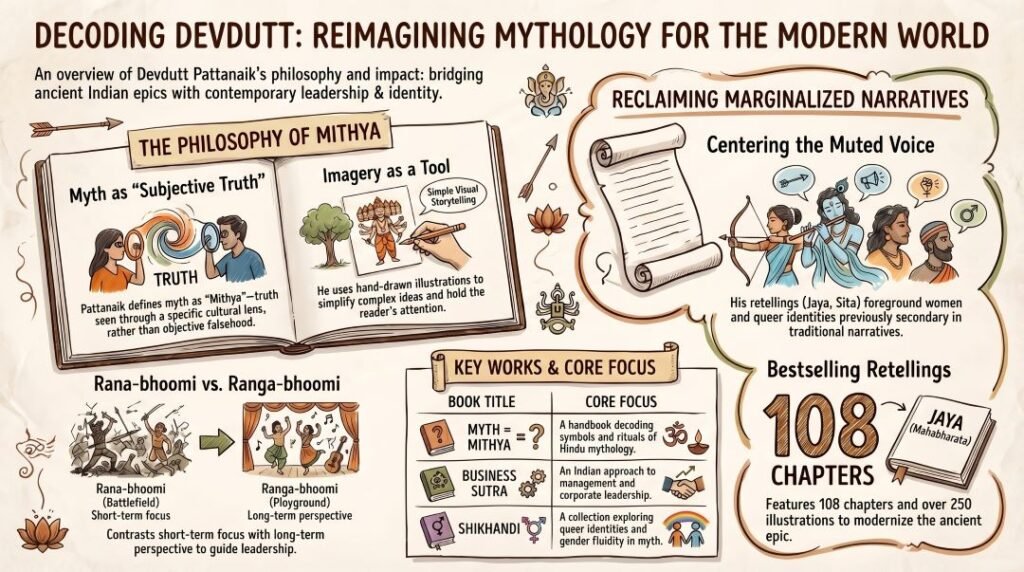
This distinction is central to the title of one of his most important books: Myth=Mithya: A Handbook of Hindu Mythology (2006). By equating the English word ‘myth’ (which in Western usage can imply ‘false story’) with the Sanskrit/Hindi word ‘mithya’ (which means ‘subjective truth’), Pattanaik argues that mythology is not false – it is subjectively true, culturally valuable, and philosophically rich – but it is not the kind of truth that can be tested or universalised.
This view allows Pattanaik to be both a passionate defender of Hindu mythological tradition and a secular, non-dogmatic interpreter. He does not ask his readers to believe in the literal truth of the stories he retells; he asks them to engage with what the stories reveal about the human mind, the social order, and the philosophical questions that all human beings face. This approach has made his work accessible and valuable to readers across a wide range of religious and secular backgrounds.
Devdutt Pattanaik All Books: Complete Bibliography in Order
Devdutt Pattanaik has published more than fifty books – a prolific output that spans mythology, philosophy, management, fiction, and children’s literature. Here is a guide to his most important books, organised by subject area:
Books on the Mahabharata
| Book | Summary |
| Jaya: An Illustrated Retelling of the Mahabharata (2010) | His most celebrated retelling – ‘Jaya’ is one of the names of the Mahabharata itself (meaning ‘victory’); the book retells the entire Mahabharata in 108 chapters, each illustrated with his distinctive minimalist line drawings. Accessible, engaging, and genuinely illuminating – widely regarded as one of the best introductions to the Mahabharata available in English. One of his most famous and most widely read books. |
| Ajaya: Roll of the Dice (with Anand Neelakantan) (2013) | A retelling of the Mahabharata from the perspective of the Kauravas – the ‘villains’ of the traditional narrative; exploring the complexity of their motivations and the moral ambiguity of the conflict. A different kind of retelling that challenges the conventional good/evil framing. |
| My Mahabharata (2015) | A more personal, reflective engagement with the Mahabharata; exploring what the epic means in the context of modern life, management, and leadership. |
| The Pregnant King (2008) | A novel – a fictional story set in the world of the Mahabharata; exploring questions of dharma, kingship, and gender through a story about a king who becomes pregnant. One of his most interesting forays into fiction. |
Books on the Ramayana
| Book | Summary |
| Sita: An Illustrated Retelling of the Ramayana (2013) | His retelling of the Ramayana from Sita’s perspective – putting the female protagonist at the centre of the story and exploring the epic’s complexities through her experience. Widely read and widely praised. One of his most important books. |
| Ramayana vs Mahabharata: A Lighthearted Comparison (2019) | A comparative study of India’s two great epics – examining their different approaches to duty, desire, dharma, and the social order; accessible and engaging. |
| Forest of Stories: Magical Tales from the Valmiki Ramayana (2012) | A collection of stories from the Valmiki Ramayana – the original Sanskrit text – retold in an accessible style; part of his project of making the primary texts of Hindu tradition available to modern readers. |
Books on Hindu Mythology – General
| Book | Summary |
| Myth=Mithya: A Handbook of Hindu Mythology (2006) | One of his most important early books – a comprehensive introduction to Hindu mythology organised around the equation myth=mithya; covers the major deities, stories, and concepts of the Hindu mythological tradition with the visual and analytical approach that characterises all his work. One of his most famous books and one of the best starting points for readers new to his work. |
| 7 Secrets of the Goddess (2014) | Explores the feminine divine in the Hindu tradition – the seven major goddesses and the secrets or wisdom they embody; one of his most popular books on the divine feminine |
| 7 Secrets of Shiva (2011) | Explores the seven aspects or secrets of Shiva – the great Hindu god of destruction and transformation; one of his most searched books on Shiva |
| 7 Secrets of Vishnu (2011) | Explores the seven aspects of Vishnu – the great Hindu god of preservation; part of his ‘7 Secrets’ series |
| Devlok: Retelling of Hindu Mythology (2015) | Companion to the television programme Devlok with Devdutt Pattanaik; accessible retelling of major Hindu mythological stories for a general audience |
| Olympus: An Indian Retelling of the Greek Myths (2013) | A comparison of Greek and Hindu mythology – retelling Greek myths through an Indian lens and examining the parallels between the two traditions; one of his most intellectually ambitious works |
| Shikhandi and Other Stories They Don’t Tell You (2014) | His most explicitly LGBTQ-themed book – exploring the representation of diverse genders and sexualities in Hindu mythology; figures including Shikhandi, Arjuna as Brihannala, and various transgender and intersex characters from the Puranas; arguing that the Hindu tradition has always contained a more diverse understanding of gender than the social mainstream acknowledges |
Books on Shiva
| Book | Summary |
| 7 Secrets of Shiva (2011) | The most comprehensive of his books specifically about Shiva – exploring the seven aspects of Shiva as destroyer, yogi, husband, father, dancer, and more; widely regarded as one of his best books on Shiva |
| Shiva to Shankara: Giving Form to the Formless (2006) | An exploration of the Shiva mythology, including the stories of Shiva and Parvati, Shiva and the other devas, and the philosophical significance of the Shivalingam |
| Various mythology books | Many of his general mythology books include extensive treatment of Shiva – Myth=Mithya, Jaya, and others all contain significant discussion of Shiva’s role in the Hindu mythological tradition |
Books on Krishna
| Book | Summary |
| My Gita (2015) | His most important and most personal book on Krishna – a retelling and interpretation of the Bhagavad Gita, the conversation between Krishna and Arjuna on the battlefield of Kurukshetra that is the philosophical heart of the Mahabharata. Pattanaik’s My Gita presents the Gita not as a religious or devotional text but as a guide to living wisely in a world of uncertainty and obligation. One of his most celebrated works. |
| 7 Secrets of the Hindu Calendar Art (2009) | An exploration of the visual tradition of Hindu devotional art, including the depiction of Krishna and other deities in the popular art tradition |
| Shyam: An Illustrated Retelling of the Bhagavata (2018) | A retelling of the Bhagavata Purana – the text that contains the most complete account of Krishna’s life and deeds – with his characteristic illustrations; ‘Shyam’ is one of the names of Krishna (meaning ‘dark-complexioned’) |
Books on the Ramayana – Shyam/Bhagavata
| Book | Summary |
| Ram: Scion of Ikshvaku (Retelling, 2015) | A retelling of the Ramayana from Ram’s perspective – exploring the dharma-king ideal and its complexities |
| Vishnu: An Introduction (2006) | An introduction to Vishnu – the preserver god, whose avatars include Rama and Krishna – and his role in the Hindu mythological tradition |
| Devi: The Mother-Goddess (2002) | One of his early books on the Hindu goddesses and the mythology of the divine feminine |
Books on Management and Leadership (Business Sutra)
| Book | Summary |
| Business Sutra: A Very Indian Approach to Management (2013) | His most important management book – arguing that Indian mythological and philosophical traditions offer a radically different approach to management, leadership, and organisational life than the Western models that dominate business education; the book has been widely used in corporate training and is one of the most discussed works on Indian management philosophy |
| Wealth of Wisdom: The Indic Perspective on Wealth Creation (2019) | Explores Indian mythological and philosophical traditions on the creation and meaning of wealth; connecting ancient wisdom to modern financial and economic thinking |
| Leadership Sutras (2016) | A guide to leadership principles drawn from Indian mythology; aimed at corporate audiences |
| Culture: 50 Insights from Mythology (2014) | Explores the cultural dimensions of Indian mythology and their relevance to modern organisational and social life |
Books for Kids
| Book / Series | Summary |
| Fun in Devlok (Series) | A series of illustrated books for children retelling Hindu mythological stories in an accessible, age-appropriate way; one of the most successful children’s mythology series in India |
| Stories in Devlok (Series) | Another series of mythological stories for children; Pattanaik has produced a substantial body of children’s literature alongside his adult mythology books, reflecting his commitment to introducing the Hindu mythological tradition to young readers |
| The Girl Who Chose (2016) | A retelling of the Ramayana for children – focusing on Sita’s choices and agency; a feminist retelling aimed at young readers |
| I Am Arjun (2015) | A retelling of the Mahabharata for children from Arjuna’s perspective |
| Various illustrated mythology books for children | Pattanaik has produced many illustrated mythology books specifically designed for children and young readers; these books on Shiva, Krishna, Ganesh, and the major Hindu epics are among the most popular in their category in India |
Jaya: An Illustrated Retelling of the Mahabharata – Complete Analysis
Jaya (2010) is widely regarded as Devdutt Pattanaik’s finest and most important work – the book that most fully demonstrates his gifts as a mythological storyteller and that has introduced the most readers to his particular approach to Hindu mythology.
| Aspect | Detail |
| Full Title | Jaya: An Illustrated Retelling of the Mahabharata |
| Author | Devdutt Pattanaik |
| Published | 2010 (Penguin Books India) |
| What ‘Jaya’ Means | ‘Jaya’ means ‘victory’ in Sanskrit and is one of the traditional names of the Mahabharata itself – the full name of the epic, according to some traditions, is ‘Jaya’. Pattanaik’s choice of this title signals his intention to present the Mahabharata in its entirety and in its own terms. |
| Structure | 108 chapters – the number 108 is sacred in Hindu tradition, associated with completeness and with the cosmic order; each chapter covers one episode or aspect of the Mahabharata story; each chapter is illustrated with Pattanaik’s characteristic minimalist line drawings |
| The Illustrations | Pattanaik illustrates all his own books – his line drawings are distinctive, schematic, and expressive; they capture the essential shapes and relationships of the mythological figures without attempting photographic realism; they are part of his unique style and one of the things that most clearly distinguish his books from other mythology retellings |
| Jaya Summary | The book retells the entire Mahabharata – from the origins of the Pandava and Kaurava families, through the events leading to the war at Kurukshetra, through the war itself and its aftermath, to the death of the Pandavas and their eventual arrival in heaven. Pattanaik retells the story in his characteristic accessible, engaging style, pausing at key moments to explain the philosophical and cultural significance of what is happening – what different characters’ choices reveal about the Hindu understanding of dharma, karma, and the relationship between human beings and the divine. |
| Why It Is His Most Famous Book | Jaya combines accessibility, visual richness, and genuine intellectual depth in a way that none of his other books quite achieves; it is the book that most readers recommend as the starting point for anyone wanting to understand Pattanaik’s approach and the Mahabharata itself; it has introduced the Mahabharata to an enormous number of readers who might otherwise never have engaged with it |
| Critical Reception | Universally praised by readers; some scholars of classical Sanskrit literature have criticised the simplifications and the psychologising interpretations that Pattanaik brings to the text; but as a work of popular mythology writing aimed at a broad modern audience, it is considered one of the finest such works in any language |
My Gita: Analysis
My Gita (2015) is Devdutt Pattanaik’s retelling and interpretation of the Bhagavad Gita – the conversation between Krishna and Arjuna that forms the philosophical heart of the Mahabharata and is one of the most important and most widely read philosophical texts in the world. It is one of his most celebrated and most discussed books.
Pattanaik’s approach to the Gita is characteristic of his broader approach to mythology: he presents it not as religious scripture to be followed literally but as a philosophical dialogue about the meaning of duty, the nature of reality, and the relationship between the individual self (atma) and the universal self (brahman). He is explicit that this is ‘My Gita’ – his reading, his interpretation – not a definitive or authoritative translation. This honest subjectivity is part of his consistent philosophy that all readings of mythology are ‘mithya’ – subjective truth.
The book presents the 18 chapters of the Gita through a series of short, accessible essays, each accompanied by his distinctive illustrations. Key concepts – dharma, karma, yoga, maya, brahman, atman – are explained in clear, modern English without losing their philosophical depth. The book has been praised for making the Gita genuinely accessible to modern readers who might otherwise find the text’s philosophical language and cultural context impenetrable.
Myth=Mithya: Handbook of Hindu Mythology – Analysis
Myth=Mithya: A Handbook of Hindu Mythology (2006) is one of Devdutt Pattanaik’s earliest and most important books – and in many ways the foundational text for understanding his entire approach to mythology. The title captures his central philosophical position: the English word ‘myth’ (which implies ‘false story’ in popular Western usage) equals the Sanskrit/Hindi word ‘mithya’ (which means ‘subjective truth’ – true for the one who believes it, but not universally objective).
The book is organised as a handbook – covering the major deities, the major texts, and the major concepts of the Hindu mythological tradition in a systematic way that makes it an excellent reference work as well as an accessible introduction. Topics covered include: the nature of the Hindu cosmos and its cycles; the major deities (Brahma, Vishnu, Shiva, the Devi/Goddess, Ganesha, Kartikeya, and others); the major epics and Puranas; the philosophical concepts of dharma, karma, moksha, maya, and brahman; and the relationship between mythology and social order.
Myth=Mithya is widely regarded as one of the best introductions to Hindu mythology available in English – it is recommended in academic courses on Indian religion and culture and has been used by teachers, students, and general readers across India and internationally.
Business Sutra: A Very Indian Approach to Management
Business Sutra: A Very Indian Approach to Management (2013) is Devdutt Pattanaik’s most important management book – and one of the most genuinely original contributions to the literature on Indian management philosophy. It argues that the Indian mythological and philosophical tradition offers a fundamentally different approach to management, leadership, and organisational life than the Western models that dominate business education worldwide.
The central argument is that Western management thinking is based on a ‘belief in one objective truth’ – one right way to run an organisation, one right set of goals, one right kind of leadership – that is rooted in the Western monotheistic philosophical tradition. Indian mythology, by contrast, reflects a world in which there are many truths, many dharmas, many ways of being – a world that is more comfortable with complexity, ambiguity, and the co-existence of different perspectives.
Pattanaik uses stories from Hindu mythology – the decisions of gods, the choices of kings, the wisdom of sages – to illustrate what this different approach looks like in practice: what it means to lead in a context of multiple truths; how to create meaning rather than just value; how to think about organisational purpose in terms of dharma rather than profit alone. The book has been widely used in corporate training in India and is regarded as one of the most significant attempts to articulate a distinctively Indian approach to management.
Shikhandi and Other Stories They Don’t Tell You
Shikhandi and Other Stories They Don’t Tell You (2014) is Devdutt Pattanaik’s most explicitly LGBTQ-themed book – and one of his most important contributions to the cultural and social debates of contemporary India. The book explores the representation of diverse genders and sexualities in Hindu mythology, arguing that the tradition has always contained a much more diverse understanding of gender and sexuality than the social mainstream – shaped partly by Victorian-era British moral codes – currently acknowledges.
The book’s central figure is Shikhandi – the gender-fluid warrior of the Mahabharata who was born female (as Amba, the princess who was humiliated by Bhishma) and reborn male to seek revenge, retaining both male and female qualities. The book also explores: Arjuna’s transformation into the eunuch Brihannala during the year of hiding; the hijra (the third gender community) tradition in Hindu culture; the intersex and transgender figures in the Puranas; the story of Ila who alternated between male and female forms; and many other figures who do not conform to binary gender norms.
Pattanaik’s argument is that the Hindu tradition’s acceptance of these diverse figures is part of a larger philosophical orientation toward diversity and complexity in human nature – an orientation that was suppressed by British colonial rule and Victorian morality but that is present in the original texts. The book was an important cultural intervention in the debate over Section 377 (the law criminalising homosexuality in India) and continues to be widely read and cited in discussions of LGBTQ+ rights and Hindu culture.
Devdutt Pattanaik Books in English – Best Books and Top Recommendations
Devdutt Pattanaik has published more than fifty books in English on Indian mythology, philosophy, management, and culture. For readers new to his work, here are the best starting points:
- Jaya: An Illustrated Retelling of the Mahabharata (2010) – the best single introduction to his work and to the Mahabharata; if you read only one Pattanaik book, make it this one
- Myth=Mithya: A Handbook of Hindu Mythology (2006) – the best systematic introduction to Hindu mythology; ideal as a reference work alongside his other books
- My Gita (2015) – his best book on the Bhagavad Gita and on Krishna; accessible, personal, and philosophically rich
- Sita: An Illustrated Retelling of the Ramayana (2013) – the best starting point for the Ramayana; feminist, accessible, visually rich
- 7 Secrets of Shiva (2011) – the best starting point for readers specifically interested in Shiva; clear, engaging, and comprehensive
- Business Sutra (2013) – essential reading for readers interested in the intersection of mythology, philosophy, and management
- Shikhandi and Other Stories They Don’t Tell You (2014) – essential reading for readers interested in LGBTQ+ representation in Hindu mythology
Devdutt Pattanaik’s Writing Style
| Element | Detail |
| Prose Style | Simple, clear, and accessible – Pattanaik writes in a plain English style that is deliberately designed to be read by anyone with a basic command of the language; he avoids academic jargon and Sanskrit technical terms (when they appear, he always explains them); his prose has the directness and clarity of a good teacher explaining something to a curious student |
| Visual Element | He illustrates all his own books – his distinctive line drawings are schematic, minimalist, and expressive; they show the essential features of mythological figures and scenes without attempting photographic realism; the visual element is central to his approach and distinguishes his books from all other mythology writing in India |
| The Comparative Method | One of his most effective techniques is the comparison of different versions of a story – the many different regional, textual, and oral versions of a myth that exist across India; this comparative approach reveals the richness and diversity of the Hindu mythological tradition and challenges the idea that there is one ‘correct’ version of any story |
| The Modern Application | He consistently draws connections between mythological stories and modern life – what does Arjuna’s dilemma on the battlefield of Kurukshetra tell us about the decisions we face in our own professional and personal lives? This modern application is what has made his work particularly resonant in corporate and educational contexts |
| Non-Dogmatic Approach | His fundamental methodological principle is that mythology is ‘mithya’ – subjective truth, not objective fact; this non-dogmatic approach allows him to engage with Hindu mythology without asking his readers to adopt any particular religious position, and it has made his work accessible to readers of all religious backgrounds |
| Criticism of His Style | Critics argue that his simplification of complex texts sometimes amounts to distortion; that his psychologising interpretation of mythological figures can be anachronistic; and that his confident, authoritative tone can give the impression of greater scholarly consensus than actually exists for some of his interpretations |
Devdutt Pattanaik Life Timeline
| Year | Key Event |
| 1970 | Born on December 11 in Chembur, Mumbai, Maharashtra – into an Odia Hindu family; Karana caste; grows up in the cosmopolitan, multi-religious world of Mumbai while absorbing the Hindu mythological tradition of his Odia family heritage |
| 1970-1988 | Schooling in Mumbai; grows up with a deep interest in mythology, religion, and philosophy alongside a rigorous scientific education |
| 1988-1993 | Studies medicine at a medical college in Mumbai; completes MBBS degree; the analytical, scientific training shapes his systematic approach to mythological material |
| 1993-1996 | Begins working in the pharmaceutical and healthcare industry; begins writing books on mythology in his spare time; first book in preparation |
| 1996 | First book published – The Goddess in India: The Five Faces of the Eternal Feminine; the beginning of his prolific publishing career |
| 1996-2007 | Continues working in the pharmaceutical industry while writing mythology books; builds a growing readership; publishes Myth=Mithya (2006), Shiva to Shankara (2006), and many other early works |
| 2006 | Myth=Mithya: A Handbook of Hindu Mythology published – establishes the theoretical framework for all his subsequent work |
| 2008 | The Pregnant King published – his first novel; Chief Belief Officer appointment at Future Group |
| 2010 | Jaya: An Illustrated Retelling of the Mahabharata published – his masterwork; immediately becomes a bestseller and one of the most widely read Indian mythology books in any language; major turning point in his career |
| 2011 | 7 Secrets of Shiva and 7 Secrets of Vishnu published; growing corporate speaking career |
| 2013 | Business Sutra published; Sita published; both become major bestsellers; fully transitions to full-time writing, speaking, and consulting |
| 2014 | Shikhandi and Other Stories They Don’t Tell You published – his most explicitly LGBTQ-themed book; comes out publicly as gay |
| 2015 | Devlok with Devdutt Pattanaik begins on Epic Channel – becomes one of India’s most watched educational television programmes; My Gita published – one of his most celebrated books |
| 2015-2018 | Television career with Devlok expands his audience to tens of millions of viewers; continues prolific publishing output |
| 2018 | Shyam: An Illustrated Retelling of the Bhagavata published |
| 2019-present | Continues writing prolifically; social media presence (millions of followers on Facebook, Instagram, Twitter); regular columns and articles for major Indian publications; corporate speaking and consulting; has now published more than fifty books |
| 2025 | Active as a writer, speaker, illustrator, and cultural commentator; one of India’s most followed public intellectuals; continues to introduce new readers to Hindu mythology through books, media, and digital content |
10 Lines About Devdutt Pattanaik for Students
- Devdutt Pattanaik was born on December 11, 1970, in Chembur, Mumbai, Maharashtra – from an Odia Hindu family of the Karana caste; he is from Maharashtra (born in Mumbai) with family roots in Odisha.
- He studied medicine (MBBS) at a Mumbai medical college and worked in the pharmaceutical industry for approximately fifteen years before becoming a full-time writer, speaker, and consultant.
- He is gay – he has publicly come out – and is not married; he has a male partner; he has written extensively about LGBTQ+ representation in Hindu mythology.
- His view on religion is that all mythology is ‘mithya’ (subjective truth) – not objectively true but culturally and philosophically valuable; this non-dogmatic approach is central to all his work.
- He has published more than fifty books on Indian mythology, Hindu philosophy, management, and culture – making him one of the most prolific authors in modern India.
- His most famous books are Jaya: An Illustrated Retelling of the Mahabharata (2010), My Gita (2015), Myth=Mithya (2006), Sita (2013), and Business Sutra (2013).
- He illustrates all his own books – his distinctive, minimalist line drawings are an integral part of his unique style and one of the things that most clearly distinguish his books from all other mythology writing.
- He hosted the popular television programme Devlok with Devdutt Pattanaik on Epic Channel (2015-2018), which brought his work to tens of millions of Indian viewers.
- He was the Chief Belief Officer at Future Group – a unique corporate title reflecting his role in bringing mythological and cultural insights into corporate strategy; he is now a highly sought-after corporate speaker on leadership and management.
- He is considered India’s most widely read mythologist and one of the most influential interpreters of the Hindu mythological tradition for modern audiences in any language.
READ ALSO: Chetan Bhagat Biography PDF and PPT Slides Download
Devdutt Pattanaik Short Biography (Profile / Biodata)
Devdutt Pattanaik (born December 11, 1970, Chembur, Mumbai, Maharashtra, India) is an Indian mythologist, author, illustrator, speaker, and leadership consultant. From Maharashtra (born in Mumbai); family roots in Odisha; Karana caste; Hindu. Gay – has publicly come out; not married; has a male partner. Education: MBBS (medicine) from a Mumbai medical college. Career: pharmaceutical industry (1993-c.2008); Chief Belief Officer, Future Group; full-time writer, speaker, and consultant. Has published more than 50 books including Jaya (2010), My Gita (2015), Myth=Mithya (2006), Business Sutra (2013), Sita (2013), 7 Secrets of Shiva (2011), Shikhandi (2014), Shyam (2018), The Pregnant King (2008). Hosted Devlok with Devdutt Pattanaik (Epic Channel, 2015-2018). Known for making Hindu mythology accessible to modern audiences through his distinctive visual, accessible, non-dogmatic approach. Net worth estimated at 5-10 crore INR.
Conclusion: Devdutt Pattanaik’s Enduring Legacy
Devdutt Pattanaik has done something genuinely important for Indian culture and for world culture: he has made the Hindu mythological tradition accessible to millions of people who might otherwise have found it inaccessible, intimidating, or simply unknown. In a world where the stories of the ancient world are increasingly marginalised by the relentless present of digital media and global popular culture, he has found a way to make these very old stories feel urgent, relevant, and alive.
His legacy is multiple. He is the person who introduced the Mahabharata to millions of Indians who had heard of it but never engaged with it; who explained the Bhagavad Gita to readers who found the original text impenetrable; who articulated, in clear and memorable terms, the philosophical distinction between ‘satya’ and ‘mithya’ that is at the heart of the Hindu approach to religious knowledge. He is also the person who has argued, loudly and at length, that the Hindu tradition’s diversity – including its diversity in matters of gender and sexuality – deserves to be acknowledged and celebrated rather than suppressed.
He will not satisfy everyone. Scholars of classical Sanskrit will find his simplifications troubling; orthodox believers will find his secular, psychological approach to religious texts uncomfortable; literary critics will find his prose style undistinguished. But his readers – the millions of people who have found in his books a living relationship with the Hindu mythological tradition – will continue to find value in what he does. And that, in the end, is the most important measure of a writer’s achievement.