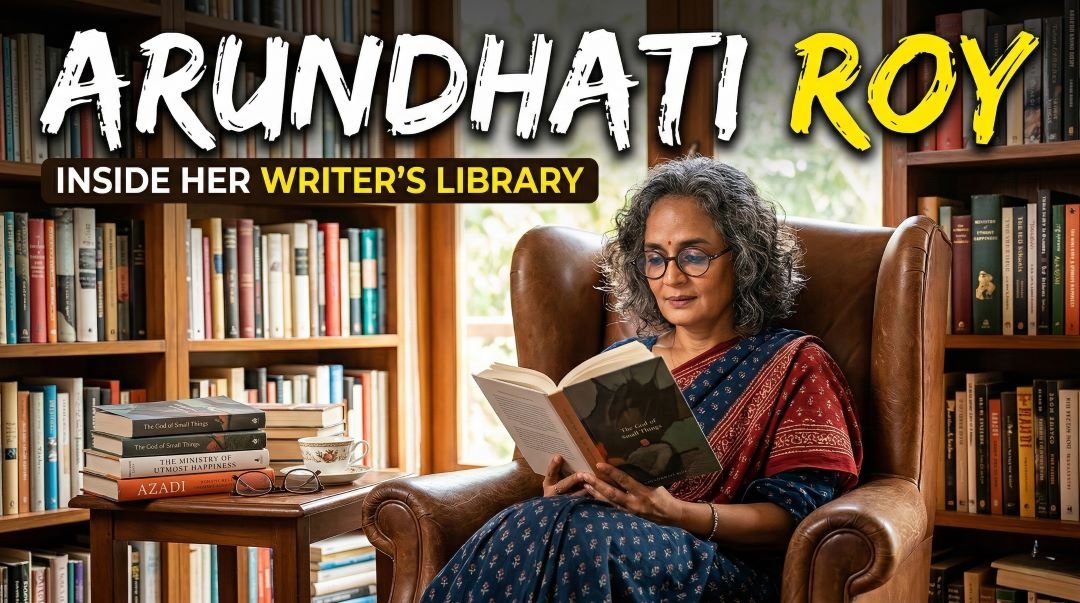
In this article we will discuss about the Arundhati Roy Biography PDF and PPT Slides Download (.PPTX), Arundhati Roy Biography, Books, Husband, Famous Works, Awards and Complete Literary Legacy so, There are writers who write books, and there are writers who become a conscience. Arundhati Roy is both. She burst into the world’s consciousness in 1997 with The God of Small Things – a debut novel so lyrical, so politically charged, and so emotionally devastating that it won the Booker Prize and became one of the best-selling Indian novels in history. Then, when the world expected another novel, she did something that surprised everyone: she put down fiction and picked up a megaphone. She wrote about nuclear weapons, about dams, about Kashmir, about Naxalism, about corporate power – and she wrote about these things with the same intelligence and passion she had brought to her fiction.
More than a quarter of a century after The God of Small Things was published, Arundhati Roy remains one of the most important – and most controversial – public intellectuals in India. She has been celebrated, condemned, taken to court, and threatened. She has won the Sydney Peace Prize and been convicted of contempt of court. She has spent time with Maoist guerrillas in the forests of Chhattisgarh and spoken at the World Social Forum in Brazil. And in 2025, she published her first memoir and walked out of the Berlin Film Festival over its refusal to allow political speech. She is, by any measure, one of the most extraordinary figures in contemporary Indian – and world – literature and public life.
This comprehensive article covers everything about Arundhati Roy – biography in English and Hindi, husband and personal life, mother Mary Roy, father, brother, children, education, books in order (fiction and non-fiction), famous works, The God of Small Things, The Ministry of Utmost Happiness, new book 2025, movies and films, Pradip Krishen, awards won, Pulitzer Prize clarification, famous quotes, writing style, and why she is so famous.
Arundhati Roy Biography Table (Complete)
The table below provides every essential biographical fact about Arundhati Roy – from her birth and parents to her books, marriages, children, awards, and latest news in 2025:
| Biographical Detail | Information |
| Full Name | Suzanna Arundhati Roy |
| Date of Birth | 24 November 1961 |
| Born Place | Shillong, Meghalaya (then Assam), India |
| Age (as of 2025) | 63 years |
| Raised In | Aymanam, Kerala – she and her brother were raised by their mother in Kerala after her parents separated |
| Nationality | Indian |
| Father | Rajib Roy – a Bengali Hindu tea estate manager from Assam; her parents separated when Arundhati was very young |
| Mother | Mary Roy – a celebrated Syrian Christian activist, educator, and founder of the Corpus Christi School in Kottayam, Kerala; famous for winning a landmark Supreme Court case in 1986 securing equal inheritance rights for Syrian Christian women in Kerala |
| Brother | LKC (Laleh) Roy – Arundhati’s brother; the two were raised together by their mother Mary Roy in Kerala after their parents’ separation |
| Religion / Is Arundhati Roy a Hindu? | Arundhati Roy is of mixed religious heritage – her father was Bengali Hindu, her mother is Syrian Christian (one of India’s oldest Christian communities). She does not publicly identify with either religion and has consistently described herself in secular, non-religious terms. She is not conventionally Hindu. |
| First Husband | Gerard da Cunha – an architect from Goa; Arundhati married him when she was very young (around age 16–17); the marriage ended in divorce |
| Second Husband (Partner) | Pradip Krishen (also spelled Pradip Krishen / Pradip Kishen) – an Indian filmmaker, environmentalist, and writer; she lived with him for many years; they separated but their relationship was long and significant; he directed the 1989 film In Which Annie Gives It Those Ones, written by and starring Arundhati Roy |
| Is Arundhati Roy Married Now? | As of 2025, Arundhati Roy is not publicly known to be married. She and Pradip Krishen separated. She has spoken of her preference for a life of independence outside conventional marriage. |
| Children / Daughter | Arundhati Roy does not have any publicly known children. She has no daughter or son. |
| Does Arundhati Roy Have Any Children? | No – Arundhati Roy has no children. She made a deliberate choice not to have children, consistent with her fiercely independent approach to her personal life. |
| Education | Lawrence School, Lovedale (Ooty, Tamil Nadu) – briefly; Corpus Christi School, Kottayam (her mother’s school); School of Planning and Architecture, New Delhi – studied architecture (did not complete a conventional degree) |
| Profession | Novelist; political essayist; activist; screenwriter; actress (briefly in early career) |
| Most Famous Work | The God of Small Things (1997) – her debut novel; winner of the Booker Prize 1997 |
| Booker Prize | Won the Man Booker Prize 1997 for The God of Small Things – the first Indian woman to win the Booker Prize, and among the youngest Booker winners |
| Second Novel | The Ministry of Utmost Happiness (2017) – published 20 years after The God of Small Things |
| New Book (Latest) | Mother Mary Comes to Me (2025) – her first memoir; an intimate personal narrative; discussed at the Women’s Prize event |
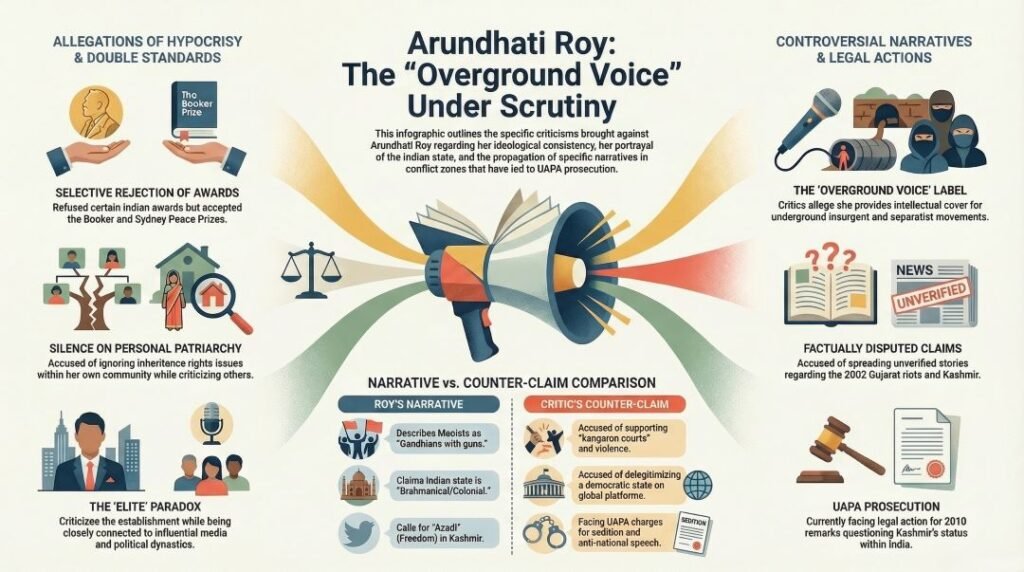
| Non-Fiction Books on Kashmir | She has written extensively about Kashmir in her political essays – particularly in collections like The Algebra of Infinite Justice (2002), Listening to Grasshoppers (2009), and Broken Republic (2011). She is one of the most prominent voices calling for Kashmiri self-determination. |
| Films / Movies | In Which Annie Gives It Those Ones (1989, TV film) – she wrote the screenplay and starred in it; directed by Pradip Krishen. Electric Moon (1992) – screenplay. She also appeared in a minor role in Massey Sahib (1985). |
| Why Is Arundhati Roy So Famous? | She is famous as the author of The God of Small Things – one of the best-selling Indian novels in history; as the first Indian woman to win the Booker Prize; as one of India’s most prominent political activists and essayists on issues of globalisation, Kashmir, Naxalism, nuclear weapons, and social justice; and for her extraordinary literary voice that combines political passion with poetic precision. |
| Awards Won | Booker Prize 1997 (The God of Small Things); Sydney Peace Prize 2004; Lannan Cultural Freedom Prize 2002; Sahitya Akademi Award (declined); Crossword Book Award |
| Pulitzer Prize | Arundhati Roy has NOT won the Pulitzer Prize. She has won the Booker Prize (1997). The Pulitzer is an American award; Roy’s major international prize is the Booker. |
| Recent News (2025) | Arundhati Roy withdrew from the Berlin International Film Festival (Berlinale) in early 2025 after jury chair Wim Wenders told filmmakers to ‘stay out of politics’ when asked about German support for Israel’s war in Gaza. Roy called the remark ‘shocking’ and quit the festival in protest. |
Arundhati Roy Biography PDF and PPT Slides Download (PPT SLIDES)
Who Is Arundhati Roy? Why Is Arundhati Roy So Famous?
Arundhati Roy – full name Suzanna Arundhati Roy – was born on 24 November 1961 in Shillong, Meghalaya. She is famous on multiple, overlapping levels that make her one of the most unusual public figures in contemporary Indian life.
She is famous, first and foremost, as the author of The God of Small Things (1997) – one of the best-selling debut novels in history, winner of the Man Booker Prize, translated into more than 40 languages, and still one of the most widely read and taught Indian novels in the world. The novel’s combination of lyrical beauty, political depth, and emotional power made it an instant classic.
She is famous, second, as a political activist and essayist of extraordinary courage and conviction – a writer who has consistently taken on the most powerful institutions in India (the Supreme Court, the central government, the nuclear establishment, the dam-building lobby, the corporate sector) and done so with a prose style that is simultaneously poetic and devastatingly precise.
She is famous, third, as a symbol of a certain kind of Indian intellectual independence – a woman who grew up outside the corridors of privilege, who made her own path, who married and separated on her own terms, who chose not to have children, who declined government honours, and who has never made her peace with the powerful simply because they are powerful.
Arundhati Roy Biography in English: Early Life, Born Place and Parents
Arundhati Roy was born on 24 November 1961 in Shillong – then part of Assam, now the capital of Meghalaya – in the hills of northeastern India. Her birth was the product of an unusual union: her father, Rajib Roy, was a Bengali Hindu from Assam who managed a tea estate; her mother, Mary Roy, was a Syrian Christian woman from Kerala – a member of one of India’s oldest Christian communities – who would go on to become a celebrated educator and activist.
The marriage did not last. Her parents separated when Arundhati was very young – she has spoken rarely and obliquely about her father, who played little role in her upbringing. She and her brother were raised by their mother in Aymanam, a small village in Kerala – the same village that would become the primary setting of The God of Small Things. Her childhood in Aymanam gave her the landscape, the community, the social textures, and the emotional material that would eventually produce her most famous novel.
Mary Roy: Arundhati’s Extraordinary Mother
Mary Roy is one of the most remarkable women in modern Indian history – and her influence on Arundhati Roy, both as a personal model and as the partial inspiration for the character of Ammu in The God of Small Things, is immense. Mary Roy founded and ran the Corpus Christi School in Kottayam, Kerala – a progressive institution that she ran with fierce independence and unconventional values. She is best known outside the school for winning a landmark Supreme Court case in 1986 in which she successfully challenged the discriminatory inheritance laws of the Syrian Christian community in Kerala, winning equal inheritance rights for Syrian Christian women. This victory – achieved by a single woman fighting alone against an entrenched religious establishment – is entirely characteristic of the fierce moral independence that Arundhati Roy absorbed from her mother.
The relationship between Mary Roy and Arundhati Roy has been complex, publicly discussed, and significant to both women’s public identities. Arundhati’s 2025 memoir Mother Mary Comes to Me is understood to be, in part, an exploration of this complex and formative relationship.
Arundhati Roy’s Father
Arundhati Roy’s father was Rajib Roy – a Bengali Hindu who managed a tea estate in Assam. He and Mary Roy separated when Arundhati was very young. Roy’s father played little public role in her life or her literary identity. Her identity and her intellectual formation were shaped overwhelmingly by her mother Mary Roy and by her upbringing in Kerala.
Arundhati Roy’s Brother
Arundhati Roy has a brother, sometimes referred to in biographical sources as LKC Roy (Laleh Roy). He and Arundhati were raised together by their mother Mary Roy in Aymanam, Kerala. The sibling relationship is part of her private life and not a subject she has written or spoken about extensively in public.
Arundhati Roy Education: School of Planning and Architecture
Arundhati Roy’s formal education was unconventional – reflecting the unconventional household in which she grew up. She attended Corpus Christi School in Kottayam (her mother’s school) and briefly attended Lawrence School in Lovedale, Ooty. The most significant part of her formal education was her enrolment at the School of Planning and Architecture in New Delhi, where she studied architecture.
Her years at the School of Planning and Architecture in Delhi were formative in unexpected ways. She did not pursue a conventional architectural career. Instead, the years in Delhi exposed her to the city’s radical intellectual culture, to film, to politics, and to the people who would shape her creative life – including Pradip Krishen, the filmmaker who would become her long-term partner. Her experiences living in Delhi as a young woman – in a rooftop room in a squatter settlement in Lodi Colony – gave her a direct understanding of poverty, class, and urban inequality that runs through all her subsequent writing. The film In Which Annie Gives It Those Ones (1989), which she wrote and starred in, is directly drawn from her own years at the architecture school.
Arundhati Roy Husband: Two Marriages and Pradip Krishen
Arundhati Roy has been married twice and has been in at least one other major long-term relationship. Her personal life has been one of fierce independence – she has made her own choices about relationships and family with a completeness that reflects her broader commitment to living outside conventional expectations.
First Husband: Gerard da Cunha
Arundhati Roy’s first husband was Gerard da Cunha – an architect from Goa. She married him when she was very young (around 16 or 17 years old, while she was living in Goa). The marriage ended quickly in divorce. She has spoken very little about this marriage in her public interviews.
Second Husband / Long-Term Partner: Pradip Krishen
Arundhati Roy’s most significant relationship was with Pradip Krishen – an Indian filmmaker, environmentalist, writer, and ecologist. Pradip Krishen is best known as the director of the films Massey Sahib (1985), In Which Annie Gives It Those Ones (1989), and Electric Moon (1992) – all three of which involve Arundhati Roy in significant creative roles (she wrote the screenplay for the latter two and starred in the 1989 film). He is also a noted environmentalist and author of Trees of Delhi, a landmark book on urban ecology.
Pradip Krishen and Arundhati Roy lived together for many years and were one of Delhi’s most celebrated intellectual-creative couples. Their relationship eventually ended. Roy has since lived independently. Pradip Krishen appears in searches for Arundhati Roy because of the significance of their creative collaboration and their long relationship.
Is Arundhati Roy Married Now?
As of 2025, Arundhati Roy is not publicly known to be married or in a publicly declared relationship. She has lived as an independent woman for many years – consistent with her long-standing rejection of conventional social structures. She has spoken in interviews about her preference for independence and her deliberate choice not to conform to what society expects of women in terms of marriage and family.
Does Arundhati Roy Have Any Children / Daughter?
No – Arundhati Roy has no children. She made a deliberate choice not to have children. She has no daughter or son. This choice is entirely consistent with the fierce independence that defines her personal as much as her professional life.
Is Arundhati Roy a Hindu?
This is one of the most frequently searched questions about Arundhati Roy, and it deserves a careful, accurate answer. Arundhati Roy is of mixed religious heritage: her father Rajib Roy was a Bengali Hindu, and her mother Mary Roy is a Syrian Christian – a member of one of the oldest Christian communities in India, which traces its origins to the early centuries of the common era.
Roy herself does not publicly identify with either religion. She has been consistently secular in her public persona and her political writing, and has been sharply critical of religious communalism – including Hindu nationalism, which has been one of the central targets of her political essays for the past two decades. She is not conventionally Hindu, nor is she conventionally Christian. She identifies, in her own words and her own practice, as an independent secular person who is deeply sceptical of all organised religious power.
Arundhati Roy Books: Complete List in Order
Arundhati Roy has published two novels and an extensive body of non-fiction political essays and collections. Below is her complete bibliography in order – fiction and non-fiction:
| Year | Title | Summary |
| FICTION / NOVELS | ||
| 1997 | The God of Small Things | Her debut novel and most famous work – winner of the Man Booker Prize 1997. Set in the small town of Aymanam in Kerala, the novel tells the story of the Ipe family – twin siblings Rahel and Estha – and the series of events in 1969 that destroyed their family. The novel explores caste, class, forbidden love (between Ammu and the Untouchable Velutha), childhood trauma, the legacy of colonialism, and the crushing weight of social convention in Indian society. Written in an extraordinary, lyrical, non-linear style. One of the best-selling debut novels in the history of Indian literature. Translated into more than 40 languages. |
| 2017 | The Ministry of Utmost Happiness | Her second and most recent novel – published 20 years after The God of Small Things. A vast, sprawling, polyphonic narrative set across contemporary India – from the Old Delhi neighbourhood of Shahjahanabad to the conflict zones of Kashmir and Naxalite-affected central India. Centres on Anjum, a hijra (transgender woman) who lives in a graveyard, and Tilo, an architect entangled in the Kashmir conflict. Explores India’s fractured democracy, religious violence, caste oppression, the Kashmir insurgency, gender and identity, and the lives of India’s marginalised people. Longlisted for the Booker Prize 2017. |
| NON-FICTION / ESSAYS | ||
| 1999 | The Cost of Living | Two long essays: ‘The End of Imagination’ (against India’s nuclear tests of 1998) and ‘The Greater Common Good’ (about the social and environmental devastation caused by the Narmada Dam project and large dams generally). Her entry into political essay writing. A passionate, beautifully written work of political journalism. |
| 2001 | Power Politics | Essays on globalisation, privatisation, and corporate power in India. Argues against the handing over of India’s public resources – water, electricity, forests – to private corporations. A powerful critique of neoliberal economic policy in India. |
| 2001 | War Is Peace | Written in the immediate aftermath of the September 11 attacks – a prescient, controversial essay arguing against the US military response and warning of the consequences of the ‘War on Terror’. Widely read and debated internationally. |
| 2002 | The Algebra of Infinite Justice | A collection of her major political essays covering nuclear weapons, globalisation, the US invasion of Afghanistan, corporate power, and social justice in India. One of her most important essay collections – the title essay on September 11 became famous worldwide. |
| 2009 | Listening to Grasshoppers: Field Notes on Democracy | Essays on democracy, elections, justice, and oppression in India. Includes important essays on the Gujarat riots, on Narendra Modi, and on the corruption of India’s democratic institutions. Written with characteristic moral urgency. |
| 2011 | Broken Republic: Three Essays | Three essays on the Maoist/Naxalite insurgency in central India – including her famous essay ‘Walking with the Comrades’ in which she spent time with Maoist guerrillas in the forests of Chhattisgarh. One of her most controversial and most praised works of political journalism. Includes essays on Kashmir. |
| 2014 | Capitalism: A Ghost Story | A critique of global capitalism, philanthropic capitalism (the Bill Gates model), and the relationships between corporations, NGOs, and political power. Argues that corporate philanthropy is a way of managing dissent and maintaining the existing social order. |
| 2016 | The End of Imagination | Updated and expanded edition of her first political essay collection, with a new introduction reflecting on 18 years of political activism since the original publication. |
| 2019 | My Seditious Heart: Collected Nonfiction | A comprehensive collection of two decades of political essays – the most complete single-volume collection of her non-fiction writing. Covers nuclear weapons, Kashmir, Naxalism, globalisation, Indian democracy, and more. |
| 2024 | Azadi: Freedom. Fascism. Fiction. (updated) | First published 2020; updated edition 2024. Essays on the scrapping of Article 370 in Kashmir, the Citizenship Amendment Act, rising Hindu nationalism in India, and the relationship between fiction, politics, and freedom. |
| 2025 | Mother Mary Comes to Me | Her first memoir – an intimate, personal narrative that marks a significant departure from her previous non-fiction, which was primarily political essay writing. Discussed at the Women’s Prize. Represents a new phase in her literary career in which she turns her gaze inward. |
The God of Small Things: Complete Reference Guide
The God of Small Things is Arundhati Roy’s most famous work – her debut novel, winner of the 1997 Man Booker Prize, and one of the most celebrated Indian novels of the 20th century. Here is a complete reference guide:
| Aspect | Detail |
| Full Title | The God of Small Things |
| Author | Arundhati Roy |
| Published | 1997 (IndiaInk / Harper Collins) |
| Award | Man Booker Prize 1997 – Roy was the first Indian woman to win the Booker Prize |
| Setting | Aymanam, a small town in Kerala – the same village where Arundhati Roy grew up; the novel is deeply autobiographical in its landscape and social texture. Set primarily in 1969, with the narrative framed from the 1990s. |
| Central Characters | Rahel and Estha – twin siblings; Ammu – their mother (based partly on Roy’s own mother); Velutha – an Untouchable (Dalit) carpenter who works for the Ipe family; Pappachi – the father; Mammachi – the grandmother; Chacko – Ammu’s brother; Sophie Mol – Chacko’s English daughter |
| Plot Summary | The novel opens with Rahel returning to Aymanam in the 1990s and slowly, non-linearly, reconstructs the events of 1969 that shattered the Ipe family. At the heart of the story is the forbidden love between Ammu (a Syrian Christian woman) and Velutha (a Dalit man) – a relationship that violates both caste rules and social convention. The arrival of Sophie Mol (the English cousin) and the events that follow lead to tragedy: Velutha is beaten to death by police; the twins are traumatised and separated. The novel asks what love costs when it crosses the ‘love laws’ – the laws that dictate who may be loved and how much. |
| Key Themes | Caste discrimination and the violence of untouchability; forbidden love and the ‘love laws’; childhood and trauma; the legacy of colonialism and the ambivalence of the anglicised Indian middle class; gender and the oppression of women; the social conservatism of Syrian Christian society in Kerala; the non-linear nature of memory and grief; the political upheaval of Kerala’s communist movement |
| Writing Style | Non-linear narrative structure – the story moves back and forth in time; extraordinary lyrical prose combining Malayalam rhythms with English; intense attention to sensory detail; the perspective of children used to defamiliarise the adult social world; wordplay, neologism, and syntactic innovation throughout |
| What Is the Most Heart-Wrenching Book? | The God of Small Things is widely considered one of the most emotionally devastating novels in Indian literature – the treatment of Velutha’s death, the separation of the twins, and the destroyed love between Ammu and Velutha are among the most heart-wrenching passages in contemporary fiction |
| Commercial Success | Became a massive international bestseller – sold millions of copies worldwide; one of the best-selling debut novels in history; translated into more than 40 languages; still widely read and taught in schools and universities across the world |
| Autobiographical Elements | Aymanam is Roy’s own childhood village; the character of Ammu shares several biographical details with Roy’s own mother Mary Roy; the experience of growing up in a broken home in Kerala; the Syrian Christian community is drawn from direct personal knowledge |
The Ministry of Utmost Happiness: Arundhati Roy’s Second Novel
After a silence of twenty years following The God of Small Things, Arundhati Roy published her second novel The Ministry of Utmost Happiness in 2017. It was one of the most anticipated literary events of the decade – and one of the most discussed and divisive. Where The God of Small Things was intimate and focused – a single family, a single village, a single summer – The Ministry of Utmost Happiness is vast and deliberately fractured, trying to hold within a single novel the full complexity of contemporary India.
Key Details – The Ministry of Utmost Happiness
- Published: 2017 (Hamish Hamilton / Penguin Random House)
- Longlisted for the Man Booker Prize 2017
- Central characters: Anjum – a hijra (transgender woman) who makes her home in a Delhi graveyard; Tilo – an architect entangled in the Kashmir conflict and its political complexities
- Settings: Old Delhi (particularly Shahjahanabad); Kashmir; the jungles of central India (Naxalite territory); various cities across India
- Themes: India’s fractured democracy; the Kashmir conflict and political disappearances; Hindu-Muslim violence; caste and gender; hijra identity and the third gender in India; the dispossessed and the marginalised; love across political divides; the possibility of building new communities outside conventional structures
- Writing style: More overtly political and deliberately fractured than The God of Small Things – the non-linear, multi-perspectival structure reflects the impossibility of a single coherent narrative about contemporary India
- Reception: Praised for its moral seriousness, its political courage, and the beauty of its prose; criticised by some for its sprawl and its political tendentiousness; widely translated and read internationally
Arundhati Roy New Book 2025: Mother Mary Comes to Me
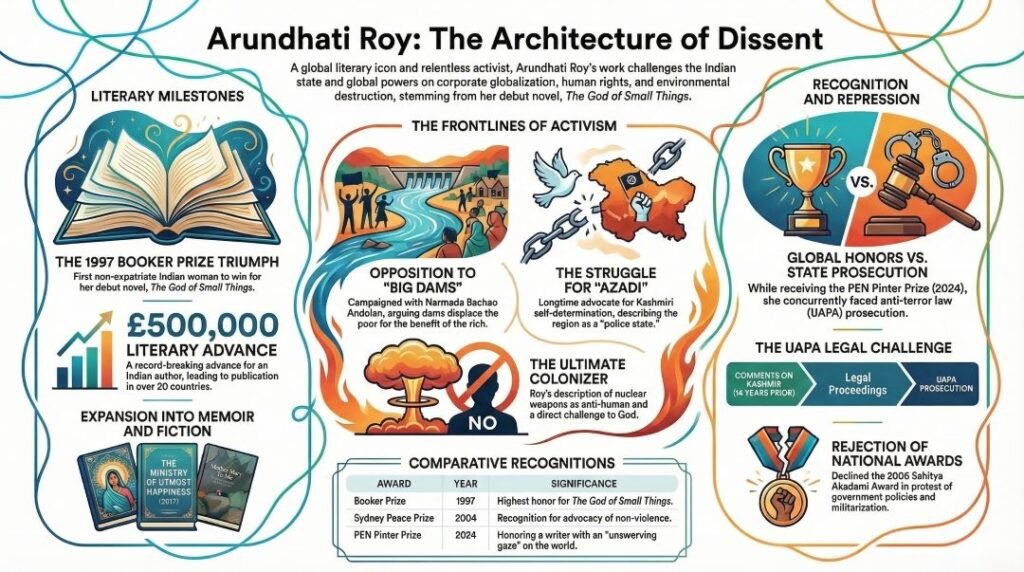
In 2025, Arundhati Roy published Mother Mary Comes to Me – her first memoir and a significant departure from her previous work. While she has written political essays for more than twenty years, she had never before turned the lens on her own life in the form of a memoir. The title – with its echo of the Beatles lyric and its reference to her own mother Mary Roy – suggests a work that is simultaneously personal, political, and literary.
The memoir was discussed at a Women’s Prize event, where it was described as an intimate and inspiring exploration of her life and her relationship with her extraordinary mother. For readers who have followed Arundhati Roy’s career, the memoir promises a rare glimpse into the private woman behind the public activist – the daughter, the student, the young writer, the person behind the political voice that has defined Indian intellectual life for nearly three decades.
Arundhati Roy Movies and Films
Before she became a novelist and political essayist, Arundhati Roy had a brief and significant career in Indian cinema – primarily as a screenwriter and actress in films directed by Pradip Krishen. Here is a complete guide to her film work:
| Year | Film | Arundhati Roy’s Role |
| 1985 | Massey Sahib | Minor acting role – her first appearance on screen; directed by Pradip Krishen |
| 1989 | In Which Annie Gives It Those Ones | SHE WROTE THE SCREENPLAY and starred as the lead character Annie. Directed by Pradip Krishen. A TV film about architecture students in Delhi – semi-autobiographical, drawn from her own years at the School of Planning and Architecture. Won the National Film Award for Best Screenplay. The film became a cult classic and was rediscovered and brought back into the spotlight in early 2025 after the Berlinale controversy involving Roy. |
| 1992 | Electric Moon | Wrote the screenplay; directed by Pradip Krishen. A satire on eco-tourism in India. |
In Which Annie Gives It Those Ones – 2025 Rediscovery
In early 2025, Arundhati Roy’s 1989 film In Which Annie Gives It Those Ones was brought back into the spotlight by an unlikely series of events. Roy had accepted an invitation to be part of the jury at the Berlin International Film Festival (the Berlinale). When jury chair Wim Wenders publicly told filmmakers to ‘stay out of politics’ when asked about the German government’s support for Israel’s war in Gaza, Roy was shocked and withdrew from the festival in protest, calling Wenders’s statement unacceptable. The controversy led to renewed media coverage of Roy’s political history – including her 1989 film – and several publications ran features on In Which Annie Gives It Those Ones as a way of tracing the arc of her political sensibility from her early life to the present.
Awards Won by Arundhati Roy
| Award | Year | For / Detail |
| Man Booker Prize | 1997 | The God of Small Things – first Indian woman to win the Booker Prize |
| National Film Award – Best Screenplay | 1989 | In Which Annie Gives It Those Ones (she wrote the screenplay) |
| Lannan Cultural Freedom Prize | 2002 | For her political writing and activism; one of the world’s most prestigious prizes for cultural and intellectual freedom |
| Sydney Peace Prize | 2004 | Awarded by the Sydney Peace Foundation for her activism on peace, justice, and human rights |
| Crossword Book Award | Multiple | For various works of non-fiction |
| Sahitya Akademi Award | Declined | She has declined several institutional awards from the Indian government as a political statement against government policies |
| Pulitzer Prize | Not won | Arundhati Roy has NOT won the Pulitzer Prize – this is a common misconception. Her main prize is the Booker Prize (1997). The Pulitzer is an American prize; the Booker is British/Commonwealth. |
Arundhati Roy’s Political Activism: Books on Kashmir and Major Causes
After winning the Booker Prize in 1997, Arundhati Roy made a decision that surprised many in the literary world: she turned away from fiction – at least temporarily – and devoted herself to political essay writing and activism. The trigger was India’s nuclear tests in May 1998. Her essay ‘The End of Imagination’ – a passionate argument against nuclear weapons – marked her emergence as a political voice, and she has not looked back.
Key Political Causes and Books on Kashmir
- Nuclear weapons: Her first political essay ‘The End of Imagination’ (1998) opposed India’s nuclear tests; she has consistently argued against nuclear weapons as a solution to India’s security challenges
- Large dams and the Narmada project: Her essay ‘The Greater Common Good’ (1999) documented the displacement of millions of people by large dam projects – particularly the Sardar Sarovar Dam on the Narmada river – and made her a leading figure in the Save Narmada movement alongside activist Medha Patkar
- Kashmir: She has written extensively and controversially about Kashmir – arguing for the right of Kashmiris to self-determination, condemning human rights abuses by Indian security forces, and calling for a political solution rather than a military one. Her books on Kashmir include The Algebra of Infinite Justice (2002), Listening to Grasshoppers (2009), Broken Republic (2011), and Azadi (2020)
- Naxalism: Her essay ‘Walking with the Comrades’ (2010, published in Broken Republic 2011) described her journey with Maoist guerrillas in the forests of Chhattisgarh; it remains one of the most controversial pieces of journalism published in India in the 21st century
- Hindu nationalism: Her essays in Listening to Grasshoppers and Azadi are among the most sustained literary critiques of Hindu nationalism and the Hindutva political project in India
- Globalisation and corporate power: Power Politics (2001) and Capitalism: A Ghost Story (2014) are her major works on the economics of globalisation and corporate capture of public resources in India
- Citizenship Amendment Act: Azadi (2020) includes major essays on the CAA and its implications for Muslim citizenship in India
Arundhati Roy Famous Quotes
Arundhati Roy is one of the most quotable writers of her generation – her prose combines poetic beauty with political precision in a way that produces sentences and passages that readers carry with them for years. Here are some of her most famous quotes:
| Famous Quote | Source |
| Another world is not only possible, she is on her way. On a quiet day, I can hear her breathing. | Porto Alegre, 2003 |
| The trouble is that once you see it, you can’t unsee it. And once you’ve seen it, keeping quiet, saying nothing, becomes as political an act as speaking out. | Algebra of Infinite Justice |
| The God of Small Things is a novel about the big things that small things make happen. | Roy, on her novel |
| Not only is another world possible, she is on her way. Maybe many of us won’t be here to greet her, but on a quiet day, if I listen very carefully, I can hear her breathing. | World Social Forum, 2003 |
| There is no such thing as a single-issue struggle because we do not live single-issue lives. | Political essays |
Arundhati Roy Writing Style: What Makes Her Work Distinctive
Arundhati Roy’s writing style is one of the most immediately recognisable in Indian literature. In her fiction, she combines a non-linear narrative structure with an extraordinary lyrical prose – influenced by the rhythms of Malayalam, the landscape of Kerala, and the tradition of modernist English fiction. In her non-fiction, she combines journalistic precision with political passion and a rhetorical power that is simultaneously accessible and sophisticated.
Key Elements of Her Writing Style
- Non-linear narrative: The God of Small Things moves back and forth in time, withholding and revealing information in ways that create an almost unbearable suspense; this technique reflects the novel’s central concern with memory and trauma
- Lyrical prose: Her sentences are dense with sensory detail, wordplay, neologism, and rhythmic complexity; she invents words and syntactic structures to capture experiences that conventional English cannot accommodate
- The child’s perspective: Both in The God of Small Things and in her political essays, she frequently adopts the perspective of the powerless, the marginalised, the child – those who experience the consequences of power without being able to name or contest it
- Political passion combined with literary precision: Her non-fiction is never merely polemical – it is written with the same care for language and structure that she brings to her fiction
- The personal and the political intertwined: Whether writing about her own childhood in Kerala or about dam-displaced villagers in Madhya Pradesh, Roy refuses the distinction between the personal and the political – for her, they are always the same thing
Arundhati Roy Life Timeline
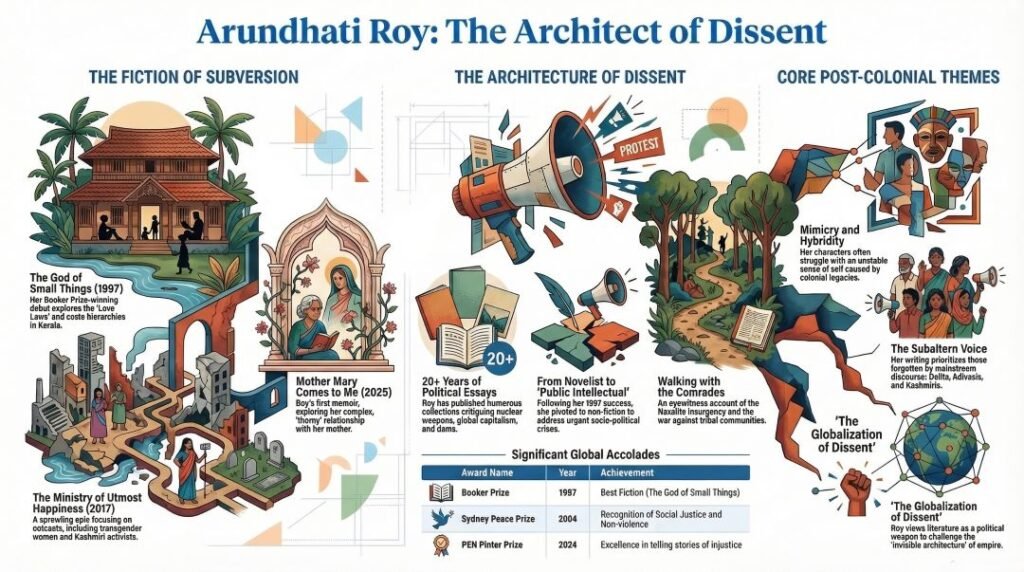
| Year | Key Event |
| 1961 | Born on 24 November in Shillong, Meghalaya (then Assam), India, to Rajib Roy (Bengali Hindu) and Mary Roy (Syrian Christian activist and educator) |
| 1960s | Parents separated; she and her brother were raised by their mother Mary Roy in Aymanam, Kerala – the small village that would become the setting of The God of Small Things |
| Early 1970s | Attended Corpus Christi School, Kottayam (her mother’s school); briefly attended Lawrence School, Lovedale, Ooty |
| Late 1970s | Moved to Delhi; enrolled at the School of Planning and Architecture, New Delhi – studied architecture; lived in a rooftop room in the squatter settlement of Lodi Colony; met Pradip Krishen during this period |
| Early 1980s | Brief first marriage to Gerard da Cunha (architect from Goa); the marriage ended quickly. Began her relationship with filmmaker Pradip Krishen. |
| 1985 | Minor acting role in Massey Sahib, directed by Pradip Krishen |
| 1989 | Wrote the screenplay and starred in In Which Annie Gives It Those Ones (directed by Pradip Krishen) – won National Film Award for Best Screenplay |
| 1992 | Wrote screenplay for Electric Moon (directed by Pradip Krishen) |
| 1992–97 | Spent approximately four years writing The God of Small Things |
| 1997 | Published The God of Small Things – immediate international sensation; won the Man Booker Prize; first Indian woman to win the Booker Prize; the novel became one of the best-selling debut novels in history |
| 1998 | India conducted nuclear tests; Roy published ‘The End of Imagination’ – her first political essay, opposing nuclear weapons; marked her transition from novelist to political activist-writer |
| 1999 | Published The Cost of Living – her first essay collection; emerged as one of India’s most important political voices |
| 2001 | Published essays on September 11 and the War on Terror; faced international controversy for her critique of US military policy |
| 2002 | Convicted by the Supreme Court of India for contempt of court (related to her essay criticising the court’s decision on the Narmada Dam); sentenced to one day’s imprisonment and a fine |
| 2004 | Awarded the Sydney Peace Prize |
| 2010 | Published ‘Walking with the Comrades’ – spent time with Maoist guerrillas in Chhattisgarh forests; faced calls for sedition charges from Indian government; the essay was published as part of Broken Republic (2011) |
| 2016–17 | Completed and published The Ministry of Utmost Happiness – 20 years after The God of Small Things; longlisted for the Booker Prize 2017 |
| 2019 | Published My Seditious Heart – comprehensive collection of two decades of political essays |
| 2020 | Published Azadi: Freedom. Fascism. Fiction. – essays on Kashmir, the Citizenship Amendment Act, and Hindu nationalism in India |
| 2025 | Published Mother Mary Comes to Me – her first memoir; withdrew from Berlin Film Festival (Berlinale) in protest over jury chair Wim Wenders’s statement that filmmakers should ‘stay out of politics’ when asked about Gaza; the 1989 film In Which Annie Gives It Those Ones was brought back into the spotlight in connection with the Berlinale controversy |
10 Lines About Arundhati Roy for Students
- Arundhati Roy (full name: Suzanna Arundhati Roy) was born on 24 November 1961 in Shillong, Meghalaya, India.
- She is the daughter of Rajib Roy (Bengali Hindu) and Mary Roy (Syrian Christian educator and activist who won a landmark Supreme Court case for women’s inheritance rights).
- She was raised in Aymanam, Kerala – the village that forms the setting of her most famous novel, The God of Small Things.
- She studied architecture at the School of Planning and Architecture, New Delhi, and wrote the screenplay and starred in the 1989 film In Which Annie Gives It Those Ones, directed by Pradip Krishen.
- Her debut novel The God of Small Things (1997) won the Man Booker Prize – making her the first Indian woman to win the prize – and became one of the best-selling debut novels in history.
- After the Booker Prize, she turned to political essay writing – publishing major works on nuclear weapons, large dams, Kashmir, Naxalism, globalisation, and Hindu nationalism.
- Her second novel The Ministry of Utmost Happiness was published in 2017 – twenty years after The God of Small Things – and was longlisted for the Booker Prize.
- She has no children and has been married twice – first to architect Gerard da Cunha (briefly) and subsequently was in a long relationship with filmmaker Pradip Krishen.
- She has won the Sydney Peace Prize (2004) and the Lannan Cultural Freedom Prize (2002), and has declined several government awards as a political statement.
- In 2025, she published her first memoir Mother Mary Comes to Me, and withdrew from the Berlin Film Festival in protest over the festival’s refusal to allow political speech about Gaza.
Arundhati Roy Short Biography (Profile / Biodata)
Arundhati Roy (born 24 November 1961, Shillong) is an Indian novelist, political essayist, and activist. Daughter of Mary Roy (Syrian Christian educator and women’s rights activist) and Rajib Roy (Bengali Hindu tea estate manager), she was raised in Aymanam, Kerala. She studied architecture at the School of Planning and Architecture, New Delhi. She wrote and starred in the 1989 film In Which Annie Gives It Those Ones (dir. Pradip Krishen) – winning the National Film Award for Best Screenplay. Her debut novel The God of Small Things (1997) won the Man Booker Prize – the first Indian woman to do so – and became a global bestseller. She subsequently devoted herself to political essay writing on nuclear weapons, dams, Kashmir, and globalisation. Her second novel The Ministry of Utmost Happiness was published in 2017. She has no children. In 2025, she published her first memoir Mother Mary Comes to Me and withdrew from the Berlin Film Festival in protest. She is one of India’s most celebrated and most controversial public intellectuals.
Conclusion: Arundhati Roy’s Enduring Significance
Arundhati Roy is, in the most complete sense, a writer who matters – not just to literature, but to the world. The God of Small Things matters because it tells a story about caste, love, and loss with a power and a beauty that has never been surpassed in Indian fiction. Her political essays matter because they have given a precise, passionate, and poetic language to millions of people’s experience of injustice, displacement, and dispossession. Her activism matters because it demonstrates, by example, that a writer’s responsibility does not end when the book is published.
She has paid a price for her courage – she has been convicted of contempt of court, threatened with sedition charges, attacked by nationalists, and dismissed by establishment commentators as a professional controversialist. None of it has silenced her. And that refusal to be silenced – that stubborn, eloquent, sometimes infuriating insistence on saying what she believes – is perhaps her greatest gift to Indian public life.
Also read: Kiran Desai Biography PDF and PPT Slides Download (.PPTX)
Final Quick Reference – Arundhati Roy Key Facts
- Full Name: Suzanna Arundhati Roy
- Born: 24 November 1961 – Shillong, Meghalaya, India
- Age (2025): 63 years
- Mother: Mary Roy – Syrian Christian educator and activist; won landmark Supreme Court case for women’s inheritance rights
- Father: Rajib Roy – Bengali Hindu tea estate manager
- Brother: LKC (Laleh) Roy
- Raised in: Aymanam, Kerala
- Religion: Mixed heritage (Hindu father, Syrian Christian mother); publicly secular
- First Husband: Gerard da Cunha (architect, Goa) – brief marriage ended in divorce
- Partner: Pradip Krishen – filmmaker, environmentalist; long relationship, now separated
- Is Arundhati Roy married now: Not publicly
- Children / Daughter: None
- Education: School of Planning and Architecture, New Delhi (architecture)
- Most Famous Work: The God of Small Things (1997) – Booker Prize winner
- Second Novel: The Ministry of Utmost Happiness (2017)
- New Book 2025: Mother Mary Comes to Me (first memoir)
- Books on Kashmir: The Algebra of Infinite Justice; Broken Republic; Azadi
- Films / Movies: In Which Annie Gives It Those Ones (1989, writer + actress); Electric Moon (1992, writer); Massey Sahib (1985, actress)
- Awards: Booker Prize 1997; Sydney Peace Prize 2004; Lannan Prize 2002; National Film Award for Best Screenplay 1989
- Pulitzer Prize: NOT won – common misconception; she won the Booker Prize
- What is she known for: The God of Small Things; political activism; Kashmir essays; Naxalism journalism; anti-nuclear writing
- 2025 News: Published memoir; withdrew from Berlin Film Festival (Berlinale) over Gaza/politics controversy
- Is she on Instagram: No official verified Instagram account