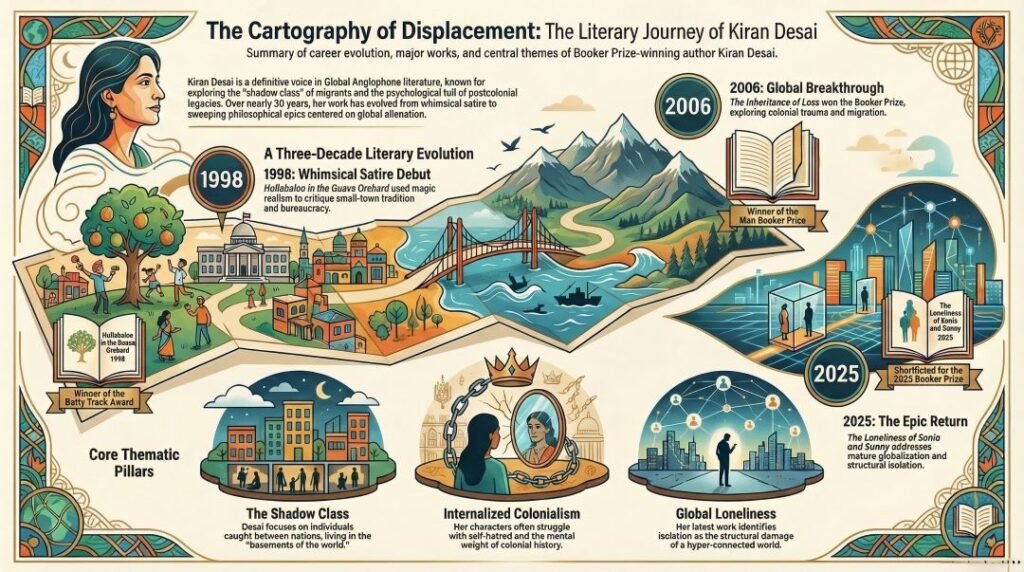
In this article we will discuss about the Kiran Desai Biography PDF and PPT Slides Download (.PPTX), Kiran Desai Biography, Books, Booker Prize, Husband, Parents and Complete Literary Legacy so, When Kiran Desai won the Man Booker Prize in 2006 for The Inheritance of Loss, she became only the second Indian woman to win the prize -after Arundhati Roy in 1997 -and, at 35 years old, one of the youngest winners in the prize’s history. What made the moment even more extraordinary was who was sitting in the audience watching her win: her mother, Anita Desai -herself a three-time Booker Prize short listee and one of India’s most distinguished novelists. In that single evening, the Desai became the only mother-daughter pair in literary history to be major nominees and winners of the same prize. But Kiran Desai’s achievement cannot be reduced to a family story, however remarkable that story is. The Inheritance of Loss is a genuinely great novel -ambitious, politically engaged, technically accomplished, and driven by a moral seriousness about the consequences of colonialism, globalisation, and economic inequality that had rarely been achieved with such literary grace. It earned its Booker Prize on every page.
This comprehensive article covers everything about Kiran Desai -her biography in English and in Hindi, her parents (Anita Desai and Ashvin Desai), her grandmother Toni Nime, husband and personal life, education, born place, age, all her books with summaries in order, famous works, the Booker Prize, her new book in 2025, her relationship with Orhan Pamuk, net worth, where she lives now, and her complete literary legacy.
Kiran Desai: Complete Biography Table
The table below provides every essential biographical fact about Kiran Desai -from her birth and parents to her books, prizes, personal life, husband question, and new 2025 novel:
| Biographical Detail | Information |
| Full Name | Kiran Desai |
| Date of Birth | 3 September 1971 |
| Born Place | New Delhi, India |
| Age (as of 2025) | 53 years |
| Nationality | Indian |
| Mother (Parents) | Anita Desai -celebrated Indian novelist; three-time Booker Prize shortlistee; Sahitya Akademi Award winner; Professor at MIT |
| Father (Parents) | Ashvin Desai -businessman |
| Grandmother (Toni Nime) | Toni Nime -Kiran Desai’s maternal grandmother; a German woman who married D. N. Mazumdar (a Bengali) and settled in India; mother of Anita Desai |
| Are Anita Desai and Kiran Desai Related? | Yes -Anita Desai is Kiran Desai’s mother. They are the only mother-daughter pair in the history of the Booker Prize to both be major nominees/winners. |
| Husband / Partner | Kiran Desai has never married. She was in a long-term relationship with Orhan Pamuk -the Turkish novelist and Nobel Prize winner -for several years (relationship became public around 2007 and ended around 2010). She has spoken of a long-term partner without disclosing details publicly. |
| Daughter | Kiran Desai has no publicly known children |
| Education | Grew up in India and England; attended Gargi College, University of Delhi; Hollins University (Virginia, USA); Columbia University MFA in Creative Writing, New York (did not complete -left to write full time) |
| Where Does Kiran Desai Live Now? | She divides her time between the United States and India; she has lived in New York and has spent extended periods in India. She does not maintain a single fixed permanent address publicly. |
| First Book | Hullabaloo in the Guava Orchard (1998) -her debut novel |
| Booker Prize Book (Which Book Won?) | The Inheritance of Loss (2006) -won the Man Booker Prize 2006 |
| Booker Prize Year | 2006 -Man Booker Prize; also won the National Book Critics Circle Award (USA) the same year |
| New Book (2025) | The Loneliness of Sonia and Sunny (2025) -her third novel; nearly 20 years in the making after The Inheritance of Loss |
| Books in Order | 1. Hullabaloo in the Guava Orchard (1998) / 2. The Inheritance of Loss (2006) / 3. The Loneliness of Sonia and Sunny (2025) |
| How Many Books Written? | Three novels as of 2025: Hullabaloo in the Guava Orchard; The Inheritance of Loss; The Loneliness of Sonia and Sunny |
| Famous Works | The Inheritance of Loss (2006) is her most famous work; Hullabaloo in the Guava Orchard (1998) is her celebrated debut |
| Net Worth | Kiran Desai’s net worth is not officially confirmed; various sources estimate it in the range of $1–5 million USD, derived from book sales, prize money, speaking engagements, and literary residencies |
| Kiran Desai and Orhan Pamuk | Kiran Desai was in a relationship with Orhan Pamuk -the Turkish novelist who won the Nobel Prize in Literature in 2006 -the same year Kiran won the Booker Prize. Their relationship was widely noted at the time as one of contemporary literature’s most celebrated literary couples. |
| Writing Style | Rich, layered, multi-perspective narrative; politically engaged; deeply concerned with globalisation, post-colonialism, class, and the immigrant experience; strongly influenced by her mother Anita Desai but more overtly political and contemporary in focus |
| Core Themes | Globalisation and its discontents; postcolonial identity; class and economic inequality; the immigrant experience; belonging and displacement; the Indian diaspora; nature and landscape; family dysfunction |
Kiran Desai Biography PDF and PPT Slides Download (.PPTX)
Who Is Kiran Desai? (Kiran Desai Wikipedia Overview)
Kiran Desai is an Indian novelist born on 3 September 1971 in New Delhi, India. She is the daughter of the celebrated novelist Anita Desai and businessman Ashvin Desai. She is best known for her second novel The Inheritance of Loss (2006), which won the Man Booker Prize and the National Book Critics Circle Award (USA) -making her one of the most decorated Indian novelists of her generation.
She has published three novels: Hullabaloo in the Guava Orchard (1998), The Inheritance of Loss (2006), and The Loneliness of Sonia and Sunny (2025). She is a highly literary writer in the tradition of her mother Anita Desai, but with a more overtly political focus -her fiction engages directly with globalisation, postcolonialism, class, the immigrant experience, and the legacy of British colonialism in India.
Kiran Desai Biography in English: Early Life, Born Place and Parents
Kiran Desai was born on 3 September 1971 in New Delhi, India -the second child of Anita Desai (born Anita Mazumdar; the celebrated novelist) and Ashvin Desai (a businessman). She grew up in a household shaped by her mother’s literary vocation -books, writing, and the life of the mind were the air the family breathed. She has spoken often about watching her mother write at the dining table between household duties, and about understanding from an early age that writing was both a vocation and a kind of discipline that had to be practised under difficult conditions.
Her childhood was peripatetic -she spent time in India, England, and eventually in the United States when her mother took up teaching positions at American universities. This experience of moving between multiple countries and cultures, of never quite belonging fully to any single place, fed directly into the themes that would define her fiction: displacement, belonging, the immigrant experience, and the gap between what countries promise and what they deliver.
Kiran Desai Parents: Anita Desai and Ashvin Desai
- Mother -Anita Desai (born Anita Mazumdar, 1937): One of India’s most distinguished novelists; three-time Booker Prize shortlistee (Clear Light of Day, 1980; In Custody, 1984; Fasting, Feasting, 1999); Sahitya Akademi Award winner; Professor of Creative Writing at MIT; author of twelve novels
- Father -Ashvin Desai: A businessman; Anita Desai married him in 1958; the marriage gave Anita -and later Kiran -the surname Desai
- The literary inheritance from her mother was profound -Kiran has acknowledged that growing up in Anita Desai’s household, surrounded by books and by the discipline of daily writing, shaped her sense of what a writer’s life looked like
- The relationship between Anita Desai’s fiction and Kiran Desai’s fiction is worth noting -both writers focus on displacement, the inner life, and the weight of the past, but Kiran’s work is more explicitly political and more directly engaged with the consequences of globalisation and postcolonialism
Kiran Desai’s Grandmother: Toni Nime
Kiran Desai’s maternal grandmother was Toni Nime -a German woman who had come to India before the Second World War and married D. N. Mazumdar, a Bengali businessman. She is therefore Kiran Desai’s grandmother on her mother Anita’s side. This German-Bengali-Indian heritage gave the Desai family an unusual cross-cultural identity -multilingual, cosmopolitan, simultaneously rooted in Indian culture and connected to European tradition. Kiran Desai’s grandmother appears in searches because of her significance in the family’s background story and because she is Anita Desai’s mother (Kiran’s maternal grandmother).
Are Anita Desai and Kiran Desai Related?
Yes -Anita Desai is Kiran Desai’s mother. This is one of the most remarkable mother-daughter relationships in the history of world literature. Anita Desai was shortlisted for the Booker Prize three times without winning it; Kiran Desai won the Booker Prize on her second novel. They are the only mother-daughter pair in the history of the Booker Prize to both be major nominees/winners. Kiran has spoken warmly about her mother’s influence -both as a literary model and as a demonstration of what dedication to writing requires.
Kiran Desai Education: From Delhi to Columbia University
Kiran Desai’s education was spread across three continents -reflecting the peripatetic nature of her childhood and young adulthood. She attended Gargi College at the University of Delhi; she later went to Hollins University in Virginia, USA; and she enrolled in the prestigious MFA (Master of Fine Arts) in Creative Writing programme at Columbia University in New York -one of the world’s most celebrated creative writing programmes. She did not complete the Columbia MFA, leaving the programme to devote herself full time to writing her debut novel. This decision -to abandon the security of an academic qualification to pursue her writing -proved to be entirely vindicated.
- Gargi College, University of Delhi -undergraduate education
- Hollins University, Virginia, USA -further study in the United States
- Columbia University MFA in Creative Writing, New York -enrolled but did not complete; left to write Hullabaloo in the Guava Orchard full time
- Her literary formation was shaped as much by her home environment -growing up with Anita Desai as a mother -as by any formal academic programme
Kiran Desai Husband and Personal Life
Kiran Desai has never married. She has lived as a single woman throughout her adult life, though she has been in significant relationships. The most publicly discussed of these was her long-term relationship with Orhan Pamuk -the Turkish novelist who won the Nobel Prize in Literature in 2006, the same year Kiran won the Booker Prize.
Kiran Desai and Orhan Pamuk
The relationship between Kiran Desai and Orhan Pamuk was one of the most widely noted literary relationships of the mid-2000s. Orhan Pamuk -born 1952 in Istanbul -is one of the world’s most celebrated novelists; his books include My Name Is Red, Snow, and The Museum of Innocence. He received the Nobel Prize in Literature in October 2006 -the same month that Kiran Desai won the Man Booker Prize.
The pair’s relationship became publicly known in 2007. They were seen together at literary events and festivals, and their relationship was widely covered in literary media. The relationship ended around 2010, though both have continued their literary careers independently. Kiran Desai has spoken sparingly about her personal life in interviews, choosing to keep her private world largely private.
Where Does Kiran Desai Live Now?
Kiran Desai divides her time between the United States and India. She has lived in New York City for significant periods of her adult life, and she has also spent extended time in India -both for research and for personal reasons. She does not have a single fixed permanent public address. Her literary life takes her between both countries, and the India-America axis is not only a biographical fact but a central imaginative territory of her fiction.
Kiran Desai Books: Complete List in Order with Summaries
Kiran Desai has published three novels. All three are listed below in order with detailed summaries. As of 2025, she has written three books:
| Title | Year | Detailed Summary |
| Hullabaloo in the Guava Orchard | 1998 | Her debut novel, published when she was 26. Set in the fictional North Indian town of Shahkot, the story follows Sampath Chawla -a dreamy, ineffectual young man who, fed up with his post office job and his chaotic family, climbs a guava tree and refuses to come down. The local community quickly decides he is a holy man, and a comic, affectionate, and increasingly absurd sequence of events follows as pilgrims flock to the tree and Sampath’s family tries to manage the situation and profit from it. The novel is warm, funny, and richly observed -rooted in the sights, smells, and social textures of small-town North India. Praised for its comic energy and its affectionate portrait of Indian family life. An immediate international success, it caught the attention of readers and critics worldwide and was longlisted for the Orange Prize. |
| The Inheritance of Loss | 2006 | Her Booker Prize-winning second novel -widely regarded as one of the most important Indian novels of the 21st century. Structured around two interweaving narratives: one set in the Himalayan hill station of Kalimpong in the 1980s, against the backdrop of the Gorkhaland insurgency; the other set in New York City in the 1990s, following Biju -an illegal immigrant working in restaurant kitchens. In Kalimpong, a retired judge named Jemubhai Patel -a deeply compromised man who absorbed colonial self-hatred during his English education -lives with his orphaned granddaughter Sai and their cook. The novel explores the devastating effects of colonialism on individual psychology and identity, the brutalities of globalisation and economic inequality, the violence of ethnic nationalism, and the crushing loneliness of the immigrant experience. Won the Man Booker Prize 2006, the National Book Critics Circle Award (USA), and several other major international prizes. Translated into dozens of languages and taught in universities worldwide. |
| The Loneliness of Sonia and Sunny | 2025 | Her long-awaited third novel, published in 2025 -nearly twenty years after The Inheritance of Loss. The novel follows two siblings, Sonia and Sunny, and is set across India and the United States. In keeping with her previous work, it deals with themes of belonging, displacement, family, and the complexities of the India-America relationship. The book was accompanied by significant literary anticipation after her extended silence following the Booker Prize, and she discussed the long gestation of the book in interviews with journalist Razia Iqbal in December 2025. The novel represents her return to literary visibility after years of working on the manuscript. |
The Inheritance of Loss: Complete Reference Guide
The Inheritance of Loss is Kiran Desai’s most famous work -the novel that won the Man Booker Prize, brought her worldwide fame, and established her as one of the most important novelists of her generation. Here is a complete reference guide to the novel -for readers, students, and researchers:
| Aspect | Detail |
| Full Title | The Inheritance of Loss |
| Author | Kiran Desai |
| Published | 2006 (Atlantic Books, UK; Grove/Atlantic, USA) |
| Award Won | Man Booker Prize 2006; National Book Critics Circle Award 2006 (USA) |
| Setting (India strand) | Kalimpong, a hill station in the Darjeeling district of West Bengal, in the 1980s, during the Gorkhaland movement (a violent insurgency by ethnic Nepali Gorkhas demanding a separate state) |
| Setting (New York strand) | New York City -specifically the restaurant kitchen world of illegal immigrants from South Asia in the 1990s |
| Main Characters | Jemubhai Patel -a retired, embittered judge who studied law in Cambridge and internalised colonial self-hatred; Sai -his orphaned granddaughter, educated in a convent school, who falls in love with her Nepali tutor Gyan; Biju -the cook’s son, working illegally in New York restaurant kitchens; the Cook -a loyal servant whose son’s American experience mirrors the failures of globalisation’s promises |
| Central Themes | The lasting psychological damage of colonialism; class and the colonial education system that produced self-hating, culturally alienated Indians; the Gorkhaland insurgency and ethnic nationalism; the brutal realities of the immigrant experience in America (Biju’s storyline); globalisation and the promise and betrayal of economic migration; love across class and cultural lines (Sai and Gyan); the inheritance of loss -how each generation inherits the wounds of the previous one |
| Narrative Structure | Multi-strand narrative shifting between Kalimpong in the 1980s and New York in the 1990s; also includes extensive flashbacks to Jemubhai’s student years in Cambridge in the 1930s and 40s -tracing the historical roots of his psychological damage |
| Political Context | The Gorkhaland movement -a real historical insurgency in the Darjeeling hills in the 1980s in which ethnic Nepali Gorkhas demanded a separate state (Gorkhaland); the movement involved significant violence and political upheaval; Kiran Desai uses it as the backdrop for her exploration of postcolonial identity and ethnic nationalism |
| Why It Won the Booker | The judges praised its extraordinary ambition -weaving together the personal and the political, the historical and the contemporary, the comic and the tragic; its rigorous engagement with questions of globalisation, postcolonial identity, and economic inequality; and the extraordinary quality and control of its prose |
| Literary Significance | Considered one of the defining Indian novels of the early 21st century; widely taught in university courses on postcolonial literature, South Asian fiction, and globalisation studies; translated into dozens of languages |
Which Book Won Kiran Desai the Man Booker Prize?
The book that won Kiran Desai the Man Booker Prize is The Inheritance of Loss, published in 2006. She was 35 years old at the time of winning, making her one of the younger winners of the prize. The Booker Prize jury that year praised the novel for its extraordinary ambition, its political seriousness, and the quality of its prose. The same novel also won the National Book Critics Circle Award in the United States -making Kiran Desai the first Indian to win that prize.
Hullabaloo in the Guava Orchard: Complete Reference Guide
Hullabaloo in the Guava Orchard (1998) is Kiran Desai’s debut novel -a celebrated, funny, and warmly observed comic novel set in small-town North India. Here is a complete guide to the novel:
| Aspect | Detail |
| Full Title | Hullabaloo in the Guava Orchard |
| Published | 1998 |
| Setting | Shahkot -a fictional North Indian town, during a summer of record heat |
| Protagonist | Sampath Chawla -a young man working at the post office; dreamy, lazy, and deeply uncomfortable in the world of social expectations |
| Plot Summary | Sampath, overwhelmed by his chaotic family and his tedious post office job, climbs a guava tree in an orchard outside town and refuses to come down. The community decides he is a holy man. Pilgrims arrive. His father tries to monetise the situation. A group of alcoholic monkeys causes chaos. Various characters spiral through a series of increasingly comic misadventures as Sampath sits peacefully among the guava trees. |
| Tone and Style | Comic, warm, fable-like; strongly rooted in the social textures of North India; reminiscent of Salman Rushdie’s early magic realism and R. K. Narayan’s gentle satire; inventive and richly imagined |
| Key Themes | The individual’s desire to escape social expectations; the absurdity of religious celebrity in India; family chaos; the gap between aspiration and reality; the comedy of small-town Indian life |
| Awards / Recognition | Longlisted for the Orange Prize for Fiction; praised by Salman Rushdie and other major literary figures; immediate international success on publication |
Kiran Desai New Book 2025: The Loneliness of Sonia and Sunny
After nearly two decades of literary silence -one of the longest gaps between major novels by any prize-winning writer of her generation -Kiran Desai published her third novel, The Loneliness of Sonia and Sunny, in 2025. The novel was nearly twenty years in the making after The Inheritance of Loss, and its publication was one of the most anticipated events in literary fiction of 2025.
About The Loneliness of Sonia and Sunny (2025)
- Published in 2025 -approximately 19 years after The Inheritance of Loss (2006)
- The title centres on two siblings -Sonia and Sunny -whose names reflect the novel’s engagement with the India-America relationship and with questions of identity, naming, and belonging across cultures
- Set across India and the United States -continuing her characteristic engagement with the two countries that have shaped her own life and imagination
- In December 2025, Kiran Desai discussed the novel publicly in a conversation with journalist and professor Razia Iqbal -her first major public literary appearance in many years
- The long gestation of the novel -nearly twenty years -reflects both the difficulty of following a Booker Prize winner and her commitment to getting the book exactly right before publication
- Early responses praised the novel’s ambition and its return to the themes and concerns of her earlier fiction
Why Did Kiran Desai Take 19 Years to Write Her Third Novel?
Kiran Desai has spoken in interviews about the extraordinary pressure and difficulty of writing after winning the Booker Prize. The Inheritance of Loss set an extraordinarily high standard, and the weight of expectation that followed the prize made the writing process much harder. She has also spoken about her perfectionism -her unwillingness to publish something she did not believe was fully realised. The nearly twenty-year gap between her second and third novels is unusual in literary history, but the quality of her previous work makes the wait understandable.
Kiran Desai Famous Works: What Is Her Most Famous Work?
Kiran Desai’s most famous work is The Inheritance of Loss (2006) -the novel that won the Man Booker Prize and the National Book Critics Circle Award and has been translated into dozens of languages and taught in universities worldwide. It is the book that defines her literary reputation internationally.
Her debut novel Hullabaloo in the Guava Orchard (1998) is also widely celebrated and remains popular with readers -particularly those who enjoy comic fiction set in India. It introduced her distinctive voice to the world and demonstrated her extraordinary gift for comic narrative and vivid social observation.
Her third novel The Loneliness of Sonia and Sunny (2025) is her most recent work and represents her return after a long absence -it will take time for its place in her literary legacy to be fully established.
Kiran Desai Net Worth
Kiran Desai’s exact net worth is not publicly confirmed. Various online sources estimate her net worth in the range of $1 million to $5 million USD. This estimate is based on several sources of income: book advances and royalties from her internationally bestselling novels (particularly The Inheritance of Loss, which has sold enormously well worldwide); prize money from the Booker Prize and the National Book Critics Circle Award; speaking fees from literary festivals, universities, and cultural events; and income from literary residencies and fellowships. As with most literary writers, the bulk of her wealth is likely derived from her book sales rather than from any other source.
Kiran Desai’s Life Timeline
| Year | Key Event |
| 1971 | Born on 3 September in New Delhi, India, to Anita Desai (novelist) and Ashvin Desai (businessman) |
| 1970s–80s | Childhood divided between India and England; grew up in a literary household shaped by her mother’s writing career |
| Late 1980s | Moved to the United States with her mother when Anita Desai took up a teaching position; attended school in Massachusetts and later New York |
| Early 1990s | Attended Gargi College, University of Delhi; later Hollins University, Virginia, USA; enrolled in the MFA in Creative Writing programme at Columbia University but did not complete the degree -she left to write full time |
| Mid 1990s | Worked on her debut novel Hullabaloo in the Guava Orchard -writing it in several countries, including India, England, and the United States, over a period of several years |
| 1998 | Published Hullabaloo in the Guava Orchard -her debut novel; immediate international success; praised by critics and major literary figures; longlisted for the Orange Prize |
| 1998–2006 | Spent eight years researching and writing The Inheritance of Loss; lived between New York and India; researched the Gorkhaland insurgency, the immigrant experience in America, and colonial history |
| 2006 | Published The Inheritance of Loss -won the Man Booker Prize and the National Book Critics Circle Award (USA); became an internationally celebrated literary figure overnight |
| 2006–07 | Her relationship with Turkish Nobel laureate Orhan Pamuk became publicly known -they were among the most celebrated literary couples of the period |
| 2007–25 | Long period of literary silence -working on her third novel; lived between New York and India; gave occasional interviews but produced no new book during this period |
| 2025 | Published The Loneliness of Sonia and Sunny -her third novel, nearly 20 years after The Inheritance of Loss; discussed the book in a public conversation in December 2025 |
Kiran Desai and Anita Desai: The Most Distinguished Mother-Daughter Pair in Indian Literature
The relationship between Kiran Desai and Anita Desai is one of the most remarkable stories in contemporary world literature. No other mother and daughter in the history of Indian writing in English -or arguably in any language -have achieved comparable literary distinction simultaneously.
The Desai Literary Dynasty
- Anita Desai -shortlisted for the Man Booker Prize THREE times: Clear Light of Day (1980), In Custody (1984), Fasting, Feasting (1999)
- Kiran Desai -WON the Man Booker Prize: The Inheritance of Loss (2006); also won the National Book Critics Circle Award (USA) the same year
- Together, the Desais are the only mother-daughter pair in the history of the Booker Prize to both be major nominees/winners
- Anita Desai is a Professor at MIT; Kiran studied creative writing at Columbia -both embedded in the Anglo-American literary academy while remaining deeply rooted in Indian literary culture
- Their literary concerns overlap significantly -both write about displacement, the inner life, family, and the India-West relationship -but differ in emphasis: Anita’s fiction is more psychologically interior, Kiran’s more overtly political
- Their combined legacy represents one of the most sustained family contributions to Indian literature in English in the post-independence period
Kiran Desai Writing Style and Themes
Kiran Desai’s writing style is rich, layered, and multi-perspectival -she is a writer who inhabits multiple points of view simultaneously, moving between different characters, time periods, and geographical settings with remarkable fluency. Her prose is dense with social and political observation, but it never loses its literary quality -she is always a novelist before she is a polemicist.
Key Characteristics of Her Writing Style
- Multi-strand narrative: She weaves together multiple storylines and perspectives -as in The Inheritance of Loss, where the Kalimpong strand and the New York strand illuminate each other without ever directly meeting
- Political engagement: Unlike her mother’s more interior fiction, Kiran Desai’s novels are directly engaged with contemporary political realities -globalisation, postcolonialism, ethnic nationalism, and the economics of immigration
- The India-America axis: Both her major novels engage with the relationship between India and the United States -the promise of America as seen from India, and the brutal reality of that promise as experienced by Indian immigrants in New York
- Comedy and darkness combined: Her debut was a comic novel; The Inheritance of Loss is deeply serious -but in both cases, she demonstrates a gift for holding comedy and darkness together, often in the same scene
- Landscape and place: Like her mother, she is a superb writer of landscape -the Himalayan hills of Kalimpong in The Inheritance of Loss are as vivid and as important as any character in the novel
- Influenced by Anita Desai, Salman Rushdie, and the tradition of postcolonial fiction: Her literary genealogy is visible -the psychological depth of her mother’s fiction, the comic energy and political ambition of Rushdie’s early work
10 Lines About Kiran Desai for Students
- Kiran Desai was born on 3 September 1971 in New Delhi, India, to novelist Anita Desai and businessman Ashvin Desai.
- She is the daughter of Anita Desai -one of India’s most distinguished novelists and a three-time Booker Prize shortlistee.
- She was educated at Gargi College (University of Delhi), Hollins University (Virginia, USA), and enrolled in the MFA Creative Writing programme at Columbia University, New York.
- Her debut novel Hullabaloo in the Guava Orchard (1998) was an immediate international success -a warm, funny comic novel set in small-town North India.
- Her second novel The Inheritance of Loss (2006) won the Man Booker Prize and the National Book Critics Circle Award (USA) -one of the most decorated Indian novels of the 21st century.
- She was 35 years old when she won the Booker Prize -one of the younger winners in the prize’s history.
- She and her mother Anita Desai are the only mother-daughter pair in the history of the Booker Prize to both be major nominees/winners.
- She was in a long-term relationship with Orhan Pamuk -the Turkish novelist and Nobel laureate -in the late 2000s.
- She has never married and has no publicly known children.
- Her third novel The Loneliness of Sonia and Sunny was published in 2025 -nearly twenty years after The Inheritance of Loss -and represents her long-awaited return to literary life.
Kiran Desai Short Biography (Profile)
Kiran Desai (born 3 September 1971, New Delhi) is an Indian novelist and the daughter of celebrated writer Anita Desai. She studied at Gargi College, Delhi, and later in the United States. Her debut novel Hullabaloo in the Guava Orchard (1998) was an international success. Her second novel The Inheritance of Loss (2006) won the Man Booker Prize and the National Book Critics Circle Award -making her one of the most decorated Indian novelists of her generation. She has never married; she was in a notable relationship with Nobel laureate Orhan Pamuk in the late 2000s. She divides her time between India and the United States. Her third novel The Loneliness of Sonia and Sunny was published in 2025 after nearly twenty years of literary silence. She and her mother Anita Desai are the most distinguished mother-daughter pair in the history of the Booker Prize.
Conclusion: Kiran Desai’s Enduring Legacy
Kiran Desai is, by any measure, one of the most significant Indian novelists of the early 21st century. With only two novels published before 2025 -and now a third -she has achieved more than many writers achieve in a lifetime. The Inheritance of Loss is a novel of genuine greatness: politically serious, beautifully written, and deeply honest about the costs of colonialism and globalisation on ordinary human lives. Hullabaloo in the Guava Orchard showed that she could write comedy with the same skill she brought to political tragedy.
The nearly twenty-year gap before her third novel will inevitably be part of the Kiran Desai story -but it is also, in a way, a mark of her seriousness. She is a writer who will not publish until she is ready. And when The Loneliness of Sonia and Sunny appeared in 2025, it was a reminder that one of the most gifted Indian novelists of her generation had been working, quietly and without fanfare, toward something she believed was worth the wait.
Also read: Anita Desai Biography PDF and PPT Slides Download (.PPTX)
Final Quick Reference -Kiran Desai Key Facts
- Full Name: Kiran Desai
- Born: 3 September 1971 -New Delhi, India
- Born Place: New Delhi, India
- Age (2025): 53 years
- Mother (Parents): Anita Desai -celebrated novelist, Booker shortlistee x3
- Father (Parents): Ashvin Desai -businessman
- Grandmother: Toni Nime -German woman; maternal grandmother (Anita Desai’s mother)
- Are Anita and Kiran Desai related: Yes -mother and daughter
- Husband: Never married
- Partner/Personal Life: Long-term relationship with Orhan Pamuk (Nobel laureate, Turkey) -late 2000s
- Education: Gargi College Delhi; Hollins University USA; Columbia University MFA (not completed)
- Where does she live: Divides time between USA and India
- Books in order: 1) Hullabaloo in the Guava Orchard (1998); 2) The Inheritance of Loss (2006); 3) The Loneliness of Sonia and Sunny (2025)
- Which book won Booker Prize: The Inheritance of Loss (2006)
- Booker Prize year: 2006
- New book 2025: The Loneliness of Sonia and Sunny
- How many books written: 3 novels as of 2025
- Famous work: The Inheritance of Loss
- First book: Hullabaloo in the Guava Orchard (1998)
- Net worth: Estimated $1–5 million USD (unconfirmed)
- Themes: Globalisation, postcolonialism, immigration, class, belonging, India-America axis