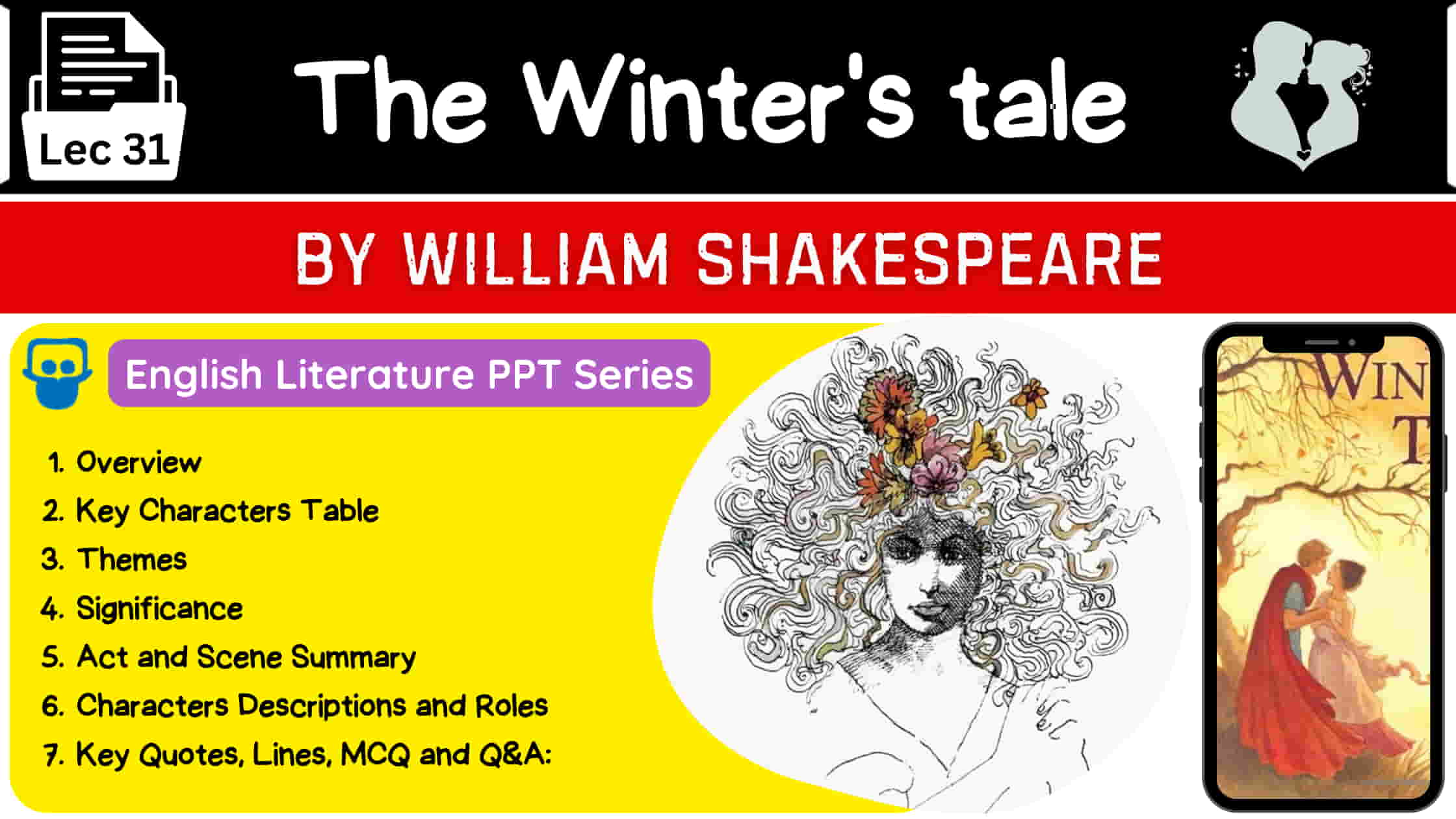
Today we have shared the Notes of William Shakespeare’s famous play The winter’s tale by William Shakespeare PPT Download, .PPTX or The Winter’s Tale PPT Slides & Study Material Download. As we know, The Winter’s Tale is one of Shakespeare’s most fascinating late plays, believed to have been written around 1610–1611. This unique work beautifully blends tragedy, romance, and comedy, creating a powerful story filled with emotion, redemption, and hope. Set across the contrasting worlds of Sicilia and Bohemia, the play follows King Leontes, whose sudden jealousy leads to devastating consequences, and later explores themes of forgiveness, time, and renewal. Through memorable characters, dramatic twists, and poetic storytelling, The Winter’s Tale offers readers and students a deep insight into human nature, relationships, and the possibility of second chances.
Whether performed on stage or explored in classrooms, The Winter’s Tale continues to enchant audiences with its powerful themes of forgiveness, transformation, and the timeless journey from loss to renewal, leaving readers with a lasting message of hope and reconciliation.
Winter’s Tale
Here’s a complete table for “The Winter’s Tale”:
| Aspect | Description |
|---|---|
| Title | The Winter’s Tale |
| Playwright | William Shakespeare |
| Genre | Romance, tragicomedy |
| Date of Composition | Estimated to be between 1609 and 1611 |
| Setting | Sicily and Bohemia |
| Main Characters | Leontes, Hermione, Polixenes, Perdita, Florizel, Paulina, Camillo, Autolycus, Antigonus |
| Plot Overview | The play begins with King Leontes of Sicily becoming consumed by jealousy and falsely accusing his wife, Hermione, of infidelity. As a result, he banishes Hermione’s newborn daughter, Perdita, and orders her death. The second half of the play takes place in Bohemia and focuses on the pastoral romance between Perdita and Prince Florizel, while Leontes grapples with the consequences of his actions. Ultimately, the play ends with reconciliation and redemption. |
| Key Themes | Jealousy and forgiveness, the power of time and transformation, the nature of love and redemption |
| Significance | “The Winter’s Tale” is one of Shakespeare’s late romances, celebrated for its blend of tragedy and comedy, as well as its exploration of themes related to redemption and reconciliation. It is often regarded as one of his most magical and enchanting works. |
| Notable Lines | – “Exit, pursued by a bear.” (Act 3, Scene 3) – “What’s gone and what’s past help / Should be past grief.” (Act 3, Scene 2) – “A sad tale’s best for winter: I have one / Of sprites and goblins.” (Act 2, Scene 1) |
| Adaptations | “The Winter’s Tale” has been adapted into various stage productions, film adaptations, and television adaptations. Notable adaptations include the film directed by Kenneth Branagh (1981), stage productions by the Royal Shakespeare Company, and modern reinterpretations by various theater companies. |
This table provides a comprehensive overview of various aspects of “The Winter’s Tale,” including its background, plot, characters, themes, significance, notable lines, and adaptations.
The winter’s tale by William Shakespeare PPT Download (PPT SLIDES)
A Complete Guide: Winter’s Tale
Introduction: Winter’s Tale, one of Shakespeare’s lesser-known works, offers a captivating blend of romance, fantasy, and drama. Set in a mythical version of England, the play unfolds amidst the stark beauty of winter, weaving together themes of love, redemption, and the passage of time. Despite its initial reception, Winter’s Tale has garnered increasing appreciation for its complex characters and evocative storytelling. In this complete guide, we delve into the intricacies of this enchanting play, exploring its plot, characters, key themes, and enduring significance.
Plot Overview: The narrative of Winter’s Tale is divided into two distinct parts, separated by a gap of sixteen years. The first three acts are filled with jealousy, betrayal, and tragedy, while the final two acts offer redemption and reconciliation.
The play opens in Sicilia, where King Leontes becomes consumed by irrational jealousy, suspecting his wife, Queen Hermione, of infidelity with his friend, King Polixenes of Bohemia. Despite Hermione’s protestations of innocence, Leontes refuses to believe her and orders her trial. The Oracle of Delphi declares Hermione’s innocence, but Leontes rejects the verdict, leading to the death of their young son, Mamillius, and the apparent death of Hermione.
Meanwhile, Leontes’ loyal lord, Antigonus, defies the king’s orders and flees to Bohemia with Hermione’s newborn daughter, Perdita. Antigonus abandons the child in Bohemia before being killed by a bear in a desolate wilderness.
The second part of the play unfolds in Bohemia, where Perdita has grown into a beautiful young woman, unaware of her royal heritage. She captures the heart of Prince Florizel, the son of Polixenes, despite the disapproval of his father. As Florizel and Perdita plan to marry in secret, their union is threatened by Polixenes’ wrath.
Ultimately, the truth about Perdita’s identity is revealed, leading to a joyous reunion between Leontes and his lost daughter. The play concludes with Hermione’s miraculous return to life, orchestrated by the repentant Paulina, and the restoration of harmony and forgiveness.
Characters: Winter’s Tale features a rich tapestry of characters, each contributing to the play’s intricate plot and thematic depth.
- Leontes: The tragic figure at the center of the play, whose jealousy and paranoia lead to the destruction of his family.
- Hermione: Leontes’ virtuous wife, falsely accused of adultery and subjected to unjust punishment.
- Perdita: The lost princess of Sicilia, raised as a shepherdess in Bohemia, whose beauty and innocence captivate those around her.
- Polixenes: The King of Bohemia and Leontes’ childhood friend, whose visit sparks the tragic chain of events.
- Paulina: Hermione’s loyal friend, whose courage and integrity drive the narrative towards redemption and reconciliation.
- Florizel: The romantic hero, who defies convention for the love of Perdita, embodying the theme of youthful rebellion.
Themes: Winter’s Tale explores a myriad of themes that resonate with audiences across centuries:
- Jealousy and Paranoia: Leontes’ irrational jealousy serves as the catalyst for the play’s tragic events, highlighting the destructive nature of suspicion and distrust.
- Redemption and Forgiveness: The play ultimately celebrates the power of repentance and forgiveness, as characters find redemption amidst the ruins of their past actions.
- Time and Transformation: The passage of time is a recurring motif, symbolizing both the inevitability of change and the possibility of renewal and rebirth.
- Nature and Artifice: The contrast between the pastoral simplicity of Bohemia and the courtly sophistication of Sicilia underscores the themes of authenticity and deception.
Enduring Significance: While Winter’s Tale may be less frequently performed than Shakespeare’s more famous works, its enduring significance lies in its exploration of timeless themes and its portrayal of human frailty and resilience. The play’s poignant depiction of love, loss, and redemption continues to captivate audiences and inspire reinterpretation across various artistic mediums.
In conclusion, Winter’s Tale stands as a testament to Shakespeare’s unparalleled mastery of language and storytelling. Through its compelling characters, intricate plot, and universal themes, the play invites audiences to contemplate the complexities of the human experience and the enduring power of forgiveness and reconciliation in the face of adversity.
Plot Overview
Below is a complete table summarizing the plot overview of “Winter’s Tale”:
| Act | Summary |
|---|---|
| Act 1 | King Leontes of Sicilia becomes consumed by jealousy, accusing his wife, Queen Hermione, of infidelity with King Polixenes of Bohemia. Despite Hermione’s innocence, Leontes orders her trial. The Oracle of Delphi declares Hermione’s innocence, but Leontes rejects the verdict, leading to the death of their son, Mamillius, and Hermione’s apparent death. |
| Act 2 | Leontes’ loyal lord, Antigonus, defies the king’s orders and flees to Bohemia with Hermione’s newborn daughter, Perdita. Antigonus abandons the child in Bohemia before being killed by a bear in a desolate wilderness. |
| Act 3 | The play shifts to Bohemia, where Perdita has grown into a beautiful young woman, unaware of her royal heritage. She captures the heart of Prince Florizel, the son of King Polixenes, despite the disapproval of his father. As Florizel and Perdita plan to marry in secret, their union is threatened by Polixenes’ wrath. |
| Act 4 | The truth about Perdita’s identity is revealed, leading to a joyous reunion between Leontes and his lost daughter. Meanwhile, Hermione’s miraculous return to life is orchestrated by the repentant Paulina, leading to the restoration of harmony and forgiveness. |
| Act 5 | The play concludes with a celebration of reconciliation and forgiveness, as the characters come together to embrace a new beginning. Leontes, Hermione, Perdita, and Florizel unite, symbolizing the triumph of love and forgiveness over jealousy and despair. |
This table provides a structured overview of the play’s narrative arc, highlighting the key events and transitions between acts.
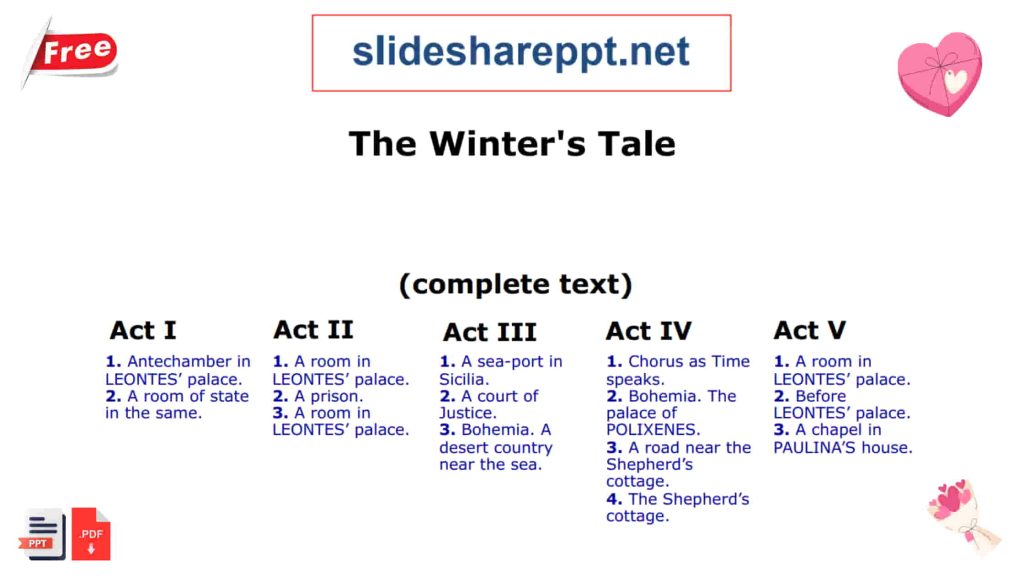
Note: The complete Text PDF Link is at the end of the PowerPoint slides (go to the last PPT Slide)
Key Characters
Here’s a complete table outlining the key characters in “Winter’s Tale”:
| Character | Role |
|---|---|
| Leontes | King of Sicilia consumed by jealousy and paranoia. |
| Hermione | Queen of Sicilia, falsely accused of infidelity by Leontes. |
| Perdita | Hermione and Leontes’ daughter, raised as a shepherdess in Bohemia. |
| Polixenes | King of Bohemia and Leontes’ childhood friend. |
| Paulina | Hermione’s loyal friend, instrumental in Hermione’s resurrection. |
| Florizel | Prince of Bohemia, in love with Perdita. |
| Antigonus | Leontes’ loyal lord who abandons Perdita in Bohemia. |
| Mamillius | Leontes and Hermione’s son who dies tragically. |
| Camillo | Courtier loyal to both Leontes and Polixenes. |
| Autolycus | A rogue and trickster who adds humor to the play. |
This table provides an overview of the main characters in “Winter’s Tale” and their respective roles within the narrative.
Also read: Alls Well That Ends Well PPT Slides and PDF Download
Themes
Here’s a complete table outlining the key themes in “Winter’s Tale”:
| Theme | Description |
|---|---|
| Jealousy and Paranoia | Leontes’ irrational jealousy and paranoia lead to the destruction of his family and kingdom. |
| Redemption and Forgiveness | The play celebrates the power of repentance and forgiveness, as characters find redemption. |
| Time and Transformation | The passage of time symbolizes change, renewal, and the possibility of transformation. |
| Nature and Artifice | Contrasts between natural settings and courtly environments underscore themes of authenticity. |
| Family and Reconciliation | The play explores familial relationships and the potential for reconciliation after conflict. |
| Love and Sacrifice | Characters demonstrate love through selfless acts of sacrifice, highlighting its transformative power. |
| Appearance vs. Reality | The disparity between outward appearances and underlying truths is a recurring motif in the play. |
| Restoration of Harmony | The narrative culminates in the restoration of harmony and the reunification of estranged families. |
This table provides an overview of the central themes in “Winter’s Tale” and their significance within the play’s narrative and broader context.
Significance
Here’s a complete table outlining the significance of “Winter’s Tale”:
| Aspect | Description |
|---|---|
| Literary | Despite being one of Shakespeare’s lesser-known plays, “Winter’s Tale” showcases the playwright’s versatility in blending tragedy, comedy, and romance. |
| Psychological | The portrayal of Leontes’ jealousy and subsequent redemption offers insights into human emotions and the destructive power of unchecked jealousy. |
| Theatrical | The play’s structure, featuring a sixteen-year gap between acts, challenges traditional theatrical conventions and allows for complex character development. |
| Philosophical | Themes of forgiveness, reconciliation, and the passage of time invite contemplation on the nature of human existence and the possibility of redemption. |
| Cultural Heritage | “Winter’s Tale” contributes to Shakespeare’s enduring legacy, serving as a testament to his profound understanding of the human condition and storytelling. |
| Artistic Inspiration | The play continues to inspire adaptations, reinterpretations, and creative works across various artistic mediums, reflecting its timeless relevance. |
This table highlights the multifaceted significance of “Winter’s Tale” encompassing its literary, psychological, theatrical, philosophical, cultural, and artistic dimensions.
Act and Scene Summary
Here’s a table summarizing each act and scene in “Winter’s Tale”:
| Act | Scene | Summary |
|---|---|---|
| Act 1 | Scene 1 | King Leontes of Sicilia becomes consumed by jealousy, accusing his wife, Queen Hermione, of infidelity with King Polixenes of Bohemia. Despite Hermione’s innocence, Leontes orders her trial. The Oracle of Delphi declares Hermione’s innocence, but Leontes rejects the verdict, leading to the death of their son, Mamillius, and Hermione’s apparent death. |
| Act 2 | Scene 1 | Leontes’ loyal lord, Antigonus, defies the king’s orders and flees to Bohemia with Hermione’s newborn daughter, Perdita. Antigonus abandons the child in Bohemia before being killed by a bear in a desolate wilderness. |
| Act 3 | Scene 1 | The play shifts to Bohemia, where Perdita has grown into a beautiful young woman, unaware of her royal heritage. She captures the heart of Prince Florizel, the son of King Polixenes, despite the disapproval of his father. As Florizel and Perdita plan to marry in secret, their union is threatened by Polixenes’ wrath. |
| Act 4 | Scene 1 | The truth about Perdita’s identity is revealed, leading to a joyous reunion between Leontes and his lost daughter. Meanwhile, Hermione’s miraculous return to life is orchestrated by the repentant Paulina, leading to the restoration of harmony and forgiveness. |
| Act 5 | Scene 1 | The play concludes with a celebration of reconciliation and forgiveness, as the characters come together to embrace a new beginning. Leontes, Hermione, Perdita, and Florizel unite, symbolizing the triumph of love and forgiveness over jealousy and despair. |
This table provides a structured overview of each act and scene in “Winter’s Tale,” summarizing the key events and transitions in the play.
Characters Descriptions and Roles
Here’s a table detailing the characters, their descriptions, and roles in “Winter’s Tale”:
| Character | Description | Role |
|---|---|---|
| Leontes | King of Sicilia who becomes consumed by jealousy, falsely accusing his wife, Hermione, of infidelity. | Central character whose jealousy sets the tragic events in motion. |
| Hermione | Queen of Sicilia, falsely accused by Leontes. She exhibits grace and dignity in the face of unjust accusations. | Victim of Leontes’ jealousy, symbolizing innocence and virtue. |
| Perdita | Hermione and Leontes’ daughter, raised as a shepherdess in Bohemia. Unaware of her royal lineage, she embodies innocence and natural beauty. | Represents purity and renewal; her discovery leads to reconciliation. |
| Polixenes | King of Bohemia and Leontes’ childhood friend. His visit to Sicilia triggers Leontes’ jealousy and sets the events of the play in motion. | Symbolizes friendship and trust, but also faces challenges in his relationship with his son, Florizel. |
| Paulina | Hermione’s loyal friend and confidante. She is instrumental in orchestrating Hermione’s return to life and serves as a voice of reason and integrity. | Catalyst for redemption and reconciliation; her courage drives the narrative towards resolution. |
| Florizel | Prince of Bohemia who falls in love with Perdita. He defies convention to pursue his love, embodying youthful rebellion and romantic ideals. | Represents youthful passion and idealism; his love for Perdita challenges social norms. |
| Antigonus | Loyal lord of Leontes who defies the king’s orders to abandon Perdita. He meets a tragic end after leaving Perdita in Bohemia. | Symbolizes loyalty and sacrifice; his actions set the stage for Perdita’s upbringing in Bohemia. |
| Mamillius | Leontes and Hermione’s young son, whose death is attributed to the turmoil caused by Leontes’ jealousy. | Represents innocence and the tragic consequences of unchecked jealousy. |
| Camillo | Courtier who serves both Leontes and Polixenes. He plays a key role in aiding Perdita’s escape to Bohemia. | Symbolizes wisdom and loyalty; his actions facilitate the resolution of the play’s conflicts. |
| Autolycus | A rogue and trickster who adds comic relief to the play. He engages in schemes and deception but ultimately experiences redemption. | Comic relief character who provides contrast to the play’s more serious themes and events. |
This table provides a comprehensive overview of the main characters in “Winter’s Tale,” their descriptions, and their roles within the narrative.
Winter’s Tale: A Summary
- Act 1: In the kingdom of Sicilia, King Leontes becomes consumed by irrational jealousy, suspecting his wife, Queen Hermione, of infidelity with his childhood friend, King Polixenes of Bohemia. Despite Hermione’s protestations of innocence, Leontes refuses to believe her and orders her trial. The Oracle of Delphi declares Hermione’s innocence, but Leontes rejects the verdict, leading to the death of their young son, Mamillius, and the apparent death of Hermione.
- Act 2: Leontes’ loyal lord, Antigonus, defies the king’s orders and flees to Bohemia with Hermione’s newborn daughter, Perdita. Antigonus abandons the child in Bohemia before being killed by a bear in a desolate wilderness.
- Act 3: The play shifts to Bohemia, where Perdita has grown into a beautiful young woman, unaware of her royal heritage. She captures the heart of Prince Florizel, the son of Polixenes, despite the disapproval of his father. As Florizel and Perdita plan to marry in secret, their union is threatened by Polixenes’ wrath.
- Act 4: The truth about Perdita’s identity is revealed, leading to a joyous reunion between Leontes and his lost daughter. Meanwhile, Hermione’s miraculous return to life is orchestrated by the repentant Paulina, leading to the restoration of harmony and forgiveness.
- Act 5: The play concludes with a celebration of reconciliation and forgiveness, as the characters come together to embrace a new beginning. Leontes, Hermione, Perdita, and Florizel unite, symbolizing the triumph of love and forgiveness over jealousy and despair.
Final Thoughts: “Winter’s Tale” is a captivating blend of tragedy, romance, and redemption. Through its complex characters and evocative storytelling, the play explores timeless themes of jealousy, forgiveness, and the transformative power of love. Despite its initial tragedy, “Winter’s Tale” ultimately offers a message of hope and reconciliation, reminding audiences of the enduring strength of the human spirit.
Facts
Here’s a table of interesting facts about “Winter’s Tale”:
| Fact | Description |
|---|---|
| Genre | “Winter’s Tale” is categorized as one of Shakespeare’s late romances, blending elements of tragedy, comedy, and romance. |
| Setting | The play is set in two contrasting locations: the courtly realm of Sicilia and the pastoral countryside of Bohemia. |
| Time Period | “Winter’s Tale” is believed to have been written between 1609 and 1611, making it one of Shakespeare’s later works. |
| Structure | The play is divided into five acts, with the first three acts depicting tragedy and the final two acts focusing on romance, redemption, and reconciliation. |
| Source Material | Shakespeare drew inspiration from Robert Greene’s pastoral romance “Pandosto” (1588) and William Painter’s “The Palace of Pleasure” (1566). |
| Literary Influences | “Winter’s Tale” is influenced by the themes of forgiveness and reconciliation found in classical literature, particularly Ovid’s “Metamorphoses.” |
| Stage Directions | The stage directions in “Winter’s Tale” are minimal compared to other Shakespearean plays, allowing directors ample creative freedom in interpretation. |
| Notable Adaptations | The play has inspired numerous adaptations, including operas, ballets, films, and stage productions, showcasing its enduring popularity and appeal. |
| Famous Lines | “Exit, pursued by a bear” (Act 3, Scene 3) is one of the most famous stage directions in English literature, illustrating the play’s blend of tragedy and humor. |
| Critical Reception | While “Winter’s Tale” received mixed reviews initially, it has gained increasing appreciation for its rich imagery, complex characters, and thematic depth. |
This table provides a glimpse into the fascinating background and reception of Shakespeare’s “Winter’s Tale.”
Key Quotes and Lines
Here’s a table featuring key quotes and lines from “Winter’s Tale”:
| Quote | Speaker | Context |
|---|---|---|
| “Exit, pursued by a bear.” | Stage Direction | This famous stage direction occurs in Act 3, Scene 3, where Antigonus is chased by a bear as he abandons Perdita in Bohemia. It is both dramatic and humorous, adding to the play’s blend of tragedy and comedy. |
| “A sad tale’s best for winter.” | Mamillius | Mamillius speaks these words in Act 2, Scene 1, during the winter’s tale he tells at his father’s court. The line foreshadows the emotional depth of the play and its exploration of tragedy, particularly in the first acts. |
| “What’s gone and what’s past help should be past grief.” | Hermione | Hermione speaks these words in Act 3, Scene 2, expressing her resignation to Leontes’ unjust accusations and her desire to move forward despite the pain of the past. |
| “Though I am not naturally honest, I am so sometimes by chance.” | Autolycus | Autolycus, the rogue and trickster, delivers this line in Act 4, Scene 4, reflecting on his own character and the unpredictable nature of honesty and deception. |
| “O, she’s warm! If this be magic, let it be an art lawful as eating.” | Antigonus | Antigonus utters these words in Act 3, Scene 3, upon discovering Hermione’s newborn daughter, Perdita, who appears to be alive after being left in the wilderness. The line reflects his awe and wonder at the miraculous sight. |
| “What we change doth not better us, but we must follow, oh, that’s certain.” | Clown | The Clown, reflecting on life’s uncertainties, speaks these lines in Act 4, Scene 4, contemplating the inevitability of change and the need to accept life’s twists and turns. |
| “You gods, look down, and from your sacred vials pour your graces upon my daughter’s head!” | Leontes | Leontes prays for divine intervention in Act 5, Scene 3, as he reconciles with his daughter, Perdita, and seeks forgiveness for his past actions. His plea symbolizes his newfound humility and desire for redemption. |
| “What’s lost and what’s past help should be past grief.” | Paulina | Paulina echoes Hermione’s sentiment in Act 5, Scene 3, emphasizing the need to let go of past sorrows and embrace the possibility of reconciliation and happiness. |
These quotes and lines capture the essence of “Winter’s Tale,” showcasing its thematic depth, emotional resonance, and memorable dialogue.
Q&A
Q: What is the genre of “Winter’s Tale”?
A: “Winter’s Tale” is categorized as one of Shakespeare’s late romances, blending elements of tragedy, comedy, and romance.
Q: Where is “Winter’s Tale” set?
A: The play is set in two contrasting locations: the courtly realm of Sicilia and the pastoral countryside of Bohemia.
Q: Who are the central characters in “Winter’s Tale”?
A: The central characters include King Leontes of Sicilia, Queen Hermione, their daughter Perdita, King Polixenes of Bohemia, and Paulina, a loyal friend of Hermione.
Q: What is the main conflict in “Winter’s Tale”?
A: The main conflict arises from King Leontes’ irrational jealousy, which leads to accusations of infidelity against Queen Hermione, triggering a chain of tragic events.
Q: How does “Winter’s Tale” end?
A: The play concludes with a celebration of reconciliation and forgiveness, as the characters come together to embrace a new beginning. Leontes, Hermione, Perdita, and Florizel unite, symbolizing the triumph of love and forgiveness over jealousy and despair.
Q: What are some famous quotes from “Winter’s Tale”?
A: Some famous quotes include “Exit, pursued by a bear,” “A sad tale’s best for winter,” and “What’s gone and what’s past help should be past grief.”
Q: What is the significance of “Winter’s Tale” in Shakespeare’s canon?
A: “Winter’s Tale” is significant for its exploration of themes such as jealousy, redemption, and the passage of time. It also showcases Shakespeare’s ability to blend genres and create complex characters.