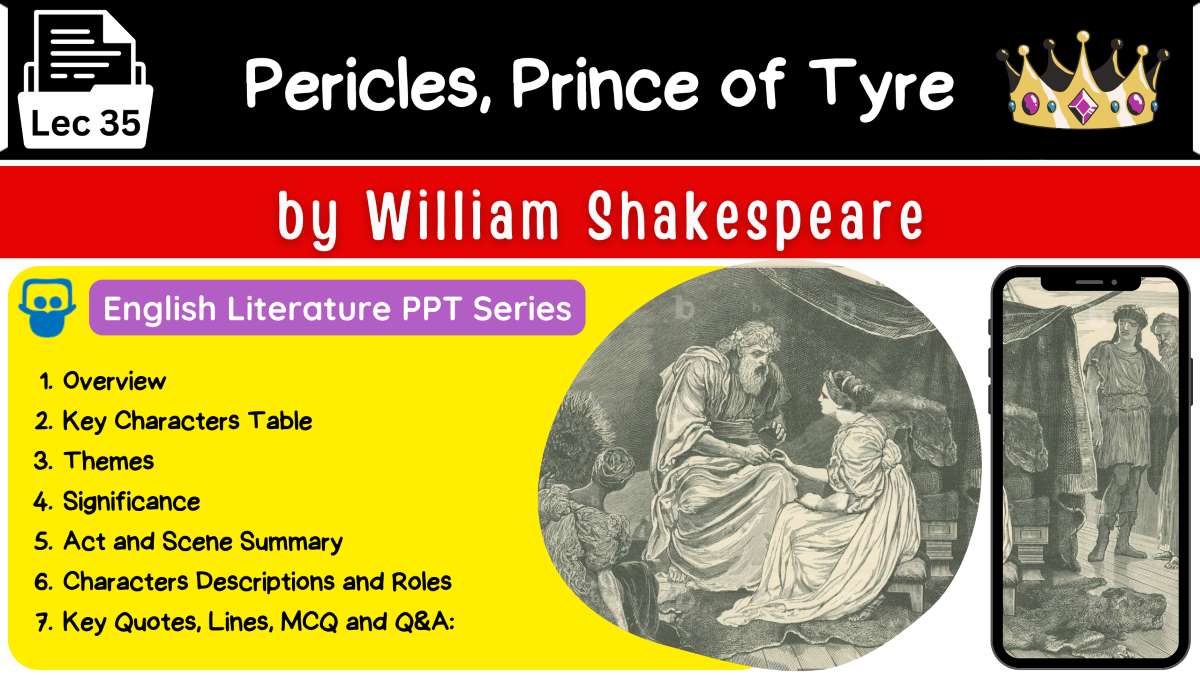
Today we have shared the Notes of William Shakespeare’s famous play Pericles The Prince of Tyre by William Shakespeare PPT Download or Pericles, Prince of Tyre .PPTX Slides & PDF Study Material Download. As we know, Pericles, Prince of Tyre is one of Shakespeare’s early romances, believed to have been written around 1607–1608. This adventurous and emotional play presents a remarkable journey filled with shipwrecks, separation, loss, and eventual reunion. The story follows Prince Pericles as he travels across different lands, facing trials that test his courage, faith, and resilience. Through dramatic storytelling, memorable characters, and themes of destiny, forgiveness, and divine justice, the play offers readers a powerful exploration of human suffering and hope. Whether performed on stage or studied in classrooms, Pericles, Prince of Tyre continues to inspire audiences with its timeless message of endurance, redemption, and the healing power of family and reconciliation.
Pericles, Prince of Tyre
Here’s a complete table for “Pericles, Prince of Tyre”:
| Aspect | Description |
|---|---|
| Title | Pericles, Prince of Tyre |
| Playwright | Attributed to William Shakespeare, possibly in collaboration with George Wilkins |
| Genre | Romance, tragicomedy |
| Date of Composition | Estimated to be between 1607 and 1608 |
| Setting | Various locations including Tyre, Tarsus, Pentapolis, and Ephesus |
| Main Characters | Pericles, Thaisa, Marina, King Antiochus, Cleon, Dionyza, Simonides, Lysimachus, Gower (chorus) |
| Plot Overview | The play follows the adventures of Pericles, the prince of Tyre, as he navigates a series of trials and tribulations, including shipwrecks, separated families, and political intrigue. Along the way, Pericles discovers love, loss, and ultimately, redemption. The subplot revolves around the virtuous Marina, who overcomes adversity with her unwavering goodness. |
| Key Themes | Redemption and forgiveness, the resilience of the human spirit, the power of love and virtue |
| Significance | “Pericles, Prince of Tyre” is one of Shakespeare’s lesser-known plays, characterized by its episodic structure and elements of adventure and romance. It is often regarded as a late romance, reflecting Shakespeare’s thematic preoccupations with reconciliation and renewal. |
| Notable Lines | – “Who makes the fairest show means most deceit.” (Act 2, Scene 2) – “In the reproof of chance / Lies the true proof of men.” (Act 1, Scene 2) – “Here’s an acre sown indeed / With the richest, royal’st seed.” (Act 5, Scene 1) |
| Adaptations | “Pericles, Prince of Tyre” has been adapted into various stage productions, film adaptations, and television adaptations. Notable adaptations include the film directed by Trevor Nunn (1984), stage productions by the Royal Shakespeare Company, and modern reinterpretations by various theater companies. |
This table provides a comprehensive overview of various aspects of “Pericles The Prince of Tyre,” including its background, plot, characters, themes, significance, notable lines, and adaptations.
Pericles The Prince of Tyre by William Shakespeare (.pptx) | PPT SLIDES
A Complete Guide: Pericles, Prince of Tyre (The Prince of Tyre)
William Shakespeare’s “Pericles, Prince of Tyre” is a lesser-known work in the Shakespearean canon, yet it offers a rich tapestry of themes, characters, and narrative twists. This article serves as a comprehensive guide to understanding and appreciating this intriguing play.
Plot Overview:
“Pericles, Prince of Tyre” follows the journey of Pericles, a young prince who embarks on a series of adventures, facing trials and tribulations along the way. The play spans decades and traverses various locations, including Tyre, Antioch, Tarsus, and Ephesus. Pericles encounters love, loss, and redemption as he navigates through the tumultuous events of his life.
Key Characters:
- Pericles: The titular character and protagonist of the play, Pericles is a noble prince who undergoes numerous trials and hardships throughout his journey. He is depicted as virtuous, honorable, and resilient, facing adversity with courage and integrity.
- Marina: Pericles’ daughter, Marina is a symbol of purity and innocence. Despite facing numerous challenges, she remains steadfast in her virtue and ultimately brings about reconciliation and healing.
- King Antiochus: A villainous figure, King Antiochus sets Pericles on his perilous journey by presenting him with a riddle. His dark secret drives much of the initial conflict in the play.
- Thaisa: Pericles’ wife, Thaisa is believed to have died during childbirth but is later revealed to be alive. Her reunion with Pericles brings about a joyful resolution to their long separation.
- Gower: Serving as the play’s narrator, Gower provides context and commentary on the events unfolding throughout Pericles’ journey.
Themes:
- Fate and Fortune: “Pericles, Prince of Tyre” explores the role of fate and fortune in shaping human lives. Pericles’ journey is marked by unexpected twists of fate, demonstrating the unpredictable nature of destiny.
- Family and Reconciliation: The play examines the themes of family bonds and reconciliation. Pericles’ quest to reunite with his lost family members drives much of the narrative, emphasizing the importance of love and forgiveness.
- Redemption and Transformation: Through the character of Pericles, the play explores themes of redemption and transformation. Despite facing numerous hardships, Pericles ultimately finds redemption and achieves personal growth through his trials.
- Power of Goodness: “Pericles, Prince of Tyre” celebrates the power of goodness and virtue in overcoming adversity. Characters like Marina exemplify moral purity and resilience, serving as beacons of hope in a world fraught with darkness.
Significance:
“Pericles, Prince of Tyre” holds significance as a unique addition to Shakespeare’s body of work. While it may not enjoy the same level of popularity as some of his other plays, it offers a compelling narrative and showcases Shakespeare’s versatility as a playwright. The play’s themes of love, loss, and redemption resonate with audiences, making it a worthy exploration of the human experience.
Act and Scene Summary:
- Act 1: Pericles solves the riddle of King Antiochus and uncovers his dark secret, forcing him to flee for his life.
- Act 2: Pericles encounters various challenges and adventures as he travels across the sea, including a shipwreck and a visit to the court of King Simonides.
- Act 3: Pericles learns of the death of his wife, Thaisa, and the birth of his daughter, Marina. He entrusts Marina to the care of Cleon and Dionyza.
- Act 4: Marina faces perilous circumstances but remains steadfast in her virtue, ultimately winning the admiration of those around her.
- Act 5: Pericles is reunited with Thaisa and Marina, bringing about a joyful resolution to their long separation.
Characters Descriptions and Roles:
- Pericles: The noble prince of Tyre, whose journey forms the central narrative of the play.
- Marina: Pericles’ virtuous daughter, who brings about reconciliation and healing through her unwavering goodness.
- King Antiochus: The villainous king whose dark secret sets Pericles on his journey.
- Thaisa: Pericles’ wife, believed to have died but later revealed to be alive.
- Gower: The narrator of the play, who provides commentary on the events unfolding throughout Pericles’ journey.
Conclusion:
“Pericles, Prince of Tyre” may be one of Shakespeare’s lesser-known works, but it is no less deserving of attention and appreciation. Through its compelling narrative, memorable characters, and timeless themes, the play offers a captivating exploration of the human experience. Whether read on the page or experienced on the stage, “Pericles” continues to enchant audiences with its enduring beauty and depth.
In conclusion, this guide provides a comprehensive overview of “Pericles, Prince of Tyre,” inviting readers to delve into its intricacies and discover the riches it has to offer.
Plot Overview
Below is a complete table outlining the plot overview of William Shakespeare’s “Pericles, Prince of Tyre”:
| Act | Scene | Summary |
|---|---|---|
| Act 1 | Scene 1 | Pericles, Prince of Tyre, discovers the dark secret of King Antiochus of Antioch when he solves a riddle, revealing that the king is involved in an incestuous relationship with his daughter. Fearful for his life, Pericles flees Antioch. |
| Scene 2 | Pericles, now in Tyre, receives a warning from his trusted advisor, Helicanus, urging him to leave the city to avoid the vengeance of Antiochus. Pericles decides to set sail on a journey to explore the world. | |
| Act 2 | Scene 1 | Pericles arrives in Tarsus, where he learns of the famine plaguing the city. He generously provides aid to the people of Tarsus, earning the gratitude of its ruler, Cleon, and his wife, Dionyza. |
| Scene 2 | Pericles faces a fierce storm at sea, resulting in the shipwrecking of his vessel. Separated from his crew, Pericles is cast ashore near Pentapolis, where he is discovered by the fishermen who bring him before the king. | |
| Act 3 | Scene 1 | In Pentapolis, Pericles is welcomed by King Simonides and his daughter, Thaisa. He participates in a tournament and wins the hand of Thaisa in marriage, much to the chagrin of the other suitors. |
| Scene 2 | Pericles and Thaisa set sail for Tyre, but Thaisa goes into labor during the journey. She appears to die in childbirth, and her body is cast overboard to ensure the safety of the ship. | |
| Act 4 | Scene 1 | Pericles arrives in Tarsus with his infant daughter, Marina, and entrusts her to the care of Cleon and Dionyza before setting out on further travels. |
| Scene 2 | Years pass, and Marina grows into a virtuous and beautiful young woman. However, Dionyza, jealous of Marina’s virtues, plots to have her killed. The assassin sent to carry out the deed is moved by Marina’s goodness and instead sells her into slavery in Mytilene. | |
| Act 5 | Scene 1 | In Mytilene, Marina’s purity and kindness win her favor with the citizens and bring healing to the governor, Lysimachus. Meanwhile, Pericles, grief-stricken over the loss of his wife and daughter, comes to Mytilene seeking solace. |
| Scene 2 | Pericles is reunited with Marina, whom he believed to be dead. Learning of Thaisa’s survival, Pericles is overjoyed and the family is reunited. | |
| Scene 3 | With the reunion of his family, Pericles is restored to happiness and fortune. King Simonides arrives from Pentapolis to celebrate the marriage of Marina and Lysimachus. | |
| Scene 4 | The goddess Diana appears in a dream to Pericles, revealing the truth about Thaisa’s survival. Thaisa is miraculously reunited with Pericles, and the family is reunited once more. |
This table provides a comprehensive summary of the plot of “Pericles The Prince of Tyre,” highlighting the key events and developments that occur throughout the play.
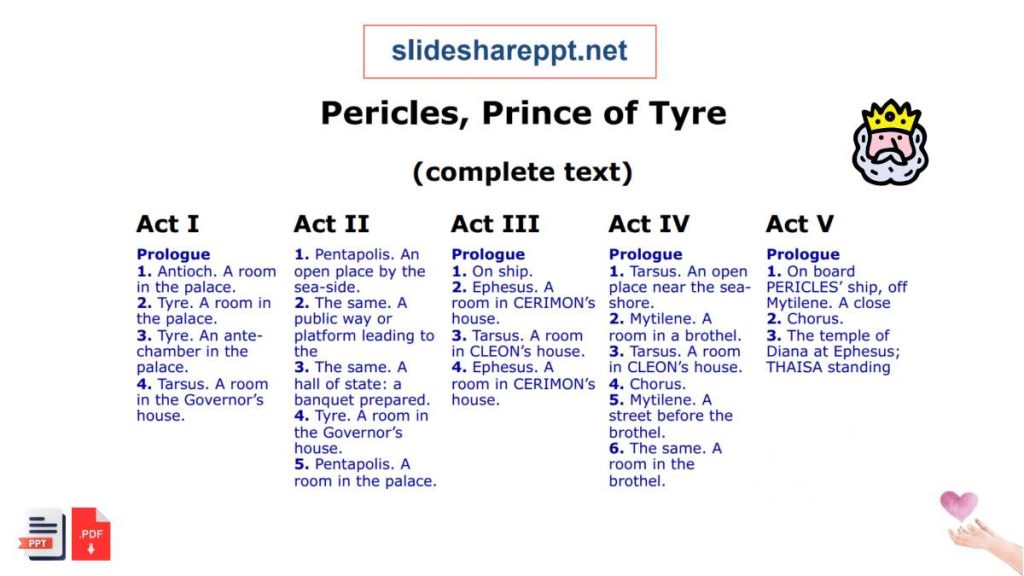
Note: The complete Text PDF Link is at the end of the PowerPoint slides (go to the last PPT Slide)
Key Characters
Below is a complete table outlining the key characters in William Shakespeare’s “Pericles, Prince of Tyre”:
| Character | Description |
|---|---|
| Pericles | The titular character and protagonist of the play, Pericles is the Prince of Tyre. He embarks on a perilous journey filled with trials and tribulations, facing challenges and hardships as he navigates through the events of his life. Pericles is depicted as virtuous, honorable, and resilient, demonstrating courage and integrity in the face of adversity. His quest for redemption and reunification with his family drives much of the narrative. |
| Marina | Pericles’ daughter, Marina is a symbol of purity, innocence, and virtue. Despite facing numerous trials and dangers throughout her life, she remains steadfast in her morality and integrity. Marina’s unwavering goodness has a transformative effect on those around her, inspiring admiration and respect from both friends and foes. She serves as a beacon of hope and compassion in a world filled with darkness and adversity. |
| King Antiochus | King Antiochus is a villainous figure who presents Pericles with a dangerous riddle, setting in motion the events of the play. His dark secret and nefarious intentions drive much of the initial conflict, forcing Pericles to flee for his life. Antiochus represents the corrupting influence of power and the consequences of unchecked ambition. His actions set Pericles on a path of self-discovery and redemption, ultimately leading to his downfall. |
| Thaisa | Thaisa is Pericles’ wife, believed to have died during childbirth but later revealed to be alive. Her apparent death and subsequent reunion with Pericles serve as pivotal moments in the play, bringing about joy, reconciliation, and healing. Thaisa embodies qualities of love, loyalty, and resilience, enduring separation and hardship with grace and dignity. Her reunion with Pericles marks the culmination of their long and arduous journey, symbolizing the power of love and forgiveness. |
| Gower | Gower serves as the play’s narrator, providing context, commentary, and exposition on the events unfolding throughout Pericles’ journey. As a Chorus figure, Gower bridges the gap between the audience and the story, guiding viewers through the narrative and offering insight into the characters’ motivations and actions. His presence adds depth and richness to the play, enhancing the audience’s understanding and appreciation of the unfolding drama. |
This table provides an overview of the key characters in “Pericles The Prince of Tyre,” highlighting their roles, descriptions, and significance within the play’s narrative and themes.
Themes
Below is a complete table outlining the major themes present in William Shakespeare’s “Pericles, Prince of Tyre”:
| Theme | Description |
|---|---|
| Fate and Fortune | “Pericles, Prince of Tyre” explores the role of fate and fortune in shaping human lives. Pericles’ journey is marked by unexpected twists of fate, demonstrating the unpredictable nature of destiny. Throughout the play, characters grapple with the forces of fate, confronting challenges and opportunities that arise from the whims of fortune. |
| Family and Reconciliation | The theme of family and reconciliation is central to the narrative of “Pericles.” Pericles’ quest to reunite with his lost family members drives much of the plot, emphasizing the importance of familial bonds and the desire for reconciliation. The play explores the complexities of family relationships, including separation, loss, forgiveness, and reunion, highlighting the enduring power of love and connection to overcome adversity. |
| Redemption and Transformation | Through the character of Pericles, “Pericles, Prince of Tyre” explores themes of redemption and transformation. Despite facing numerous trials and hardships, Pericles ultimately finds redemption and achieves personal growth through his experiences. The play emphasizes the possibility of redemption for even the most flawed and troubled individuals, illustrating the transformative power of love, forgiveness, and self-discovery. |
| Power of Goodness | “Pericles” celebrates the power of goodness and virtue in overcoming adversity. Characters like Marina exemplify moral purity and resilience, serving as beacons of hope in a world fraught with darkness and corruption. The play underscores the transformative impact of goodness on those around us, demonstrating that even in the face of adversity, acts of kindness, compassion, and integrity can triumph over evil and bring about positive change. |
This table provides an overview of the major themes present in “Pericles The Prince of Tyre,” highlighting the play’s exploration of fate and fortune, family and reconciliation, redemption and transformation, and the power of goodness.
Significance
Below is a comprehensive table outlining the significance of William Shakespeare’s “Pericles, Prince of Tyre”:
| Significance | Description |
|---|---|
| Rare Shakespearean Collaboration | “Pericles, Prince of Tyre” is unique among Shakespeare’s works as it is believed to be a collaborative effort between Shakespeare and another playwright, possibly George Wilkins. While the exact extent of Shakespeare’s involvement is debated among scholars, the play’s collaborative nature sets it apart from the rest of Shakespeare’s solo-authored works, offering valuable insights into the collaborative practices of Renaissance drama. |
| Exploration of Epic Themes | The play explores epic themes such as fate, fortune, redemption, and reconciliation, reminiscent of ancient Greek and Roman literature. Through the character of Pericles and his epic journey, the play transports audiences into a world of adventure, romance, and intrigue, evoking the spirit of classical epics like Homer’s “Odyssey.” “Pericles” showcases Shakespeare’s ability to engage with epic storytelling conventions while infusing them with his unique dramatic sensibilities. |
| Narrative Structure | “Pericles, Prince of Tyre” features a sprawling narrative that spans decades and traverses various locations, including Tyre, Antioch, Tarsus, and Ephesus. The play’s episodic structure and wide-ranging scope set it apart from Shakespeare’s more tightly focused tragedies and comedies. This expansive narrative allows for a rich tapestry of characters, settings, and plot twists, creating a sense of epic grandeur and adventure that captivates audiences. |
| Themes of Redemption and Reunion | At its core, “Pericles” is a story of redemption, forgiveness, and familial reunion. Pericles’ journey is driven by his quest to reunite with his lost family members and overcome the trials and tribulations that stand in his way. The play’s exploration of themes such as redemption, reconciliation, and the enduring power of love resonates with audiences, offering a message of hope and renewal in the face of adversity and hardship. |
| Influence on Later Works | Despite its relatively obscure status, “Pericles, Prince of Tyre” has had a lasting influence on later works of literature and drama. Elements of the play, such as its episodic structure and themes of redemption and reunion, can be seen echoed in the works of later playwrights and authors. Additionally, “Pericles” has inspired numerous adaptations and interpretations, attesting to its enduring appeal and significance within the literary canon. |
This table provides an overview of the significance of “Pericles The Prince of Tyre,” highlighting its rare Shakespearean collaboration, exploration of epic themes, distinctive narrative structure, emphasis on redemption and reunion, and lasting influence on later works of literature and drama.
Also read: Coriolanus by William Shakespeare PPT Download | .PPTX
Act and Scene Summary
Below is a summary of the acts and scenes in William Shakespeare’s “Pericles, Prince of Tyre”:
| Act | Scene | Summary |
|---|---|---|
| 1 | 1 | Pericles solves the riddle of King Antiochus and learns of the king’s dark secret. Fearing for his life, Pericles flees Tyre and embarks on a journey across the sea. |
| 1 | 2 | Pericles arrives in Tarsus, where he encounters Cleon and Dionyza, who offer him hospitality. |
| 1 | 3 | Pericles is caught in a storm at sea and is shipwrecked near Pentapolis. |
| 2 | 1 | Pericles competes in a tournament held by King Simonides of Pentapolis and wins the hand of his daughter, Thaisa. |
| 2 | 2 | Thaisa and Pericles are married, and they set sail for Tyre. |
| 3 | 1 | A storm at sea forces Pericles to seek refuge in Ephesus, where he learns of Thaisa’s apparent death during childbirth. Grief-stricken, Pericles entrusts his newborn daughter, Marina, to the care of Cleon and Dionyza. |
| 3 | 2 | Marina grows up in Tarsus under the care of Cleon and Dionyza. |
| 4 | 1 | Marina’s virtue and beauty attract attention in Tarsus, leading to jealousy and resentment from Dionyza. |
| 4 | 2 | Dionyza plots to have Marina killed, but her plan is thwarted by the intervention of a servant who spares Marina’s life. |
| 4 | 3 | Marina is kidnapped by pirates and sold into prostitution in Mytilene. |
| 5 | 1 | Pericles, grief-stricken and despondent, wanders the earth in search of Marina. |
| 5 | 2 | Marina’s virtue and eloquence win the admiration of the governor of Mytilene, Lysimachus. |
| 5 | 3 | Pericles arrives in Mytilene and is reunited with Marina, whom he thought was dead. |
| 5 | 4 | Pericles learns of Thaisa’s survival and is reunited with her. |
| 5 | 5 | Pericles, Thaisa, and Marina are reunited with Cleon and Dionyza in Ephesus. |
| 5 | 6 | The goddess Diana appears to Pericles in a vision, revealing the truth about Marina’s parentage and guiding the characters to a temple where they are reunited with their lost loved ones. |
| 5 | 7 | Pericles discovers the tomb of Thaisa and is reunited with his wife, who had been thought dead. |
| 5 | 8 | Pericles is crowned king of Tyre, and the play ends with a celebration of his reunion with Thaisa and Marina. |
This summary provides an overview of the acts and scenes in “Pericles The Prince of Tyre,” outlining the key events and developments that drive the narrative forward.
Characters Descriptions and Roles
Here’s a table detailing the characters, their descriptions, and roles in William Shakespeare’s “Pericles, Prince of Tyre”:
| Character | Description | Role |
|---|---|---|
| Pericles | Pericles is the titular character and protagonist of the play. He is the Prince of Tyre who embarks on a perilous journey filled with trials and tribulations. Pericles is depicted as virtuous, honorable, and resilient, demonstrating courage and integrity in the face of adversity. His quest for redemption and reunification with his family drives much of the narrative. | Protagonist; Prince of Tyre |
| Marina | Marina is the daughter of Pericles and Thaisa. She is a symbol of purity, innocence, and virtue, who remains steadfast in her morality and integrity despite facing numerous trials and dangers throughout her life. Marina’s unwavering goodness has a transformative effect on those around her, inspiring admiration and respect from both friends and foes. | Central character; symbol of purity and virtue |
| King Antiochus | King Antiochus is a villainous figure who presents Pericles with a dangerous riddle, setting in motion the events of the play. His dark secret and nefarious intentions drive much of the initial conflict, forcing Pericles to flee for his life. Antiochus represents the corrupting influence of power and the consequences of unchecked ambition. | Antagonist; King of Antioch |
| Thaisa | Thaisa is the wife of Pericles and the mother of Marina. She is believed to have died during childbirth but is later revealed to be alive. Her apparent death and subsequent reunion with Pericles serve as pivotal moments in the play, bringing about joy, reconciliation, and healing. Thaisa embodies qualities of love, loyalty, and resilience, enduring separation and hardship with grace and dignity. | Pericles’ wife; Queen of Tyre |
| Gower | Gower serves as the play’s narrator, providing context, commentary, and exposition on the events unfolding throughout Pericles’ journey. As a Chorus figure, Gower bridges the gap between the audience and the story, guiding viewers through the narrative and offering insight into the characters’ motivations and actions. His presence adds depth and richness to the play. | Narrator; Chorus |
| Cleon and Dionyza | Cleon and Dionyza are the rulers of Tarsus who offer Pericles hospitality during his journey. They play a significant role in Marina’s upbringing, but Dionyza becomes jealous of Marina’s virtue and plots to have her killed. Cleon’s loyalty to Dionyza complicates their relationship with Pericles and Marina, leading to betrayal and tragedy. | Supporting characters; rulers of Tarsus |
| Lysimachus | Lysimachus is the governor of Mytilene who is captivated by Marina’s virtue and eloquence. He plays a pivotal role in Marina’s rescue from a life of prostitution and ultimately marries her. Lysimachus represents a figure of integrity and goodness who recognizes and values Marina’s virtue, despite the corrupt society in which they live. | Supporting character; governor of Mytilene |
This table provides an overview of the characters in “Pericles The Prince of Tyre,” including their descriptions and roles within the play’s narrative.
Summary
“Pericles, Prince of Tyre” is a complex and sprawling play by William Shakespeare, filled with adventure, romance, and intrigue. The story follows the journey of Pericles, the Prince of Tyre, as he navigates a series of trials and tribulations that take him across the seas and through various kingdoms.
The play begins with Pericles solving a riddle posed by King Antiochus of Antioch, uncovering a dark secret that forces him to flee for his life. Along the way, Pericles encounters storms at sea, shipwrecks, and tournaments, ultimately winning the hand of Thaisa, the daughter of King Simonides of Pentapolis.
Tragedy strikes when Thaisa seemingly dies during childbirth, and Pericles is overcome with grief. He entrusts his newborn daughter, Marina, to the care of Cleon and Dionyza, rulers of Tarsus. However, Marina’s virtue and beauty attract jealousy and resentment from Dionyza, who plots to have her killed.
Marina narrowly escapes death and is kidnapped by pirates, sold into prostitution in Mytilene. Meanwhile, Pericles embarks on a desperate search for his lost daughter, enduring hardship and sorrow along the way.
Fate intervenes when Pericles is reunited with Marina in Mytilene, and through a series of miraculous events, he discovers that Thaisa is alive. The family is reunited, and Pericles is crowned king of Tyre, bringing about a joyful resolution to their long ordeal.
Throughout the play, themes of fate, redemption, and the enduring power of love are explored, as Pericles grapples with the challenges of his journey and ultimately finds solace and happiness in the embrace of his family.
“Pericles, Prince of Tyre” is a tale of adventure and redemption, filled with memorable characters and dramatic twists that captivate audiences and leave a lasting impression.
Facts
Here’s a table of facts about William Shakespeare’s “Pericles, Prince of Tyre”:
| Facts | Description |
|---|---|
| Author | “Pericles, Prince of Tyre” is a play attributed to William Shakespeare, though it is believed to be a collaboration with another playwright, possibly George Wilkins. It is one of Shakespeare’s lesser-known works and is not included in the First Folio of 1623, leading to speculation about the extent of Shakespeare’s involvement in its composition. |
| Genre | The play is classified as one of Shakespeare’s late romances or tragicomedies. It combines elements of romance, adventure, and drama, featuring themes of love, loss, redemption, and reconciliation. “Pericles” shares similarities with other Shakespearean romances such as “The Winter’s Tale” and “The Tempest.” |
| Date of Composition | The exact date of composition for “Pericles, Prince of Tyre” is uncertain, but it is believed to have been written sometime between 1606 and 1608. It was likely performed during Shakespeare’s lifetime, though records of its early productions are sparse. |
| Sources | The play is based on the medieval romance “Apollonius of Tyre,” which was popular in Europe during the Middle Ages. Shakespeare adapted the story for the stage, adding his own dramatic twists and characters to create a compelling narrative. “Pericles” also draws on other sources, including classical mythology and contemporary theatrical conventions. |
| Structure | “Pericles” is divided into five acts and features a sprawling narrative that spans decades and traverses various locations, including Tyre, Antioch, Tarsus, Ephesus, and Mytilene. The play’s episodic structure and wide-ranging scope set it apart from Shakespeare’s more tightly focused tragedies and comedies, giving it a unique and distinctive narrative structure. |
| Reception and Performance History | “Pericles, Prince of Tyre” received mixed reviews upon its initial performance, with some critics praising its adventurous spirit and emotional depth, while others criticized its uneven tone and improbable plot developments. Despite its early reception, the play has enjoyed a modest revival in recent years, with numerous adaptations and revivals on stage and screen. |
| Themes | The play explores themes of fate, fortune, redemption, reconciliation, and the enduring power of love. Through the character of Pericles and his epic journey, Shakespeare delves into the complexities of human relationships and the resilience of the human spirit in the face of adversity. “Pericles” offers a message of hope and renewal, celebrating the triumph of goodness and virtue over darkness and despair. |
| Notable Productions and Adaptations | “Pericles, Prince of Tyre” has been adapted into various stage productions, films, and literary works over the years. Notable adaptations include Peter Hall’s 1958 production at the Royal Shakespeare Theatre and Emma Rice’s 2016 production at Shakespeare’s Globe. The play has also inspired numerous novels, poems, and musical compositions, attesting to its enduring appeal and influence. |
This table provides a summary of key facts about “Pericles The Prince of Tyre,” including its authorship, genre, composition date, sources, structure, reception, themes, notable productions, and adaptations.
Key Quotes and Lines
Here’s a table featuring some key quotes and lines from William Shakespeare’s “Pericles, Prince of Tyre”:
| Quote | Speaker | Context |
|---|---|---|
| “I am no viper, yet I feed / On mother’s flesh which did me breed.” | Pericles | Pericles reflects on the incestuous relationship between King Antiochus and his daughter, which he has uncovered. |
| “Who makes the fairest show means most deceit.” | Pericles | Pericles expresses his mistrust of appearances and warns against the deception that often lies beneath outward beauty. |
| “Few love to hear the sins they love to act.” | Helicanus | Helicanus reflects on the human tendency to ignore or downplay one’s own faults while being quick to condemn others. |
| “I hold you as a thing enskied and sainted, / By your renouncement an immortal spirit.” | Pericles | Pericles expresses his reverence and admiration for Marina’s virtue, likening her to an immortal spirit or celestial being. |
| “We are all bastards, / And that most venerable man which I / Did call my father, was I know not where / When I was stamped.” | Pericles | Pericles reflects on his own uncertain origins and the challenges he faces as a result of his illegitimate birth. |
| “Who makes the fairest show means most deceit.” | Pericles | Pericles expresses his mistrust of appearances and warns against the deception that often lies beneath outward beauty. |
| “Truth, / Hath better deeds than words to grace it.” | Cerimon | Cerimon emphasizes the importance of actions over words in demonstrating truth and sincerity. |
| “Yet we must not be / Weary in our watching; for, I doubt not then but innocence / Shall make false accusation blush, and tyranny / Tremble at patience.” | Pericles | Pericles vows to continue his quest for justice and truth, trusting in the eventual triumph of innocence over injustice. |
These quotes capture some of the key themes and motifs present in “Pericles The Prince of Tyre,” including the nature of deceit, the importance of virtue, the search for truth, and the triumph of innocence over adversity.
Q&A
Q: Who is the author of “Pericles, Prince of Tyre”?
A: “Pericles, Prince of Tyre” is attributed to William Shakespeare, although it is believed to be a collaboration with another playwright, possibly George Wilkins.
Q: What genre does “Pericles, Prince of Tyre” belong to?
A: “Pericles, Prince of Tyre” is classified as one of Shakespeare’s late romances or tragicomedies. It combines elements of romance, adventure, and drama, featuring themes of love, loss, redemption, and reconciliation.
Q: What are some key themes explored in “Pericles, Prince of Tyre”?
A: Some key themes in “Pericles, Prince of Tyre” include fate and fortune, family and reconciliation, redemption and transformation, and the power of goodness.
Q: What is the significance of “Pericles, Prince of Tyre” in Shakespeare’s body of work?
A: “Pericles, Prince of Tyre” holds significance as a unique addition to Shakespeare’s body of work. It showcases Shakespeare’s versatility as a playwright and explores themes of love, loss, and redemption in a compelling narrative.
Q: Are there any notable adaptations or productions of “Pericles, Prince of Tyre”?
A: Yes, “Pericles, Prince of Tyre” has been adapted into various stage productions, films, and literary works over the years. Notable adaptations include Peter Hall’s 1958 production at the Royal Shakespeare Theatre and Emma Rice’s 2016 production at Shakespeare’s Globe.
Q: What is the structure of “Pericles, Prince of Tyre”?
A: “Pericles, Prince of Tyre” is divided into five acts and features a sprawling narrative that spans decades and traverses various locations, including Tyre, Antioch, Tarsus, Ephesus, and Mytilene. The play’s episodic structure and wide-ranging scope set it apart from Shakespeare’s more tightly focused tragedies and comedies.