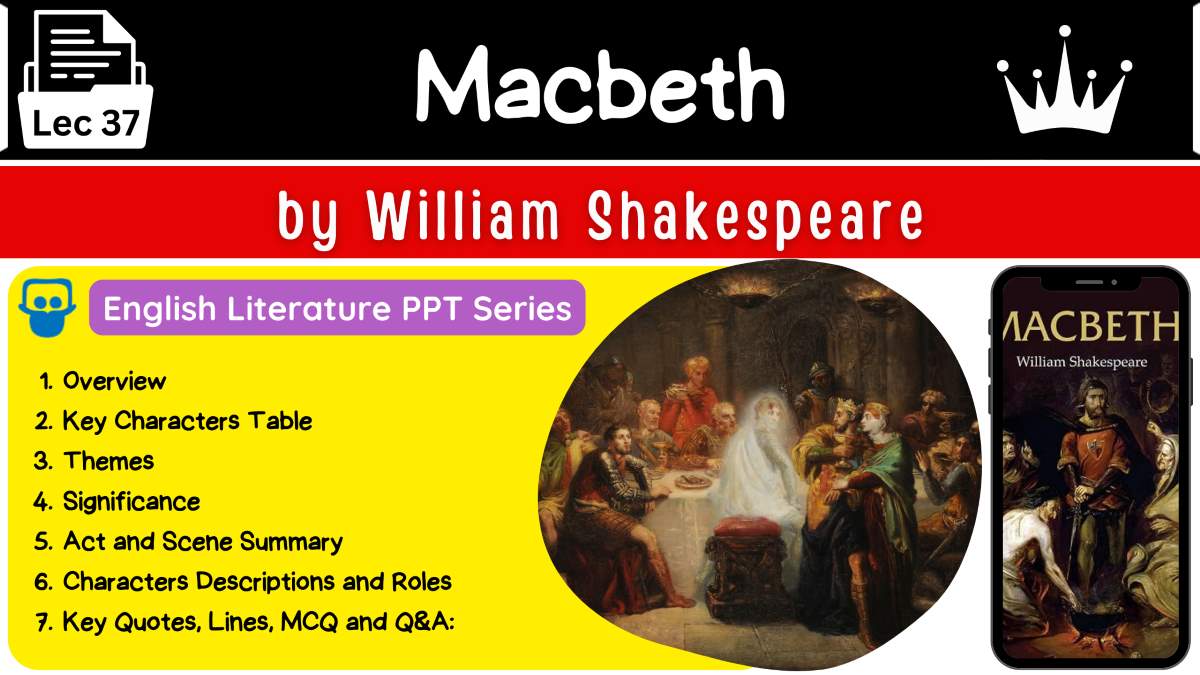
Today we have shared the Notes of Macbeth by William Shakespeare PPT Download (.pptx) or Macbeth PPT Slides & PDF Study Material Download. As we know, Macbeth is one of the most powerful tragedies written by William Shakespeare, believed to have been composed around 1606. This intense and gripping drama explores the dark consequences of unchecked ambition, guilt, and the desire for power. Set in medieval Scotland, the play follows Macbeth, a brave warrior whose encounter with mysterious witches awakens a dangerous ambition that ultimately leads to betrayal, tyranny, and tragedy. Through dramatic tension, unforgettable characters, and powerful symbolism, the play examines themes of fate, free will, moral corruption, and psychological conflict. Whether performed on stage or studied in classrooms, Macbeth continues to captivate audiences with its timeless warning about ambition and its profound insight into the human conscience.
Macbeth by William Shakespeare PPT Download (.pptx) | Lec 37
Macbeth
Here’s a complete table for “Macbeth”:
| Aspect | Description |
|---|---|
| Title | Macbeth |
| Playwright | William Shakespeare |
| Genre | Tragedy |
| Date of Composition | Estimated to be between 1603 and 1607 |
| Setting | Scotland |
| Main Characters | Macbeth, Lady Macbeth, Duncan, Banquo, Macduff, Malcolm, Three Witches, Lady Macduff, Hecate |
| Plot Overview | The play follows the ambitious Scottish general, Macbeth, who receives a prophecy from three witches that he will become king. Spurred on by his wife, Lady Macbeth, Macbeth murders King Duncan and ascends to the throne. However, plagued by guilt and paranoia, Macbeth descends into tyranny and madness, leading to his downfall and death. |
| Key Themes | Ambition and power, fate and free will, guilt and conscience, the supernatural |
| Significance | “Macbeth” is one of Shakespeare’s most famous and enduring tragedies, known for its exploration of the corrupting influence of unchecked ambition and the psychological toll of guilt. It is often regarded as a cautionary tale about the dangers of pursuing power at any cost. |
| Notable Lines | – “Out, damned spot! Out, I say!” (Act 5, Scene 1) – “Is this a dagger which I see before me, / The handle toward my hand?” (Act 2, Scene 1) – “Fair is foul, and foul is fair.” (Act 1, Scene 1) |
| Adaptations | “Macbeth” has been adapted into various stage productions, film adaptations, and television adaptations. Notable adaptations include the film directed by Roman Polanski (1971), stage productions by the Royal Shakespeare Company, and modern reinterpretations by various theater companies. |
This table provides a comprehensive overview of various aspects of “Macbeth,” including its background, plot, characters, themes, significance, notable lines, and adaptations.
A Complete Guide: Macbeth
Shakespeare’s “Macbeth” is one of his most renowned tragedies, renowned for its compelling characters, intricate plot, and exploration of themes such as ambition, power, and the corrupting influence of unchecked ambition. Set in medieval Scotland, the play follows the titular character, Macbeth, a valiant soldier whose encounter with three witches propels him on a path of ruthless ambition and bloody tyranny.
Plot Overview:
“Macbeth” begins with Macbeth and Banquo, two generals in the service of King Duncan, encountering three witches who prophesy Macbeth’s rise to power as the future king of Scotland. Encouraged by the witches’ predictions and his ambitious wife, Lady Macbeth, Macbeth murders King Duncan and ascends to the throne. However, his reign is marred by guilt, paranoia, and a series of murders to secure his hold on power. As Macbeth becomes increasingly tyrannical, he spirals into madness and faces a rebellion led by Duncan’s son, Malcolm, and the Scottish nobles. Ultimately, Macbeth meets his tragic demise in a final battle against Macduff, a nobleman seeking vengeance for his family’s murder.
Key Characters:
- Macbeth: The protagonist of the play, Macbeth is a brave and ambitious warrior whose ambition leads him to commit regicide and descend into madness.
- Lady Macbeth: Macbeth’s ambitious wife, who goads him into committing murder to fulfill their ambitions for power.
- Banquo: A loyal friend of Macbeth who also encounters the witches and whose descendants are prophesied to inherit the throne.
- King Duncan: The benevolent and virtuous king of Scotland whose murder sets off the chain of events in the play.
- Macduff: A Scottish nobleman who leads the rebellion against Macbeth after his family is brutally murdered.
- The Three Witches: Supernatural beings who prophesy Macbeth’s rise to power and manipulate events in the play.
Themes:
- Ambition: The driving force behind Macbeth’s actions, ambition is depicted as a destructive force that leads to moral corruption and downfall.
- Guilt: Macbeth and Lady Macbeth are consumed by guilt after committing murder, illustrating the psychological toll of their actions.
- Power: “Macbeth” explores the nature of power and its corrupting influence, as Macbeth becomes increasingly tyrannical in his pursuit of power.
- Fate vs. Free Will: The play raises questions about whether Macbeth’s actions are predestined by fate or the result of his own choices.
- Appearance vs. Reality: Characters in “Macbeth” often conceal their true intentions and manipulate others through deception and illusion.
Significance:
“Macbeth” remains one of Shakespeare’s most enduring works, celebrated for its exploration of timeless themes and its complex portrayal of human nature. The play continues to be performed and studied worldwide, captivating audiences with its gripping plot, memorable characters, and evocative language.
Adaptations:
“Macbeth” has been adapted into various forms, including stage productions, films, operas, and novels. Notable adaptations include Roman Polanski’s 1971 film adaptation, the 2015 film “Macbeth” starring Michael Fassbender and Marion Cotillard, and numerous stage productions featuring acclaimed actors in the title role.
In conclusion, “Macbeth” stands as a masterful exploration of ambition, power, and the consequences of unchecked ambition. With its compelling characters, evocative language, and timeless themes, “Macbeth” continues to captivate audiences and inspire generations of readers, scholars, and artists.
Plot Overview
here’s a complete table summarizing the plot overview of Shakespeare’s “Macbeth”:
| Act | Scene | Summary |
|---|---|---|
| Act 1 | Scene 1 | Three witches meet on a desolate heath and plan to meet Macbeth, a Scottish general, upon the heath after the battle. |
| Scene 2 | King Duncan receives news of Macbeth and Banquo’s bravery in battle against rebels and orders the execution of the Thane of Cawdor. | |
| Scene 3 | The witches encounter Macbeth and Banquo and deliver prophecies. They hail Macbeth as Thane of Glamis, Thane of Cawdor, and future king, and predict that Banquo’s descendants will inherit the throne. | |
| Act 2 | Scene 1 | Macbeth debates whether to murder King Duncan to fulfill the witches’ prophecy. |
| Scene 2 | Macbeth murders King Duncan while Lady Macbeth waits nearby, then frames Duncan’s guards for the crime. | |
| Act 3 | Scene 1 | Macbeth is crowned king, but his reign is threatened by the prophecy that Banquo’s descendants will inherit the throne. Macbeth orders Banquo’s murder to prevent this. |
| Scene 2 | Macbeth hosts a banquet and sees Banquo’s ghost, causing him to unravel mentally. | |
| Act 4 | Scene 1 | Macbeth seeks out the witches to learn more about his fate. They conjure apparitions that offer ambiguous prophecies, including warnings about Macduff. |
| Scene 2 | Macbeth orders the murder of Macduff’s family. | |
| Act 5 | Scene 1 | Lady Macbeth suffers from guilt and hallucinations, while Scottish nobles, led by Malcolm and Macduff, gather to overthrow Macbeth. |
| Scene 2 | Macbeth is informed of his wife’s death and reflects on the futility of life. | |
| Scene 3 | The army of Scottish nobles advances on Macbeth’s castle. | |
| Scene 4 | Macbeth learns of Birnam Wood’s apparent movement towards his castle, fulfilling one of the witches’ prophecies. | |
| Scene 5 | Macbeth fights Macduff, who reveals that he was born by Caesarean section and is not “of woman born.” | |
| Scene 6 | Macduff kills Macbeth, fulfilling the witches’ final prophecy. | |
| Scene 7 | Malcolm is declared king, and order is restored to Scotland. |
This table provides a comprehensive summary of the plot of Shakespeare’s “Macbeth,” detailing the major events and developments in each act and scene.
Key Characters
Below is a comprehensive table outlining the key characters in Shakespeare’s “Macbeth”:
| Character | Description |
|---|---|
| Macbeth | The protagonist of the play, Macbeth is a Scottish general who is consumed by ambition after encountering three witches who prophesy that he will become king. He murders King Duncan to seize the throne and descends into tyranny and madness. |
| Lady Macbeth | Macbeth’s ambitious and ruthless wife, Lady Macbeth goads her husband into committing regicide to fulfill their ambitions for power. She becomes consumed by guilt and descends into madness, ultimately dying by suicide. |
| Banquo | A Scottish general and Macbeth’s friend, Banquo also encounters the witches and receives prophecies about his descendants inheriting the throne. He serves as a foil to Macbeth, representing moral integrity and the consequences of ambition. |
| King Duncan | The virtuous and benevolent king of Scotland, King Duncan is murdered by Macbeth in his quest for power. His death sets off a chain of events that leads to chaos and civil war in Scotland. |
| Macduff | A Scottish nobleman who suspects Macbeth’s treachery and leads the rebellion against him. Macduff is driven by a desire for vengeance after Macbeth murders his wife and children. He ultimately kills Macbeth in the final battle. |
| Malcolm | The son of King Duncan, Malcolm flees Scotland after his father’s murder but returns to lead the rebellion against Macbeth. He is proclaimed king of Scotland after Macbeth’s death, restoring order and justice to the kingdom. |
| The Three Witches | Supernatural beings who prophesy Macbeth’s rise to power and manipulate events in the play. They represent the forces of fate and the supernatural, tempting Macbeth with visions of glory and driving him towards his tragic fate. |
| Macbeth’s servants | Characters who serve Macbeth in various capacities, including executing his orders and carrying out his bidding. They are often implicated in Macbeth’s crimes, reflecting the corrupting influence of power and the consequences of blind loyalty. |
This table provides an overview of the key characters in “Macbeth,” highlighting their roles and significance in the play’s narrative and themes.
Themes
Below is a comprehensive table outlining the key themes explored in Shakespeare’s “Macbeth”:
| Theme | Description |
|---|---|
| Ambition | Ambition is a central theme in “Macbeth,” as the play explores how unchecked ambition can lead to moral corruption, tyranny, and downfall. Macbeth’s ambition for power drives him to commit regicide and descend into madness and tyranny. |
| Guilt | Guilt plays a significant role in the play, particularly for Macbeth and Lady Macbeth, who are consumed by guilt after committing murder. Their guilt leads to paranoia, hallucinations, and ultimately, their downfall as they are unable to escape their conscience. |
| Fate vs. Free Will | The play raises questions about the extent to which fate determines human actions and the role of free will in shaping one’s destiny. While the witches’ prophecies influence Macbeth’s choices, he ultimately has the agency to act upon them or resist them. |
| Appearance vs. Reality | “Macbeth” explores the theme of appearance vs. reality, as characters often conceal their true intentions and manipulate others through deception and illusion. This theme highlights the ambiguity of truth and the dangers of trusting superficial appearances. |
| Tyranny vs. Order | The play examines the consequences of tyranny and the importance of maintaining order and justice in society. Macbeth’s tyrannical rule leads to chaos and civil war in Scotland, while Malcolm’s ascension restores order and stability to the kingdom. |
| Supernatural | The supernatural plays a significant role in “Macbeth,” as the witches’ prophecies and supernatural elements drive the plot and influence the characters’ actions. The presence of the supernatural underscores the play’s themes of fate, ambition, and moral corruption. |
| Masculinity and Violence | “Macbeth” portrays masculinity as synonymous with violence and ambition, as characters like Macbeth and Lady Macbeth equate strength with the willingness to commit murder and achieve power at any cost. This theme explores the toxic nature of hypermasculinity and its consequences. |
This table provides an overview of the key themes in “Macbeth,” highlighting the play’s exploration of ambition, guilt, fate vs. free will, appearance vs. reality, tyranny vs. order, the supernatural, and masculinity and violence.
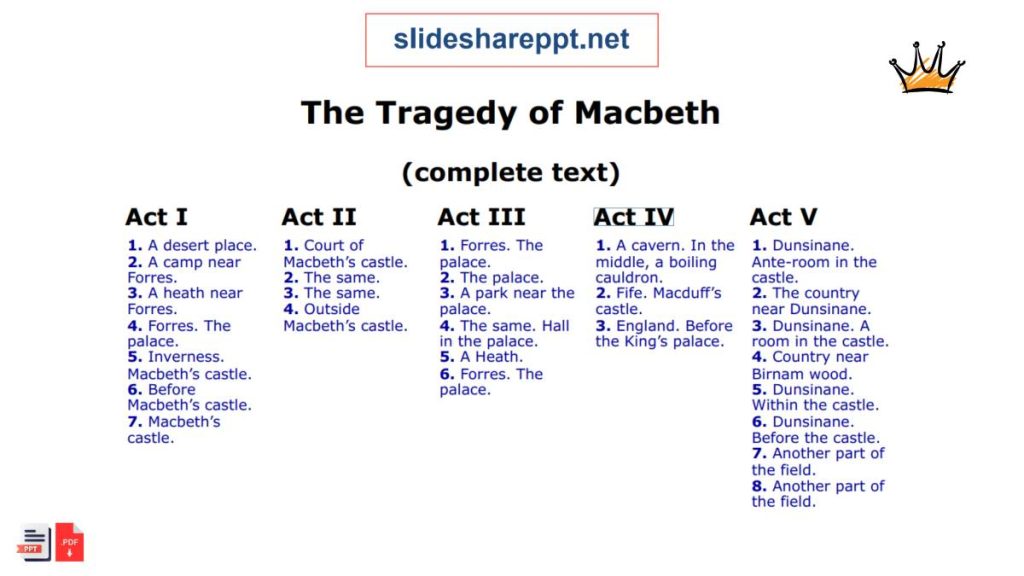
Note: The complete Text PDF Link is at the end of the PowerPoint slides (go to the last PPT Slide)
Significance
Below is a complete table highlighting the significance of Shakespeare’s “Macbeth”:
| Aspect | Significance |
|---|---|
| Literary | “Macbeth” is considered one of Shakespeare’s greatest tragedies, renowned for its compelling characters, intricate plot, and exploration of timeless themes such as ambition, guilt, and the corrupting influence of power. The play’s poetic language, vivid imagery, and psychological depth continue to captivate readers and audiences worldwide, making it a cornerstone of English literature and a staple of Shakespearean studies. |
| Cultural | “Macbeth” has had a significant cultural impact, influencing literature, theater, and popular culture for centuries. The play’s themes of ambition, guilt, and the pursuit of power resonate with audiences across cultures and time periods, making it a timeless classic that continues to be adapted and reinterpreted in various forms, including stage productions, films, novels, and television series. “Macbeth” has also left a lasting mark on the English language, with phrases such as “fair is foul and foul is fair” and “something wicked this way comes” becoming iconic expressions widely recognized beyond the context of the play. |
| Psychological | The character of Macbeth offers a compelling study of the human psyche, illustrating how unchecked ambition and guilt can lead to moral corruption and psychological turmoil. Macbeth’s descent into madness and paranoia, as well as Lady Macbeth’s haunting guilt and eventual madness, provide insights into the complexities of human nature and the consequences of succumbing to inner demons. “Macbeth” continues to be analyzed through psychological lenses, offering valuable insights into themes of identity, morality, and mental health. |
| Theatrical | “Macbeth” is celebrated for its dramatic intensity and theatrical spectacle, featuring vivid scenes of murder, madness, and supernatural elements. The play’s atmospheric settings, including eerie landscapes and haunted castles, provide rich material for directors, designers, and actors to explore and interpret. From traditional stage productions to experimental adaptations, “Macbeth” offers endless possibilities for creative expression and artistic innovation, captivating audiences with its gripping plot, memorable characters, and evocative language. |
| Philosophical | “Macbeth” raises profound philosophical questions about the nature of power, morality, and the human condition. The play prompts audiences to reflect on issues such as fate vs. free will, the consequences of ambition, and the fragility of conscience. Through its exploration of themes such as appearance vs. reality and the existence of the supernatural, “Macbeth” invites viewers to ponder the ambiguity of truth and the complexities of the moral universe. As a result, the play continues to spark philosophical inquiry and debate, offering fertile ground for exploring timeless questions about ethics, justice, and the pursuit of power. |
This table provides an overview of the significance of “Macbeth” across literary, cultural, psychological, theatrical, and philosophical dimensions, highlighting its enduring impact and relevance in the world of literature and beyond.
Also read: Antony and Cleopatra by William Shakespeare PPT (.pptx)
Summary
Below is a comprehensive table summarizing each act and scene in Shakespeare’s “Macbeth”:
| Act | Scene | Summary |
|---|---|---|
| Act 1 | Scene 1 | Three witches meet on a desolate heath and plan to meet Macbeth, a Scottish general, upon the heath after the battle. |
| Scene 2 | King Duncan receives news of Macbeth and Banquo’s bravery in battle against rebels and orders the execution of the Thane of Cawdor. | |
| Scene 3 | The witches encounter Macbeth and Banquo and deliver prophecies. They hail Macbeth as Thane of Glamis, Thane of Cawdor, and future king, and predict that Banquo’s descendants will inherit the throne. | |
| Act 2 | Scene 1 | Macbeth debates whether to murder King Duncan to fulfill the witches’ prophecy. |
| Scene 2 | Macbeth murders King Duncan while Lady Macbeth waits nearby, then frames Duncan’s guards for the crime. | |
| Act 3 | Scene 1 | Macbeth is crowned king, but his reign is threatened by the prophecy that Banquo’s descendants will inherit the throne. Macbeth orders Banquo’s murder to prevent this. |
| Scene 2 | Macbeth hosts a banquet and sees Banquo’s ghost, causing him to unravel mentally. | |
| Act 4 | Scene 1 | Macbeth seeks out the witches to learn more about his fate. They conjure apparitions that offer ambiguous prophecies, including warnings about Macduff. |
| Scene 2 | Macbeth orders the murder of Macduff’s family. | |
| Act 5 | Scene 1 | Lady Macbeth suffers from guilt and hallucinations, while Scottish nobles, led by Malcolm and Macduff, gather to overthrow Macbeth. |
| Scene 2 | Macbeth is informed of his wife’s death and reflects on the futility of life. | |
| Scene 3 | The army of Scottish nobles advances on Macbeth’s castle. | |
| Scene 4 | Macbeth learns of Birnam Wood’s apparent movement towards his castle, fulfilling one of the witches’ prophecies. | |
| Scene 5 | Macbeth fights Macduff, who reveals that he was born by Caesarean section and is not “of woman born.” | |
| Scene 6 | Macduff kills Macbeth, fulfilling the witches’ final prophecy. | |
| Scene 7 | Malcolm is declared king, and order is restored to Scotland. |
This table provides a comprehensive summary of each act and scene in Shakespeare’s “Macbeth,” detailing the major events and developments throughout the play.
Characters Descriptions and Roles
Below is a comprehensive table providing descriptions and roles of the key characters in Shakespeare’s “Macbeth”:
| Character | Description | Role |
|---|---|---|
| Macbeth | A Scottish general and protagonist of the play, Macbeth is initially portrayed as a valiant warrior loyal to King Duncan. However, after encountering three witches who prophesy his rise to power, Macbeth’s ambition leads him to commit regicide and seize the throne. He becomes increasingly ruthless and paranoid, descending into madness as he struggles to maintain his grip on power. Ultimately, Macbeth’s unchecked ambition leads to his downfall and death. | Protagonist; his ambition, moral corruption, and descent into tyranny drive the plot of the play. |
| Lady Macbeth | Macbeth’s ambitious and manipulative wife, Lady Macbeth is instrumental in goading her husband into committing regicide to fulfill their ambitions for power. She is initially portrayed as ruthless and determined, willing to sacrifice her morality for political gain. However, Lady Macbeth’s guilt and remorse over the murders drive her to madness and ultimately lead to her suicide. Lady Macbeth serves as a catalyst for Macbeth’s actions and is a key figure in the play’s exploration of ambition and guilt. | Antagonist; her ambition, manipulation, and descent into madness contribute to the tragic events of the play. |
| Banquo | A Scottish general and loyal friend of Macbeth, Banquo encounters the witches alongside Macbeth and receives prophecies regarding his descendants. Unlike Macbeth, Banquo remains morally upright and skeptical of the witches’ predictions. He serves as a foil to Macbeth, highlighting the consequences of unchecked ambition and the corrupting influence of power. Banquo’s ghost haunts Macbeth, symbolizing Macbeth’s guilt and the inevitability of divine retribution. | Foil to Macbeth; represents moral integrity and serves as a reminder of the consequences of ambition. |
| King Duncan | The benevolent and virtuous king of Scotland, Duncan is murdered by Macbeth in his quest for power. Duncan’s death sets off a chain of events that leads to chaos and civil war in Scotland. Duncan’s murder serves as the catalyst for Macbeth’s descent into tyranny and madness, and his character symbolizes the disruption of order and the consequences of regicide. | Symbolizes order and virtue; his murder triggers the central conflict of the play. |
| Macduff | A Scottish nobleman who suspects Macbeth’s treachery and leads the rebellion against him, Macduff is driven by a desire for vengeance after Macbeth murders his wife and children. Macduff embodies loyalty to Scotland and serves as a symbol of resistance against tyranny. He ultimately kills Macbeth in the final battle, fulfilling the witches’ prophecy and restoring order to Scotland. Macduff represents justice and the triumph of good over evil in the play. | Represents justice and the forces of resistance against tyranny; his vengeance drives the climax of the play. |
| Malcolm | The son of King Duncan, Malcolm flees Scotland after his father’s murder but returns to lead the rebellion against Macbeth. Malcolm is proclaimed king of Scotland after Macbeth’s death, restoring order and stability to the kingdom. He represents the legitimate heir to the throne and symbolizes the restoration of rightful rule. Malcolm’s ascension signifies the end of tyranny and the return to lawful governance in Scotland. | Symbolizes the restoration of order and legitimacy to Scotland; his ascension brings an end to Macbeth’s tyrannical rule. |
| The Three Witches | Supernatural beings who prophesy Macbeth’s rise to power and manipulate events in the play, the witches serve as instigators of Macbeth’s ambition and moral corruption. Their prophecies drive the plot and influence the characters’ actions, highlighting the theme of fate vs. free will. The witches symbolize the forces of fate and the supernatural, tempting Macbeth with visions of glory and manipulating events to fulfill their own mysterious agenda. | Catalysts for the plot; symbolize the corrupting influence of ambition and the supernatural. |
| Macbeth’s servants | Characters who serve Macbeth in various capacities, including executing his orders and carrying out his bidding. They are often implicated in Macbeth’s crimes, reflecting the corrupting influence of power and the consequences of blind loyalty. Macbeth’s servants are complicit in the murders of Duncan and Banquo, demonstrating the pervasiveness of moral corruption in Macbeth’s reign. | Reflect the theme of moral corruption and blind obedience; complicit in Macbeth’s crimes. |
This table provides an overview of the key characters in “Macbeth,” outlining their descriptions, roles, and significance within the play’s narrative and themes.
Summary
“Macbeth,” one of William Shakespeare’s most renowned tragedies, unfolds amidst a backdrop of ambition, treachery, and supernatural forces. Set in medieval Scotland, the play centers around the titular character, Macbeth, a valiant warrior whose encounter with three witches propels him on a path of ruthless ambition and bloody tyranny.
At the outset, Macbeth, along with his comrade Banquo, encounters three witches who prophesy his ascension to the throne. Encouraged by their predictions and spurred on by his ambitious wife, Lady Macbeth, Macbeth murders King Duncan and seizes the throne for himself. However, his reign is fraught with guilt, paranoia, and further bloodshed as he eliminates threats to his power, including Banquo and the family of nobleman Macduff.
As Macbeth descends into madness and tyranny, Scotland plunges into chaos and rebellion. Macduff leads a revolt against Macbeth, rallying support from Scottish nobles and Malcolm, the rightful heir to the throne. Lady Macbeth, tormented by guilt and visions, descends into madness and eventually dies by suicide.
In the climactic final battle, Macbeth confronts Macduff, who reveals he was “from his mother’s womb untimely ripped” and therefore not technically born of woman. Macduff kills Macbeth, fulfilling the witches’ final prophecy and restoring order to Scotland. Malcolm is proclaimed king, ushering in a new era of peace and stability.
“Macbeth” delves deep into themes of ambition, guilt, fate, and the corrupting influence of power. It explores the consequences of unchecked ambition and the moral decay that accompanies the pursuit of power at any cost. Through its compelling characters and dramatic narrative, “Macbeth” remains a timeless exploration of the human condition and the destructive forces that lurk within us all.
Facts
Below is a table outlining various facts about William Shakespeare’s “Macbeth”:
| Fact | Description |
|---|---|
| Author | “Macbeth” was written by William Shakespeare, believed to have been composed between 1603 and 1607. It is one of Shakespeare’s shortest and most intense tragedies. |
| Genre | The play is classified as a tragedy, featuring themes of ambition, power, guilt, and the consequences of unchecked ambition. |
| Sources | Shakespeare’s primary source for “Macbeth” was Raphael Holinshed’s “Chronicles of England, Scotland, and Ireland,” which provided historical accounts of Scottish kings and events. Shakespeare also drew upon other literary sources and traditions, including medieval morality plays and folk legends. |
| Setting | “Macbeth” is set in medieval Scotland, amidst a tumultuous political landscape characterized by warfare, betrayal, and supernatural forces. |
| Characters | The play features a diverse cast of characters, including the ambitious and morally conflicted Macbeth, his manipulative wife Lady Macbeth, the loyal yet suspicious Banquo, the virtuous King Duncan, and the vengeful nobleman Macduff, among others. |
| Language and Style | Shakespeare’s language in “Macbeth” is characterized by its rich imagery, powerful soliloquies, and vivid depiction of human emotions. The play features some of Shakespeare’s most memorable speeches and metaphors, contributing to its enduring popularity and critical acclaim. |
| Reception | “Macbeth” has been widely acclaimed for its gripping plot, complex characters, and exploration of universal themes. Despite initial mixed reviews, it has since become one of Shakespeare’s most performed and studied plays, captivating audiences and scholars alike for centuries. |
| Adaptations | “Macbeth” has been adapted into various forms, including stage productions, films, operas, and novels. Notable adaptations include Roman Polanski’s 1971 film adaptation and Justin Kurzel’s 2015 film starring Michael Fassbender and Marion Cotillard. |
| Cultural Impact | The play’s themes and characters continue to resonate with audiences worldwide, making “Macbeth” a timeless classic that remains relevant in discussions of ambition, power, and the human condition. Its influence can be seen across literature, theater, and popular culture. |
This table provides an overview of key facts and aspects related to William Shakespeare’s “Macbeth,” including its authorship, genre, sources, reception, and cultural impact.
Key Quotes and Lines
Below is a table featuring key quotes and lines from William Shakespeare’s “Macbeth”:
| Quote | Speaker | Context |
|---|---|---|
| “Out, damned spot! Out, I say!” | Lady Macbeth | Lady Macbeth is sleepwalking and obsessively trying to wash imaginary bloodstains from her hands, symbolizing her guilt and descent into madness. |
| “Is this a dagger which I see before me, / The handle toward my hand?” | Macbeth | Macbeth is alone, contemplating whether the dagger he sees is real or a figment of his imagination, as he prepares to murder King Duncan. |
| “All the perfumes of Arabia will not sweeten this little hand.” | Lady Macbeth | Lady Macbeth reflects on her inability to wash away the guilt of King Duncan’s murder, realizing that no amount of perfumes or cleansing will rid her of her conscience. |
| “Fair is foul, and foul is fair.” | Witches | The witches chant this line at the beginning of the play, foreshadowing the inversion of moral values and the deceptive nature of appearances throughout the play. |
| “Double, double toil and trouble; / Fire burn and caldron bubble.” | Witches | The witches chant this incantation while concocting a potion in Act 4, Scene 1, using rhyming couplets and repetition to create an eerie and mystical atmosphere. |
| “Out, out, brief candle! Life’s but a walking shadow.” | Macbeth | Macbeth reflects on the fleeting nature of life and the insignificance of human existence, likening it to a “brief candle” that is extinguished with a gust of wind. |
| “By the pricking of my thumbs, / Something wicked this way comes.” | Second Witch | The Second Witch senses Macbeth’s approach before his arrival, foreshadowing the impending evil and chaos that he will bring to Scotland. |
| “What’s done is done.” | Lady Macbeth | Lady Macbeth reassures Macbeth after Duncan’s murder, urging him to focus on the present rather than dwell on the past. |
| “Fair is foul, and foul is fair: / Hover through the fog and filthy air.” | Witches | The witches repeat this line in Act 1, Scene 1, setting the tone for the play by suggesting that appearances can be deceiving and that moral values are inverted. |
| “Tomorrow, and tomorrow, and tomorrow, / Creeps in this petty pace from day to day.” | Macbeth | Macbeth delivers this soliloquy upon hearing of Lady Macbeth’s death, reflecting on the futility of life and the inevitability of his own demise. |
These quotes capture some of the most memorable lines from “Macbeth,” highlighting the play’s themes of ambition, guilt, fate, and the corrupting influence of power.
Q&A:
Q: What is the central theme of “Macbeth”?
A: The central theme of “Macbeth” is the corrupting influence of unchecked ambition. The play explores how Macbeth’s ambition for power leads him to commit regicide and descend into tyranny, ultimately resulting in his tragic downfall.
Q: How does Lady Macbeth contribute to Macbeth’s downfall?
A: Lady Macbeth plays a significant role in Macbeth’s downfall by goading him into committing regicide and manipulating him to fulfill their ambitions for power. However, her guilt and descent into madness also contribute to their downfall as she becomes consumed by remorse.
Q: What role do the witches play in the play?
A: The witches serve as catalysts for the plot by prophesying Macbeth’s rise to power and manipulating events to fulfill their own mysterious agenda. They symbolize the corrupting influence of ambition and the supernatural forces at work in the world of the play.
Q: How does Macbeth’s character change throughout the play?
A: At the beginning of the play, Macbeth is portrayed as a valiant warrior loyal to King Duncan. However, his encounter with the witches and his ambition for power lead him to commit regicide and descend into madness and tyranny. He becomes increasingly ruthless and paranoid, ultimately meeting a tragic end.
Q: What is the significance of the imagery in “Macbeth”?
A: The imagery in “Macbeth” serves to enhance the play’s themes and atmosphere. Dark and supernatural imagery, such as blood, darkness, and the supernatural, underscores the moral corruption and chaos unleashed by Macbeth’s ambition.
Q: How does “Macbeth” explore the consequences of guilt?
A: “Macbeth” explores the psychological effects of guilt through the characters of Macbeth and Lady Macbeth. Both characters are haunted by their guilt over the murders they have committed, leading to hallucinations, paranoia, and ultimately, their downfall.
Q: What is the role of fate in “Macbeth”?
A: “Macbeth” raises questions about the extent to which fate determines human actions. While the witches’ prophecies influence Macbeth’s choices, he ultimately has the agency to act upon them or resist them. The play suggests that fate and free will are intertwined in shaping one’s destiny.
Q: How does “Macbeth” reflect the political climate of Shakespeare’s time?
A: “Macbeth” reflects the political instability and paranoia of Shakespeare’s time, particularly during the reign of King James I. The play explores themes of kingship, loyalty, and the consequences of political ambition, resonating with contemporary anxieties about power and authority.