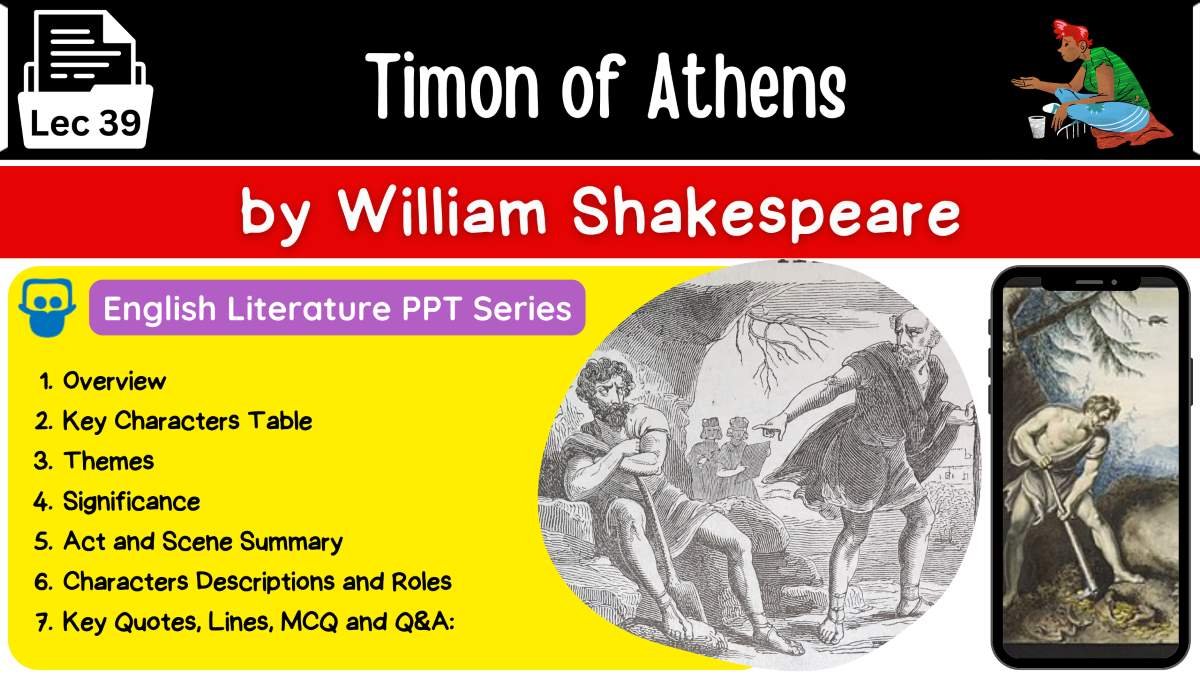
Today we have shared the PDF, PPT, Infographics and Notes of Timon of Athens by William Shakespeare or Timon of Athens PPT Slides & PDF Study Material Download. As we know, Timon of Athens is one of the lesser-performed tragedies written by William Shakespeare, believed to have been composed around 1605–1606. This intense and thought-provoking play presents a powerful exploration of wealth, friendship, betrayal, and human hypocrisy. Set in ancient Athens, the story follows Timon, a generous nobleman whose lavish spending and blind trust in others lead to financial ruin and emotional devastation. Abandoned by those he once supported, Timon’s transformation from a kind benefactor to a bitter recluse forms the emotional core of the drama. Through sharp dialogue and dramatic contrasts, the play examines themes of loyalty, greed, isolation, and the true nature of society. Whether performed on stage or studied in classrooms, Timon of Athens continues to engage audiences with its timeless reflection on trust, disillusionment, and the complexities of human relationships.
Timon of Athens by William Shakespeare PPT SLIDES (.pptx)
Timon of Athens
Here’s a complete table for “Timon of Athens”:
| Aspect | Description |
|---|---|
| Title | Timon of Athens |
| Playwright | William Shakespeare and possibly Thomas Middleton |
| Genre | Tragedy, problem play |
| Date of Composition | Estimated to be between 1605 and 1608 |
| Setting | Athens |
| Main Characters | Timon, Apemantus, Alcibiades, Flavius, Ventidius, Timon’s creditors, Senators, Poet, Painter, Jeweler |
| Plot Overview | The play centers around Timon, a wealthy Athenian noble who lavishes gifts on his friends but finds himself betrayed and abandoned when he faces financial ruin. Embittered and disillusioned, Timon retreats to the wilderness, where he discovers gold and curses humanity. Meanwhile, Athens faces political unrest, and Timon’s former associates seek his assistance. The play ends tragically with Timon’s death. |
| Key Themes | Friendship and betrayal, wealth and generosity, misanthropy, the corrupting influence of money |
| Significance | “Timon of Athens” is one of Shakespeare’s lesser-known plays, characterized by its cynical depiction of human nature and exploration of themes related to wealth and friendship. It is often regarded as one of his most enigmatic works. |
| Notable Lines | – “The middle of humanity thou never knewest, but the extremity of both ends.” (Act 3, Scene 6) – “Who lives that’s not depraved or depraves? / Who dies, that bears not one spurn to their graves / Of their friends’ gift?” (Act 5, Scene 1) – “I am sick of this false world, and will love naught / But even the mere necessities upon ‘t.” (Act 4, Scene 3) |
| Adaptations | “Timon of Athens” has been adapted into various stage productions, but it is not as frequently performed as some of Shakespeare’s other works. Notable adaptations include stage productions by the Royal Shakespeare Company and other theater companies. |
This table provides a comprehensive overview of various aspects of “Timon of Athens,” including its background, plot, characters, themes, significance, notable lines, and adaptations.
A Complete Guide to Shakespeare’s Timon of Athens
Introduction: William Shakespeare’s Timon of Athens is a lesser-known play in the Bard’s canon, yet it offers profound insights into human nature, wealth, and friendship. Despite its relative obscurity, this play remains a compelling exploration of themes that resonate with contemporary audiences. In this comprehensive guide, we delve into the plot, characters, themes, and historical context of Timon of Athens.
Plot Summary: Timon of Athens follows the tragic arc of Timon, a wealthy and generous nobleman in ancient Athens. At the play’s outset, Timon lavishly spends his fortune on his friends, hosting extravagant feasts and loaning money without hesitation. However, when his wealth dwindles, Timon finds himself abandoned by those he once considered friends. Betrayed and disillusioned, he retreats to the wilderness, where he discovers hidden treasures. Despite this newfound wealth, Timon becomes bitter and misanthropic, railing against humanity until his death.
Characters:
- Timon: The protagonist of the play, Timon embodies generosity and later, extreme misanthropy.
- Apemantus: A cynical philosopher who serves as a foil to Timon, criticizing his extravagant lifestyle and eventual misfortune.
- Alcibiades: A general and friend of Timon, who ultimately leads a rebellion against Athens.
- Flavius: Timon’s loyal steward, who remains devoted to him even in his darkest hour.
- Various senators, lords, and other characters who represent different facets of society and its relationship with wealth.
Themes:
- Wealth and Generosity: Timon’s excessive generosity at the beginning of the play highlights the power dynamics inherent in wealth. His downfall exposes the fickle nature of friendship and the corrupting influence of money.
- Friendship and Betrayal: The play explores the theme of friendship, portraying how relationships can be tested and ultimately shattered by greed and self-interest.
- Misanthropy: Timon’s transformation into a misanthrope reflects the disillusionment that can arise from betrayal and ingratitude.
- Social Commentary: Through its depiction of the Athenian elite and their disregard for the less fortunate, Timon of Athens offers a critique of social hierarchy and inequality.
- Redemption and Revenge: Characters like Alcibiades represent the possibility of redemption through righteous anger and rebellion against injustice.
Historical Context: Timon of Athens is believed to have been written in the early 17th century, possibly in collaboration with Thomas Middleton. The play’s themes of wealth, friendship, and betrayal resonate with the socio-economic climate of Shakespeare’s time, marked by rapid urbanization, economic disparity, and shifting social norms.
Conclusion: Despite its relative obscurity, Timon of Athens remains a compelling and relevant work in Shakespeare’s oeuvre. Its exploration of wealth, friendship, and the human condition continues to captivate audiences and provoke thought centuries after its initial composition. Through its timeless themes and complex characters, Timon of Athens invites readers and audiences to reflect on the nature of generosity, loyalty, and the corrupting influence of wealth.
Plot Overview
| Act | Scene | Summary |
|---|---|---|
| Act 1 | Scene 1 | Timon, a wealthy nobleman of Athens, generously hosts a lavish feast, showering his friends with gifts and loans. His steward, Flavius, warns him of his excessive spending, but Timon dismisses his concerns. |
| Scene 2 | Timon’s creditors demand repayment, revealing the extent of his financial troubles. Despite his previous generosity, Timon finds himself abandoned by his friends, who refuse to lend him money in his time of need. | |
| Act 2 | Scene 1 | Timon sends his servants to his fair-weather friends to request assistance, but they all reject him, some even sending back insulting messages. Only Apemantus, a cynical philosopher, visits Timon, criticizing his past extravagance and predicting his downfall. |
| Scene 2 | Timon’s creditors escalate their demands, leading to a confrontation with Flavius. Timon decides to sell off his lands and possessions to settle his debts, but even this proves insufficient to appease his creditors. | |
| Act 3 | Scene 1 | Timon retreats to the wilderness, cursing humanity and embracing a life of solitude. He discovers buried treasure, which he uses to fund his misanthropic lifestyle, inviting thieves and outcasts to join him in his newfound wealth. |
| Scene 2 | Meanwhile, in Athens, political unrest brews as Alcibiades, a general, is banished for seeking justice against a corrupt Athenian official. | |
| Act 4 | Scene 1 | Timon encounters Alcibiades and his followers in the wilderness, sympathizing with their plight and urging them to seek revenge against Athens. |
| Scene 2 | Flavius and other loyal servants search for Timon, hoping to persuade him to return to Athens. They find him in his cave, but Timon rejects their pleas and dies shortly after, cursing Athens until his last breath. | |
| Act 5 | Scene 1 | Alcibiades leads a siege against Athens, seeking justice for his banishment and the mistreatment of its citizens. |
| Scene 2 | The Athenian senators plead for mercy as Alcibiades demands justice, but he remains resolute in his pursuit of revenge. | |
| Scene 3 | Alcibiades spares some Athenians who aided him, but he condemns the city’s leaders to death for their corruption and cruelty. | |
| Scene 4 | With Athens in ruins and its leaders dead, Alcibiades assumes control, promising to govern with justice and compassion. | |
| Scene 5 | The play ends with Alcibiades reflecting on the consequences of unchecked power and corruption, hinting at the cyclical nature of history and the fragility of societal order. |
This table provides a comprehensive overview of the plot of Timon of Athens, summarizing each act and scene to give readers a clear understanding of the play’s progression.
Key Characters
| Character | Description |
|---|---|
| Timon | A wealthy nobleman of Athens known for his extreme generosity. Initially lavish in his spending and benevolent towards his friends, Timon faces betrayal and abandonment when his fortunes decline, leading to his transformation into a misanthrope. |
| Apemantus | A cynical philosopher who serves as a foil to Timon. He criticizes Timon’s lavish lifestyle and warns him of the consequences of his excessive generosity. Despite his misanthropic views, Apemantus remains a consistent presence in Timon’s life, offering commentary on the fickleness of human nature. |
| Flavius | Timon’s loyal steward, who remains devoted to him even in his darkest hour. Flavius serves as a voice of reason, cautioning Timon against his extravagant spending and attempting to manage his financial affairs. Despite Timon’s decline, Flavius remains steadfast in his loyalty and concern for his master. |
| Alcibiades | A general in the Athenian army and a friend of Timon. Alcibiades becomes embroiled in political conflict after being unjustly banished from Athens. He later leads a rebellion against the city, seeking justice for himself and the mistreated citizens, ultimately assuming control after the downfall of its leaders. |
| Various Senators, Lords, and Servants | These characters represent different facets of Athenian society and its relationship with wealth and power. Some exploit Timon’s generosity for personal gain, while others remain loyal or express sympathy towards his plight. They contribute to the play’s exploration of social hierarchy and corruption. |
This table provides a concise overview of the key characters in Timon of Athens, highlighting their roles and significance within the play’s narrative and themes.
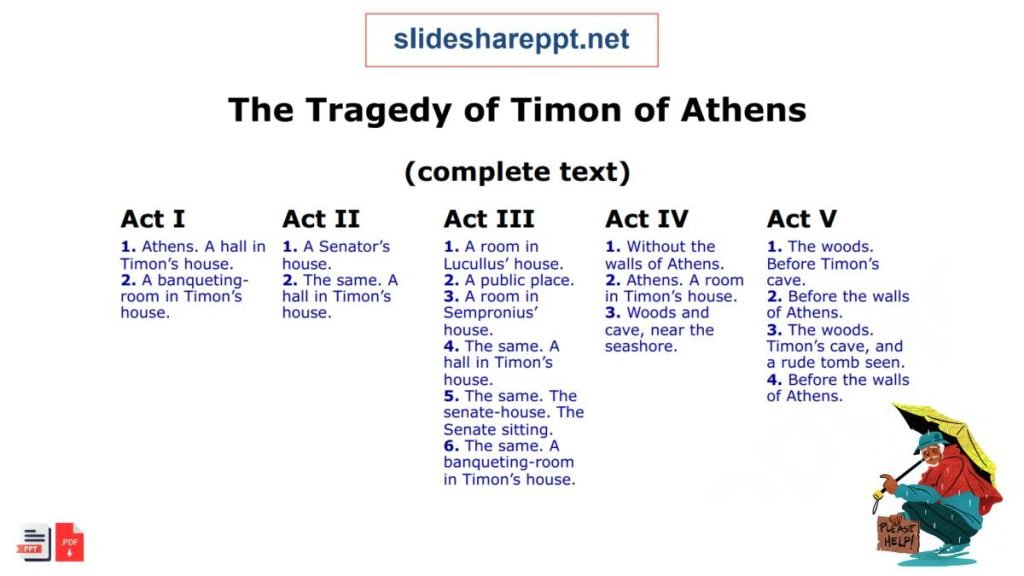
Note: The complete Text PDF Link is at the end of the PowerPoint slides (go to the last PPT Slide)
Themes
| Theme | Description |
|---|---|
| Wealth and Generosity | Timon’s excessive generosity at the beginning of the play highlights the power dynamics inherent in wealth. His downfall exposes the fickle nature of friendship and the corrupting influence of money. The play explores how wealth can shape relationships and lead to both loyalty and betrayal. |
| Friendship and Betrayal | Timon’s relationships with his friends undergo a dramatic transformation throughout the play. Initially surrounded by loyal companions, Timon experiences betrayal and abandonment when his fortunes decline. The theme of friendship explores the complexities of human relationships, trust, and the consequences of betrayal. |
| Misanthropy | Timon’s transformation into a misanthrope reflects the disillusionment that can arise from betrayal and ingratitude. His retreat into the wilderness and rejection of society symbolize a rejection of humanity itself, highlighting the dark consequences of unchecked greed and the breakdown of social bonds. |
| Social Commentary | Through its depiction of the Athenian elite and their disregard for the less fortunate, Timon of Athens offers a critique of social hierarchy and inequality. The play explores the consequences of societal greed and corruption, shedding light on the disparities between the wealthy elite and the marginalized members of society. |
| Redemption and Revenge | Characters like Alcibiades represent the possibility of redemption through righteous anger and rebellion against injustice. The theme of revenge underscores the consequences of oppression and mistreatment, as well as the potential for individuals to seek justice and bring about societal change. |
This table provides an overview of the central themes explored in Timon of Athens, highlighting the play’s examination of wealth, friendship, misanthropy, social commentary, and redemption.
Also read: The Tragedy of King Lear by William Shakespeare (.pptx)
Significance
| Aspect | Significance |
|---|---|
| Literary | Despite being considered one of Shakespeare’s lesser-known works, Timon of Athens offers a unique exploration of themes such as wealth, friendship, and betrayal. Its portrayal of Timon’s descent into misanthropy and eventual demise provides rich material for literary analysis and interpretation. |
| Social | The play’s critique of social hierarchy, corruption, and the consequences of unchecked greed remains relevant in contemporary society. It prompts audiences to reflect on issues of wealth disparity, the fragility of human relationships, and the moral implications of societal injustice. |
| Philosophical | Timon’s transformation into a misanthrope raises philosophical questions about the nature of humanity, morality, and the pursuit of wealth. The play invites contemplation on the ethics of generosity, the limits of friendship, and the consequences of extreme cynicism. |
| Historical | Timon of Athens provides insight into the socio-economic conditions and cultural values of Shakespeare’s time, reflecting concerns about wealth accumulation, social status, and the corrupting influence of power. Its portrayal of political turmoil and moral decay resonates with historical contexts beyond the Elizabethan era. |
| Theatrical | While not as frequently performed as some of Shakespeare’s more popular plays, Timon of Athens offers compelling roles for actors and directors. Its mix of tragedy, satire, and philosophical inquiry presents creative opportunities for reinterpretation and adaptation on the stage. |
This table outlines the significance of Timon of Athens across literary, social, philosophical, historical, and theatrical dimensions, highlighting its enduring relevance and cultural impact.
Act and Scene Summary
| Act | Scene | Summary |
|---|---|---|
| Act 1 | Scene 1 | Timon hosts a lavish feast, displaying his excessive generosity by showering his friends with gifts and loans. Despite warnings from his steward, Flavius, about his unsustainable spending, Timon remains indifferent to his financial situation. |
| Scene 2 | Timon’s creditors demand repayment, revealing the extent of his financial troubles. When Timon seeks help from his friends, they refuse to lend him money, exposing their selfishness and ingratitude. This betrayal prompts Timon to reevaluate his relationships and his perception of wealth and friendship. | |
| Act 2 | Scene 1 | Timon sends his servants to request assistance from his fair-weather friends, but they all reject him, some even sending back insulting messages. Only Apemantus, a cynical philosopher, visits Timon, criticizing his past extravagance and predicting his downfall. |
| Scene 2 | Timon confronts his creditors, attempting to negotiate his debts, but to no avail. He decides to sell off his lands and possessions to settle his debts, but even this proves insufficient to appease his creditors. Timon’s financial ruin pushes him towards a solitary existence as he retreats to the wilderness. | |
| Act 3 | Scene 1 | Timon, now living in the wilderness, curses humanity and embraces a life of misanthropy. He discovers buried treasure, which he uses to fund his new lifestyle, inviting thieves and outcasts to join him. |
| Scene 2 | In Athens, political unrest brews as Alcibiades, a general, is banished for seeking justice against a corrupt Athenian official. | |
| Act 4 | Scene 1 | Timon encounters Alcibiades and his followers in the wilderness, sympathizing with their plight and urging them to seek revenge against Athens. |
| Scene 2 | Flavius and other loyal servants search for Timon, hoping to persuade him to return to Athens. They find him in his cave, but Timon rejects their pleas and dies shortly after, cursing Athens until his last breath. | |
| Act 5 | Scene 1 | Alcibiades leads a siege against Athens, seeking justice for his banishment and the mistreatment of its citizens. |
| Scene 2 | The Athenian senators plead for mercy as Alcibiades demands justice, but he remains resolute in his pursuit of revenge. | |
| Scene 3 | Alcibiades spares some Athenians who aided him, but he condemns the city’s leaders to death for their corruption and cruelty. | |
| Scene 4 | With Athens in ruins and its leaders dead, Alcibiades assumes control, promising to govern with justice and compassion. | |
| Scene 5 | The play ends with Alcibiades reflecting on the consequences of unchecked power and corruption, hinting at the cyclical nature of history and the fragility of societal order. |
This table presents a detailed summary of each act and scene in Shakespeare’s Timon of Athens, outlining the key events and developments in the play’s plot.
Characters Descriptions and Roles
| Character | Description | Role |
|---|---|---|
| Timon | A wealthy nobleman of Athens known for his extreme generosity. Initially lavish in his spending and benevolent towards his friends, Timon faces betrayal and abandonment when his fortunes decline, leading to his transformation into a misanthrope. | Protagonist; symbolizes the consequences of excessive generosity and the corrosive effects of betrayal and ingratitude. |
| Apemantus | A cynical philosopher who serves as a foil to Timon. He criticizes Timon’s lavish lifestyle and warns him of the consequences of his excessive generosity. Despite his misanthropic views, Apemantus remains a consistent presence in Timon’s life. | Foil to Timon; provides commentary on the folly of human nature and serves as a voice of reason amidst the chaos of Timon’s downfall. |
| Flavius | Timon’s loyal steward, who remains devoted to him even in his darkest hour. Flavius serves as a voice of reason, cautioning Timon against his extravagant spending and attempting to manage his financial affairs. | Loyal servant; represents unwavering devotion and loyalty in the face of adversity. |
| Alcibiades | A general in the Athenian army and a friend of Timon. Alcibiades becomes embroiled in political conflict after being unjustly banished from Athens. He later leads a rebellion against the city, seeking justice for himself and the mistreated citizens. | Catalyst for political upheaval; embodies the struggle against corruption and injustice in Athenian society. |
| Senators, Lords, and Servants | Various characters representing different facets of Athenian society and its relationship with wealth and power. Some exploit Timon’s generosity for personal gain, while others remain loyal or express sympathy towards his plight. | Secondary characters; contribute to the play’s exploration of social hierarchy, corruption, and the consequences of wealth disparity. |
This table provides descriptions of the key characters in Shakespeare’s Timon of Athens, along with their roles and significance within the play’s narrative and themes.
Summary
In Shakespeare’s “Timon of Athens,” the audience is introduced to Timon, a wealthy and generous nobleman of Athens, who lavishly spends his fortune on feasts and gifts for his friends. Despite warnings from his steward, Flavius, about his extravagant lifestyle, Timon continues to indulge in his generosity until his finances are depleted. When Timon seeks assistance from his friends to alleviate his financial troubles, they selfishly reject him, revealing their true nature.
Feeling betrayed and abandoned, Timon retreats to the wilderness, where he discovers hidden treasures. However, rather than using his newfound wealth to rebuild his life, Timon becomes bitter and misanthropic, cursing humanity for its greed and ingratitude. He embraces a solitary existence, surrounded only by thieves and outcasts.
Meanwhile, in Athens, political unrest brews as Alcibiades, a general and friend of Timon, is banished for seeking justice against a corrupt Athenian official. Alcibiades leads a rebellion against the city, seeking vengeance for his mistreatment and the plight of its citizens.
As Timon’s misanthropy deepens, Flavius and other loyal servants search for him, hoping to persuade him to return to Athens. However, Timon rejects their pleas and dies alone in his cave, cursing Athens until his last breath.
In the final act, Alcibiades leads a siege against Athens, holding its leaders accountable for their corruption and cruelty. With the city in ruins and its leaders dead, Alcibiades assumes control, promising to govern with justice and compassion.
“Timon of Athens” explores themes of wealth, friendship, betrayal, and the corrupting influence of power. Through its complex characters and intricate plot, the play offers a profound commentary on the human condition, prompting audiences to reflect on the consequences of unchecked greed and the fragility of societal bonds.
Facts
Here’s a table outlining various facts about Shakespeare’s “Timon of Athens”:
| Fact | Description |
|---|---|
| Author | “Timon of Athens” is attributed to William Shakespeare, though it is believed to have been a collaborative work, possibly with Thomas Middleton. |
| Date of Composition | The exact date of composition is uncertain, but scholars believe it was written sometime between 1605 and 1608, towards the end of Shakespeare’s career. |
| Genre | The play is categorized as one of Shakespeare’s tragedies, although it also contains elements of satire and social commentary. |
| Setting | The play is set in ancient Athens, Greece, and explores the social and political dynamics of the city-state. |
| Sources | The plot of “Timon of Athens” is thought to be loosely based on the life of the historical figure Timon of Phlius, as recounted by Plutarch in his “Lives of the Noble Greeks and Romans.” |
| Themes | Major themes in the play include wealth and generosity, friendship and betrayal, misanthropy, social hierarchy, and corruption. |
| Reception | “Timon of Athens” is considered one of Shakespeare’s lesser-known works and has received mixed reviews over the centuries. |
| Character of Timon | Timon is depicted as a generous nobleman who experiences a dramatic reversal of fortune, leading to his transformation into a bitter misanthrope. |
| Character of Alcibiades | Alcibiades is a historical figure known for his military prowess and political intrigue. In the play, he serves as a foil to Timon and leads a rebellion against Athens. |
| Adaptations | “Timon of Athens” has been adapted into various forms, including stage productions, operas, and film adaptations. |
| Modern Interpretations | Contemporary interpretations of the play often emphasize its relevance to issues of wealth inequality, political corruption, and the human capacity for compassion and cruelty. |
This table provides an overview of key facts and aspects related to Shakespeare’s “Timon of Athens,” including its authorship, composition, themes, characters, reception, and adaptations.
Key Quotes and Lines
Below is a table featuring key quotes and lines from Shakespeare’s “Timon of Athens”:
| Quote | Context |
|---|---|
| “I am Misanthropos and hate mankind.” | Timon, Act 4, Scene 1 – Timon expresses his misanthropy, reflecting his disillusionment with humanity after being betrayed by his friends and experiencing financial ruin. |
| “The sun’s a thief, and with his great attraction / Robs the vast sea; the moon’s an arrant thief, / And her pale fire she snatches from the sun.” | Apemantus, Act 4, Scene 3 – Apemantus cynically criticizes the natural world, likening celestial bodies to thieves, reflecting his negative outlook on life. |
| “Immortal gods, I crave no pelf; / I pray for no man but myself. / Grant I may never prove so fond, / To trust man on his oath or bond.” | Timon, Act 1, Scene 2 – Timon reflects on the dangers of trusting others and expresses his disillusionment with friendship and human nature. |
| “O, this life / Is nobler than attending for a check, / Richer than doing nothing for a bribe, / Prouder than rustling in unpaid-for silk.” | Timon, Act 4, Scene 3 – Timon extols the virtues of a simple life in nature, free from the corruption and deceit of society. |
| “The middle of humanity thou never knewest, but the extremity of both ends.” | Apemantus, Act 4, Scene 3 – Apemantus criticizes Timon for his lack of understanding of human nature, suggesting that Timon has only experienced the extremes of generosity and misanthropy. |
These quotes represent some of the most memorable lines from “Timon of Athens,” encapsulating the play’s themes of misanthropy, betrayal, and the corrupting influence of wealth.
Q&A
Q: Who is the protagonist of “Timon of Athens”?
- A: The protagonist of “Timon of Athens” is Timon, a wealthy and generous nobleman who experiences a dramatic reversal of fortune and undergoes a transformation from extreme generosity to bitter misanthropy.
Q: What prompts Timon’s transformation into a misanthrope?
- A: Timon’s transformation is prompted by the betrayal and ingratitude he experiences from his friends when his fortunes decline. This betrayal leads him to renounce society and embrace a life of solitude and bitterness.
Q: How does Alcibiades contribute to the plot of “Timon of Athens”?
- A: Alcibiades, a general and friend of Timon, becomes embroiled in political conflict after being unjustly banished from Athens. He later leads a rebellion against the city, seeking justice for himself and the mistreated citizens, which serves as a parallel narrative to Timon’s own downfall.
Q: What are some major themes explored in “Timon of Athens”?
- A: Major themes in “Timon of Athens” include wealth and generosity, friendship and betrayal, misanthropy, social hierarchy, and corruption. The play delves into the consequences of excessive generosity, the fickleness of human relationships, and the moral decay of society.
Q: How is “Timon of Athens” viewed in comparison to other works by Shakespeare?
- A: “Timon of Athens” is considered one of Shakespeare’s lesser-known works and has received mixed reviews over the centuries. While it may not be as popular as some of his other plays, it offers a unique exploration of themes and characters that continue to resonate with audiences.