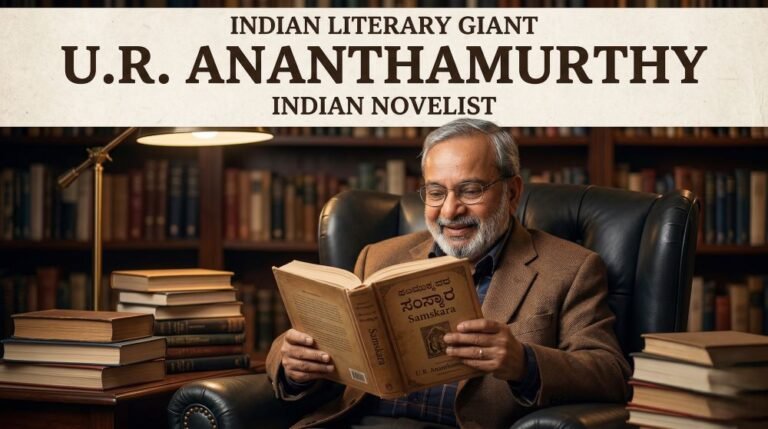
In this article we will discuss everything about U.R. Ananthamurthy Biography PDF and PPT Slides Download – his biography in English, Kannada, and Hindi, all books in English and Kannada, famous works including Samskara, Bharathipura, Bhava, Avasthe, Ghatashraddha, his poems, Jnanpith Award and for which book he won it, why he got the Jnanpith Award, his wife, caste, death, information in Kannada and Kavi Parichaya, and his complete legacy as the most important, most complex, and most courageous writer in the history of modern Kannada literature.
Table of Contents
U.R. Ananthamurthy is a name that stands at the very centre of modern Indian literature in Kannada – and, through translations, at the centre of modern Indian literature in any language. He was a novelist, poet, short story writer, literary critic, professor, public intellectual, and one of the most significant cultural figures in the history of post-independence India. His novel Samskara (1965), translated into English by A.K. Ramanujan, is one of the most celebrated and most debated novels in Indian literature – a work that dared to interrogate the caste system, Brahmin orthodoxy, and the moral foundations of traditional Indian society with an honesty and a literary power that had never been seen before in Kannada fiction.
He was a man of deep contradictions – a Brahmin who questioned Brahminism; a modernist shaped by Western thought who remained rooted in the Kannada tradition; a public intellectual who could be simultaneously radical and traditional; a literary figure who became a political one; and a writer whose works continued to disturb, challenge, and illuminate for the six decades of his creative life. He died in 2014, leaving behind one of the most important literary legacies in the history of Indian writing.
U.R. Ananthamurthy Biography Table (Biodata / Author Profile)
| Biographical Detail | Information |
| Full Name | Udupi Rajagopalacharya Ananthamurthy – universally known as U.R. Ananthamurthy; sometimes written as U.R. Ananthamurti or UR Ananthamurthy |
| Date of Birth | December 28, 1932 |
| Born Place | Melige, Thirthahalli taluk, Shimoga district (now Shivamogga), Karnataka, India – a small village in the Malnad region of Karnataka, the hilly, forested area between the Western Ghats and the Deccan plateau; his birthplace in rural Karnataka gave him the intimate knowledge of village life, caste society, and Brahmin orthodoxy that informs all his major fiction |
| Date of Death | August 22, 2014 |
| Age at Death | 81 years |
| Place of Death | Bangalore (Bengaluru), Karnataka, India – he died in hospital in Bangalore after a prolonged illness |
| Cause of Death | Kidney failure and related organ complications – he had been suffering from renal failure and was on dialysis for an extended period before his death in August 2014 |
| Nationality | Indian |
| Caste | U.R. Ananthamurthy was a Brahmin – specifically from the Smarta Brahmin tradition of Karnataka. His caste background is directly relevant to his literary work: Samskara and several of his other major works are explorations of Brahmin society from the inside – critiques of the caste system, Brahmin orthodoxy, and ritual purity written by a man who had been formed by that very system and who brought to his critique the authority of an insider. He was not merely an external critic of Brahminism but a man interrogating his own formation – and the resulting tension gives his work its particular depth and power. |
| Wife | Esther Ananthamurthy – she is of Christian background; their marriage was itself a statement about the caste and religious boundaries that Ananthamurthy’s fiction questions. Esther Ananthamurthy has spoken publicly about her husband’s life and work after his death. |
| Children | The couple had children; his family has been involved in preserving and promoting his literary legacy after his death in 2014. |
| Education | Madhva High School, Thirthahalli; B.A. from Central College, Bangalore; M.A. in Kannada literature from Mysore University; Ph.D. from the University of Birmingham, UK – his doctoral thesis, written under the supervision of the distinguished critic Malcolm Bradbury, was on the English novel; this combination of deep roots in the Kannada literary tradition and a formal Western academic education in English literature gave him the cross-cultural perspective that makes his work unique |
| Academic Career | Professor of English literature at the University of Mysore – he taught English literature while writing in Kannada; this position as a professor of English who wrote in his mother tongue was itself characteristic of the cross-cultural, border-crossing position he occupied in Indian intellectual life. He also served as Vice-Chancellor of Mahatma Gandhi University, Kottayam, Kerala; Chairman of the National Book Trust of India; and President of the Sahitya Akademi (India’s national academy of letters). |
| Languages | Kannada (his primary literary language – he wrote virtually all his fiction and poetry in Kannada); English (he read, lectured, and published criticism in English; he also engaged extensively with English and European literature and philosophy); Hindi and Sanskrit (both important parts of his intellectual formation) |
| Literary Movement | Navya Movement (Navya means ‘New’ or ‘Modern’ in Kannada) – Ananthamurthy was the central figure of the Navya literary movement that transformed Kannada fiction and poetry in the 1950s, 1960s, and 1970s. The Navya movement brought modernist literary techniques, existentialist philosophy, and a new social and political seriousness to Kannada literature, challenging the older Navodaya (Renaissance) tradition and the Progressivist tradition that preceded it. |
| Famous Works | Samskara (novel, 1965); Bharathipura (novel, 1974); Avasthe (novel, 1978); Bhava (novel, 1994); Ghatashraddha (short story); Akku (short story); Mouni (short story); three volumes of poetry; literary criticism and essays |
| Jnanpith Award | Received the Jnanpith Award in 1994 – India’s highest literary honour, awarded for lifetime achievement in Indian literature. The specific book for which he won the Jnanpith Award is Samskara – though the award recognised his entire body of work; the novel Samskara is universally cited as the primary basis for the award. |
| Jnanpith Award for Which Book | Samskara (1965) – the novel that is universally cited as the primary reason for his Jnanpith Award, though the award officially recognised his entire body of work in Kannada literature |
| Why Did He Get the Jnanpith Award? | U.R. Ananthamurthy received the Jnanpith Award because he is the most important and most influential writer in the history of modern Kannada literature; because Samskara transformed the possibilities of the Indian novel in any language; because his entire body of work – novels, stories, poems, and criticism – raised Kannada literature to the level of world literature; and because he brought to Indian fiction a combination of deep cultural rootedness and genuine intellectual seriousness that had not been seen before. |
| Other Awards | Sahitya Akademi Award (1974, for Avasthe); Padma Bhushan (1998); Fellowship of the Sahitya Akademi; D.Litt. (honorary) from several universities; various Karnataka state literary awards; the Ezra Pound Scholarship to the University of Birmingham |
| Political Views | Ananthamurthy was a public intellectual who engaged actively with Indian political life throughout his career. He was associated with socialist and secular values; he was a vocal critic of Hindu nationalism and of the BJP; he was one of the most prominent cultural voices opposing communalism and defending India’s secular Constitution. In 2014 he famously said that he would not want to live in an India where Narendra Modi was prime minister – a statement that generated enormous controversy and made him a target of political attack in his final months. |
U.R. Ananthamurthy Biography PDF and PPT Slides Download
Who Is U.R. Ananthamurthy? What Are His Major Works?
U.R. Ananthamurthy – full name Udupi Rajagopalacharya Ananthamurthy – was a Kannada novelist, poet, short story writer, literary critic, professor, and public intellectual, born on December 28, 1932, in Melige village, Shimoga district, Karnataka. He died on August 22, 2014, in Bangalore after a prolonged illness. He is the most important writer in the history of modern Kannada literature and one of the most significant literary figures in post-independence Indian culture.
His major works are: Samskara (1965) – his debut novel and masterpiece, translated into English by A.K. Ramanujan and into many other languages, a revolutionary examination of Brahmin caste society; Bharathipura (1974) – a novel about tradition, modernity, and the Dalits, set in a Karnataka town; Avasthe (1978) – winner of the Sahitya Akademi Award, a political novel about the failure of socialist idealism in India; Bhava (1994) – his most complex and most philosophically ambitious novel; and his short stories, of which Ghatashraddha (translated as The Rite of Ceremonial Bathing or Ceremonial Mourning) and Akku are the most celebrated.
He received the Jnanpith Award in 1994 – India’s highest literary honour. He was also a Professor of English at the University of Mysore, Vice-Chancellor of Mahatma Gandhi University, Chairman of the National Book Trust, and President of the Sahitya Akademi. He was one of the most important public intellectuals in India, speaking out consistently on questions of communalism, secularism, caste, and the relationship between tradition and modernity.
U.R. Ananthamurthy Biography in English: Early Life, Born Place and Education
U.R. Ananthamurthy was born on December 28, 1932, in the village of Melige in the Thirthahalli taluk of Shimoga district (now Shivamogga district), Karnataka. Melige is in the Malnad region – the hilly, forested area between the Western Ghats and the Deccan plateau, a landscape of great natural beauty and of deeply conservative rural Hindu society. It was a world shaped by Brahmin orthodoxy, by Sanskrit learning, by the rituals of caste purity, and by the rhythms of agricultural and village life that had changed little for centuries.
Ananthamurthy grew up in this world with the double consciousness that would shape all his work: he was formed by it, loved it, understood it from the inside – and was also, from his earliest intellectual awakening, deeply troubled by it. The Brahmin orthodoxy of his village childhood – its rituals, its hierarchies, its exclusions, its beauty, and its cruelties – is the direct subject of Samskara and the background of much of his subsequent fiction.
He was educated at Madhva High School in Thirthahalli before moving to Bangalore for his undergraduate studies at Central College. He then went to Mysore University for his M.A. in Kannada literature – immersing himself in the Kannada literary tradition while simultaneously encountering the modernist ideas and the Western philosophical currents that were transforming Indian intellectual life in the 1950s. He was a founding figure of the Navya literary movement in Kannada – the movement that brought modernism, existentialism, and a new social seriousness to Kannada literature – and his M.A. thesis and early critical essays were important contributions to establishing the Navya aesthetic.
He won an Ezra Pound Scholarship to the University of Birmingham in the UK, where he pursued his Ph.D. under the supervision of the distinguished literary critic Malcolm Bradbury. His doctoral thesis was on the English novel – a formal engagement with Western literary tradition that deepened his understanding of the novel as a form and gave him the comparative perspective that distinguishes his own fiction. The Birmingham years were intellectually transformative: he encountered directly the European intellectual traditions – existentialism, social criticism, modernist literature – that had already been reaching him at second hand through translation and criticism.
He returned to India and built his academic career at the University of Mysore, where he became a Professor of English literature – the characteristic position of the Indian intellectual of his generation: a man who writes in his mother tongue and teaches in the colonial language, carrying the full weight of both traditions.
U.R. Ananthamurthy Wife: Esther Ananthamurthy
U.R. Ananthamurthy’s wife is Esther Ananthamurthy – a woman of Christian background, whose marriage to Ananthamurthy was itself an act of personal and social statement. Ananthamurthy, a Brahmin, married outside his caste and religious community – an act that, in the conservative Karnataka of the 1950s and 1960s, was deeply unconventional and that reflected the same willingness to challenge orthodoxy and convention that characterises all his literary work.
Esther Ananthamurthy has been a quiet but significant presence in Ananthamurthy’s life and in the preservation of his literary legacy. After his death in 2014, she has spoken publicly about his life, his work, and his values, and she has been involved in efforts to ensure that his literary archive and his unpublished manuscripts are preserved and made available to scholars.
The marriage across caste and religious lines was itself a living expression of the values that Ananthamurthy’s fiction preaches – the rejection of caste hierarchy, the assertion of individual choice over social convention, and the belief that human solidarity transcends the boundaries of caste, religion, and community.
U.R. Ananthamurthy Caste
U.R. Ananthamurthy was a Brahmin – specifically from the Smarta Brahmin tradition of Karnataka. His caste background is one of the most important facts about him as a writer, because it is directly relevant to his literary work in a way that is unusual even among writers who engage with caste.
Samskara, his masterpiece, is a novel about Brahmin caste society written from the inside – by a man who was himself a Brahmin, who had been formed by the traditions, the rituals, the hierarchies, and the orthodoxies that the novel interrogates. This insider position gives Samskara its particular authority and its particular power: Ananthamurthy was not writing about a world he had observed from outside but about the world that had made him, and his critique of that world is therefore also a self-critique – a reckoning with his own formation that is all the more honest for being so personal.
The question ‘What is the caste of U.R. Ananthamurthy?’ appears frequently in academic and general searches – the answer is that he was a Smarta Brahmin from Karnataka. But the more important answer is that his caste background is inseparable from his literary achievement: he used the authority and the intimacy of his Brahmin formation to produce the most searching, the most honest, and the most literarily powerful critique of the Brahmin caste system in the history of Indian fiction.
U.R. Ananthamurthy Death
U.R. Ananthamurthy died on August 22, 2014, in Bangalore, Karnataka. He was 81 years old. The cause of death was kidney failure – he had been suffering from renal failure for an extended period and was on dialysis. His health had been declining for several years before his death, though he remained intellectually active and politically outspoken virtually until the end.
His death, in August 2014, came just months after he had made his famous statement about not wanting to live in an India where Narendra Modi was prime minister – a statement made before the 2014 general elections, which the BJP won with a substantial majority. The statement had generated enormous controversy and had made Ananthamurthy a target of political attack and personal abuse in his final months. He did not recant his views.
He died as he had lived – intellectually engaged, politically committed, and uncompromising in his values. His death was mourned across India and across the literary world, and the tributes that poured in from writers, scholars, politicians (of all political persuasions), and ordinary readers testified to the extraordinary range and depth of his influence on Indian cultural life.
He was cremated with full state honours in Karnataka, and the Karnataka government declared a day of state mourning. His literary archive was subsequently deposited with Manipal University and other institutions.
U.R. Ananthamurthy All Books: Complete List in English and Kannada
U.R. Ananthamurthy wrote primarily in Kannada – his novels, stories, and poems were all written in his mother tongue. Here is his complete bibliography, with both Kannada titles and their English translations:
| Year | Kannada Title / English Translation | Type / Summary |
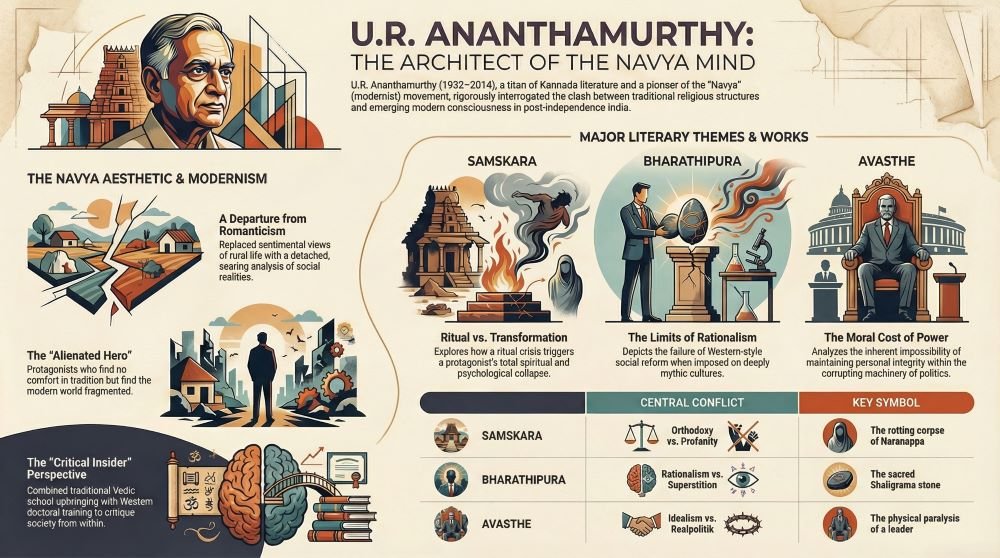
| 1965 | Samskara (Kannada) / Samskara: A Rite for a Dead Man (English, tr. A.K. Ramanujan, 1976) | Novel – his debut novel and masterpiece; one of the most important novels in Indian literature in any language. Set in an agrahara (a Brahmin settlement) in Karnataka, the novel follows Praneshacharya, the most learned and most orthodox of the Brahmin community, who is faced with the problem of what to do with the body of Naranappa – a Brahmin who has violated every rule of caste purity (he ate meat, drank, kept a low-caste concubine, and defied the community’s norms) and who has died without repentance. Should Naranappa’s body be given a Brahmin funeral? The text is silent; Praneshacharya cannot find the answer in any text. His quest for an answer leads him into a series of encounters that force him to confront the foundations of his own identity, his own repressed desires, and the limits of the tradition that has formed him. The novel is a philosophical, moral, and literary earthquake in Kannada literature – and, through A.K. Ramanujan’s brilliant translation, in Indian literature as a whole. |
| 1973/1974 | Bharathipura (Kannada) / Bharathipura (English, tr. P. Srinivasa Iyengar and others) | Novel – set in the fictional Karnataka town of Bharathipura; the story of Jagannatha, a man who has returned from England (where he studied) to his ancestral home and who decides to challenge caste orthodoxy by forcing the Untouchables of the town to enter the local temple – which has traditionally been closed to them. The novel explores the gap between intellectual conviction and social reality, between the liberal values Jagannatha has absorbed in England and the conservative forces of tradition and interest that resist change in the actual world. A meditation on the relationship between modernity and tradition, between individual will and social structure, and between the ideals of Indian democracy and the realities of caste society. |
| 1978 | Avasthe (Kannada) / Avasthe (English, tr. various) | Novel – winner of the Sahitya Akademi Award (1974, though published 1978 – the award was given for his body of work including earlier drafts and publications). Avasthe means ‘condition’ or ‘situation’ in Kannada/Sanskrit. The novel explores the political and ideological disillusionment of the post-independence generation – particularly the failure of socialist and secular idealism in the face of the realities of Indian political life. The protagonist, Krishnappa, is a socialist politician whose ideals are progressively compromised by the demands of political survival and the corruptions of power. One of the most searching examinations of the failure of Indian political idealism in the post-independence era. |
| 1994 | Bhava (Kannada) / Bhava (English, tr. various) | Novel – his most formally complex and most philosophically ambitious novel; ‘Bhava’ means ‘Being’ or ‘Existence’ or ‘Emotion’ in Sanskrit and Kannada. The novel explores questions of identity, desire, tradition, and modernity in the contemporary India of the 1980s and early 1990s. It is less accessible than Samskara and Bharathipura but is regarded by many critics as his deepest and most philosophically rich work. It engages directly with the postmodern questioning of identity and the Vedantic philosophical tradition’s questioning of the self – placing these two very different intellectual traditions in conversation. |
| Various | Ghatashraddha (Kannada short story) / The Rite of Ceremonial Bathing (English tr.) | Short story – one of his most celebrated and most frequently anthologised stories; also the basis of the Kannada film directed by Girish Karnad. The story explores a widow’s relationship with a student at a traditional Sanskrit school (matha) – her pregnancy by him leads to their expulsion from the school and community. A devastating portrait of the cruelty of a tradition that condemns those who transgress its rules – particularly women – without compassion or mercy. |
| Various | Akku (Kannada short story) / Akku (English translation) | Short story – one of his most powerful shorter works; exploring the relationship between a brother and his sister (Akku means ‘elder sister’ in Kannada) in the context of caste society and its expectations. A story about love, loyalty, and the cost of belonging to a tradition that demands conformity at the price of individual freedom. |
| Various | Mouni (Kannada short story) / The Silence (English tr.) | Short story – ‘Mouni’ means one who observes silence, a silent sage. A story exploring the encounter between modernity and tradition through the figure of a silent holy man and those who seek to understand him. Characteristic Ananthamurthy: using a traditional figure and a traditional situation to explore thoroughly modern questions about meaning, communication, and the relationship between the individual and the community. |
| Various | Three Volumes of Poetry (Kannada) | Poetry – Ananthamurthy published three volumes of Kannada poetry; his poems engage with the same themes as his fiction – caste, tradition, modernity, desire, the self and its formation – but in a more concentrated, lyrical form. His poems are widely studied in Kannada literature courses and are among the most discussed in the modern Kannada poetic tradition. |
| Various | Suryananu Kantevu (Kannada essays / criticism) | Literary criticism and essays – Ananthamurthy was also a major literary critic; his essays on Kannada literature, on the Navya movement, on comparative Indian literature, and on the relationship between literature and society are important contributions to literary criticism. His critical writing in English is also significant – it brought Kannada literary culture to the attention of an international audience. |
| Various | Prasnegalu Utaregalu (Kannada) | Essays / interviews – collections of his conversations and interviews on literary, political, and cultural questions; these are important documents for understanding his intellectual development and his positions on the major questions of Indian cultural and political life. |
Samskara: Complete Analysis – The Jnanpith Award Novel
Samskara (1965) is U.R. Ananthamurthy’s debut novel and masterpiece – the work most associated with his name, the one most widely studied in Indian universities and internationally, and the primary reason he received the Jnanpith Award. It is one of the most important novels in Indian literature in any language – a work that changed what the Indian novel could do and what it could say.
| Aspect | Detail |
| Full Title | Samskara (Kannada original, 1965); Samskara: A Rite for a Dead Man (English translation by A.K. Ramanujan, 1976) |
| Author | U.R. Ananthamurthy |
| Published | 1965 (Kannada original); 1976 (English translation, Oxford University Press) |
| Translator | A.K. Ramanujan – one of the greatest translators in the history of Indian literature; his English translation of Samskara is itself a major literary achievement, capturing the Kannada original’s density of language and thought in brilliantly lucid English |
| Setting | An agrahara – a Brahmin settlement – in the Malnad region of Karnataka; a world of traditional Brahmin learning, ritual purity, caste hierarchy, and orthodox practice; the world Ananthamurthy grew up in |
| Central Problem | Naranappa, a Brahmin who has violated every rule of caste purity – he ate meat, drank, kept a low-caste concubine, defied and mocked the community’s norms – dies of plague without repentance. His body lies unburied, a source of ritual pollution. Who should perform his funeral rites? The community cannot agree. The most learned Brahmin, Praneshacharya, must seek an answer in the sacred texts – but the texts are silent. |
| Protagonist | Praneshacharya – the most orthodox, the most learned, and the most respected man in the agrahara community; a man who has devoted his life to Brahmin scholarship and ritual purity; a man who has suppressed all personal desire in the service of his duties as a husband (his wife is chronically ill) and a scholar. His encounter with Chandri – Naranappa’s concubine – after a night of unexpected intimacy, shatters the foundations of his identity and sets the novel’s central question: who is he, if he is no longer the man he thought he was? |
| Samskara Meaning | ‘Samskara’ in Sanskrit and Kannada has multiple meanings that are all relevant to the novel: it means the ritual rites of passage that mark the stages of a Hindu life (birth, initiation, marriage, death); it means the cultural formation and the inherited traditions that shape a person’s identity and behaviour; and it means the psychological impressions or dispositions that are carried from past lives in Hindu cosmology. All these meanings are in play in the novel: the funeral rite (samskara) that cannot be performed is both a literal problem and a metaphor for the crisis of identity, tradition, and moral formation that is the novel’s real subject. |
| Samskara Summary | After Naranappa’s death, his concubine Chandri comes to Praneshacharya for help. During a night in the forest, Praneshacharya and Chandri have a sexual encounter – an act that violates every rule of the Brahmin code and that Praneshacharya cannot explain in terms of his own understanding of himself. Shattered by this encounter, he wanders away from the agrahara, unable to return to his old identity or to find a new one. The novel follows his wandering – through a series of encounters that force him to confront the questions that his orthodox formation had suppressed: questions of desire, of individuality, of the relationship between tradition and freedom, and of what it means to be a person when the identity provided by your community is taken away. |
| Why It Is Revolutionary | Samskara is revolutionary for several reasons: it was the first major Indian novel to interrogate the caste system and Brahmin orthodoxy from the inside – from the perspective of a Brahmin who is simultaneously a product of the system and its most searching critic; it brought existentialist philosophy (the question of authentic selfhood) into Kannada fiction for the first time; it used the forms of classical Indian literature (the Sanskrit epic, the ritual text) as structural models while simultaneously questioning their moral foundations; and it was written in a Kannada prose style of extraordinary density and beauty that had no precedent in the tradition. |
| Film Adaptation | Samskara was adapted into a Kannada film by Pattabhirama Reddy in 1970 – a film that itself became a landmark of Indian cinema. The film was initially banned by the Karnataka state government because of its portrayal of Brahmin society, but the ban was eventually lifted and the film was recognised as a masterpiece. It starred Girish Karnad (the playwright and actor who went on to become one of India’s most celebrated cultural figures) as Praneshacharya. |
| Academic Study | Samskara is one of the most widely studied texts in Indian literature – it appears on university curricula across India, in Britain, and in the United States; it is discussed in the contexts of postcolonial theory, caste studies, Indian feminism, comparative literature, and the study of religion and literature. The volume of academic criticism on Samskara is larger than that on almost any other novel in Kannada or in Indian literature in English translation. |
| Jnanpith Connection | Samskara is the novel most commonly cited as the primary reason for Ananthamurthy’s Jnanpith Award – the specific book, in the language of the searches, for which he won India’s highest literary honour. The award was given for his entire body of work, but Samskara is the work that most clearly demonstrates the scale of his achievement and the depth of his contribution to Indian literature. |
Bharathipura: Analysis
Bharathipura (1974) is U.R. Ananthamurthy’s second novel – the story of Jagannatha, a man who has returned to his ancestral Karnataka town after studying in England and who decides to challenge caste orthodoxy by taking Untouchables to the local temple, which has traditionally denied them entry.
The novel uses Jagannatha’s project as a lens through which to examine one of the central problems of modern India: the gap between the liberal, egalitarian values that educated Indians have absorbed (from the independence movement, from Western liberal thought, from the Constitution) and the conservative reality of caste society that these values are supposed to transform. Jagannatha’s attempt is both idealistic and confused – he has absorbed the right values but he does not fully understand the society he is trying to change, or the ways in which his own privilege and his own formation have shaped his perception of it.
Bharathipura is a more politically explicit novel than Samskara – it engages more directly with the project of social reform and with the specific question of the Dalits and their exclusion from Hindu religious spaces. But it is not a simple reform novel: it is too honest about the contradictions of its protagonist, too clear-eyed about the complexity of the social situation, to offer easy conclusions or triumphant resolutions. Like all of Ananthamurthy’s best work, it raises questions without providing answers, and trusts the reader to engage with the difficulty.
Avasthe: Analysis and Sahitya Akademi Award
Avasthe (1978) – ‘Condition’ or ‘Situation’ – is U.R. Ananthamurthy’s third major novel and the work for which he received the Sahitya Akademi Award. It is his most directly political novel – a portrait of the failure of socialist and secular idealism in the India of the Emergency era (1975-77) and its aftermath.
The protagonist, Krishnappa, is a socialist politician who has devoted his life to the ideals of the independence movement and of Nehruvian socialism: secularism, equality, democratic participation, and the transformation of Indian society. But as the novel follows his political career, it traces the progressive erosion of these ideals – the compromises forced by political survival, the corruptions of power, the gap between the rhetoric of social transformation and the reality of Indian political life.
Avasthe is one of the most searching examinations of the failure of Indian political idealism in the post-independence era – a novel that asks, with great honesty and great sadness, what happens to a man’s values when the historical project to which he has devoted them proves impossible. It is less formally experimental than Samskara but is, in some ways, a more directly relevant political document – its questions about the relationship between idealism, power, and compromise are as urgent today as when Ananthamurthy wrote it.
Ghatashraddha: Short Story Analysis
Ghatashraddha is one of U.R. Ananthamurthy’s most celebrated and most frequently anthologised short stories – and the basis of the celebrated 1977 Kannada film directed by Girish Karnad.
The story is set in a traditional Sanskrit school (matha or veda patha shala) in a Brahmin community. The central figure is a young widow – condemned by Brahmin orthodoxy to a life of severe restriction after her husband’s death – who lives in the community attached to the school. She becomes pregnant by a student at the school. When this is discovered, both the widow and the student are expelled from the community in a ritual ceremony – the ghatashraddha of the title, a ceremony that symbolically treats the expelled persons as if they were dead.
The story is a devastating examination of the cruelty that tradition can inflict on those who violate its codes – particularly on women, whose transgression is treated with incomparably greater severity than that of men. The story also explores the complicity of the boy (a student narrator) who witnesses these events and whose admiration for the widow and his own moral failure to act is part of the story’s moral landscape. It is one of the finest short stories in Indian literature.
U.R. Ananthamurthy Poems
U.R. Ananthamurthy published three volumes of Kannada poetry over the course of his literary career. His poems are less widely known internationally than his novels – partly because they have been less extensively translated – but they are an important part of his literary achievement and are widely studied in Kannada literature courses.
His poetry engages with the same themes as his fiction: caste and its moral foundations; the relationship between tradition and modernity; desire and its suppression; the individual self and its formation by community; and the crisis of meaning in contemporary India. But the poetic form allows him to engage with these themes more intimately and more lyrically – in his poems, the intellectual seriousness of his fiction is combined with a directness and a vulnerability that is characteristic of his best lyric writing.
His poems in Kannada are highly regarded by Kannada literary scholars and are taught as part of the Navya poetic tradition. Several have been translated into English and into other Indian languages. They are an essential part of the complete picture of Ananthamurthy’s literary achievement.
U.R. Ananthamurthy and the Navya Movement
The Navya movement (‘Navya’ means ‘New’ or ‘Modern’ in Kannada) was the literary revolution that transformed Kannada fiction and poetry in the 1950s, 1960s, and 1970s – and U.R. Ananthamurthy was its central figure. Understanding Navya is essential to understanding Ananthamurthy’s place in Kannada literary history.
Before Navya, Kannada literature was dominated by two major traditions: the Navodaya (Renaissance) tradition of the early twentieth century, which celebrated the beauty of Karnataka’s landscape and the richness of its cultural heritage in a lyrical, romantic style; and the Progressivist tradition of the 1940s and 1950s, which brought social realism and political commitment to Kannada fiction and which was allied with the socialist and communist movements in India.
Navya challenged both of these traditions. It brought to Kannada fiction the formal innovations of Western modernism – stream of consciousness, non-linear narrative, symbolism, existentialist philosophy – and it insisted that literature must engage with the full complexity of human experience rather than subordinating that complexity to either aesthetic beauty (Navodaya) or political programme (Progressivism). It was a literature of questioning rather than of assertion, of ambiguity rather than of certainty, of the individual consciousness rather than of collective movements.
Ananthamurthy was the central novelist of the Navya movement; the poet P. Lankesh was its central poetic voice; and the critical writing of Ananthamurthy himself, along with other critics, articulated its aesthetic principles. Together, they transformed Kannada literature from a regional literature of cultural celebration and social commentary into a literature capable of engaging with the most serious philosophical, moral, and political questions of the age.
U.R. Ananthamurthy Jnanpith Award: For Which Book and Why
The Jnanpith Award – India’s highest literary honour, given annually by the Bharatiya Jnanpith organisation to a writer in any Indian language for outstanding contribution to Indian literature – was awarded to U.R. Ananthamurthy in 1994.
The specific book for which U.R. Ananthamurthy won the Jnanpith Award is Samskara – his 1965 novel that is universally regarded as his masterpiece and as one of the most important novels in Indian literature. The award officially recognised his entire body of work in Kannada literature, but Samskara is the work most commonly cited as the primary basis for the award.
Why did U.R. Ananthamurthy get the Jnanpith Award? The answer encompasses his entire literary achievement: he received the award because he is the most important novelist in the history of modern Kannada literature; because Samskara transformed the possibilities of Indian fiction in any language; because his novels, stories, and poems collectively represent one of the most serious, most honest, and most literarily accomplished bodies of work in post-independence Indian literature; because he raised Kannada literature to the level of world literature through the depth of his vision and the power of his literary execution; and because he was not merely a great Kannada writer but a genuinely important figure in the world literary tradition.
| Aspect of the Jnanpith Award | Detail |
| Award Name | Jnanpith Award (Jnanpith Puraskar) |
| Awarding Organisation | Bharatiya Jnanpith – India’s most prestigious literary institution; established in 1944 |
| Year Received | 1994 |
| Language Recognised | Kannada – Ananthamurthy was the seventh Kannada writer to receive the Jnanpith Award |
| Book for Which He Won It | Samskara (1965) – the specific novel most commonly cited; the award officially recognised his entire body of work |
| Why He Won It | For the transformation of Kannada literature through Samskara and his subsequent novels; for raising Kannada to the level of world literature; for bringing modernist literary techniques and existentialist philosophy to Indian fiction; for his honest, courageous interrogation of caste, tradition, and identity in Indian society |
| Significance | The Jnanpith Award is India’s highest literary honour – equivalent in prestige to the Booker Prize or the Nobel Prize in the Indian literary context. Its award to Ananthamurthy confirmed his standing not merely as the foremost Kannada writer but as one of the most important literary figures in post-independence India |
U.R. Ananthamurthy Information in Kannada: Kavi Parichaya
The searches for ‘U.R. Ananthamurthy information in Kannada’ and ‘U.R. Ananthamurthy information in Kannada Kavi Parichaya’ reflect the widespread study of Ananthamurthy in Kannada school and college curricula. ‘Kavi Parichaya’ (Poet Introduction or Author Introduction) is a standard section in Kannada language textbooks at school level, in which students are required to know and write basic biographical and literary information about major Kannada authors.
For students preparing Kavi Parichaya on U.R. Ananthamurthy, here are the key facts in summary form:
- Hesar (Name): Udupi Rajagopalacharya Ananthamurthy (U.R. Ananthamurthy)
- Janana Dina (Birth Date): December 28, 1932
- Janana Sthala (Birth Place): Melige village, Thirthahalli, Shimoga district (now Shivamogga), Karnataka
- Nidana Dina (Death Date): August 22, 2014
- Shikshana (Education): M.A. (Kannada literature), Mysore University; Ph.D., University of Birmingham, UK
- Vritti (Occupation): Professor of English, University of Mysore; Vice-Chancellor, Mahatma Gandhi University; President, Sahitya Akademi
- Sahitya Chalaval (Literary Movement): Navya (Modern/New) movement in Kannada literature
- Prasiddha Krithigalu (Famous Works): Samskara (novel); Bharathipura (novel); Avasthe (novel); Bhava (novel); Ghatashraddha (short story); Akku (short story); three volumes of poetry
- Puraskaragalu (Awards): Jnanpith Award (1994); Sahitya Akademi Award (1974); Padma Bhushan (1998)
- Visheshata (Special Feature): Samskara is his most famous novel, translated by A.K. Ramanujan into English; he was a central figure of the Navya movement; he was a public intellectual who spoke out on caste, communalism, and secularism throughout his life
U.R. Ananthamurthy’s Writing Style
| Element | Detail |
| Prose Style in Kannada | Dense, philosophically charged, and syntactically complex – Ananthamurthy’s Kannada prose is not easy; it demands a reader who is willing to work with it, to follow its arguments through their full complexity, and to engage with the philosophical questions it raises. At its best, it has a quality of concentrated, multi-layered meaning that few writers in any language achieve. |
| Use of Myth and Ritual | One of his most distinctive techniques is the use of Hindu myth, ritual, and scriptural tradition – not to celebrate or affirm these traditions but to interrogate them. His fiction takes the forms of traditional Hindu literary culture (the ritual text, the epic structure, the myth of the sacred forest) and uses them as a framework within which to ask deeply uncomfortable questions about what those traditions mean and what they cost. |
| Existentialism and Indian Tradition | His work is shaped by the encounter between European existentialism (particularly Camus, Sartre, and Kafka) and the Indian philosophical tradition (Vedanta, the Bhagavad Gita, the ritual traditions of Brahmin society). This encounter is not a simple combination but a genuine intellectual tension – the existentialist questioning of identity and authentic selfhood is placed in direct conflict with the Hindu tradition’s insistence on the dissolution of individual identity into a larger cosmic order. |
| The Insider Critique | His most powerful device is the insider critique – the use of his own Brahmin formation to interrogate Brahminism from the inside. This gives his work an authority and an intimacy that external critiques of caste could never achieve. He is not judging a tradition he does not know; he is reckoning with the tradition that made him. |
| Ambiguity and Openness | Like the best literary fiction anywhere, his work refuses to provide easy answers. Samskara does not tell us whether Praneshacharya is saved or damned, whether his encounter with Chandri is liberation or transgression, whether the tradition he has abandoned can be recovered or replaced. This refusal of closure is not a weakness but a strength – it reflects his deep intellectual honesty and his respect for the complexity of the questions he is asking. |
| Social and Political Engagement | His fiction is always socially and politically engaged – it is never art for art’s sake; it is always writing that cares about the world and about what human beings do to each other. But this engagement is never propagandistic; it is the engagement of a writer who brings to social questions the full resources of literary art. |
U.R. Ananthamurthy Awards: Complete List
| Award | Year | For / Detail |
| Sahitya Akademi Award | 1974 | For Avasthe – India’s national literary honour; one of the most prestigious awards in Indian literature |
| Jnanpith Award | 1994 | For his entire body of work in Kannada literature, with Samskara as the primary basis – India’s highest literary honour |
| Padma Bhushan | 1998 | Awarded by the Government of India – one of India’s three highest civilian honours, in recognition of his distinguished service to the nation through literature |
| Fellowship of the Sahitya Akademi | Various | The Sahitya Akademi’s highest honour – a lifetime fellowship recognising exceptional contribution to Indian literature |
| Various honorary D.Litt. degrees | Various | Honorary doctorates from Indian universities in recognition of his literary and intellectual achievement |
| Karnataka Rajyotsava Award | Various | Karnataka state’s highest cultural honour |
U.R. Ananthamurthy Life Timeline
| Year | Key Event |
| 1932 | Born on December 28 in Melige village, Thirthahalli taluk, Shimoga district, Karnataka – in the heart of the Malnad region; son of a Smarta Brahmin family; grows up in the world of Brahmin orthodoxy and Sanskrit learning that will become the subject of his greatest fiction |
| 1932-1940s | Childhood in Melige; early education in the village and at Madhva High School, Thirthahalli; absorbs the world of Brahmin agrahara society that he will later interrogate in Samskara |
| Late 1940s-early 1950s | B.A. from Central College, Bangalore; moves to the city and begins to encounter the modernist literary and intellectual currents that are transforming Indian intellectual life in the post-independence period |
| Early-mid 1950s | M.A. in Kannada literature, Mysore University; becomes a central figure of the emerging Navya literary movement in Kannada; begins writing fiction and poetry; early publications in Kannada literary magazines |
| Late 1950s-early 1960s | Wins Ezra Pound Scholarship to the University of Birmingham, UK; pursues Ph.D. on the English novel under Malcolm Bradbury; encounters European existentialism, modernism, and Western literary criticism directly; the Birmingham years are intellectually transformative |
| 1963 | Returns to India; joins the University of Mysore as a Professor of English literature – the characteristic post-independence Indian intellectual position: teaching in the colonial language while writing in the mother tongue |
| 1965 | Samskara published in Kannada – immediately recognised as a revolutionary work in Kannada literature; the novel that will define his career and his legacy |
| 1970 | Samskara adapted into Kannada film by Pattabhirama Reddy; initially banned by Karnataka government; eventually recognised as a landmark of Indian cinema; Girish Karnad stars as Praneshacharya |
| 1974 | Bharathipura published; Receives Sahitya Akademi Award – India’s national literary honour |
| 1976 | A.K. Ramanujan’s English translation of Samskara published by Oxford University Press – bringing the novel to an international audience and establishing Ananthamurthy’s reputation well beyond Kannada-speaking India |
| 1978 | Avasthe published – his political novel about the failure of socialist idealism in India |
| 1980s | Grows in public prominence as a literary and political intellectual; speaks and writes on questions of communalism, secularism, caste, and the relationship between tradition and modernity; serves in various public intellectual roles |
| 1990s | Bhava published (1994); Serves as Vice-Chancellor of Mahatma Gandhi University, Kottayam (Kerala); serves as Chairman of the National Book Trust of India; serves as President of the Sahitya Akademi |
| 1994 | Receives the Jnanpith Award – India’s highest literary honour – for his body of work in Kannada literature; the specific work cited is Samskara |
| 1998 | Awarded Padma Bhushan by the Government of India |
| 2000s | Continues as a major public intellectual; speaks out on communalism, Hindu nationalism, and the threats to Indian secularism; engages in public controversies; continues to write and lecture |
| 2014 (early) | Before the general elections, makes his famous statement that he would not want to live in an India where Narendra Modi was prime minister; the BJP wins the election with a substantial majority; Ananthamurthy becomes a target of political attack and personal abuse |
| 2014 | Dies on August 22 in Bangalore after prolonged illness from kidney failure; aged 81; Karnataka government declares a day of state mourning; tributes pour in from across India and the literary world |
| 2014-present | Posthumous recognition continues; his works continue to be published, translated, and studied; Samskara remains in print in multiple languages and continues to be taught worldwide; he is increasingly recognised as one of the most important literary figures in post-independence India |
10 Lines About U.R. Ananthamurthy for Students
- U.R. Ananthamurthy – full name Udupi Rajagopalacharya Ananthamurthy – was born on December 28, 1932, in Melige village, Shimoga district, Karnataka, and died on August 22, 2014, in Bangalore.
- He was the most important writer in the history of modern Kannada literature and a leading figure of the Navya (New/Modern) literary movement that transformed Kannada fiction and poetry from the 1950s onwards.
- His debut novel Samskara (1965), translated into English by A.K. Ramanujan, is one of the most important novels in Indian literature – a revolutionary examination of Brahmin caste society from the inside.
- He received the Jnanpith Award in 1994 – India’s highest literary honour – for his entire body of work in Kannada, with Samskara as the primary basis for the award.
- He also received the Sahitya Akademi Award (1974, for Avasthe) and the Padma Bhushan (1998).
- His other major novels are Bharathipura (1974), Avasthe (1978), and Bhava (1994); his celebrated short stories include Ghatashraddha, Akku, and Mouni.
- He was a Professor of English at the University of Mysore; Vice-Chancellor of Mahatma Gandhi University, Kerala; Chairman of the National Book Trust; and President of the Sahitya Akademi.
- He was a Smarta Brahmin from Karnataka, and his fiction uses his Brahmin formation to interrogate the caste system from the inside – giving his work a moral authority and an intimacy that few writers can match.
- His wife is Esther Ananthamurthy, of Christian background – their cross-caste, cross-religion marriage was itself an expression of the values his fiction promotes.
- He was a major public intellectual who spoke out throughout his life on caste, communalism, secularism, and the need to defend India’s constitutional values – and his death in 2014 was mourned across India as the loss of one of its most important cultural voices.
U.R. Ananthamurthy Short Biography (Profile / Biodata)
U.R. Ananthamurthy (full name: Udupi Rajagopalacharya Ananthamurthy; born December 28, 1932, Melige, Shimoga, Karnataka; died August 22, 2014, Bangalore) was a Kannada novelist, poet, short story writer, literary critic, and public intellectual. A Smarta Brahmin from the Malnad region of Karnataka. Wife: Esther Ananthamurthy (Christian background). Education: M.A., Mysore University; Ph.D., University of Birmingham (under Malcolm Bradbury). Professor of English, University of Mysore; Vice-Chancellor, Mahatma Gandhi University; Chairman, National Book Trust; President, Sahitya Akademi. Central figure of the Navya literary movement. Major works: Samskara (1965, tr. A.K. Ramanujan); Bharathipura (1974); Avasthe (1978); Bhava (1994); short stories including Ghatashraddha and Akku; three volumes of poetry. Awards: Sahitya Akademi Award (1974); Jnanpith Award (1994, for Samskara / entire body of work); Padma Bhushan (1998). Died of kidney failure at 81. One of the most important literary and intellectual figures in post-independence India.
READ ALSO: Nayantara Sahgal Biography PDF and PPT Slides Download
Conclusion:
U.R. Ananthamurthy left Indian literature two things that will endure for as long as Indian literature exists. The first is Samskara – a novel that does not merely describe a world but interrogates the foundations on which that world rests, with an honesty and a literary power that has not been surpassed in Indian fiction in any language. The second is the example of a literary life: a life dedicated to the proposition that literature matters, that it has moral and political consequences, that the writer has an obligation to speak the truth about the society he or she inhabits, and that this obligation continues even when the truth is uncomfortable.
His Brahmin formation, which he turned into the instrument of his own most searching self-examination, is a model for what literature can do: it can take the very materials of a tradition – its stories, its rituals, its hierarchies, its exclusions – and use them to ask whether that tradition deserves the allegiance it demands. This is a dangerous activity, and Ananthamurthy paid the price for it throughout his career in controversy, in political attack, and in the hostility of those who preferred their traditions unexamined. He paid it without flinching.
In 2014, in his eighties, dying, he was still speaking out. The tradition of Kannada literature – and of Indian literature – is richer for everything he said and wrote. He remains one of the great writers and one of the great consciences of modern India.