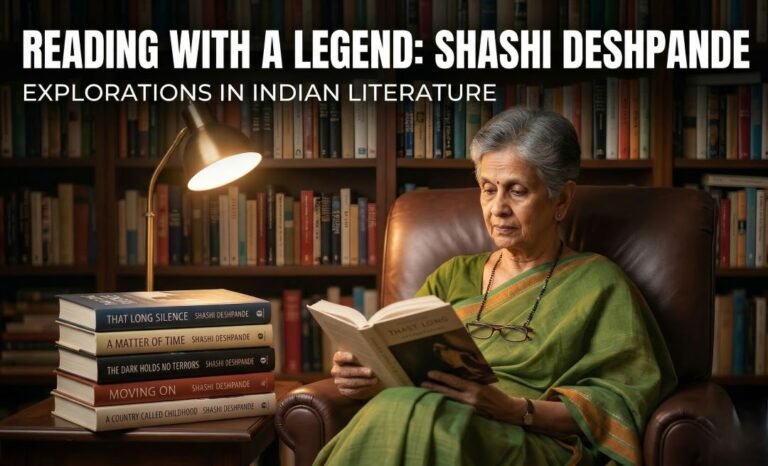
Shashi Deshpande Biography PDF and PPT Slides, Books, Famous Works, Awards and Complete Legacy, A Complete Article Covering Shashi Deshpande Biography in English, All Books in Chronological Order, That Long Silence, Dark Holds No Terrors, Roots and Shadows, The Binding Vine, A Matter of Time, The Intrusion and Other Stories, Short Stories, Feminist Writing, Husband, Education, Awards, Is She Alive, and Her Complete Legacy as One of India’s Most Important Women Writers.
Table of Contents
In this article we will discuss everything about Shashi Deshpande – her biography in English, all books in chronological order (novels list), famous works including That Long Silence, Dark Holds No Terrors, Roots and Shadows, The Binding Vine, A Matter of Time, Listen to Me, Shadow Play, The Intrusion and Other Stories, Hear Me Sanjay, The Miracle, her short stories, her themes as a feminist writer, her husband, education, autobiography, born date, awards, notable works, and her complete legacy as one of the most important and most honest women writers in the history of Indian literature in English.
Shashi Deshpande is a writer who has spent her entire literary career doing something that very few writers in any tradition manage: looking at the interior lives of ordinary Indian women with absolute honesty, without sentimentality, without political distortion, and without the comfort of easy resolution. She writes about women trapped in marriages, women silenced by the expectations of their families and their society, women who cannot find words for what they feel, and women who slowly, painfully, begin to find a language for their own experience. She is, in the deepest sense, a feminist writer – not in the sense of producing ideological fiction, but in the sense of insisting on the full humanity of women and on the right of women’s inner lives to be the subject of serious literary attention.
She has published nine novels, nine short story collections, children’s books, and a memoir – a body of work that spans more than four decades and that represents one of the most sustained, most serious, and most consistently excellent literary careers in Indian writing in English.
Shashi Deshpande Biography Table (Biodata / Author Profile)
| Biographical Detail | Information |
| Full Name | Shashi Deshpande |
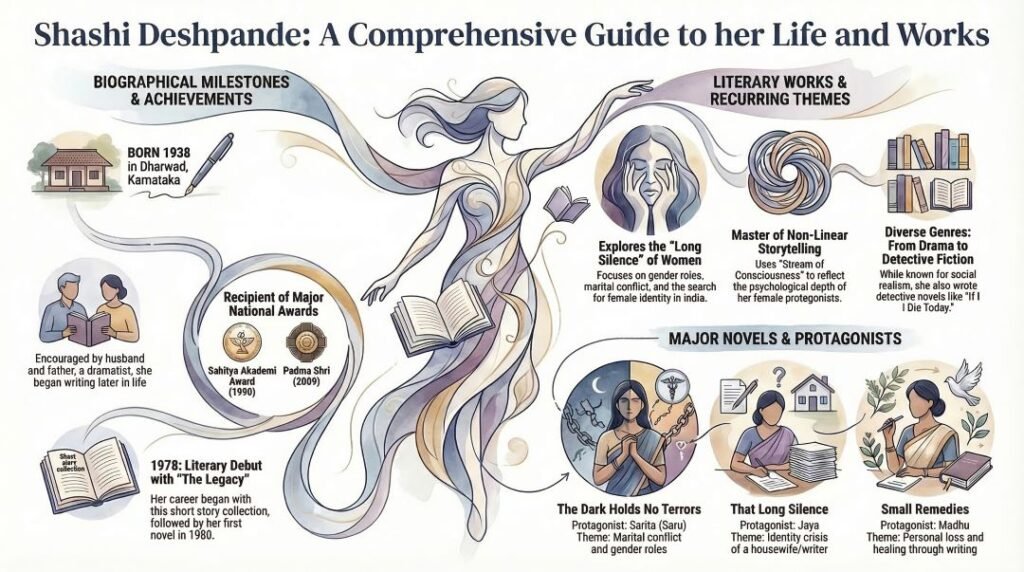
| Date of Birth | August 19, 1938 |
| Born Place | Dharwad, Karnataka, India – born into a distinguished Kannada literary family; her father, Adya Rangacharya (known by his pen name Sriranga), was one of the most celebrated Kannada playwrights of the twentieth century; growing up in a household shaped by literature and by Kannada cultural life gave Deshpande a deep grounding in the literary tradition that she would eventually carry into English |
| Born Date | August 19, 1938 – she is one of the senior figures of Indian writing in English, with a career spanning from the 1970s to the present |
| Is Shashi Deshpande Alive? | Yes – Shashi Deshpande is alive as of 2025. She was born on August 19, 1938, and continues to be an active literary presence, speaking at literary events, giving interviews, and engaging with questions about Indian literature, women’s writing, and the state of Indian society. She lives in Bangalore (Bengaluru), Karnataka. |
| Nationality | Indian |
| Father | Adya Rangacharya (pen name: Sriranga) – one of the most distinguished Kannada playwrights of the twentieth century; his literary seriousness, his commitment to writing about the realities of Indian society, and his deep engagement with the Kannada literary tradition all shaped his daughter’s development as a writer. Growing up as the daughter of a celebrated Kannada writer gave Deshpande both a literary formation and a complex relationship with the tradition – since she would write in English, not in Kannada, the language of her father’s greatest achievement. |
| Husband | D. R. Deshpande – a doctor and academic; he was a Professor of Pharmacology at a medical college in Bangalore. The couple married and settled in Bangalore, where Shashi Deshpande has lived and worked throughout her literary career. Her husband’s academic and professional world – and the social world of the educated Kannada professional class in Bangalore – provided the social setting of much of her fiction. He predeceased her. |
| Children | Two sons |
| Education | Shashi Deshpande received her early education in Dharwad and later in Mumbai (Bombay). She studied Law at the Government Law College in Mumbai (Bombay) – she has a degree in Law – and also studied at the Bombay University. She later pursued a Diploma in Journalism. She did not make a career in law or journalism but instead turned to writing fiction, beginning with short stories in the 1970s. Her education gave her a broad intellectual formation that is visible in the precision and analytical rigour of her fiction. |
| Occupation | Novelist, short story writer, children’s book author, memoirist; she is also a former editor (she worked as a freelance journalist and editor before becoming a full-time writer) |
| Languages | She writes in English; her mother tongue is Kannada; she is also fluent in Hindi and other Indian languages |
| Autobiography / Memoir | Shashi Deshpande published a memoir titled A Life in Words: Memoirs (2018) – in which she reflects on her life as a writer, the development of her literary career, her family, her relationship with her father’s literary legacy, and the questions of identity, language, and belonging that have shaped her work. The memoir is one of the most valuable documents available for understanding the personal and intellectual formation behind her fiction. |
| Notable Works | That Long Silence (1988); Dark Holds No Terrors (1980); Roots and Shadows (1983); The Binding Vine (1993); A Matter of Time (1996); Listen to Me (2018); Shadow Play (2019); The Intrusion and Other Stories; Hear Me Sanjay; The Miracle |
| Famous Works | That Long Silence is her most famous and most widely studied novel – the work that won her the Sahitya Akademi Award and established her internationally. Dark Holds No Terrors is her second most celebrated novel and her most frequently taught work. |
| Is She a Feminist Writer? | Yes – Shashi Deshpande is one of the most important feminist writers in Indian literature in English. She is feminist in the deepest sense: her fiction insists on the full humanity of women, on the importance of women’s inner lives as subject matter for serious literary attention, and on the social and cultural structures that silence and constrain Indian women. However, she herself has expressed some ambivalence about the feminist label – she prefers to call herself a writer who writes about human beings, and she has resisted the reduction of her work to a political programme. Her feminism is embedded in the texture of her fiction rather than imposed on it from outside. |
| Awards | Sahitya Akademi Award (1990, for That Long Silence); Padma Shri (2009); Nanjangud Tirumalamba Award; Thirumathi Rangammal Prize; various state and national literary awards |
| First Novel | The Dark Holds No Terrors (1980) – her debut novel; a powerful, psychologically intense portrait of a woman who returns to her parents’ home after a crisis in her marriage |
| Children’s Books | Deshpande has also written books for children – including works aimed at younger readers that engage with Indian stories and values; a less discussed but genuine part of her literary output |
| What Is the Title of Shashi Deshpande’s Autobiography? | The title of Shashi Deshpande’s autobiography (memoir) is A Life in Words: Memoirs, published in 2018. It is her account of her life as a writer – the development of her literary career, her family history, her relationship with her father’s Kannada literary legacy, and the questions of identity and language that have shaped all her work. |
Shashi Deshpande Biography PDF and PPT Slides Download (.PPTX)
Who Is Shashi Deshpande? What Are Her Important Works?
Shashi Deshpande is an Indian novelist and short story writer, born on August 19, 1938, in Dharwad, Karnataka. She is the daughter of the celebrated Kannada playwright Adya Rangacharya (Sriranga) and the wife of Dr. D. R. Deshpande, a professor of pharmacology. She has spent her entire literary career writing about the inner lives of Indian women – particularly middle-class, educated women navigating the constraints of marriage, family, and society – with a honesty, a psychological depth, and a formal precision that have established her as one of the most important writers in the history of Indian literature in English.
Her important works – the novels and stories that define her achievement – are: That Long Silence (1988, Sahitya Akademi Award winner), which is her most celebrated novel and the one most widely studied in Indian universities; Dark Holds No Terrors (1980), her debut novel and one of her most psychologically powerful; Roots and Shadows (1983), her second novel; The Binding Vine (1993), which explores violence against women through multiple narrative layers; A Matter of Time (1996), her most formally complex and most philosophically ambitious novel; Listen to Me (2018) and Shadow Play (2019), her more recent novels; and her many short story collections, of which The Intrusion and Other Stories is among the most discussed.
She received the Sahitya Akademi Award in 1990 for That Long Silence – India’s most prestigious literary honour – and the Padma Shri from the Government of India in 2009. She is alive as of 2025, living in Bangalore, and remains one of the most respected and most honoured voices in Indian literary culture.
Shashi Deshpande Biography in English: Early Life, Born Place and Education
Shashi Deshpande was born on August 19, 1938, in Dharwad – a city in the northern Karnataka region that has been one of the cultural and intellectual centres of Kannada literary life. She was born into a family that was already distinguished in Indian literature: her father, Adya Rangacharya, who wrote under the pen name Sriranga, was one of the most celebrated Kannada playwrights of the twentieth century – a writer whose plays engaged with the social and political realities of Indian life with a seriousness and a formal mastery that made him a major figure in the tradition.
Growing up as the daughter of Sriranga shaped Deshpande in complex ways. On one hand, she received a literary formation that most writers never have – the daily reality of a household in which literature was taken seriously, in which the question of how to write about Indian life was a living and urgent question, and in which the Kannada literary tradition was a living presence rather than a museum piece. On the other hand, she would eventually choose to write in English rather than in Kannada – the language of her father’s greatest achievement – a choice that has given her career a particular kind of tension and that she has reflected on extensively in interviews and in her memoir.
She received her early education in Dharwad before moving to Mumbai (Bombay) for higher education. She studied Law at the Government Law College in Mumbai and also pursued journalism, taking a Diploma in Journalism. She did not make a career in either law or journalism – both were formative intellectual experiences that gave her a broad, analytical, socially engaged perspective, but it was fiction that claimed her finally. She began writing short stories in the early 1970s, publishing first in Indian literary magazines and journals, before turning to the novel with The Dark Holds No Terrors in 1980.
She married D. R. Deshpande – a doctor who became a Professor of Pharmacology at a medical college in Bangalore – and the couple settled in Bangalore, where she has lived and worked throughout her career. Bangalore – its educated middle-class professional world, its social hierarchies, its domestic interiors – is the implicit setting of much of her fiction, even when a specific city is not named.
Shashi Deshpande Husband: D. R. Deshpande
Shashi Deshpande’s husband was Dr. D. R. Deshpande – a doctor and academic who worked as a Professor of Pharmacology at a medical college in Bangalore. Their marriage brought Deshpande to Bangalore, the city that has been her home throughout her literary career and that has provided the social world of her fiction – the educated, professional, urban South Indian middle class, with its particular pressures, its particular silences, and its particular forms of constraint on women’s lives and aspirations.
D. R. Deshpande predeceased Shashi Deshpande. She has written about him and about their life together – with characteristic reticence and honesty – in her memoir A Life in Words (2018). The marriage, while deeply private in its details (Deshpande is not a writer who exposes her personal life in her fiction), is clearly present as a formative experience behind the many fictional marriages she has written about – the marriages of Jaya in That Long Silence, of Sarita in Dark Holds No Terrors, of Indu in Roots and Shadows, and of the various women at the centre of her subsequent novels. These are not autobiographical portraits, but they are shaped by an intimate knowledge of what a long marriage can mean, can cost, and can give.
Deshpande has two sons. Her family life in Bangalore – the life of a writer who is also a wife, a mother, and a daughter-in-law, navigating the expectations of an Indian household while simultaneously writing fiction that questions those very expectations – is itself a version of the situation she writes about in her novels. The difference is that she found words for it; her fictional women are struggling to find the words that she has already discovered.
Shashi Deshpande All Books: Complete List in Chronological Order
Shashi Deshpande has published nine novels, nine short story collections, children’s books, and a memoir. Here is her complete bibliography in chronological order:
| Year | Title | Type / Summary |
| 1978 | The Legacy and Other Stories | Her debut short story collection – the work that first established her as a writer of short fiction; introducing the themes that would dominate all her subsequent work: women’s silence, the constraints of marriage, the gap between women’s inner lives and the lives they are permitted to live. |
| 1980 | The Dark Holds No Terrors | Her debut novel – a powerful, psychologically intense portrait of Sarita, a doctor who returns to her parents’ home after a crisis in her marriage. Sarita’s husband has begun to assault her sexually at night – a phenomenon she cannot name or discuss in the daylight hours of their seemingly normal marriage. The novel explores the disconnect between the public face of a respectable Indian middle-class marriage and its hidden violence. One of the first Indian novels in English to directly address marital sexual violence. Her first novel and one of her most discussed. |
| 1982 | Come Up and Be Dead | A short story collection – continuing to explore the territory of women’s lives, relationships, and the social structures that constrain them; demonstrating the range and depth of her short fiction alongside her developing novelistic career. |
| 1983 | Roots and Shadows | Her second novel – the story of Indu, a journalist who returns to her ancestral home in a small town after the death of her aunt. Indu is a modern, educated woman who has married outside her caste and has forged an independent life; but the return to her roots forces her to confront the traditions, the family expectations, and the ‘shadows’ of the past that she thought she had escaped. The novel explores the tension between the modern Indian woman’s desire for independence and the pull of family, tradition, and belonging. |
| 1984 | It Was the Nightingale and Other Stories | A short story collection – published as her novelistic career was gaining momentum; the stories demonstrate the same qualities that distinguish her novels: psychological depth, precise observation of domestic life, and a commitment to taking women’s inner experiences seriously. |
| 1986 | The Intrusion and Other Stories | One of her most discussed short story collections – containing the title story The Intrusion, which is widely studied and frequently anthologised. The collection explores the ways in which the private spaces of women’s lives are violated by the intrusions of society’s expectations, of male authority, and of the silences imposed by culture. The Intrusion itself is a story about the violation of a woman’s inner life by forces she cannot name or resist. |
| 1988 | That Long Silence | Her most famous novel – winner of the Sahitya Akademi Award (1990). Jaya, a writer who has published some stories but who has been largely silent for years, is forced into a period of literal silence when her husband Mohan, who is under investigation for professional misconduct, takes her to a flat in Dadar where they wait for the crisis to pass. In this forced silence and stillness, Jaya reviews her marriage, her silencing of herself, the suppression of her own voice in order to be a good wife, and the possibility that she might find her voice again. The novel is both a meditation on women’s silence – the silences they are taught, the silences they choose, and the silence of their inner lives – and one of the most precise and most moving portrayals of a marriage in Indian fiction. |
| 1990 | The Miracle and Other Stories | A short story collection including the story The Miracle – which, along with Hear Me Sanjay, is one of her most searched and most discussed short stories. The stories continue to explore the central terrain of her fiction: the interior lives of women in Indian domestic and social settings. |
| 1992 | A Matter of Time (first edition – later revised) | Her most formally complex novel – exploring three generations of women in a Brahmin family facing crisis and abandonment. (Note: the final published version dates from 1996 – see below.) |
| 1993 | The Binding Vine | Her fourth major novel – exploring the theme of violence against women through a double narrative. Urmila, whose infant daughter has just died, is drawn into the story of her dead mother-in-law Mira through Mira’s secret notebooks of poetry. She also becomes involved with a woman in her neighbourhood who has been raped and is now in a coma. The novel uses these parallel stories to explore the silencing of women’s experience of violence – the ways in which rape, marital rape, and the suffering of women are hidden, denied, and suppressed. One of the most structurally ambitious of her novels and one of her most politically engaged. |
| 1995 | The Stone Women and Other Stories | A short story collection – further demonstrating her mastery of the short form and her consistent engagement with the central themes of women’s lives, silence, and survival. |
| 1996 | A Matter of Time | Her most formally complex and most philosophically ambitious novel – exploring three generations of women in a South Indian Brahmin family after a man, Gopal, abandons his wife Sumi and their daughters without explanation and goes to live with his ageing parents. The novel weaves together three time periods and three generations of women – Sumi’s mother Kalyani, Sumi herself, and Sumi’s daughters – to create a meditation on women’s experience of loss, abandonment, and survival, and on the ways in which women’s lives are shaped by the choices and the failures of men. Widely considered her most ambitious novel. |
| 1998 | Small Remedies | Her sixth major novel – the story of Madhu, a journalist who goes to research a biography of an aging classical musician, Savitribai Indorekar, and finds herself drawn into a complex engagement with Savitribai’s life and choices. The novel explores the tension between art and life, between the demands of creativity and the demands of love and family, and between the freedom that art offers and the constraints of the social world. One of her most nuanced and most absorbing novels. |
| 2000 | Listen to Me and Other Stories | A short story collection – the title story Listen to Me is one of her most discussed and most searched short stories; exploring the theme of communication and its failure in intimate relationships. |
| 2003 | In the Country of Deceit | Her seventh novel – continuing to explore the emotional and psychological landscape of her fiction, with a focus on deception, truth-telling, and the gap between the face people present to the world and the reality of their inner lives. |
| 2009 | Collected Stories | A major collection of her short stories – bringing together stories from across her career and making her short fiction more widely available to readers who had not been able to access the individual collections. |
| 2018 | Listen to Me | Her novel (distinct from the story collection of the same name) – one of her most recent works of long fiction; continuing to engage with the questions of women’s lives, relationships, and the possibility of authentic self-expression that have driven all her work. |
| 2018 | A Life in Words: Memoirs | Her memoir – the title of her autobiography; a reflection on her life as a writer, her family, her father’s Kannada literary legacy, her development as a writer, and the questions of identity, language, and belonging that have shaped her work. One of the most valuable documents for understanding the personal and intellectual formation behind her fiction. |
| 2019 | Shadow Play | Her most recent novel as of 2025 – continuing to engage with the emotional and psychological landscape of her fiction; exploring the ways in which the ‘shadows’ of the past shape the present lives of her characters. |
That Long Silence: Complete Analysis
That Long Silence (1988) is Shashi Deshpande’s most famous and most widely studied novel – the work that won her the Sahitya Akademi Award in 1990 and that established her as one of the most important novelists in Indian literature in English. It remains the novel most associated with her name and the one most frequently assigned in Indian university courses on Indian writing in English, women’s fiction, and postcolonial literature.
| Aspect | Detail |
| Full Title | That Long Silence |
| Author | Shashi Deshpande |
| Published | 1988 (Virago Press, UK; Penguin India) |
| Award | Sahitya Akademi Award (1990) – India’s most prestigious literary honour |
| Protagonist | Jaya – a married woman, a writer who has published some stories but has largely silenced herself; the wife of Mohan, a middle-class professional in Bombay (Mumbai) |
| Central Situation | Mohan, Jaya’s husband, is under investigation for professional misconduct. He takes Jaya out of their comfortable Bombay flat and installs her in a smaller flat in Dadar, away from their social world, while he manages the crisis. In this enforced stillness and silence, Jaya is thrown back on herself – forced to examine her marriage, her life, and the silence she has imposed on herself over many years of being a wife. |
| That Long Silence Summary | The novel is structured as Jaya’s internal monologue during this period of forced withdrawal – a stream of memory, reflection, and self-examination in which she traces the history of her marriage and her self-silencing. She remembers her mother, her childhood expectations, her marriage to Mohan, the suppression of her own writing and her own voice in order to be a supportive wife, and the slow recognition that the silence she has kept is not merely circumstantial but structural – the product of the social expectations placed on Indian women. The novel ends with the suggestion, rather than the certainty, that Jaya might find her voice again. |
| The Title | The ‘long silence’ of the title refers simultaneously to: the silence of Jaya’s marriage – the things she and Mohan cannot say to each other; the silence of women in general – the social silencing of women’s inner lives and experiences; the silence of Indian women writers – the tradition of women who have not been able to write or to be heard; and the specific silence of this enforced retreat. |
| Central Themes | Women’s silence and its causes; the suppression of women’s voices in marriage and in society; the relationship between marriage and identity; the tension between the role of wife and the role of writer; the inner life of the educated Indian woman; the gap between the public face of a marriage and its private reality; self-silencing as a form of complicity in one’s own oppression |
| Feminist Reading | That Long Silence is one of the central texts of Indian feminist literary criticism. It is read as a feminist novel because it takes seriously the question of why women are silent – not just externally silenced by force, but internally silenced by the internalisation of expectations; and because it insists that this silence is not natural or inevitable but cultural and political. |
| Long Silence Summary for Students | Jaya, a Bombay housewife and writer, is forced to spend time in a small flat when her husband faces a professional crisis. In this isolation, she reviews her married life – her suppressed writing, her adaptation to the role of wife, and the silence she has kept. The novel is her interior monologue – a slow, painful coming to awareness of how she has silenced herself and of the possibility of finding her voice again. |
| Critical Reception and Legacy | Universally praised by critics in India and internationally; established Deshpande as a major voice in Indian fiction; won the Sahitya Akademi Award; continues to be one of the most widely taught texts in Indian English literature courses worldwide |
Dark Holds No Terrors: Complete Analysis
Dark Holds No Terrors (1980) is Shashi Deshpande’s debut novel and one of the most psychologically powerful novels in Indian literature in English. It was the work that established her as a writer of serious literary ambition and that announced the themes – women’s silence, the gap between public and private experience, the hidden violence of marriage – that would run through all her subsequent fiction.
| Aspect | Detail |
| Full Title | Dark Holds No Terrors |
| Author | Shashi Deshpande |
| Published | 1980 (Vikas Publishing House; later Penguin India) |
| Protagonist | Sarita (Saru) – a doctor, a successful woman by any conventional measure, who returns to her parents’ home in a small town after a crisis in her marriage |
| The Crisis | Sarita’s husband Manohar has begun to behave violently toward her sexually at night – a violence that is completely at odds with his behaviour during the day. The marriage appears normal, even successful, to the outside world; but at night, Manohar enacts on Sarita’s body the humiliation he feels at being married to a woman who is more professionally successful than himself. This is one of the first Indian novels in English to directly address marital sexual violence. |
| Dark Holds No Terrors Summary | Sarita returns to her parents’ home – specifically to her father, since her mother has died. The novel is structured around this return and around Sarita’s memories and reflections as she tries to understand what has happened to her marriage and to herself. She remembers her relationship with her mother – a woman who always preferred her brother, who always made Sarita feel unwanted and guilty for her own achievements. She traces the history of her marriage, her relationship with Manohar, and the slow development of the violence that has driven her from her home. The novel ends without a neat resolution – Sarita must find her own way forward. |
| The Mother | One of the novel’s most powerful threads is Sarita’s relationship with her mother – a woman who embodied the traditional Indian preference for sons, who always made Sarita feel less loved and less valued than her brother, and who reproached Sarita for her educational and professional success. This mother-daughter relationship is one of the most psychologically acute in Indian fiction and gives the novel a depth that goes beyond the immediate crisis of the marriage. |
| Central Themes | Marital violence and its hidden nature; the gap between professional success and personal pain; the mother-daughter relationship and its complexities; the social structures that make it impossible for women to name their experience of marital violence; guilt, self-blame, and the difficulty of leaving; the experience of the educated, successful Indian woman who is simultaneously trapped and silenced by her marriage |
| Why It Is Called ‘Dark Holds No Terrors’ | The title captures the paradox at the heart of the novel: the darkness – the literal darkness of night in which the violence occurs – holds no terrors because Sarita has learned to endure it, to suppress her experience of it, to survive. But the very endurance is its own form of terror. The darkness of the title also refers to the psychological darkness of the experiences the novel explores – the things that cannot be spoken in daylight. |
| Critical Reception and Legacy | Widely praised as one of the most powerful and most honest portrayals of domestic violence in Indian fiction; frequently studied in courses on women’s writing, Indian literature, and postcolonial fiction; one of the first Indian novels to bring marital sexual violence into literary discourse |
Roots and Shadows: Analysis
Roots and Shadows (1983) is Shashi Deshpande’s second novel – the story of Indu, a journalist who returns to her ancestral home in a small town when her aunt – the matriarch of the family – is dying. Indu is a modern woman: she has had a love marriage, she has a career, she has constructed an independent life outside the traditional family structures in which she was raised. But the return to her roots confronts her with the ‘shadows’ – the weight of family history, of traditional expectations, and of the women’s lives that have shaped her own.
The novel explores the tension that runs through all of Deshpande’s fiction: between the educated Indian woman’s desire for independence, self-determination, and authentic self-expression, and the pull of the family, the tradition, and the social world that formed her and that continues to claim her. Indu’s story is also a story about the women of previous generations – the women of her family whose lives were entirely determined by tradition – and about what their lives mean for her own.
Roots and Shadows is less widely discussed than That Long Silence or Dark Holds No Terrors, but it is an important work in Deshpande’s development as a novelist – the first full demonstration of her ability to explore the social and historical dimensions of women’s experience alongside the psychological.
The Binding Vine: Analysis
The Binding Vine (1993) is Shashi Deshpande’s fourth major novel and one of her most structurally ambitious. It brings together three women’s stories – those of Urmila, Mira, and Kalpana – in a narrative that explores the silencing of women’s experience of violence from multiple angles.
Urmila, the narrator, is a woman whose infant daughter has just died. Grieving and isolated, she begins reading the secret notebooks of her dead mother-in-law, Mira – notebooks containing poetry that reveals that Mira was raped by her husband on their wedding night and throughout their marriage. Simultaneously, Urmila becomes involved with a woman in her neighbourhood, Kalpana, who has been raped and is now in a coma – her story hushed up and denied by her family.
The three stories are connected by the common thread of violence against women and the silencing of that violence. Mira could not speak of her experience in her lifetime – her poetry was the only outlet, and it was hidden. Kalpana’s rape is being suppressed by her family to protect the family’s honour. Urmila is the one who insists on speaking – who demands that the violence be named, that the women be heard, that the silence be broken.
The Binding Vine is the novel in which Deshpande most directly engages with the political dimensions of women’s silence – moving from the personal and psychological territory of her earlier novels to a more explicitly social and political critique. The ‘binding vine’ of the title is both the vine that ties women together in their shared experience of suffering and the social structures that bind them into silence.
A Matter of Time: Analysis
A Matter of Time (1996) is widely considered Shashi Deshpande’s most formally complex and most philosophically ambitious novel. It explores three generations of women in a South Indian Brahmin family after a devastating rupture: Gopal, the husband of Sumi, abandons his family without explanation – leaves his wife and daughters and goes to live with his own ageing parents, offering no reason and no possibility of discussion.
The novel weaves together three time periods and three women’s stories: Kalyani, Sumi’s mother, who was abandoned by her own husband in a different but related way; Sumi herself, who must find a way to live in the aftermath of her husband’s inexplicable departure; and Sumi’s daughters, particularly Aru, who must understand what has happened to her family and what it means for her own future.
The novel is a meditation on the ways in which women’s lives are shaped by the choices and the failures of men – by absences, by silences, by departures – and on the strength and the resourcefulness with which women respond to these disruptions. It is also a meditation on time – on the ways in which the past is always present in the lives of the women it has shaped.
A Matter of Time is less accessible than That Long Silence – its formal complexity, its multiple time frames, and its philosophical ambition make greater demands on the reader. But for those who engage with it fully, it is one of the most rewarding novels in the Indian tradition.
Small Remedies: Analysis
Small Remedies (1998) is Shashi Deshpande’s sixth major novel – a departure from the domestic interiors of her earlier work in that it engages directly with the world of Indian classical music and with the life of a woman artist. Madhu, a journalist, goes to write a biography of Savitribai Indorekar, an aging and legendary classical singer. In researching Savitribai’s life, Madhu is drawn into a complex engagement with the choices Savitribai made – choices that placed her art above the conventional expectations of Indian womanhood.
The novel asks: what does it cost a woman to be a serious artist in Indian society? What must she give up – or refuse to give up – in order to pursue her art fully? Savitribai’s choices are presented without sentimentality: she pursued her music at the cost of conventional domestic life, and the novel does not pretend that this cost was nothing. But it also insists that the music – the art – is real, is valuable, and is worth the cost.
Small Remedies is one of Deshpande’s most nuanced and most absorbing novels – a meditation on art, sacrifice, and the specific difficulty of being a woman artist in India.
Shashi Deshpande Short Stories: Key Works
| Story / Collection | Summary / Detail |
| The Intrusion | From The Intrusion and Other Stories (1986) – one of her most discussed and most frequently anthologised stories; the story of the violation of a woman’s inner life and private space by forces she cannot name or resist; a meditation on the many forms that intrusion takes in women’s lives – physical, emotional, social, psychological. |
| The Miracle | From The Miracle and Other Stories (1990) – one of her most searched and most studied stories; exploring the possibility of transformation and change in the lives of ordinary Indian women; a story of quiet, everyday miracle – the kind of small but real change that Deshpande’s fiction consistently celebrates. |
| Hear Me Sanjay | One of her most frequently studied short stories – a story written from the perspective of a woman addressing a child named Sanjay; exploring the theme of communication across generations and the things that mothers and children cannot say to each other; widely included in school and university curricula. |
| Listen to Me | The title story of her 2000 collection – exploring the failure of communication in intimate relationships; the gap between what people say and what they mean; and the desperate need of women to be heard that runs through all of Deshpande’s fiction. |
| The Legacy and Other Stories (1978) | Her debut story collection – introducing the central themes that would drive all her subsequent work: women’s lives, women’s silence, the constraints of marriage and family. |
| Come Up and Be Dead (1982) | Her second story collection – deepening her exploration of women’s inner lives with the precision and honesty that characterise all her best work. |
| It Was the Nightingale (1984) | A story collection demonstrating her consistent engagement with the territory of women’s domestic lives, their desires, and their constraints. |
| The Stone Women and Other Stories (1995) | A further collection exploring the ways in which women are ‘turned to stone’ – rendered immobile, silent, unfeeling – by the social and personal pressures of their lives. |
| Collected Stories (2009) | A major collection bringing together stories from across her career – making her short fiction more accessible and demonstrating the extraordinary consistency and depth of her engagement with the form over four decades. |
| Shashi Deshpande Short Stories PDF | Her short stories are widely available in PDF form through Indian university library systems, academic repositories, and literary databases. The most commonly accessed stories in PDF are The Intrusion, Hear Me Sanjay, The Miracle, and Listen to Me – all of which appear on school and university curricula across India. |
Is Shashi Deshpande a Feminist Writer?
The question of whether Shashi Deshpande is a feminist writer is one of the most frequently asked in academic and literary discussions of her work – and the answer requires some nuance, because Deshpande herself has expressed ambivalence about the feminist label while producing fiction that is deeply and consistently feminist in its vision and its effects.
In the simplest and most meaningful sense, yes – Shashi Deshpande is a feminist writer. Her fiction is feminist because it insists on the full humanity of women; because it takes seriously the question of what happens to women’s inner lives under the pressures of a society that expects them to be wives, mothers, and daughters before they are individuals; because it names – with precision and with honesty – the social structures that silence and constrain women; and because it refuses to accept that these structures are natural or inevitable.
Her novels are feminist documents in the most basic sense: they make visible what has been invisible. The experiences of Jaya in That Long Silence, of Sarita in Dark Holds No Terrors, of Urmila in The Binding Vine, and of Sumi in A Matter of Time are not unusual or exceptional – they are the experiences of millions of Indian women. What is exceptional is that Deshpande names them, examines them, and insists on their importance.
At the same time, Deshpande’s feminism is not programmatic or ideological. She does not write to illustrate a feminist thesis; she does not divide her characters into victims and oppressors; she does not provide easy solutions or triumphant endings. Her fiction is feminist precisely because it is too honest for that – it shows the full complexity of the situations it portrays, including the ways in which women sometimes collude in their own silencing.
Deshpande herself has said that she prefers to think of herself as a writer who writes about human beings rather than as a feminist writer – a position that reflects her distrust of reductive labels but that does not diminish the feminist significance of her work. Her novels’ feminist study – the academic tradition of reading her work as feminist literature – is one of the most substantial bodies of criticism on any Indian woman writer in English.
Shashi Deshpande’s Novels: Themes – A Feminist Study
A feminist study of Shashi Deshpande’s novels reveals a set of consistent themes that run through her entire body of work and that constitute her most important contribution to Indian literature:
- Women’s Silence – the central theme of all her fiction; the many forms of silence that Indian women are taught, forced, or compelled to maintain; the silence of Jaya in That Long Silence; the silence of Mira in The Binding Vine; the social silence that surrounds marital rape in Dark Holds No Terrors; and the question of what it would mean for women to speak.
- Marriage and Its Constraints – Deshpande portrays marriage with a combination of honesty and sympathy that is unique in Indian fiction; she neither idealises nor demonises the institution; she shows, with great precision, the specific ways in which marriage can silence and constrain a woman while also being a genuine source of love, companionship, and meaning.
- The Mother-Daughter Relationship – one of her most consistently explored themes; the relationship between mothers and daughters in Indian society, with its particular forms of competition, love, expectation, and disappointment; the way in which mothers pass on to daughters the very constraints that have shaped their own lives.
- Violence Against Women – from the marital sexual violence in Dark Holds No Terrors to the rape narrative in The Binding Vine; Deshpande is one of the first Indian novelists to bring these experiences directly and honestly into literary discourse.
- The Educated Indian Woman – her protagonists are typically educated, middle-class women who have some access to professional life and to the wider world; the tension between this education and these aspirations on the one hand and the constraints of their domestic roles on the other is the central drama of her fiction.
- Self-Expression and the Right to Write – several of her protagonists are writers or artists; the question of women’s right to creative self-expression, and the social forces that suppress it, is a recurrent concern.
- The Past and Its Shadows – the ‘shadows’ of title of Roots and Shadows and the ‘matter of time’ of her most ambitious novel; the ways in which the past – particularly the past of women’s lives in previous generations – shapes and constrains the present.
- Communication and Its Failure – the gap between what people feel and what they can say; the failure of intimacy in marriages where the real communication never happens; and the desperate need of women to be heard that drives many of her protagonists.
Shashi Deshpande Autobiography: A Life in Words
The title of Shashi Deshpande’s autobiography is A Life in Words: Memoirs, published in 2018. It is one of the most valuable documents available for understanding the personal and intellectual formation behind her fiction – a memoir in which she reflects on her life as a writer, her family history, her relationship with her father’s Kannada literary legacy, and the questions of identity, language, and belonging that have shaped all her work.
The memoir is characteristically honest and characteristically reticent – Deshpande does not produce the kind of confessional autobiography that exposes private suffering for public consumption; instead, she reflects with care and intelligence on the larger questions that her life raises: what does it mean to be a writer in India? What is the relationship between the language in which you write and the identity you carry? What does it mean to be the daughter of a celebrated Kannada writer and to choose to write in English? What does it mean to be a woman writer in a literary culture that has not always taken women writers seriously?
A Life in Words is not only a memoir but a work of literary criticism – Deshpande reflects on her own novels with the kind of honest, unsentimental intelligence that she brings to her fiction, and her account of how her books were written, received, and understood is one of the most illuminating pieces of literary self-examination available from any Indian writer.
Shashi Deshpande Education
Shashi Deshpande’s education took her from her hometown of Dharwad to Mumbai, giving her an intellectual formation that combined law, journalism, and literature.
- Early education in Dharwad, Karnataka – her home city, shaped by the Kannada literary culture of her father’s world
- School education in Mumbai (Bombay) – the family moved to Mumbai, where she completed her schooling in the cosmopolitan environment of the city
- Government Law College, Mumbai – a degree in Law; the analytical rigour of legal training is visible in the precise, structured way Deshpande examines the social and personal situations of her characters
- University of Mumbai (Bombay University) – further academic study
- Diploma in Journalism – reflecting her interest in writing and in the public communication of ideas; she worked as a journalist and editor before turning fully to fiction
Deshpande has spoken about her education in interviews – noting that while law and journalism gave her intellectual tools, it was fiction that ultimately claimed her as the form through which she could explore the realities she most wanted to examine. Her educational background is visible in the precision, the analytical depth, and the social awareness that distinguish her fiction from more purely literary or aesthetic approaches to the novel.
Shashi Deshpande Awards
| Award | Year | For / Detail |
| Sahitya Akademi Award | 1990 | For That Long Silence (1988) – India’s most prestigious literary honour, awarded by the national academy of letters; confirmed Deshpande’s place in the first rank of Indian writers in English |
| Padma Shri | 2009 | Awarded by the Government of India in recognition of her contribution to Indian literature – one of India’s four highest civilian honours; a late but important official recognition of her literary achievement |
| Nanjangud Tirumalamba Award | Various | A Karnataka state literary award recognising her contribution to Indian literature |
| Thirumathi Rangammal Prize | Various | A literary award recognising women’s writing in India |
| German Book Trade Women’s Award | Various | International recognition of her contribution to women’s literature |
Shashi Deshpande’s Writing Style
| Element | Detail |
| Prose Style | Clean, precise, understated – Deshpande writes with a deliberate economy of means that is itself an expression of her themes; the prose never overreaches, never strains for effect; it proceeds with the same quiet, controlled determination that characterises her best protagonists |
| Narrative Voice | Often first-person or close third-person – the narrative is typically positioned very close to the consciousness of the central woman character; the reader is given direct access to the character’s thoughts, memories, and reflections in a way that mirrors the novel’s concern with women’s inner lives |
| Interior Monologue | Several of her novels – most notably That Long Silence – use an extended interior monologue as their primary mode; the reader lives in the protagonist’s consciousness, following the movements of her thought and memory rather than the external events of a plot |
| Structure | Her novels are typically structured around a period of crisis and withdrawal – a time in which the protagonist is forced, by circumstances, to review her life and her choices; this structure mirrors the movement of self-examination that is the subject of the novels themselves |
| Psychological Depth | Her greatest strength is psychological accuracy – the ability to render the inner life of her characters with a precision and an honesty that makes the reader feel that they are reading about their own experience; this quality is rare in any literature and is the primary source of her power |
| Social Observation | Alongside the psychological depth, Deshpande has a sharp eye for social detail – the specific textures of middle-class Indian domestic life, the social codes and expectations of the educated Brahmin professional world in which her characters typically live, and the ways in which social structures shape individual experience |
| Avoidance of Resolution | Deshpande consistently refuses to provide neat resolutions – her novels end with openings rather than closures; with the possibility of change rather than its certainty; with questions rather than answers. This refusal of resolution is itself a statement about the reality of the situations she portrays. |
| Influences | She has spoken about the influence of Virginia Woolf (particularly Woolf’s attention to women’s consciousness and her narrative technique); of Indian women writers in Kannada and other languages; and of the tradition of the realist novel in both English and Indian literature |
Shashi Deshpande Life Timeline
| Year | Key Event |
| 1938 | Born on August 19 in Dharwad, Karnataka, India – daughter of the celebrated Kannada playwright Adya Rangacharya (Sriranga) |
| 1938–1950s | Early childhood and schooling in Dharwad and later in Mumbai; grows up in a literary household shaped by Kannada culture and her father’s dramatic writing |
| 1950s–early 1960s | Studies Law at Government Law College, Mumbai; also studies at the University of Mumbai; takes a Diploma in Journalism; begins to think seriously about writing |
| Early 1960s | Marries Dr. D. R. Deshpande, a professor of pharmacology; moves to Bangalore, which will be her home for the rest of her life |
| 1960s–early 1970s | Raises two sons; begins writing short stories – initially publishing in Indian literary magazines and journals; slowly finds her voice and her subject matter |
| 1978 | The Legacy and Other Stories published – her debut short story collection; announces her arrival as a writer of serious literary ambition |
| 1980 | The Dark Holds No Terrors published – her debut novel; one of the first Indian novels to address marital sexual violence; establishes her as a major new voice in Indian fiction |
| 1982 | Come Up and Be Dead published – second short story collection |
| 1983 | Roots and Shadows published – her second novel; exploring the tension between the modern Indian woman’s independence and the pull of family and tradition |
| 1984 | It Was the Nightingale and Other Stories published |
| 1986 | The Intrusion and Other Stories published – containing the title story that would become one of her most widely studied works |
| 1988 | That Long Silence published – her most famous novel; immediately recognised as a landmark of Indian women’s fiction |
| 1990 | Receives the Sahitya Akademi Award for That Long Silence – India’s most prestigious literary honour; her career is now fully and officially established in the first rank of Indian writing in English |
| 1990 | The Miracle and Other Stories published |
| 1993 | The Binding Vine published – her most explicitly political novel about violence against women |
| 1995 | The Stone Women and Other Stories published |
| 1996 | A Matter of Time published – her most formally complex and most ambitious novel; exploring three generations of women facing abandonment |
| 1998 | Small Remedies published – exploring the life of a woman classical musician and the demands of art |
| 2000 | Listen to Me and Other Stories published |
| 2003 | In the Country of Deceit published |
| 2009 | Receives the Padma Shri from the Government of India – one of the four highest civilian honours; official recognition of her lifetime contribution to Indian literature |
| 2009 | Collected Stories published – making her short fiction more widely available |
| 2018 | Listen to Me (novel) published; A Life in Words: Memoirs published – her autobiography, reflecting on her life as a writer |
| 2019 | Shadow Play published – her most recent novel |
| 2025 | Alive and living in Bangalore, Karnataka; continues to be one of the most respected and most honoured voices in Indian literary culture |
10 Lines About Shashi Deshpande for Students
- Shashi Deshpande was born on August 19, 1938, in Dharwad, Karnataka, India – the daughter of the celebrated Kannada playwright Adya Rangacharya (Sriranga).
- She studied Law at the Government Law College, Mumbai, and also took a Diploma in Journalism before turning fully to fiction writing.
- She married Dr. D. R. Deshpande, a professor of pharmacology, and has lived in Bangalore throughout her literary career.
- She is the author of nine novels, nine short story collections, children’s books, and a memoir (A Life in Words: Memoirs, 2018).
- Her most famous novel, That Long Silence (1988), won the Sahitya Akademi Award in 1990 – India’s most prestigious literary honour.
- Her debut novel, Dark Holds No Terrors (1980), was one of the first Indian novels in English to directly address marital sexual violence.
- Her central themes are women’s silence, the constraints of marriage, the psychology of the educated Indian woman, violence against women, and the difficulty and importance of self-expression.
- She is widely recognised as a feminist writer – though she herself prefers to be called simply a writer who takes women’s lives seriously.
- She received the Padma Shri from the Government of India in 2009 in recognition of her contribution to Indian literature.
- She is alive as of 2025, living in Bangalore, and remains one of the most respected and most significant figures in Indian literary culture.
Shashi Deshpande Short Biography (Profile / Biodata)
Shashi Deshpande (born August 19, 1938, Dharwad, Karnataka, India; alive as of 2025) is an Indian novelist and short story writer. Daughter of celebrated Kannada playwright Adya Rangacharya (Sriranga). Educated at Government Law College, Mumbai (Law degree) and University of Mumbai (Diploma in Journalism). Wife of Dr. D. R. Deshpande (professor of pharmacology; predeceased). Two sons. Lives in Bangalore. She has published nine novels – The Dark Holds No Terrors (1980), Roots and Shadows (1983), That Long Silence (1988, Sahitya Akademi Award 1990), The Binding Vine (1993), A Matter of Time (1996), Small Remedies (1998), In the Country of Deceit (2003), Listen to Me (2018), and Shadow Play (2019) – nine short story collections including The Intrusion and Other Stories, The Miracle and Other Stories, Hear Me Sanjay, Listen to Me, and Collected Stories (2009); and a memoir, A Life in Words: Memoirs (2018). She received the Padma Shri in 2009. She is India’s most important and most sustained literary explorer of women’s silence, women’s inner lives, and the social structures that constrain Indian women.
Also read: Vikram Seth Biography PDF and PPT Slides Download (.PPTX)
Conclusion:
Shashi Deshpande has spent more than four decades doing something that very few writers in any tradition manage to do consistently: she has looked at the inner lives of ordinary Indian women with absolute honesty, without sentimentality, without political distortion, and without the comfort of easy resolution. She has written about women’s silence when almost no one else in Indian literature in English was doing so. She has named experiences – marital sexual violence, self-silencing, the suppression of women’s creativity – that Indian culture had consigned to the realm of the unspeakable. And she has done this with a literary seriousness, a psychological precision, and a formal discipline that have made her novels and stories genuinely important works of literature, not merely important documents.
Her legacy is twofold. First, she opened a space in Indian women’s fiction that had not existed before – a space in which the inner life of the educated Indian woman could be explored with the full seriousness that the great tradition of the novel demands. Every Indian woman writer who has written about marriage, silence, and self-expression since 1980 has written in the space that Deshpande created. Second, she produced a body of work – particularly That Long Silence, Dark Holds No Terrors, The Binding Vine, and A Matter of Time – that will last. These are not period pieces; they are not sociology dressed as fiction; they are novels that illuminate a permanent human condition through the specific details of a particular social and historical world.
She is, by any fair measure, one of the most important writers in the history of Indian literature in English – a writer whose work deserves to be far more widely known outside India than it currently is, and whose continued presence in Indian literary culture is a reminder of what serious, honest, uncompromising literary fiction can achieve.