In this article we will discuss about the Ruskin Bond Biography PDF and PPT Slides Download, Ruskin Bond Biography, Books, Famous Works, Wife, Awards and Complete Legacy so, Ruskin Bond is one of the most beloved writers in India – a man who has spent more than seven decades telling stories about the hills of northern India, about childhood, friendship, nature, and the quiet joys of a simple life, and in doing so has made himself a permanent fixture in the hearts of millions of Indian readers across every generation. He has written over 500 short stories and more than 100 books. He has been read by grandparents and their grandchildren, by school students and university professors, by city dwellers who have never seen the Himalayas and by hill people who recognize every detail of the world he describes.
Table of Contents
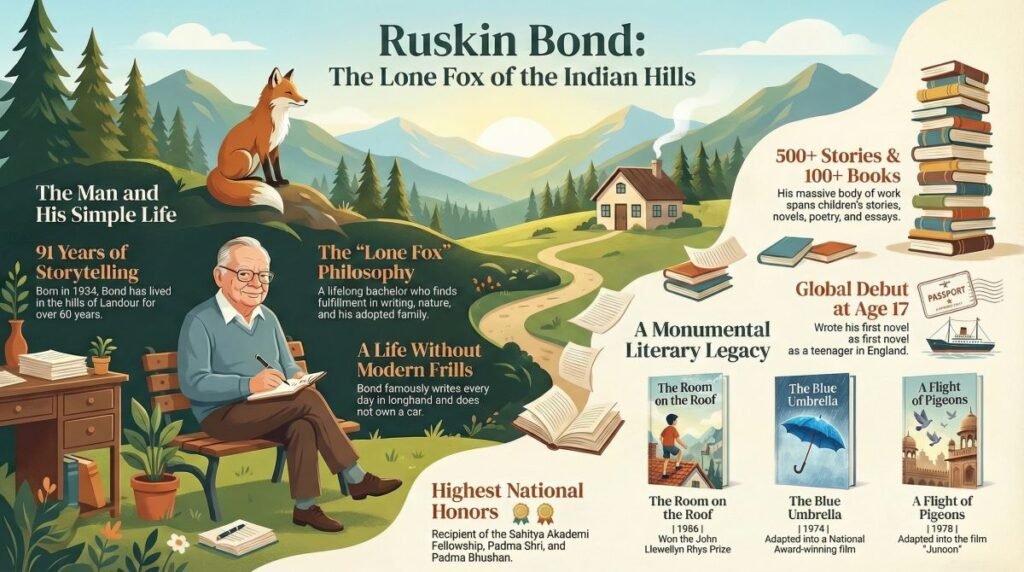
Yet for all his popularity, Ruskin Bond has lived the most un-glamorous of literary lives. He lives in a small house in Landour, above Mussoorie in Uttarakhand, at over 2,000 metres above sea level, surrounded by forests, birds, and the Himalayan landscape he has written about all his life. He does not own a car. He has never married. He writes every day in longhand. He walks to the local bookshop to sign copies of his books for the readers who come to find him there, as they have been doing for more than forty years. He is, in the fullest sense, exactly the man his books describe him to be.
This comprehensive article covers everything about Ruskin Bond – his biography in English, in 100 words, 150 words, 200 words, 500 words, and 1000 words; his parents, education, wife question, where he lives currently; all his books with summaries organised by age group; famous works; poems; autobiography; awards; and his complete literary legacy.
Ruskin Bond Biography: Complete At-A-Glance Table
The table below provides every essential fact about Ruskin Bond – from birth and parents to education, where he lives, awards, books, and the frequently asked question of whether he ever married:
| Biographical Detail | Information |
| Full Name | Ruskin Bond |
| Date of Birth | 19 May 1934 |
| Place of Birth | Kasauli, Himachal Pradesh (then Punjab, British India) |
| Age (as of 2026) | 92 years |
| Is Ruskin Bond Alive? | Yes – Ruskin Bond is alive and still writing as of 2026 |
| Nationality | Indian |
| Father’s Name | Aubrey Bond (British Army officer; died when Ruskin was 10) |
| Mother’s Name | Edith Dorothy (remarried after Aubrey Bond’s death) |
| Parents | Edith Dorothy and Aubrey Bond – his parents’ separation and his father’s early death profoundly shaped his childhood and his writing |
| Siblings | Ellen Bond (sister) and William Bond (brother) |
| Wife / Married? | Ruskin Bond never married – he has lived as a bachelor throughout his life and has explained this as a matter of temperament and circumstance |
| Why Did Ruskin Bond Not Marry? | He has said in interviews that he was never quite the marrying kind; he found fulfilment in writing, friendship, and his adopted family. He lives with the Behari family in Landour, Mussoorie – his adopted family of many decades. |
| Adopted Family | The Behari family – he has lived with them in Landour, Mussoorie for decades and considers them his family |
| Education | Bishop Cotton School, Shimla (1944–1950) – one of India’s most prestigious residential schools |
| Where Does He Live Currently? | Landour, Mussoorie, Uttarakhand – a small hill station above Mussoorie where he has lived for most of his adult life |
| First Book / First Novel | The Room on the Roof (1956) – written when he was 17; won the John Llewellyn Rhys Prize |
| Most Famous Books | The Room on the Roof (1956), The Blue Umbrella (1974), A Flight of Pigeons (1978), The Night Train at Deoli (1988 collection) |
| Autobiography Title | Lone Fox Dancing: My Autobiography (2017) |
| Total Books Written | Over 500 short stories, essays, and novellas; more than 69 books for children; over 100 books total |
| Padma Shri | 1999 |
| Padma Bhushan | 2014 |
| Sahitya Akademi Award | 1992 – for Our Trees Still Grow in Dehra (short story collection) |
| John Llewellyn Rhys Prize | 1957 – for The Room on the Roof; awarded by the Royal Literary Fund, UK |
| Lifetime Achievement | Sahitya Akademi Fellowship (2021) – the highest honour given by India’s national academy of letters; given to only the most distinguished living writers |
| Famous Line / Writing Style | Warm, lyrical, gentle prose celebrating the hills of India, childhood, nature, friendship, and simple pleasures; deeply rooted in the Himalayan landscape of Mussoorie and Dehradun |
| Core Themes | Nature, childhood, the hills of India, friendship, loneliness, nostalgia, simple living, the Anglo-Indian experience, love, loss |
| Ruskin Bond Young | He wrote his first novel at the age of 17 while living in England; returned to India at 18 to pursue a writing career |
Ruskin Bond Biography PDF and PPT Slides Download (.PPTX)
Who Is Ruskin Bond? (Ruskin Bond Wiki Overview)
Ruskin Bond is an Indian author and poet born on 19 May 1934 in Kasauli, Himachal Pradesh. He is one of India’s most prolific and most beloved writers – the author of more than 500 short stories, essays, and novellas, and more than 69 books specifically written for children. He writes in English with a warmth, simplicity, and gentleness that has made his work accessible to readers of all ages and from every background.
He is best known for his debut novel The Room on the Roof (written at 17, published in 1956), for the novella The Blue Umbrella (1974), for the short story collection The Night Train at Deoli (1988), and for his autobiography Lone Fox Dancing (2017). He has received the Sahitya Akademi Award (1992), the Padma Shri (1999), the Padma Bhushan (2014), and the Sahitya Akademi Fellowship (2021) – the highest honour India’s national literary academy gives to living writers.
He currently lives in Landour, Mussoorie, Uttarakhand – as he has for most of his adult life – and at the age of 91 continues to write, walk in the hills, and welcome the readers who make the journey up the mountain to find him.
Is Ruskin Bond Alive?
Yes – Ruskin Bond is alive. As of 2026, Ruskin Bond is 92 years old and lives in Landour, Mussoorie, Uttarakhand. He continues to write and remains actively engaged with his readers. He regularly visits the Cambridge Book Depot in Mussoorie to sign books for readers who travel from across India and the world to meet him.
Biography of Ruskin Bond in English: Early Life, Parents and Childhood
Ruskin Bond was born on 19 May 1934 in Kasauli, a small hill station in what was then the Punjab of British India and is now Himachal Pradesh. He was the son of Aubrey Bond – a British Army officer – and Edith Dorothy, an Anglo-Indian woman. His parents separated when he was still very young, and this early fracturing of his family became the defining emotional experience of his childhood and a recurring theme in all his most personal writing.
After his parents’ separation, the young Ruskin went to live with his father Aubrey Bond in Dehradun – a period he would later describe as the happiest of his childhood. His father was gentle, bookish, and deeply fond of his son, and their time together in Dehradun – reading, walking in the forests, watching birds – laid the foundations for everything Ruskin Bond would later become as a writer. The hills, the trees, the birds, the small-town life of northern India: all of it entered him during these years with his father.
Ruskin Bond Parents: Edith Dorothy and Aubrey Bond
- Father: Aubrey Bond – a British officer stationed in India; he separated from Edith Dorothy when Ruskin was very young; Ruskin lived with him in Dehradun and was closer to his father than to anyone else in his early life
- Mother: Edith Dorothy – Anglo-Indian woman; she remarried after her separation from Aubrey Bond; Ruskin lived with her and his stepfather for a period that he found unhappy; the tension between his love for his absent father and his difficult relationship with his stepfather is a central thread of his early autobiographical writing
- Aubrey Bond’s death in 1944 – when Ruskin was only 10 years old – was the most devastating event of his childhood; his father died of malaria while serving in the RAF in Burma; Ruskin was sent to boarding school and later lived with various family members before finding his own way in the world
- The sense of being an orphan – emotionally if not always literally – runs through much of his early fiction, and Rusty, the semi-autobiographical protagonist of The Room on the Roof, reflects directly this experience of displacement and the hunger for belonging
Ruskin Bond Education: Bishop Cotton School, Shimla
Ruskin Bond received his formal education at Bishop Cotton School in Shimla – one of the oldest, most prestigious, and most beautiful residential schools in India, founded in 1859 and set in the pine forests above the colonial hill station. He was a student there from 1944 to 1950, years that coincided with the most turbulent period of his early life – the death of his father, the difficult years with his mother and stepfather, and the gradual discovery of his vocation as a writer.
Education Timeline
- Born in Kasauli 1934; early childhood in Jamnagar, Dehradun, Delhi, and Shimla as his parents moved with Aubrey Bond’s postings
- 1944–1950: Enrolled at Bishop Cotton School, Shimla (also known as BCS) – a boarding school in the hills that gave him both a rigorous English education and his lifelong love of the mountain landscape
- At Bishop Cotton School he became a voracious reader – consuming everything he could find in the school library – and began writing his first stories and poems
- After school, he went to England – partly to explore the country that was part of his heritage, partly for adventure, partly to write
- In England he worked various jobs while writing; it was in England, aged 17, that he wrote the first draft of The Room on the Roof
- He returned to India permanently in 1955 – a choice driven not by practical calculation but by deep love: he belonged to India, to its hills, its sounds, its smells, and its people in a way he had never belonged to England
- He received no university education – he is entirely self-made as a writer, educated by books, by observation, and by a lifetime of attentive engagement with the world around him
Ruskin Bond Wife: Why Did Ruskin Bond Not Marry?
One of the most frequently asked questions about Ruskin Bond is about his wife – or rather, about why he has no wife, since Ruskin Bond has never married. He has lived as a bachelor throughout his life and has addressed this question directly and without embarrassment in interviews and in his autobiography.
Why Did Ruskin Bond Not Marry?
In his own words, Ruskin Bond has explained his unmarried status in several ways across different interviews and in his autobiography Lone Fox Dancing. He has said, essentially, that he was never quite ‘the marrying kind’ – that his temperament, his way of life, and his vocation as a writer made the settled domestic life of marriage feel less suited to him than the freedom of his bachelor existence. He has also spoken honestly about close relationships with women that never quite became marriage – some who married others, some whose lives and his simply diverged.
What he has found instead of a conventional family is the Behari family – the Dehradun family with whom he has lived in Landour for many decades. He has written warmly about his adopted grandchildren – particularly Siddharth (Rakesh) and Mukesh – who have grown up around him and who have given his later years the warmth of family without the formal structure of marriage.
He has also said, with the humour and honesty that characterise all his self-reflection, that a wife might not have found him very easy to live with – a man who spends his mornings writing, his afternoons walking in the hills, and his evenings reading. The life of Landour suited a bachelor perfectly, and Ruskin Bond has lived it with visible contentment for more than sixty years.

Where Does Ruskin Bond Live Currently?
Ruskin Bond currently lives in Landour, a small hill station located about 400 metres above Mussoorie in the Garhwal hills of Uttarakhand. Landour sits at an altitude of approximately 2,100 metres and is accessed by a steep road winding up through oak and chestnut forests above Mussoorie proper.
He has lived in Landour for most of his adult life – arriving in the early 1960s and staying ever since. He lives in a modest cottage with the Behari family – his adopted family – and his days follow a rhythmically simple pattern: writing in the mornings, walking in the afternoons, reading in the evenings. He is a familiar figure in Landour and in Mussoorie, and he makes regular visits to the Cambridge Book Depot in Mussoorie – one of the oldest bookshops in India – where readers who travel from across the country to meet him can find him signing copies of his books.
Landour has become, through his writing, one of the most literary places in India. His essays and stories about the town – its mist, its monkeys, its changing seasons, its old colonial buildings – have made it beloved to readers who have never visited it in person. Landour Days (2002), Roads to Mussoorie (2005), and dozens of essays in other collections have created a literary landscape around this small hill town that belongs entirely to Ruskin Bond.
Ruskin Bond Famous Books and Works: Complete List with Summaries
Ruskin Bond has written over 100 books and 500 short stories. The table below covers his major novels, collections, and non-fiction works – a comprehensive books list with year and summary for each:
| Title | Year | Summary / Description |
| The Room on the Roof | 1956 | His debut novel, written when he was just 17 years old while living in England. Semi-autobiographical story of Rusty, a young Anglo-Indian boy who escapes his strict guardian’s home in Dehradun to live with Indian friends on the rooftop of a house in the bazaar. A tender, beautifully observed portrait of adolescence and belonging in small-town India. Won the John Llewellyn Rhys Prize. |
| Vagrants in the Valley | 1961 | The sequel to The Room on the Roof, continuing the adventures of Rusty in the hills of northern India. |
| The Blue Umbrella | 1974 | One of his most loved works. A small girl named Binya living in the Himalayan hills trades her lucky leopard-claw necklace for a beautiful blue umbrella brought by Japanese tourists. The umbrella becomes a source of wonder and envy in the village. A simple, magical story that captures the innocence of childhood and the generosity of spirit of hill communities. Adapted into a successful Hindi film by Vishal Bhardwaj (2005). |
| A Flight of Pigeons | 1978 | A novella set during the 1857 Indian Mutiny, based on a real historical incident. Ruth Labadoor, a young Anglo-Indian girl, and her family are caught in the chaos of the uprising and are sheltered by an Indian Muslim landowner. A moving story of compassion, courage, and unexpected human connection across religious and cultural divides. Adapted into the Bollywood film Junoon (1978) by Shyam Benegal. |
| The Night Train at Deoli and Other Stories | 1988 | One of his most celebrated short story collections. The title story – about a young man who sees a girl at a railway station, loses her, and returns year after year to find her – is one of the most famous and widely anthologised Indian short stories in English. The collection showcases his mastery of the short form: atmospheric, deeply felt, and perfectly controlled. |
| Time Stops at Shamli and Other Stories | 1989 | Another beloved short story collection. Shamli is a fictional small town that appears in several of his stories – a place out of time, dreamy and half-forgotten, that perfectly embodies his nostalgic vision of small-town India. |
| Our Trees Still Grow in Dehra | 1991 | A collection of autobiographical stories drawing on his childhood and young adult years in Dehradun. Won the Sahitya Akademi Award in 1992. These deeply personal stories form the fullest literary account of his own life before the autobiography. |
| Delhi Is Not Far | 1994 | A novel about a young man dreaming of making his way to Delhi from a small hill town. Explores ambition, restlessness, and the allure of the city seen from a distance. |
| Roads to Mussoorie | 2005 | A collection of essays and stories about Mussoorie and the surrounding hill country – his home for most of his adult life. Reflective, warm, and filled with his intimate knowledge of the landscape, the people, and the history of the Himalayan foothills. |
| A Book of Simple Living: Brief Notes from the Hills | 2015 | A collection of reflections on the pleasures and philosophy of simple living – drawing on his decades of life in Landour. One of his most popular recent books, resonating deeply with readers seeking a quieter way of living. |
| Lone Fox Dancing: My Autobiography | 2017 | His autobiography – a long-awaited account of his life from his Anglo-Indian childhood through his years in England, his return to India, his decades in Landour, and his long literary career. Warm, candid, and beautifully written; the fullest account of the man behind the stories. |
| The Panther’s Moon | 1991 | One of his most popular books for young readers – a thrilling adventure set in the Himalayan forests involving a young boy and a panther. Showcases his deep knowledge of Indian wildlife and his gift for suspenseful, beautifully described nature writing. |
| The Cherry Tree | 1980 | A short, perfect picture book for children about a young boy who plants a cherry tree and watches it grow through the seasons. One of his most beloved books for young children – a gentle meditation on patience, nurturing, and the rewards of tending the natural world. |
| Dust on the Mountain | 1990 | A novella about a young boy from the hills who goes to work in a limestone quarry in the mountains – a sharp, compassionate story about the exploitation of child labour and the destruction of the natural environment. |
| The Great Train Journey | 2016 | A collection of stories and reflections centred on the experience of train travel across India – a recurring and much-loved motif in his writing. |
| Wind on the Haunted Hill | 2018 | A collection of ghost stories and horror tales – showing his versatility across genres. His supernatural stories are among the most beloved in Indian children’s literature. |
| Susanna’s Seven Husbands (and other stories) | 2011 | A collection including his famous dark comedy story about a woman who outlives seven husbands. The title story was adapted into the Bollywood film 7 Khoon Maaf (2011) directed by Vishal Bhardwaj. |
Ruskin Bond Books by Age Group: For Kids, 11 Year Olds, 12 Year Olds, Teenagers and Adults
One of the distinctive qualities of Ruskin Bond as a writer is that he writes for readers of all ages – from picture books for very young children to reflective essays for adults. The table below organises his books by the age group for which they are most appropriate:
| Age Group | Recommended Ruskin Bond Books |
| Books for Kids (5–10 years) | The Cherry Tree; The Blue Umbrella; Adventures of Rusty; Great Stories for Children; Cricket for the Crocodile; Snake Trouble; Owls in the Family |
| Books for 11 Year Olds | The Panther’s Moon; Dust on the Mountain; A Handful of Nuts; Rusty the Boy from the Hills; Landour Days |
| Books for 12 Year Olds | The Room on the Roof; The Night Train at Deoli; Time Stops at Shamli; The Hidden Pool; Children of India |
| Books for Teenagers | The Room on the Roof; Vagrants in the Valley; A Flight of Pigeons; The Great Train Journey; Wind on the Haunted Hill (horror stories) |
| Books for Adults | Lone Fox Dancing (autobiography); A Book of Simple Living; Roads to Mussoorie; Our Trees Still Grow in Dehra; Delhi Is Not Far; Susanna’s Seven Husbands; The Sensualist |
| Books for Horror Readers | Wind on the Haunted Hill; Secrets of the Forest; Strange Men Strange Places – his ghost stories and supernatural tales are beloved across age groups |
| Books Used in School | The Blue Umbrella; The Cherry Tree; A Flight of Pigeons; The Night Train at Deoli; selections from Our Trees Still Grow in Dehra – widely included in school English curricula across India |
What Is the Best Ruskin Bond Book to Start With?
- For young children (under 10): Start with The Cherry Tree or The Blue Umbrella – short, gentle, beautifully illustrated stories about children in the hills
- For children (10–12): Start with The Panther’s Moon or Adventures of Rusty – exciting, accessible, and rooted in the Himalayan landscape
- For teenagers: Start with The Room on the Roof – his debut novel, written when he himself was 17; its teenage protagonist and themes of belonging and adventure make it instantly relatable
- For adults: Start with The Night Train at Deoli and Other Stories – his short story writing at its finest; or Lone Fox Dancing for the full story of his extraordinary life
- For horror fans: Wind on the Haunted Hill – his ghost stories and supernatural tales are atmospheric, original, and genuinely unsettling
What Was Ruskin Bond’s First Book?
Ruskin Bond’s first book was The Room on the Roof, published in 1956. He wrote the first draft of this novel at the age of 17 while living in England – making him one of the youngest authors ever to produce a debut novel of lasting literary quality. The book was published by Deutsch in London and immediately won the John Llewellyn Rhys Prize – a prestigious British literary award for the best work of literature by a Commonwealth writer under 30.
The novel is semi-autobiographical – its protagonist, Rusty, is clearly a version of the young Ruskin Bond himself: an Anglo-Indian boy in Dehradun who escapes his strict, loveless guardian’s household to live among Indian friends in the bazaar. The themes of displacement, belonging, and the search for a true home that Ruskin Bond has explored throughout his literary life are all present in this first novel, making it both a remarkable debut and a perfect introduction to his entire body of work.
What Is the Autobiography of Ruskin Bond?
The autobiography of Ruskin Bond is Lone Fox Dancing: My Autobiography, published in 2017. It was a long-awaited book – readers and literary scholars had been urging Bond to write his autobiography for decades, and when it finally appeared, it did not disappoint.
About Lone Fox Dancing
- The title comes from a Japanese haiku – a small, solitary, dancing fox – which captures perfectly Ruskin Bond’s temperament: independent, unassuming, finding joy in small things, moving through life at his own unhurried pace
- The autobiography covers his entire life from his Anglo-Indian childhood in Kasauli and Dehradun, through his difficult years in England, his decision to return to India, his decades in Landour, and his long literary career
- He writes with characteristic warmth, humour, and lack of self-importance – he is as interested in the birds outside his window and the friends who passed through his life as he is in the literary awards and famous encounters
- He writes honestly about his father’s death, his difficult relationship with his mother and stepfather, his early years of near-poverty as a freelance writer, and the contentment he has found in his simple Landour life
- The book is essential reading for any Ruskin Bond fan – it brings together the scattered autobiographical threads of decades of stories and essays into a single coherent and deeply moving narrative
Ruskin Bond Poems and Poetry
While Ruskin Bond is primarily known as a prose writer of fiction and essays, he has also written poems throughout his career, and his poetry shares all the qualities of his best prose – simplicity, warmth, precise observation of the natural world, and a gentle melancholy that never tips into sentimentality.
His Poetry and Poems in English
- He has described himself as ‘a poet who writes fiction’ – suggesting that poetry is at the root of his sensibility even in his prose
- His poems are collected in several volumes including It Isn’t Time That’s Passing: Poems 1970–1999 and Poems (published in various editions by Penguin India)
- Common themes in his poems include the seasons of the hill year, the birds and trees of the Himalayan foothills, solitude, old age, and the passage of time
- Some of his most loved poems include ‘The Last Tram’, ‘All Roads Lead to Landour’, ‘The Seasons’, and many short nature lyrics written over five decades
- His poem ‘Rain in the Mountains’ – celebrating the monsoon arriving in the hills – is one of the most quoted and beloved pieces of writing about the Indian monsoon
- His poetry is accessible, musical, and deeply rooted in the sensory world of the hills – perfect for young readers being introduced to poetry and for adults who find most poetry difficult
- He has said that the haiku – the Japanese form of ultra-short nature poetry – is the poetic form closest to his own sensibility; its combination of precise observation and deep feeling in a very small space is exactly what he tries to achieve in all his writing
What Is the Famous Line of Ruskin Bond?
Ruskin Bond has written many lines that have become famous and widely quoted – both from his fiction and from his essays. Below is a selection of his most celebrated and widely shared lines:
| Famous Line / Quote | Source |
| If you are not happy where you are, you are not likely to be happy where you are going. | Essays |
| A small house, a garden, a few friends, a few books – what more does one need for a good life? | A Book of Simple Living |
| One must always have something to look forward to. Even if it’s only a cheese sandwich. | Various essays |
| The night train at Deoli stops for about ten minutes. In those ten minutes I lived a whole life. | The Night Train at Deoli |
| The trees were my best friends. They did not ask questions, make demands or spoil things by talking. | Our Trees Still Grow in Dehra |
| The hills are always there, patient and permanent. We are the ones who are passing through. | Landour Days |
| I am not a great writer. I am simply a man who loves stories and has been telling them for many years. | Interview |
These lines reflect the essential qualities of Ruskin Bond as a writer and a man – his belief in simplicity and contentment, his love of nature and friendship, his acceptance of loneliness and loss without bitterness, and his quiet conviction that a life lived close to the natural world and to honest human feeling is a life well lived.
Ruskin Bond: Complete Life and Career Timeline
| Year | Key Event |
| 1934 | Born on 19 May in Kasauli, Punjab, British India (now Himachal Pradesh) |
| 1939–44 | Childhood in Jamnagar, Dehradun, Delhi, and Shimla; parents separated; lived with father Aubrey Bond in Dehradun |
| 1944 | His beloved father Aubrey Bond died of malaria – the most devastating event of his childhood, which left him feeling profoundly alone and untethered |
| 1944–50 | Enrolled at Bishop Cotton School, Shimla – one of India’s most prestigious residential schools |
| 1951 | Went to England after completing school; worked in the Channel Islands and London; began writing seriously |
| 1951 | Wrote the first draft of The Room on the Roof at the age of 17 while living in England |
| 1955 | Returned to India permanently – a conscious and defining choice to live as a writer in the country he loved rather than remain in England |
| 1956 | Published The Room on the Roof – his debut novel, written at 17 |
| 1957 | Won the John Llewellyn Rhys Prize for The Room on the Roof – his first major literary honour |
| 1960s | Lived in Delhi and various parts of northern India; wrote prolifically for newspapers and magazines; established himself as a working writer |
| 1963 | Moved to Mussoorie and Landour – the hill station that would become his permanent home and the setting of much of his best writing |
| 1974 | Published The Blue Umbrella – one of his most beloved works |
| 1978 | Published A Flight of Pigeons; adapted into Bollywood film Junoon by Shyam Benegal |
| 1988 | Published The Night Train at Deoli and Other Stories – one of his most celebrated collections |
| 1991 | Published Our Trees Still Grow in Dehra – his most autobiographical story collection |
| 1992 | Won the Sahitya Akademi Award for Our Trees Still Grow in Dehra |
| 1999 | Awarded the Padma Shri – India’s fourth-highest civilian honour |
| 2005 | The Blue Umbrella adapted into a Hindi film by Vishal Bhardwaj |
| 2011 | Susanna’s Seven Husbands adapted into 7 Khoon Maaf by Vishal Bhardwaj |
| 2014 | Awarded the Padma Bhushan – India’s third-highest civilian honour |
| 2017 | Published Lone Fox Dancing – his long-awaited autobiography |
| 2021 | Awarded the Sahitya Akademi Fellowship – the highest honour given by India’s national literary academy, awarded only to the most distinguished living writers |
| 2025 | Continues to live and write in Landour, Mussoorie at the age of 91 |
| 2026 | Age of 92, Still Alive |
Biography of Ruskin Bond in 100 Words
Ruskin Bond was born on 19 May 1934 in Kasauli, Himachal Pradesh. His father Aubrey Bond died when he was 10, a loss that shaped his entire life. Educated at Bishop Cotton School, Shimla, he wrote his first novel The Room on the Roof at age 17 while in England. He returned to India in 1955 and has lived in Landour, Mussoorie ever since. He has written over 500 short stories and 100 books, including The Blue Umbrella, A Flight of Pigeons, and his autobiography Lone Fox Dancing. He received the Sahitya Akademi Award (1992), Padma Shri (1999), and Padma Bhushan (2014). He is 91 years old and still writing.
Biography of Ruskin Bond in 150 Words
Ruskin Bond was born on 19 May 1934 in Kasauli, Himachal Pradesh, to Aubrey Bond (British Army officer) and Edith Dorothy. His parents separated early, and his father died of malaria in 1944 when Ruskin was just ten – a loss that became the emotional centre of his early writing. He was educated at Bishop Cotton School, Shimla, and wrote his debut novel The Room on the Roof at 17 while living in England. He returned permanently to India in 1955, eventually settling in Landour, Mussoorie, where he has lived and written for over sixty years.
He has authored over 500 short stories, dozens of novels, and numerous books for children, including The Blue Umbrella, A Flight of Pigeons, and The Night Train at Deoli. He received the Sahitya Akademi Award in 1992, the Padma Shri in 1999, and the Padma Bhushan in 2014. He never married. He is alive and still writing at the age of 91.
Biography of Ruskin Bond in 200 Words
Ruskin Bond was born on 19 May 1934 in Kasauli, Punjab, British India (now Himachal Pradesh), to Aubrey Bond and Edith Dorothy. His parents separated early in his childhood, and Ruskin lived with his beloved father in Dehradun until Aubrey Bond’s sudden death from malaria in 1944, when Ruskin was just ten years old. This loss defined his childhood and became the emotional root of his most personal writing.
He was educated at Bishop Cotton School in Shimla, one of India’s finest residential schools, from 1944 to 1950. After school, he went to England, where at the age of 17 he wrote the first draft of The Room on the Roof – his debut novel. He returned permanently to India in 1955 and settled eventually in Landour, Mussoorie, Uttarakhand, where he has lived and written for more than sixty years.
Over his career he has written more than 500 short stories, over 69 books for children, and dozens of novels, novellas, and collections for adults. His most celebrated works include The Blue Umbrella, A Flight of Pigeons, The Night Train at Deoli, Our Trees Still Grow in Dehra, and his autobiography Lone Fox Dancing. He received the John Llewellyn Rhys Prize (1957), the Sahitya Akademi Award (1992), the Padma Shri (1999), the Padma Bhushan (2014), and the Sahitya Akademi Fellowship (2021). He never married. He is alive and still writing at 91.
Ruskin Bond Awards and Honours
- John Llewellyn Rhys Prize (1957) – Awarded by the Royal Literary Fund, UK, for The Room on the Roof; one of Britain’s most prestigious literary awards for a writer under 30
- Sahitya Akademi Award (1992) – India’s national literary academy award, received for Our Trees Still Grow in Dehra
- Padma Shri (1999) – India’s fourth-highest civilian honour
- Padma Bhushan (2014) – India’s third-highest civilian honour
- Sahitya Akademi Fellowship (2021) – The highest honour given by the Sahitya Akademi; awarded only to the most distinguished living writers, making Bond a Fellow of India’s national academy of letters alongside names like Amitav Ghosh and Gulzar
Ruskin Bond Books Adapted into Films
Several of Ruskin Bond’s stories have been adapted for cinema, testament to the cinematic quality of his storytelling:
- Junoon (1978) – Directed by Shyam Benegal; based on A Flight of Pigeons; starring Nafisa Ali and Shashi Kapoor; one of the finest Indian films of the 1970s
- The Blue Umbrella (Hindi film, 2005) – Directed by Vishal Bhardwaj; starring Pankaj Kapur; won the National Film Award for Best Children’s Film
- 7 Khoon Maaf (2011) – Directed by Vishal Bhardwaj; based on Susanna’s Seven Husbands; starring Priyanka Chopra in the lead role
- Ruskin Bond has also been adapted for television – several episodes of popular children’s television programmes have been based on his stories
Why Is Ruskin Bond So Famous?
Ruskin Bond’s fame rests on a combination of qualities that are rare in any writer and rarer still in a writer who achieves them across an entire lifetime of work. Here is why he is so famous, so widely read, and so deeply loved:
- He writes for everyone: few writers can claim to be genuinely enjoyed by eight-year-olds and eighty-year-olds, by school students and university professors, by city readers and hill communities; Ruskin Bond can
- He has never compromised: his writing has remained, across seven decades, loyal to the same values – simplicity, honesty, warmth, precise observation, and a love of the natural world; he has never written for the market or chased fashion
- He lives exactly as he writes: readers who visit him in Landour find the man his books describe – modest, warm, quietly witty, genuinely happy in his small house in the hills; there is no gap between the author and the person
- He brought the Indian hills to life: his Mussoorie and Landour, his Dehradun and Deoli, are as vividly realised as any fictional landscape in world literature; he has given Indian readers a way of seeing their own Himalayan landscape that nobody else has provided
- He is a master of the short story: the Indian short story in English has no finer practitioner; stories like The Night Train at Deoli, A Face in the Dark, and Time Stops at Shamli are perfect achievements – complete, resonant, and seemingly effortless
- He is a children’s writer of genius: The Blue Umbrella, The Cherry Tree, The Panther’s Moon – these books have introduced generations of Indian children to the pleasure of reading
10 Lines About Ruskin Bond for Students
- Ruskin Bond was born on 19 May 1934 in Kasauli, Himachal Pradesh, to Aubrey Bond and Edith Dorothy.
- He was educated at Bishop Cotton School, Shimla – one of India’s most prestigious residential schools.
- He wrote his debut novel The Room on the Roof at the age of 17 while living in England; it was published in 1956 and won the John Llewellyn Rhys Prize.
- He returned permanently to India in 1955 and settled in Landour, Mussoorie, Uttarakhand, where he has lived for over sixty years.
- He has written over 500 short stories and more than 100 books – including novels, essays, children’s books, and his autobiography.
- His most famous works include The Blue Umbrella, A Flight of Pigeons, The Night Train at Deoli, Our Trees Still Grow in Dehra, and Lone Fox Dancing.
- He was awarded the Sahitya Akademi Award in 1992, the Padma Shri in 1999, the Padma Bhushan in 2014, and the Sahitya Akademi Fellowship in 2021.
- He never married; he has lived with his adopted family – the Beharis – in Landour for many decades.
- His works have been adapted into films including The Blue Umbrella (2005), Junoon (1978), and 7 Khoon Maaf (2011).
- Ruskin Bond is alive and still writing at the age of 91, continuing to live in Landour, Mussoorie – one of India’s most beloved and enduring literary figures.
Conclusion: The Enduring Legacy of Ruskin Bond
Ruskin Bond is one of those rare writers who have become part of the landscape of a nation. In India, he belongs to the hills the way the leopard and the oak tree belong to them – naturally, quietly, without fuss. He did not set out to build a legacy; he set out to write the things he loved about the world he lived in, and the legacy built itself around him.
In an era of loud literary ambition, of experimental fiction and global prizes and social media celebrity, Ruskin Bond has simply continued doing what he has always done: writing short, honest, beautiful stories about a small boy in the hills, about a blue umbrella, about the night train at Deoli, about the trees that still grow in Dehra. And generation after generation of Indian readers has found in those stories exactly what they needed – comfort, beauty, the reminder that the world is good, and that a simple life, close to nature and to honest human feeling, is the richest life of all.
Also read: Khushwant Singh Biography PDF and PPT Slides Download
Final Quick Reference Summary
- Full Name: Ruskin Bond
- Born: 19 May 1934 – Kasauli, Himachal Pradesh
- Is Ruskin Bond Alive: Yes – alive and writing at 91 (2025)
- Parents: Aubrey Bond (father; died 1944) and Edith Dorothy (mother)
- Siblings: Ellen Bond (sister), William Bond (brother)
- Wife: Never married
- Why Not Marry: By temperament; finds fulfilment in writing, friendship, and adopted family
- Education: Bishop Cotton School, Shimla (1944–1950)
- Where He Lives: Landour, Mussoorie, Uttarakhand
- First Book: The Room on the Roof (1956) – written at age 17
- Autobiography: Lone Fox Dancing (2017)
- Famous Books: The Blue Umbrella; A Flight of Pigeons; The Night Train at Deoli; The Cherry Tree; Our Trees Still Grow in Dehra
- Books for Kids: The Blue Umbrella; The Cherry Tree; Adventures of Rusty; The Panther’s Moon
- Horror Books: Wind on the Haunted Hill
- Awards: John Llewellyn Rhys Prize (1957); Sahitya Akademi Award (1992); Padma Shri (1999); Padma Bhushan (2014); Sahitya Akademi Fellowship (2021)
- Famous Line: ‘If you are not happy where you are, you are not likely to be happy where you are going.’
- Films: Junoon (1978); The Blue Umbrella (2005); 7 Khoon Maaf (2011)
- Total Output: Over 500 short stories, 69+ children’s books, 100+ books total