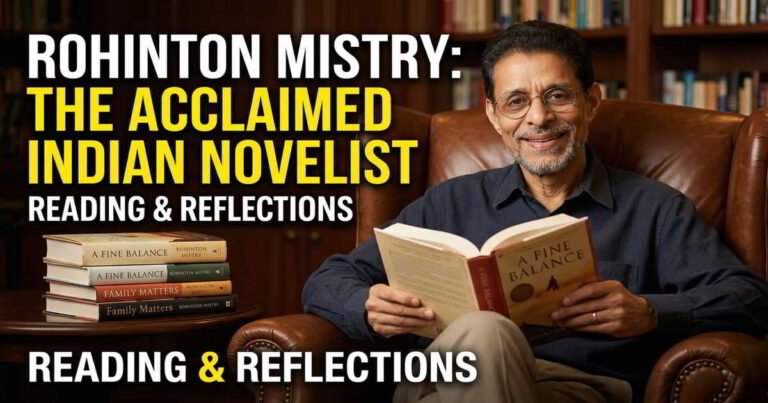
In this article we will discuss everything about Rohinton Mistry, Rohinton Mistry Biography PDF and PPT Slides Download – his biography, born date, age, where he lives, wife Freny Elavia, religion, all books in chronological order and in order of reading, famous works including A Fine Balance, Such a Long Journey, Family Matters, and Tales from Firozsha Baag, why he stopped writing, whether there is a new book, awards won by Rohinton Mistry, what he is known for, whether A Fine Balance is based on a true story, and his complete legacy as one of the greatest and most beloved novelists of his generation.
Table of Contents
Rohinton Mistry is a writer of rare and extraordinary gifts – a man who has published just four books over nearly four decades, and yet those four books have made him one of the most celebrated and most beloved novelists in the English-speaking world. He is an Indian-born Canadian author, a Parsi from Bombay who immigrated to Toronto in 1975, and whose fiction is rooted in two worlds: the Parsi community of Bombay that formed him, and the larger world of Indian history and Indian suffering that surrounds that community. He writes about India with the intimacy of someone who grew up there and the perspective of someone who has lived outside it for fifty years, and the combination produces fiction of extraordinary moral authority and emotional depth.
A Fine Balance (1995) – his masterpiece – is one of the most discussed, most debated, and most emotionally overwhelming novels of the twentieth century. It has been described as a great humanitarian novel, a devastating indictment of the Indian Emergency, a Dickensian portrait of poverty and injustice, and simply as one of the saddest and most beautiful books ever written. Oprah Winfrey selected it for her Book Club in 2001, and the selection brought it to an audience of millions of new readers who had the same experience: they wept, they were shattered, and they could not put it down.
Rohinton Mistry Biography Table (Biodata / Author Profile)
| Biographical Detail | Information |
| Full Name | Rohinton Mistry |
| Date of Birth / Born | July 3, 1952 |
| Born Place | Bombay (now Mumbai), Maharashtra, India – born into the Parsi community of Bombay; the Parsis are a small community of Zoroastrian faith whose ancestors fled from Persia to India over a thousand years ago and who settled primarily in the Gujarat and Bombay regions; the Parsi community of Bombay – its distinctive culture, its dwindling numbers, its apartments and Fire Temples and social institutions – is the world of Mistry’s fiction |
| Age | As of 2025, Rohinton Mistry is 72 years old – born July 3, 1952 |
| Where Does Rohinton Mistry Live? | Rohinton Mistry lives in Brampton, Ontario, Canada – a city in the Greater Toronto Area where he has lived since emigrating from India in 1975. He has lived in Brampton for nearly fifty years and is one of Canada’s most distinguished literary citizens, though he is rarely seen at public events and maintains an intensely private life. |
| Nationality | Canadian (he has lived in Canada since 1975 and is a Canadian citizen); Indian by birth and cultural formation |
| Religion | Zoroastrian – Rohinton Mistry is a Parsi, a member of the Zoroastrian faith community whose ancestors migrated from Persia (Iran) to India more than a thousand years ago. Zoroastrianism is one of the world’s oldest monotheistic religions, founded by the prophet Zarathustra (Zoroaster). The Parsi Zoroastrian community – its faith, its rituals, its Fire Temples, its social institutions, its declining numbers, and its uncertain future – is central to Mistry’s fiction. His characters are almost always Parsis, and the Parsi experience of living as a small minority community within the larger Hindu and Muslim majority of India is one of his most consistent themes. |
| What Is the Religion of Rohinton Mistry? | Rohinton Mistry is a Parsi Zoroastrian – a member of the Zoroastrian faith community descended from Persian immigrants to India. Zoroastrianism is one of the world’s oldest religions. The Parsi community of Bombay (Mumbai) is the social and spiritual world of his fiction. |
| Wife | Freny Elavia – Rohinton Mistry’s wife; she is also of Parsi background; the couple married before emigrating to Canada in 1975. Freny Elavia Mistry has been a constant presence in his life and a significant figure in his domestic and creative world; he maintains an intensely private personal life, and details about Freny Elavia are not widely available in published sources, but she is mentioned in various biographical accounts and is understood to have supported his writing career throughout its development. |
| Freny Elavia | Freny Elavia is Rohinton Mistry’s wife – searches for ‘Freny Elavia’ and ‘Freny Mistry’ in connection with Rohinton Mistry reflect the interest of readers and students in his personal life. She is of Parsi background and has been married to Mistry since before their emigration to Canada. She maintains a private life alongside her husband. |
| Family | Rohinton Mistry and his wife Freny Elavia have maintained an intensely private family life in Brampton, Ontario. He has largely withdrawn from public life – he rarely gives interviews, does not attend literary festivals, and makes almost no public appearances. This withdrawal reflects both his deeply private temperament and a traumatic experience he had in 2002 when he cancelled a US book tour after being repeatedly stopped, questioned, and subjected to racial profiling by airport security personnel – an experience he found deeply humiliating and that reinforced his reluctance to travel and to appear in public. |
| Education | St. Xavier’s College, Bombay (he studied Science before switching to other studies); University of Toronto (he worked as a bank clerk after emigrating and studied part-time, eventually taking courses in English literature and completing a degree) |
| Career Before Writing | After emigrating to Canada in 1975, Mistry worked as a bank clerk in Toronto – a job he held for a decade while writing his early short stories in his spare time; the experience of the immigrant working in a bank, navigating the Canadian world while remaining deeply connected to his Bombay past, is reflected in some of his early fiction |
| What Is Rohinton Mistry Known For? | Rohinton Mistry is known for A Fine Balance (1995) – his devastating masterpiece about the Indian Emergency; for Such a Long Journey (1991) – his debut novel about a Parsi bank clerk in Bombay during the 1971 war; for Family Matters (2002) – his third novel about a Parsi family in contemporary Bombay; and for Tales from Firozsha Baag (1987) – his debut short story collection about a Parsi apartment building in Bombay. He is known for the moral seriousness, the emotional power, the compassion, and the Dickensian scope of his fiction. |
| First Book | Tales from Firozsha Baag (1987) – his debut short story collection; published in Canada as Tales from Firozsha Baag and in the UK and India as Swimming Lessons and Other Stories from Firozsha Baag |
| Most Famous Work | A Fine Balance (1995) – his most celebrated and most widely read novel; shortlisted for the Booker Prize; selected for Oprah’s Book Club (2001); considered one of the great novels of the twentieth century |
| Why Did Rohinton Mistry Stop Writing? | Rohinton Mistry has not published a novel since Family Matters in 2002 – a silence of more than twenty years that has puzzled and saddened his many admirers. Several factors appear to have contributed to this long silence. In 2002, he cancelled a US book tour for Family Matters after being repeatedly subjected to racial profiling at American airports – stopped, searched, and questioned in ways he found deeply humiliating; this experience appears to have reinforced his general reluctance to engage in the public aspects of literary life. He has also spoken about the difficulty of writing – of the extreme demands that producing novels of the depth and scope of A Fine Balance and Family Matters places on a writer. He has not formally announced that he has stopped writing; he has simply not published. Whether a new book is coming remains unknown. |
| Is Rohinton Mistry Still Writing? | This is one of the most frequently asked questions about him – and the honest answer is that it is not publicly known. He has not published since Family Matters (2002). He has not announced that he has stopped writing, but he has also not announced an upcoming work. His admirers continue to hope that another novel is coming; his silence has now lasted more than twenty years. |
| New Book | As of 2025, Rohinton Mistry has not published a new book since Family Matters (2002). There have been occasional reports and rumours over the years about work in progress, but nothing has been confirmed or published. This long silence is one of the most discussed mysteries in contemporary literature. |
| Awards Won by Rohinton Mistry | Governor General’s Award for English-language fiction (1991, for Such a Long Journey); Commonwealth Writers’ Prize for Best Book (1992, for Such a Long Journey); Booker Prize shortlist (1991 for Such a Long Journey; 1995 for A Fine Balance; 2002 for Family Matters) – three Booker shortlistings without a win, which is itself a remarkable achievement; WH Smith Literary Award (1996, for A Fine Balance); Giller Prize shortlist; various honorary degrees |
Rohinton Mistry Biography PDF and PPT Slides Download (.PPTX)
Who Is Rohinton Mistry? What Is He Known For?
Rohinton Mistry is an Indian-born Canadian novelist and short story writer, born on July 3, 1952, in Bombay (now Mumbai), India. He is a Parsi – a member of the small Zoroastrian community whose ancestors emigrated from Persia to India over a thousand years ago. He emigrated to Canada in 1975, settled in Brampton, Ontario, and began writing fiction while working as a bank clerk.
He is known above all for A Fine Balance (1995) – one of the most powerful, most emotionally devastating, and most morally serious novels of the twentieth century; a vast, Dickensian portrait of four people thrown together in Bombay during the Emergency (1975-77), whose lives are broken by the indifference and the cruelty of the society around them. He is also known for Such a Long Journey (1991) – his debut novel, winner of the Governor General’s Award and the Commonwealth Writers’ Prize, about a Parsi bank clerk in Bombay during the 1971 war; and for Family Matters (2002) – his third novel, shortlisted for the Booker Prize, about a Parsi family navigating the difficulties of old age, family obligation, and contemporary Bombay.
He is known, too, for a kind of writing that is increasingly rare: writing that is morally serious without being didactic, emotionally powerful without being sentimental, politically engaged without being propagandistic, and compassionate without being naive. He is one of the last writers in the tradition of the great Victorian novelists – Dickens above all – who believed that fiction can change the way people see the world and can move them to care about suffering they might otherwise have ignored.
He lives in Brampton, Ontario. He has not published a novel since 2002. He maintains one of the most private literary lives of any major writer in the English-speaking world.
Rohinton Mistry Biography in English: Early Life, Born Place and Education
Rohinton Mistry was born on July 3, 1952, in Bombay – the great port city of western India that had been one of the most cosmopolitan and most culturally diverse cities in the world. He was born into the Parsi community – the small, close-knit community of Zoroastrian faith that had settled in India more than a thousand years earlier and that had, by the twentieth century, established itself as one of the most educated, most prosperous, and most culturally influential communities in the Indian subcontinent.
The Parsi community of Bombay – with its apartment buildings, its Fire Temples, its social institutions, its strong tradition of education and professional achievement, its dwindling numbers (Parsis have a very low birth rate and a policy against accepting converts), and its complex relationship with the larger Hindu majority of India – is the world of all Mistry’s fiction. He grew up in the kind of Parsi apartment building – the ‘baag’ – that would become the setting of Tales from Firozsha Baag; he attended school and college in Bombay; and he absorbed the world of Bombay’s streets, its class structures, its religious communities, and its political life in ways that would feed into A Fine Balance and his other novels.
He studied at St. Xavier’s College in Bombay before emigrating to Canada in 1975 with his wife Freny Elavia. The decision to emigrate was shaped by the political and social climate of India during the Emergency period (1975-77) – the period when Prime Minister Indira Gandhi suspended civil liberties and ruled by decree – and by the economic and professional opportunities available in Canada. He was 23 years old when he arrived in Toronto.
In Canada, he worked as a bank clerk – a job he held for about a decade while writing in his spare time. He also studied at the University of Toronto, taking courses in English literature and developing his formal literary education alongside his practical writing. He won his first literary prizes through short story competitions organised by the University of Toronto, which gave him early encouragement and early recognition.
Rohinton Mistry Wife: Freny Elavia
Rohinton Mistry’s wife is Freny Elavia – a Parsi woman from Bombay whom he married before emigrating to Canada in 1975. She is also known as Freny Mistry. The couple have lived together in Brampton, Ontario for nearly fifty years, and Freny has been a constant presence in the background of Mistry’s literary life.
Mistry maintains an intensely private personal life, and detailed information about Freny Elavia is not widely available in published sources. What is known is that she is of Parsi background, that she emigrated with him from Bombay, and that she has supported his writing career throughout its development. He has dedicated his novels to her and has spoken warmly about her in the rare interviews he has given.
The searches for ‘Freny Elavia’ and ‘Freny Mistry’ in connection with Rohinton Mistry reflect the natural curiosity of readers about the personal life of a writer who guards his privacy so carefully. What can be said with confidence is that Freny Elavia has been a partner in the literary life that produced four of the most important works of fiction in late-twentieth and early-twenty-first century literature.
Rohinton Mistry All Books: Complete List in Order
Rohinton Mistry has published four books over a career spanning nearly four decades – a small output by any measure, but each work is of the highest quality and of substantial scope. Here is his complete bibliography in chronological order:
| Year | Title | Type / Summary |
| 1987 | Tales from Firozsha Baag (Canadian edition) / Swimming Lessons and Other Stories from Firozsha Baag (UK/India edition) | Short story collection – his debut book; eleven interconnected stories set in Firozsha Baag, a Parsi apartment building in Bombay (Mumbai); the stories follow the residents of the building across different generations and different circumstances, exploring the specific world of the Parsi community – its traditions, its social hierarchies, its humour, its anxieties, its relationship to the larger world of Bombay. The final story, ‘Swimming Lessons’, is set in Canada and follows a young man (clearly a version of Mistry himself) who is writing stories about the residents of Firozsha Baag – a metafictional frame that connects the collection to the writer’s own experience of immigration and memory. One of the finest debut story collections in Canadian literature. Shortlisted for the Books in Canada First Novel Award. |
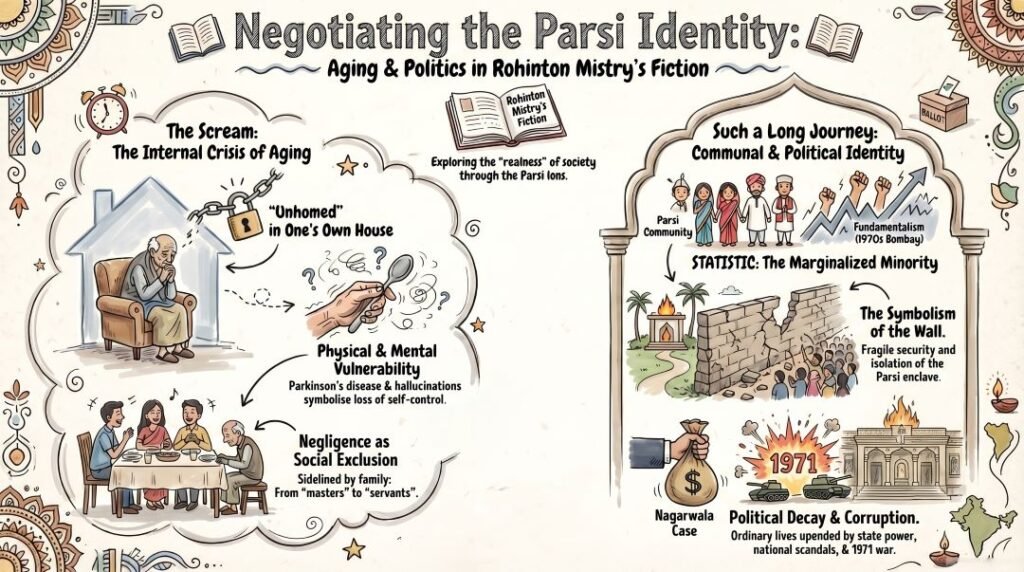
| 1991 | Such a Long Journey | His debut novel – winner of the Governor General’s Award for English-language fiction (1991) and the Commonwealth Writers’ Prize for Best Book (1992); shortlisted for the Booker Prize (1991). The story of Gustad Noble – a Parsi bank clerk in Bombay, a good man of strong principles and modest means, navigating the political chaos of the 1971 war (India’s war with Pakistan that led to the creation of Bangladesh) and its impact on his family and his small community. The novel is both an intimate portrait of Gustad’s family life – his troubled relationship with his eldest son Sohrab, his care for his sick friend Dinshawji, his attachment to the wall outside his home that becomes covered with religious paintings – and a vivid portrait of Bombay at a moment of political crisis. Winner of two of Canada’s most important literary prizes; considered the finest Indian-Canadian novel of its decade. |
| 1995 | A Fine Balance | His masterpiece and most famous work – shortlisted for the Booker Prize (1995); winner of the WH Smith Literary Award (1996); selected for Oprah’s Book Club (2001); widely regarded as one of the great novels of the twentieth century. Set during the Emergency (1975-77), the novel follows four characters – Dina Dalal, a Parsi widow trying to maintain her independence; Maneck Kohlah, a young man from the hills sent to board with Dina; Ishvar Darji and his nephew Omprakash, two tailors from a low-caste family who have come to the city – whose lives become entangled and are then systematically destroyed by the indifference and the cruelty of the Emergency regime. One of the most emotionally powerful and morally serious novels in the English language. |
| 2002 | Family Matters | His third and (so far) final novel – shortlisted for the Booker Prize (2002); winner of the Kiriyama Pacific Rim Book Prize. The story of Nariman Vakeel, a 79-year-old Parsi man suffering from Parkinson’s disease, who is moved from his comfortable home to the crowded apartment of his stepchildren Coomy and Jal when he breaks his ankle. The burden of his care falls increasingly on his daughter Roxana and her husband Yezad and their family. The novel is both an intimate portrait of a family under the pressure of old age, illness, and economic stress, and a meditation on the relationship between past and present – Nariman’s memories of his youth, his lost love Lucia, and his forced marriage to a woman he did not love haunting the novel’s present action. Shortlisted for the Booker Prize; considered one of the finest novels about old age and family obligation available in contemporary literature. |
A Fine Balance: Complete Analysis
A Fine Balance (1995) is Rohinton Mistry’s masterpiece – the novel most associated with his name, the one most frequently taught, most discussed, and most widely read. It is a work of extraordinary moral seriousness, emotional power, and Dickensian scope, set during one of the most traumatic episodes in modern Indian history: the Emergency declared by Prime Minister Indira Gandhi from June 1975 to March 1977.
| Aspect | Detail |
| Full Title | A Fine Balance |
| Author | Rohinton Mistry |
| Published | 1995 (McClelland and Stewart, Canada; Faber and Faber, UK) |
| Awards | Shortlisted for the Booker Prize (1995); WH Smith Literary Award (1996); selected for Oprah’s Book Club (2001); various other prizes and recognition |
| Setting | Bombay (now Mumbai), India, during the Emergency (1975-1977) – the period when Prime Minister Indira Gandhi suspended fundamental rights, imposed press censorship, imprisoned political opponents, and allowed her son Sanjay Gandhi to run a programme of forced slum clearances and compulsory sterilisation |
| Four Central Characters | Dina Dalal – a Parsi widow in her late thirties who has struggled to maintain her independence and financial self-sufficiency since her husband’s early death; she takes in a boarder and hires two tailors to help with a garment business. Maneck Kohlah – a young man from a hill town, sent to the city to study, who boards with Dina. Ishvar Darji – a tailor, the uncle, who has escaped the caste violence of his village with his nephew. Omprakash (Om) Darji – Ishvar’s nephew, young, hopeful, vulnerable. |
| A Fine Balance Summary | The novel begins with Dina Dalal’s story – her childhood, her brief happy marriage, and her years of widowhood spent maintaining her independence against the pressure of her bullying brother who wants to control her finances. It then introduces Maneck and the two tailors, all of whom come to live and work in her small flat. As the Emergency tightens its grip on the city – slum clearances, forced sterilisation camps, the corruption of the police and the government – the four characters’ lives become increasingly intertwined and increasingly precarious. The novel traces, with extraordinary compassion and without sentimentality, the progressive destruction of the tailors’ lives by forces entirely beyond their control: the Emergency, caste violence, the indifference of the state, and the random cruelty of powerful men. It is both a love story – the four characters form a genuine family – and a tragedy of immense power. |
| Is A Fine Balance Based on a True Story? | A Fine Balance is not based on a single true story – it is a work of fiction. However, it is deeply grounded in historical fact: the Emergency (1975-77) is a real historical event, and the abuses Mistry describes – the forced slum clearances, the compulsory sterilisation programme, the police brutality, the corruption of official power – are all historically documented aspects of that period. The characters are fictional, but they inhabit a historical reality that was all too real for millions of Indians. Many readers who lived through the Emergency have recognised the accuracy of Mistry’s portrayal. So the answer to ‘Is A Fine Balance based on a true story?’ is: it is based on a true history, inhabited by fictional characters. |
| The Title | The title comes from a line in Voltaire: ‘Optimism is the madness of insisting that all is well when we are miserable. There is a fine balance between hope and hopelessness – the fine balance that Mistry’s characters must maintain to survive in a world that is doing its best to destroy them. |
| Dickensian Quality | A Fine Balance is the novel most frequently compared to Dickens in contemporary literature – and the comparison is earned. Like Dickens, Mistry creates a vast social canvas inhabited by characters of extraordinary vividness; like Dickens, he is simultaneously a comic writer and a writer of deep pathos; like Dickens, he is furious about injustice and uses fiction as a vehicle for moral outrage; and like Dickens, he is, above all, a storyteller who makes the reader care desperately about what happens to his characters. |
| Oprah’s Book Club | Oprah Winfrey selected A Fine Balance for her Book Club in 2001 – six years after publication. The selection brought the novel to millions of new readers and made it one of the best-selling literary novels of the early 2000s. Many readers who discovered the novel through Oprah’s recommendation describe it as one of the most emotionally powerful books they have ever read. |
| Critical Reception and Legacy | Universally praised by critics; shortlisted for the Booker Prize; wins multiple literary awards; continues to be taught in universities worldwide in courses on postcolonial literature, South Asian literature, and the twentieth-century novel; regularly cited in lists of the greatest novels of the twentieth century; considered Mistry’s masterpiece and one of the defining works of Indian-Canadian literature |
Such a Long Journey: Complete Analysis
Such a Long Journey (1991) is Rohinton Mistry’s debut novel – the work that launched his career as a major literary figure and that remains, alongside A Fine Balance, one of the finest novels to have come from the South Asian diaspora in the twentieth century.
| Aspect | Detail |
| Full Title | Such a Long Journey |
| Author | Rohinton Mistry |
| Published | 1991 (McClelland and Stewart, Canada; Faber and Faber, UK) |
| Awards | Governor General’s Award for English-language fiction (1991); Commonwealth Writers’ Prize for Best Book (1992); Booker Prize shortlist (1991) |
| Protagonist | Gustad Noble – a Parsi bank clerk in Bombay; a good, decent man of deep principles; devoted to his family, his community, and his faith; haunted by a past injury to his leg (from an accident while protecting his son) and by a difficult relationship with his eldest son Sohrab, who has refused a coveted place at IIT (Indian Institute of Technology) that Gustad had worked hard to secure for him |
| Setting | Bombay, 1971 – during the lead-up to the Bangladesh Liberation War and India’s war with Pakistan; a moment of enormous political upheaval in which India’s engagement with the conflict in East Pakistan (Bangladesh) is intertwined with the internal politics of the Indira Gandhi government |
| Such a Long Journey Summary | Gustad Noble’s quiet, principled life in Khodadad Building (a Parsi apartment block in Bombay) is disrupted by a request from his old friend Jimmy Bilimoria, now mysteriously disappeared, asking him to deposit a large sum of money in a bank account – money that turns out to be connected to the government’s covert operations related to the Bangladesh war. Gustad, caught between his loyalty to his friend and his sense of integrity, finds himself entangled in events far beyond his understanding. Simultaneously, he navigates his difficult relationship with Sohrab, his wife Dilnawaz’s resort to a local holy man to cure their sick daughter, his friendship with the dying Dinshawji, and the small daily dramas of life in Khodadad Building. The novel builds to a climax involving the wall outside the building – which has been covered with religious paintings by a pavement artist – and a confrontation with authority. |
| The Wall | One of the novel’s most memorable and most symbolic elements is the wall outside Khodadad Building, which gradually becomes covered with religious images – Hindu gods, Muslim saints, Christian saints – painted by a local artist. The wall becomes a kind of secular shrine, bringing different religious communities together in a single sacred space. When it is threatened with demolition to make way for a road widening, the community rallies to defend it. The wall is both a literal plot element and a symbol of the syncretic, multi-religious culture of Bombay that Mistry values and mourns. |
| What Is the First Book of Rohinton Mistry? | Tales from Firozsha Baag (1987) is his first published book. Such a Long Journey (1991) is his first novel. Both answers are correct depending on whether the question refers to books in general or specifically to novels. |
| Film Adaptation | Such a Long Journey was adapted into a film in 1998, directed by Sturla Gunnarsson, starring Roshan Seth as Gustad Noble; the film received positive reviews and helped bring Mistry’s work to a wider audience |
Family Matters: Complete Analysis
Family Matters (2002) is Rohinton Mistry’s third and (as of 2025) most recent novel – shortlisted for the Booker Prize in 2002 and winner of the Kiriyama Pacific Rim Book Prize. It is a quieter, more intimate novel than A Fine Balance – its canvas is smaller, its politics less central, its focus more directly on the domestic world of a single family – but it is one of the most moving and most wise novels about old age, family obligation, and the weight of the past available in contemporary literature.
The novel centres on Nariman Vakeel – a 79-year-old Parsi man suffering from Parkinson’s disease, who has spent his life paying the price of a forced marriage: in his youth, he was in love with a non-Parsi woman, Lucia, but was pressured by his family to give her up and marry a Parsi widow with two children, Yasmin. Yasmin has since died, and Nariman lives with her now-adult children, Coomy and Jal, in a comfortable flat. When he breaks his ankle, Coomy engineers his removal to the crowded apartment of his biological daughter Roxana and her husband Yezad, where he becomes a burden on the family’s limited resources.
The novel traces the impact of Nariman’s presence on Roxana and Yezad’s family – on their marriage, their finances, their children, and their daily lives – with the psychological precision and the compassionate moral vision that characterise all of Mistry’s best work. Yezad’s gradual turn toward religious extremism – toward an increasingly orthodox and intolerant form of Parsi practice – is one of the novel’s most disturbing and most carefully observed developments.
Family Matters is dedicated to the theme of what families owe each other – what it means to care for the old, what it costs, and what it reveals about the people who do it. It is a novel about love and duty, and about the ways in which the past continues to shape and constrain the lives of the people who lived it.
Tales from Firozsha Baag: Analysis
Tales from Firozsha Baag (1987) – published in the UK and India as Swimming Lessons and Other Stories from Firozsha Baag – is Rohinton Mistry’s debut book and the foundation on which all his subsequent fiction was built. It is a collection of eleven interconnected short stories, all set in Firozsha Baag – a fictional Parsi apartment building in Bombay that serves as a microcosm of the Parsi community.
Each story focuses on a different resident or group of residents of the Baag: the Bulsara family with their eccentric son; the competitive apartments of Tehmurasps and Najamai; the old doctor Almaas; the couple whose marriage is falling apart. Together, the stories build a rich, multi-layered portrait of a community – its humour and its tragedy, its traditions and its small daily dramas, its relationship to the larger world of Bombay and to the India that surrounds it.
The final story, ‘Swimming Lessons’, is the most autobiographical – it follows a young Parsi man who has emigrated to Canada and is writing stories about the residents of Firozsha Baag, while his parents in Bombay read and react to the stories. It is a metafictional frame that connects the collection to Mistry’s own experience of immigration and memory, and that raises questions about the relationship between the writer and his community, between the immigrant and the world he has left behind.
Tales from Firozsha Baag is one of the finest debut story collections in Canadian literature – a work that announced a major new voice and that demonstrated, from the very beginning, the qualities that would make Mistry one of the most celebrated writers of his generation: the compassion, the precision, the Dickensian gift for character, and the deep, loving knowledge of a specific community and its world.
Why Did Rohinton Mistry Stop Writing?
The question ‘Why did Rohinton Mistry stop writing?’ is one of the most frequently asked in discussions of his work – and it deserves a careful and honest answer.
Rohinton Mistry has not formally announced that he has stopped writing. He has simply not published a novel since Family Matters in 2002 – a silence of more than twenty years. Several factors appear to have contributed to this long silence.
The most significant external factor was the traumatic experience of his 2002 US book tour for Family Matters. Shortly after the September 11 attacks, Mistry was repeatedly stopped, searched, and subjected to what he clearly felt was racial profiling at American airports – questioned and detained because he looked South Asian in a climate of post-9/11 anxiety about terrorism. He found this experience deeply humiliating and disturbing, and he cancelled the remainder of the US tour. This incident reinforced his existing reluctance to travel and to participate in the public aspects of literary life, and it may have deepened the withdrawal from public engagement that has characterised his career since.
There are also artistic factors. Writing novels of the depth, scope, and emotional power of A Fine Balance and Family Matters is extraordinarily demanding – it requires years of immersion in research, planning, and writing, and it requires a willingness to inhabit suffering and injustice with full imaginative commitment. After Family Matters, Mistry may have needed an extended period of recovery and recharging before being able to undertake another such project.
Mistry himself has been almost entirely silent on the subject – he gives almost no interviews and makes almost no public statements. He has not announced that he has abandoned writing; he has simply been absent from publication. His admirers continue to hope that another novel is coming. Whether that hope will be fulfilled remains the most tantalising unanswered question in contemporary Canadian literature.
Is A Fine Balance Based on a True Story?
A Fine Balance is not based on a specific true story – it is a work of fiction, with fictional characters. However, it is deeply and thoroughly grounded in historical reality. The Emergency (June 1975 – March 1977), during which the novel is set, was a real historical event in which Prime Minister Indira Gandhi suspended fundamental rights, imposed press censorship, imprisoned thousands of political opponents, and allowed her son Sanjay Gandhi to run a programme of forced slum clearances and compulsory sterilisation that caused enormous suffering.
The specific abuses depicted in A Fine Balance – the forced demolition of slums, the compulsory sterilisation camps, the corruption and violence of the police and the government, the powerlessness of ordinary citizens against the machinery of state power – are all historically documented. Mistry researched the Emergency extensively before writing the novel, and many readers who lived through it have testified to the accuracy of his portrayal. In that sense, the novel is deeply true – not to any single story, but to the experience of millions of Indians during those terrible years.
So the honest answer to ‘Is A Fine Balance based on a true story?’ is: it is fiction inhabited by historical truth. The characters are invented; the world they inhabit was real.
Rohinton Mistry Religion: Parsi Zoroastrian
Rohinton Mistry is a Parsi – a member of the Zoroastrian faith community whose ancestors emigrated from Persia (modern Iran) to India more than a thousand years ago, fleeing the Arab conquest and the Islamisation of Persia. The Parsi community settled primarily in the Gujarat and Bombay (Mumbai) regions of western India, where they established themselves as one of the most educated, most prosperous, and most culturally influential communities in the subcontinent.
Zoroastrianism is one of the world’s oldest monotheistic religions – older than Christianity and Islam, dating to the teachings of the prophet Zarathustra (Zoroaster) in ancient Persia, probably between 1500 and 1000 BCE. Zoroastrians worship one God (Ahura Mazda, the Wise Lord) and follow the prophet Zarathustra’s teachings about the cosmic struggle between truth and falsehood, light and darkness. Their sacred fire (the Atash) is maintained in Fire Temples (Agiaries), and the Parsis of India maintain these temples with great care and devotion.
The Parsi community is one of the smallest religious communities in India – numbering only around 60,000-70,000 people in India today, with a very low birth rate and a policy against accepting converts. The community’s sense of its own vulnerability, its dwindling numbers, and the question of its long-term survival are recurrent themes in Mistry’s fiction. The Parsis in his novels are acutely aware that they are a tiny minority in the vast Hindu majority of India, and this awareness shapes their social behaviour, their family life, and their relationship to the larger world around them.
Mistry’s fiction is the most comprehensive and the most artistically accomplished literary portrait of the Parsi community available in any language. His knowledge of Parsi culture – its rituals, its social institutions, its distinctive Bombay Gujarati language, its humour, its anxieties – is intimate and loving, and it gives his fiction a specificity and an authority that is one of its most distinguishing qualities.
Awards Won by Rohinton Mistry
| Award | Year | For / Detail |
| Governor General’s Award (English fiction) | 1991 | For Such a Long Journey – Canada’s most prestigious literary award; one of the most significant recognitions in Canadian literature |
| Commonwealth Writers’ Prize for Best Book | 1992 | For Such a Long Journey – the most prestigious Commonwealth literary prize |
| Booker Prize Shortlist | 1991 | For Such a Long Journey – first Booker shortlisting |
| Booker Prize Shortlist | 1995 | For A Fine Balance – second Booker shortlisting |
| WH Smith Literary Award | 1996 | For A Fine Balance – one of the most prestigious UK literary prizes |
| Booker Prize Shortlist | 2002 | For Family Matters – third Booker shortlisting; three shortlistings without a win is itself a remarkable distinction |
| Kiriyama Pacific Rim Book Prize | 2002 | For Family Matters |
| Giller Prize Shortlist | Various | Shortlisted for Canada’s most prestigious literary prize for fiction |
| Various honorary degrees | Various | From Canadian and international universities in recognition of his literary achievement |
It is worth noting that Rohinton Mistry has been shortlisted for the Booker Prize three times – for each of his three novels – without winning. This record is almost without parallel in the history of the prize and reflects both the consistently high quality of his work and the frustrating vagaries of prize-giving. Many readers and critics regard A Fine Balance as one of the greatest injustices in Booker Prize history – a masterpiece that deserved to win and did not.
Rohinton Mistry’s Writing Style
| Element | Detail |
| Prose Style | Clear, unaffected, and deeply humane – Mistry writes without stylistic showiness or formal experimentation; his prose is transparent in the best sense: it gets out of the way of the story and the characters, making the reader forget that they are reading and feel only that they are experiencing. The clarity and the simplicity of his prose are themselves artistic achievements – it is harder than it looks to write with this degree of naturalness. |
| The Dickensian Quality | Mistry is the contemporary novelist most frequently and most justifiably compared to Dickens – he shares with Dickens the vast social canvas, the extraordinary gallery of vivid characters, the combination of comedy and pathos, the moral outrage at injustice, and the gift of making the reader care desperately about fictional people. This Dickensian quality is his most distinctive feature and his greatest strength. |
| Compassion | His most fundamental quality as a writer is compassion – the ability to see every person, however humble or however damaged, as fully human; to render suffering with accuracy and without sentimentality; and to make the reader share his care for people they would never otherwise have encountered. This compassion is the source of the emotional power of A Fine Balance. |
| The Parsi World | His fiction is rooted in the specific world of the Parsi community of Bombay – its culture, its language, its humour, its anxieties, its social institutions. This rootedness gives his fiction a quality of cultural specificity that is one of its most valuable features: he is not writing about ‘India in general’ but about a particular community, in a particular city, at a particular historical moment. |
| Historical Grounding | His fiction is always deeply historically grounded – the political and historical events that form the background of his novels (the 1971 war in Such a Long Journey; the Emergency in A Fine Balance; Hindu nationalism and the Bombay riots of 1992-93 in Family Matters) are rendered with accuracy and authority. He researches his historical settings as thoroughly as any historian. |
| Humour | One of the less-often-noted qualities of his fiction is its humour – the comedy of the Parsi characters, their distinctively sardonic and self-deprecating wit, their ability to find the absurd in the tragic, is a consistent pleasure and a necessary counterweight to the suffering he also portrays. The humour does not diminish the suffering; it makes it more bearable, and it makes the characters more fully human. |
| Influences | He has cited Charles Dickens as the most important literary influence on his work; also Tolstoy and the Russian tradition; the Indian storytelling tradition in both its oral and written forms; and the specific tradition of Parsi literature in Bombay |
Rohinton Mistry Life Timeline
| Year | Key Event |
| 1952 | Born on July 3 in Bombay (now Mumbai), India – into the Parsi Zoroastrian community; grows up in a Parsi baag (apartment building) of the kind that will become the setting of his first book |
| 1952-1974 | Childhood and education in Bombay; attends St. Xavier’s College; absorbs the world of the Parsi community, of Bombay’s streets and social life, that will become the material of all his fiction |
| 1975 | Emigrates to Canada with his wife Freny Elavia; settles in Toronto (later Brampton), Ontario; begins working as a bank clerk |
| 1975-1985 | Works as a bank clerk while beginning to write short stories; studies at the University of Toronto; wins early literary recognition through University of Toronto short story competitions |
| 1983-1987 | Wins the Hart House Literary Contest at the University of Toronto for his short fiction; the stories that win prizes become the foundation of Tales from Firozsha Baag |
| 1987 | Tales from Firozsha Baag published – his debut book; immediately recognised as a major new voice in Canadian and Indian literature |
| 1991 | Such a Long Journey published – his debut novel; wins the Governor General’s Award for English-language fiction and the Commonwealth Writers’ Prize; shortlisted for the Booker Prize; establishes him as one of the most important novelists of his generation |
| 1995 | A Fine Balance published – his masterpiece; shortlisted for the Booker Prize; wins the WH Smith Literary Award; considered one of the great novels of the twentieth century |
| 2001 | Oprah Winfrey selects A Fine Balance for her Book Club – bringing the novel to millions of new readers six years after its publication; creates a new wave of readers and renewed critical attention |
| 2002 | Family Matters published – shortlisted for the Booker Prize; wins the Kiriyama Pacific Rim Book Prize; during the US book tour, he is repeatedly subjected to racial profiling at American airports and cancels the remainder of the tour; this experience reinforces his withdrawal from public literary life |
| 2002-present | Has not published another novel; maintains an intensely private life in Brampton, Ontario; gives almost no interviews; makes almost no public appearances; his long silence is one of the most discussed mysteries in contemporary literature |
| 2025 | Alive and living in Brampton, Ontario; 72 years old; no new publication announced |
10 Lines About Rohinton Mistry for Students
- Rohinton Mistry was born on July 3, 1952, in Bombay (Mumbai), India, into the Parsi Zoroastrian community; he immigrated to Canada in 1975 and lives in Brampton, Ontario.
- He is a Parsi Zoroastrian – a member of the small community of Zoroastrian faith whose ancestors emigrated from Persia to India over a thousand years ago; the Parsi community of Bombay is the world of all his fiction.
- His wife is Freny Elavia, also a Parsi; they emigrated to Canada together in 1975 and have been together throughout his literary career.
- His first book was Tales from Firozsha Baag (1987) – a collection of eleven interconnected short stories about residents of a Parsi apartment building in Bombay.
- His debut novel, Such a Long Journey (1991), won the Governor General’s Award and the Commonwealth Writers’ Prize and was shortlisted for the Booker Prize.
- His masterpiece, A Fine Balance (1995), is set during the Indian Emergency (1975-77) and is one of the most emotionally powerful and morally serious novels of the twentieth century; it was shortlisted for the Booker Prize and selected for Oprah’s Book Club.
- His third novel, Family Matters (2002), about a Parsi family caring for an elderly father with Parkinson’s disease, was also shortlisted for the Booker Prize – making him one of very few writers to be shortlisted three times without winning.
- He has not published since 2002; the question of why he stopped writing is one of the most discussed in contemporary literature; he cancelled a US book tour in 2002 after being subjected to racial profiling at American airports.
- A Fine Balance is not based on a single true story, but is deeply grounded in the historical reality of the Emergency – the forced slum clearances, compulsory sterilisation, and police brutality of the Indira Gandhi period are all historically documented.
- He is known for the compassion, the moral seriousness, the Dickensian scope, and the emotional power of his fiction – and is widely regarded as one of the greatest novelists of his generation.
Rohinton Mistry Short Biography (Profile / Biodata)
Rohinton Mistry (born July 3, 1952, Bombay/Mumbai, India; alive as of 2025) is an Indian-born Canadian novelist and short story writer. A Parsi Zoroastrian by faith and cultural background. Wife: Freny Elavia (also Parsi). Emigrated to Canada 1975; lives in Brampton, Ontario. Worked as a bank clerk in Toronto before becoming a full-time writer. Education: St. Xavier’s College, Bombay; University of Toronto. Published works: Tales from Firozsha Baag (1987, debut story collection); Such a Long Journey (1991, debut novel – Governor General’s Award, Commonwealth Writers’ Prize, Booker shortlist); A Fine Balance (1995, masterpiece – Booker shortlist, WH Smith Award, Oprah’s Book Club); Family Matters (2002 – Booker shortlist, Kiriyama Prize). Has not published since 2002. Three Booker shortlistings without a win. Known for compassion, moral seriousness, Dickensian scope, and the depth of his portrayal of the Parsi community of Bombay. A Fine Balance is not based on a single true story but is grounded in the historical reality of the Emergency (1975-77).
ALSO READ: Salman Rushdie Biography PDF and PPT Slides Download
Conclusion: Rohinton Mistry’s Enduring Legacy
Rohinton Mistry has published four books. That small output – one story collection and three novels – has been enough to make him one of the most celebrated and most beloved literary figures of his generation. The reason is simple: each of those four books is the product of a genuinely serious, genuinely gifted, and genuinely compassionate literary intelligence, working at the highest level of the art.
A Fine Balance will endure as long as people care about fiction that tells the truth about suffering and injustice. It is one of those rare novels that changes the reader – that makes them see the world differently, care about people they had never imagined, and understand history as something that happens to human beings, not to abstractions. It is the novel by which Mistry’s legacy will ultimately be measured, and that legacy is secure.
His long silence since 2002 is a source of sadness and of frustrated admiration for his readers. But the four books he has given us are enough. They are more than enough. They are, in their own way, as complete and as sufficient as anything in contemporary literature.
He lives quietly in Brampton, Ontario. He does not give interviews. He does not attend festivals. He does not court celebrity. He simply, quietly, wrote four books that will last – and that is a form of courage, and a form of achievement, that very few writers can claim.