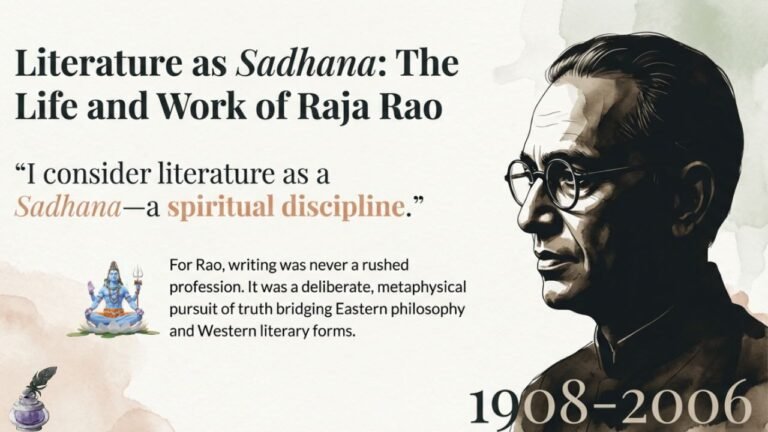
Today in this article we will discuss about the Raja Rao Biography PDF and PPT Slides, Raja Rao: Biography, Books, Famous Works, Kanthapura, Awards and Complete Legacy so, Raja Rao occupies a singular and somewhat solitary place in the landscape of Indian literature. While his fellow founding fathers of Indian writing in English – R.K. Narayan and Mulk Raj Anand – were prolific and widely read, Raja Rao was a slow, meticulous, demanding writer who produced only a handful of novels over a career spanning more than five decades. But the depth, philosophical ambition, and literary brilliance of those novels – especially Kanthapura (1938) and The Serpent and the Rope (1960) – have secured his place not just as one of India’s greatest writers, but as one of the major literary voices of the entire 20th century.
Table of Contents
He was a man who lived between worlds – between India and France, between East and West, between the ancient traditions of Advaita Vedanta and the modern philosophical currents of Europe. This in-between existence was not a problem for him to solve; it was his subject matter, his inspiration, and ultimately the source of his greatness. He wrote about what it means to be Indian in a world that does not fully understand India, what it means to seek spiritual truth in a century obsessed with material progress, and what it means to use the English language to say things that English was never designed to say. This article covers everything about Raja Rao – his biography in English, his education, his wives and family, his famous works and books, a full summary of Kanthapura, his awards including the Sahitya Akademi Award and Padma Vibhushan, his last work, the foreword to Kanthapura, and his enduring literary legacy.
Raja Rao Biography: Complete At-A-Glance Table
The table below provides a comprehensive biography of Raja Rao – every key fact from his birth and family to his marriages, education, awards, and literary output:
| Biographical Detail | Information |
| Full Name | Raja Rao |
| Date of Birth | November 8, 1908 |
| Place of Birth | Hassan, Karnataka (then Mysore State), British India |
| Date of Death | July 8, 2006 |
| Place of Death | Austin, Texas, USA |
| Age at Death | 97 years |
| Nationality | Indian (lived long years in France and the United States) |
| Father’s Name | H. V. Krishnaswamy (teacher and later headmaster) |
| Caste | Brahmin (Kannada-speaking Brahmin family from Karnataka) |
| First Spouse | Camille Mouly (French woman; married 1931; divorced) |
| Second Spouse | Katharine Jones (American actress; married 1965; divorced) |
| Third Spouse | Susan Vaught (married 1986) |
| Children | One son – Christopher (from second marriage) |
| Education | Aligarh Muslim University; University of Montpellier (France); University of Paris (Sorbonne) |
| Academic Career | Professor of Philosophy, University of Texas at Austin (1965–1988) |
| Language of Writing | English (with Sanskrit, Kannada and Indian philosophical thought deeply embedded) |
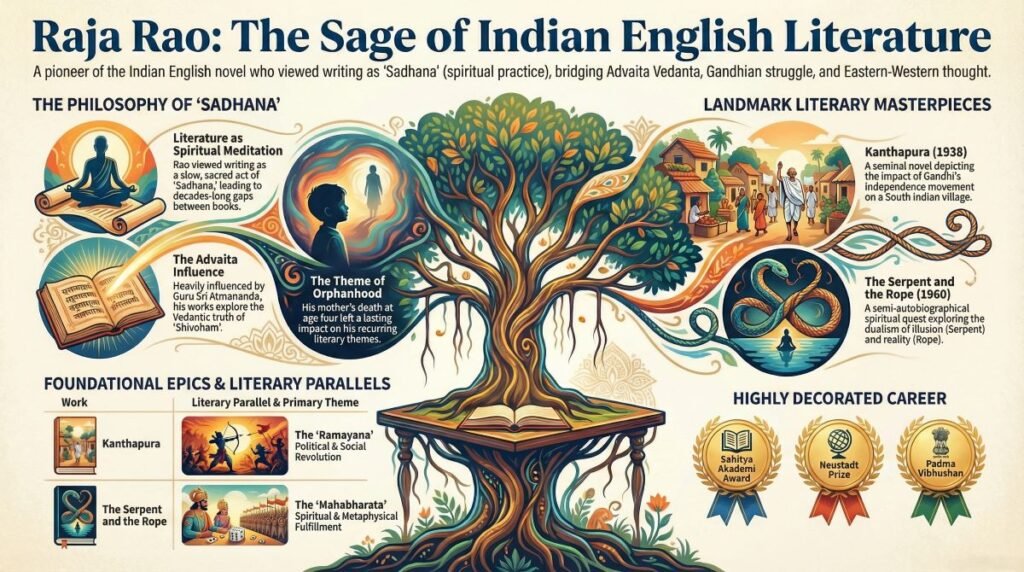
| First Novel | Kanthapura (1938) |
| Most Famous Novel | The Serpent and the Rope (1960) – won Sahitya Akademi Award 1964 |
| Last Major Novel | The Chessmaster and His Moves (1988) |
| Sahitya Akademi Award | 1964 – for The Serpent and the Rope |
| Padma Vibhushan | 2007 (posthumously) |
| Padma Bhushan | Never awarded Padma Bhushan; received Padma Vibhushan (India’s 2nd highest civilian honour) |
| Neustadt International Prize | 1988 – one of the most prestigious literary prizes in the world, often described as the ‘American Nobel’ |
| Literary Movement | Indian Writing in English; Vedantic Philosophy; Spiritual Realism |
| Spiritual Influence | Advaita Vedanta; Sri Ramana Maharshi; Sri Atmananda (his guru) |
| Core Themes | Indian philosophy (Vedanta), spiritual quest, colonialism and identity, East vs West, the nature of reality, Brahminical tradition |
| Literary Peers | R.K. Narayan, Mulk Raj Anand (the trio of founding Indian writers in English) |
Raja Rao Biography PDF and PPT Slides (136)
Who Was Raja Rao? (Raja Rao Wiki Overview)
Raja Rao was an Indian novelist, short story writer, and philosopher born in 1908 in Hassan, Karnataka, and died in 2006 in Austin, Texas, USA, at the remarkable age of 97. He wrote primarily in English but spent decades living in France and later the United States, teaching philosophy at the University of Texas at Austin for over twenty years.
He is one of the three writers universally credited with establishing the tradition of Indian writing in English – the others being R.K. Narayan and Mulk Raj Anand. But of the three, Raja Rao is by far the most philosophically ambitious and the most difficult to read. Where Narayan charmed with gentle irony and Anand moved with social passion, Raja Rao challenged, provoked, and demanded of his readers a willingness to engage with ancient Indian philosophy, Sanskrit thought, and the deepest questions of spiritual existence.
Quick Key Facts About Raja Rao
- Born: November 8, 1908 in Hassan, Karnataka, British India
- Died: July 8, 2006 in Austin, Texas, USA – aged 97
- First novel: Kanthapura (1938)
- Masterpiece: The Serpent and the Rope (1960) – won Sahitya Akademi Award 1964
- Major award: Neustadt International Prize for Literature (1988)
- Posthumous award: Padma Vibhushan (2007)
- Academic career: Professor of Philosophy, University of Texas at Austin (1965–1988)
- Spiritual path: Devoted follower of Advaita Vedanta; disciple of Sri Atmananda Krishna Menon
- Literary peers: R.K. Narayan and Mulk Raj Anand – the founding trio of Indian writing in English
Raja Rao Biography in English: Early Life, Background and Formative Years
Raja Rao was born on November 8, 1908, in the town of Hassan in the Mysore State (now Karnataka), British India. He came from a distinguished Kannada-speaking Brahmin family with deep roots in Sanskrit learning and the Shaivite religious tradition. His father, H. V. Krishnaswamy, was a teacher and later headmaster, which ensured that the young Raja Rao grew up in an environment that valued education, learning, and intellectual inquiry.
A defining feature of his early formation was that he spent much of his childhood and adolescence in Hyderabad, living in the household of his grandfather – a Sanskrit scholar – where he was immersed in the world of Hindu philosophy, mythology, and classical Indian learning from the very beginning. At the same time, he attended a Madrasa (Muslim school) in Hyderabad, giving him an unusually broad exposure to different religious and cultural traditions from a young age – an experience that would later give his writing its distinctive quality of finding philosophical truth across boundaries.
What Is the Caste of Raja Rao?
Raja Rao came from a Kannada Brahmin family – specifically from the Smartha Brahmin tradition of Karnataka. This Brahmin background and the deep Sanskrit learning that came with it were absolutely central to his intellectual formation and his literary vision. His novels, especially The Serpent and the Rope, are steeped in the concepts, symbols, and philosophical arguments of the Brahminical tradition – particularly Advaita Vedanta, the non-dualistic school of Hindu philosophy associated with the philosopher Adi Shankaracharya.
His caste and cultural background were not simply biographical facts for him; they were the lens through which he understood the world, the source of his deepest intellectual commitments, and a central subject in his fiction. He wrote from within the Brahmin tradition while also subjecting it to searching philosophical examination.
Raja Rao Education: From Hyderabad to the Sorbonne
Raja Rao’s education was one of the most extraordinary of any Indian writer of his generation – spanning continents, languages, and intellectual traditions in a way that perfectly mirrors the cross-cultural concerns of his fiction.
Education Timeline
- Early schooling in Hyderabad – attended Madrasa-e-Aliya, a Muslim educational institution; this unusual beginning in a Muslim educational environment gave him a lifelong respect for religious and cultural diversity
- Enrolled at Aligarh Muslim University – one of the most prestigious institutions in colonial India; further deepened his multicultural, multilingual intellectual formation
- 1927: Left India for France at the age of 19 – a pivotal decision that would shape the entire course of his life and work
- Enrolled at the University of Montpellier in southern France; studied French language, literature, and culture
- Moved to Paris and enrolled at the University of Paris (Sorbonne) – one of the world’s great universities, with a particularly strong tradition in philosophy and literature
- At the Sorbonne, he studied French and Provencal literature; encountered the ideas of Bergson, Sartre, and other major French philosophers
- He never completed a formal doctoral degree, but his years in Paris gave him a thorough grounding in European philosophy, literature, and intellectual culture
- His years in Europe – and especially his marriage to a French woman and his life in French intellectual circles – provided the direct experiential material for his masterpiece The Serpent and the Rope
Raja Rao’s education was not simply academic. He was educated equally by his immersion in Indian philosophical tradition – particularly Advaita Vedanta – and by his decades of life in Europe. This double education, in the deepest Indian and deepest Western traditions simultaneously, made him one of the most philosophically sophisticated Indian writers of the 20th century.
Raja Rao Wife: Three Marriages and Personal Life
Raja Rao’s personal life was marked by three marriages – each reflecting a different phase of his long life and each bearing on the themes of his literary work. His relationships across cultural and national boundaries were not merely biographical facts; they were lived experiences of the very East-West encounter that his fiction explores most deeply.
First Marriage: Camille Mouly (1931)
- Married Camille Mouly, a French woman, in 1931 while living in France
- Their marriage was one of the first and most intense cross-cultural encounters of his life – an Indian Brahmin scholar and a French woman navigating the vast differences in their cultural and spiritual worlds
- The marriage became the direct biographical inspiration for The Serpent and the Rope – in which the protagonist Ramaswamy is an Indian scholar married to a French woman, and the novel traces the slow, painful dissolution of that marriage as the two fundamental philosophical and spiritual orientations of their worlds prove ultimately irreconcilable
- The marriage ended in divorce, after many years, around 1963
Second Marriage: Katharine Jones (1965)
- Married Katharine Jones, an American actress, in 1965 – the same year he joined the University of Texas at Austin
- They had one son together, named Christopher
- This marriage also eventually ended in divorce
Third Marriage: Susan Vaught (1986)
- Married Susan Vaught in 1986 – his third and final marriage
- This marriage lasted until his death in 2006
- Susan Vaught was with him in his final decades in Austin, Texas
The pattern of Raja Rao’s marriages – to a French woman, then an American woman, before finding final stability – mirrors the trajectory of his inner life: a long, restless quest that took him through the intellectual and spiritual landscapes of Europe and America before arriving at a kind of acceptance. His experience of cross-cultural marriage gave his fiction an authenticity and a depth of feeling in its treatment of East-West relationships that no amount of research could have produced.
Raja Rao Famous Works: Complete Books, Novels and Stories
Raja Rao was not a prolific writer in terms of volume. Over his entire career, he published five novels, two short story collections, and a volume of essays. But what he produced was of extraordinary quality – dense, philosophically ambitious, and linguistically inventive in ways that no other Indian writer in English has matched.
Complete Novels and Major Books Table
| Title | Year | Summary / Description |
| Kanthapura | 1938 | His debut novel and one of the great works of Indian literature in English. Set in a small South Indian village called Kanthapura, it tells the story of how Gandhi’s independence movement reaches and transforms an isolated Brahmin community. Narrated in the voice of an old village woman in a style that mimics the rhythms of oral Indian storytelling. Considered essential reading in postcolonial literature. |
| The Serpent and the Rope | 1960 | His masterpiece. A vast, philosophically dense, semi-autobiographical novel following Ramaswamy, a young South Indian Brahmin scholar living in France and navigating the collapse of his marriage to a French woman, his spiritual quest for truth, and the ultimate tension between Indian and Western ways of knowing. Won the Sahitya Akademi Award in 1964. Widely regarded as one of the greatest Indian novels ever written. |
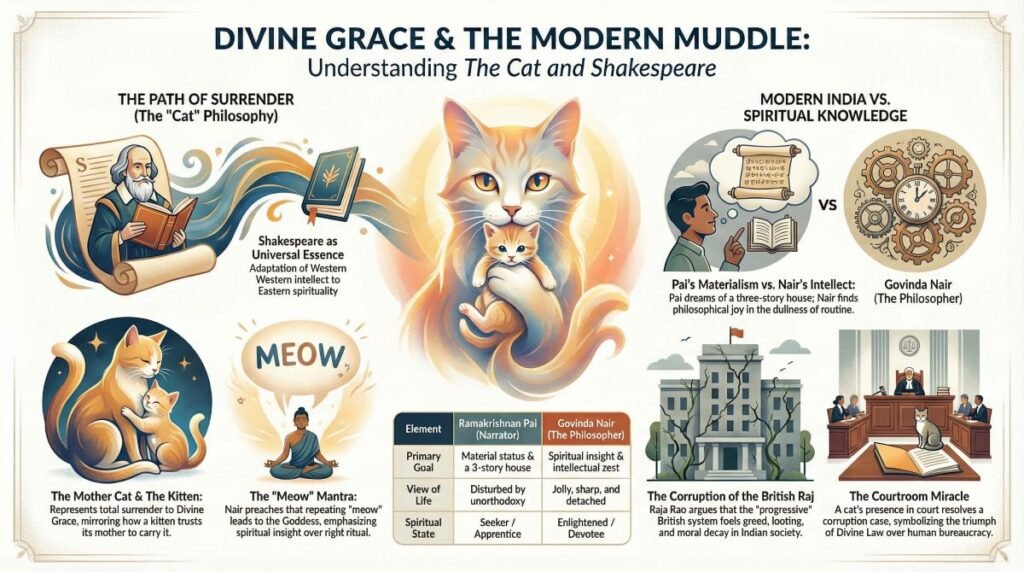
| The Cat and Shakespeare | 1965 | A short, experimental philosophical novel set in Trivandrum, Kerala. Two government clerks – Ramakrishna Pai and his neighbour Govindan Nair – live out their daily lives while an allegorical cat moves freely between their worlds and rooftops, embodying the Hindu concept of divine grace (bhakti). The cat operates as a symbol of God’s will and human surrender. |
| Comrade Kirillov | 1976 | A short novel exploring the intersection of Communist ideology and Indian philosophical thought through the character of a South Indian intellectual who becomes a committed Marxist in Europe. A meditation on political belief as a form of spiritual substitute. |
| The Chessmaster and His Moves | 1988 | His most ambitious and longest novel – a vast philosophical work exploring mathematics, metaphysics, Vedantic philosophy, and the nature of consciousness through a chess grandmaster protagonist. Demanding and erudite; considered his most complex work. |
| On the Ganga Ghat | 1989 | A collection of short fiction set along the ghats of Varanasi; meditative, atmospheric, deeply rooted in the spiritual geography of India’s holiest city. |
| The Meaning of India | 1996 | A collection of essays in which Raja Rao reflects on Indian civilisation, philosophy, culture, and identity over a lifetime of thought and global experience. |
Short Story Collections
| Collection Title | Year | Description |
| The Cow of the Barricades and Other Stories | 1947 | His first short story collection. The title story features a sacred cow who becomes a symbol of Gandhian non-violence during the independence movement. Stories blend Indian mythology, village life, and political awakening. |
| The Policeman and the Rose | 1978 | A later collection of short fiction exploring philosophical and spiritual themes through compressed, fable-like narratives. Demonstrates his mastery of the short form. |
| Javni | 1989 | A short story frequently studied in academic contexts; depicts the life of a devoted old servant woman and explores caste, devotion, and quiet dignity. |
| A Client | (short story) | A frequently anthologised short story; explores themes of encounter, exchange, and the nature of human transaction in an Indian social context. |
Kanthapura by Raja Rao: Complete Summary, Characters, Notes and Introduction
Kanthapura (1938) is Raja Rao’s debut novel and one of the landmark works of Indian literature in English. It is essential reading for anyone studying Indian literature, postcolonial literature, or the Indian independence movement. Below is a comprehensive guide to the novel – including its summary, characters, narrative technique, the famous foreword, and its literary significance:
| Aspect | Detail |
| Full Title | Kanthapura |
| Author | Raja Rao |
| Year of Publication | 1938 |
| Publisher | George Allen and Unwin (London) |
| Setting | Fictional village of Kanthapura in South India (based on Karnataka) |
| Narrator | Achakka – an old Brahmin woman narrating the story to an unseen listener |
| Narrative Style | Oral storytelling tradition (Sthala-Purana style – a form of mythological local chronicle); long, flowing sentences mimicking spoken Indian speech |
| Central Theme | The arrival of Gandhi’s independence movement (Non-Cooperation and Civil Disobedience) in a remote South Indian village and the transformation it causes |
| Protagonist | Moorthy – a young Brahmin man who becomes a devoted Gandhian activist in the village |
| Key Characters | Achakka (narrator), Moorthy, Rangamma, Ratna, various village women – the women of Kanthapura are among the novel’s most powerful presences |
| Foreword / Introduction | Raja Rao’s famous Foreword to Kanthapura is one of the most cited statements on the challenges of Indian writing in English – it explains his choice of English as a medium and his use of an Indian narrative rhythm |
| Literary Significance | One of the first major Indian novels in English to successfully use English while retaining Indian cadences, mythology, and oral tradition. Considered a landmark of postcolonial literature worldwide. |
| Academic Study | Widely taught in universities in India, the United Kingdom, the United States, and internationally; a core text in postcolonial literary studies |
Raja Rao Kanthapura Summary: Chapter-Wise Overview
Kanthapura is set in a small, remote South Indian village of the same name, located in the Ghats region of Karnataka. The novel is narrated entirely by Achakka, an elderly Brahmin woman who tells the story of what happened to her village when a young man named Moorthy came back from the city fired with Gandhian ideals.
- Opening – Achakka introduces Kanthapura: its caste hierarchy, its gods, its rhythms of daily agricultural life, and its social divisions. The village is centred on the Brahmin quarter, with lower-caste communities living on its margins.
- Moorthy’s Return – Moorthy, a young educated Brahmin, returns to the village having been transformed by exposure to Gandhi’s philosophy. He begins working across caste lines – an act that scandalises the conservative village establishment.
- The Spread of the Movement – Moorthy’s ideas gradually take hold. He organises a Congress committee, persuades women to participate in the movement, challenges caste divisions, and introduces the spinning of khadi (homespun cloth) as an act of resistance.
- The Women’s Role – The women of Kanthapura, led by figures like Rangamma and the widow Ratna, become the backbone of the resistance movement. Their courage and sacrifice are among the most memorable aspects of the novel.
- Conflict and Violence – The local British-aligned landlord and the police begin to crack down. The village is subjected to violence, raids, and coercion. Moorthy is arrested.
- The Destruction of Kanthapura – The village is eventually destroyed – its inhabitants dispersed, its physical structure dismantled as retribution for its resistance. The novel ends with Achakka narrating from exile – the village itself has ceased to exist in its original form.
- The Mythological Frame – Throughout the novel, Raja Rao weaves the independence movement into the fabric of Hindu mythology, presenting Moorthy as a kind of avatar of the god Vishnu and Gandhi as a divine saviour figure. This mythologising of political events is one of the novel’s most distinctive and debated literary strategies.
Raja Rao Foreword to Kanthapura: The Most Famous Statement on Indian Writing in English
The Foreword to Kanthapura is one of the most quoted and discussed passages in the entire history of Indian writing in English. In it, Raja Rao addresses directly the challenge that faced every Indian writer choosing to write in English – a language inherited from the coloniser, with its own deep cultural assumptions – while trying to express the lived reality of India.
He writes that the English language is not truly foreign to India – that it is ‘the language of our intellectual make-up’ even if ‘not of our emotional make-up.’ He argues that Indians must use English, but must use it differently – infusing it with Indian rhythms, Indian thought patterns, and the cadences of Indian storytelling traditions.
Key Ideas in the Kanthapura Foreword
- English as a medium must be ‘Indianised’ – not by importing Indian words wholesale, but by changing the rhythm and pace and breath of the prose itself
- He draws on the tradition of the Purana – the Indian mythological chronicle – as a model for the kind of storytelling he attempts in the novel
- He acknowledges that ‘we cannot write like the English’ and that ‘we should not’ – the Indian writer must forge their own relationship to the English language
- The Foreword establishes Raja Rao as the most self-aware and theoretically sophisticated of the three founding Indian writers in English
- It has been reprinted and anthologised dozens of times and is considered essential reading for anyone studying Indian English literature
The Serpent and the Rope: Raja Rao’s Masterpiece
The Serpent and the Rope (1960) is Raja Rao’s greatest novel and one of the most philosophically ambitious works of fiction ever produced by an Indian writer. It took him more than twenty years to write – the gap between Kanthapura (1938) and this novel (1960) is one of the most dramatic silences in the history of Indian literature, and what emerged from it was a work of extraordinary power and complexity.
Summary of The Serpent and the Rope
The novel follows Ramaswamy, a young South Indian Brahmin historian living in France, who is engaged in doctoral research on the Albigensian heresy – a medieval religious movement that has deep thematic connections to the Advaita Vedanta philosophy Ramaswamy (and Raja Rao himself) hold most dear. The novel traces the deterioration of his marriage to Madeleine, a French Catholic woman, as their two worldviews – Indian and European, Vedantic and Christian – prove ultimately and philosophically irreconcilable.
The title refers to a famous metaphor from Advaita Vedanta: a man in the dark sees a serpent on the path and is filled with terror – but when light is brought, the serpent turns out to be nothing but a rope. The serpent was never real; it was a projection of the mind onto a neutral reality. The novel uses this metaphor to explore the nature of all our perceptions, attachments, and fears – including the fear of death, the illusion of separation, and the ultimate non-reality of the ego.
Key Themes in The Serpent and the Rope
- Advaita Vedanta as a way of understanding all experience – the novel is as much a philosophical treatise as a work of fiction
- The failure of East-West marriage as a metaphor for the impossibility of bridging two fundamentally different metaphysical worldviews
- India and Europe in dialogue – Ramaswamy moves through French society, French intellectual life, and European culture while always remaining essentially, irreducibly Indian
- The nature of illusion (maya) – the serpent-rope metaphor permeates the entire novel; all of life’s apparent certainties are revealed as projections
- Love, death, and transcendence – the novel includes a deeply moving section dealing with the death of a child, drawn from Raja Rao’s own experience
- The guru-disciple relationship – Ramaswamy’s search for his true guru is one of the novel’s central dramatic and spiritual threads
The Cat and Shakespeare: Raja Rao’s Philosophical Fable
The Cat and Shakespeare (1965) is Raja Rao’s shortest novel and in many ways his most accessible – though it remains deeply philosophical. Set in Trivandrum, Kerala, among ordinary people going about their everyday lives, it uses the figure of a cat to explore the Hindu concept of divine grace (bhakti) and human surrender to God’s will.
Summary and Key Themes
- The novel follows two neighbours – the rational, cautious Ramakrishna Pai and the spontaneous, carefree Govindan Nair
- A neighbourhood cat moves freely between their worlds – climbing over walls, wandering between rooftops – and becomes the novel’s central symbol
- The cat represents God’s will, or divine grace – something that moves freely through the world without the need for human planning, control, or logic
- Govindan Nair represents the way of bhakti (devotional surrender) – he lives in complete trust of God’s will, like a kitten carried by the scruff of its neck by the mother cat
- Ramakrishna Pai represents the way of rational effort – he plans, worries, and controls, like a baby monkey that must cling to its mother by its own strength
- The novel gently argues that the way of surrender and trust – the cat’s way – is ultimately the path to peace and freedom
What Was Raja Rao’s Last Work?
Raja Rao’s last major novel was The Chessmaster and His Moves, published in 1988. It is his most ambitious, most complex, and longest work – a vast philosophical novel that weaves together themes of mathematics, metaphysics, Vedantic philosophy, language, consciousness, and the nature of reality through the figure of a chess grandmaster protagonist.
The novel is extraordinarily demanding – it presupposes a reader deeply familiar with Advaita Vedanta, European philosophy, and abstract mathematical thought. Even among admirers of Raja Rao’s work, it is considered his most difficult and most polarising novel. Some critics regard it as the culmination of his philosophical vision; others find it more philosophical treatise than novel.
After The Chessmaster and His Moves, Raja Rao published On the Ganga Ghat (1989), a collection of short meditative fiction, and The Meaning of India (1996), his collected essays on Indian civilisation. These were his final published works before his death in 2006.
Raja Rao Awards and Honours
Despite his relatively small literary output, Raja Rao received some of the most prestigious literary awards available to writers in India and internationally – a testament to the quality and significance of his work:
Complete Awards and Honours
- Sahitya Akademi Award (1964) – India’s highest literary honour, awarded for The Serpent and the Rope. This is the award given by the national academy of letters and represents the formal recognition of India’s literary establishment.
- Neustadt International Prize for Literature (1988) – Awarded by the University of Oklahoma and the magazine World Literature Today; widely described as the most prestigious literary award in the world after the Nobel Prize. Sometimes called the ‘American Nobel.’ Raja Rao was the first Indian writer to receive this award.
- Padma Vibhushan (2007, posthumous) – India’s second-highest civilian honour, awarded posthumously by the Government of India in recognition of his lifetime’s contribution to Indian literature and culture.
- Honorary degrees – received from various universities in India and abroad
- His nomination and receipt of the Neustadt Prize brought him close to consideration for the Nobel Prize in Literature, though he never won it
Raja Rao Sahitya Akademi Award – Details
- Year: 1964
- Book: The Serpent and the Rope (published 1960)
- The award recognised both the literary excellence and the philosophical depth of the novel
- The Sahitya Akademi Award placed him alongside R.K. Narayan (who won in 1960 for The Guide) as a co-foundational figure of Indian writing in English
Raja Rao as a Novelist: His Writing Style and Literary Significance
Understanding Raja Rao as a novelist requires understanding that for him, literature was not separable from philosophy. He did not write novels that contained philosophical ideas as a backdrop or decoration; he wrote novels in which philosophy was the very substance of the story. For Raja Rao, the act of writing a novel was itself a spiritual and philosophical act – an attempt to approach truth through language and story.
Defining Features of Raja Rao’s Writing Style
- Philosophical density: His novels, especially The Serpent and the Rope, contain extended passages of philosophical reflection that require familiarity with Advaita Vedanta, European phenomenology, and other complex traditions of thought
- Linguistic innovation: Following the principles he articulated in the Foreword to Kanthapura, he worked to Indianise English – to give it the long rhythms, the breath, and the cadence of Indian spoken narrative
- Mythological dimension: He consistently places the events of ordinary life within a mythological and cosmic frame; human drama is always simultaneously a reflection of eternal truths
- The East-West encounter: His fiction repeatedly returns to the meeting of Indian and Western worldviews – in marriage, in friendship, in intellectual dialogue – and explores both its richness and its ultimate incommensurability
- Autobiographical depth: All his major novels draw deeply from his own life – the village of his father’s family (Kanthapura), his marriage to a French woman (The Serpent and the Rope), his philosophical quest (The Cat and Shakespeare and The Chessmaster)
- Small output, profound quality: Unlike Narayan’s prolific output, Raja Rao published rarely – but every novel was a major literary event
Raja Rao and Ram Baksh Singh: Clarification
Some online searches connect the name Raja Rao with ‘Ram Baksh Singh.’ These are entirely different people. Ram Baksh Singh was a freedom fighter and revolutionary from Uttar Pradesh associated with the Indian independence movement – his story is historical and political in nature.
Raja Rao the novelist was a Karnataka-born, France-educated literary figure whose connection to the independence movement was through literature (Kanthapura) and philosophy, not through political action. There is no biographical connection between the novelist Raja Rao and Ram Baksh Singh. Searches combining these names likely appear because both are prominent Indian historical figures whose names sometimes appear together in general searches about Indian history.
Raja Rao: Complete Life and Career Timeline
| Year | Key Event |
| 1908 | Born on November 8 in Hassan, Mysore State (now Karnataka), British India |
| 1915–25 | Grew up in Hyderabad; educated in a Muslim household environment that gave him an early cross-cultural sensibility; attended Madrasa-e-Aliya |
| 1926 | Enrolled at Aligarh Muslim University; further developed his multilingual, cross-cultural intellectual formation |
| 1927 | Left India for France; enrolled at the University of Montpellier to study French language and literature |
| 1929–31 | Studied at the University of Paris (Sorbonne); immersed in French literature, philosophy, and intellectual life |
| 1931 | Married Camille Mouly, a French woman – his first of three marriages |
| 1930s | Moved between India and Europe; became part of French intellectual and literary circles; associated with progressive writers in India |
| 1933 | Published early short stories in Indian and European literary magazines |
| 1938 | Published Kanthapura – his landmark debut novel; written in London and Paris, set in Karnataka. Immediately recognised as a masterwork. |
| 1943 | Participated in Indian independence activities; returned periodically to India; associated with Gandhian circles |
| 1947 | Published The Cow of the Barricades and Other Stories; India gained independence |
| 1950s | Lived primarily in France; underwent a profound spiritual transformation; became a disciple of Sri Atmananda (Krishna Menon) – an Advaita Vedanta master |
| 1960 | Published The Serpent and the Rope – his masterpiece; 22 years after Kanthapura |
| 1963 | Divorced from Camille Mouly |
| 1964 | Won the Sahitya Akademi Award – India’s highest literary honour – for The Serpent and the Rope |
| 1965 | Published The Cat and Shakespeare; joined the University of Texas at Austin as Professor of Philosophy |
| 1965 | Married Katharine Jones (American actress) – his second marriage |
| 1976 | Published Comrade Kirillov |
| 1986 | Married Susan Vaught – his third and final marriage |
| 1988 | Published The Chessmaster and His Moves; received the Neustadt International Prize for Literature |
| 1988 | Retired from the University of Texas at Austin after 23 years as Professor of Philosophy |
| 1996 | Published The Meaning of India – his collected essays on Indian civilisation |
| 2006 | Died on July 8 in Austin, Texas, USA, at the age of 97 |
| 2007 | Posthumously awarded the Padma Vibhushan – India’s second-highest civilian honour |
10 Lines About Raja Rao for Students and Quick Reference
Here are 10 essential lines about Raja Rao – ideal for school assignments, essays, quick biographical summaries, and biography PDF reference:
- Raja Rao was born on November 8, 1908, in Hassan, Karnataka (then Mysore State), British India, into a distinguished Kannada Brahmin family.
- He is considered one of the three founding figures of Indian writing in English, alongside R.K. Narayan and Mulk Raj Anand.
- His debut novel Kanthapura (1938) tells the story of Gandhi’s independence movement reaching a remote South Indian village and is a landmark of postcolonial world literature.
- His masterpiece The Serpent and the Rope (1960) is a vast, semi-autobiographical philosophical novel about a South Indian scholar living in France; it won the Sahitya Akademi Award in 1964.
- He spent much of his adult life outside India – primarily in France and later in the United States, where he taught philosophy at the University of Texas at Austin from 1965 to 1988.
- He was deeply influenced by Advaita Vedanta – the non-dualistic school of Hindu philosophy – and became a disciple of Sri Atmananda (Krishna Menon), an Advaita master.
- He received the Neustadt International Prize for Literature in 1988 – one of the world’s most prestigious literary awards, sometimes called the ‘American Nobel.’
- He was married three times: to a French woman (Camille Mouly), an American actress (Katharine Jones), and Susan Vaught; he had one son named Christopher.
- He was posthumously awarded the Padma Vibhushan in 2007 – India’s second-highest civilian honour.
- He died on July 8, 2006, in Austin, Texas, at the age of 97, leaving behind one of the most philosophically profound bodies of work in the history of Indian literature.
Raja Rao Children and Family
Raja Rao had one son, Christopher, born from his second marriage to the American actress Katharine Jones. Christopher was raised primarily in the United States, and Raja Rao’s relationship with him was shaped by the complexities of a life divided between continents and cultures.
Raja Rao rarely spoke publicly about his children and family life in interviews – he was known for keeping his private life largely separate from his public literary persona. What is clear from his biography is that his three marriages and his cross-cultural family experience were a direct source of material for his fiction, particularly The Serpent and the Rope, which draws extensively on his first marriage to Camille Mouly.
Raja Rao Was Born In: Family Origins and Birthplace
Raja Rao was born in Hassan, a town in the Mysore State of British India (now the state of Karnataka). Hassan is located in the southern part of Karnataka, approximately 180 kilometres from Bangalore. It is a town known for its proximity to the famous Hoysala temple sites at Belur and Halebidu – ancient centres of Brahminical culture and Sanskrit learning.
His family’s roots in Karnataka’s Brahmin intellectual tradition were central to his identity. Though he spent most of his adult life abroad, he always identified as deeply, essentially Indian – and specifically as a product of the Sanskrit-learning, Vedanta-practising Brahmin culture of South India. This identity was not nostalgia for him; it was his philosophical foundation and the ground from which all his writing grew.
Also read: R.K. Narayan Biography PDF and PPT Slides
Conclusion: The Enduring Legacy of Raja Rao
Raja Rao was one of those rare writers who refused to make things easy – for himself or for his readers. He lived a long, demanding, philosophically serious life and wrote a small number of books that are among the most intellectually challenging and spiritually profound works in the entire tradition of Indian literature in English.
He is not the writer you turn to for an easy afternoon’s reading. He is the writer you turn to when you want to be genuinely changed by literature – when you want to encounter ideas and ways of seeing the world that are truly different from the ones you brought to the page. His Kanthapura gives you Gandhi’s India through the voice of a village woman narrating a mythological chronicle. His Serpent and the Rope gives you Advaita Vedanta in the form of a love story and a philosophical quest set against the backdrop of post-war Europe. His Cat and Shakespeare gives you the mystery of divine grace in the guise of an ordinary neighbourhood cat.
No other Indian writer has attempted quite what Raja Rao attempted – and none has succeeded so brilliantly in bringing the deepest resources of Indian philosophical thought into living contact with the modern English-language novel. His legacy is still being discovered, appreciated, and argued over – and it will continue to be, for as long as Indian literature is read and valued.