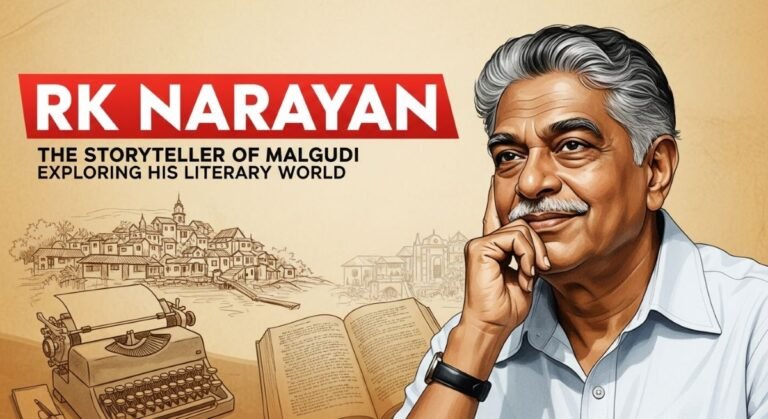
Today in this article we will discuss about the R.K. Narayan Biography PDF and PPT Slides, Rasipuram Krishnaswami Iyer Narayanaswami known as R.K. Narayan: Complete Biography, Books, Famous Works, Malgudi Days, The Guide and Full Legacy so, R.K. Narayan is one of the most beloved writers in the history of Indian literature – and arguably the greatest Indian novelist to have written in the English language. Over a career spanning more than six decades, he created an entire fictional universe in the imaginary South Indian town of Malgudi, populating it with characters so vivid, warm, and recognisably human that readers across the world have felt they know every street, every shopkeeper, and every schoolboy in that town as intimately as their own neighbourhood.
Table of Contents
From his debut novel Swami and Friends (1935) to his final work The World of Nagaraj (1990), R.K. Narayan gave Indian literature something it had never quite had before – a gentle, ironic, deeply compassionate voice that found the universal in the local, the profound in the ordinary, and the comic in the tragic. His masterpiece The Guide won the Sahitya Akademi Award and transformed into a landmark Hindi film. His short story collection Malgudi Days became a beloved television series watched by an entire generation of Indians. This comprehensive article blog covers everything you need to know about R.K. Narayan – his full name, biography, education, wife, awards, all his books with summaries, famous works, short stories, quotes, movies adapted from his work, and his enduring legacy.
R.K. Narayan Biography: Complete At-A-Glance Table
The following biography table covers every key detail about R.K. Narayan’s life – from birth and family to education, awards, and literary legacy:
| Biographical Detail | Information |
| Full Name | Rasipuram Krishnaswami Iyer Narayanaswami |
| Pen Name / Known As | R.K. Narayan |
| Date of Birth | October 10, 1906 |
| Place of Birth | Madras (now Chennai), Tamil Nadu, British India |
| Date of Death | May 13, 2001 |
| Place of Death | Bangalore (now Bengaluru), Karnataka, India |
| Age at Death | 94 years |
| Nationality | Indian (British India / Republic of India) |
| Father’s Name | R. V. Krishnaswami Iyer (school headmaster) |
| Mother’s Name | Gnanambal |
| Wife | Rajam (married 1934; died 1939) |
| Children | One daughter – Hema |
| Notable Sibling | R. K. Laxman – celebrated cartoonist and creator of ‘The Common Man’ |
| Education | Maharaja’s College, Mysore; University of Mysore (BA, 1930) |
| Language of Writing | English |
| Fictional Town Created | Malgudi – a fictional South Indian town that is the setting of nearly all his novels and stories |
| First Novel | Swami and Friends (1935) |
| Most Famous Novel | The Guide (1958) – won Sahitya Akademi Award 1960 |
| Famous Short Story Collection | Malgudi Days (1943 / expanded 1982) |
| Malgudi Trilogy | Swami and Friends (1935), The Bachelor of Arts (1937), The English Teacher (1945) |
| Mentor / Supporter | Graham Greene – helped Narayan find his first British publisher (1935) |
| Major Awards | Sahitya Akademi Award (1960); Padma Bhushan (1964); Padma Vibhushan (2000); AC Benson Medal (Royal Society of Literature) |
| Rajya Sabha Member | Nominated Member of Rajya Sabha (1989–1994) |
| Literary Movement | Indian Writing in English; Gentle Realism; Humour and Satire |
| Core Themes | Small-town Indian life, human comedy, tradition vs modernity, fate and irony, everyday dignity |
| Total Novels Written | 14 novels |
| International Recognition | Nobel Prize in Literature – nominated but never awarded; widely considered one of India’s greatest English-language writers |
R.K. Narayan Biography PDF and PPT Slides (.PPTX)
Who Was R.K. Narayan? (R.K. Narayan Wikipedia Overview)
Rasipuram Krishnaswami Iyer Narayanaswami – known to the world simply as R.K. Narayan – was an Indian novelist and short story writer who wrote in English. He was born on October 10, 1906, in Madras (now Chennai) and died on May 13, 2001, in Bangalore at the age of 94. He is widely considered one of the three founding figures of Indian writing in English, alongside Mulk Raj Anand and Raja Rao.
Where Mulk Raj Anand wrote about the oppressed poor and Raja Rao explored Hindu philosophy, R.K. Narayan carved out his own entirely unique territory – the richly comic, gently ironic, and deeply human world of small-town India. He never wrote about grand political events or epic historical sweeps. Instead, he wrote about the small daily dramas of ordinary people – a tourist guide, a sweet-seller, a schoolboy, a financial expert operating from under a banyan tree – and in doing so captured something universal and permanent about what it means to be human.
R.K. Narayan Full Name and Identity
- Full birth name: Rasipuram Krishnaswami Iyer Narayanaswami
- His pen name R.K. Narayan was a shortened version adopted for practical publishing purposes
- ‘Rasipuram’ is the name of his father’s native village in Tamil Nadu
- He is also sometimes referred to as R.K. Narayan or RK Narayan – all refer to the same writer
- His younger brother R.K. Laxman became equally famous as India’s greatest political cartoonist and creator of ‘The Common Man’ – a legendary figure in Indian journalism
R.K. Narayan Biography in English: Early Life and Background
R.K. Narayan was born in Madras (Chennai) in 1906 into a Tamil Brahmin family. His father, R.V. Krishnaswami Iyer, was a school headmaster who worked in different towns, which meant that Narayan spent much of his childhood in Mysore, raised by his maternal grandmother while his parents were elsewhere. This grandmother – a formidable, wise, and deeply traditional woman – became one of the most important figures in his life and a clear influence on many of the memorable older women who appear in his fiction.
Growing up in Mysore in the 1910s and 1920s, young Narayan absorbed the rhythms of South Indian town life with the eyes of an observer and the sensibility of a storyteller. The streets of Mysore – its markets, its schools, its temples, its small dramas of daily life – would later be transformed into the fictional Malgudi, the imaginary town that became his literary home for more than fifty years.
Key Influences on His Early Life
- His maternal grandmother’s storytelling and deep-rooted Tamil cultural sensibility shaped his imaginative world from the very beginning
- The gentle rhythms and small-scale human dramas of South Indian town life in Mysore provided the raw material for Malgudi
- His father’s work as an educator gave him access to books and a love of English literature from early childhood
- His own repeated failure to pass his school matriculation exam – he failed the English paper, of all subjects – gave him a lifelong sympathy for the ordinary, imperfect human being struggling against circumstances
- The colonial education system, with its absurd insistence on Shakespeare and British literature for Indian children, gave him rich comic material for his early Malgudi novels
R.K. Narayan Education: The Making of a Writer
R.K. Narayan’s educational journey was neither smooth nor conventionally impressive – and he was the first to admit it with characteristic self-deprecating humour. Yet his education, such as it was, formed him perfectly for the writer he would become.
Education Timeline
- Attended various schools in Madras and Mysore as the family moved with his father’s postings
- Struggled with formal academics – famously failed his school matriculation exam in English the first time he attempted it
- Eventually passed his matriculation and enrolled at Maharaja’s College, Mysore (one of the oldest and most prestigious colleges in South India)
- Studied at Maharaja’s College, which was affiliated with the University of Mysore
- 1930: Graduated with a Bachelor of Arts degree from the University of Mysore – after reportedly failing his final year examination once before passing
- After graduation, he briefly attempted to work as a teacher but found he was unsuited to the profession
- He then turned entirely to writing – a decision that changed the course of Indian literature
What Narayan lacked in academic distinction he more than made up for in his education as a reader and observer of human life. He read voraciously – English literature, Tamil classics, Sanskrit epics, and the great novels of Europe. This wide and informal self-education gave his writing its unusual combination of humour, depth, and accessibility.
R.K. Narayan Wife: The Story of Rajam
One of the most poignant aspects of R.K. Narayan’s personal life is the story of his wife, Rajam. Their marriage and her tragically early death profoundly shaped both the man and the writer.
Rajam: Love, Marriage and Loss
- Narayan married Rajam in 1934 – an arranged marriage that quickly grew into a deep and loving partnership
- Rajam was young, warm, and full of life; Narayan described his years with her as among the happiest of his life
- They had one daughter together, named Hema
- In 1939, just five years after their marriage, Rajam contracted typhoid and died – a sudden, shattering loss that devastated Narayan
- He was left a widower at the age of 33, with a young daughter to raise alone
- He never remarried – Rajam remained the defining love of his life
- His grief found direct expression in his novel The English Teacher (1945), in which the protagonist Krishna loses his young wife to typhoid in a sequence of heartbreaking realism that draws directly from Narayan’s own experience
- The novel’s second half, in which Krishna attempts to communicate with his dead wife through a medium, reflects Narayan’s own documented interest in spiritualism in the years after Rajam’s death
The story of Rajam and Narayan is one of the great love stories of Indian literary life. Her memory runs like a quiet river through much of his best work – in the warmth with which he wrote about women, in the tenderness of his domestic scenes, and in the recurring theme of loss and acceptance that gives even his most comic novels a deeper emotional undertow.
What Is Malgudi? The Fictional Town That Made R.K. Narayan Famous
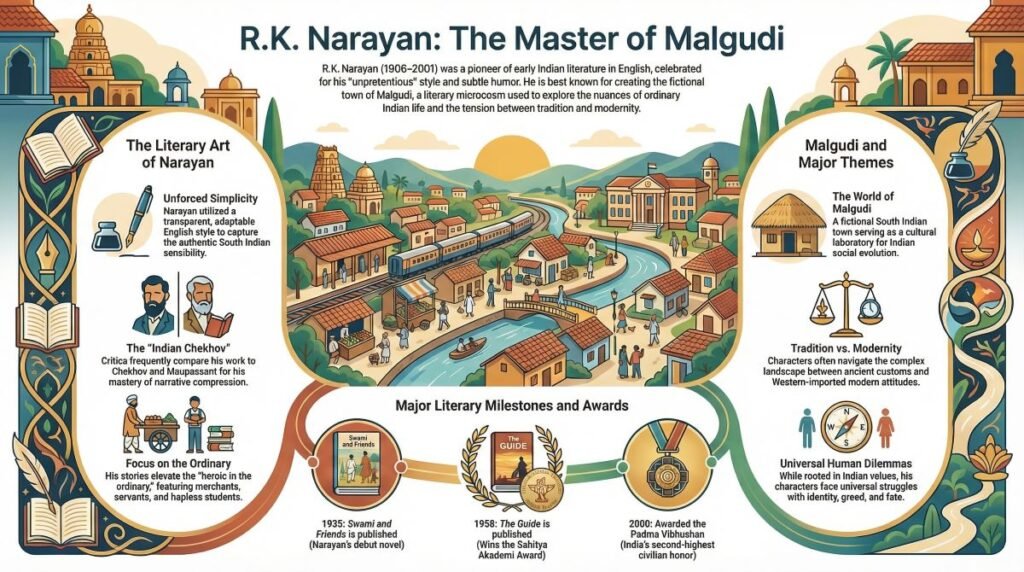
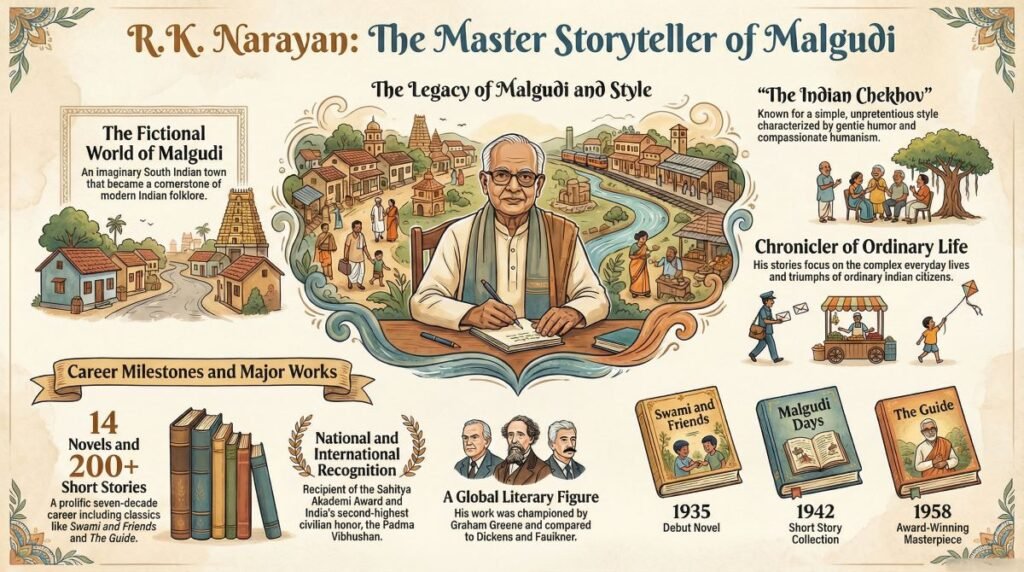
Malgudi is the fictional South Indian town that R.K. Narayan created in 1935 with his debut novel Swami and Friends and inhabited with characters across 14 novels and dozens of short stories over the next 55 years. It is one of the most famous fictional places in world literature – comparable in its imaginative completeness to Thomas Hardy’s Wessex or William Faulkner’s Yoknapatawpha County.
Key Features of Malgudi
- Malgudi is a fictional composite of various South Indian towns, especially Mysore, where Narayan spent much of his life
- It has a clearly imagined geography – the Market Road, the Lawley Extension, the Sarayu river, the Albert Mission School, the Malgudi railway station
- It is populated by recurring characters who appear across different novels and stories – the printer Nataraj, various vendors and shopkeepers, schoolteachers and government officials
- Malgudi is deliberately and lovingly ordinary – it is not glamorous, not historically significant, not politically important; its power lies precisely in its ordinariness
- It functions as a microcosm of India – all of India’s social dynamics, its comedy and tragedy, its tradition and modernity, can be found in miniature in this small town
- Despite being fictional, Malgudi has been so vividly realised that readers often ask where in India they can visit it
The power of Malgudi lies in what the great novelist Graham Greene recognised when he first read Swami and Friends in 1935 – that Narayan had created a world so real, so funny, and so deeply true to human experience that it would endure long after the specific historical moment that produced it. Greene helped Narayan find a publisher for that first novel, launching one of the great careers in Indian literature.
R.K. Narayan Books: Complete List, Name and Summary (R.K. Narayan Novels)
R.K. Narayan wrote 14 novels over his literary career, almost all of them set in Malgudi. Below is a complete books list with the year of publication and a detailed summary of each novel. This serves as a comprehensive R.K. Narayan books name and list reference:
| Novel Title | Year | Summary / Description |
| Swami and Friends | 1935 | His debut novel and the book that introduced the world to Malgudi. Follows young Swaminathan (Swami) and his school friends growing up in the fictional South Indian town of Malgudi. A charming, nostalgic portrait of Indian childhood. |
| The Bachelor of Arts | 1937 | Follows Chandran, a young college graduate in Malgudi, as he navigates love, disappointment, the pull of tradition, and the search for purpose after university. A gentle coming-of-age story. |
| The Dark Room | 1938 | One of Narayan’s more serious and psychologically intense novels. Focuses on Savitri, a housewife who endures a suffocating marriage and attempts to assert her independence. Remarkably ahead of its time in depicting the inner life of a woman trapped by social expectations. |
| The English Teacher | 1945 | Deeply autobiographical; mirrors Narayan’s own experience of the sudden death of his wife Rajam. The protagonist, Krishna, is an English teacher in Malgudi who loses his young wife and must find a way to continue living and raising their daughter. |
| Mr. Sampath – The Printer of Malgudi | 1949 | A comic novel about Srinivas, a journalist who gets entangled with the charismatic but unreliable printer Mr. Sampath and a disastrous film production. A satire on ambition, creative compromise, and the chaos of modern enterprise. |
| The Financial Expert | 1952 | Often cited as one of Narayan’s finest novels. Follows Margayya, a man who sets himself up as an informal financial advisor under a banyan tree outside a bank and rises to wealth, only to face ruin through pride and greed. |
| Waiting for the Mahatma | 1955 | Set against the backdrop of India’s independence movement. A young man named Sriram falls in love with Bharati, a follower of Mahatma Gandhi, and joins the independence movement more out of infatuation than conviction. A warm, humorous look at love and nationalism. |
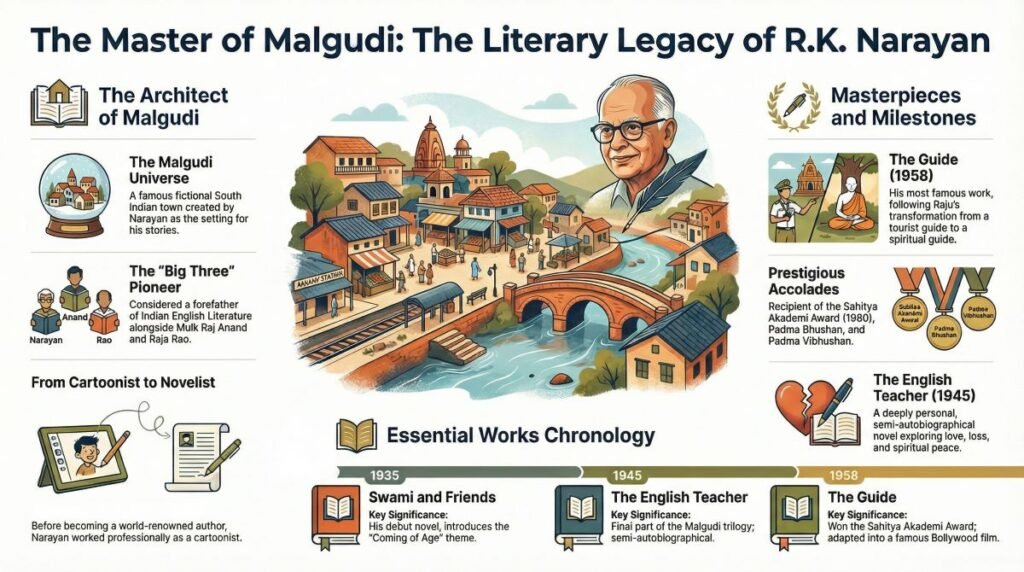
| The Guide | 1958 | His masterpiece and most celebrated novel. Raju, a tourist guide in Malgudi, rises to fame, falls from grace after a scandal, and is eventually mistaken by villagers for a holy man. A brilliant exploration of identity, transformation, sin, and accidental sainthood. Won the Sahitya Akademi Award (1960) and was adapted into an acclaimed Hindi film. |
| The Man-Eater of Malgudi | 1961 | Nataraj, a printer, is bullied and terrorised by a taxidermist named Vasu who takes up residence in his attic. A comic fable about the battle between good and evil, with roots in Hindu mythology – Vasu is clearly modelled on the rakshasa (demon) archetype. |
| The Vendor of Sweets | 1967 | Jagan, a Gandhian sweet-seller in Malgudi, is confronted by his westernised, wasteful son Mali. A thoughtful exploration of the generational divide in post-independence India – tradition versus modernity, austerity versus consumerism. |
| The Painter of Signs | 1976 | Raman, a sign-painter in Malgudi, falls in love with the independent-minded Daisy, who works on a family-planning campaign. A nuanced novel about modernity, love, and the conflict between individual freedom and social expectation. |
| A Tiger for Malgudi | 1983 | Narrated from the perspective of a tiger who escapes a circus, roams Malgudi, and is ultimately tamed by a spiritual hermit. A unique philosophical novel that explores the soul’s journey toward enlightenment through an animal narrator. |
| Talkative Man | 1986 | A journalist in Malgudi is drawn into the orbit of a mysterious stranger who claims to be a United Nations representative. A short, playful novel about storytelling, truth, and human credulity. |
| The World of Nagaraj | 1990 | His final novel; centres on Nagaraj, a quiet, scholarly man in Malgudi whose comfortable domestic routine is disrupted by the arrival of a boisterous nephew. |
R.K. Narayan Book: Swami and Friends Was Published in the Year 1935
Swami and Friends was published in 1935 and is the novel that started everything – it introduced Malgudi to the world and established R.K. Narayan as a major new voice in Indian writing in English. The book was famously championed by Graham Greene, who helped Narayan find a publisher at Oxford University Press after reading the manuscript.
The novel follows Swaminathan (affectionately called Swami) – a ten-year-old boy navigating the pressures of school, the bonds of friendship, the discovery of cricket, and the excitement of the Indian independence movement – all filtered through the guileless, wonderfully comic perspective of childhood. It is one of the finest evocations of Indian boyhood ever written and remains enormously popular with young readers and adults alike.
Why Swami and Friends Is Still Read Today
- It is frequently included in school and college curricula across India as an example of Indian English literature at its most accessible and charming
- R.K. Narayan books for kids often refer to Swami and Friends as the ideal entry point into his work – its young protagonist and school setting make it immediately engaging for younger readers
- The novel captures universal themes of friendship, childhood adventure, and the small betrayals and loyalties of growing up that resonate with readers of all ages and nationalities
- It was the first appearance of Malgudi – the town that would become one of the most beloved settings in world literature
The Guide: R.K. Narayan’s Masterpiece – Summary, Review and Significance
The Guide (1958) is universally regarded as R.K. Narayan’s greatest novel and one of the finest works of Indian literature in any language. It is certainly his most complex, most layered, and most philosophically rich work. It won the Sahitya Akademi Award in 1960 and was later adapted into two major films.
Summary of The Guide
The novel is structured around the story of Raju – a man who has been many things: a tourist guide in Malgudi, the lover of a dancer named Rosie, a promoter and impresario, and finally a prisoner. After his release from jail, Raju ends up in a remote village where the simple villagers take him to be a holy man and a saint. Swept along by their belief and his own complex need for acceptance and redemption, Raju begins to play the role of a swami – fasting to bring rain to a drought-stricken land.
The novel moves between Raju’s present situation in the village and his past, narrated in a series of brilliant flashbacks. The ending – deeply ambiguous, deeply moving – has generated more critical debate and discussion than almost any other ending in Indian fiction.
Key Themes in The Guide
- The nature of identity – Raju is always becoming someone else, always reinventing himself to meet the expectations of others
- Accidental sainthood and the thin line between performance and genuine transformation
- The relationship between art, passion, and morality – Rosie is a gifted classical dancer whose talent Raju recognises and exploits, and then fails
- Fate and irony – Raju’s path to an accidental kind of grace passes through lies, self-deception, and genuine suffering
- The village’s faith in Raju raises profound questions about the nature of spiritual belief itself
The Guide – Movies and Film Adaptations
- 1965 (Hindi): Directed by Vijay Anand, starring Dev Anand as Raju and Waheeda Rehman as Rosie. One of the landmark films of Hindi cinema, celebrated for its direction, performances, and its iconic music (composed by S.D. Burman). The film won multiple Filmfare Awards.
- 1965 (English): A simultaneous English-language version was also produced, starring Dev Anand alongside Hollywood actor Telly Savalas – one of the early experiments in bilingual Indian cinema.
- The Hindi film Guide is consistently listed among the greatest Indian films ever made and introduced R.K. Narayan’s work to a massive popular audience that had not read his novels.
Malgudi Days: R.K. Narayan’s Famous Short Stories Collection
Malgudi Days is R.K. Narayan’s most celebrated short story collection, first published in 1943 and later expanded in 1982. The collection contains some of the finest short fiction ever written in Indian English literature – each story a small, perfectly formed gem set in the world of Malgudi.
About the Short Stories
- The stories range from the touching to the comic to the quietly tragic – all rooted in the daily life of Malgudi’s inhabitants
- Characters include astrologers, beggars, shopkeepers, schoolchildren, bureaucrats, and holy men – the full social spectrum of a South Indian town
- The stories are remarkable for their economy – Narayan achieves in a few pages what many novelists cannot achieve in hundreds
- They are among the most widely translated and anthologised examples of Indian short fiction in the world
Malgudi Days Television Series
- In 1986–87, director Shankar Nag adapted Malgudi Days into a landmark television series for Doordarshan (India’s national television network)
- The series became one of the most beloved television productions in Indian history – watched by an entire generation of Indian children and adults
- Its opening credits – with the iconic music composed by L. Vaidyanathan and the image of Swami running through Malgudi’s streets – became one of the most recognisable images in Indian popular culture
- The series introduced millions of Indians who had never read Narayan’s books to the world of Malgudi
- A revival of the series was also produced and broadcast years later, testifying to the enduring popularity of the material
R.K. Narayan Famous Works, Important Works, Notable Works and Major Works
R.K. Narayan’s literary output was large and consistently excellent. Here is a definitive overview of his famous works organised by significance and category:
Most Famous Novels (Major Works)
- The Guide (1958) – His undisputed masterpiece; won the Sahitya Akademi Award; adapted into a landmark Hindi film
- Swami and Friends (1935) – His debut; the novel that created Malgudi and launched his career
- The Financial Expert (1952) – Often called his most technically accomplished novel; a sharp comic study of greed and ambition
- The English Teacher (1945) – His most autobiographical and emotionally profound work; inspired by his wife Rajam’s death
- The Man-Eater of Malgudi (1961) – A brilliantly comic novel with deep mythological roots; one of his most inventive
- Malgudi Days (1943/1982) – His most famous short story collection; inspired the legendary Doordarshan TV series
Important and Notable Works
- The Bachelor of Arts (1937) – A charming coming-of-age novel; part of the early Malgudi Trilogy
- The Dark Room (1938) – His most psychologically complex early novel; deals with domestic oppression and female resilience
- Waiting for the Mahatma (1955) – A warm, gently comic novel set during the Indian independence movement
- The Vendor of Sweets (1967) – A sharp generational comedy examining tradition versus westernisation in post-independence India
- A Tiger for Malgudi (1983) – His most experimental novel; narrated by a tiger on a spiritual journey
R.K. Narayan Trilogy – The Malgudi Trilogy
- R.K. Narayan’s trilogy refers to what scholars and readers often call the Malgudi Trilogy or the Early Malgudi Trilogy
- The three novels are: Swami and Friends (1935), The Bachelor of Arts (1937), and The English Teacher (1945)
- All three follow protagonists at different stages of life – childhood, young adulthood, and early married life – and are loosely linked by their shared Malgudi setting and their exploration of the transition from innocence to experience
- Some scholars also group The Financial Expert, Waiting for the Mahatma, and The Guide together as Narayan’s mature masterworks
R.K. Narayan Short Stories: Collections and Highlights
Alongside his novels, R.K. Narayan was a masterful writer of short stories. His short fiction appeared in various collections over the decades and represents some of the finest short-form writing in Indian English literature.
Short Story Collections
- Malgudi Days (1943, expanded 1982) – His most celebrated collection; dozens of stories set in Malgudi covering every aspect of its social life
- Dodu and Other Stories (1943) – Early stories marked by gentle humour and sharp observation
- Cyclone and Other Stories (1944) – Stories exploring disruption, both natural and human, in ordinary lives
- An Astrologer’s Day and Other Stories (1947) – Contains the famous story An Astrologer’s Day, one of the most anthologised Indian short stories in the world
- Lawley Road (1956) – Stories marked by comic irony and Narayan’s characteristic gentle satire of bureaucracy and human pretension
- A Horse and Two Goats (1970) – Contains the story of the same name, set in a remote Tamil village; widely taught in schools and universities in the United States and United Kingdom
- Under the Banyan Tree (1985) – A late collection gathering some of his finest shorter fiction
Among individual short stories, An Astrologer’s Day is perhaps the most famous – a masterwork of compact storytelling about an astrologer who encounters a man from his dark past. A Horse and Two Goats is widely considered his finest single story – a deeply funny and deeply moving account of a cross-cultural misunderstanding between a Tamil farmer and an American tourist.
R.K. Narayan Awards and Honours
Over his long career, R.K. Narayan received numerous awards and recognitions that cemented his place as one of India’s greatest writers:
Complete Awards List
- Sahitya Akademi Award (1960) – India’s national academy of letters award, received for The Guide. This is India’s highest literary honour.
- Padma Bhushan (1964) – The third-highest civilian honour in India, awarded by the Government of India in recognition of his distinguished service to Indian literature
- AC Benson Medal – Awarded by the Royal Society of Literature in the United Kingdom; one of the most prestigious literary honours in the English-speaking world
- Padma Vibhushan (2000) – The second-highest civilian honour in India, awarded just one year before his death in recognition of his lifetime’s contribution to Indian literature
- Nominated Member of the Rajya Sabha (1989–1994) – The President of India nominated him to India’s upper house of Parliament, acknowledging his status as a national cultural institution
- Honorary degrees from several universities in India and abroad
- Widely considered a perennial candidate for the Nobel Prize in Literature – though he never won it, his name was mentioned regularly in discussions of potential laureates
R.K. Narayan Famous Quotes
R.K. Narayan was not only a great novelist but also a thoughtful and witty observer of life. His interviews and essays contain many memorable statements about writing, India, and the human condition. Here is a selection of his most famous and widely cited quotes:
| Famous Quote | Source / Context |
| The town of Malgudi was my own creation – its people were my own people. | On Malgudi |
| I am not a reformer. I am only a storyteller. | On his writing |
| An author, in my view, is a person who writes with a certain degree of dedication and sincerity. | On craft |
| Every human being carries a story within, and the storyteller’s task is to reveal it. | On storytelling |
| English is an Indian language now. It is the language of our public life, our courts, our universities. | On writing in English |
These quotes reflect the essential qualities of the man – his humility, his lack of pretension, his deep belief in the power of storytelling, and his characteristically wry perspective on the big questions of life and art.
R.K. Narayan Movies: His Works on Screen
Several of R.K. Narayan’s novels and stories have been adapted for cinema and television, with varying degrees of fidelity to the originals and with widely varying critical receptions:
Major Film Adaptations
- Guide (Hindi, 1965) – Directed by Vijay Anand, produced by Dev Anand; starring Dev Anand and Waheeda Rehman. Widely considered one of the greatest Hindi films ever made. The film won several Filmfare Awards and is celebrated for its direction, performances, cinematography, and music (S.D. Burman). Narayan himself had complicated feelings about the adaptation, feeling it strayed significantly from his novel.
- Guide (English, 1965) – A simultaneous English-language version directed by Tad Danielewski, starring Dev Anand and American actor Telly Savalas; less well-known than the Hindi version.
- Swami and Friends (1987 TV series) – The Malgudi Days television series on Doordarshan, directed by Shankar Nag, adapted many Malgudi Days stories and also covered elements of Swami and Friends. It became one of the most beloved Indian television productions ever made.
- The Financial Expert – Was considered for adaptation on multiple occasions though a major production was never completed.
- Several of his short stories, including An Astrologer’s Day, have been adapted for short film and theatrical productions in India and abroad.
R.K. Narayan himself was famously ambivalent about film adaptations of his work. He wrote an essay called ‘Misguided Guide’ in which he described his experience watching the filming of the Guide adaptation with increasing dismay at how far it departed from his original novel. This essay is as funny and revealing as any of his fiction.
R.K. Narayan Books for Kids: Where Young Readers Should Start
R.K. Narayan’s writing is unusually accessible and enjoyable for young readers, making him one of the few Indian English writers whose work can be genuinely recommended for children and teenagers. His prose is clear, his humour is gentle, and his characters are vivid and immediately likeable.
Best R.K. Narayan Books for Young Readers
- Swami and Friends – The ideal starting point for any young reader. The ten-year-old protagonist Swami and his school adventures are relatable to children anywhere in the world. The book is funny, warm, and full of life.
- Malgudi Days (short stories) – Individual stories from this collection are widely included in school textbooks and are perfect for younger readers who may not be ready for a full novel. Stories like An Astrologer’s Day, The Blind Dog, and The Snake-Song are particular favourites.
- The Bachelor of Arts – Suitable for older teenagers; a gentle and perceptive coming-of-age story about a young man finishing college and facing the adult world.
- A Horse and Two Goats – A single story, short enough for young readers, deeply funny, and perfectly constructed; an excellent introduction to Narayan’s short fiction.
R.K. Narayan: Complete Life and Career Timeline
| Year | Key Event |
| 1906 | Born on October 10 in Madras (now Chennai), Tamil Nadu, British India |
| 1920s | Grew up largely in Mysore, raised by his maternal grandmother while his father worked elsewhere |
| 1930 | Graduated with a BA from Maharaja’s College, University of Mysore – after failing his final year exam once |
| 1930–34 | Began writing seriously; worked briefly as a teacher but left to pursue writing full time |
| 1934 | Married Rajam in a traditional arranged marriage; their partnership was deeply loving and deeply formative |
| 1935 | Published Swami and Friends – his debut novel; Graham Greene helped secure the publisher (Oxford University Press). Malgudi was born. |
| 1937 | Published The Bachelor of Arts – second Malgudi novel |
| 1938 | Published The Dark Room |
| 1939 | Wife Rajam died of typhoid – a devastating personal loss. Their daughter Hema was just a baby. |
| 1943 | Published Malgudi Days – his first major collection of short stories |
| 1945 | Published The English Teacher – his most autobiographical and emotionally raw novel, inspired by Rajam’s death |
| 1952 | Published The Financial Expert – widely considered among his best works |
| 1958 | Published The Guide – his masterpiece |
| 1960 | Won the Sahitya Akademi Award for The Guide |
| 1963 | The Guide adapted into a celebrated Hindi film directed by Vijay Anand, starring Dev Anand and Waheeda Rehman |
| 1964 | Awarded the Padma Bhushan by the Government of India |
| 1965 | The Guide also adapted into an English-language film starring Dev Anand and Telly Savalas |
| 1982 | Malgudi Days adapted into a landmark television series by Shankar Nag for Doordarshan – became one of the most beloved Indian TV serials ever made |
| 1989 | Nominated as a Member of the Rajya Sabha (upper house of Indian Parliament) |
| 2000 | Awarded the Padma Vibhushan – India’s second-highest civilian honour |
| 2001 | Died on May 13 in Bangalore at the age of 94 |
10 Lines About R.K. Narayan for Students and Quick Reference
Here are 10 essential lines about R.K. Narayan, ideal for school assignments, quick summaries, and biography PDFs:
- R.K. Narayan’s full name was Rasipuram Krishnaswami Iyer Narayanaswami; he adopted the pen name R.K. Narayan for his writing career.
- He was born on October 10, 1906, in Madras (now Chennai), Tamil Nadu, British India.
- He is considered one of the three founding fathers of Indian writing in English, alongside Mulk Raj Anand and Raja Rao.
- He created the fictional South Indian town of Malgudi, which serves as the setting for nearly all his novels and short stories.
- His debut novel Swami and Friends was published in 1935, with the help of his literary champion Graham Greene.
- His masterpiece The Guide (1958) won the Sahitya Akademi Award in 1960 and was adapted into a landmark Hindi film in 1965.
- His wife Rajam died of typhoid in 1939, just five years after their marriage; he never remarried and the grief shaped his finest writing.
- He received the Padma Bhushan (1964) and the Padma Vibhushan (2000) – two of India’s highest civilian honours.
- His short story collection Malgudi Days was adapted into a beloved television series by Shankar Nag for Doordarshan in 1986–87.
- He died on May 13, 2001, in Bangalore, at the age of 94, leaving behind 14 novels and dozens of short stories that remain essential reading in Indian literature.
R.K. Narayan Books in Hindi: Availability and Reach
While R.K. Narayan wrote exclusively in English, his books have been widely translated into Hindi and other Indian languages, bringing his work to the vast Hindi-reading audience across North and Central India.
- The Guide (Marg Darshak) – The most widely available of his novels in Hindi translation, boosted by the enormous popularity of the 1965 Hindi film
- Swami and Friends (Swami aur Uske Dost) – Available in Hindi translation; popular in school and college libraries
- Malgudi Days (Malgudi ke Din) – Hindi translations of his short stories are widely available and frequently taught in Hindi-medium schools
- The Bachelor of Arts and The English Teacher have also been translated into Hindi
- Major Indian publishers including Rajkamal Prakashan and others have published Hindi translations of his key works
For Hindi-speaking readers who want to experience Narayan’s work in their first language, these translations preserve much of the warmth and gentle comedy of the originals, though as Narayan himself noted, the distinctly Indian idiom of his English is something that resists easy translation.
R.K. Narayan Summary: His Writing Style and Literary Significance
A summary of R.K. Narayan’s literary achievement must begin with his style – because his style is inseparable from his subject matter and his vision of life. He wrote clear, simple, seemingly effortless prose that conceals enormous craft. There are no purple passages in Narayan, no rhetorical flourishes, no straining after effect. Every sentence does exactly what it needs to do and nothing more.
This deceptive simplicity has sometimes led casual readers to underestimate him. But the best critics – from Graham Greene to V.S. Naipaul to William Trevor – recognised in Narayan a master of the novel form: a writer who understood that the deepest truths are best approached indirectly, through comedy, through irony, through the small ordinary details of daily life rather than through grand dramatic gestures.
Defining Characteristics of R.K. Narayan’s Writing
- Gentle irony: He never mocks his characters; he observes them with a combination of amused detachment and deep affection
- Comic vision: His comedy is never cruel; it arises from the gap between human pretension and human reality, a gap he finds endlessly and warmly funny
- Economy of language: He achieved in a few hundred pages what other novelists require far more space to accomplish
- The ordinary as subject: He elevated the small dramas of small-town Indian life to the level of universal literature
- Indian English: His English absorbed Indian rhythms, idioms, and thought patterns without affectation – it feels entirely natural and entirely his own
- Philosophical acceptance: Beneath all the comedy and irony lies a deep Hindu acceptance of life as it is – with its ironies, its disappointments, and its unexpected grace
Also read: Mulk Raj Anand Biography PDF and PPT Slides
Conclusion: Why R.K. Narayan Remains Essential Reading?
R.K. Narayan was, in the most precise and complimentary sense of the phrase, a writer’s writer – admired by his peers, beloved by his readers, and in every way worthy of the comparison with the great novelists of world literature. He created a fictional world that will outlast the century that produced it, peopled with characters that feel as real and as human as anyone we know in life.
His Malgudi is not just a fictional South Indian town. It is a meditation on what it means to live with grace and humour in a world that is always larger, stranger, and more ironic than any individual can fully comprehend. It is a celebration of ordinary life – of the sweet-seller, the guide, the schoolboy, the financial expert – and of the quiet dignity that ordinary people bring to their extraordinary inner lives.
Whether you are discovering R.K. Narayan for the first time through Swami and Friends, returning to The Guide for the tenth time, or introducing a young reader to the world of Malgudi Days – you are entering a literary world that will stay with you for the rest of your reading life.