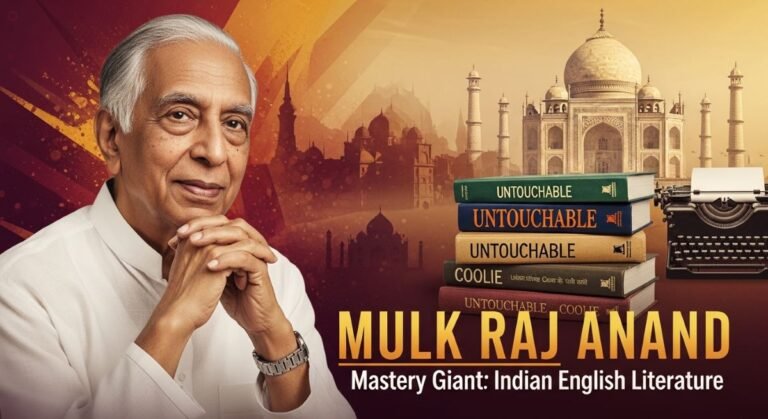
Today in this article we will discuss about the Mulk Raj Anand Biography PDF and PPT Slides as well as Infographic, Mulk Raj Anand, Biography, Books, Famous Works, Trilogy and Legacy so, Mulk Raj Anand was one of the pioneers of Indian writing in English and one of the most important novelists of the 20th century. Known for his compassionate portrayal of India’s marginalised communities – the untouchables, the landless poor, the factory workers, and the colonial subjects – he brought the lived reality of India’s most oppressed people onto the world literary stage. His debut novel Untouchable (1935) shook the literary establishment in Britain and India alike and established him as a major voice in world literature.
Table of Contents
Over a career spanning seven decades, Mulk Raj Anand wrote more than 30 novels, several volumes of short stories, and numerous essays on art, culture, and philosophy. He remains essential reading for anyone seeking to understand 20th-century India, the caste system, colonialism, and the human struggle for dignity.
Mulk Raj Anand Biography: Complete At-A-Glance Table
The table below covers every key biographical detail about Mulk Raj Anand – from his birth and family background to his awards, marriages, and core literary themes:
| Biographical Detail | Information |
| Full Name | Mulk Raj Anand |
| Date of Birth | December 12, 1905 |
| Place of Birth | Peshawar, Punjab, British India (now Pakistan) |
| Date of Death | September 28, 2004 |
| Place of Death | Pune, Maharashtra, India |
| Age at Death | 98 years |
| Nationality | Indian (British India / Republic of India) |
| Father’s Name | Lal Chand Anand (Subedar in the British Indian Army) |
| Mother’s Name | Ishwar Kaur |
| Spouse | Kathleen Van Gelder (1st); Shirin Vajifdar (2nd) |
| Education | University of Punjab; University College London; Cambridge University |
| Degree | PhD in Philosophy, University of London (1929) |
| Occupation | Novelist, Short Story Writer, Art Critic, Essayist |
| Language of Writing | English (with Indian idioms and dialects woven in) |
| Literary Movement | Indian Writing in English; Socialist Realism; Progressive Literature |
| First Novel | Untouchable (1935) |
| Most Famous Work | Untouchable (1935), Coolie (1936), The Village Trilogy |
| Famous Trilogy | The Village Trilogy: The Village (1939), Across the Black Waters (1940), The Sword and the Sickle (1942) |
| Awards & Honours | Sahitya Akademi Award (1971); Padma Bhushan (1967); International Peace Prize; Leverhulme Fellowship |
| Mentor / Influence | E.M. Forster (wrote preface to Untouchable); Mahatma Gandhi; Sigmund Freud; Karl Marx |
| Magazine Founded | Marg (art and culture magazine, founded 1946) |
| Political Stance | Progressive; Anti-colonial; Pro-working class; Socialist sympathies |
| Core Themes | Caste discrimination, poverty, colonial oppression, human dignity, class struggle |
Mulk Raj Anand Biography PDF and PPT Slides (.PPTX)
Who Was Mulk Raj Anand? (Mulk Raj Anand Overview)
Mulk Raj Anand was an Indian novelist, short story writer, art critic, and essayist who wrote primarily in English. He was born on December 12, 1905, in Peshawar, Punjab – a city that is now part of Pakistan – and died on September 28, 2004, in Pune, Maharashtra, India. He lived for 98 years, and was intellectually active and writing into his nineties.
He is widely considered one of the three founding figures of Indian writing in English, alongside Raja Rao and R.K. Narayan. While R.K. Narayan wrote about the genteel middle classes of South India, and Raja Rao explored Hindu philosophy, Mulk Raj Anand devoted his literary life to the struggles of India’s most downtrodden – the untouchables, the coolies, the tea-garden labourers, and the landless peasants.
Quick Key Facts About Mulk Raj Anand
- Born: December 12, 1905 in Peshawar, Punjab, British India
- Died: September 28, 2004 in Pune, Maharashtra – aged 98
- First novel: Untouchable (1935) – preface by E.M. Forster
- Most famous trilogy: The Village Trilogy (1939–1942)
- Awards: Padma Bhushan (1967), Sahitya Akademi Award (1971)
- Founded Marg magazine in 1946 – India’s premier art and culture publication
- Associated with the Bloomsbury Group and the All India Progressive Writers’ Association
- Close friend and admirer of Mahatma Gandhi, whose philosophy deeply influenced his writing
Mulk Raj Anand Biography in English: Early Life and Background
Mulk Raj Anand was born into a lower-middle-class Hindu family in Peshawar. His father, Lal Chand Anand, was a Subedar (a commissioned officer) in the British Indian Army, and his mother, Ishwar Kaur, was a devout and caring woman whose warmth and suffering left a deep impression on the young Anand. Growing up in British India – moving from Peshawar to various cantonments as his father’s postings changed – gave Anand an early, direct experience of the hierarchies and injustices of colonial society.
A defining moment in his early life came when he witnessed how his mother and other lower-caste people were treated. He later wrote that the seeds of Untouchable were sown when, as a child, he watched his mother clean a courtyard after a low-caste woman had accidentally touched a cooking vessel – an act of ‘purification’ that deeply disturbed him and stayed with him for the rest of his life.
Family and Early Influences
- His father’s military background gave him an exposure to both discipline and the class-based cruelties of the British Indian system
- His mother’s quiet suffering and dignity became a recurring source of compassion in his writing
- The death of his cousin – who was ostracised for eating with a Muslim friend and died by suicide – was a formative trauma that radicalized his views on caste
- He grew up speaking Punjabi and Hindustani, experiences that enriched his literary English with a distinctly Indian voice and idiom
- He was exposed early to both Hindu religious traditions and the political ferment of Indian nationalism
Mulk Raj Anand Education: From Peshawar to Cambridge
Mulk Raj Anand’s educational journey took him from the classrooms of colonial India to the lecture halls of London and Cambridge – a trajectory that shaped him into one of the most intellectually formidable writers of his generation.
Education Timeline
- Received early schooling in Peshawar, Punjab, where he showed early aptitude for literature and languages
- Enrolled at Government College, Lahore (affiliated with the University of Punjab) – a prestigious institution that also produced other major Indian literary figures
- 1924: Moved to England at the age of 18 and enrolled at University College London (UCL)
- Studied philosophy under some of the leading philosophers of the era
- Also attended Cambridge University, where he came into contact with Bertrand Russell and other major intellectual figures
- 1929: Earned his PhD in Philosophy from the University of London – his doctoral work focused on the relationship between Romanticism and science
- During his years in London, he attended lectures by Sigmund Freud and was deeply influenced by Marxist political theory
His years in Europe were not just about academic study. He moved in the circles of the Bloomsbury Group – the famous intellectual and artistic community that included Virginia Woolf, E.M. Forster, T.S. Eliot, and others. E.M. Forster in particular became an important mentor who would later write the preface to Anand’s debut novel Untouchable. This exposure to the best minds of the era, combined with his firsthand experience of Indian poverty and caste oppression, gave Anand’s writing its unusual combination of literary sophistication and burning social conscience.
Mulk Raj Anand Famous Works and Books: Complete Overview
Mulk Raj Anand wrote prolifically across more than five decades. His works range from his breakthrough social realist novels to autobiographical fiction, short stories, and serious non-fiction on Indian art and culture. Below is a comprehensive table of his major novels and their descriptions:
| Title | Year | Description / Summary |
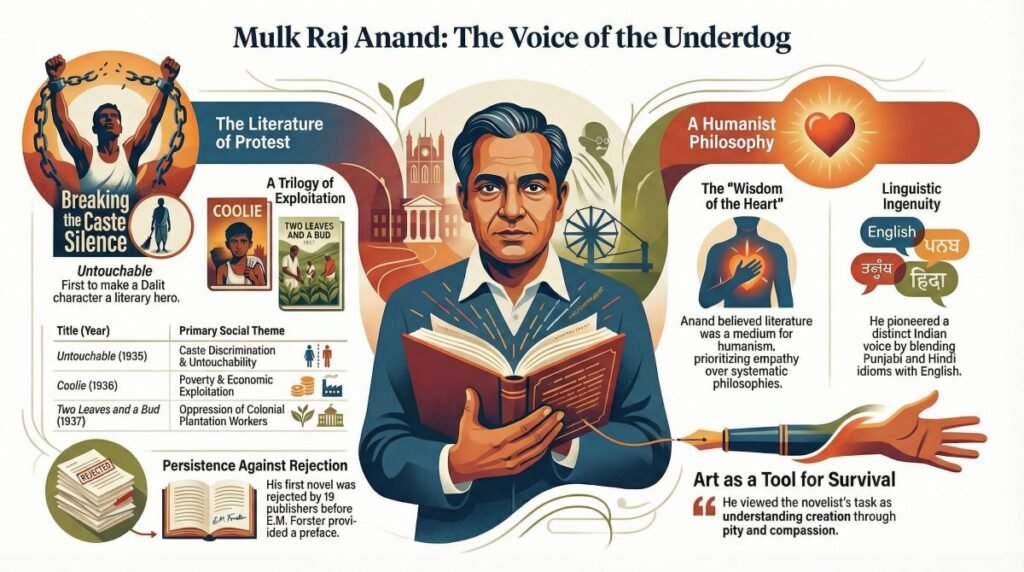
| Untouchable | 1935 | His debut and most celebrated novel; follows Bakha, a young sweeper, through a single transformative day as he confronts caste discrimination in colonial India. Preface written by E.M. Forster. |
| Coolie | 1936 | Traces the tragic journey of Munoo, a poor hill-boy who becomes a domestic servant and factory worker, ultimately crushed by poverty and exploitation. A powerful indictment of capitalism and class inequality. |
| Two Leaves and a Bud | 1937 | Set on a tea plantation in Assam; exposes the brutal exploitation of Indian tea-garden labourers under British colonial management. |
| The Village | 1939 | First part of the Village Trilogy; introduces Lal Singh, a Sikh peasant, and his village life in pre-Partition Punjab. |
| Across the Black Waters | 1940 | Second part of the Trilogy; follows Lal Singh as he fights for Britain in World War I; explores colonialism and the irony of Indian soldiers dying for their oppressors. |
| The Sword and the Sickle | 1942 | Final part of the Trilogy; Lal Singh returns home and becomes involved in the Indian independence movement and agrarian revolution. |
| The Big Heart | 1945 | Set in the coppersmith community of Amritsar; explores conflict between tradition and industrial modernisation. |
| Seven Summers | 1951 | Autobiographical novel; recounts Anand’s own childhood and early years growing up in colonial India. |
| Private Life of an Indian Prince | 1953 | A psychological portrait of an Indian prince struggling with power, corruption and personal ruin after Indian independence. |
| The Old Woman and the Cow | 1960 | Also published as Gauri; focuses on the struggles and resilience of a rural Indian woman, celebrating female strength. |
| The Road | 1961 | Chronicles the construction of a mountain road in India; examines labour, dignity, and the government’s relationship with the working class. |
| Death of a Hero | 1963 | Explores heroism, sacrifice and disillusionment in the context of Indian political life. |
| Morning Face | 1968 | Second part of his autobiography; covers his formative intellectual years, his time in London and encounters with major thinkers. |
| Confession of a Lover | 1976 | Third volume of autobiography; explores his romantic relationships and emotional development as a young man in Europe. |
| The Bubble | 1984 | Critically examines the vanity and corruption of the newly independent Indian ruling class. |
Short Story Collections by Mulk Raj Anand
- The Lost Child and Other Stories (1934) – His first published work; a collection of short stories dealing with the lives of ordinary Indians
- The Barber’s Trade Union and Other Stories (1944) – Sharp, witty stories examining class and labour in India
- The Tractor and the Corn Goddess and Other Stories (1947) – Stories set in rural India exploring modernisation and tradition
- Reflections on the Golden Bed (1954) – A collection exploring desire, morality, and the lives of the marginalised
- Between Tears and Laughter (1973) – Stories marked by both humour and deep pathos
Non-Fiction, Essays and Art Criticism
- Persian Painting (1930) – One of his earliest publications; a scholarly study of Persian visual art
- The Hindu View of Art (1933) – A significant early essay exploring Indian aesthetics and artistic philosophy
- Letters on India (1942) – Political essays written to explain India’s situation to Western audiences during World War II
- Is There a Contemporary Indian Civilisation? (1963) – A philosophical examination of modern Indian cultural identity
- Kama Kala (1963) – A scholarly work on Indian erotic art traditions
- Author to Critic: The Letters of Mulk Raj Anand – His collected correspondence, revealing his intellectual development
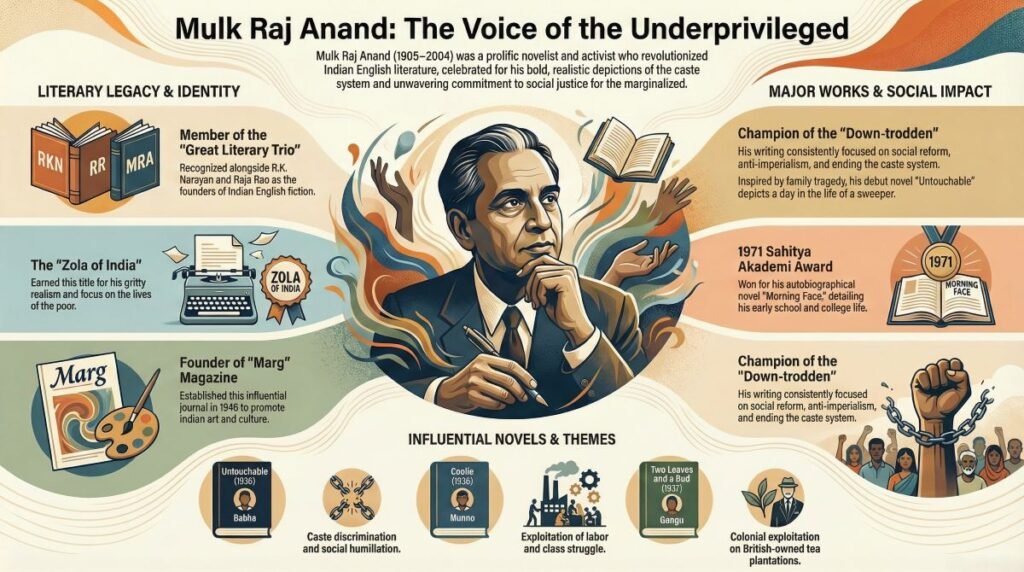
What Is Mulk Raj Anand Famous For? Top Contributions
Mulk Raj Anand is famous for multiple landmark contributions to Indian and world literature. Here is a comprehensive look at what makes him one of the most significant Indian writers of the 20th century:
#1. Pioneering Indian Writing in English
- He was one of the first Indian writers to achieve international recognition writing in English
- Alongside R.K. Narayan and Raja Rao, he established the tradition of serious Indian fiction in English
- His English prose was uniquely his own – infused with Punjabi rhythms, Indian idioms, and the speech patterns of ordinary people, giving his novels an authenticity no other writer of his era achieved
#2. Giving Voice to the Untouchables and the Oppressed
- Untouchable (1935) was the first major work of Indian literature in English to put a Dalit (lower-caste) protagonist at the centre of the story
- At a time when caste discrimination was rarely discussed openly in literary circles, Anand made it the subject of his very first novel
- His portrayal was neither sentimental nor preachy – it was deeply human, following one ordinary day in the life of Bakha the sweeper with extraordinary empathy and detail
#3. The Village Trilogy – Mulk Raj Anand Trilogy
- The Village (1939), Across the Black Waters (1940), and The Sword and the Sickle (1942) together form what is known as the Village Trilogy or the Lal Singh Trilogy
- The trilogy follows Lal Singh, a Punjabi Sikh peasant, from his village life through World War I and into the Indian independence movement
- It is considered one of the great works of 20th-century Indian fiction in English, comparable in ambition and scope to major war novels of the era
- Across the Black Waters in particular is praised for its unflinching portrayal of Indian soldiers fighting and dying for Britain – the painful irony of colonial subjects defending their colonisers
#4. Progressive Literature and Political Activism
- He was a founding member of the All India Progressive Writers’ Association (AIPWA) in 1936 – a movement that sought to use literature as a tool for social change
- He went to Spain during the Spanish Civil War (1936-39) to support the Republican cause against fascism
- He was deeply influenced by Marxist ideas about class struggle and wrote extensively about the exploitation of workers and peasants
- His friendship with Mahatma Gandhi – whose ideas about non-violence and dignity for all people deeply resonated with him – also shaped his literary and political outlook
#5. Art Criticism and the Founding of Marg Magazine
- He founded Marg (meaning ‘path’ in Sanskrit) in 1946 – India’s premier magazine on art, architecture, and culture
- Marg became one of the most respected publications on Indian art in the world and is still published today
- Anand himself was a serious scholar of Indian art – publishing studies on Persian painting, Indian aesthetics, erotic art traditions, and the philosophy of creativity
Mulk Raj Anand Untouchable: Summary and Significance
Untouchable (1935) is Mulk Raj Anand’s debut novel and remains his most celebrated and widely read work. It is essential reading for anyone interested in Indian literature, caste, colonialism, and the human condition.
Summary of Untouchable
The novel takes place over a single day in the life of Bakha, an eighteen-year-old sweeper boy who cleans latrines at a military cantonment in colonial India. Bakha is a member of the lowest rung of the Hindu caste hierarchy – an untouchable – and his daily life is defined by humiliation, exclusion, and the internalised shame that the caste system imposes on those it deems impure.
Key Themes in Untouchable
- Caste discrimination and the daily indignities suffered by Dalits in colonial India
- The psychological damage inflicted by internalised oppression – Bakha simultaneously resents and accepts the world’s verdict on his worth
- Colonial modernity as both a source of hope and a new form of disappointment – Bakha admires British dress and culture, seeing them as an escape from the caste system, yet remains trapped within it
- Three possible solutions to untouchability are debated at the novel’s end: the Christian mission, Gandhi’s philosophy of service, and Dr. B.R. Ambedkar’s political approach – a remarkably ahead-of-its-time structural discussion
- The novel ends not with a neat resolution but with an open question, reflecting Anand’s intellectual honesty about the complexity of social change
The novel was rejected by nineteen publishers before E.M. Forster, who had read it and been moved by it, agreed to write the preface – a gesture that finally opened doors for publication. It went on to become a landmark in world literature.
What Is ‘The Lost Child’ About? Mulk Raj Anand Short Story
The Lost Child (1934) is one of Mulk Raj Anand’s most beloved and widely taught short stories. It was part of his first published collection, The Lost Child and Other Stories (1934), which appeared a year before his debut novel Untouchable.
The story follows a young child who accompanies his parents to a spring festival fair. Enchanted by everything around him – the bright colours, the toys, the sweets, the flower-sellers, the snake charmer, the merry-go-round – the child repeatedly asks his parents to buy him things, but is each time gently refused. In his excitement and wonder, the child wanders away from his parents and becomes lost in the crowd.
Key Themes in The Lost Child
- Childhood innocence and the sensory wonder of experiencing the world for the first time
- The tension between desire and denial – the child’s requests are refused throughout, yet he remains joyful until separated from his parents
- The power of parental love – when lost, the child suddenly no longer desires any of the things he wanted; he only wants his parents
- Community and belonging – the festive crowd that was once a place of joy becomes a place of terror when the child is separated from his family
- A quiet critique of material desire – the story suggests that what we truly need is human connection, not possessions
The story is a standard text in Indian school curricula and is celebrated for its simple, lyrical prose and its deep emotional resonance. It demonstrates Anand’s gift for writing with equal power about adult social realities and the tender inner world of childhood.
Which Was the First Novel of Mulk Raj Anand?
The first novel of Mulk Raj Anand was Untouchable, published in 1935. It was a novel that almost never saw publication – rejected by nineteen publishing houses before finally being accepted, largely because E.M. Forster, the celebrated English novelist, wrote a preface for it that helped convince publishers of its literary merit.
The Story Behind Untouchable’s Publication
- Anand spent years writing and rewriting the manuscript of Untouchable while living in London in the late 1920s and early 1930s
- He shared the manuscript with E.M. Forster, who was moved by it and offered to write the preface – a significant act of literary sponsorship
- Despite Forster’s endorsement, nineteen publishers rejected the manuscript before it was finally accepted
- It was published in 1935 by Lawrence and Wishart, a left-leaning British publisher
- Upon publication, it was immediately recognised as a powerful and original work – a novel that brought the reality of caste discrimination to readers in Britain and across the world
- It has since been translated into dozens of languages and is included in university curricula across India, the United Kingdom, the United States, and other countries
Mulk Raj Anand Essay: His Non-Fiction Voice and Style
While Mulk Raj Anand is best known as a novelist, he was also a prolific and important essayist. His essays covered politics, culture, art, philosophy, and the situation of the Indian writer in the postcolonial world. His essay writing voice was passionate, learned, and deeply personal – always anchored in his commitment to social justice and human dignity.
Key Areas of His Essay Writing
- Indian Independence and Colonialism: His Letters on India (1942) sought to explain to Western audiences why India deserved independence, making a powerful moral and political case
- Art and Aesthetics: He wrote extensively on Indian art – from ancient temple sculpture to Mughal miniature painting – and sought to define an Indian philosophy of beauty
- The Role of the Writer: He often wrote about the responsibility of the Indian writer to their society, arguing that literature must be engaged with the life of the people, not retreat into ivory-tower aestheticism
- Caste and Social Reform: His essays frequently revisited the themes of his novels – the brutal irrationality of the caste system, the necessity of dignity for all people
- Gandhi and Non-Violence: He wrote thoughtfully about Gandhi’s philosophy and its relationship to his own socialist and humanist beliefs
Mulk Raj Anand Death: End of a Remarkable Century-Long Life
Mulk Raj Anand died on September 28, 2004, in Pune, Maharashtra, India. He was 98 years old. His death marked the end of a literary life that had spanned more than seven decades – from his first published stories in the early 1930s to essays and interviews he gave in the early 2000s.
He had moved to Pune in his later years and spent his final decades there, still engaged with literature, art criticism, and public intellectual life. He was in declining health in his final years but remained mentally sharp and deeply committed to the causes he had championed all his life – the dignity of the poor, the fight against caste discrimination, and the importance of Indian art and culture.
His Legacy at the Time of His Death
- More than 30 novels published over six decades
- Untouchable had become a global classic, translated into dozens of languages and taught in universities worldwide
- Marg magazine, which he had founded in 1946, was still being published – one of the longest-running art magazines in India
- He was widely recognised as one of the founders of Indian writing in English alongside R.K. Narayan and Raja Rao
- He had received the Padma Bhushan (1967) and the Sahitya Akademi Award (1971) – India’s two of the highest literary honours
- He had mentored generations of younger Indian writers and intellectuals through his writing, his teaching, and his conversations
His death was mourned widely in India’s literary and intellectual community. Tributes poured in from writers, academics, politicians, and ordinary readers who had been shaped by his work.
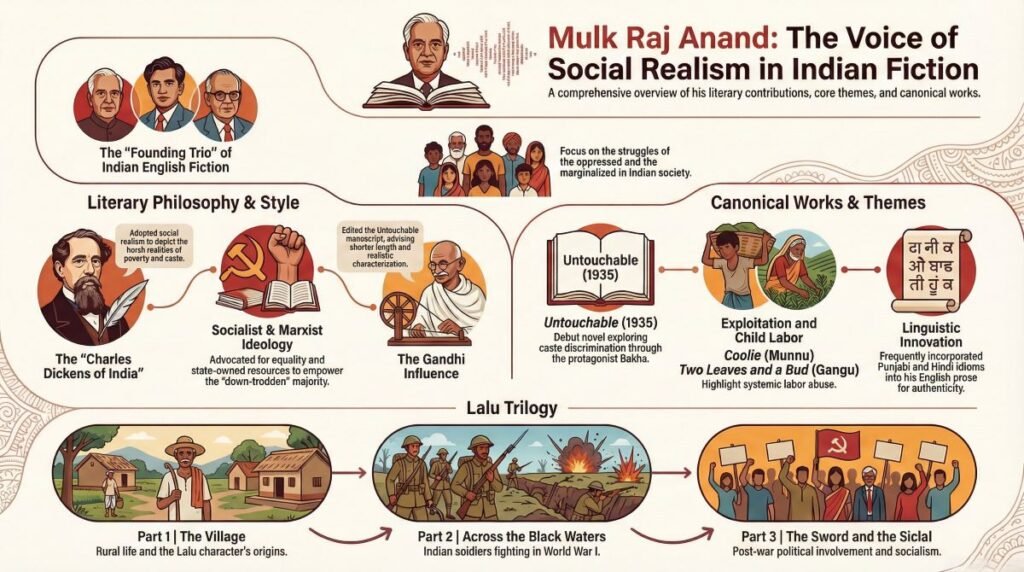
Mulk Raj Anand: Complete Life and Career Timeline
| Year | Key Event |
| 1905 | Born on December 12 in Peshawar, Punjab, British India |
| 1921 | Moved to Lahore; enrolled at Government College (affiliated with University of Punjab) |
| 1924 | Left for England; enrolled at University College London |
| 1927 | Met and was influenced by Sigmund Freud and Bertrand Russell during his years in Europe |
| 1929 | Earned his PhD in Philosophy from the University of London |
| 1930s | Became closely associated with the Bloomsbury Group in London; met E.M. Forster, T.S. Eliot, and Virginia Woolf |
| 1935 | Published Untouchable – his debut novel; E.M. Forster wrote the preface |
| 1936 | Published Coolie; participated in the founding of the All India Progressive Writers’ Association |
| 1937 | Published Two Leaves and a Bud; went to Spain to support the Republican cause during the Spanish Civil War |
| 1939-42 | Published The Village Trilogy – The Village, Across the Black Waters, The Sword and the Sickle |
| 1945 | Returned to India permanently after years in England and Europe |
| 1946 | Founded Marg, the influential Indian art and culture magazine |
| 1967 | Awarded the Padma Bhushan by the Government of India |
| 1970 | Appointed President of the Lalit Kala Akademi (National Academy of Art) |
| 1971 | Awarded the Sahitya Akademi Award for his autobiography Morning Face |
| 1990s | Remained active as a writer, editor and public intellectual into his nineties |
| 2004 | Died on September 28 in Pune, Maharashtra, at the age of 98 |
Mulk Raj Anand Summary: 10 Key Lines for Students and Quick Reference
Whether you are looking for a quick summary for a school assignment or a reference for a biography PDF, here are 10 essential lines about Mulk Raj Anand:
- Mulk Raj Anand was born on December 12, 1905, in Peshawar, Punjab, British India (now Pakistan).
- He is considered one of the three founding fathers of Indian writing in English, alongside R.K. Narayan and Raja Rao.
- His debut novel Untouchable (1935), with a preface by E.M. Forster, brought the reality of caste discrimination to world readers for the first time.
- He earned a PhD in Philosophy from the University of London in 1929 and was closely associated with the Bloomsbury Group in London.
- He wrote the famous Village Trilogy – The Village (1939), Across the Black Waters (1940), and The Sword and the Sickle (1942).
- He was a founding member of the All India Progressive Writers’ Association (1936), which used literature as a tool for social change.
- He founded Marg magazine in 1946 – India’s leading art and culture publication, still published today.
- He was awarded the Padma Bhushan by the Government of India in 1967 and the Sahitya Akademi Award in 1971.
- He wrote more than 30 novels, numerous short story collections, and important works of art criticism over a career spanning seven decades.
- He died on September 28, 2004, in Pune, Maharashtra, at the age of 98, leaving behind an irreplaceable legacy in Indian and world literature.
Why Should You Read Mulk Raj Anand Today?
Mulk Raj Anand’s writing remains urgently relevant in the 21st century. The issues he wrote about – caste discrimination, poverty, the exploitation of labour, the dignity of the individual against oppressive systems – are not resolved problems. They continue to define millions of lives in India and across the world.
Reasons to Read Mulk Raj Anand in the 21st Century
- To understand caste: Untouchable remains one of the most powerful and accessible literary explorations of the caste system ever written. Reading it today provides essential context for understanding contemporary debates about caste and Dalit rights in India.
- To understand colonialism: His Village Trilogy – especially Across the Black Waters – offers a uniquely Indian perspective on World War I and the experience of colonised peoples fighting for their colonisers.
- To experience literary pioneering: Reading Anand is to witness the birth of a literary tradition – Indian writing in English – that would go on to produce Nobel laureates and internationally celebrated authors.
- To engage with progressive politics through literature: His novels demonstrate that fiction can be both artistically excellent and politically engaged – a combination that many writers aspire to but few achieve.
- To discover The Lost Child: This short story, taught in Indian schools for generations, is a perfect introduction to Anand’s gift for combining simple, beautiful prose with deep emotional and thematic resonance.
Also read: Bankim Chandra Chatterjee Biography (PDF & PPT SLIDES)
Conclusion: The Enduring Legacy of Mulk Raj Anand
Mulk Raj Anand lived one of the most remarkable literary lives of the 20th century. Born in colonial India, educated at the great universities of Britain, shaped by two World Wars, the Indian independence movement, and the ferment of progressive politics, he channelled all of these experiences into a body of work that stands as one of the great monuments of Indian literature.
He gave a voice to those who had been denied one. He wrote about sweepers and coolies, peasants and factory workers, not as statistics or symbols but as fully realised human beings with inner lives, aspirations, fears, and dignity. In doing so, he expanded what the English-language novel could be and do.
Whether you begin with Untouchable, explore his famous trilogy, discover The Lost Child, or dive into his essays and art criticism – Mulk Raj Anand offers a rich, challenging, and deeply rewarding literary journey. He was a man who believed that literature must serve life, and he lived that belief with every word he wrote.