In this article we will discuss everything about Manohar Malgonkar Biography PDF and PPT Slides Download – his biography, born and died dates, born place, wife, family, education, all books in chronological order, famous works including A Bend in the Ganges, The Princes, The Devil’s Wind, Distant Drum, Combat of Shadows, A Toast in Warm Wine, The Garland Keepers, his awards, and his complete legacy as one of the most prolific, most widely read, and most distinctively Indian of post-independence English novelists.
Table of Contents
Manohar Malgonkar is a writer whom R.K. Narayan once called his ‘favourite Indian novelist in English’ – a tribute from one master to another that captures both the quality of Malgonkar’s work and its somewhat unusual position in the landscape of Indian writing. He was a soldier, a hunter, a landlord, a civil servant, and a politician before he became a novelist – and he brought to his fiction the authority of a man who had lived the kind of life he was writing about: the life of the Indian soldier, the life of the Indian prince, the life of the Indian landlord in the twilight of colonial rule and the dawn of independence.
He wrote about India’s history – the Mutiny of 1857, the lives of the princely states, the Second World War in India – with the confidence and the specificity of someone who had done his research and who cared passionately about getting the details right. He was, in the best sense, a storyteller: a writer who believed that the purpose of fiction was to tell a good story, and who told his stories with skill, energy, and an infectious pleasure in the craft. He was born in 1913 and died in 2010 – a life of 97 years that spanned the entire history of modern India from the late colonial period through independence, partition, the Emergency, liberalisation, and the beginnings of the twenty-first century.
Manohar Malgonkar Biography Table (Biodata / Author Profile)
| Biographical Detail | Information |
| Full Name | Manohar Malgonkar |
| Date of Birth / Born | July 12, 1913 |
| Born Place | Born near Belgaum (now Belagavi), Karnataka (then part of the Bombay Presidency of British India) – though he spent much of his life in the Kolhapur region of Maharashtra, particularly in the area around Jagalbet, where his family had land. The western Deccan region – its landscape, its history, its surviving princely culture – is the world of much of his fiction. |
| Date of Death | June 14, 2010 |
| Born and Died | Born July 12, 1913; Died June 14, 2010 – he lived to the age of 96, one of the longest-lived major writers in Indian literary history; his lifespan encompassed the entire arc of modern Indian history from the late colonial period through the first decade of the twenty-first century |
| Age at Death | 96 years |
| Nationality | Indian |
| Who Was Manohar Malgonkar? | Manohar Malgonkar was an Indian author who wrote in English – one of the most important and most prolific English-language novelists of post-independence India. He had a varied career that included time as a professional army officer (he served in the Indian Army and later the British Indian Army), a shikar (big-game hunting) guide, a landlord managing his family’s estate in Karnataka/Maharashtra, a civil servant, and a candidate for the Indian Parliament. He then turned to writing and produced a substantial body of fiction – novels, short stories, and non-fiction – over a career spanning more than four decades. |
| Family | Malgonkar came from a family of Saraswat Brahmins with roots in the Konkan coast of Maharashtra and Karnataka. His family had land in the Kolhapur region. He was from a background that combined military tradition, landlord status, and the educated professional class of western India – a social world that appears directly in his fiction, particularly in The Princes and A Bend in the Ganges. |
| Wife | Manohar Malgonkar was married. His wife shared his life at their home in Jagalbet, Karnataka, where they lived for much of their adult lives. He has spoken about his domestic life in interviews, describing Jagalbet – surrounded by forest, wildlife, and the landscape of the western Deccan – as the setting in which he did most of his writing. The details of his wife’s name are less widely documented in published sources, but she was a constant presence in the background of the life he describes in interviews and autobiographical writing. |
| Education | Manohar Malgonkar was educated at the prestigious Deccan College in Pune (Poona), one of the oldest and most distinguished educational institutions in Maharashtra, where he studied English literature. He also had military training as part of his career as an army officer. His education gave him the English literary foundation that shaped his prose style, and his military training gave him the discipline, the attention to detail, and the knowledge of military life that informs his war novels. |
| Career Before Writing | British Indian Army officer (he served in the Grenadiers regiment during the Second World War); shikar (big-game hunting) guide in central and western India; landlord managing the family estate in Jagalbet; Indian Civil Service officer; member of the Lok Sabha (Parliament of India) – he stood as a candidate in parliamentary elections; full-time writer from the late 1950s onwards |
| First Novel | Distant Drum (1960) – his debut novel; a story of the Indian Army during the Second World War, drawing directly on his own military service |
| Most Famous Works | A Bend in the Ganges (1964); The Princes (1963); The Devil’s Wind: Nana Saheb’s Story (1988); Combat of Shadows (1962); Distant Drum (1960); A Toast in Warm Wine (1974); The Garland Keepers (1986) |
| Which Was the First Novel of Manohar Malgonkar? | Distant Drum (1960) was the first novel of Manohar Malgonkar – a war novel set during the Second World War, drawing on his own experience as an Indian Army officer |
| Awards | Manohar Malgonkar received recognition from the literary establishment, though he was not a major prize winner in the formal sense; his work was widely read and critically appreciated; he received the Sahitya Akademi Award consideration and was widely recognised as one of the most important English-language novelists of his generation in India. R.K. Narayan’s famous description of him as ‘my favourite Indian novelist in English’ is itself the most significant recognition he received. |
| R.K. Narayan’s Tribute | R.K. Narayan once called Manohar Malgonkar his ‘favourite Indian novelist in English’ – one of the most generous and most significant tributes one major Indian novelist has paid to another; it reflects both Narayan’s admiration for Malgonkar’s storytelling gifts and the high esteem in which Malgonkar was held by his peers |
| Writing Themes | Indian military life; the Second World War in India and Burma; the princely states and their absorption into independent India; the Indian Mutiny of 1857; the partition of India; Indian history from the colonial period to independence; the lives of the educated Indian upper and middle classes in the transition from colony to independent nation; hunting and wildlife; the landscape and society of western India |
Manohar Malgonkar Biography PDF and PPT Slides Download
Who Was Manohar Malgonkar? What Are His Famous Works?
Manohar Malgonkar was an Indian author born on July 12, 1913, near Belgaum (Belagavi), Karnataka, who died on June 14, 2010, at the age of 96. He was an eminent post-independence writer in English – one of the most prolific, most widely read, and most consistently entertaining of the Indian novelists who emerged in the decades after independence. He had a varied career before turning to writing: he served as an officer in the British Indian Army and then the Indian Army, worked as a shikar guide, managed his family’s estate, and served as a civil servant before becoming a full-time novelist in the late 1950s.
His famous works include A Bend in the Ganges (1964) – his most widely read and most internationally recognised novel, a vast historical panorama of the partition of India; The Princes (1963) – the story of a fictional Indian prince navigating the end of the princely order; The Devil’s Wind: Nana Saheb’s Story (1988) – a historical novel about the Indian Mutiny of 1857 told from the perspective of one of its most controversial figures; Combat of Shadows (1962) – a thriller set during the Second World War in India and Burma; and Distant Drum (1960) – his debut novel about Indian Army life during the war.
R.K. Narayan famously called him ‘my favourite Indian novelist in English’ – a tribute that captures both the quality of Malgonkar’s storytelling and the pleasure his fiction gives to readers who love a well-constructed, fast-paced, historically grounded narrative. He is a writer for whom story was primary, and who told his stories with skill, energy, and an infectious love of the craft.
Manohar Malgonkar Biography in English: Early Life, Born Place and Education
Manohar Malgonkar was born on July 12, 1913, near Belgaum (now Belagavi) in what was then the Bombay Presidency of British India – a region on the border between present-day Karnataka and Maharashtra. He came from a family of Saraswat Brahmins with land in the Kolhapur region of Maharashtra, and he grew up in the social world of the western Deccan – a world shaped by the lingering culture of the Maratha Empire, by British colonial administration, by the traditions of the landlord class, and by the forests and wildlife of the region that would shape his lifelong passion for shikar (big-game hunting).
He was educated at Deccan College in Pune – one of the oldest and most prestigious educational institutions in Maharashtra, founded in 1821, which has produced many of India’s most important scholars, writers, and public figures. He studied English literature there, acquiring the literary formation that would eventually produce his novels. His prose style – clear, confident, well-constructed, influenced by the English literary tradition but not subordinated to it – reflects the solid grounding in English literature he received at Deccan College.
After his education, Malgonkar joined the British Indian Army – serving as an officer in the Grenadiers regiment, one of the oldest and most distinguished infantry regiments in the Indian Army. He served through the Second World War, seeing active service in the campaign against the Japanese in Burma and elsewhere in the eastern theatre. This military experience gave him a direct, lived knowledge of the Indian Army and of war that informs all his war novels – the sense of what military life actually feels like, from the inside, is one of the things that distinguishes his war fiction from that of writers who have not experienced it.
After independence, Malgonkar managed his family’s estate in Jagalbet, Karnataka – a property in a forested area that gave him the setting and the lifestyle that would shape his later life as a writer. He worked for a period in the civil service and stood as a candidate for the Indian Parliament. He also worked for years as a shikar guide – leading big-game hunting expeditions in central and western India – a career that gave him an intimate knowledge of Indian wildlife, of the forests of the Deccan, and of the social world of those who still hunted in post-independence India.
He began writing seriously in the late 1950s – producing his first novel, Distant Drum, in 1960 – and thereafter devoted himself primarily to fiction. He wrote from his home in Jagalbet, surrounded by the forests and the wildlife of Karnataka, and continued writing into his eighties. He died on June 14, 2010, at the age of 96.
Manohar Malgonkar Wife and Family
Manohar Malgonkar was married and settled with his wife at their home in Jagalbet, in the forested area of Karnataka near the Maharashtra border. He has spoken about his domestic life in interviews, describing Jagalbet as the place where he did most of his writing – surrounded by the forests he loved, the wildlife that had occupied him as a shikar guide, and the landscape of the western Deccan that shaped both his personal life and his fiction.
His family background was one of the landed Saraswat Brahmin class of western India – a social world that he brought directly into his fiction, particularly in his portrayal of the princely and landlord classes in The Princes and other novels. His family had land in the Kolhapur region, and his experience of managing that land – of the social relationships between landlord and tenant, between the old order and the new India – gave him the material and the authority for some of his most vivid social observation.
Malgonkar had children. His family continued to live in the Jagalbet area after his death in 2010. The estate and the landscape of his home in Karnataka remained central to his identity as a writer throughout his life – he was not a metropolitan literary figure but a man rooted in a specific place, and that rootedness gives his fiction a quality of geographical and social specificity that enriches it greatly.
Manohar Malgonkar All Books: Complete List in Chronological Order
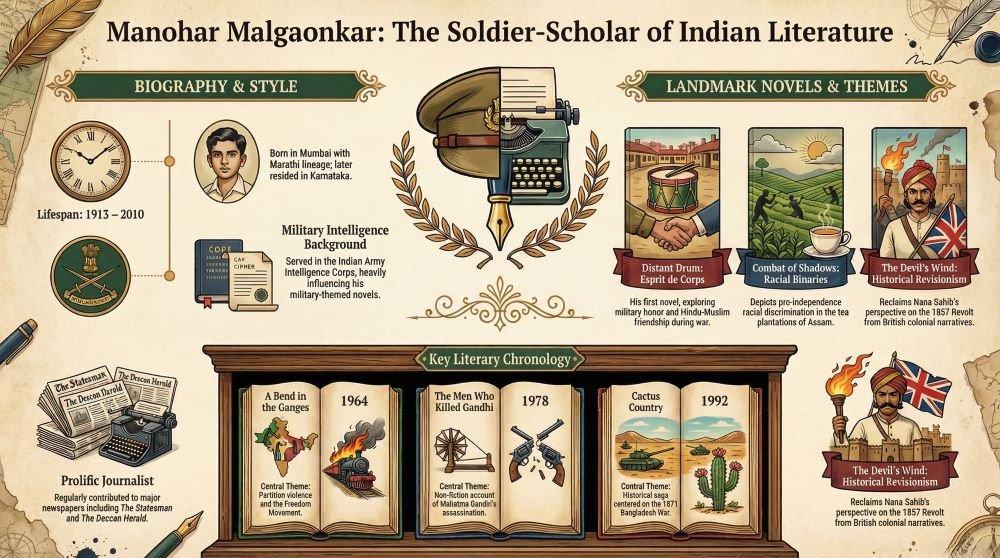
Manohar Malgonkar was a prolific author who produced novels, short story collections, non-fiction, and autobiography over a career spanning more than four decades. Here is his complete bibliography in chronological order:
| Year | Title | Type / Summary |
| 1959 | Kanha: India’s Wildlife Sanctuary | Non-fiction – one of his early publications; reflecting his deep knowledge of and love for Indian wildlife, and specifically his experience of the forests of central India where Kanha, one of India’s most important tiger reserves, is located. An early demonstration of his range as a writer beyond fiction. |
| 1960 | Distant Drum | His debut novel – set in the Indian Army during the Second World War; drawing directly on his own experience as an army officer during the war. The novel follows Indian soldiers through the experience of wartime service – its camaraderie, its discipline, its dangers, and the complex relationship between Indian soldiers and their British officers in the final years of the Raj. A first novel of striking confidence and authority, reflecting the depth of his personal knowledge of the world it describes. |
| 1961 | Combat of Shadows | His second novel – a thriller set in India and Burma during the Second World War; combining the elements of the war novel with those of the thriller. The novel is set partly in the tea gardens of Assam and partly in the Burmese theatre of war – two worlds that Malgonkar knew well from his military service. Demonstrates his gifts as a storyteller – his ability to create suspense, to construct a plot, and to render the specific atmosphere of a particular time and place. |
| 1963 | The Princes | One of his most celebrated novels – the story of Abhayraj, the young heir to the fictional Indian princely state of Begwad, and his journey from the privileged world of the princely order through Indian independence, partition, and the integration of the princely states into the Indian Union. The novel is both a personal story – the coming of age of a young man – and a historical panorama of one of the most significant transitions in Indian history: the end of the princely order and the absorption of India’s hundreds of kingdoms into the new democratic state. Widely praised as one of the finest novels about the princely states in Indian literature. |
| 1964 | A Bend in the Ganges | His most famous and most widely read novel – a vast historical panorama set during the partition of India in 1947. The novel follows several characters – including Gian Talwar, a young man drawn into nationalist violence, and his friend Debi-dayal, a revolutionary who becomes involved in terrorism – across the years leading up to and through partition. The novel examines the violence of partition – the mass killings, the migrations, the human cost – with a directness and an emotional power that few other novels about partition have achieved. A landmark of Indian historical fiction. |
| 1966 | Spy in Amber | A thriller – further demonstrating his range as a writer of genre fiction alongside his historical novels; the novel uses the conventions of the spy thriller to explore political and social questions in the Indian context. One of his more commercially oriented works. |
| 1969 | The Devil’s Wind: Nana Saheb’s Story | Begun in the 1960s, published/revised through subsequent editions – a historical novel about Nana Saheb, one of the most controversial figures of the Indian Mutiny of 1857 (also known as the First War of Indian Independence). Nana Saheb – the adopted son of the last Peshwa, who is denied his pension by the East India Company – becomes one of the leaders of the Mutiny and is held responsible for the massacre at Cawnpore (Kanpur). The novel is told in Nana Saheb’s own voice – a bold narrative choice that forces the reader to see the Mutiny from the perspective of one of its Indian protagonists. One of Malgonkar’s finest works and one of the most important historical novels about the Mutiny. |
| 1972 | A Toast in Warm Wine | A novel exploring social and personal themes in the context of post-independence Indian life; demonstrating his range beyond purely historical and military subjects. The novel engages with the personal relationships and the social world of the educated Indian upper class in the decades after independence. |
| 1975 | Lines Across Time | A collection of short stories – demonstrating his gifts as a short story writer alongside his novelistic career; the stories draw on the same range of subjects and settings as his novels: military life, Indian history, the social world of western India. |
| 1978 | The Garland Keepers | A novel – exploring themes of Indian political and social life; set in the world of Indian democracy and its corruptions; one of his more explicitly political works. The title refers to the garland-keepers – the people who maintain the rituals of power and of public life in Indian political culture. |
| 1988 | Bandicoot Run | A thriller – continuing his engagement with the genre fiction that he handled alongside his literary novels; set in the world of contemporary India. |
| 1989 | Princess: The Autobiography of the Dowager Maharani of Gwalior | Non-fiction / Ghostwritten autobiography – Malgonkar wrote the autobiography of Vijayaraje Scindia, the Dowager Maharani of Gwalior, one of the most powerful and most celebrated figures in post-independence Indian politics. Vijayaraje Scindia was a co-founder of the BJP and one of the most significant women in Indian political history. This work demonstrates Malgonkar’s range as a writer of non-fiction and his deep engagement with the world of the princely states. |
| 1992 | Inside Goa | Non-fiction – an account of Goa, the former Portuguese colony that was incorporated into India in 1961; drawing on Malgonkar’s knowledge of the region and its history. |
| 1993 | Dropping Names | Memoir / Autobiography – Malgonkar’s own memoir; a record of his encounters with the famous and the powerful across his long life; drawing on his military service, his years as a shikar guide, his career as a novelist, and his engagement with Indian public life. A valuable personal document and a characteristically readable piece of autobiographical writing. |
| 2000 | The Men Who Killed Gandhi | Non-fiction – a detailed, thoroughly researched account of the assassination of Mahatma Gandhi on January 30, 1948; examining the conspiracy, the conspirators (including Nathuram Godse), and the political context of the assassination. One of the most important non-fiction works on the Gandhi assassination available in English; praised for its research and its objectivity. |
A Bend in the Ganges: Complete Analysis
A Bend in the Ganges (1964) is Manohar Malgonkar’s most famous and most widely read novel – the work most associated with his name and the one most frequently cited when his importance in Indian literary history is discussed. It is a vast historical panorama set against the background of the partition of India in 1947 – one of the most traumatic events in modern history, in which the subcontinent was divided into India and Pakistan, accompanied by mass violence that killed perhaps a million people and displaced many millions more.
| Aspect | Detail |
| Full Title | A Bend in the Ganges |
| Author | Manohar Malgonkar |
| Published | 1964 (Hamish Hamilton, London; Orient Longman, India) |
| Setting | India from the 1930s through Partition in 1947 – moving from the Congress nationalist movement through the final years of the Raj to the catastrophe of partition |
| Central Characters | Gian Talwar – a young idealistic nationalist who becomes involved in revolutionary violence; Debi-dayal – his friend, a more committed revolutionary who is drawn into terrorism against the British; Sundari – a woman whose life intersects with both men; and various other characters who represent the different responses to the crisis of independence and partition |
| A Bend in the Ganges Summary | The novel begins in the years of the nationalist movement, when Gian and Debi-dayal are young men drawn by different impulses into different forms of anti-British activity. Debi-dayal becomes a revolutionary terrorist; Gian is more ambivalent. The novel follows their lives through the war years, through the final crisis of British rule, and into the catastrophe of partition – the mass killings on both sides of the new border, the migrations of millions of people, and the human cost of dividing a subcontinent along religious lines. The novel ends in the aftermath of partition, with the survivors trying to make sense of what has happened and to build lives in the new India. |
| Treatment of Partition Violence | One of the most striking things about A Bend in the Ganges is its unflinching portrayal of the violence of partition – the killings, the rapes, the destruction of communities on both sides of the new border. Malgonkar does not look away from this violence, and he portrays it from multiple perspectives – Hindu, Muslim, Sikh – with a moral seriousness that refuses to assign blame to any single community. This balanced, honest treatment of one of the most painful episodes in modern history is one of the novel’s greatest strengths. |
| Historical Accuracy | Malgonkar was known for the thoroughness of his historical research, and A Bend in the Ganges reflects this: the political background of the novel – the Congress movement, the Muslim League, the debate over partition, the final negotiations – is rendered with accuracy and authority. The novel is both a work of historical fiction and a historical document. |
| Critical Reception | Widely praised on publication in both India and the UK; recognised as one of the most important historical novels about partition and about the independence era; continues to be taught in Indian universities and to find new readers; considered one of the landmarks of Indian historical fiction in English |
| Comparison with Other Partition Novels | A Bend in the Ganges is often compared to other major novels about partition – Train to Pakistan by Khushwant Singh (1956), Tamas by Bhisham Sahni (1974), and others. Its scale, its historical ambition, and its moral seriousness place it among the most important literary responses to partition in any language. |
The Princes: Complete Analysis
The Princes (1963) is Manohar Malgonkar’s second major novel and one of his most celebrated – a story that uses the life of a fictional Indian prince to explore one of the most extraordinary transitions in Indian history: the end of the princely order and the integration of India’s hundreds of kingdoms into the new democratic state.
| Aspect | Detail |
| Full Title | The Princes |
| Author | Manohar Malgonkar |
| Published | 1963 |
| Protagonist | Abhayraj (Abhay) – the young heir to the fictional princely state of Begwad; a young man of privilege who grows up in the extraordinary world of the Indian princes and who must navigate the end of that world after Indian independence |
| The Princely World | The novel is set in the world of the Indian princely states – the hundreds of kingdoms, large and small, that existed as semi-autonomous units within British India and that were absorbed into the Indian Union after independence. This world – with its palaces, its traditions, its ritual splendour, its hunting parties, its political complexity – is rendered by Malgonkar with a vividness and an authority that comes from his own deep knowledge of that social world. He had grown up in a region shaped by the remnants of the Maratha princely tradition, and his portrait of Begwad is both fictional and deeply historically grounded. |
| The Princes Summary | The novel follows Abhay from his childhood as the privileged heir of a princely state – educated with the sons of other princes, trained in the traditions of the court, prepared for a future as a ruler – through Indian independence (1947) and the integration of the princely states into the Indian Union (1947-49). After independence, the princely states are abolished and their rulers are left with privy purses and reduced status. Abhay must find a way to live in the new India – a democratic republic that has no place for the kind of hereditary authority he was raised to exercise. The novel is both a coming-of-age story and a historical elegy: a meditation on the end of a world. |
| Historical Context | The integration of the princely states was one of the most remarkable political achievements of post-independence India – the peaceful (with some exceptions) absorption of more than 500 princely states into the Indian Union, engineered primarily by Sardar Vallabhbhai Patel, India’s first Home Minister. Malgonkar portrays this process with historical accuracy and with an evident sympathy for the princes whose world was being ended – though without any nostalgia for the political system that world represented. |
| Critical Reception | Widely praised as one of the finest novels about the princely states in Indian literature; celebrated for the vividness of its evocation of the princely world and for the emotional depth of its portrayal of Abhay’s journey; compared favourably to other novels about the Indian aristocracy; continues to be taught and read as a major work of Indian historical fiction |
The Devil’s Wind: Nana Saheb’s Story – Analysis
The Devil’s Wind: Nana Saheb’s Story is one of Malgonkar’s most ambitious and most celebrated works – a historical novel about Nana Saheb, one of the most controversial and most complex figures of the Indian Mutiny of 1857, told in Nana Saheb’s own voice.
Nana Saheb – whose full name was Dhondu Pant – was the adopted son of Baji Rao II, the last Peshwa of the Maratha Confederacy. When Baji Rao died, the East India Company refused to continue paying Nana Saheb the pension that had been granted to his adoptive father, on the grounds that the Doctrine of Lapse (which the Company used to absorb princely states when there was no direct male heir) applied to the pension as well as to the title. Nana Saheb – denied his inheritance, stripped of his status – became one of the leaders of the Mutiny of 1857. He is held responsible by British accounts for the massacre at Cawnpore (Kanpur), in which captured British soldiers and civilians were killed.
Malgonkar’s novel tells Nana Saheb’s story from his own perspective – in the first person, in Nana Saheb’s voice. This narrative choice is itself a political and moral act: it insists that the ‘villain’ of British imperial historiography about the Mutiny has a story, a perspective, and a human complexity that the dominant narrative has suppressed. By giving Nana Saheb his own voice, Malgonkar asks the reader to understand the Mutiny from the perspective of those who rose against British rule – to see the British not as the bearers of civilisation defending themselves against barbarism but as a colonial power whose injustices drove the Mutiny into being.
The novel is extensively researched – Malgonkar spent years working through historical sources on the Mutiny – and it is one of the most important Indian literary responses to 1857. It stands alongside other major imaginative engagements with the Mutiny – including Amitav Ghosh’s work and various other Indian novels on the subject – as a work that insists on the Indian perspective in a historical event that had too long been told exclusively from the British side.
Distant Drum: First Novel Analysis
Distant Drum (1960) is Manohar Malgonkar’s debut novel – the work that launched his literary career and that established the military subject matter and the confident, authoritative style that would characterise his best fiction.
The novel is set in the Indian Army during the Second World War – drawing directly on Malgonkar’s own experience as an army officer during the war years. It follows the lives of Indian soldiers and officers through the experience of wartime service – the camaraderie of the mess, the discipline of military life, the experience of active service, and the complex, sometimes fraught relationship between Indian officers and their British superiors in the final years of the British Raj.
The novel is notable for its authentic portrayal of Indian Army life – a world that Malgonkar knew from the inside, and that very few Indian novelists in English had written about with comparable authority. It established his reputation as a writer who brought personal experience and genuine knowledge to his fiction, and it announced a major new voice in Indian English literature.
The question ‘Which was the first novel of Manohar Malgonkar?’ is answered clearly: Distant Drum (1960).
Combat of Shadows: Analysis
Combat of Shadows (1962) is Manohar Malgonkar’s second novel – a thriller set in India and Burma during the Second World War, combining the elements of the war novel with those of the espionage thriller.
The novel is set partly in the tea gardens of Assam – the vast plantations of northeastern India where tea has been grown since the nineteenth century – and partly in the Burmese theatre of the war, where British, Indian, and Japanese forces fought one of the most arduous campaigns of the Second World War. The setting is rendered with great specificity and atmospheric power – the lush, claustrophobic landscape of Assam and Burma, the heat and the rain and the jungle, the particular social world of the tea gardens with their planters and their workers – and the thriller plot is constructed with Malgonkar’s characteristic skill and pace.
Combat of Shadows demonstrates that Malgonkar was not merely a literary novelist but a writer capable of producing genre fiction of high quality – and that his knowledge of the Indian military experience during the Second World War was both deep and varied. The novel has remained in print and continues to be read as one of the better thrillers set in wartime India.
The Men Who Killed Gandhi: Non-Fiction Analysis
The Men Who Killed Gandhi is one of Manohar Malgonkar’s most important non-fiction works – a detailed, thoroughly researched account of the assassination of Mahatma Gandhi on January 30, 1948, examining the conspiracy, the conspirators, and the political context of the assassination.
Gandhi was assassinated by Nathuram Godse – a Chitpavan Brahmin from Maharashtra who was a member of the RSS and who believed that Gandhi’s policies toward Pakistan had weakened India and betrayed Hindu interests. Godse and several co-conspirators were tried, convicted, and two of them – Godse and Narayan Apte – were executed.
Malgonkar’s account of the assassination is notable for its objectivity – he attempts to understand Godse’s motivations without endorsing them, and he examines the political context of 1947-48 India with the same thoroughness he brought to his historical fiction. The book is considered one of the most important accounts of the Gandhi assassination available in English – combining historical research with narrative skill to produce a work that is both informative and compelling.
The Men Who Killed Gandhi is also significant as a demonstration of Malgonkar’s range as a writer: he was not merely a novelist of historical fiction but a serious researcher and non-fiction writer capable of engaging with the most sensitive and most complex episodes in modern Indian history.
Manohar Malgonkar as a Military Writer
Manohar Malgonkar’s military career – his service as an officer in the British Indian Army during the Second World War, his knowledge of the Indian Army from the inside – is one of the most important shaping forces in his fiction and one of the qualities that most clearly distinguish him from other Indian novelists writing in English.
He served in the Grenadiers regiment – one of the oldest and most distinguished infantry regiments in the Indian Army, with a history going back to 1778. His service during the Second World War gave him direct experience of active military operations, of the culture and traditions of the Indian Army, of the relationship between Indian and British officers, and of the physical and psychological demands of military service. This experience informs Distant Drum and Combat of Shadows with a specificity and an authenticity that no amount of research could have provided.
His military novels are notable for their respect for the Indian soldier – for the courage, the professionalism, and the dignity of the men who served in the Indian Army – and for their honest portrayal of the complex relationship between India’s military tradition and the colonial system within which it operated. He wrote about Indian soldiers as full human beings, not as supporting characters in a British story, and this was itself a significant act in the literary culture of post-independence India.
Manohar Malgonkar’s Writing Style
| Element | Detail |
| Prose Style | Clear, confident, fast-paced – Malgonkar writes with the assurance of a man who knows his material and trusts his reader; his prose is never obscure or experimental; it moves with the energy and the directness of a natural storyteller. He was influenced by the English literary tradition he had studied at Deccan College – particularly by the tradition of the historical novel – but he made that tradition serve his own specifically Indian subjects. |
| Storytelling | His greatest gift is storytelling – the ability to construct a plot, to create and sustain suspense, to make the reader want to turn the page. This gift, which is rarer in literary fiction than it should be, is what earned him R.K. Narayan’s tribute as ‘my favourite Indian novelist in English’ and what has kept his novels in print and in readers’ hands for more than half a century. |
| Historical Research | He was known for the thoroughness of his historical research. Before writing A Bend in the Ganges, he researched partition; before writing The Devil’s Wind, he researched the Mutiny exhaustively; before writing The Men Who Killed Gandhi, he researched the assassination in detail. This research discipline gives his historical fiction an authority and a specificity that enriches both its literary and its historical value. |
| Characterisation | His characters are not always as psychologically complex as those of more literary novelists – but they are vivid, distinctive, and memorable; and his ability to create characters who are immediately recognisable as products of specific social worlds (the Indian Army, the princely states, the nationalist movement) is a real literary achievement. |
| Setting | His settings are rendered with great specificity and atmospheric power – the Indian Army, the tea gardens of Assam, the palaces of the princely states, the rivers and forests of the western Deccan, the chaos and violence of partition. This sense of place is one of the most consistent pleasures of his fiction. |
| Genre Range | He worked confidently across multiple genres – the literary historical novel, the thriller, the war novel, non-fiction history, autobiography, ghostwritten memoir – and he maintained a consistently high standard of craft across all of them. This range reflects both his intellectual curiosity and his professional commitment to the craft of writing. |
Manohar Malgonkar Awards and Recognition
Manohar Malgonkar did not receive major formal literary prizes in the way that some of his contemporaries did – he was not a Sahitya Akademi Award winner, though his work was certainly considered; he did not win the Commonwealth Writers’ Prize or other major international awards. But his recognition came from another direction: from the admiration of his peers, from the loyalty of his readers, and from the sustained critical attention that his best novels have continued to attract.
The most significant recognition he received was R.K. Narayan’s description of him as ‘my favourite Indian novelist in English’ – a tribute from one of the most important literary figures in Indian writing that speaks to the quality of his storytelling and the pleasure his fiction gives. This informal but significant recognition places Malgonkar in the first rank of Indian novelists in English of his generation.
His novel A Bend in the Ganges was published in the UK by Hamish Hamilton and received serious critical attention in the British literary press; his work was appreciated by readers both in India and internationally. The continuing availability of his novels in reprint editions, and the continuing interest in his work among students of Indian literature, testifies to the enduring quality of what he achieved.
Manohar Malgonkar Life Timeline
| Year | Key Event |
| 1913 | Born on July 12 near Belgaum (Belagavi), Karnataka – into a family of Saraswat Brahmins with land in the Kolhapur region of Maharashtra; grows up in the world of the western Deccan, its forests, its wildlife, and the surviving culture of the Maratha princely tradition |
| 1913-1930s | Early childhood and schooling; grows up with a deep love of the outdoors, of hunting, and of the landscape of western India; forms the knowledge of wildlife and of the forests of the Deccan that will shape his non-fiction and his fiction |
| 1930s | Educated at Deccan College, Pune – studies English literature; acquires the literary formation and the prose discipline that will shape his writing career |
| Late 1930s | Joins the British Indian Army; serves as an officer in the Grenadiers regiment; begins his military career in the final years of the Raj |
| 1939-1945 | Second World War – serves as an Indian Army officer; sees active service in the eastern theatre, including the Burma campaign; acquires the direct military experience that will inform Distant Drum, Combat of Shadows, and other war novels |
| 1947-1950s | Indian independence; manages family estate at Jagalbet, Karnataka; works as a shikar guide; works in the civil service; stands as a candidate for the Indian Parliament; begins writing seriously |
| 1959 | Kanha: India’s Wildlife Sanctuary published – his first book, a non-fiction account of the Kanha tiger reserve |
| 1960 | Distant Drum published – his debut novel; immediately recognised as a significant new voice in Indian English fiction |
| 1961 | Combat of Shadows published – his second novel; establishes his reputation as a skilled novelist of military and thriller fiction |
| 1963 | The Princes published – one of his most celebrated novels; praised for its vivid portrayal of the princely world and the transition to independent India |
| 1964 | A Bend in the Ganges published – his most famous novel; a landmark of Indian historical fiction about partition; published in the UK by Hamish Hamilton |
| 1966 | Spy in Amber published |
| 1969 / later | The Devil’s Wind: Nana Saheb’s Story – his historical novel about the 1857 Mutiny, told from Nana Saheb’s perspective; one of his finest works |
| 1972 | A Toast in Warm Wine published |
| 1975 | Lines Across Time (short stories) published |
| 1978 | The Garland Keepers published |
| 1989 | Princess: The Autobiography of the Dowager Maharani of Gwalior published – ghostwritten autobiography of Vijayaraje Scindia |
| 1993 | Dropping Names published – his own memoir |
| 2000 | The Men Who Killed Gandhi published – his major non-fiction account of the Gandhi assassination; praised for its research and objectivity |
| 2000s | Continues living at Jagalbet, Karnataka; writing and receiving recognition as one of the significant figures in the history of Indian English fiction |
| 2010 | Dies on June 14 in Jagalbet (or nearby), Karnataka – at the age of 96; mourned as one of the last of the great post-independence generation of Indian novelists in English; tributes note his extraordinary lifespan, his prolific output, and R.K. Narayan’s famous tribute |
10 Lines About Manohar Malgonkar for Students
- Manohar Malgonkar was an Indian author who wrote in English, born on July 12, 1913, near Belgaum (Belagavi), Karnataka, and died on June 14, 2010, at the age of 96.
- Before becoming a full-time novelist, he had a varied career as a British Indian Army officer (serving in the Second World War), a shikar guide, a landlord, a civil servant, and a parliamentary candidate.
- His first novel was Distant Drum (1960) – a war novel drawing on his own military experience; which was the first novel of Manohar Malgonkar is a frequently asked question answered clearly by this title.
- His most famous novel is A Bend in the Ganges (1964) – a vast historical panorama of the partition of India in 1947; it is widely regarded as one of the most important historical novels about partition in Indian literature.
- Other major works include The Princes (1963), The Devil’s Wind: Nana Saheb’s Story, Combat of Shadows (1962), A Toast in Warm Wine (1972), and The Garland Keepers (1978).
- He also wrote important non-fiction, including The Men Who Killed Gandhi – one of the most thoroughly researched accounts of the Gandhi assassination – and the ghostwritten autobiography of Vijayaraje Scindia, the Dowager Maharani of Gwalior.
- R.K. Narayan once called him ‘my favourite Indian novelist in English’ – one of the most significant tributes one major Indian writer has paid to another.
- He spent most of his writing life at his home in Jagalbet, Karnataka, surrounded by the forests and wildlife of the western Deccan that he had known since childhood.
- He was known for the thoroughness of his historical research, the energy and pace of his storytelling, and the authenticity of his portrayal of the Indian military world and the princely states.
- He lived to the age of 96 – one of the longest-lived major writers in Indian literary history – and his death in 2010 marked the end of a career spanning more than fifty years of fiction writing.
Manohar Malgonkar Short Biography (Profile / Biodata)
Manohar Malgonkar (born July 12, 1913, near Belgaum/Belagavi, Karnataka; died June 14, 2010, age 96) was an Indian author who wrote in English. Born into a family of Saraswat Brahmins with land in the Kolhapur region of Maharashtra. Educated at Deccan College, Pune (English literature). Career before writing: British Indian Army officer (Grenadiers regiment, Second World War service in Burma); shikar guide; estate manager; civil servant; parliamentary candidate. Full-time writer from late 1950s. Settled at Jagalbet, Karnataka. First novel: Distant Drum (1960). Most famous novel: A Bend in the Ganges (1964). Major works: The Princes (1963); Combat of Shadows (1962); The Devil’s Wind; A Toast in Warm Wine (1972); The Garland Keepers (1978); Lines Across Time (short stories, 1975); The Men Who Killed Gandhi (non-fiction); Princess: The Autobiography of the Dowager Maharani of Gwalior (ghostwritten); Dropping Names (memoir, 1993). R.K. Narayan called him ‘my favourite Indian novelist in English.’ Died at Jagalbet, Karnataka, at the age of 96.
READ ALSO: U.R. Ananthamurthy Biography PDF and PPT Slides Download
Conclusion:
Manohar Malgonkar’s legacy in Indian literature rests on a simple but important foundation: he told good stories, and he told them well. He brought to Indian historical fiction the combination of meticulous research, narrative skill, and personal authority that the best historical novel requires – and he brought those qualities to subjects that other Indian novelists had not yet touched: the Indian Army in wartime, the princely states in their final days, the violence of partition, the Mutiny of 1857 from the Indian side.
A Bend in the Ganges remains one of the most important literary responses to partition in any language – a novel that looks at one of the most painful events in modern Indian history with honesty, moral seriousness, and the kind of narrative power that keeps a reader turning pages. The Princes remains one of the finest evocations of the princely world and its passing. The Devil’s Wind remains one of the most important Indian literary responses to 1857.
R.K. Narayan’s tribute – ‘my favourite Indian novelist in English’ – is the most eloquent summary of his achievement. Narayan knew Indian fiction in English better than almost anyone, and his choice of Malgonkar as his favourite speaks to the quality of the storytelling, the authenticity of the world-picture, and the pleasure that reading Malgonkar gives. That pleasure is still available, for any reader willing to discover him. His books remain in print. His best work endures.