Today in this article we will discuss about the List of Indian Writers in English Literature with PDF, PPT, INFOGRAPHIC, TABLE and A Comprehensive Guide to Famous Indian Writers in English Literature and Their Works so, Indian writing in English stretches back more than two centuries, from the lyrical verse of Toru Dutt in the 1870s to the dystopian fiction of Prayaag Akbar in the 2020s. Along the way, this tradition has produced Nobel laureates, Booker Prize winners, Pulitzer Prize recipients, and some of the most widely read novels in the world. This article provides the most comprehensive list of Indian writers in English literature available – complete with full data tables covering their lives, major works, themes, awards, and fascinating facts.
Table of Contents
Indian writing in English has a rich, layered history that stretches back more than two centuries. From the colonial era to the postmodern present, Indian authors writing in English have not only shaped the global literary conversation but have also brought the complexity of Indian society, culture, and history to readers across the world. Today, a growing number of readers and students are searching for a complete list of Indian writers in English literature – and for good reason. These voices are vibrant, diverse, and essential.
Whether you are a student, a researcher, a literature lover, or someone preparing for competitive examinations, the tables below give you everything you need to understand Indian English literature from its earliest pioneers to its most exciting 21st century voices. We cover famous Indian writers in English literature and their works PDF-ready data, a list of top 5 Indian writers in English, 10 Indian English writers by generation, novel 21st century Indian writers in English literature, and contemporary Indian writers in English literature from across India and the diaspora.
Why Indian Writing in English Matters?
India is a country of over 1.4 billion people with more than 22 officially recognized languages and hundreds of dialects. English, introduced during the British colonial period, became a bridge language – one that allowed writers from Tamil Nadu, Bengal, Punjab, and Kashmir to speak to each other and to the world. This linguistic crossroads has produced a uniquely powerful body of literature.
Indian English literature is not a monolith. It carries the weight of Partition, the pride of independence, the irony of postcolonialism, the energy of urbanization, and the quiet grief of caste and gender discrimination. To understand Indian writing in English is to understand India itself – in all its contradictions and brilliance.
List of Indian Writers in English Literature PDF (PPT SLIDES)
Early Pioneers: Indian Writers in English Literature (Pre-Independence)
The foundation of Indian English literature was laid well before independence in 1947. These early writers navigated colonial power structures while finding their own authentic voice.
1. Rabindranath Tagore (1861–1941)
Widely regarded as the greatest Indian writer of the modern era, Rabindranath Tagore was the first Asian to win the Nobel Prize in Literature in 1913. Though he primarily wrote in Bengali, his self-translated works – particularly Gitanjali (Song Offerings) – brought Indian philosophy and spirituality to a global English-reading audience. His plays, novels, short stories, and essays in English translation remain essential reading. Works: Gitanjali, The Home and the World, Gora, The Post Office.
2. Henry Louis Vivian Derozio (1809–1831)
One of the earliest known Indian poets to write in English, Derozio is a foundational figure in Indian English poetry. His romantic verse was influenced by Byron and Keats, and he was a fierce advocate for rational thought and social reform. Works: Poems, The Fakeer of Jungheera.
3. Toru Dutt (1856–1877)
A prodigious talent who died at just 21, Toru Dutt wrote poetry in both English and French and translated French poems into English. Her work is remarkable for its cultural hybridity and lyrical beauty. Works: A Sheaf Gleaned in French Fields, Ancient Ballads and Legends of Hindustan.
4. Aurobindo Ghose / Sri Aurobindo (1872–1950)
A philosopher, yogi, and poet, Sri Aurobindo wrote extensively in English. His monumental epic poem Savitri and his philosophical prose works are landmarks in Indian English literature. Works: Savitri: A Legend and a Symbol, The Life Divine, Essays on the Gita.
Post-Independence Indian Writers in English Literature (1947–1980)
After independence, a new wave of Indian writers in English emerged who grappled with partition, national identity, and the promise and failure of the new nation. This era gave birth to some of the most celebrated names in global literature.
5. R.K. Narayan (1906–2001)
Rasipuram Krishnaswami Narayan is one of the most beloved Indian English novelists of the 20th century. His fictional town of Malgudi became a mirror for the entirety of Indian middle-class life. His writing is deceptively simple yet deeply insightful. Works: Swami and Friends, The Guide (Sahitya Akademi Award), The Bachelor of Arts, Malgudi Days.
6. Mulk Raj Anand (1905–2004)
A socially committed novelist, Mulk Raj Anand used English fiction to expose caste discrimination, poverty, and the exploitation of the working class. His novels are among the earliest in Indian English literature to center the lives of Dalits and laborers. Works: Untouchable, Coolie, Two Leaves and a Bud.
7. Raja Rao (1908–2006)
Raja Rao is celebrated for his philosophical depth and his effort to adapt English to Indian rhythms of storytelling. His preface to Kanthapura is itself a landmark statement on the nature of Indian writing in English. Works: Kanthapura, The Serpent and the Rope, The Cat and Shakespeare.
8. Kamala Das (1934–2009)
Writing under the pen name Madhavikutty in Malayalam and Kamala Das in English, she was a pioneering voice in Indian women’s poetry. Her confessional, candid, and often controversial verses broke the silence around female desire and identity. Works: Summer in Calcutta, The Old Playhouse and Other Poems, My Story (autobiography).
9. Nissim Ezekiel (1924–2004)
Considered the father of modern Indian English poetry, Nissim Ezekiel shaped an entire generation of Indian poets. A Bombay Jew by background, his work explored urban alienation, identity, and the Indian experience with wit and precision. Works: A Time to Change, Sixty Poems, Hymns in Darkness, Latter-Day Psalms.
Top 5 Indian Writers in English Who Changed Global Literature
When people search for the top 5 Indian writers in English, they are usually looking for the writers who made an undeniable mark on world literature. Here is a definitive list based on literary impact, critical recognition, and global readership.
1. Salman Rushdie
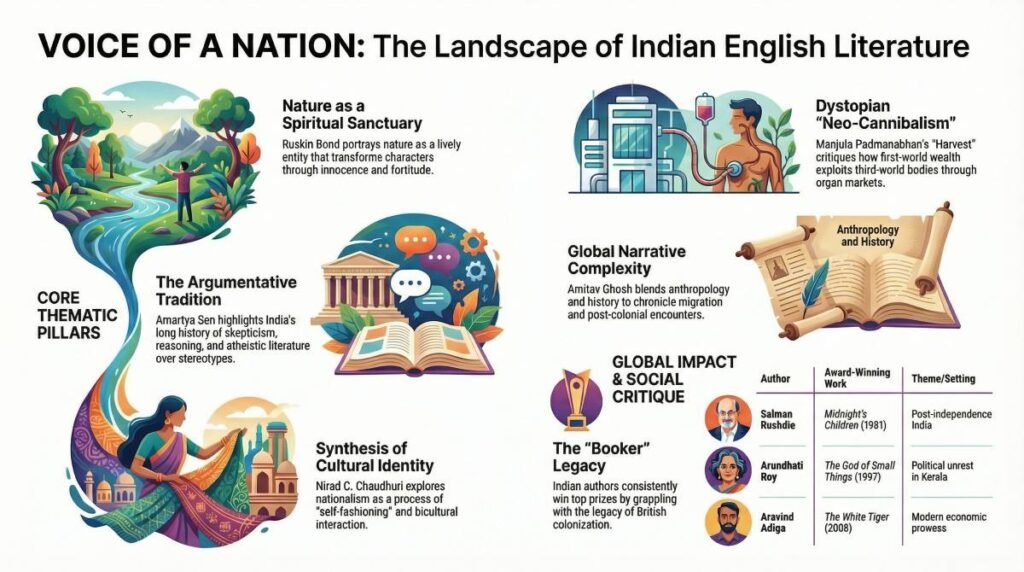
Salman Rushdie is arguably the most internationally recognized Indian English novelist. His Midnight’s Children (1981), which won the Booker Prize and the Booker of Bookers, redefined what the postcolonial novel could be. Using magical realism and a sprawling narrative canvas, Rushdie transformed the story of India’s independence into a global epic. Works: Midnight’s Children, The Satanic Verses, The Moor’s Last Sigh, Haroun and the Sea of Stories.
2. Arundhati Roy
Arundhati Roy burst onto the world literary scene with The God of Small Things (1997), which won the Man Booker Prize and became one of the best-selling novels by an Indian author. Twenty years later, she returned with The Ministry of Utmost Happiness (2017). Her fiction and nonfiction both probe the fault lines of Indian society – caste, gender, politics, and environmental justice. Works: The God of Small Things, The Ministry of Utmost Happiness, The Algebra of Infinite Justice (essays).
3. Vikram Seth
Vikram Seth is celebrated for the astonishing breadth and craftsmanship of his writing. A Suitable Boy (1993) – at 1,349 pages – is one of the longest novels ever published in the English language and a sweeping portrait of post-Partition India. His poetry collection The Golden Gate, written in sonnets, is equally remarkable. Works: A Suitable Boy, The Golden Gate, An Equal Music, A Suitable Girl.
4. Amitav Ghosh
Amitav Ghosh writes at the intersection of history, anthropology, and fiction. His Ibis Trilogy, beginning with Sea of Poppies, reconstructs the world of the opium trade in the 19th century Indian Ocean. His nonfiction work The Great Derangement is one of the most important books written about climate change and literature. Works: The Shadow Lines, The Calcutta Chromosome, Sea of Poppies, The Great Derangement.
5. Jhumpa Lahiri
Though born in London and raised in the United States, Jhumpa Lahiri is of Indian Bengali heritage and her fiction explores the interior lives of Indian immigrants navigating identity and belonging. Her debut short story collection Interpreter of Maladies won the Pulitzer Prize for Fiction in 2000. Works: Interpreter of Maladies, The Namesake, Unaccustomed Earth, The Lowland.
Also read: List Of Nobel Prize Winners in English Literature PDF PPT
Novel 21st Century Indian Writers in English Literature
The landscape of contemporary Indian writers in English literature is vibrant, diverse, and constantly evolving. A new generation of novelists, poets, and essayists is pushing boundaries in remarkable ways. Here are some of the most exciting 21st century Indian writers in English literature whose work deserves attention.
Aravind Adiga (b. 1974)
Aravind Adiga won the Man Booker Prize in 2008 for his debut novel The White Tiger, a darkly comic exploration of class, corruption, and ambition in modern India. The book was later adapted into an acclaimed Netflix film. Works: The White Tiger, Between the Assassinations, Last Man in Tower, Amnesty.
Kiran Desai (b. 1971)
Daughter of celebrated writer Anita Desai, Kiran Desai won the Man Booker Prize in 2006 for The Inheritance of Loss – a novel that navigates the aftermath of colonialism, immigration, and insurgency across continents. Works: Hullabaloo in the Guava Orchard, The Inheritance of Loss.
Chetan Bhagat (b. 1974)
Among the most commercially successful Indian English writers of the 21st century, Chetan Bhagat has democratized reading in India. His novels, written in accessible English and targeted at young urban readers, have consistently topped bestseller charts. Works: Five Point Someone, 2 States, 3 Mistakes of My Life, Half Girlfriend, One Indian Girl.
Anita Desai (b. 1937)
A three-time Booker Prize shortlisted author, Anita Desai is one of the most critically admired Indian English novelists. Her fiction is known for its psychological depth and its focus on the inner lives of women in Indian society. Works: Clear Light of Day, Fire on the Mountain, In Custody, Baumgartner’s Bombay.
Ruskin Bond (b. 1934)
One of India’s most beloved writers, Ruskin Bond has been writing stories, novellas, and essays for over six decades. His gentle, evocative prose captures the landscape of the Himalayas and small-town Indian life with warmth and humor. He is particularly cherished as a writer for children and young adults. Works: The Room on the Roof, A Flight of Pigeons, Our Trees Still Grow in Dehra, Rusty the Boy from the Hills.
Shashi Tharoor (b. 1956)
A diplomat, politician, and prolific writer, Shashi Tharoor is one of the most eloquent voices in contemporary Indian English nonfiction. His political and historical writing has sparked major national conversations, particularly around British colonialism and its legacy. Works: The Great Indian Novel, An Era of Darkness, Inglorious Empire, Why I Am a Hindu.
Preeti Shenoy (b. 1971)
One of the most popular contemporary Indian writers in English, Preeti Shenoy writes emotionally resonant fiction that explores relationships, mental health, and personal transformation. She has a massive following and several of her novels have been bestsellers. Works: Life is What You Make It, The Secret Wish List, It Happens for a Reason.
Anjum Hasan, Prayaag Akbar, Deepa Anappara, and Avni Doshi
A wave of younger Indian English writers has emerged in the 2010s and 2020s who are gaining international critical acclaim. Prayaag Akbar’s Leila (adapted by Netflix) explores a near-future dystopian India. Deepa Anappara’s Djinn Patrol on the Purple Line examines child disappearances in urban slums. Avni Doshi’s Burnt Sugar was shortlisted for the Booker Prize in 2020, bringing her into the global spotlight.
10 Indian English Writers Who Defined Their Generation
For those seeking a concise, definitive roll call of 10 Indian English writers who made a lasting mark on literature, here is our curated list based on critical legacy, influence, and cultural significance:
- 1. Rabindranath Tagore – The poet-philosopher who gave India a Nobel Prize.
- 2. R.K. Narayan – The gentle chronicler of Malgudi and Indian middle-class life.
- 3. Mulk Raj Anand – The socialist novelist who gave a voice to the marginalized.
- 4. Raja Rao – The philosopher-novelist who made English Indian.
- 5. Salman Rushdie – The magician of magical realism and postcolonial fiction.
- 6. Arundhati Roy – The activist-novelist who made the personal political.
- 7. Vikram Seth – The novelist-poet whose ambition matched his craft.
- 8. Amitav Ghosh – The historian-novelist who wrote the Indian Ocean into literature.
- 9. Jhumpa Lahiri – The diaspora voice who won the Pulitzer and redefined belonging.
- 10. Nissim Ezekiel – The father of modern Indian English poetry.
Indian Women Writers in English Literature
Indian women writers in English have produced some of the most powerful and transformative literary works of the past century. From Kamala Das’s confessional poetry to Arundhati Roy’s activist fiction, these voices have challenged patriarchy, caste, and colonial legacy from the inside out. Other significant Indian women writers in English include: Shashi Deshpande (The Dark Holds No Terrors), Manju Kapur (Difficult Daughters, The Immigrant), Namita Gokhale (Paro: Dreams of Passion), Gita Hariharan (The Thousand Faces of Night), Taslima Nasrin (though Bangladeshi-born, she writes about the Indian subcontinent’s shared experience), Meena Kandasamy (The Gypsy Goddess, When I Hit You), and Nayantara Sahgal, one of the first major Indian English women novelists.
Indian English Poets: Voices of Verse
The list of Indian writers in English literature would be incomplete without acknowledging the rich tradition of Indian English poetry. Beyond Nissim Ezekiel and Kamala Das, important Indian English poets include: A.K. Ramanujan (renowned for his translations and original poetry), Jayanta Mahapatra (the first Indian poet to win a Sahitya Akademi Award for English poetry), Dom Moraes (a Bombay-born poet who won the Hawthornden Prize at just 19), Eunice de Souza (known for her satirical verse on Goan Catholic culture), and Agha Shahid Ali (celebrated for his ghazals in English, especially The Country Without a Post Office).
The Indian Diaspora Writers in English
A significant portion of famous Indian writers in English literature and their works come from the diaspora – Indian-origin writers living in the UK, USA, Canada, and elsewhere. These writers occupy a unique cultural position, negotiating between multiple homelands and identities. Key figures include: V.S. Naipaul (Trinidad-born, Indian heritage, Nobel laureate – A House for Mr Biswas, In a Free State), Hanif Kureishi (British-Pakistani, My Beautiful Laundrette, The Buddha of Suburbia), Bharati Mukherjee (The Middleman and Other Stories, Jasmine), and Hari Kunzru (The Impressionist, White Tears). These writers expand what it means to be an Indian writer in English – proving that Indian English literature is not bounded by geography.
Award-Winning Indian Writers in English Literature
Several Indian English writers have received the highest international literary honors. Below is a summary of major award winners:
- Nobel Prize in Literature: Rabindranath Tagore (1913), V.S. Naipaul (2001)
- Man Booker Prize: Salman Rushdie (Midnight’s Children, 1981), Arundhati Roy (The God of Small Things, 1997), Kiran Desai (The Inheritance of Loss, 2006), Aravind Adiga (The White Tiger, 2008)
- Pulitzer Prize: Jhumpa Lahiri (Interpreter of Maladies, 2000)
- Sahitya Akademi Award: Given to numerous Indian English writers including Nissim Ezekiel, Jayanta Mahapatra, Shashi Deshpande, Amitav Ghosh, and many more.
Why Students and Researchers Should Study This List
For students of English literature in India and abroad, this list of Indian writers in English literature is not just culturally valuable – it is academically essential. Across university syllabi from Delhi University to JNU, from UPSC general studies preparation to competitive literary examinations, Indian English literature is a core area of study. Here is why you should engage with these writers:
- Cultural fluency: Reading these writers gives you an intimate understanding of Indian history, society, and culture as seen from the inside.
- Global literary context: Indian English writers are part of the broader tradition of world literature, postcolonial literature, and Commonwealth literature.
- Exam preparation: For UPSC, NET, state public service examinations, and literature entrance tests, knowledge of major Indian English writers is regularly tested.
- Critical thinking: These works offer rich material for literary analysis, including themes of identity, nationalism, gender, caste, and postcolonialism.
How to Begin Reading Indian English Literature: A Practical Guide
If you are new to Indian writing in English, the sheer number of names and books can feel overwhelming. Here is a practical reading roadmap to get you started, organized by reading level and interest.
Beginners: Start With Accessible and Engaging Books
Begin with R.K. Narayan’s Malgudi Days for its short, beautifully crafted stories. Then move to Ruskin Bond’s short fiction for its warmth and simplicity. Chetan Bhagat’s Five Point Someone is an ideal entry point for readers who prefer contemporary, colloquial prose.
Intermediate: Explore Depth and Complexity
Arundhati Roy’s The God of Small Things is a must-read at this stage. Follow it with Amitav Ghosh’s The Shadow Lines, one of the most beautifully written novels about Partition and memory. Jhumpa Lahiri’s Interpreter of Maladies offers perfectly crafted short fiction about the Indian diaspora experience.
Advanced: Engage With Challenging and Canonical Texts
At this level, tackle Salman Rushdie’s Midnight’s Children, which demands patience but rewards it magnificently. Vikram Seth’s A Suitable Boy offers a complete social panorama. Raja Rao’s Kanthapura is essential for understanding the philosophical dimensions of Indian English fiction.
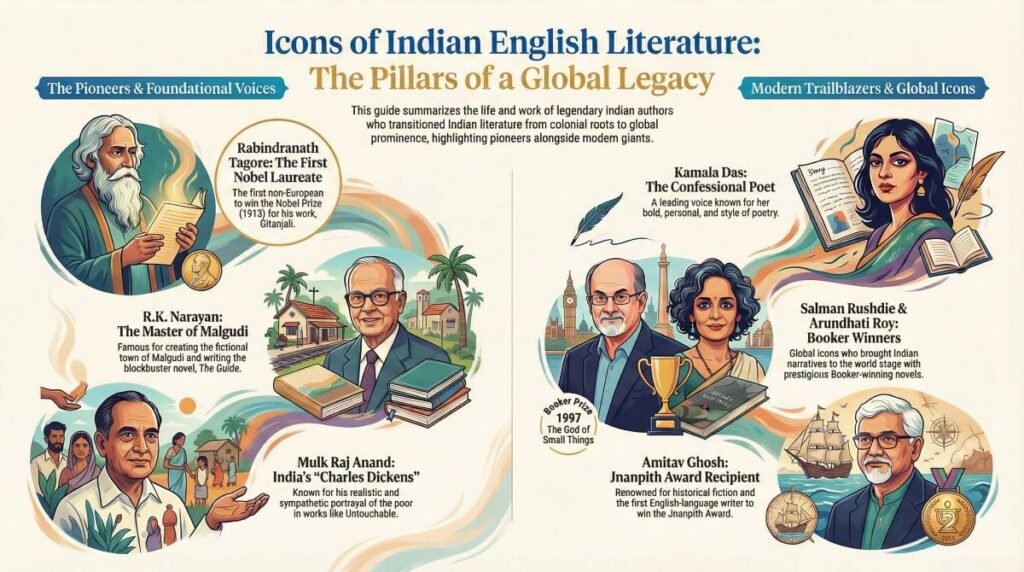
Table: List of Indian Writers in English Literature
A Complete Guide: Famous Indian Writers, Their Books, Awards, Stories, and Key Facts
Table 1: Complete List of Indian Writers in English Literature – Master Reference
The table below covers 40 major Indian English writers across all eras, with their dates, genre, major works, awards, and a defining key fact about each. This is the most comprehensive single-table reference available on this topic.
| Author | Born–Died | Era | Genre | Major Works | Awards & Honours | Key Fact |
| Rabindranath Tagore | 1861–1941 | Colonial | Poetry, Novel, Drama | Gitanjali, The Home and the World, Gora, The Post Office | Nobel Prize in Literature (1913), Knighthood (renounced 1919) | First Asian to win the Nobel Prize in Literature |
| Henry Louis Vivian Derozio | 1809–1831 | Colonial | Poetry | Poems (1827), The Fakeer of Jungheera | – | Died at age 22; one of the earliest Indian poets in English |
| Toru Dutt | 1856–1877 | Colonial | Poetry, Translation | A Sheaf Gleaned in French Fields, Ancient Ballads and Legends of Hindustan | – | Wrote poetry in English AND French; died at only 21 |
| Sri Aurobindo | 1872–1950 | Colonial / Post-Ind. | Philosophy, Epic Poetry | Savitri, The Life Divine, Essays on the Gita | – | Savitri is one of the longest poems in English literature (23,813 lines) |
| Mulk Raj Anand | 1905–2004 | Post-Ind. | Social Novel | Untouchable, Coolie, Two Leaves and a Bud, The Village | Sahitya Akademi Fellowship (1974) | Worked with E.M. Forster; championed Dalit rights through fiction |
| R.K. Narayan | 1906–2001 | Post-Ind. | Novel, Short Story | Swami and Friends, The Guide, Malgudi Days, The Bachelor of Arts | Sahitya Akademi Award (1960), Padma Bhushan (1964), AC Benson Medal | Created the fictional town of Malgudi, one of literature’s great invented places |
| Raja Rao | 1908–2006 | Post-Ind. | Philosophical Novel | Kanthapura, The Serpent and the Rope, The Cat and Shakespeare | Sahitya Akademi Award (1964), Neustadt Prize (1988) | His preface to Kanthapura is a landmark essay on Indian English writing |
| Kamala Das | 1934–2009 | Post-Ind. | Poetry, Autobiography | Summer in Calcutta, The Old Playhouse, My Story | Sahitya Akademi Award (1985), Ezhuthachan Puraskaram | Pioneer of confessional poetry in India; wrote as Madhavikutty in Malayalam |
| Nissim Ezekiel | 1924–2004 | Post-Ind. | Poetry | A Time to Change, Sixty Poems, Hymns in Darkness, Latter-Day Psalms | Sahitya Akademi Award (1983), Padma Shri (1988) | Called the father of modern Indian English poetry; helped launch Poetry India magazine |
| A.K. Ramanujan | 1929–1993 | Post-Ind. | Poetry, Translation | The Striders, Relations, Second Sight | Sahitya Akademi Award (1983), MacArthur Fellowship (1983) | His essay ‘Is There an Indian Way of Thinking?’ is a landmark in Indian thought |
| Dom Moraes | 1938–2004 | Post-Ind. | Poetry, Travel | A Beginning, John Nobody, Poems 1955–1965 | Hawthornden Prize (1958) | Won the Hawthornden Prize at age 19 – youngest recipient ever |
| Jayanta Mahapatra | b. 1928 | Post-Ind. | Poetry | Close the Sky Ten by Ten, Relationship, Random Descent | Sahitya Akademi Award (1981) | First Indian poet to win the Sahitya Akademi Award for English poetry |
| Salman Rushdie | b. 1947 | Contemporary | Magic Realist Novel | Midnight’s Children, The Satanic Verses, The Moor’s Last Sigh, Haroun and the Sea of Stories | Booker Prize (1981), Booker of Bookers (1993 & 2008), Knighthood (2007) | Midnight’s Children sold over 1 million copies; fatwa issued against him in 1989 |
| Vikram Seth | b. 1952 | Contemporary | Novel, Poetry | A Suitable Boy, The Golden Gate, An Equal Music, Two Lives | WH Smith Literary Award (1994), Sahitya Akademi Award (1988) | A Suitable Boy (1,349 pages) is one of the longest novels published in English |
| Amitav Ghosh | b. 1956 | Contemporary | Historical Novel, Non-fiction | The Shadow Lines, The Calcutta Chromosome, Sea of Poppies, The Great Derangement | Sahitya Akademi Award (2005), Jnanpith Award (2018) | First English-language writer to win the Jnanpith Award, India’s highest literary honour |
| Arundhati Roy | b. 1961 | Contemporary | Novel, Essays | The God of Small Things, The Ministry of Utmost Happiness, The Algebra of Infinite Justice | Booker Prize (1997) | The God of Small Things sold over 6 million copies worldwide in its first year |
| Anita Desai | b. 1937 | Contemporary | Psychological Novel | Clear Light of Day, Fire on the Mountain, In Custody, Baumgartner’s Bombay | Sahitya Akademi Award (1978), Guardian Prize; 3x Booker shortlist | Her daughter Kiran Desai also won the Booker Prize, making them the only mother-daughter Booker winners |
| Kiran Desai | b. 1971 | Contemporary | Novel | Hullabaloo in the Guava Orchard, The Inheritance of Loss | Booker Prize (2006), National Book Critics Circle Award (2006) | Youngest woman to win the Man Booker Prize (at age 35) |
| Aravind Adiga | b. 1974 | Contemporary | Novel | The White Tiger, Between the Assassinations, Last Man in Tower, Amnesty | Booker Prize (2008) | Debut novel The White Tiger was adapted into a Netflix film in 2021 |
| Jhumpa Lahiri | b. 1967 | Diaspora | Short Story, Novel | Interpreter of Maladies, The Namesake, Unaccustomed Earth, The Lowland | Pulitzer Prize (2000), PEN/Hemingway Award (2000), DSC Prize | Born in London, raised in the USA; later learned Italian and writes in Italian |
| Ruskin Bond | b. 1934 | Contemporary | Short Story, Children’s Lit | The Room on the Roof, A Flight of Pigeons, Our Trees Still Grow in Dehra | Sahitya Akademi Award (1992), Padma Shri (1999), Padma Bhushan (2014) | Has published over 500 books and short stories in a career spanning 70+ years |
| Shashi Tharoor | b. 1956 | Contemporary | Non-fiction, Novel | The Great Indian Novel, Inglorious Empire, Why I Am a Hindu, An Era of Darkness | Commonwealth Writers’ Prize shortlist | His Oxford speech on British reparations for India went viral with 4 million+ views |
| Chetan Bhagat | b. 1974 | Contemporary | Popular Fiction | Five Point Someone, 2 States, Half Girlfriend, One Indian Girl | – | Five Point Someone was adapted into the Bollywood blockbuster 3 Idiots (2009) |
| Shashi Deshpande | b. 1938 | Contemporary | Feminist Novel | The Dark Holds No Terrors, That Long Silence, A Matter of Time | Sahitya Akademi Award (1990), Padma Shri (2009) | A leading voice in Indian feminist fiction; her novels explore the inner lives of Indian women |
| Manju Kapur | b. 1948 | Contemporary | Novel | Difficult Daughters, A Married Woman, The Immigrant | Commonwealth Writers’ Prize (1999) | Difficult Daughters is set against the Partition of India in 1947 |
| Gita Hariharan | b. 1954 | Contemporary | Novel | The Thousand Faces of Night, The Ghosts of Vasu Master, In Times of Siege | Commonwealth Writers’ Prize (1993) | The Thousand Faces of Night weaves together myths from the Mahabharata |
| V.S. Naipaul | 1932–2018 | Diaspora | Novel, Non-fiction | A House for Mr Biswas, In a Free State, A Bend in the River, An Area of Darkness | Nobel Prize in Literature (2001), Booker Prize (1971), Knighthood | Trinidad-born of Indian heritage; controversial but hugely influential figure |
| Meena Kandasamy | b. 1984 | Contemporary | Poetry, Novel | Touch, Ms Militancy, The Gypsy Goddess, When I Hit You | Sahitya Akademi Yuva Puraskar (2013) | Known for her fierce anti-caste and feminist activism alongside her literary work |
| Prayaag Akbar | b. 1985 | Contemporary | Novel | Leila | – | Leila (2017) was adapted into a Netflix dystopian series (2019) |
| Avni Doshi | b. 1982 | Contemporary | Novel | Burnt Sugar (pub. as Girl in White Cotton in India) | Booker Prize shortlist (2020) | Burnt Sugar was shortlisted for the 2020 Booker Prize – one of just 6 books selected |
| Deepa Anappara | b. 1980 | Contemporary | Novel | Djinn Patrol on the Purple Line | Edgar Award (2021), Dagger Award (2020) | Former journalist; worked covering child rights before turning to fiction |
| Vikram Chandra | b. 1961 | Contemporary | Novel, Short Story | Red Earth and Pouring Rain, Love and Longing in Bombay, Sacred Games | Commonwealth Writers’ Prize (1996) | Sacred Games (novel) was adapted into India’s first Netflix original series |
| Namita Gokhale | b. 1956 | Contemporary | Novel, Non-fiction | Paro: Dreams of Passion, Gods, Graves and Grandmother, Things to Leave Behind | Himalayan Festival Award | Co-founder and director of the Jaipur Literature Festival |
| Agha Shahid Ali | 1949–2001 | Diaspora | Poetry | The Half-Inch Himalayas, A Nostalgist’s Map of America, The Country Without a Post Office | – | Pioneered the English-language ghazal form; born in Delhi, settled in the USA |
| Eunice de Souza | 1940–2017 | Contemporary | Poetry | Fix, Women in Dutch Painting, Catholic Mother | – | Known for sharp, ironic verse about Goan Catholic identity in Mumbai |
| Preeti Shenoy | b. 1971 | Contemporary | Popular Fiction | Life is What You Make It, The Secret Wish List, It Happens for a Reason | Forbes India Celebrity 100 list | Life is What You Make It tackled bipolar disorder – rare in mainstream Indian fiction |
| Sudha Murty | b. 1950 | Contemporary | Non-fiction, Children’s Lit | Wise and Otherwise, The Magic of the Lost Temple, Gently Falls the Bakula | Padma Shri (2006), Padma Bhushan (2023), R.K. Narayan Award | Chairperson of Infosys Foundation; one of the most widely read Indian English authors |
| Devdutt Pattanaik | b. 1970 | Contemporary | Mythology, Non-fiction | Myth=Mithya, Jaya, Sita, Shikhandi | – | Has written 50+ books on Indian mythology; credited with reigniting interest in Hindu epics |
| Amish Tripathi | b. 1974 | Contemporary | Mythological Fiction | The Immortals of Meluha, The Secret of the Nagas, The Oath of the Vayuputras | – | Shiva Trilogy sold over 5 million copies; fastest-selling book series in Indian publishing history |
| Nayantara Sahgal | b. 1927 | Post-Ind. | Novel, Memoir | A Time to Be Happy, Rich Like Us, Plans for Departure | Commonwealth Writers’ Prize (1987), Sahitya Akademi Award (1986) | Niece of Jawaharlal Nehru; one of the first women novelists in Indian English literature |
Table 2: Famous Indian Writers in English – Books, Stories, and Synopses
This table provides a detailed look at the most celebrated individual books by Indian writers in English – including genre, core themes, story summaries, and why each book became famous. Use this as your ready reference for understanding what each major Indian English work is actually about.
| Book Title | Author | Year | Genre | Core Theme | Story / Synopsis | Why It Is Famous |
| Gitanjali | Rabindranath Tagore | 1912 | Poetry | Devotion & Spirituality | 108 prose-poems offering the poet’s soul to the Divine; translated by Tagore himself from Bengali | Won Nobel Prize in Literature 1913; introduced Indian mysticism to the Western world |
| Untouchable | Mulk Raj Anand | 1935 | Novel | Caste Discrimination | A single day in the life of Bakha, a young sweeper navigating humiliation and hope in colonial India | Preface by E.M. Forster; groundbreaking in giving a Dalit character the full humanity of a literary hero |
| Kanthapura | Raja Rao | 1938 | Novel | Gandhian Independence Movement | A village in South India is transformed by Gandhi’s non-cooperation movement, narrated like a Purana | Landmark for adapting the English novel to Indian oral storytelling rhythms |
| Swami and Friends | R.K. Narayan | 1935 | Novel | Childhood & Friendship | The mischievous adventures of ten-year-old Swaminathan in the fictional town of Malgudi | Narayan’s debut; launched the beloved Malgudi series that defined Indian English fiction for decades |
| The Guide | R.K. Narayan | 1958 | Novel | Redemption & Sainthood | A tourist guide becomes lover, then convict, then accidentally an accidental saint in the eyes of villagers | Won the Sahitya Akademi Award 1960; adapted into a celebrated Hindi film (1965) |
| Malgudi Days | R.K. Narayan | 1943 | Short Stories | Small-Town India | 32 stories set in Malgudi capturing the comedy and sadness of ordinary Indian life | Adapted into a beloved Doordarshan TV series; considered a masterpiece of the short story form |
| My Story | Kamala Das | 1976 | Autobiography | Female Desire & Identity | Candid memoir of her life, marriages, lovers, and search for selfhood – shocking for its frankness | One of the first Indian women writers to write so openly about sexuality and marriage |
| Midnight’s Children | Salman Rushdie | 1981 | Magic Realist Novel | Independence & Identity | Saleem Sinai is born at the exact moment of India’s independence; his life mirrors the nation’s fate | Booker Prize 1981; Booker of Bookers 1993 & 2008; over 1 million copies sold |
| The Satanic Verses | Salman Rushdie | 1988 | Novel | Faith & Identity | Two Indian actors survive a plane bombing and undergo magical transformations touching on Islam | Led to a fatwa issued by Ayatollah Khomeini; banned in India; sparked a global debate on free speech |
| A Suitable Boy | Vikram Seth | 1993 | Novel | Post-Partition India & Marriage | A mother searches for a suitable husband for her daughter in 1950s India across four intertwined families | One of the longest novels in the English language (1,349 pages); adapted into BBC TV series (2020) |
| The God of Small Things | Arundhati Roy | 1997 | Novel | Forbidden Love & Caste | Twins Rahel and Estha’s lives are shattered by a forbidden love affair in Kerala and the tragedy that follows | Booker Prize 1997; over 6 million copies sold in first year; translated into 42 languages |
| The Shadow Lines | Amitav Ghosh | 1988 | Novel | Memory & Partition | An unnamed narrator explores memory, borders, and the violence of Partition through his family’s story | Sahitya Akademi Award 1990; considered one of the greatest novels about Partition |
| Sea of Poppies | Amitav Ghosh | 2008 | Historical Novel | Opium Trade & Colonialism | A diverse crew aboard the Ibis – a former slave ship – are bound together by the opium trade in 1838 | Shortlisted for the Booker Prize 2008; first in the acclaimed Ibis Trilogy |
| The Great Derangement | Amitav Ghosh | 2016 | Non-fiction | Climate Change & Literature | A meditation on why literary fiction has failed to adequately address the climate crisis | Called the most important book on climate and culture in years; now a staple in ecocriticism courses |
| The Inheritance of Loss | Kiran Desai | 2006 | Novel | Colonialism & Immigration | A retired judge, his granddaughter, and an illegal immigrant in New York navigate loss, class, and belonging | Booker Prize 2006; National Book Critics Circle Award 2006 |
| The White Tiger | Aravind Adiga | 2008 | Novel | Class & Corruption | Balram Halwai escapes his caste bondage by murdering his employer and reinventing himself as an entrepreneur | Booker Prize 2008; Netflix adaptation (2021) starred Priyanka Chopra and Rajkummar Rao |
| Interpreter of Maladies | Jhumpa Lahiri | 1999 | Short Stories | Diaspora & Belonging | Nine stories about Indian and Indian-American characters navigating cultural dislocation and longing | Pulitzer Prize for Fiction 2000; PEN/Hemingway Award; sold over 15 million copies worldwide |
| The Namesake | Jhumpa Lahiri | 2003 | Novel | Immigration & Identity | The Ganguli family’s journey from Calcutta to suburban America told across two generations | Adapted into a film by Mira Nair (2006) starring Irrfan Khan and Tabu |
| A House for Mr Biswas | V.S. Naipaul | 1961 | Novel | Independence & Selfhood | Mr Biswas’s lifelong quest for a house of his own – a metaphor for freedom and selfhood in colonial Trinidad | Considered Naipaul’s masterpiece; one of the greatest novels of the 20th century |
| The Room on the Roof | Ruskin Bond | 1956 | Novel | Coming of Age | 16-year-old Anglo-Indian Rusty runs away from his strict guardian to live with Indian friends in Dehradun | John Llewellyn Rhys Prize (1957); Bond’s debut novel; largely autobiographical |
| A Flight of Pigeons | Ruskin Bond | 1978 | Novella | 1857 Uprising & Survival | An English family tries to survive the 1857 Revolt as Indian rebels close in on their small town | Adapted into the acclaimed Bollywood film Junoon (1979) by Shyam Benegal |
| The Great Indian Novel | Shashi Tharoor | 1989 | Satirical Novel | Indian Politics & History | A retelling of the Mahabharata set against 20th-century Indian political history – Gandhi as Bhishma | Tharoor’s debut; a landmark of Indian political satire and postmodern fiction |
| Inglorious Empire | Shashi Tharoor | 2017 | Non-fiction / History | British Colonialism | A systematic dismantling of the myth that British colonial rule benefited India | Based on his viral Oxford Union speech; became a bestseller in India and the UK |
| Five Point Someone | Chetan Bhagat | 2004 | Popular Fiction | Education & Youth | Three students at IIT Delhi struggle with the pressure of India’s elite engineering culture | Inspired the Bollywood blockbuster 3 Idiots (2009); among the best-selling Indian English novels ever |
| 2 States | Chetan Bhagat | 2009 | Romantic Comedy | Cross-Cultural Marriage | A Punjabi boy and Tamil girl fall in love at IIM and must convince their very different families to approve | Adapted into a Bollywood film (2014) starring Alia Bhatt and Arjun Kapoor |
| The Thousand Faces of Night | Gita Hariharan | 1992 | Novel | Myth & Female Identity | Devi returns from America to India and must navigate family, myth, and her own identity | Commonwealth Writers’ Prize 1993 (Best First Book) |
| Difficult Daughters | Manju Kapur | 1998 | Novel | Partition & Women’s Agency | Virmati rebels against tradition and falls in love with a married professor as Partition looms | Commonwealth Writers’ Prize 1999; set against the backdrop of the 1947 Partition of India |
| The Country Without a Post Office | Agha Shahid Ali | 1997 | Poetry | Kashmir & Loss | Elegies for Kashmir’s tragic conflict told through the ghazal form in English | Considered a masterpiece of the political lyric; put the English-language ghazal on the world map |
| Savitri | Sri Aurobindo | 1950 | Epic Poetry | Yoga, Myth & Transcendence | An expansion of the Mahabharata story of Savitri into a vast spiritual epic of 23,813 lines | One of the longest poems in English literature; described as Aurobindo’s ‘supreme work’ |
| The Immortals of Meluha | Amish Tripathi | 2010 | Mythological Fiction | Lord Shiva as Historical Hero | Shiva – a Tibetan tribal chief – discovers he may be the prophesied Neelkanth who will save the Suryavanshis | First book in the Shiva Trilogy; sold 1 million copies in first year; fastest-selling Indian English novel at the time |
| Burnt Sugar | Avni Doshi | 2019 | Novel | Memory & Toxic Relationships | Antara cares for her ageing, dementia-stricken mother while confronting a childhood of neglect | Booker Prize shortlist 2020; published as Girl in White Cotton in India |
| Djinn Patrol on the Purple Line | Deepa Anappara | 2019 | Novel | Child Disappearances & Urban Poverty | Nine-year-old Jai investigates the disappearances of children from his slum near Delhi | Edgar Award (Best Novel) 2021; Crime Writers’ Association Gold Dagger 2020 |
| Sacred Games | Vikram Chandra | 2006 | Crime Thriller | Crime & Corruption in Mumbai | A Sikh police officer in Mumbai unravels a web of crime connected to a Bollywood gangster | Adapted into India’s first Netflix original series (2018); one of the longest Indian English novels |
| Life is What You Make It | Preeti Shenoy | 2011 | Novel | Mental Health & Resilience | Ankita, a high-achiever, is diagnosed with bipolar disorder and must rebuild her life | One of the first mainstream Indian English novels to deal with bipolar disorder openly |
| Wise and Otherwise | Sudha Murty | 2002 | Non-fiction Essays | Indian Life & Values | 50 stories from Murty’s travels across India as chairperson of the Infosys Foundation | Sold over 1.2 million copies; translated into all major Indian languages |
Table 3: Awards Won by Indian Writers in English Literature
Indian English writers have won virtually every major literary prize in the world. Below is a comprehensive awards table covering Nobel, Booker, Pulitzer, Jnanpith, Sahitya Akademi, Commonwealth Writers’ Prize, and more.
| Award | Author | Work | Year | Significance |
| Nobel Prize in Literature | Rabindranath Tagore | Gitanjali | 1913 | First Asian to win the Nobel Prize in Literature; introduced Indian spiritual poetry to the world |
| Nobel Prize in Literature | V.S. Naipaul | Lifetime achievement | 2001 | Awarded for work that ‘compels us to see the presence of suppressed histories’; Indian-origin Caribbean writer |
| Man Booker Prize | Salman Rushdie | Midnight’s Children | 1981 | Also won Booker of Bookers in 1993 and 2008 – the only novel to win it twice |
| Man Booker Prize | Arundhati Roy | The God of Small Things | 1997 | First Indian woman to win the Booker Prize; over 6 million copies sold in first year |
| Man Booker Prize | Kiran Desai | The Inheritance of Loss | 2006 | Youngest woman to win the Man Booker Prize at age 35 |
| Man Booker Prize | Aravind Adiga | The White Tiger | 2008 | Debut novel; won the Booker Prize; later adapted into a Netflix film |
| Booker Prize (shortlist) | Avni Doshi | Burnt Sugar | 2020 | One of only 6 novels shortlisted; drew global attention to a new generation of Indian writers |
| Pulitzer Prize for Fiction | Jhumpa Lahiri | Interpreter of Maladies | 2000 | First Indian-origin writer to win the Pulitzer Prize; sold 15 million+ copies worldwide |
| Jnanpith Award | Amitav Ghosh | Lifetime achievement | 2018 | First English-language writer to win India’s highest literary honour |
| Sahitya Akademi Award | R.K. Narayan | The Guide | 1960 | India’s most prestigious literary award; Narayan’s work remains one of the most translated in Indian English lit |
| Sahitya Akademi Award | Nissim Ezekiel | Latter-Day Psalms | 1983 | Celebrated the father of modern Indian English poetry |
| Sahitya Akademi Award | A.K. Ramanujan | Second Sight | 1983 | Awarded to a poet renowned for both original verse and translation of Kannada and Tamil classics |
| Sahitya Akademi Award | Jayanta Mahapatra | Relationship | 1981 | First Indian poet to win Sahitya Akademi Award in English |
| Sahitya Akademi Award | Kamala Das | Collected Poems | 1985 | Recognised her groundbreaking confessional poetry that broke every taboo |
| Sahitya Akademi Award | Ruskin Bond | Our Trees Still Grow in Dehra | 1992 | Celebrating a career of over 500 books spanning 6 decades |
| Commonwealth Writers’ Prize | Manju Kapur | Difficult Daughters | 1999 | Best First Book; set during the Partition of 1947 |
| Commonwealth Writers’ Prize | Gita Hariharan | The Thousand Faces of Night | 1993 | Best First Book; praised for weaving myth into modern narrative |
| Commonwealth Writers’ Prize | Nayantara Sahgal | Plans for Departure | 1987 | One of India’s earliest and most distinguished women novelists |
| Hawthornden Prize | Dom Moraes | A Beginning | 1958 | Youngest-ever winner at age 19 |
| Edgar Award (Best Novel) | Deepa Anappara | Djinn Patrol on the Purple Line | 2021 | Highest honour in crime fiction; won by a former journalist turned novelist |
| Padma Bhushan | Ruskin Bond | Lifetime achievement | 2014 | India’s third-highest civilian award; recognised over 60 years of literary contribution |
| Padma Bhushan | Sudha Murty | Lifetime achievement | 2023 | Recognised for both literary and philanthropic work through the Infosys Foundation |
| Neustadt International Prize | Raja Rao | Lifetime achievement | 1988 | Often called the American Nobel; recognised Rao’s philosophical depth |
| MacArthur Fellowship | A.K. Ramanujan | – | 1983 | The so-called ‘Genius Grant’; recognised his contributions to literary translation and scholarship |
Table 4: Indian English Literature by Era – Themes, Writers, and Literary Movements
Understanding Indian English literature means understanding how it has evolved across eras. This table maps out five key periods – from colonial-era writing to the 21st century – showing which writers belonged to each era, what they wrote, and what themes dominated their work.
| Era | Period | Key Writers | Key Works | Dominant Themes | Literary Context |
| Colonial / Early | 1800–1947 | H.L.V. Derozio, Toru Dutt, Rabindranath Tagore, Sri Aurobindo, Sarojini Naidu | Gitanjali, Ancient Ballads, Savitri, Poems (Derozio) | Colonialism, nationalism, spirituality, romantic idealism, social reform | Influenced by British Romanticism and Victorian literature; writers negotiated colonial identity |
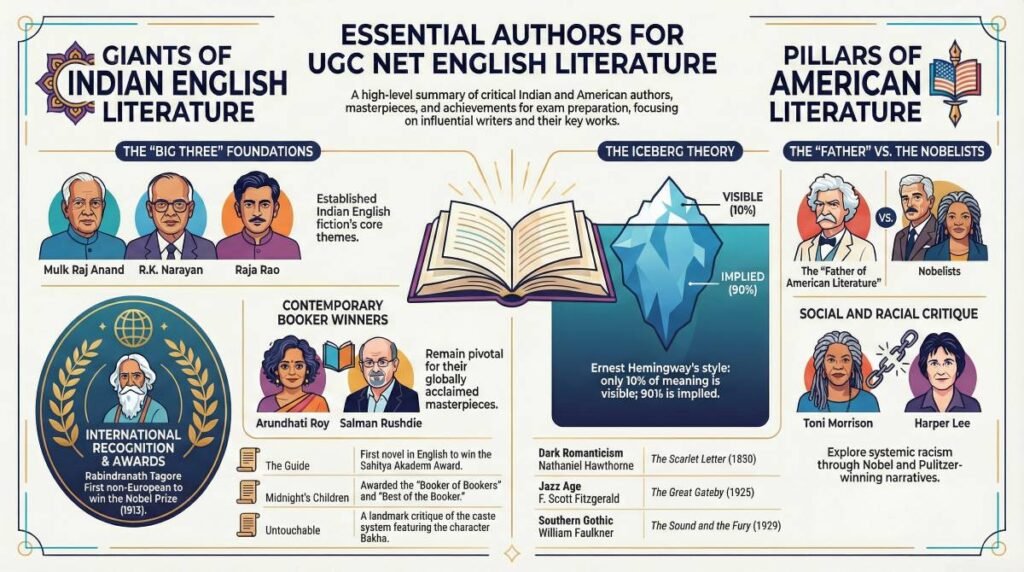
| Post-Independence | 1947–1980 | R.K. Narayan, Mulk Raj Anand, Raja Rao, Nayantara Sahgal, Kamala Das, Nissim Ezekiel | The Guide, Untouchable, Kanthapura, My Story, A Time to Be Happy | Partition trauma, nation-building, caste, gender, small-town India, Dalit rights | Rise of the Indian English novel; Narayan, Anand, and Rao called the ‘Big Three’ of Indian English fiction |
| Contemporary (1980–2000) | 1980–2000 | Salman Rushdie, Vikram Seth, Amitav Ghosh, Arundhati Roy, Anita Desai, Shashi Tharoor, Vikram Chandra | Midnight’s Children, A Suitable Boy, The God of Small Things, The Shadow Lines, The Dark Holds No Terrors | Postcolonialism, magical realism, History and memory, gender politics, globalisation | Indian English literature achieved full global recognition; Booker Prize wins brought unprecedented visibility |
| 21st Century (2000–present) | 2000–present | Aravind Adiga, Kiran Desai, Jhumpa Lahiri, Chetan Bhagat, Avni Doshi, Deepa Anappara, Prayaag Akbar, Amish Tripathi | The White Tiger, The Inheritance of Loss, Interpreter of Maladies, Burnt Sugar, Djinn Patrol | Class, inequality, immigration, diaspora, urban India, dystopia, mythology reimagined, mental health | Rise of popular fiction alongside literary fiction; boom in Indian publishing; digital platforms expanding readership |
| Diaspora / Global | 1950–present | V.S. Naipaul, Jhumpa Lahiri, Hanif Kureishi, Agha Shahid Ali, Bharati Mukherjee | A House for Mr Biswas, Interpreter of Maladies, The Country Without a Post Office, The Buddha of Suburbia | Identity, displacement, cultural hybridity, belonging, nostalgia, negotiating multiple homelands | Indian-origin writers based abroad who challenge definitions of what ‘Indian’ literature means |
Table 5: Key Facts and Records in Indian English Literature
Here are verified facts, firsts, records, and remarkable details about Indian writers in English that make for compelling reading – and are frequently tested in competitive examinations.
| Fact Category | Detail |
| First Indian English poet | H.L.V. Derozio (1809–1831) is considered the earliest known Indian poet to write substantially in English |
| First Indian Nobel laureate | Rabindranath Tagore won the Nobel Prize in Literature in 1913 – the first Asian to do so |
| First Booker Prize (Indian) | Salman Rushdie won the Booker Prize in 1981 for Midnight’s Children |
| First Indian woman Booker winner | Arundhati Roy in 1997 for The God of Small Things |
| Youngest Booker winner (Indian) | Kiran Desai was 35 when she won the 2006 Booker Prize for The Inheritance of Loss |
| First Indian Pulitzer winner | Jhumpa Lahiri won the Pulitzer Prize for Fiction in 2000 for Interpreter of Maladies |
| First English-language Jnanpith winner | Amitav Ghosh in 2018 – the Jnanpith Award is India’s highest literary honour |
| Longest Indian English novel | A Suitable Boy by Vikram Seth (1993) – 1,349 pages, 591,552 words |
| Longest Indian English poem | Savitri by Sri Aurobindo – 23,813 lines across 12 books and an epilogue |
| Best-selling Indian English series | The Shiva Trilogy by Amish Tripathi – over 5 million copies sold; fastest-selling Indian English series |
| First Indian English novelist to go to Netflix | Vikram Chandra’s Sacred Games became India’s first Netflix original series in 2018 |
| Indian English novels adapted to Bollywood | Five Point Someone → 3 Idiots (2009); 2 States → 2 States (2014); A Flight of Pigeons → Junoon (1979); The Guide → Guide (1965) |
| Indian English novels adapted to Hollywood / Netflix | The White Tiger (Netflix 2021); The Namesake (film 2006); Leila (Netflix 2019) |
| Only mother-daughter Booker Prize winners | Anita Desai (3x shortlisted) and her daughter Kiran Desai (winner 2006) |
| Only Indian work to win Booker of Bookers twice | Midnight’s Children by Salman Rushdie – won in 1993 and 2008 |
| Youngest Hawthornden Prize winner | Dom Moraes won at age 19 in 1958 for A Beginning |
| Most prolific Indian English writer | Ruskin Bond – over 500 published titles across 70+ years of writing |
| Most widely spoken language of Indian English authors | Born into communities speaking Hindi, Bengali, Tamil, Kannada, Marathi, Gujarati, Punjabi, and Urdu – yet writing in English |
| Sahitya Akademi Award (English) – earliest winner | Nissim Ezekiel (1983) and A.K. Ramanujan (1983) both won in the same year |
| Indian English writer who also writes in Italian | Jhumpa Lahiri – she learned Italian and has published In Other Words (2016) and Whereabouts (2021) in Italian |
| Writer who renounced a national honour | Nayantara Sahgal returned her Sahitya Akademi Award in 2015 in protest against rising intolerance in India |
| Largest literary festival co-founded by an Indian English writer | Jaipur Literature Festival – co-founded by Namita Gokhale and William Dalrymple; draws 400,000+ visitors annually |
Table 6: Where to Start – A Genre-by-Genre Reading Guide
Not sure where to begin with Indian English literature? This table matches your reading preferences to the ideal starting point – with a brief explanation of why each book is the perfect entry into that genre or mood.
| If You Enjoy… | Start With | Author | Why This Book |
| Historical epics | A Suitable Boy | Vikram Seth | A 1,349-page social panorama of post-Partition India – rich, warm, and absorbing |
| Magical realism | Midnight’s Children | Salman Rushdie | India’s independence story told through a child born at midnight with telepathic powers |
| Short stories | Interpreter of Maladies | Jhumpa Lahiri | Nine perfectly crafted stories about identity and longing – Pulitzer Prize winner |
| Political satire | The Great Indian Novel | Shashi Tharoor | The Mahabharata retold as modern Indian political history – wickedly funny |
| Social realism | Untouchable | Mulk Raj Anand | A single day in a sweeper’s life that exposes the brutality of caste in colonial India |
| Crime and thriller | Sacred Games | Vikram Chandra | Mumbai crime fiction at its most sprawling and cinematic – basis for the Netflix series |
| Nature and nostalgia | Malgudi Days | R.K. Narayan | Timeless stories from India’s most beloved fictional small town |
| Mythology retold | The Immortals of Meluha | Amish Tripathi | Shiva as a mortal hero – page-turning mythological adventure |
| Feminist fiction | The Dark Holds No Terrors | Shashi Deshpande | A woman’s reckoning with marriage, identity, and violence – powerful and honest |
| Diaspora and belonging | The Namesake | Jhumpa Lahiri | A Bengali immigrant family in America across two generations – also a celebrated film |
| Dystopia | Leila | Prayaag Akbar | A near-future India defined by purity laws – chilling and prescient; adapted by Netflix |
| Poetry (lyric) | The Country Without a Post Office | Agha Shahid Ali | Elegies for Kashmir in the ghazal form – haunting and beautiful |
| Young adult / Children | The Room on the Roof | Ruskin Bond | A coming-of-age story set in the Himalayas – warm, funny, and deeply felt |
| Non-fiction / History | Inglorious Empire | Shashi Tharoor | A rigorous and passionate argument about the true cost of British colonialism in India |
| Women’s autobiography | My Story | Kamala Das | A scandalously honest memoir of desire, marriage, and identity – far ahead of its time |
| Popular romance | 2 States | Chetan Bhagat | A funny, breezy novel about a cross-cultural love story – immensely readable |
| Indian mythology non-fiction | Myth = Mithya | Devdutt Pattanaik | A clear and engaging guide to the structure of Hindu myths and what they mean |
| Village India | Kanthapura | Raja Rao | A South Indian village’s experience of Gandhi’s movement – lyrical and powerful |
| Climate and environment | The Great Derangement | Amitav Ghosh | An urgent argument for why literature must grapple with climate change |
| Inspirational non-fiction | Wise and Otherwise | Sudha Murty | 50 life stories from across India – gentle, wise, and uplifting |
Why Indian English Literature Matters: 10 Reasons to Read It
- 1. It captures 5,000 years of civilisation through a modern lens. Indian writing in English bridges ancient epics, colonial history, and contemporary urban life in ways that few other literary traditions can match.
- 2. It is one of the most diverse bodies of literature in the world. India’s linguistic, religious, caste, and regional diversity means that no two Indian English writers sound alike – every book is a window into a completely different world.
- 3. It has produced more global prize-winners than almost any other non-native English literature. Two Nobel laureates, multiple Booker Prize winners, a Pulitzer Prize winner, and India’s own Jnanpith Award winners make this a tradition of extraordinary achievement.
- 4. It is essential reading for understanding postcolonial literature. Indian English writing sits at the heart of postcolonial literary studies worldwide – it is impossible to understand the field without engaging with Rushdie, Roy, Ghosh, and their peers.
- 5. It offers some of the most exciting new voices in global fiction today. Writers like Avni Doshi, Deepa Anappara, and Meena Kandasamy are among the most inventive and urgent voices currently writing in English anywhere in the world.
- 6. It spans every genre imaginable. From magical realism (Rushdie) to dystopia (Akbar), from historical epic (Seth) to crime fiction (Chandra), from children’s literature (Bond) to mythological fantasy (Tripathi) – Indian English fiction covers the full range.
- 7. Many works have been adapted into acclaimed films and series. The Guide, 3 Idiots, Sacred Games, The White Tiger, Leila, and The Namesake are just some of the Indian English works that have become major screen adaptations.
- 8. It is central to Indian academic curricula. Indian English literature is a core component of English departments across Indian universities and is regularly tested in UPSC, UGC NET, and state civil service examinations.
- 9. Reading it builds genuine cultural empathy. These books give outsiders a real, nuanced understanding of India – not the postcard version, but the complex, contradictory, beautiful reality.
- 10. It is still being written. The tradition is alive and producing major new works every year. Engaging with it now means being part of a literary conversation that will shape global culture for decades to come.
A Note on Indian Writers in English Literature and Their Works PDF
Many students and researchers search specifically for Indian writers in English literature and their works in PDF format for offline study and exam preparation. While downloadable PDFs are available through university reading lists, Sahitya Akademi publications, and educational platforms, this article – with its six comprehensive tables – is designed to serve the same function as a complete printed reference. You can save or print this document as a PDF for personal study use. The tables are structured to be exam-ready, covering all major Indian English writers, their works, awards, eras, and key facts in a single comprehensive resource.
Conclusion: The Ongoing Story of Indian English Literature
This list of Indian writers in English literature is, by necessity, incomplete. The tradition is too vast, too varied, and too alive to be fully contained in any single article. From the lyrical genius of Toru Dutt to the dazzling postmodernism of Salman Rushdie, from the quiet Himalayan prose of Ruskin Bond to the fierce political voice of Arundhati Roy, Indian writing in English encompasses every human experience worth writing about.
What unites all these writers – across centuries, languages, genders, castes, and regions – is a commitment to telling the truth about human experience in the particular context of India. And that, ultimately, is what great literature does everywhere.
As a reader, you are entering one of the richest literary traditions in the world. Whether you begin with a Malgudi short story or dive straight into a 1,300-page Booker Prize-winning novel, you will find India – in all its splendor and struggle – waiting for you on every page.
Indian writing in English is not a niche subject or a subcategory of British or American literature. It is a full, rich, and autonomous literary tradition of global importance – one that has produced Nobel laureates, Booker Prize winners, Pulitzer Prize recipients, and some of the most widely read novels of the past century. From Rabindranath Tagore’s devotional poetry to Arundhati Roy’s activist fiction, from R.K. Narayan’s Malgudi to Salman Rushdie’s magical Bombay, this literature captures the full complexity of human experience through an unmistakably Indian lens.
The tables in this article represent the most comprehensive single reference available on the list of Indian writers in English literature – covering 40 authors, 35 individual works, 24 awards, 5 eras, 22 key facts and records, and 20 genre-based reading recommendations. Use them well.
(FAQs)
Who is the most famous Indian writer in English literature?
Salman Rushdie and Arundhati Roy are widely considered the most internationally famous Indian writers in English. Rabindranath Tagore holds a unique place as the only Indian Nobel laureate in literature.
Who are the top 5 Indian writers in English?
Based on literary quality, international recognition, and cultural influence, a strong case can be made for: Salman Rushdie, Arundhati Roy, Vikram Seth, Amitav Ghosh, and Jhumpa Lahiri.
Who are the best 21st century Indian writers in English literature?
Aravind Adiga (The White Tiger), Kiran Desai (The Inheritance of Loss), Avni Doshi (Burnt Sugar), Deepa Anappara (Djinn Patrol on the Purple Line), and Prayaag Akbar (Leila) are among the most acclaimed.
Which Indian English novel has won the most awards?
Midnight’s Children by Salman Rushdie – it won the Booker Prize in 1981 and the Booker of Bookers in both 1993 and 2008, making it the only novel to win the latter award twice.
Where can I find Indian writers in English literature and their works PDF?
University reading lists, Sahitya Akademi publications, and this printable article provide comprehensive reference data. Save this page as a PDF for offline study.
Who was the first Indian writer to write in English?
H.L.V. Derozio (1809–1831) is considered the earliest known Indian poet to write substantially in English. Toru Dutt (1856–1877) was among the first Indian women writers in English.
Who is the most famous Indian writer in English literature?
Salman Rushdie and Arundhati Roy are often cited as the most internationally famous Indian writers in English. Rabindranath Tagore, as the only Indian Nobel laureate in literature, holds a unique place in literary history.
Who are the top 5 Indian writers in English?
A strong case can be made for Salman Rushdie, Arundhati Roy, Vikram Seth, Amitav Ghosh, and Jhumpa Lahiri as the top 5 Indian writers in English based on literary quality, international recognition, and cultural influence.
What are the best works of Indian writers in English literature?
Some of the best-known works include Midnight’s Children by Salman Rushdie, The God of Small Things by Arundhati Roy, The Guide by R.K. Narayan, A Suitable Boy by Vikram Seth, and Interpreter of Maladies by Jhumpa Lahiri.
Are there Indian writers in English from the 21st century worth reading?
Absolutely. Aravind Adiga (The White Tiger), Kiran Desai (The Inheritance of Loss), Avni Doshi (Burnt Sugar), Deepa Anappara (Djinn Patrol on the Purple Line), and Prayaag Akbar (Leila) are among the most important 21st century Indian writers in English literature.
Where can I find a list of famous Indian writers in English literature and their works PDF?
Many university reading lists, Sahitya Akademi publications, and educational websites offer downloadable PDFs on Indian writers in English literature and their works. This article itself can serve as a comprehensive reference guide for research and academic purposes.