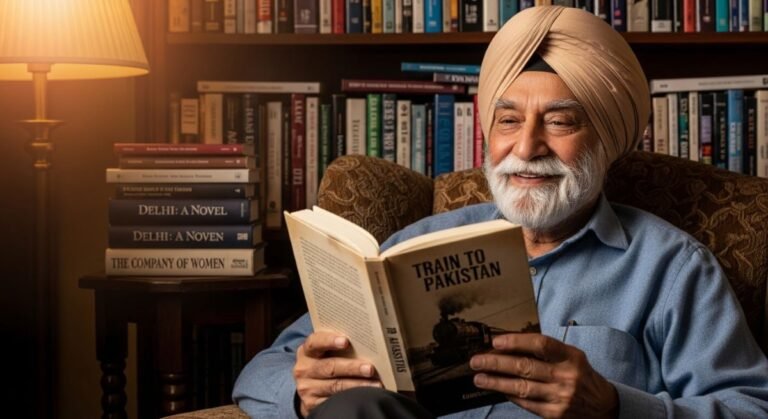
In this article we will discuss about the Khushwant Singh Biography PDF and PPT Slides Download, Khushwant Singh Biography, Books, Famous Works, Wife, Awards and Complete Legacy so, Khushwant Singh was one of the most beloved, controversial, admired, and entertaining figures in Indian literary and journalistic life. Over a career spanning more than six decades – from his first short stories in the late 1940s to his final novel published at the age of 95 – he produced an extraordinary body of work that ranged from the literary masterpiece of Train to Pakistan to the definitive scholarly history of the Sikhs, from his best-selling autobiography to hundreds of essays that were read every week by millions of Indians in his famous syndicated column ‘With Malice Towards One and All.’
Table of Contents
He was a man of fierce contradictions who wore them all with pride. He was a Sikh who called himself an agnostic. He was a lawyer who gave up the law for writing. He was a diplomat who gave up diplomacy for journalism. He was a journalist who gave up editing at the height of his influence to write novels. He was a moralist who wrote frankly about sex. He was a defender of secularism who understood and loved Sikh religious tradition more deeply than almost anyone alive. He was a man of the establishment who returned his highest government award in protest at the establishment’s actions.
This comprehensive article covers everything about Khushwant Singh – his biography in English and in short, family and grandmother, wife, education, books and famous works, the famous story Portrait of a Lady, Delhi novel summary, Train to Pakistan, autobiography, awards including the Padma Bhushan controversy, cause of death, poems and poetry, and his complete legacy.
Khushwant Singh Biography: Complete At-A-Glance Table
The table below provides a comprehensive biography of Khushwant Singh – covering every key fact from his birth and family to his education, career, wife, death, awards, and literary legacy:
| Biographical Detail | Information |
| Full Name | Khushwant Singh |
| Date of Birth | 2 February 1915 |
| Place of Birth | Hadali, Punjab, British India (now in Pakistan) |
| Date of Death | 20 March 2014 |
| Place of Death | New Delhi, India |
| Age at Death | 99 years |
| Nationality | Indian |
| Religion | Sikh (born into a Sikh family; self-described as agnostic in later life) |
| Father’s Name | Sir Sobha Singh (prominent builder, contractor and real estate developer in New Delhi) |
| Mother’s Name | Veeran Bai |
| Grandmother | His grandmother, a deeply religious Sikh woman, played an important role in his early upbringing in Hadali and later Delhi |
| Wife | Kaval Malik Singh (married 1939; died 2001) |
| Children | Two – Rahul Singh (son; also a journalist and writer) and Mala Singh (daughter) |
| Education | Government College, Lahore; St. Stephen’s College, Delhi (BA); King’s College London (BA Law); called to the Bar at the Inner Temple, London |
| Early Career | Lawyer in Lahore High Court (1940s); later joined the Indian Foreign Service (1947–1951) |
| Journalism Career | Editor of The Illustrated Weekly of India (1969–1978); Editor of Hindustan Times (1980–1983); Editor of National Herald |
| First Novel | Train to Pakistan (1956) |
| Most Famous Work | Train to Pakistan (1956) – his debut novel about Partition |
| Autobiography Title | Truth, Love and a Little Malice (2002) |
| History of Sikhs | A History of the Sikhs (2 volumes, 1963 and 1966) – the definitive scholarly work on Sikh history in English |
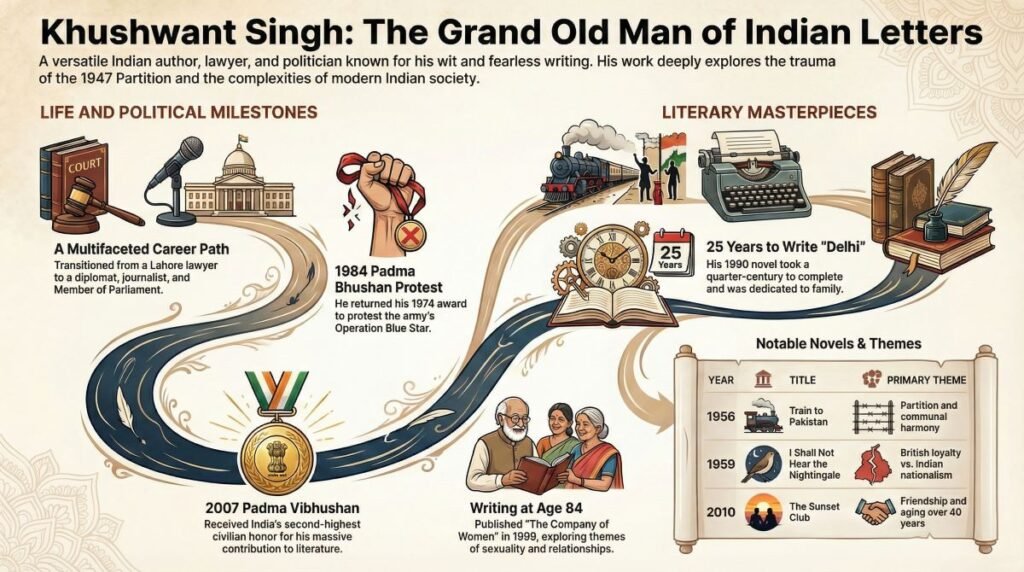
| Padma Bhushan | Awarded 1974; returned in 1984 in protest against Operation Blue Star (Indian Army storming of the Golden Temple) |
| Padma Vibhushan | Awarded 2007 |
| Why He Returned Padma Bhushan | Returned the Padma Bhushan in 1984 as a protest against Prime Minister Indira Gandhi’s decision to order the Indian Army into the Golden Temple in Amritsar (Operation Blue Star) during the militancy crisis |
| Rajya Sabha | Nominated Member of Rajya Sabha (1980–1986) – nominated by the Indian National Congress government |
| Total Books | Over 80 books – novels, short story collections, histories, humour anthologies, and non-fiction |
| Writing Style | Witty, irreverent, frank, often controversial; combined literary quality with popular accessibility; famous for his ribald humour and sharp political commentary |
| Core Themes | Partition, Sikh history and identity, death, sexuality, communalism, political satire, Indian culture, agnosticism, humour |
| Cause of Death | Natural causes; died peacefully at his New Delhi home on 20 March 2014, just weeks after his 99th birthday |
Khushwant Singh Biography PDF and PPT Slides Download (.pptx)
Who Was Khushwant Singh? (Khushwant Singh Wiki Overview)
Khushwant Singh was an Indian writer, journalist, lawyer, and public intellectual who was born on 2 February 1915 in Hadali, Punjab (now in Pakistan) and died on 20 March 2014 in New Delhi at the age of 99. He was one of India’s most widely read and most controversial public figures – a man whose weekly newspaper column reached millions of readers, whose novels are taught in schools and universities, and whose autobiography remains one of the most candid and entertaining books ever written by an Indian public figure.
He wore many hats with distinction – novelist, short story writer, historian, journalist, editor, diplomat, lawyer, and Member of Parliament. But beneath all these roles, he was above all a storyteller and an observer of Indian life with an eye for hypocrisy, an appetite for honesty, and a wit that could puncture pomposity with a single well-aimed sentence. He was also, beneath the sardonic exterior, a man of deep feeling – about his Sikh heritage, about Partition and its aftermath, about death, and about the extraordinary city of Delhi that was both his home and one of his greatest subjects.
Quick Key Facts About Khushwant Singh
- Born: 2 February 1915 in Hadali, Punjab, British India (now Pakistan)
- Died: 20 March 2014 in New Delhi – aged 99
- Father: Sir Sobha Singh – famous builder of New Delhi
- Wife: Kaval Malik Singh – married 1939; died 2001
- Children: Son Rahul Singh (journalist/writer) and daughter Mala Singh
- First book: The Mark of Vishnu and Other Stories (1950)
- First novel: Train to Pakistan (1956)
- Autobiography: Truth, Love and a Little Malice (2002)
- Major awards: Padma Bhushan (1974, returned 1984); Padma Vibhushan (2007)
- Editor of: The Illustrated Weekly of India (1969–1978); Hindustan Times (1980–1983)
- Famous column: ‘With Malice Towards One and All’ – syndicated across dozens of Indian newspapers
Biography of Khushwant Singh in English: Early Life and Family Background
Khushwant Singh was born on 2 February 1915 in Hadali – a small town in the district of Khushab in the Punjab of British India, now located in Pakistan. He was born into a prominent Sikh family. His father, Sir Sobha Singh, was one of the most successful builders and contractors in British India – the man whose construction company built large portions of New Delhi including Rashtrapati Bhavan (the Viceroy’s House) and Connaught Place. Sobha Singh was later knighted by the British for his services, which gave Khushwant a privileged and cosmopolitan upbringing in the heart of the new imperial capital.
Growing up in New Delhi in the 1920s and 1930s, the young Khushwant was formed by an unusual combination of Sikh religious and cultural tradition – maintained by his deeply religious mother and grandmother – and the English-medium, Westernised environment of his father’s social world. This double formation – rooted in Sikh identity, fluent in English culture – shaped everything he would later write.
Khushwant Singh Grandmother: A Central Figure
Khushwant Singh’s grandmother features prominently both in his autobiographical writing and in his most famous short story, Portrait of a Lady. His grandmother was a deeply religious Sikh woman – always dressed in white, always telling her prayer beads, always attached to the gurdwara and its rhythms of prayer and devotion. She was one of the most formative figures of his childhood.
In Portrait of a Lady – the story that millions of Indian schoolchildren study in Class 11 English – he draws directly on his memories of his grandmother to create one of the most moving portraits of old age and religious devotion in Indian literature. The grandmother in the story embodies everything he loved and respected about traditional Sikh values: her quiet faith, her daily feeding of sparrows, her dignified acceptance of age and death, and her absolute certainty that God was present in every moment of her life.
The contrast between this grandmother’s world and the Westernised, English-educated world that he himself inhabited became one of the central tensions of his personal and literary life – and the source of some of his most tender and most honest writing.
Khushwant Singh Education: From Lahore to London’s Inner Temple
Khushwant Singh’s education was exceptional – taking him from the schools of colonial Delhi and Lahore to the law courts of London, and giving him a formation that combined deep roots in Indian culture with a thorough immersion in British intellectual and legal life.
Education Timeline
- Attended schools in New Delhi during the 1920s and early 1930s – growing up in the privileged environment created by his father’s success
- Enrolled at Government College, Lahore – one of the most prestigious educational institutions in colonial India, also attended by poets, politicians, and literary figures of the era
- Transferred to St. Stephen’s College, Delhi – another prestigious institution; graduated with a Bachelor of Arts degree
- 1938–1939: Went to England; enrolled at King’s College, University of London to study law
- Called to the Bar at the Inner Temple, London – one of the four Inns of Court and one of the most distinguished legal training institutions in the world
- Returned to India and practised as a lawyer at the Lahore High Court in the 1940s – a career he would abandon in 1951 in favour of writing and journalism
His legal training gave him a rigorous analytical mind and a habit of evidence-based argument that served him well as a journalist and as a historian. His time in London in the late 1930s also gave him a direct personal experience of European culture, and it was there that he began writing – sending articles and stories to Indian magazines from his London bedsit.
Khushwant Singh Wife: Kaval Malik Singh
Khushwant Singh’s wife was Kaval Malik Singh, whom he married in 1939 – the same year he qualified as a barrister in London. Their marriage lasted 62 years, until Kaval’s death in 2001. It was one of the longest and most defining relationships of his life.
Kaval Malik was an educated, independent-minded woman who was her husband’s partner through all the transformations of his long career – from lawyer to diplomat to journalist to novelist. Khushwant wrote about her with characteristic honesty in his autobiography, acknowledging both the depth of his love for her and the difficulties and infidelities that marked their marriage. This honesty about his own flaws and failures – unusual in an autobiography by an Indian public figure – is one of the qualities that makes Truth, Love and a Little Malice such a remarkable book.
Kaval’s death in 2001 was a profound blow. In his later years, Khushwant wrote movingly about her absence and about the loneliness of extreme old age – themes that find their fullest expression in The Sunset Club (2010), his final novel about three elderly friends meeting daily in Delhi’s Lodhi Garden as their world narrows toward its end.
Children
- Rahul Singh – his son; followed his father into journalism and writing; has published several books and has written about growing up as Khushwant Singh’s son
- Mala Singh – his daughter
Khushwant Singh Famous Works and Books: Complete List with Summaries
Khushwant Singh published over 80 books across his career – an extraordinary output even by the standards of the most prolific writers. His works span every genre: literary novels, short story collections, historical scholarship, political non-fiction, humour anthologies, translations of Sikh sacred poetry, and his famous autobiography. The table below covers his major novels and most important books:
| Title | Year | Summary / Description |
| Train to Pakistan | 1956 | His debut novel and most celebrated work. Set in the fictional Punjabi village of Mano Majra during the catastrophic violence of the 1947 Partition. The village has lived in communal harmony – Muslims, Sikhs, and Hindus side by side – until the trains carrying dead bodies begin to arrive, and the outside world’s hatred reaches even this remote community. One of the definitive literary accounts of Partition. |
| I Shall Not Hear the Nightingale | 1959 | Set in the Punjab during the final years of World War II and the waning years of British rule. A complex family drama centred on Sher Singh, the son of a loyalist Sikh magistrate who is drawn into an underground anti-British movement. A subtle examination of collaboration, betrayal, and the moral ambiguities of colonial resistance. |
| Delhi: A Novel | 1990 | A vast, richly imagined panoramic novel tracing the history of Delhi across several centuries – from the Mughals through the British Raj to modern independent India. Narrated by an unnamed male protagonist who encounters historical figures and episodes across time. One of his most ambitious literary achievements; widely used in syllabi on Indian history and literature. |
| The Company of Women | 1999 | A frank and often comic novel about Mohan Kumar, a middle-aged Delhi businessman who seeks fulfilment in relationships with a series of women. Written with Khushwant Singh’s characteristic wit and lack of prudishness about sexuality; reflects his lifelong conviction that Indian literature needed to engage more honestly with sexual experience. |
| Burial at Sea | 2004 | A novel set in post-independence India; explores desire, ageing, and the relationship between an old man and a young woman – themes that recurred in his fiction and reflected his own preoccupation with mortality and the persistence of human desire into old age. |
| The Sunset Club | 2010 | Published when he was 95 years old. Three elderly friends – a Hindu, a Muslim, and a Sikh – meet daily on a bench in Delhi’s Lodhi Garden to talk, debate, and remember. A gentle, wise meditation on ageing, friendship, religion, and the approach of death – arguably his most personal and most reflective novel. |
| A History of the Sikhs, Vol. 1 | 1963 | The first volume of his landmark scholarly history of the Sikh people, covering the period from 1469 (the birth of Guru Nanak) to 1839. Widely regarded as the most authoritative and accessible single-volume history of the Sikhs in English; still in print and widely used in academic courses. |
| A History of the Sikhs, Vol. 2 | 1966 | The second volume, covering 1839 to 1988. Together with Volume 1, forms the definitive English-language history of the Sikh people and their place in Indian and world history. |
| Truth, Love and a Little Malice | 2002 | His autobiography – candid, entertaining, and utterly lacking in self-congratulation. Covers his childhood in Hadali and Delhi, his education in London, his legal and diplomatic career, his decades as a journalist and editor, and his literary life. Famous for its ‘malice’ – his willingness to share unflattering opinions of famous people he encountered. |
| The Mark of Vishnu and Other Stories | 1950 | His first published book – a collection of short stories showcasing the dark wit, social observation, and storytelling craft that would define his longer fiction. The title story, about a devout Hindu servant’s faith in a cobra, is one of the finest Indian short stories in English. |
| Portrait of a Lady (short story) | (1950s) | One of his most famous and widely anthologised short stories. Narrates the relationship between a young narrator and his grandmother – a deeply religious, white-haired old Sikh woman who raised him and with whom he loses contact as he grows up and goes to England for higher education. A tender, quietly devastating meditation on the passage of time and the disconnection between generations. |
| Mano Majra (US title of Train to Pakistan) | 1956 | Train to Pakistan was published under the title Mano Majra in the United States. Both titles refer to the same novel. |
| Not a Nice Man to Know | 1993 | A collection of essays, humorous writing, and autobiographical reflections – a characteristic gathering of his journalism, book reviews, and personal observations. |
| We Indians | 1982 | A witty, sharp collection of essays on Indian society, culture, politics, and character – reflecting his decades of observation as a journalist and his gift for making serious social commentary accessible and entertaining. |
| The End of India | 2003 | A serious political non-fiction work examining the rise of Hindu nationalism and communalism in India and warning of the dangers they pose to Indian secularism and democracy. Written in the aftermath of the 2002 Gujarat riots, it is one of his most urgent and politically engaged books. |
Portrait of a Lady: The Famous Story by Khushwant Singh
Portrait of a Lady is the most famous short story by Khushwant Singh and one of the most widely read pieces of Indian literature in English. It is included in the NCERT Class 11 English textbook Hornbill, which means it is studied by millions of Indian students every year across the country. Below is a complete reference guide to this story – for students, teachers, and general readers:
| Aspect | Detail |
| Full Title | Portrait of a Lady |
| Author | Khushwant Singh |
| Type | Short story; widely taught in school and college curricula across India |
| Narrator | An unnamed male narrator looking back on his relationship with his grandmother |
| Setting | A village in Punjab, then Delhi, then England (told in retrospect) |
| Central Character | The narrator’s grandmother – a deeply religious, white-haired Sikh woman of great dignity and quiet love |
| Plot Summary | The narrator recalls his childhood in the village with his grandmother, who walked him to school every day, fed the birds, and prayed constantly. As he grows up and moves to a city school, then to England, the bond between them gradually loosens. When he returns from England after five years, she spends her final hours singing devotional songs with her neighbourhood women – she dies that night, peacefully. |
| Key Themes | The passage of time and the inevitable loosening of family bonds; the quiet dignity of old age and religious faith; the disconnection between generations caused by modern education and Westernisation; death as a natural culmination of a life well-lived |
| Textbook Inclusion | Included in the NCERT Class 11 English textbook Hornbill – making it one of the most widely read Indian short stories by students across India |
| Literary Significance | One of the finest Indian short stories in English; celebrated for its economy, its emotional depth, and the beauty of its central character – the grandmother – who is widely recognised as one of the most memorable figures in Indian short fiction |
What Is the Famous Story of Khushwant Singh?
When people ask what is the famous story of Khushwant Singh, the answer is almost always Portrait of a Lady – his masterfully crafted short story about his grandmother. Published in the 1950s, the story follows the narrator’s memories of his grandmother from his village childhood through to her peaceful death in Delhi. It is famous for its simplicity, its emotional restraint, and the extraordinary vividness with which the grandmother is drawn – a small, white-haired woman who feeds sparrows, tells her prayer beads, and accepts her own death with the same quiet faith with which she has lived her entire life. The image of the sparrows flying in circles above her dead body at the story’s end is one of the most memorable closing images in Indian short fiction.
Train to Pakistan: Khushwant Singh’s Masterpiece – Summary and Significance
Train to Pakistan (1956) is Khushwant Singh’s debut novel and, by the consensus of critics and readers, his greatest literary achievement. Published in the United States under the title Mano Majra, it tells the story of Partition through the lens of a single Punjabi village – and in doing so, captures the full horror and human cost of one of the worst communal catastrophes of the 20th century.
Summary of Train to Pakistan
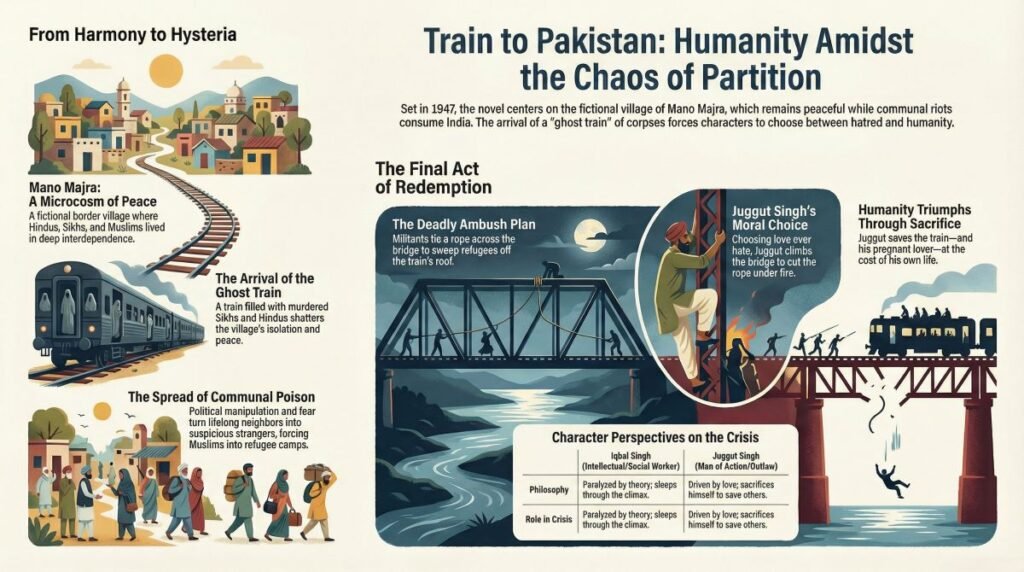
- The novel is set in the fictional village of Mano Majra, on the border between India and Pakistan, in the summer of 1947
- The village has lived for generations in perfect communal harmony – its Sikh, Hindu, and Muslim inhabitants coexisting in the natural rhythms of agricultural life
- As Partition tears the subcontinent apart, trains begin to pass through Mano Majra carrying dead bodies – an almost surreal incursion of the outside world’s violence into this peaceful rural community
- The novel’s central characters are Juggut Singh – a Sikh dacoit (bandit) and local outlaw – and Iqbal, an educated city-dweller of ambiguous political affiliation
- As communal violence spreads and outside agitators arrive to organise the killing of Muslim refugees, the novel builds to a climax in which an individual act of extraordinary courage is pitted against the organised machinery of hate
- The ending – deeply moving and deeply ambiguous – raises profound questions about heroism, sacrifice, and the possibility of individual decency in the face of collective barbarism
Key Themes in Train to Pakistan
- Partition as human catastrophe – the novel refuses to assign blame to any one community; all sides are shown capable of both decency and brutality
- The failure of the educated and the political class – Iqbal and the local magistrate represent the intellectual and administrative establishment that is revealed as powerless and ultimately irrelevant in the face of mass violence
- The dignity of the ordinary and the criminal – Juggut Singh, the dacoit and local outlaw, is the novel’s true hero; his act of courage is the novel’s moral centre
- The randomness of communal identity – in Mano Majra, before the outsiders arrive, a man’s religion is less important than his neighbourliness; Partition shows how quickly this can be reversed
- Love across the communal divide – Juggut Singh’s love for Nooran, a Muslim woman, is one of the novel’s most tender threads
Delhi by Khushwant Singh: Summary and Significance
Delhi: A Novel (1990) is one of Khushwant Singh’s most ambitious literary achievements – a vast, multi-layered historical novel that sweeps through the entire history of India’s capital city from the Mughal era to modern times.
Delhi Novel Summary
- The novel is structured as a series of historical vignettes spanning several centuries, connected by an unnamed journalist-narrator who has lived in Delhi all his life and serves as a witness and commentator across the ages
- The narrator’s recurring encounters with a eunuch named Bhagmati – a sexually ambiguous figure who represents Delhi’s underworld of pleasure and transgression – provide the novel’s continuous human thread
- Historical episodes cover the reigns of the Mughal emperors, the Maratha invasions, the 1857 Mutiny, the British Raj, and independent India – each section recreating a different era with meticulous historical detail
- The novel is frank about sexuality and violence in a way that reflects Khushwant Singh’s characteristic refusal to sanitise or sentimentalise Indian history
- Delhi itself is the true protagonist of the novel – the city is portrayed as a place of extraordinary beauty, unbroken continuity, and perpetual violence; a city that has been destroyed and rebuilt countless times and yet persists
- The book is widely used in academic courses on Indian history and literature and is one of the definitive literary explorations of Delhi as a subject
What Is the Name of Khushwant Singh’s Autobiography?
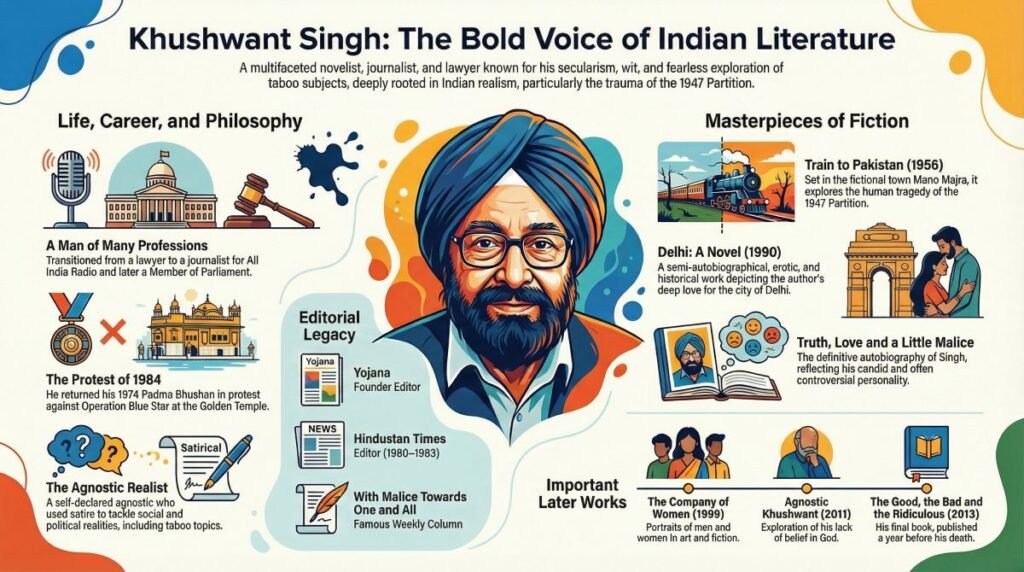
The name of Khushwant Singh’s autobiography is Truth, Love and a Little Malice, published in 2002. It is one of the most frank, entertaining, and self-aware autobiographies ever written by an Indian public figure.
About Truth, Love and a Little Malice
- The title says it all – Khushwant Singh was committed throughout his life to telling the truth as he saw it, driven by a genuine love for people and India, and always ready to season his observations with a little well-aimed malice toward the pompous and the hypocritical
- The book covers his childhood in Hadali and Delhi, his legal education in London, his experience of Partition, his career as a diplomat, his decades as a journalist and editor, and his life as a novelist
- He writes with unusual candour about his own failures – his infidelities, his disappointments, his political mistakes, his complicated relationships with powerful figures
- He shares unflatteringly honest opinions of many famous Indians he encountered over eight decades – politicians, writers, businesspeople, and celebrities – earning the book both admiration for its honesty and criticism from those he wrote about
- The autobiography is essential reading for anyone interested in 20th-century Indian history, literature, and journalism – it covers nearly nine decades of Indian public life from the perspective of one of its sharpest and most engaged observers
Khushwant Singh Awards and Honours
Complete Awards List
- Padma Bhushan (1974) – India’s third-highest civilian honour, awarded by the Government of India in recognition of his distinguished contribution to Indian literature and journalism
- Padma Bhushan Returned (1984) – He returned the Padma Bhushan in protest against Operation Blue Star (see below)
- Padma Vibhushan (2007) – India’s second-highest civilian honour; awarded by the Government of India in recognition of his lifetime’s contribution to Indian culture, literature, and public life
- Nominated Member of Rajya Sabha (1980–1986) – Nominated to India’s upper house of Parliament by the Indian National Congress government
- Honorary degrees from several Indian universities
- Grove Press Award (USA) – for Train to Pakistan, recognising its achievement as a work of world literature
Why Did Khushwant Singh Return Padma Bhushan?
One of the most frequently asked questions about Khushwant Singh is: why did he return his Padma Bhushan? The answer lies in the events of June 1984 and his response to Operation Blue Star.
Operation Blue Star was the code name for the Indian Army’s military operation in June 1984, ordered by Prime Minister Indira Gandhi, to remove Sikh militants – led by Jarnail Singh Bhindranwale – who had fortified themselves inside the Golden Temple complex in Amritsar, the holiest shrine of the Sikh religion. The operation resulted in significant loss of life and caused massive damage to the sacred complex, including to the Akal Takht – the seat of Sikh temporal authority.
For Khushwant Singh – a man who had spent decades writing about Sikh history and identity, who had deep personal roots in Punjab, and who had always been a passionate defender of Sikh religious dignity – the assault on the Golden Temple was an act that could not go unprotested. He returned his Padma Bhushan as a public statement of protest and grief at what he saw as a profound desecration. This act cost him significantly in terms of his relationship with the Congress government that had both nominated him to the Rajya Sabha and awarded him the honour in the first place.
Khushwant Singh Poems and Poetry
While Khushwant Singh is primarily known as a novelist, journalist, and prose writer, he also engaged with poetry throughout his literary life – particularly as a translator and interpreter of Sikh and Punjabi poetic tradition.
His Engagement with Poetry
- He translated selections from the Guru Granth Sahib – the sacred scripture of Sikhism, which is written entirely in verse – into English; these translations brought the poetic and spiritual tradition of Sikh scripture to an international English-speaking audience
- He translated the works of major Punjabi poets including Bulleh Shah – the 17th–18th century Sufi poet whose mystical verses in Punjabi are among the most beloved in the language
- He included poems in several of his anthologies and essay collections, often as illustrations of aspects of Indian philosophical or spiritual thought
- His poem ‘The End of India’ (the title piece of his 2003 non-fiction work) is written in a poetic, prophetic register that reflects his deep concern about the direction of Indian society
- In his weekly column and in essays, he frequently quoted poetry – Urdu ghazals, Punjabi folk verse, English poems – as part of his discursive style, making poetry a regular part of his popular journalism
Khushwant Singh Death: Cause of Death and Final Years
Khushwant Singh died on 20 March 2014 in New Delhi. He was 99 years old – just a few weeks after celebrating his 99th birthday on 2 February 2014. The cause of death was natural causes – he died peacefully at his home in Sujan Singh Park, the elegant New Delhi housing complex built by his father Sir Sobha Singh that had been his home for most of his adult life.
His death was mourned widely across India. He had been one of the country’s most prominent public voices for more than six decades, and his passing felt like the end of an era. Tributes poured in from writers, politicians, journalists, and ordinary readers who had grown up with his column, his novels, and his irrepressible personality.
His Final Years
- He continued writing almost to the end – publishing The Sunset Club in 2010 at the age of 95
- He gave interviews regularly into his nineties, characteristically frank and witty even as his hearing and mobility declined
- He remained deeply engaged with Indian public life and continued to write his newspaper column into old age
- He spoke often and with evident serenity about death – a subject he had engaged with throughout his literary life. In one famous remark, he said he had no fear of death and hoped only to die without suffering, quickly and without fuss
- His death fulfilled something of that wish – he died peacefully at home, in the city he had lived in all his adult life, in the apartment building his father built
Biography of Khushwant Singh in 150 Words (For Students in Short)
Khushwant Singh (2 February 1915 – 20 March 2014) was one of India’s most celebrated and controversial writers, journalists, and public intellectuals. Born in Hadali, Punjab (now Pakistan), into a prominent Sikh family, he was educated in Delhi and London, where he qualified as a barrister. After working as a lawyer and diplomat, he turned to writing and journalism, editing The Illustrated Weekly of India and the Hindustan Times. His debut novel Train to Pakistan (1956) is one of the definitive literary accounts of Partition. His two-volume A History of the Sikhs remains the standard scholarly work on the subject. He was awarded the Padma Bhushan in 1974, which he returned in 1984 to protest Operation Blue Star. He later received the Padma Vibhushan in 2007. He married Kaval Malik in 1939. Known for his wit, frankness, and irreverence, he wrote over 80 books and died peacefully in New Delhi at the age of 99.
Biography of Khushwant Singh in 200 Words (For Students and Class 11 & 12)
Khushwant Singh was born on 2 February 1915 in Hadali, Punjab, British India – a town that now lies in Pakistan. He grew up in New Delhi, where his father Sir Sobha Singh was a prominent builder responsible for constructing large parts of the imperial capital. Educated at Government College Lahore, St. Stephen’s College Delhi, and King’s College London, he was called to the Bar at the Inner Temple before practising as a lawyer at the Lahore High Court in the 1940s.
He served in the Indian Foreign Service from 1947 to 1951 before leaving to pursue writing and journalism full time. He went on to edit The Illustrated Weekly of India (1969–1978) and the Hindustan Times (1980–1983), transforming both publications. His debut novel Train to Pakistan (1956) is widely regarded as the finest literary account of the 1947 Partition. His two-volume A History of the Sikhs is the definitive scholarly work on Sikh history in English. He also wrote the famous short story Portrait of a Lady, studied in Class 11 NCERT curricula across India.
Married to Kaval Malik from 1939 until her death in 2001, he had two children – Rahul and Mala. He received the Padma Bhushan in 1974, which he returned in protest in 1984, and the Padma Vibhushan in 2007. He died peacefully in New Delhi on 20 March 2014 at the age of 99, leaving behind one of the most distinctive and wide-ranging literary legacies in Indian English literature.
Khushwant Singh: Complete Life and Career Timeline
| Year | Key Event |
| 1915 | Born on 2 February in Hadali, Punjab, British India (now in Pakistan) |
| 1920s | Family moved to Delhi; grew up in New Delhi as his father Sir Sobha Singh became one of the city’s most prominent builders |
| 1934 | Enrolled at Government College, Lahore – one of the finest educational institutions in colonial India |
| 1936 | Transferred to St. Stephen’s College, Delhi; graduated with a BA |
| 1938–39 | Went to London; studied law at King’s College London; called to the Bar at the Inner Temple |
| 1939 | Married Kaval Malik – a union that would last 62 years until her death in 2001 |
| 1940s | Practised as a lawyer at the Lahore High Court; witnessed the growing violence and tension as Partition approached |
| 1947 | Indian independence and Partition; the family’s ancestral home of Hadali became part of Pakistan; the trauma of Partition became the defining subject of his most important literary work |
| 1947–51 | Joined the Indian Foreign Service; posted to London and Ottawa as a diplomat |
| 1950 | Published The Mark of Vishnu and Other Stories – his first book |
| 1951 | Left the Foreign Service to pursue writing and journalism full time |
| 1956 | Published Train to Pakistan – his debut novel; immediate critical recognition; became the definitive literary account of Partition |
| 1963–66 | Published A History of the Sikhs in two volumes – his landmark scholarly work on Sikh history |
| 1969 | Appointed Editor of The Illustrated Weekly of India – transformed the magazine into the most widely read English-language magazine in India |
| 1974 | Awarded the Padma Bhushan by the Government of India |
| 1978 | Resigned as Editor of The Illustrated Weekly of India |
| 1980 | Nominated as Member of Rajya Sabha (upper house of Indian Parliament) |
| 1980–83 | Appointed Editor of the Hindustan Times – one of India’s most influential national newspapers |
| 1984 | Returned his Padma Bhushan in protest against Operation Blue Star – the Indian Army’s assault on the Golden Temple in Amritsar during the Sikh militancy crisis |
| 1986 | Retired from Rajya Sabha |
| 1990 | Published Delhi: A Novel – his most ambitious historical novel |
| 2001 | Wife Kaval Malik Singh died – a profound personal loss after 62 years of marriage |
| 2002 | Published Truth, Love and a Little Malice – his autobiography |
| 2007 | Awarded the Padma Vibhushan – India’s second-highest civilian honour |
| 2010 | Published The Sunset Club – his final novel, written at the age of 95 |
| 2014 | Died on 20 March in New Delhi at the age of 99 |
10 Lines About Khushwant Singh for Students
- Khushwant Singh was born on 2 February 1915 in Hadali, Punjab, British India (now in Pakistan), into a prominent Sikh family.
- His father, Sir Sobha Singh, was the famous builder who constructed large parts of New Delhi including Rashtrapati Bhavan and Connaught Place.
- He was educated at Government College Lahore, St. Stephen’s College Delhi, and King’s College London, where he qualified as a barrister.
- His debut novel Train to Pakistan (1956) is one of the greatest literary accounts of the 1947 Partition and is studied in universities worldwide.
- His famous short story Portrait of a Lady is included in the NCERT Class 11 English textbook Hornbill and is read by millions of Indian students every year.
- He edited The Illustrated Weekly of India (1969–1978) and the Hindustan Times (1980–1983), making both publications the most widely read of their kind in India.
- He was awarded the Padma Bhushan in 1974 but returned it in 1984 to protest Operation Blue Star – the Indian Army’s assault on the Golden Temple in Amritsar.
- He was later awarded the Padma Vibhushan in 2007 – India’s second-highest civilian honour.
- His autobiography, Truth, Love and a Little Malice (2002), is one of the most candid and entertaining autobiographies written by an Indian public figure.
- He died peacefully on 20 March 2014 in New Delhi at the age of 99, leaving behind over 80 books and a legacy as one of India’s most beloved and irreplaceable literary voices.
Conclusion: The Enduring Legacy of Khushwant Singh
Khushwant Singh was, in the fullest sense of the phrase, a man who belonged to India – to all of it, not just to the comfortable, educated, secular English-speaking India that produced him. He wrote about Partition with the grief of a man whose own village had been taken away. He wrote about Sikh history with the love of a man who knew that tradition from the inside. He wrote about death with the equanimity of a man who had thought about it carefully for ninety years. And he wrote about sex and desire and the body with the frankness of a man who believed that Indian literature had been dishonest about these things for too long.
His legacy is everywhere in Indian literary and public life. Train to Pakistan remains the novel that most students in India first encounter when they read about Partition. Portrait of a Lady remains the story that most Indian schoolchildren read when they are introduced to Indian short fiction in English. His History of the Sikhs remains the book to which anyone serious about Sikh history must turn. And his autobiography remains the standard against which the honesty of Indian public men is measured – and nearly always found wanting.
He was not a perfect man – he was the first to say so, and to list his imperfections in print. But he was a great writer, a great journalist, a serious historian, and an irreplaceable voice in the long conversation India has been having with itself about who it is and who it wants to be. That voice is still heard, on every page he left behind.
Also read: Kamala Markandaya Biography PDF and PPT Slides Download
Final Quick Reference Summary
- Full Name: Khushwant Singh
- Born: 2 February 1915 – Hadali, Punjab, British India (now Pakistan)
- Died: 20 March 2014 – New Delhi (aged 99; cause: natural causes)
- Father: Sir Sobha Singh – builder of New Delhi
- Grandmother: Deeply religious Sikh woman; inspiration for Portrait of a Lady
- Wife: Kaval Malik Singh (married 1939; died 2001)
- Children: Rahul Singh (son), Mala Singh (daughter)
- Education: Govt. College Lahore; St. Stephen’s Delhi; King’s College London; Inner Temple (barrister)
- First Novel: Train to Pakistan (1956)
- Famous Short Story: Portrait of a Lady (Class 11 NCERT textbook)
- Delhi Novel: Delhi: A Novel (1990) – summary: panoramic history of Delhi across centuries
- Autobiography: Truth, Love and a Little Malice (2002)
- Sikh History: A History of the Sikhs (2 volumes, 1963 and 1966)
- Awards: Padma Bhushan (1974, returned 1984); Padma Vibhushan (2007)
- Why returned Padma Bhushan: Protest against Operation Blue Star (assault on Golden Temple, 1984)
- Editor of: The Illustrated Weekly of India; Hindustan Times
- Famous column: ‘With Malice Towards One and All’
- Most Famous Book: Train to Pakistan