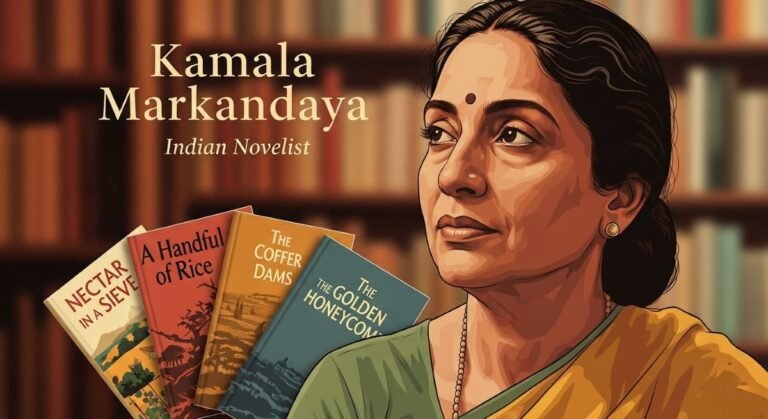
Today we will discuss about the Kamala Markandaya Biography PDF and PPT Slides with Infographic, Kamala Markandaya: Biography, Books, Famous Works, Writing Style, Themes and Full Legacy so, Kamala Markandaya is one of the most important and most underappreciated novelists in the history of Indian literature in English. A pioneering first-generation Indian woman writer, she published nine novels between 1954 and 1982 that explored the tensions between rural and urban India, between the colonial past and the postcolonial present, between Eastern and Western ways of life – all filtered through prose of uncommon clarity, emotional intelligence, and quiet power.
Table of Contents
Her debut novel Nectar in a Sieve (1954) became an international bestseller, was adopted into American school curricula, and established her as a major literary voice at a time when very few Indian women writers were achieving international recognition. Nearly seven decades later, that novel is still read, still taught, and still moves readers with the force of its simple, devastating honesty about what it means to be poor, female, and Indian in a world that offers neither comfort nor justice to the powerless.
This comprehensive article covers everything about Kamala Markandaya – her real name, biography, husband and personal life, education, all her books with summaries, famous works, themes, writing style, achievements, awards, the Two Virgins summary, and the complete Nectar in a Sieve analysis – using all the key search terms readers are looking for.
Kamala Markandaya Biography: Complete At-A-Glance Table
The following table provides a comprehensive biography of Kamala Markandaya – every essential fact from her birth and real name to her husband, education, achievements, and literary legacy:
| Biographical Detail | Information |
| Real / Original Name | Kamala Purnaiya (birth name); pen name Kamala Markandaya |
| Full Married Name | Kamala Purnaiya Taylor |
| Date of Birth | 1 June 1924 |
| Place of Birth | Mysore (now Karnataka), British India |
| Date of Death | 16 May 2004 |
| Place of Death | London, United Kingdom |
| Age at Death | 79 years |
| Nationality | British-Indian (settled in London from the early 1950s) |
| Family Background | South Indian Brahmin family from Karnataka; father was a civil servant |
| Husband | Bertrand Taylor (an Englishman; married in the early 1950s) |
| Children | One daughter – Kim Taylor |
| Education | University of Madras (graduated 1940s) |
| Early Career | Journalist in India before emigrating to England |
| Language of Writing | English |
| First Novel | Nectar in a Sieve (1954) |
| Most Famous Work | Nectar in a Sieve (1954) – shortlisted for Lost Booker Prize 1970 |
| Total Novels Written | 9 novels (1954–1982) |
| Writing Period | 1954–1982 (nearly three decades of active publication) |
| Awards and Recognition | Shortlisted for the Lost Booker Prize (1970) for The Nowhere Man; widely studied in universities internationally |
| Achievements | One of the first Indian women to achieve major international literary recognition writing in English; her debut novel became a bestseller in the United States and was adopted into US school curricula |
| Literary Movement | Indian Writing in English; Postcolonial Literature; Indo-Anglian Fiction |
| Core Themes | Poverty and rural India, industrialisation, colonial and postcolonial identity, cross-cultural relationships, the plight of Indian women, tradition vs modernity, displacement and belonging |
| Literary Peers / Context | Often grouped with Anita Desai, Ruth Prawer Jhabvala, and other first-generation women writers of Indian fiction in English |
Kamala Markandaya Biography PDF and PPT Slides (170)
What Is the Real Name of Kamala Markandaya? (Original Name)
The real name and original name of Kamala Markandaya was Kamala Purnaiya. She was born Kamala Purnaiya in Mysore, Karnataka, in 1924. The name Markandaya was a pen name – a literary pseudonym she adopted when she began publishing fiction. After marrying Bertrand Taylor, an Englishman, her full legal name became Kamala Purnaiya Taylor, though she continued to publish exclusively under the pen name Kamala Markandaya throughout her literary career.
The pen name Markandaya is believed to have been derived from her family’s connection to the town of Markandapuram (Markandeya) in South India – a place name from her roots in Karnataka. The choice of a pen name was also practical: it gave her a distinct authorial identity separate from her married name and rooted her publicly in her Indian heritage at a time when she was living and writing in England.
Why the Real Name Matters
- Understanding her real name – Kamala Purnaiya – helps place her firmly within a South Indian Brahmin family tradition, just as Raja Rao and R.K. Narayan came from similar Karnataka backgrounds
- Her married name – Taylor – reflected her cross-cultural marriage to an Englishman, a personal experience that directly informed the cross-cultural relationships at the heart of novels like Some Inner Fury, The Coffer Dams, and Possession
- The pen name Markandaya allowed her to maintain a separate, distinctly Indian literary identity while living as a British-Indian woman in London
Kamala Markandaya Biography in English: Early Life and Background
Kamala Markandaya was born on 1 June 1924 in Mysore, Karnataka, into a South Indian Brahmin family. Her father was a civil servant, which placed her family in the educated, professionally aspirant middle class of colonial India – a background that gave her access to English-medium education and the cultural resources to become a writer, while also exposing her to the vast inequalities of Indian society around her.
She grew up during one of the most dramatic periods of modern Indian history – the final decades of British rule, the mass mobilisation of the independence movement, the partition and independence of 1947, and the early years of the Indian Republic. These experiences of political upheaval, social transformation, and the meeting of Indian and British cultures permeate all her fiction.
Education and Early Career
- She studied at the University of Madras, graduating in the 1940s – making her one of the relatively small number of Indian women of her generation to receive a university education
- After graduating, she worked as a journalist in India – writing for newspapers and publications that sharpened her observational skills and her ability to write clearly and directly about the world around her
- Her journalistic career also exposed her to the realities of Indian poverty, rural life, and social inequality that would become the central subject of her fiction
- In the early 1950s, she emigrated to England, married Bertrand Taylor, and settled in London – joining a small but growing community of Indian writers living and working in Britain
- She began writing fiction seriously after arriving in London, drawing on both her memories of India and her new perspective as an Indian woman living in the West
Life in London and the Cross-Cultural Dimension
Living in London as an Indian woman married to an Englishman gave Kamala Markandaya a unique vantage point that shaped her fiction profoundly. She was neither fully at home in England nor – after years abroad – fully at home in India. This in-between position, which she shared with a generation of postcolonial writers, gave her an acute sensitivity to the dynamics of cultural encounter, colonial power, and personal displacement that runs through all her work.
Unlike some of her Indian contemporaries who lived between cultures uncomfortably, Markandaya turned this double perspective into a literary strength – using it to examine the encounter between India and the West from both sides simultaneously, with empathy for both and sentimentality toward neither.
Kamala Markandaya Husband: Marriage to Bertrand Taylor
Kamala Markandaya’s husband was Bertrand Taylor, a British man whom she married in the early 1950s after emigrating to England. Very little biographical detail about Bertrand Taylor is available in published sources – Markandaya was an intensely private woman who rarely gave interviews and who kept her personal life firmly separate from her public literary persona.
What is known is that the marriage to Taylor was central to her life in England and provided the direct personal experience of cross-cultural partnership that informed several of her most important novels. The relationship between an Indian woman and a British man – with all its emotional depth, cultural friction, and social complexity – is a recurring motif in her fiction, most directly in Some Inner Fury, The Coffer Dams, and Pleasure City.
Together, Kamala and Bertrand Taylor had one daughter, Kim Taylor. Kamala Markandaya continued to write under her pen name throughout her marriage, maintaining her Indian literary identity as a distinct professional persona. She died in London on 16 May 2004.
Kamala Markandaya Famous Works and Books: Complete List with Summaries
Kamala Markandaya published nine novels over her career, spanning nearly three decades from 1954 to 1982. Each novel explores distinct social, historical, and human terrain – together they constitute one of the most varied, intelligent, and emotionally powerful bodies of work in the history of Indian writing in English. The table below is a comprehensive reference for all her books:
| Novel Title | Year | Summary / Description |
| Nectar in a Sieve | 1954 | Her debut and most celebrated novel. Narrated in the first person by Rukmani, a rural Indian woman who lives through poverty, drought, the intrusion of industrial development into her village, the loss of her children, and the quiet endurance of a life defined by hardship and love. A profound portrait of rural Indian womanhood. Became an international bestseller and was adopted into American school curricula. |
| Some Inner Fury | 1955 | Set during the final years of British rule in India, around the Quit India Movement of 1942. A love story between Mira, an educated Indian woman, and Richard, a young Englishman, whose relationship is torn apart by the political and cultural forces of colonial India. Explores the personal cost of nationalist politics and the impossibility of cross-cultural love under colonialism. |
| A Silence of Desire | 1960 | A nuanced domestic drama set in post-independence India. Dandekar, a middle-class government official, discovers his wife Sarojini is secretly visiting a faith healer to treat a serious illness rather than seeking conventional medical help. A thoughtful exploration of the tension between rational modernity and traditional Indian spiritual belief. |
| Possession | 1963 | An English aristocratic woman, Lady Caroline Bell, discovers a young Indian boy with exceptional artistic talent in a South Indian village and takes him to London to develop his gifts. A complex examination of cultural ownership, colonial patronage, artistic exploitation, and the cost of being ‘discovered’ and removed from one’s cultural roots. |
| A Handful of Rice | 1966 | Set in the slums of urban India. Ravi, a young rural migrant, arrives in the city hoping for a better life and marries the daughter of a tailor. The novel traces his struggle against poverty, his gradual moral corruption under desperate circumstances, and his ultimately doomed search for dignity and security in a brutal urban environment. |
| The Coffer Dams | 1969 | Set on a dam construction site in South India where a British engineering company is working alongside Indian labourers. Explores the fraught relationship between British technical expertise and Indian workers, the arrogance of colonial-era thinking in post-independence India, and the love story between a British engineer and his wife who comes to empathise deeply with the Indian workers. |
| The Nowhere Man | 1972 | One of her most powerful novels. Srinivas, an elderly Indian man who has lived in England for decades, faces racial hostility in 1960s London as immigration becomes politically charged. A deeply moving portrait of displacement, belonging, and the brutal human cost of racism. Shortlisted for the Lost Booker Prize in 1970 (for works published between 1970 and 1972 that were overlooked when the Booker Prize was first awarded). |
| Two Virgins | 1973 | A coming-of-age novel set in rural India contrasting two sisters: the studious, conventional Saroja and the beautiful, spirited Lalitha who is seduced by the glamour of the film industry. A sharp critique of the exploitation of young women by the entertainment industry and the collision between traditional village values and modern mass culture. |
| The Golden Honeycomb | 1977 | Her most ambitious and historically sweeping novel. Set in the fictional princely state of Devapur during the final decades of British rule, it follows several generations of an Indian royal family and their encounters with colonialism, nationalism, and the approaching end of the princely system. An epic examination of power, tradition, and the collapse of a world. |
| Pleasure City | 1982 | Also published as Shalimar in the United States. Set on the South Indian coast where a luxury Western tourist resort is being built. Explores the relationship between Rikki, a young Indian fisherman, and Tully, a British woman employed by the resort. Examines tourism, development, cultural exploitation, and the clash between traditional coastal communities and modern commercial forces. |
Kamala Markandaya Nectar in a Sieve: Full Summary, Themes and Significance
Nectar in a Sieve (1954) is Kamala Markandaya’s debut novel, her most famous work, and one of the most widely read and taught novels in the history of Indian literature in English. It has been in continuous print since its publication and remains her defining achievement. Below is a comprehensive reference for the novel:
| Aspect | Detail |
| Full Title | Nectar in a Sieve |
| Author | Kamala Markandaya |
| Year Published | 1954 (United States: 1954; United Kingdom: 1955) |
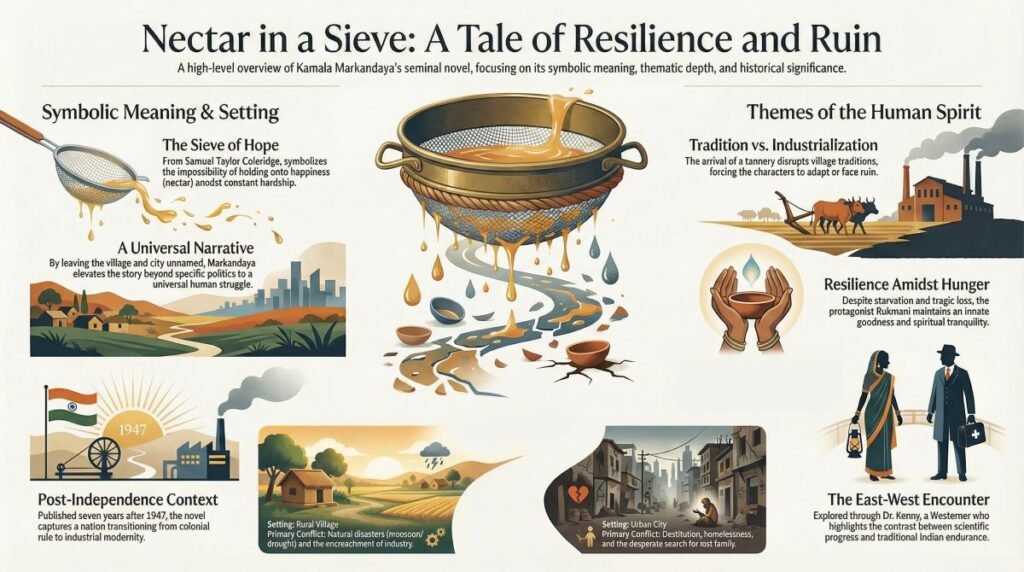
| Title Source | The title is drawn from a poem by Samuel Taylor Coleridge (‘Work Without Hope’): the image of nectar strained through a sieve – abundance lost, nothing retained – perfectly captures the novel’s themes of endurance and loss |
| Narrator | Rukmani – a rural Indian woman narrating her life story in her old age |
| Setting | A rural village in South India during the mid-20th century – a period of industrialisation, social disruption, and the arrival of a tannery that transforms the community forever |
| Central Characters | Rukmani (narrator and protagonist), Nathan (her husband – a tenant farmer), Kenny (a compassionate English doctor), Ira (their daughter), and their many sons |
| Core Plot | Rukmani narrates her life from girlhood through marriage to Nathan, the births of their children, the arrival of an industrial tannery that displaces agricultural workers, repeated encounters with drought and famine, the tragic fates of her children, her husband’s failing health, and their desperate journey to the city in old age |
| Key Themes | Rural poverty and endurance; industrialisation’s destruction of traditional village life; the resilience and suffering of Indian women; the failure of colonial institutions to protect the poor; love, loss, and human dignity in the face of relentless adversity |
| Writing Style | Simple, lyrical, restrained prose that speaks in the authentic voice of a rural Indian woman; deeply emotional without being sentimental; the simplicity of the language amplifies rather than diminishes the power of the suffering it describes |
| International Reception | Became an immediate bestseller in the United States; selected by the Literary Guild of America; translated into numerous languages; widely adopted in US and UK school and university curricula |
| Academic Significance | One of the most widely taught texts in postcolonial literature courses worldwide; a core text for studying Indian women’s writing, rural India, and the human cost of development |
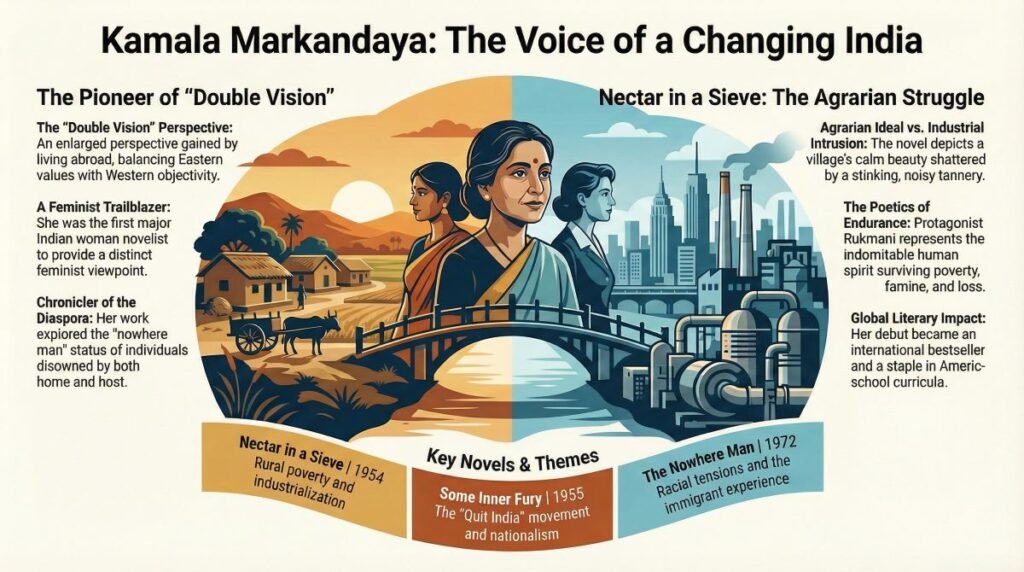
Nectar in a Sieve: Chapter-by-Chapter Overview
- Opening – Rukmani introduces herself as an old woman looking back on her life; she describes her girlhood, her unexpected marriage to Nathan, a poor tenant farmer, and the beginnings of their life together in a simple mud-walled house
- Early Marriage – Despite their poverty, Rukmani and Nathan’s marriage grows into a genuine partnership of love and mutual respect; Rukmani secretly learns to read from the doctor Kenny, an act that gives her a private inner world and a form of quiet resistance
- The Coming of the Tannery – An industrial tannery is built in the village, bringing economic disruption – some families benefit from wages, but the agricultural community is undermined as land is taken and the traditional economy is upended
- The Children – Rukmani gives birth to many children; several die young; one daughter, Ira, is sent back from her husband’s home as infertile; one son, Arjun, takes factory work; the fates of the children form the emotional core of the novel
- Drought and Famine – The monsoon fails; the family faces starvation; the novel describes with quiet devastation the daily calculations of survival – what can be eaten, what can be sold, how long the food will last
- Ira’s Sacrifice – Desperate to feed her starving youngest brother, Ira becomes a prostitute; Rukmani’s complex response – grief, understanding, love without judgment – is one of the novel’s most morally sophisticated passages
- Nathan and Rukmani’s Dispossession – Their landlord sells the land Nathan has farmed his whole life; they are left with nothing and must travel to the city to find one of their sons
- The City – The city is brutal, impersonal, and indifferent; Nathan falls ill; they encounter cruelty and occasional kindness from strangers; their savings are stolen
- Nathan’s Death – Nathan dies in the city, far from the land he loved; Rukmani prepares to return to the village alone, carrying his memory
- Ending – Rukmani returns home, devastated but unbroken; the novel ends not in triumph but in the quiet dignity of a woman who has survived everything life has thrown at her – the nectar of her life poured perpetually through a sieve, always draining away, yet always somehow sustaining
What Is Special About Kamala Markandaya’s Novels?
The question of what makes Kamala Markandaya’s novels special – and Nectar in a Sieve in particular – is one that many readers and students ask. The answer lies in several qualities that distinguish her work from that of her contemporaries:
- Her female protagonists are fully realised human beings, not symbols or victims: Rukmani, Sarojini, Mira, and others have inner lives, contradictions, desires, and quiet forms of agency that were unusual in Indian fiction of the 1950s and 1960s
- She writes about poverty from the inside: her portrayal of rural and urban Indian poverty is neither romanticised nor sensationalised – it is precise, empathetic, and rooted in specific material detail that gives it an authenticity rare in writing by educated middle-class authors
- Her prose is beautifully controlled: she writes with apparent simplicity that conceals considerable craft; every sentence does exactly what it needs to do
- She brings a double perspective: as an Indian woman writing in England, she can see India with both the intimacy of a native and the analytical distance of an observer – a double vision that gives her fiction both emotional depth and intellectual clarity
- Her novels endure: unlike much topical fiction, her work has lasted because its themes – poverty, dignity, love, endurance, the cost of development, the position of women – are not dated but perpetually relevant
Two Virgins by Kamala Markandaya: Summary
Two Virgins (1973) is one of Kamala Markandaya’s most accessible and widely studied novels. It tells the story of two sisters growing up in rural India – Saroja and Lalitha – whose contrasting responses to the arrival of modernity in their lives form the novel’s central drama.
Summary of Two Virgins
- Saroja is the quieter, more studious sister who is content within the traditional rhythms of village life; she represents the grounded, accepting dimension of Indian rural culture
- Lalitha is the more beautiful, more restless sister – drawn to the excitement and glamour that seems to emanate from the world beyond the village, especially from the film crew that comes to shoot near their home
- The film director notices Lalitha’s beauty and promises her a career in the film industry; Lalitha is seduced – not necessarily sexually, but by the promise of escape, beauty, fame, and a different kind of life
- The novel traces Lalitha’s departure from the village and her entry into the world of Indian cinema – and the brutal disappointment and exploitation she encounters there
- Through Saroja’s perspective, we watch as Lalitha’s dream collapses and as the family grapples with the social shame that her story brings upon them
- The novel is a sharp, compassionate critique of the exploitation of young women’s beauty and ambition by the entertainment industry – and of the collision between traditional village values and the seductive but dangerous promises of modern mass culture
- The title – Two Virgins – refers both literally to the innocence of the two sisters at the novel’s opening and metaphorically to the vulnerability of traditional Indian life to the corrupting or at least transforming power of modernity
Kamala Markandaya Writing Style: What Defines Her Prose
Kamala Markandaya’s writing style is one of the most distinctive in Indian English literature – immediately recognisable, deceptively simple, and emotionally powerful in a way that accumulates quietly over the course of a novel rather than announcing itself in individual brilliant sentences.
Key Features of Her Writing Style
- Lyrical restraint: Her prose has a quality of controlled lyricism – beautiful but never florid; emotional but never mawkish; the restraint is itself a form of respect for her characters and their suffering
- First-person intimacy: Her best novels – especially Nectar in a Sieve – are narrated in the first person, which creates a sense of direct, unmediated access to the inner life of her protagonists; the reader inhabits these women rather than merely observing them
- Concrete specificity: She grounds even her most emotional passages in physical detail – the texture of the earth, the smell of the tannery, the weight of a sack of grain – which gives her fiction its quality of witnessed reality
- The insider-outsider voice: Writing as an Indian woman living in England, she could approach India with both love and analytical distance; this produces a prose voice that is simultaneously intimate and clear-eyed
- Simplicity as a moral stance: Her simple, unadorned prose style is not a limitation but a deliberate choice – it says that the lives of ordinary, poor Indian people do not need to be dressed up or made exotic to be worth reading about
- Cross-cultural sensitivity: In novels dealing with Indian-Western relationships, she gives fair psychological weight to both sides – she neither demonises the British characters nor sentimentalises the Indian ones
Kamala Markandaya Themes: What Her Novels Are Really About
Kamala Markandaya’s novels return repeatedly to a set of deeply interconnected themes that give her body of work its coherence and its enduring relevance. Below is a comprehensive overview of the major themes in her fiction:
| Theme | How It Appears in Her Work |
| Poverty and Rural India | Most powerfully in Nectar in a Sieve and A Handful of Rice; she depicts the daily grinding reality of rural and urban Indian poverty with unflinching empathy and without sentimentality |
| Industrialisation and Its Human Cost | The arrival of a tannery in Nectar in a Sieve, the dam construction in The Coffer Dams, and the tourist resort in Pleasure City all explore how industrial and commercial development destroys traditional ways of life |
| The Position of Women | Her female protagonists – Rukmani, Sarojini, Lalitha, the women of The Coffer Dams – are among the most fully realised female characters in Indian English fiction; she explores their endurance, resilience, and the social constraints that define their lives |
| Cross-Cultural Relationships | In Some Inner Fury, Possession, The Coffer Dams, and Pleasure City, she examines the personal and political dimensions of relationships between Indians and Westerners under and after colonialism |
| Displacement and Belonging | Most directly in The Nowhere Man – the experience of the Indian immigrant in England, caught between two cultures and fully accepted by neither; also in Two Virgins, where Lalitha is displaced from her rural roots |
| Tradition vs Modernity | A constant tension throughout her work – the encounter between India’s ancient traditional structures (caste, religion, family) and the forces of modernity (industrialisation, Western education, mass culture) |
| Colonialism and Its Aftermath | She examines colonialism not as a historical abstraction but as a lived experience – in the relationship between British employers and Indian workers, in the cultural condescension of the English toward India, and in the psychological legacy of colonial rule on Indian self-perception |
| Endurance and Resilience | Especially in her portrayals of Indian women like Rukmani in Nectar in a Sieve – the capacity of ordinary people to endure extraordinary suffering with dignity is one of the most consistent and moving qualities of her fiction |
Kamala Markandaya Awards and Achievements
Kamala Markandaya did not win the major literary prizes of her era in the way that some of her contemporaries did – a fact that reflects the persistent undervaluation of women writers and writers from the Global South in mid-20th century literary culture. Nevertheless, her achievements were real, substantial, and historically significant:
Awards and Recognition
- Lost Booker Prize Shortlist (1970) – The Nowhere Man was shortlisted for the Lost Booker Prize, a special award created in 2010 to recognise works published in 1970 that were overlooked when the Booker Prize was first awarded. This retroactive recognition confirmed the literary quality of her work.
- Literary Guild of America Selection – Nectar in a Sieve was selected by the Literary Guild of America upon publication in 1954, guaranteeing it a large readership and making it an immediate bestseller in the United States
- Widely translated – Her novels, especially Nectar in a Sieve, were translated into numerous languages including French, German, Italian, Japanese, and several Indian languages
- Adopted into curricula – Nectar in a Sieve became a standard text in American high school and university curricula studying world literature, Indian writing, and postcolonial fiction – a distinction very few Indian writers of her generation achieved
Kamala Markandaya Achievements: Historical Firsts
- She was one of the very first Indian women writers to achieve significant international commercial and critical success writing in English – paving the way for later generations of Indian women writers including Anita Desai, Shashi Deshpande, Arundhati Roy, and Jhumpa Lahiri
- Her debut novel Nectar in a Sieve remains one of the bestselling Indian novels of all time in the United States
- She demonstrated that Indian fiction in English could deal with the lives of the rural poor – not just the educated urban elite – and reach a global audience
- She was among the first Indian writers to place a woman’s interior experience at the absolute centre of a novel about poverty and social change, not as a secondary figure but as the primary consciousness through which everything is seen and felt
- She showed that an Indian writer living in England could write about India with authenticity and depth – opening a literary path later walked by Salman Rushdie, Anita Desai, Vikram Seth, and others
Kamala Markandaya: Complete Life and Career Timeline
| Year | Key Event |
| 1924 | Born on 1 June in Mysore, Karnataka (then Mysore State), British India |
| 1940s | Graduated from the University of Madras; began working as a journalist in India |
| Early 1950s | Emigrated to England; married Bertrand Taylor, an Englishman; settled in London |
| 1954 | Published Nectar in a Sieve – her debut novel; immediate international success; became a bestseller in the United States; selected by the Literary Guild of America |
| 1955 | Published Some Inner Fury – her second novel, set during the Quit India Movement |
| 1960 | Published A Silence of Desire |
| 1963 | Published Possession – exploring cultural ownership and colonial patronage of Indian art |
| 1966 | Published A Handful of Rice – set in the urban slums of India |
| 1969 | Published The Coffer Dams – exploring British-Indian relations on a dam construction site |
| 1972 | Published The Nowhere Man – her most politically charged novel; shortlisted for the Lost Booker Prize |
| 1973 | Published Two Virgins – a coming-of-age novel contrasting two sisters and rural vs urban India |
| 1977 | Published The Golden Honeycomb – her most historically ambitious novel |
| 1982 | Published Pleasure City (also titled Shalimar) – her final novel; set on the South Indian coast |
| 1982–2004 | Lived quietly in London; largely withdrew from public literary life; no further novels published |
| 2004 | Died on 16 May in London, at the age of 79 |
What Was Kamala Markandaya’s First Novel?
Kamala Markandaya’s first novel was Nectar in a Sieve, published in 1954. It was written while she was living in London, drawing on her memories of rural South India and her understanding of the deep social inequalities of Indian life. The novel was published first in the United States, where it achieved immediate and substantial success – an unusual achievement for a first novel by an Indian woman writer at that time.
The fact that her debut was such a critical and commercial success both blessed and complicated her career. All subsequent novels were inevitably measured against Nectar in a Sieve, and though several – particularly The Nowhere Man, The Golden Honeycomb, and A Handful of Rice – are works of comparable quality and greater complexity, none achieved the same iconic status. This is a common fate for authors whose debut is their most accessible and emotionally immediate work.
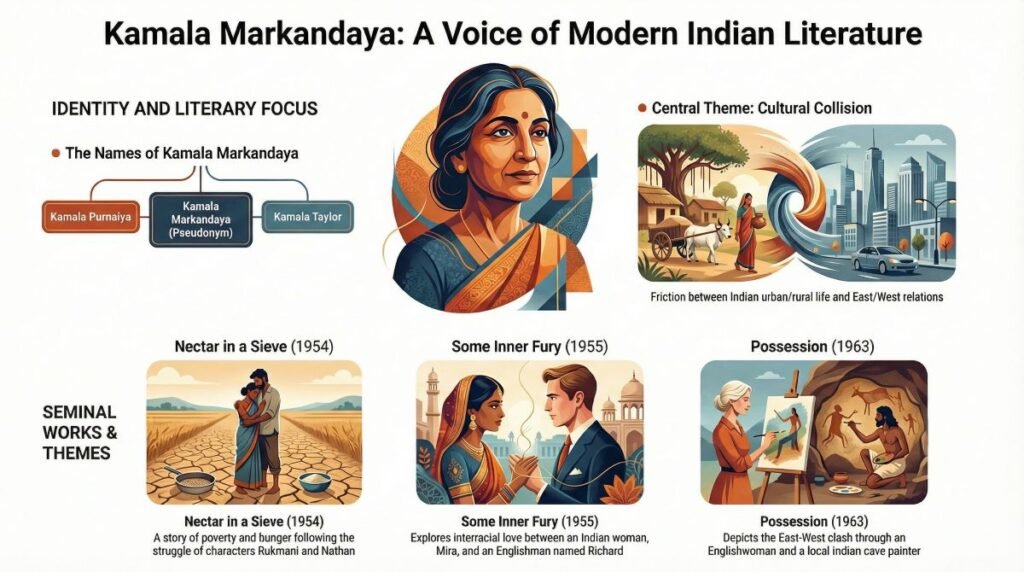
10 Lines About Kamala Markandaya for Students and Quick Reference
Here are 10 essential lines about Kamala Markandaya – useful for school essays, quick biographical summaries, and academic assignments:
- Kamala Markandaya’s real name was Kamala Purnaiya; she adopted the pen name Markandaya for her literary career and her full married name was Kamala Purnaiya Taylor.
- She was born on 1 June 1924 in Mysore, Karnataka, British India, into a South Indian Brahmin family.
- She is considered one of the most important first-generation Indian women novelists writing in English, and a pioneer of postcolonial Indian fiction.
- Her debut novel Nectar in a Sieve (1954) became an international bestseller, was selected by the Literary Guild of America, and was widely adopted into US school and university curricula.
- She emigrated to England in the early 1950s, married a British man named Bertrand Taylor, and spent the rest of her life in London.
- She published nine novels between 1954 and 1982, covering themes of rural poverty, industrialisation, colonialism, cross-cultural relationships, and the lives of Indian women.
- Her novel The Nowhere Man (1972) – about an elderly Indian immigrant facing racism in 1960s London – was shortlisted for the Lost Booker Prize.
- Her most historically ambitious novel was The Golden Honeycomb (1977), which follows generations of an Indian royal family during the final decades of British rule.
- Her writing style is characterised by lyrical restraint, precise emotional detail, and a compassionate but unsentimental portrayal of poverty and social injustice.
- She died on 16 May 2004 in London at the age of 79, leaving behind a body of work that remains essential reading in Indian and postcolonial literature.
Why Read Kamala Markandaya Today?
In a literary landscape that is increasingly recognising the importance of women’s voices, postcolonial perspectives, and stories from the Global South, Kamala Markandaya’s work feels more relevant than ever. She was writing about things that the literary world is still grappling with – the human cost of economic development, the position of women in societies undergoing rapid social change, the experience of immigrants caught between cultures, the persistence of poverty and the resilience of the poor – decades before these became mainstream literary preoccupations.
Reasons to Read Kamala Markandaya Now
- To discover a pioneer: She was one of the first Indian women writers to achieve international recognition in English – understanding her work helps understand the literary tradition that later produced Anita Desai, Arundhati Roy, and Jhumpa Lahiri
- To read Nectar in a Sieve: Her debut remains one of the most powerful and accessible novels about rural Indian poverty ever written; it is a book that stays with you
- To explore Two Virgins: This novel offers a sharp, compassionate and still-relevant examination of how modern mass culture exploits young women’s aspirations and beauty
- To understand The Nowhere Man: In a world where questions of immigration, belonging, and racial hostility are as pressing as ever, this novel speaks directly to our present moment
- To discover a neglected masterpiece: The Golden Honeycomb is arguably one of the finest historical novels ever set in India – panoramic, deeply researched, and compellingly written – yet it is rarely discussed outside academic circles
Also read: Raja Rao Biography PDF and PPT Slides
Beyond the Sieve: 6 Impactful Truths from the Life and Works of Kamala Markandaya
1. Introduction: The Woman Who Re-wrote the Indian Map
In 1948, as the dust of Partition settled over a newly independent India, the nation stood at a precarious crossroads of “colonial exhaustion.” While the British Raj had physically retreated, centuries of systemic extraction had left the subcontinent’s wealth “sucked dry.” It was against this backdrop of economic poverty and historical rupture that Kamala Markandaya made a strategic move to London. She did not merely move to escape; she moved to find a publishing environment where her voice could be heard without being stifled by the immediate trauma of a nation in labor. Markandaya was a trailblazer-the first female Indian author to garner significant Western acclaim and become a permanent fixture on international best-seller lists. She successfully took the “Indian reality” to the West, not as an exotic curiosity, but as a deeply human struggle. Her work is defined by a profound “Double Vision” -the unique perspective of an emigrant who observes her homeland with the dispassionate objectivity of a historian and the bone-deep empathy of a daughter.
2. The Power of “Double Vision”: Why Distance Makes the Heart See Clearer
Markandaya’s life as an expatriate in London was not a rejection of her roots, but a sharpening of them. Born Kamala Purnaiya, she was a descendant of the distinguished Diwan Purnaiya of Mysore. This elite Brahminical lineage and intellectual heritage informed her refusal to accept the label of “immigrant.” To her, she was always an Indian writer living abroad, maintaining a “transitional bridge” in fiction that mediated between Eastern spiritualism and Western rationalism. This perspective required a certain unflinching reclusiveness. Her daughter, Kim Oliver, recalls a woman of sophisticated privacy who guarded her creative process with a “force field” that even her family could not breach. “My mother was a very private person… she somehow managed to surround the subject of her writing with a ‘force field’ we could not cross! That is a wonderful thing about having a parent who was an artist-they live on in their art. They live in the hearts of many, not just the immediate family.” – Kim Oliver
3. The Myth of the “Passive” Woman: Endurance as a Radical Act
In her landmark debut, Nectar in a Sieve, Markandaya introduces us to Rukmani, a character often misread by Western audiences as a symbol of submissive suffering. To Kenny-the English doctor representing a Western rationalist perspective-the peasants’ refusal to “cry out” against poverty looks like weakness. However, Markandaya reframes this through the advice Nathan gives his wife: to “bend like grass” so that she might not break during the storm. Rukmani’s endurance is not passivity; it is a subversion of the patriarchal order. In a daring act of agency, she secretly visits Kenny to seek medical aid for her infertility. By keeping this a secret from Nathan, she takes the continuity of her family into her own hands, bridging the gap between traditional faith and Western science. Her life becomes a testament to the Samuel Taylor Coleridge quote that gave the novel its title: “Work without Hope draws nectar in a sieve, / And Hope without an object cannot live.”
4. The “Malignant Tumor” of Progress: The Industrial Intrusion
Markandaya was a prescient chronicler of what she called the “Industrial Intrusion.” In her rural novels, progress is often depicted as a “malignant tumor” that shatters the “slow, calm beauty” of village life, replacing the song of birds with the “chatter and din” of machinery. In Nectar in a Sieve, the tannery serves as the central entity of this social dislocation. Markandaya meticulously details the shift in social hierarchy: the tannery is owned by a solitary white man, with “nine or ten Muslims under him,” creating a new colony of outsiders that disrupts the traditional village fabric. This intrusion creates a specific set of social disruptions:
- Economic Inflation: The arrival of the tannery inflates prices, making simple survival a luxury and collapsing traditional exchange relations.
- Loss of Communal Space: The destruction of the “maiden,” the physical space where children once played, symbolizes the erasure of innocence.
- The Moral Abyss: The “stinking smell and crowds” of the tannery bring a moral rot that drives Rukmani’s daughter, Ira, into prostitution. It is a tragic survival tactic necessitated by an urban rot invading rural sanctity.
5. The Tragedy of the “Nowhere Man”: A Warning for the 21st Century
Long before the current era of global migration, Markandaya’s The Nowhere Man (1972) offered a haunting exploration of the “fissured identity.” The protagonist, Srinivas, is an elderly Brahmin in London who finds himself “disowned by India and disposed of by England.”Markandaya uses leprosy as a powerful metaphor for social alienation; Srinivas is treated as “unclean” by a society he has inhabited for fifty years. This “Social Realism” was briefly overshadowed in the 1980s by the rise of “Magic Realism”-the escapist, fragmented style popularized by Salman Rushdie. However, today’s diaspora readers are rediscovering Markandaya’s work. Her unflinching look at the abstract violence of xenophobia feels more urgent now than ever, as she humanizes the psychological toll of being a “nowhere man.”
6. The “Silence” of Desire: Faith vs. Logic
In A Silence of Desire, Markandaya turns her lens toward the Indian middle class, exploring the marriage of Dandekar, a secular clerk, and Sarojini. When Sarojini discovers a growth, she bypasses Western medicine for a traditional faith healer. The resulting “silence” in their marriage represents a broader post-colonial crisis. Dandekar acts as the “Western lens” within the Indian home, viewing his wife’s faith with a skepticism born of colonial education. However, Sarojini’s silence is a refusal to let Western logic colonize her spiritual health. Markandaya suggests that while Western rationalism provides economic security, it cannot replicate the psychological equilibrium found in inherited spiritual traditions. The “silence” is not a lack of communication, but a barrier protected by the soul.
7. From “History” to “Her-story”
Kamala Markandaya did not merely record the history of India; she curated a “Her-story.” Whether writing of the peasantry in Nectar in a Sieve, the construction of a dam in The Coffer Dams, or the glittering Indian courts of The Golden Honeycomb, she consistently centered the narrative on the resilient lives of women like Rukmani, Helen, and Mohini. Her posthumous novel, Bombay Tiger (2008), further proves that her voice lived on long after her physical departure. She reminds us that home is not always a place on a map, but a state of being maintained through memory and resilience. In our modern world of constant movement, we are left to ask: are we all becoming “Nowhere Men,” or can we find a way to carry our “Home” within us, as Markandaya did through her words?
Conclusion: The Enduring Legacy of Kamala Markandaya
Kamala Markandaya deserves to be far better known than she is. In the history of Indian writing in English, she occupies a position of real historical and literary importance – as one of the first women to break through, as one of the first to write about the lives of the rural poor with insider knowledge and genuine empathy, and as one of the most consistently skilled prose writers of her generation.
Nectar in a Sieve will endure as long as people care about literature that speaks honestly about the lives of those the world overlooks. Rukmani’s voice – simple, dignified, unbowed – is one of the great voices of 20th-century Indian fiction. But there is so much more in Markandaya’s work waiting to be rediscovered: the political passion of Some Inner Fury, the racial rage of The Nowhere Man, the historical sweep of The Golden Honeycomb, the quiet philosophical intelligence of A Silence of Desire.
She was a writer who chose difficult, important subjects and treated them with the seriousness, the craft, and the human sympathy they deserved. That is ultimately what makes her work both special and lasting.