CTET TAG WORDS Marathon Classes PPT Download
(Complete Slides)
Today we are providing self -made , PDF and PPT slides for you, which are available for CTET TAG WORDS Marathon Classes PPT Download (COMPLETE). The Central Teacher Eligibility Test (CTET) is a highly competitive exam conducted by the Central Board of Secondary Education (CBSE) in India. It is mandatory for candidates aspiring to become teachers in primary (Classes 1-5) and upper primary (Classes 6-8) schools. To excel in the CTET exam, it is essential to familiarize yourself with key concepts and tag words that frequently appear in the syllabus and question papers. This article provides a comprehensive list of CTET tag words, organized by subject, to help you streamline your preparation.
Table of Contents
CTET TAG WORDS MARATHON
(PPT SLIDES)
Important Notes:
- If you are viewing this PPT on your phone, switch to full-screen mode for the best experience. (Tap the 3 dots in the PPT and select “Full Screen.”)
- If you encounter issues while navigating, simply tap on the slide instead of using the “Next” button.
- For an enhanced viewing experience on a PC or laptop, press Ctrl + Shift + F.
Pricing Page (SlidesharePPT.net)
CTET Marathon Notes (PPT + PDF) Bundle
(BUY ONLINE)
| Placement / Section | Details / Click To Action Text |
|---|---|
| Title | CTET PPT & PDF Notes (BUNDLE) |
| Number of PPTs / Slides | 10 PPTs + 10 PDFs |
| Delivery Method | Instant Access after Payment (Google Drive Folder) |
| Additional Info | Full Marathon Syllabus Coverage, Study-Friendly PPT Format |
| Copyright / Ownership | Self-made Notes (slideshareppt.net) |
| Payment | Online Gateway – QR, CREDIT CARD, UPI etc… |
| Pricing / Purchase CTA |
Check Price & Buy (Redirects to Pricing Page) |
| Demo Link | View Sample Slides (Click to Open Demo) |
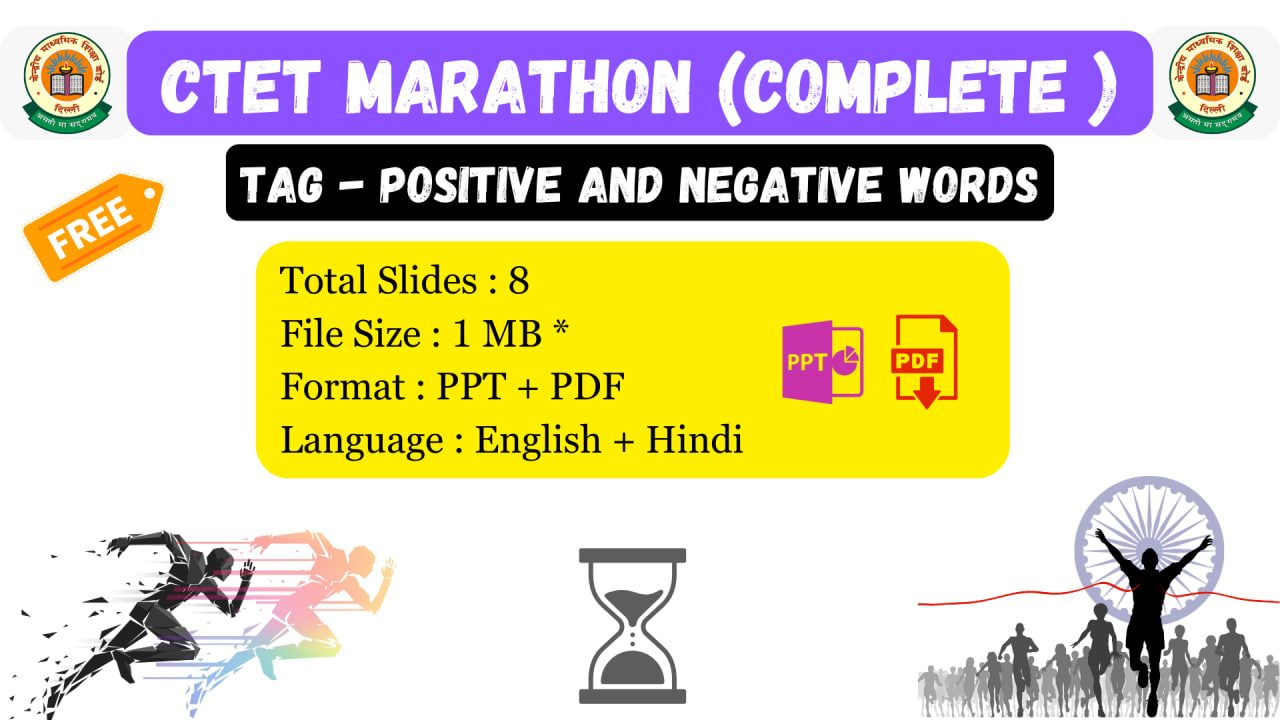
(CTET Positive and Negative TAG WORDS Self Study Topics)
1. Child Development and Pedagogy (CDP)
- Key Concepts:
- Piaget’s stages of cognitive development
- Vygotsky’s Zone of Proximal Development (ZPD)
- Kohlberg’s stages of moral development
- Inclusive education
- Learning theories (Behaviorism, Constructivism)
- Individual differences
- Continuous and Comprehensive Evaluation (CCE)
- Formative and summative assessment
- Remedial teaching
- Child-centered education
- Tag Words:
- Scaffolding
- Assimilation and Accommodation
- Intrinsic and Extrinsic Motivation
- Multiple Intelligences
- Special Educational Needs (SEN)
- Learning Disabilities (Dyslexia, Dyscalculia)
- Social Constructivism
- Experiential Learning
- Pedagogy
- Bloom’s Taxonomy
2. English Language
- Key Concepts:
- Reading comprehension
- Grammar (tenses, voice, narration)
- Vocabulary (synonyms, antonyms, idioms)
- Language skills (LSRW: Listening, Speaking, Reading, Writing)
- Phonetics and phonology
- Language acquisition vs. language learning
- Tag Words:
- Unseen passages
- Parts of speech
- Direct and Indirect Speech
- Active and Passive Voice
- Prefixes and Suffixes
- Homonyms and Homophones
- Remedial Teaching
- Language Development
- Communicative Approach
- Multilingualism
Also Read: UPSC PPT SLIDES (COMPLETE SERIES)
3. Mathematics
- Key Concepts:
- Number system (integers, fractions, decimals)
- Geometry (shapes, angles, symmetry)
- Measurement (length, weight, time)
- Data handling (graphs, mean, median, mode)
- Patterns and algebra
- Problem-solving strategies
- Tag Words:
- LCM and HCF
- BODMAS Rule
- Area and Perimeter
- Volume and Capacity
- Pictographs and Bar Graphs
- Number Patterns
- Place Value
- Mathematical Operations
- Word Problems
- Vedic Mathematics
4. Environmental Studies (EVS)
- Key Concepts:
- Family and friends
- Food, shelter, and water
- Travel and communication
- Environmental issues (pollution, conservation)
- Natural resources (renewable and non-renewable)
- Community and festivals
- Tag Words:
- Photosynthesis
- Water Cycle
- Rainwater Harvesting
- Waste Management
- Climate Change
- Biodiversity
- Renewable Energy
- Ecosystem
- Sustainable Development
- Global Warming
5. Science
- Key Concepts:
- Food and nutrition
- Materials and their properties
- The world of living organisms
- Motion and force
- Electricity and magnetism
- Natural phenomena (weather, climate)
- Tag Words:
- Balanced Diet
- Deficiency Diseases
- Photosynthesis
- Newton’s Laws of Motion
- Electric Circuits
- Magnetic Field
- Natural Disasters
- Solar System
- Conservation of Energy
- Renewable Resources
6. Social Studies/Social Science (SST)
- Key Concepts:
- Indian history (ancient, medieval, modern)
- Geography (earth, natural resources, climate)
- Social and political life (Constitution, governance)
- Pedagogical issues in Social Science
- Tag Words:
- Indus Valley Civilization
- Mughal Empire
- Indian Independence Movement
- Fundamental Rights and Duties
- Local Self-Government
- Natural Resources
- Climate and Weather
- Sustainable Development
- Case Studies
- Inquiry-Based Learning
Also Read: CTET EVS Marathon Classes PPT Download (COMPLETE)
How to Use CTET Tag Words for Preparation
- Create Flashcards: Write tag words on flashcards with their definitions and examples for quick revision.
- Mind Maps: Use tag words to create mind maps that connect related concepts.
- Practice Questions: Solve previous year papers and mock tests to identify how tag words are used in questions.
- Group Study: Discuss tag words with peers to deepen your understanding.
- Daily Revision: Dedicate time daily to revise tag words and their applications.
Conclusion
CTET tag words are essential tools for effective preparation. By familiarizing yourself with these key concepts and keywords, you can streamline your study process and improve your performance in the exam. Focus on understanding the meaning and application of each tag word, and practice regularly to reinforce your learning. With the right approach, you can crack the CTET exam and achieve your dream of becoming a teacher.