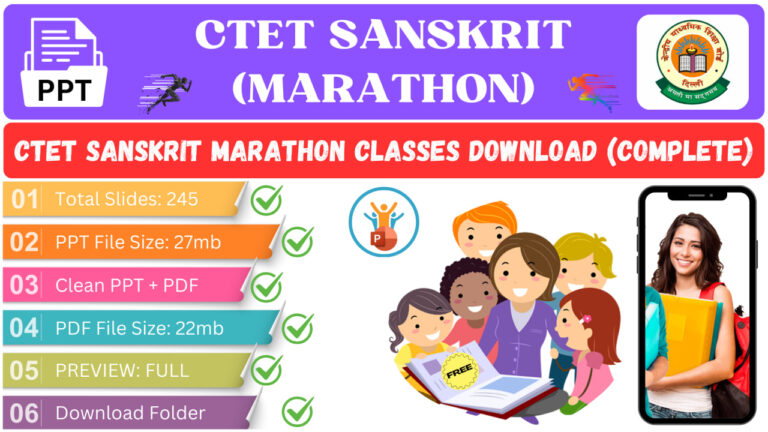
CTET SANSKRIT Marathon Classes PPT Download
(Complete Slides)
Today we are providing self -made , PDF and PPT slides for you, which are available for CTET SANSKRIT Marathon Classes PPT Download (COMPLETE). The Central Teacher Eligibility Test (CTET) is a national-level examination conducted by the Central Board of Secondary Education (CBSE) in India. It is mandatory for candidates aspiring to become teachers in primary (Classes 1-5) and upper primary (Classes 6-8) schools. Sanskrit is one of the optional languages in the CTET exam, and candidates can choose it as their first or second language. This article provides a comprehensive guide to the CTET Sanskrit syllabus, important topics, preparation strategies, and study notes to help you excel in the exam.
Table of Contents
CTET SANSKRIT Marathon Classes
(PPT SLIDES)
Important Notes:
- If you are viewing this PPT on your phone, switch to full-screen mode for the best experience. (Tap the 3 dots in the PPT and select “Full Screen.”)
- If you encounter issues while navigating, simply tap on the slide instead of using the “Next” button.
- For an enhanced viewing experience on a PC or laptop, press Ctrl + Shift + F.
Pricing Page (SlidesharePPT.net)
CTET Marathon Notes (PPT + PDF) Bundle
(BUY ONLINE)
| Placement / Section | Details / Click To Action Text |
|---|---|
| Title | CTET PPT & PDF Notes (BUNDLE) |
| Number of PPTs / Slides | 10 PPTs + 10 PDFs |
| Delivery Method | Instant Access after Payment (Google Drive Folder) |
| Additional Info | Full Marathon Syllabus Coverage, Study-Friendly PPT Format |
| Copyright / Ownership | Self-made Notes (slideshareppt.net) |
| Payment | Online Gateway – QR, CREDIT CARD, UPI etc… |
| Pricing / Purchase CTA |
Check Price & Buy (Redirects to Pricing Page) |
| Demo Link | View Sample Slides (Click to Open Demo) |
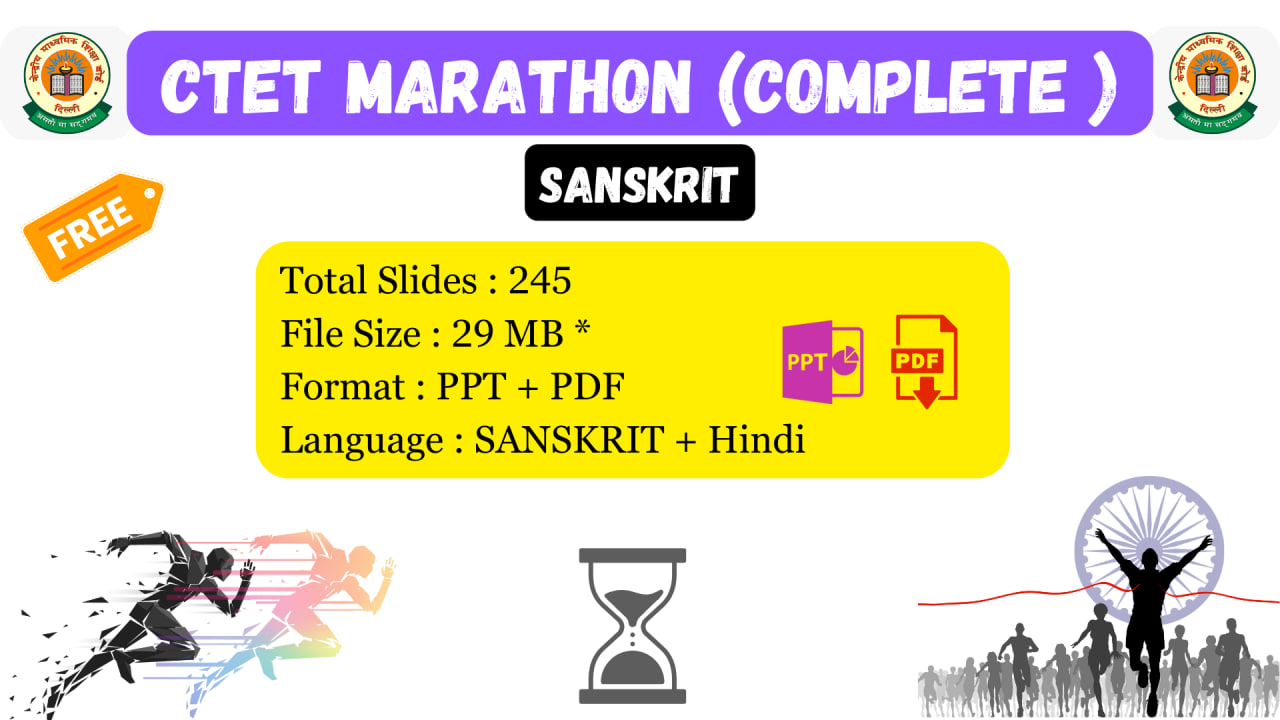
(CTET Sanskrit Self Study Topics)
The Sanskrit section in CTET is divided into two parts:
- Language Comprehension
- Pedagogy of Language Development
1. Language Comprehension
This section tests your proficiency in Sanskrit, including reading comprehension, grammar, and vocabulary. Key areas include:
- Reading Unseen Passages:
- Prose
- Poetry
- Comprehension questions (e.g., inferential, factual, and vocabulary-based)
- Grammar:
- संज्ञा (Noun), सर्वनाम (Pronoun), क्रिया (Verb), विशेषण (Adjective), क्रिया-विशेषण (Adverb)
- लिंग (Gender), वचन (Number), कारक (Case)
- समास (Compound), संधि (Joining), विलोम (Antonyms), पर्यायवाची (Synonyms)
- मुहावरे और लोकोक्तियाँ (Idioms and Proverbs)
- वाक्य रचना (Sentence Structure)
- विराम चिह्न (Punctuation Marks)
- Vocabulary:
- शब्द रचना (Word Formation)
- उपसर्ग और प्रत्यय (Prefixes and Suffixes)
- अनेक शब्दों के लिए एक शब्द (One-word Substitutions)
Also Read: UPSC PPT SLIDES (COMPLETE SERIES)
2. Pedagogy of Language Development
This section evaluates your understanding of teaching methodologies and strategies for Sanskrit. Key areas include:
- Learning and Acquisition:
- Principles of language learning
- Role of listening and speaking in language development
- Language Skills:
- Listening, speaking, reading, and writing (LSRW)
- Strategies for developing these skills
- Teaching-Learning Materials:
- Use of textbooks, audio-visual aids, and technology
- Remedial Teaching:
- Identifying and addressing learning difficulties
- Techniques for teaching students with special needs
- Evaluation:
- Continuous and Comprehensive Evaluation (CCE)
- Formative and summative assessments
- Designing assessment tools (e.g., quizzes, projects, oral tests)
Important Topics for CTET Sanskrit
Here are some key topics to focus on for the CTET Sanskrit exam:
- Reading Comprehension:
- Practice unseen passages and answer questions based on them.
- Example: Read a short story and answer questions about the main idea, characters, and plot.
- Grammar:
- Focus on संज्ञा, सर्वनाम, क्रिया, विशेषण, and वाक्य रचना.
- Example: Identify the सर्वनाम in the sentence: “सः पठति।” (Answer: सः)
- Vocabulary:
- Learn मुहावरे, लोकोक्तियाँ, and अनेक शब्दों के लिए एक शब्द.
- Example: “अहं न जानामि।” (I do not know).
- Pedagogy of Language Development:
- Understand the principles of language teaching and learning.
- Example: Use storytelling to improve listening and speaking skills.
Preparation Tips for CTET Sanskrit
- Understand the Syllabus:
Familiarize yourself with the CTET Sanskrit syllabus and exam pattern. - Practice Reading Comprehension:
Read Sanskrit texts and answer questions based on them. - Focus on Grammar:
Revise basic grammar rules and practice exercises regularly. - Enhance Vocabulary:
Learn new words daily and use them in sentences. - Solve Previous Year Papers:
Practice past CTET question papers to understand the type of questions asked. - Take Mock Tests:
Attempt mock tests to improve time management and accuracy. - Refer to NCERT Books:
NCERT textbooks for Classes 1-8 are excellent resources for Sanskrit preparation.
CTET Sanskrit Study Notes
Here are some concise notes to help you prepare:
- Reading Comprehension:
- Read the passage carefully and identify the main idea.
- Answer questions based on facts, inferences, and vocabulary.
- Grammar:
- संज्ञा: व्यक्ति, वस्तु, स्थान, या भाव का नाम (e.g., रामः, पुस्तकम्).
- सर्वनाम: संज्ञा के स्थान पर प्रयुक्त शब्द (e.g., सः, एषः).
- क्रिया: कार्य का बोध कराने वाला शब्द (e.g., पठति, गच्छति).
- विशेषण: संज्ञा या सर्वनाम की विशेषता बताने वाला शब्द (e.g., शुभ्रः, महान्).
- Vocabulary:
- मुहावरे: “अन्धस्य किम् दर्पणेन” (What is the use of a mirror to a blind person?).
- अनेक शब्दों के लिए एक शब्द: “जो सब कुछ जानता है” (सर्वज्ञः).
- Pedagogy of Language Development:
- Use interactive methods like role-playing and group discussions.
- Assess students through projects, quizzes, and oral tests.
Also Read: CTET TAG WORDS Marathon Classes PPT Download (COMPLETE)
Conclusion
CTET Sanskrit is a crucial subject that tests your language proficiency and teaching skills. By understanding the syllabus, focusing on key topics, and practicing regularly, you can excel in this section. Use NCERT books, solve previous year papers, and take mock tests to boost your confidence. With the right preparation, you can crack the CTET Sanskrit section and move closer to achieving your dream of becoming a teacher.