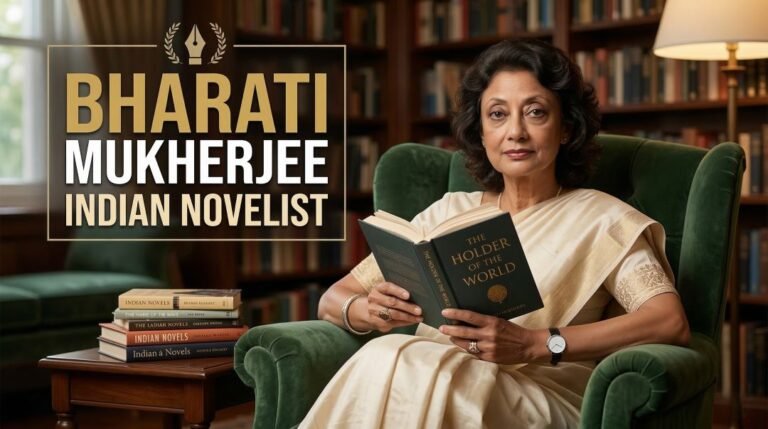
In this article we will discuss everything about Bharati Mukherjee – Bharati Mukherjee Biography PDF and PPT Slides Download, Books, Famous Works, Awards and Complete Legacy, her biography in English, books in chronological order, famous works including Jasmine, The Tiger’s Daughter, Wife, The Middleman and Other Stories, Darkness, The Holder of the World, Leave It to Me, Desirable Daughters, and Miss New India, her short stories PDF, writing style, her husband Clark Blaise, cause of death, awards, bibliography, her role as a diasporic writer, her freedom fighter theme, and her complete legacy as one of the most important and most controversial South Asian-American writers of the twentieth century.
Table of Contents
Bharati Mukherjee is a writer whose work forces a confrontation with some of the most urgent questions of our time: What does it mean to become American? How does a person reinvent herself in a new world? What is lost and what is gained in the process of immigration and cultural transformation? And who has the right to tell those stories and how? She was a Bengali woman born in Calcutta in 1940 who eventually became one of the leading voices of American immigrant fiction, a professor at the University of California, Berkeley, and the winner of the National Book Critics Circle Award. She was also, throughout her career, a deeply controversial figure – admired by some for her fearless celebration of the immigrant’s transformation into an American and criticised by others for her politics of assimilation and her willingness to leave her Indian identity behind.
She died in 2017 in New York City, leaving behind a body of work that remains as urgent and as contested as it ever was.
Bharati Mukherjee Biography Table (Biodata / Author Bio)
| Biographical Detail | Information |
| Full Name | Bharati Mukherjee |
| Date of Birth | July 27, 1940 |
| Born Place | Calcutta (now Kolkata), West Bengal, India – born into a wealthy, upper-class Bengali Brahmin family; her father was a chemist and businessman; the family’s privilege and its connection to Indian traditions of classical education shaped her early formation as a writer and intellectual |
| Date of Death | January 28, 2017 |
| Cause of Death | Bharati Mukherjee died of complications from a urinary tract infection in New York City, on January 28, 2017. She was 76 years old. The cause of death was a systemic infection that led to organ failure. Her death was widely mourned in both the American and the Indian literary worlds. |
| Age at Death | 76 years |
| Place of Death | New York City, USA |
| Nationality | American (naturalised) – she was born Indian but became an American citizen; she strongly identified as an American writer rather than as an Indian or Indian-American writer, which was itself a source of significant critical controversy |
| Ethnicity / Origin | Bengali Indian – born into a Bengali Brahmin family in Calcutta; she came from the educated, upper-class Bengali professional world that has produced many of India’s most important writers and thinkers |
| Father | Sudhir Lal Mukherjee – a chemist and successful businessman in Calcutta; his success enabled the family to live well and to send his daughters, including Bharati, abroad for education – a highly unusual step for an Indian family in the 1950s |
| Mother | Bina Mukherjee – a Bengali woman from the traditional upper-class Bengali world; the family’s social position was that of the Bengal bhadralok (genteel class) – educated, cultured, and deeply aware of its social standing |
| Husband | Clark Blaise – a Canadian-American writer of French-Canadian origin, whom Mukherjee met as a fellow student at the Iowa Writers’ Workshop and married in 1963. Their marriage was a cross-cultural, inter-racial marriage at a time when such marriages were rare and often controversial. Clark Blaise has written about their life together, and the couple collaborated on two non-fiction books. He is himself a distinguished fiction writer and memoirist. They remained married until her death in 2017. |
| Children | Two sons: Bart Blaise and Bernard Blaise |
| Education | Loreto House, Calcutta (early education in the elite Catholic convent school tradition of colonial Bengal); University of Calcutta (B.A. in English); University of Baroda (M.A. in English and Ancient Indian Culture); University of Iowa Writers’ Workshop (M.F.A. in Creative Writing and Ph.D. in English and Comparative Literature) – one of the most extensively and internationally educated writers of her generation |
| Academic Career | Taught at McGill University (Montreal); Skidmore College; Queens College; City University of New York; UC Berkeley – she was a Professor of English at the University of California, Berkeley, from 1989 until her death; one of the most distinguished academic positions in American literary studies |
| First Novel | The Tiger’s Daughter (1971) – her debut novel; a relatively quiet, satirical portrait of a westernised Bengali woman’s return to Calcutta; very different in tone and ambition from the work that would make her famous |
| Most Famous Work | Jasmine (1989) – her most celebrated and most widely read novel; the story of a young Indian woman’s transformation into an American; and The Middleman and Other Stories (1988) – the short story collection that won the National Book Critics Circle Award |
| Pulitzer Prize Book | Bharati Mukherjee did not win the Pulitzer Prize; she won the National Book Critics Circle Award (1988) for The Middleman and Other Stories – which is sometimes confused with the Pulitzer but is a distinct and equally prestigious award |
| Awards | National Book Critics Circle Award (1988, for The Middleman and Other Stories); Guggenheim Fellowship; various honorary degrees and literary recognition |
| Trilogy | Bharati Mukherjee’s trilogy consists of Desirable Daughters (2002), The Tree Bride (2004), and Miss New India (2011) – three novels connected by character and by their engagement with the Bengali diaspora experience across generations and continents |
| Freedom Fighter Theme | Mukherjee’s fiction frequently engages with the theme of the freedom fighter – the person who fights to free herself from the constraints of culture, tradition, gender, and nationality. Her protagonists – particularly Jasmine and Dimple in Wife – are women fighting, in different ways and with different methods, for a form of freedom. The theme also connects to Indian history and the independence movement, which appears in The Holder of the World and in the background of several of her other works. |
| Diasporic Writer | Bharati Mukherjee is one of the founding figures of the literature of the South Asian diaspora in North America. Her work helped define what diasporic writing could be – and her insistence on identifying as an American writer rather than an immigrant or Indian-American writer was itself a powerful statement about the nature of diaspora and cultural identity. |
| What Is She Known For? | Her exploration of the immigrant experience in America; her controversial politics of assimilation; the novel Jasmine; The Middleman and Other Stories; her role as a pioneer of South Asian-American literature; her academic career at UC Berkeley; her marriage to Clark Blaise; and her insistence on American identity over Indian or Indian-American identity |
Bharati Mukherjee Biography PDF and PPT Slides Download (.PPTX)
Who Is Bharati Mukherjee? What Is She Known For?
Bharati Mukherjee was an Indian-born American novelist, short story writer, and academic, born on July 27, 1940, in Calcutta, India, and died on January 28, 2017, in New York City. She is known above all as the author of Jasmine (1989) – the novel about a young Indian woman’s transformative journey to America – and The Middleman and Other Stories (1988), which won the National Book Critics Circle Award and established her as one of the leading voices of American immigrant fiction.
She is known, too, for being one of the most controversial South Asian writers writing in English – controversial not because of her subject matter but because of her explicit, forceful rejection of the ‘Indian-American’ label and her insistence on calling herself simply an ‘American’ writer. Where other South Asian writers of her generation – including Salman Rushdie and Jhumpa Lahiri – maintained a complex, hyphenated identity that acknowledged both their origins and their adopted cultures, Mukherjee argued that true immigration meant full transformation: that the immigrant who refuses to be changed by America is not truly immigrating but merely visiting. This position made her a hero to some readers and a traitor to others.
She is known also for her intellectual partnership with her husband, Clark Blaise – the Canadian-American writer whom she married in 1963 and with whom she collaborated on two important non-fiction books about the experience of living between cultures: Days and Nights in Calcutta (1977) and The Sorrow and the Terror (1987).
She died in 2017 after a short illness, leaving behind a body of work – eight novels, two short story collections, and two collaborative non-fiction books – that continues to be widely taught, widely debated, and widely read.
Bharati Mukherjee Biography in English: Early Life, Born Place and Education
Bharati Mukherjee was born on July 27, 1940, in Calcutta – the great city of Bengal that has been the intellectual and cultural capital of India for much of the modern period. She was born into a wealthy, upper-class Bengali Brahmin family: her father, Sudhir Lal Mukherjee, was a successful chemist and businessman, and the family lived in the comfortable, cultured style of the Bengali bhadralok – the educated genteel class that produced so many of India’s greatest writers, thinkers, and public figures.
Her early education was at Loreto House in Calcutta – one of the elite Catholic convent schools established by the British in colonial India that educated the daughters of the Indian professional and business classes. This education gave her a thorough grounding in English literature and in the formal conventions of educated English expression that would shape her writing throughout her career.
In 1947 – the year of Indian independence and the catastrophic Partition – Mukherjee’s father relocated the family to England and later to Switzerland, where he was working. This early experience of living outside India, as a child of a prosperous family navigating a foreign world, planted the seeds of the displacement and cultural negotiation that would become the central subject of her fiction. The family returned to India, and Mukherjee completed her B.A. in English at the University of Calcutta and her M.A. in English and Ancient Indian Culture at the University of Baroda (now Vadodara).
In 1961, her father – with the progressive vision unusual for an Indian parent of that era – sent his three daughters to the United States to study at the University of Iowa Writers’ Workshop, one of the most prestigious creative writing programs in the world. It was at Iowa that Mukherjee found her literary vocation, her literary community, and her husband. She met Clark Blaise – a fellow student at the Workshop, a Canadian writer of French-Canadian origin – and they married in 1963, an inter-racial, cross-cultural marriage that was itself a statement about the kind of life she intended to live.
She completed both an M.F.A. in Creative Writing and a Ph.D. in English and Comparative Literature at Iowa. The intellectual formation she received there – grounded in American literary traditions, in the study of comparative literature, and in the demanding craft-focused environment of the Writers’ Workshop – shaped her approach to fiction in ways that distinguished her from all other South Asian writers of her generation.
Bharati Mukherjee Husband: Clark Blaise
Bharati Mukherjee’s husband was Clark Blaise – a Canadian-American fiction writer and memoirist of French-Canadian (Quebecois) origin, born in Fargo, North Dakota, in 1940. They met as fellow students at the University of Iowa Writers’ Workshop in the early 1960s and married in 1963 – a marriage that was, at that time, both an inter-racial and a cross-cultural act, since marriage between an Indian woman and a North American man was far from commonplace in any social circle, Indian or American.
Clark Blaise is a distinguished writer in his own right – his story collections and novels engage with questions of identity, cultural dislocation, and the French-Canadian experience in North America. Together, he and Mukherjee wrote two important non-fiction books that document their shared experience of living between cultures: Days and Nights in Calcutta (1977) – a dual memoir of a year the couple spent in Calcutta, told from both perspectives – and The Sorrow and the Terror: The Haunting Legacy of the Air India Tragedy (1987) – a reportorial account of the 1985 Air India bombing, in which a terrorist attack killed 329 people, the majority of them Canadian citizens of Indian origin. This second book was both a journalistic investigation and a deeply personal meditation on the violence that can be directed at immigrant communities by those who feel that their cultural identity is threatened.
Their marriage endured for more than fifty years – through the years in Canada (where Mukherjee lived and worked before becoming an American citizen), through her years in New York and Berkeley, and through all the controversies and critical battles of her career. Clark Blaise survived her and has spoken publicly about her life and work since her death in 2017.
Bharati Mukherjee Cause of Death
Bharati Mukherjee died on January 28, 2017, in New York City, at the age of 76. The cause of death was complications from a urinary tract infection – a systemic infection that spread and led to organ failure. Her death came after a relatively short illness and was unexpected by many who knew her, as she had remained intellectually active and professionally engaged virtually until the end of her life.
Her death was widely mourned in both the American and the Indian literary worlds – though the mourning was sometimes complicated by the ambivalence with which some South Asian critics and readers had long regarded her work and her positions on cultural identity. Tributes came from fellow writers, former students, colleagues at UC Berkeley, and readers around the world who had been shaped by her fiction. Clark Blaise, her husband, spoke of the loss of a life partner and intellectual companion of more than fifty years.
She is buried in the United States, where she spent the final and most productive decades of her literary life.
Bharati Mukherjee Books: Complete List in Chronological Order
Bharati Mukherjee published eight novels and two short story collections over a career spanning roughly four decades. Here is her complete bibliography in chronological order:
| Year | Title | Summary / Detail |
| 1971 | The Tiger’s Daughter | Her debut novel – a quiet, ironic, satirical portrait of Tara Banerjee, a westernised Bengali woman who has spent years in America and returns to Calcutta to find it both familiar and completely alien. The novel is cool and observational in tone – it does not yet have the explosive energy of her later work – but it establishes the central preoccupation that will drive all her fiction: the experience of the woman who has been changed by her time in the West and cannot go back to the world she left. The title refers both literally to the daughter of a Bengali ‘tiger’ (a powerful, domineering father figure) and symbolically to the daughter of a specific Indian cultural tradition from which she is now estranged. |
| 1975 | Wife | Her second novel – darker, more intense, and far more disturbing than The Tiger’s Daughter. Dimple Dasgupta is a young Bengali woman who comes to America as the wife of an immigrant engineer. She has been raised to be a wife – to subordinate her own desires and identity to the demands of marriage and wifely duty – and the novel is a study of what happens to a woman who has been entirely defined by a role that the new world she is entering cannot sustain. Dimple’s gradual psychological disintegration, culminating in an act of shocking violence, makes Wife one of the most disturbing and most powerful of all Mukherjee’s novels. It is a study of the destruction that results when a woman is given no self of her own. |
| 1977 | Days and Nights in Calcutta (with Clark Blaise) | A collaborative non-fiction dual memoir – Mukherjee and Clark Blaise each write their own account of a year spent in Calcutta in the 1970s, presented side by side. Two perspectives on the same year, the same city, the same experience: the insider who has become an outsider (Mukherjee) and the complete outsider who must rely entirely on his wife’s guidance (Blaise). One of the most interesting experiments in collaborative autobiography in modern literature, and an important document of the Calcutta that Mukherjee had left behind and to which she returned as a stranger. |
| 1985 | Darkness | Her first short story collection – fourteen stories set in both India and North America, exploring the experience of South Asian immigrants and diasporic communities in a range of situations. The title refers both to the literal darkness of immigrant experience – its hidden griefs, its unspoken violences, its invisibility to the mainstream culture – and to the moral and psychological darkness that Mukherjee finds at the heart of the immigrant condition. The collection is notable for the range of its voices and perspectives: Mukherjee does not limit herself to female protagonists or to the experiences of the educated professional class. Winner of the Canada Council for the Arts Award. |
| 1987 | The Sorrow and the Terror: The Haunting Legacy of the Air India Tragedy (with Clark Blaise) | A collaborative non-fiction investigative account of the 1985 Air India bombing – one of the worst terrorist attacks in Canadian history, in which a Sikh separatist bomb destroyed an Air India flight over the Atlantic Ocean, killing 329 people, the majority of them Canadian citizens of South Asian origin. The book combines investigative journalism, political analysis, and deeply personal reflection on the vulnerability of immigrant communities to the violence of those who feel threatened by cultural change. An important and underread work in Mukherjee’s bibliography. |
| 1988 | The Middleman and Other Stories | Her second short story collection – eleven stories, widely regarded as her finest short fiction and as one of the best collections of American short stories published in the 1980s. Won the National Book Critics Circle Award in 1988 – the most important award of her career. The collection is notable for its extraordinary range of voices and perspectives: the narrators include immigrants from many different countries and backgrounds, not only from India. The ‘middleman’ of the title story is an Iraqi-Jewish immigrant in America – demonstrating Mukherjee’s refusal to limit her vision of the immigrant experience to any single ethnic or national group. The stories are fast-paced, energetic, funny, and sometimes violent – very different in tone from most South Asian writing of the period. |
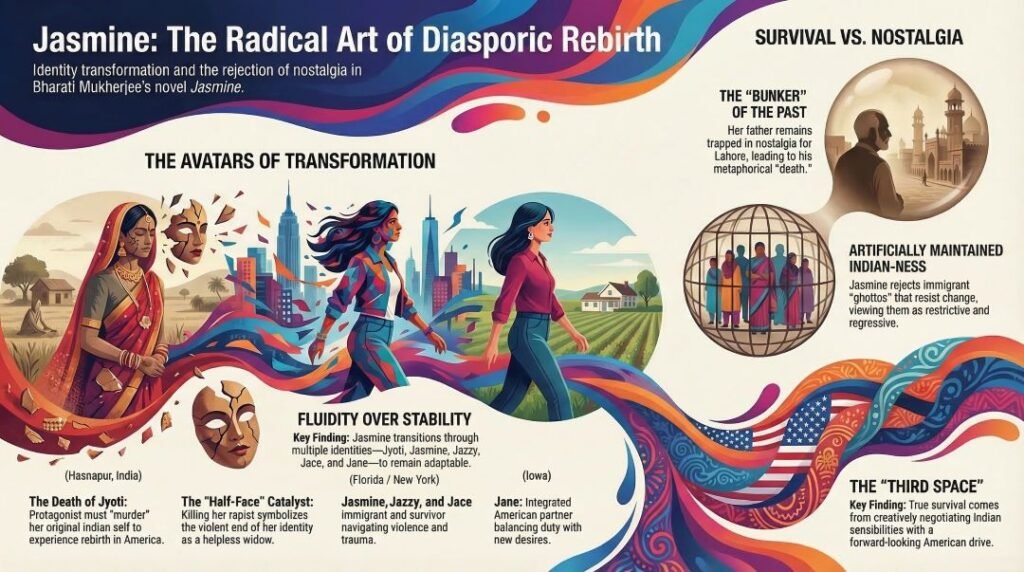
| 1989 | Jasmine | Her most famous and most widely read novel – the story of Jyoti, a young woman from a small village in Punjab, India, who survives widowhood and violence, travels to America, and transforms herself through a series of identities (Jyoti, Jasmine, Jazzy, Jane) into an American. The novel is simultaneously a rags-to-reinvention story, a feminist narrative, a meditation on the violence of immigration, and a philosophical statement about the American dream. Jasmine has been both celebrated as a powerful story of female transformation and criticised as a romanticisation of assimilation and a too-easy endorsement of the American dream at the expense of the immigrant’s original identity. It remains Mukherjee’s most read and most discussed novel. |
| 1993 | The Holder of the World | A formally ambitious and imaginatively expansive novel – moving between 17th-century Massachusetts, Mughal India, and the present day. Hannah Easton, a 17th-century New England Puritan woman, makes her way to India, where she becomes the consort of a Hindu raja and the holder of a legendary diamond. A present-day researcher reconstructs Hannah’s story. The novel is a meditation on the long, complex, and often violent entanglement of East and West – and an exploration of the idea that the American identity has always been formed by encounters with other worlds. More ambitious in its historical and geographical range than anything Mukherjee had previously written. |
| 1997 | Leave It to Me | A novel exploring themes of identity, revenge, and the dark side of the American immigrant experience. Debby Di Martino is an adoptee who discovers that her biological mother was an American hippie and her father an Indian guru. Her search for her origins takes her into the dark underside of American counterculture and immigrant life. A more Gothic, more violent novel than Jasmine – engaging with the destructive as well as the liberating possibilities of self-reinvention. |
| 2002 | Desirable Daughters | The first novel of her trilogy – the story of Tara Chatterjee, a Bengali woman living in San Francisco who is forced to confront her past, her Indian identity, and the arrival of a mysterious young man who claims to be connected to her family history. The novel interweaves the present-day story of Tara’s life in San Francisco with a historical narrative about a young Bengali girl who was married to a tree (a practice used when no human husband was available) and died young. Bharati Mukherjee uses this historical story to meditate on the condition of women in traditional Bengali society and on the relationship between that world and the contemporary lives of diasporic Bengalis. |
| 2004 | The Tree Bride | The second novel of the trilogy – continuing the story of Tara Chatterjee and exploring in greater depth the history of the ‘tree bride’ – Tara Lata Gangooly – whose story was introduced in Desirable Daughters. This volume moves further into Indian history, exploring the period of the Indian independence movement and the role of women in the freedom struggle. The tree bride figure becomes a symbol of female resistance and sacrifice that resonates across the generations of the Chatterjee family. |
| 2011 | Miss New India | The third and final novel of the trilogy – though it shifts focus from the Chatterjee family to a young Indian woman, Anjali, who leaves her provincial home and travels to Bangalore, the city of the new India’s technology-driven economy. Less directly connected to the Bengali diaspora themes of the first two volumes, Miss New India is an attempt by Mukherjee to engage with the new India that had emerged since the economic reforms of the 1990s – the India of call centres, software companies, and a newly confident urban middle class. The novel was less successful with critics than the earlier volumes of the trilogy. |
Bharati Mukherjee Famous Works: Detailed Analysis
Jasmine (1989)
| Aspect | Detail |
| Full Title | Jasmine |
| Author | Bharati Mukherjee |
| Published | 1989 (Grove Weidenfeld, USA) |
| Genre | Literary fiction; immigrant novel; feminist narrative |
| Protagonist | Jyoti – a young woman from the village of Hasnapur in Punjab, India. Over the course of the novel she takes a series of names – Jyoti, Jasmine, Jazzy, Jane – each representing a different stage of her transformation into an American. |
| Plot Summary | Jyoti’s husband, Prakash, is killed by a Sikh separatist bomb. She travels to America illegally, is assaulted on arrival, and kills her attacker in self-defence. She then makes her way through a series of lives and identities: as an au pair in New York; as the lover of a professor; as ‘Jane Ripplemeyer’, partner of Bud, a disabled Iowa banker; and finally as a woman who chooses to follow the man she loves – leaving Bud to travel with Taylor to California. The novel ends mid-journey, with Jyoti/Jasmine/Jane moving forward into an uncertain American future. |
| Central Themes | The immigrant’s transformation and reinvention of self; the American dream and its costs; female agency and survival; violence as both threat and liberation; the multiplicity of identity; the tension between the old world and the new; assimilation vs. preservation of cultural identity |
| Most Famous Aspect | The novel’s central argument – that the immigrant must be willing to die and be reborn, to shed old identities and take on new ones, to allow herself to be transformed by America – is both its most celebrated and its most contested feature. Critics who admire the novel see Jasmine’s transformations as a powerful feminist affirmation of female agency. Critics who disagree with the novel’s politics argue that it romanticises a violent and traumatic process and endorses an assimilationist ideology that erases the immigrant’s original culture. |
| Mukherjee’s Most Famous Book | Jasmine is widely regarded as Mukherjee’s most famous book – the novel most associated with her name and most frequently assigned in American university courses on immigrant literature, women’s fiction, and South Asian-American writing. |
| Critical Reception | Mixed but predominantly positive; celebrated for its energy, its feminist politics, and the vividness of its portrayal of the immigrant experience; criticised by some South Asian critics for its politics of assimilation and its willingness to endorse the destruction of the protagonist’s original cultural identity |
| Legacy | Jasmine has been one of the most widely taught novels in the field of South Asian-American literature for three decades; it continues to provoke debate about the nature of the immigrant experience, the politics of assimilation, and the representation of South Asian women in American fiction |
The Middleman and Other Stories (1988)
| Aspect | Detail |
| Full Title | The Middleman and Other Stories |
| Author | Bharati Mukherjee |
| Published | 1988 |
| Award | National Book Critics Circle Award (1988) – the most prestigious literary award of her career |
| Number of Stories | Eleven stories |
| Range of Voices | One of the collection’s most remarkable features is the extraordinary range of its narrative voices – the stories are narrated by an Iraqi Jew, a Filipino woman, a young Afghan man, a Trinidadian woman, an Indian man, and various other immigrant and minority characters. Mukherjee refuses to limit the immigrant experience to the South Asian perspective. |
| Title Story | The Middleman – the story of Alfie Judah, an Iraqi-Jewish immigrant who has come to America via a complicated route and is now in Central America, involved in gun-running. A story of moral ambiguity, cultural displacement, and the survival strategies of those who live permanently on the margins of legality and legitimacy. |
| Key Stories | A Wife’s Story – a powerful, ironic story of an Indian woman studying in New York who watches a Broadway show that mocks Indian accents and must decide what to feel about it; The Management of Grief – a devastating story about the wife of a man killed in the Air India bombing, and how she and other wives manage their grief in the face of an official response that cannot understand their cultural experience; Jasmine – the short story that became the seed of the novel; Danny’s Girls; Orbiting |
| The Management of Grief | Often considered the finest story in the collection – and one of the finest short stories written in America in the 1980s. Shaila Bhave’s husband and sons die in the Air India bombing. The story follows her through the immediate aftermath – the official response, the grief counsellors, the well-meaning Canadians who cannot understand her – and eventually to a kind of quiet resolution that is both culturally specific and universally moving. A masterpiece of the form. |
| Central Themes | The multiplicity of the immigrant experience; survival and adaptation; the violence beneath the surface of the American dream; the comedy and tragedy of cultural misunderstanding; the costs of assimilation; the moral complexity of the lives of those who live between cultures |
| Why It Won the Award | The collection was praised for the range of its vision, the quality and energy of its prose, the authenticity and specificity of its portrayals of immigrant experience across many different national and ethnic groups, and its refusal to sentimentalise or simplify the complexities of the immigrant condition |
Darkness (1985): Short Stories Analysis
Darkness (1985) was Bharati Mukherjee’s first short story collection – fourteen stories exploring the experience of South Asian immigrants in North America, published while she was still living in Canada and before she had become the fully American writer she would declare herself to be. The collection was the first serious indication of the range and the darkness of her fictional vision.
The stories of Darkness are set in both India and North America, and they explore the experience of South Asian immigration with a frankness about its violence, its loneliness, and its moral complexity that was new in the literature of the South Asian diaspora. The title captures several dimensions of the collection’s world: the literal darkness of immigrant life hidden from mainstream culture; the moral darkness of lives lived under pressure and often in desperation; and the racial politics of darkness in a white-majority society.
The collection is notable for the variety of its protagonists – men and women, educated professionals and unskilled labourers, the newly arrived and the long-settled – and for its refusal to present the immigrant experience as either wholly positive or wholly negative. It won the Canada Council for the Arts Award.
The Tiger’s Daughter (1971): Analysis
The Tiger’s Daughter is Bharati Mukherjee’s debut novel – a quiet, ironic, sometimes satirical portrait of Tara Banerjee, a Bengali woman who has been educated in America and returns to Calcutta after a long absence to find it both familiar and completely foreign. The novel is written in a style that owes something to the cool observational mode of E. M. Forster and something to the social novel of manners – it is more concerned with the social comedy of the encounter between the westernised Indian woman and the Indian world she has left than with the explosive questions of identity and transformation that would dominate her later work.
The Tiger’s Daughter is the least read of Mukherjee’s novels, but it is significant as the foundation on which all her subsequent work was built: it establishes the central figure – the Indian woman who has been transformed by her experience of the West and cannot simply return to the world she came from – and it identifies the Indian upper-middle-class world as a target for both satire and sympathy.
Wife (1975): Analysis
Wife is Bharati Mukherjee’s second novel and arguably her darkest – a claustrophobic psychological portrait of Dimple Dasgupta, a young Bengali woman who has been raised to define herself entirely through the role of wife and who comes to America as the wife of an immigrant engineer, only to find that the new world she has entered cannot contain or sustain the self she has been trained to be.
The novel traces Dimple’s gradual psychological disintegration with a cold, precise, almost clinical attention that is both disturbing and formally impressive. As Dimple’s sense of self crumbles under the pressure of a role that cannot give her what she needs, she retreats further and further into a fantasy life, until the fantasy erupts in an act of shocking violence. Wife is, in some ways, Mukherjee’s most feminist novel – the most direct and most unsparing in its examination of the damage done to a woman who is given no identity of her own, who is entirely defined by her relationship to a man.
The novel has been compared to Jean Rhys’s Wide Sargasso Sea in its portrait of female psychological disintegration under the pressures of an impossible social role, and to Gustave Flaubert’s Madame Bovary in its examination of the destruction that follows when a woman’s desires cannot be accommodated by the life available to her.
Desirable Daughters (2002): Analysis
Desirable Daughters is the first novel of Bharati Mukherjee’s trilogy and represents a significant evolution in her fiction – a turn toward more complex narrative structures, more historical depth, and a more ambivalent engagement with both Indian and American identity than her earlier work had offered.
The novel’s protagonist, Tara Chatterjee, is a Bengali woman living in San Francisco – divorced from her conservative Indian husband, involved with a Californian man, and living a life that is, in many ways, the embodiment of the assimilation that Mukherjee had always celebrated. But Tara’s comfortable American life is disrupted by the arrival of a young man who claims to be the son of Tara’s sister’s ‘tree bride’ – a young girl who was married to a tree in the 19th century in the tradition used when no human husband was available. This historical story – the story of the original tree bride – is woven through the novel as a meditation on the condition of women in traditional Bengali society and on what has changed and what has endured across the generations.
Desirable Daughters is a more measured and more structurally complex novel than Jasmine – reflecting Mukherjee’s increased formal ambition and her willingness, in her later career, to engage more critically and more fully with the Indian world she had previously seemed to leave entirely behind.
The Holder of the World (1993): Analysis
The Holder of the World is Bharati Mukherjee’s most formally ambitious novel – a work of historical fiction that moves between 17th-century Massachusetts, Mughal India, and the present day, and that uses this extraordinary temporal and geographical range to explore the long history of the encounter between East and West.
The central figure is Hannah Easton – a 17th-century New England Puritan woman whose life takes her to India, where she becomes the consort of a Hindu raja and the holder of a legendary diamond. A present-day researcher, Beigh Masters, reconstructs Hannah’s story through archival research and a form of digital time-travel. The novel is both a historical romance and a philosophical meditation on the idea that American identity has always been formed by encounters with other cultures and other worlds – that the ‘American’ is always, in some sense, a figure shaped by the global.
The Holder of the World was praised for its imaginative ambition and its historical research; some critics found its combination of historical fiction and contemporary technology somewhat strained, but the novel’s central vision – of a woman who crosses the deepest cultural boundaries and emerges transformed – is consistent with Mukherjee’s deepest preoccupations.
Bharati Mukherjee Short Stories: Key Works
| Story Title | Collection / Summary |
| The Middleman | The Middleman and Other Stories. Alfie Judah, an Iraqi-Jewish immigrant, finds himself in Central America involved in arms dealing – a story of moral ambiguity, cultural displacement, and the survival strategies of those who live permanently on society’s margins. |
| The Management of Grief | The Middleman and Other Stories. Shaila Bhave’s husband and sons are killed in the Air India bombing. The story follows her grief across cultural boundaries – between the Indian way of mourning and the Canadian official response – to a quiet, devastating resolution. Widely considered Mukherjee’s finest short story. |
| A Wife’s Story | The Middleman and Other Stories. Panna, an Indian woman studying in New York, watches a Broadway show that mocks Indian speech and must negotiate the complicated feelings this provokes – between cultural pride, immigrant vulnerability, and the desire to belong to the new world she has entered. |
| Jasmine (story) | The Middleman and Other Stories. The seed from which the novel grew – the story of a young Indian woman’s arrival in America and her first encounters with American life. More compressed and more violent than the novel; provides a window into the ideas that would expand into the full-length work. |
| Orbiting | The Middleman and Other Stories. An Afghan refugee meets his American girlfriend’s family for Thanksgiving – a comedy of cultural collision that is also a meditation on what America means and who gets to belong to it. |
| Danny’s Girls | The Middleman and Other Stories. A story exploring the dark underside of the immigrant experience – the exploitation and vulnerability of immigrant women in American cities. |
| Angela | Darkness. A story from her first collection – a portrait of a South Asian immigrant woman navigating the complicated world of American social relations. |
| Hindus | Darkness. A story exploring the internal dynamics and tensions of the South Asian immigrant community – the ways in which immigrants from India navigate not only American culture but the hierarchies and prejudices of their own communities transplanted to a new world. |
Bharati Mukherjee as a Diasporic Writer
Bharati Mukherjee is one of the founding figures of the literature of the South Asian diaspora in North America – but she is also one of the most controversial, because of her explicit rejection of the ‘diasporic’ label and of the politics that usually accompany it.
Most diasporic writing – including the work of Salman Rushdie, Jhumpa Lahiri, and many others – maintains a complex, ambivalent relationship with both the country of origin and the country of adoption: the writer holds onto the hyphen, celebrates the hybrid identity, mourns the lost home, and refuses to be wholly assimilated into either world. Mukherjee rejected this model completely and forcefully. She argued that the immigrant who maintains this kind of bifurcated, hyphenated identity is not truly immigrating – is, in effect, choosing exile rather than transformation. True immigration, she insisted, meant full transformation: the willingness to die as one kind of person and be reborn as another. She identified herself as an American writer, not an Indian-American writer, and she was willing to be criticised – at length, by many people – for that position.
This position has made her a more controversial figure in diasporic literary studies than any of her contemporaries. Critics who study diaspora literature often use Mukherjee as a counter-example – the writer who refuses to value cultural retention, who endorses assimilation, who is willing to leave her Bengali identity behind. But defenders of Mukherjee argue that this misreads her work: that the violence and loss in her fiction are fully acknowledged; that Jasmine is not a celebration of assimilation but a complex portrait of what transformation costs; and that her insistence on American identity was itself a political act – the immigrant claiming full membership of the society that wants to keep her marginal.
Whatever position one takes in this debate, Mukherjee’s place in the history of South Asian-American literature is secure. She was the first writer of South Asian origin to win a major mainstream American literary award (the National Book Critics Circle Award), and her work opened the space in which all subsequent South Asian-American writing has operated – even when, and sometimes precisely because, later writers have defined themselves in opposition to her positions.
Bharati Mukherjee Freedom Fighter Theme
One of the recurrent themes in Bharati Mukherjee’s fiction is what might be called the ‘freedom fighter’ theme – the idea of the woman who fights, in various ways and at various costs, for her own freedom: freedom from the constraints of Indian tradition and patriarchy; freedom from the limiting expectations of gender; freedom from the ‘immigrant’ identity that mainstream America seeks to impose on newcomers; and freedom from the past itself.
This theme is most visible in Jasmine – where Jyoti’s journey through a series of names and identities is literally a fight for survival and for self-determination, and where her final act of leaving Bud and following Taylor is an act of radical self-determination – and in Wife, where Dimple’s violence is a terrible, destructive form of the same impulse: the attempt to escape the role of wife that has imprisoned her.
The theme also connects to Indian political history. In The Tree Bride (the second volume of her trilogy), Mukherjee engages directly with the history of the Indian independence movement and with the role of women in that movement – women who were freedom fighters in the literal sense, who participated in the struggle against British colonial rule. The ‘tree bride’ figure – a woman sacrificed to tradition – becomes, in the historical sections of the novel, a kind of martyr whose sacrifice prefigures the more consciously chosen sacrifices of the women who would fight for Indian independence a generation later.
This layering of personal and political freedom – the woman’s fight for herself and the nation’s fight for its freedom – is one of the ways in which Mukherjee’s fiction operates simultaneously at the level of individual psychology and historical vision.
Bharati Mukherjee Trilogy: Desirable Daughters, The Tree Bride, and Miss New India
Bharati Mukherjee’s trilogy consists of three connected novels published in the last decade of her productive career:
- Desirable Daughters (2002) – the first volume; introduces Tara Chatterjee, a Bengali woman living in San Francisco, and the story of the ‘tree bride’, a historical figure whose ghost haunts the family across generations
- The Tree Bride (2004) – the second volume; deepens the historical narrative of the tree bride, connecting her story to the Indian independence movement and the role of women as freedom fighters
- Miss New India (2011) – the third volume; moves the focus to Anjali, a young woman from provincial India who moves to Bangalore and the new economy of post-liberalisation India; less directly connected to the Bengali diaspora themes of the first two volumes
The trilogy represents Mukherjee’s most ambitious attempt to connect the Bengali past – including its social traditions (the tree bride custom), its political history (the independence movement), and its cultural inheritance – with the lives of contemporary diasporic Bengalis in America and of young Indians navigating the new India of the 21st century. It is a more historically conscious and more formally complex body of work than her earlier fiction, and it shows the evolution of a writer who, by the end of her career, was engaging more fully and more critically with the Indian world she had previously seemed to leave behind.
Bharati Mukherjee Writing Style
| Element | Detail |
| Prose Style | Fast, energetic, immediate – the prose of her best fiction (particularly The Middleman stories and Jasmine) moves at a pace that is unusual in literary fiction; it has the urgency and forward momentum of someone who is running toward something rather than contemplating it from a distance |
| Narrative Voice | Often first-person and confessional; her narrators are typically women under pressure – surviving, adapting, fighting – and the first-person voice gives their stories an intimacy and an urgency that third-person narration would not achieve |
| Tone | Varied – ranging from comic irony (The Tiger’s Daughter, some Middleman stories) to dark psychological intensity (Wife) to urgent, propulsive energy (Jasmine); she does not have a single signature tone but adapts her register to the demands of each work |
| Violence | Violence is a recurring presence in Mukherjee’s fiction – not sensationalised but treated as part of the reality of immigrant life and of women’s experience in particular. The violence in her stories is rarely gratuitous; it is always the expression of forces that have been building throughout the narrative. |
| Humour | Her work, particularly in The Middleman stories, has a dark, ironic humour that distinguishes it from most other South Asian writing of its period – a willingness to find the absurd and the comic in situations that are also genuinely dangerous and painful |
| Range of Voices | Her greatest technical achievement in the short story form is the range of voices she commands – narrators from many different national, ethnic, and class backgrounds, all rendered with conviction and specificity. This range is itself a statement of her vision: that the immigrant experience is not the property of any single ethnic group but a universal condition of the modern world. |
| Historical Ambition | In her later work – particularly The Holder of the World and the trilogy – she becomes more formally ambitious and more historically expansive; her canvas widens to include centuries of history and continents of geography |
| Influences | Henry James (the novel of manners and consciousness); Jean Rhys (female psychological disintegration); Bernard Malamud (immigrant fiction); Flannery O’Connor (violence and grace in American fiction); and the Bengali literary tradition (Rabindranath Tagore and the bhadralok literary world of 19th and early 20th century Calcutta) |
Bharati Mukherjee Awards
| Award | Year | For / Detail |
| National Book Critics Circle Award | 1988 | For The Middleman and Other Stories – the most prestigious literary award of her career; one of the most important American literary prizes, awarded annually for the best work of fiction published in the USA |
| Canada Council for the Arts Award | 1985 | For Darkness – her first short story collection |
| Guggenheim Fellowship | Various | A Guggenheim Fellowship, awarded by the John Simon Guggenheim Memorial Foundation, supporting her research and creative work |
| Various Honorary Degrees | Various | Honorary doctorates from American universities recognising her contribution to American literature |
Bharati Mukherjee Bibliography: Complete Reference
| Category | Works |
| Novels (8) | The Tiger’s Daughter (1971); Wife (1975); Jasmine (1989); The Holder of the World (1993); Leave It to Me (1997); Desirable Daughters (2002); The Tree Bride (2004); Miss New India (2011) |
| Short Story Collections (2) | Darkness (1985); The Middleman and Other Stories (1988) |
| Non-Fiction (with Clark Blaise) | Days and Nights in Calcutta (1977); The Sorrow and the Terror: The Haunting Legacy of the Air India Tragedy (1987) |
| Critical Essays | Numerous essays on immigration, American identity, diasporic writing, and the politics of literary identity published in literary journals and collected in anthologies of South Asian-American writing |
| Trilogy | Desirable Daughters (2002); The Tree Bride (2004); Miss New India (2011) |
What Is the First Novel of Bharati Mukherjee?
The first novel of Bharati Mukherjee is The Tiger’s Daughter, published in 1971. It is her debut novel – the work that announced her as a writer of literary fiction and established the central preoccupation that would drive all her subsequent work: the experience of the Indian woman who has been changed by her encounter with the West and who can no longer simply return to the world she came from.
The Tiger’s Daughter is a quieter, more satirical, and more socially contained novel than the work that would make Mukherjee famous. Its protagonist, Tara Banerjee, is a westernised Bengali woman who returns to Calcutta after years in America, and the novel follows her as she navigates a city and a social world that have become simultaneously familiar and foreign. The tone is cool and observational – influenced by the social novel of manners and by the cool irony of E. M. Forster – and very different from the explosive energy of Jasmine or The Middleman stories.
The novel is significant in Mukherjee’s bibliography both as a starting point and as a contrast – a before-picture of what her fiction would become when she had fully committed to the American literary project and abandoned the detached irony of the Anglo-Indian novel of manners for the urgent, propulsive energy of immigrant fiction.
What Is the Trilogy of Bharati Mukherjee?
The trilogy of Bharati Mukherjee consists of three novels published in the last decade of her productive career: Desirable Daughters (2002), The Tree Bride (2004), and Miss New India (2011). The three novels are connected by character, theme, and the shared concern with the experience of the Bengali diaspora across generations and between continents.
The first two volumes – Desirable Daughters and The Tree Bride – are closely connected: they share the protagonist Tara Chatterjee and the historical figure of the ‘tree bride’, whose story runs through both novels as a meditation on the condition of women in traditional Bengali society and on the relationship between that past and the contemporary lives of diasporic Bengalis. The third volume – Miss New India – shifts focus to a young Indian woman navigating the new economy of post-liberalisation India, and is less directly connected to the Bengali diaspora themes of the first two.
Together, the trilogy represents Mukherjee’s most historically ambitious and most formally complex body of work – an attempt to connect the Bengali past with the diasporic present and with the new India of the 21st century.
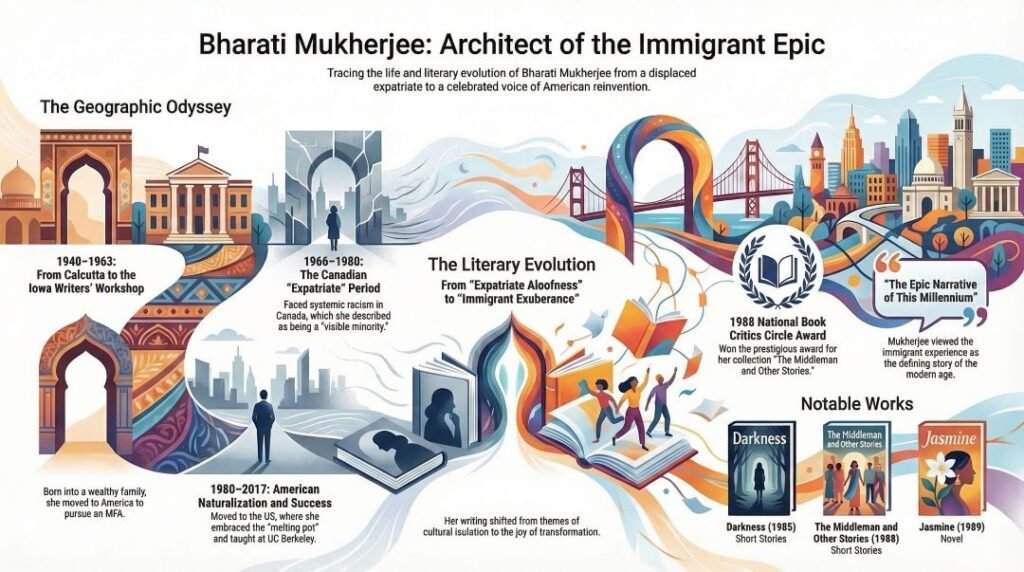
Bharati Mukherjee Life Timeline
| Year | Key Event |
| 1940 | Born on July 27 in Calcutta, West Bengal, India – into a wealthy Bengali Brahmin family; father Sudhir Lal Mukherjee is a chemist and businessman |
| 1940-1947 | Early childhood in Calcutta; early education at Loreto House, the elite Catholic convent school |
| 1947 | Family moves to England and Switzerland as father works abroad; early experience of living outside India |
| Late 1940s-1950s | Family returns to India; completes early education; develops passion for English literature and writing |
| Late 1950s-early 1960s | B.A. in English at University of Calcutta; M.A. in English and Ancient Indian Culture at University of Baroda |
| 1961 | Father sends his three daughters to the University of Iowa Writers’ Workshop in the United States – a remarkable progressive decision for an Indian parent of that era |
| 1963 | Marries Clark Blaise – a fellow student at the Iowa Writers’ Workshop, a Canadian writer of French-Canadian origin; an inter-racial, cross-cultural marriage |
| 1960s | Completes M.F.A. in Creative Writing and Ph.D. in English and Comparative Literature at the University of Iowa; begins academic career |
| 1966-1980 | Lives and works in Canada – teaches at McGill University, Montreal; begins writing fiction seriously; becomes Canadian citizen; raises two sons, Bart and Bernard |
| 1971 | The Tiger’s Daughter published – her debut novel |
| 1975 | Wife published – her second novel; darker and more disturbing than the debut |
| 1977 | Days and Nights in Calcutta published – collaborative memoir with Clark Blaise; documents a year spent in Calcutta |
| 1980 | Moves to the United States; makes the decisive personal and political choice to identify as an American rather than as a Canadian or Indian writer; becomes a key document in debates about immigrant identity and cultural assimilation |
| 1985 | Darkness published – her first short story collection; wins Canada Council for the Arts Award |
| 1987 | The Sorrow and the Terror published with Clark Blaise – about the Air India bombing |
| 1988 | The Middleman and Other Stories published – wins the National Book Critics Circle Award; establishes her as one of the leading voices of American immigrant fiction |
| 1989 | Jasmine published – her most famous and most widely read novel |
| 1989 | Joins the faculty of the University of California, Berkeley – eventually becomes a Professor of English; one of the most distinguished positions in American academic literary life |
| 1993 | The Holder of the World published – her most historically ambitious novel |
| 1997 | Leave It to Me published |
| 2002 | Desirable Daughters published – first volume of the trilogy |
| 2004 | The Tree Bride published – second volume of the trilogy |
| 2011 | Miss New India published – third and final volume of the trilogy; her last published novel |
| 2017 | Dies on January 28 in New York City – cause of death: complications from a urinary tract infection leading to organ failure; age 76; mourned in both American and Indian literary worlds |
10 Lines About Bharati Mukherjee for Students
- Bharati Mukherjee was an Indian-born American novelist and short story writer, born on July 27, 1940, in Calcutta, India, and died on January 28, 2017, in New York City.
- She was educated at Loreto House, Calcutta; the University of Calcutta; the University of Baroda; and the University of Iowa Writers’ Workshop, where she earned both an M.F.A. and a Ph.D.
- She married Canadian-American writer Clark Blaise in 1963 – an inter-racial, cross-cultural marriage that was itself an expression of the cross-cultural world she would spend her career exploring.
- Her cause of death was complications from a urinary tract infection that led to organ failure; she died at the age of 76.
- Her most famous novel is Jasmine (1989) – the story of a young Indian woman’s transformation through a series of identities into an American.
- Her short story collection The Middleman and Other Stories (1988) won the National Book Critics Circle Award – the most prestigious literary award of her career.
- She was controversial for her explicit rejection of the ‘Indian-American’ label and her insistence on identifying herself as simply an ‘American’ writer – a position that made her a pioneer to some and a traitor to others.
- She is recognised as a founding figure of South Asian-American literature and as a diasporic writer whose work defined what the immigrant novel in America could be.
- Her trilogy – Desirable Daughters (2002), The Tree Bride (2004), and Miss New India (2011) – represents her most historically ambitious and most formally complex body of work.
- She was a Professor of English at the University of California, Berkeley, from 1989 until her death – one of the most distinguished academic positions in American literary studies.
Bharati Mukherjee Short Biography (Profile / Biodata)
Bharati Mukherjee (born July 27, 1940, Calcutta, India; died January 28, 2017, New York City, USA; cause of death: complications from a urinary tract infection) was an Indian-born American novelist, short story writer, and academic. Born into a wealthy Bengali Brahmin family, she was educated at Loreto House, Calcutta; the University of Calcutta (B.A.); the University of Baroda (M.A.); and the University of Iowa Writers’ Workshop (M.F.A. and Ph.D.). She married writer Clark Blaise in 1963. She lived in Canada before moving to the United States, where she became a citizen and a Professor of English at UC Berkeley. She published eight novels – The Tiger’s Daughter (1971), Wife (1975), Jasmine (1989), The Holder of the World (1993), Leave It to Me (1997), Desirable Daughters (2002), The Tree Bride (2004), and Miss New India (2011) – and two short story collections – Darkness (1985) and The Middleman and Other Stories (1988, National Book Critics Circle Award). With her husband Clark Blaise she wrote Days and Nights in Calcutta (1977) and The Sorrow and the Terror (1987). She is famous for Jasmine, for The Middleman and Other Stories, and for her controversial identification as an American rather than an Indian American writer.
Also read: Arun Joshi Biography PDF And PPT Slides Download (.PPTX)
Conclusion:
Bharati Mukherjee died in 2017 as she had lived: in New York, fiercely identified as an American, committed to the literary project she had pursued for more than four decades. She left behind eight novels, two short story collections, two collaborative non-fiction books, a distinguished academic career at UC Berkeley, and a place in the history of American and South Asian-American literature that no subsequent writer can take from her.
Her legacy is complicated – as she herself was complicated. She was a pioneer who opened a door, but she kicked it open with an energy and a willingness to accept the costs that not everyone admired. She was the first South Asian writer to win a major mainstream American literary award, and she did it by refusing to limit herself to the South Asian perspective. She wrote about Iraqis, Afghans, Filipinos, and Trinidadians as well as Indians; she claimed the whole immigrant experience as her subject; and she insisted that the immigrant’s transformation into an American was not a loss to be mourned but an act of creative self-determination.
Whether one agrees with that position or not – and many South Asian critics have disagreed with it, loudly and at length – it is impossible to write honestly about American immigrant literature without engaging with it. Mukherjee’s position defines one pole of the debate about what immigration means, what assimilation costs, and who has the right to call themselves American. That debate is as urgent today as it was when she began writing, and her fiction – particularly Jasmine and The Middleman stories – will continue to be the texts around which it is conducted. She was a writer of real power and real courage – a woman who reinvented herself, as her protagonists reinvent themselves, and who paid the price of that reinvention in controversy, criticism, and misunderstanding, without ever losing the conviction that she had chosen the right path. That is its own kind of freedom fighting.