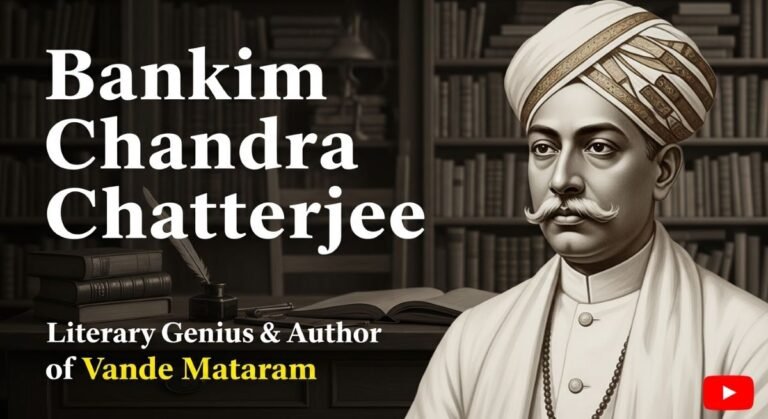
Today in this article we will discuss about the Bankim Chandra Chatterjee Biography: Life, Books, Education and Legacy with PPT, PDF and Infographic so, Bankim Chandra Chatterjee – also widely known as Bankim Chandra Chattopadhyay – was one of the most influential Indian writers of the 19th century. Celebrated as the father of the Bengali novel, he left behind a literary legacy that continues to inspire generations of readers, scholars, and patriots across India and beyond. From writing Vande Mataram to crafting timeless novels that shaped Bengali and Indian literature, his contributions remain unparalleled.
Table of Contents
Bankim Chandra Chatterjee Biography: Complete At-A-Glance Table
Here is a comprehensive biography table covering every key detail of Bankim Chandra Chatterjee‘s life – from his birth and education to his death and literary legacy:
| Biographical Detail | Information |
| Full Name | Bankim Chandra Chattopadhyay (Chatterjee) |
| Date of Birth | June 27, 1838 |
| Place of Birth | Kanthalpara, Naihati, North 24 Parganas, West Bengal, India |
| Date of Death | April 8, 1894 |
| Place of Death | Calcutta (now Kolkata), West Bengal, India |
| Age at Death | 55 years |
| Nationality | Indian (British India) |
| Religion | Hinduism |
| Caste | Brahmin (Bengali Brahmin) |
| Father’s Name | Yadav Chandra Chattopadhyay |
| Mother’s Name | Durgadebi Devi |
| First Wife | Name unknown (married at age 11, died young) |
| Second Wife | Rajlakshmi Devi |
| Education | BA – University of Calcutta (1858); Law – Presidency College, Calcutta |
| Occupation | Novelist, Poet, Journalist, Civil Servant (Deputy Collector) |
| Languages | Bengali, English, Sanskrit |
| Most Famous Work | Vande Mataram (national song of India) |
| Literary Title | Sahitya Samrat (Emperor of Literature) |
| Total Novels Written | 14 major novels |
| Magazine Founded | Bangadarshan (1872) |
| Literary Era | Bengali Renaissance (19th Century) |
| First Novel | Durgeshnandini (1865) |
| Last Novel | Sitaram (1887) |
Bankim Chandra Chatterjee Biography (PDF & PPT SLIDES)
Who Was Bankim Chandra Chatterjee? (Bankim Chandra Chatterjee Kaun The)
Bankim Chandra Chatterjee was a Bengali novelist, poet, journalist, and civil servant born on June 27, 1838, in Kanthalpara, Naihati, West Bengal, India. He is best known as the author of Vande Mataram – the patriotic hymn that became a rallying cry during India’s freedom movement and is today India’s national song.
He served as a Deputy Collector and Deputy Magistrate under the British Indian administration for over three decades. His dual identity as a government officer and a revolutionary voice for Indian culture made him a truly unique figure in Indian history. He was the first great novelist of the Bengali language and is considered the architect of modern Bengali prose.
Key Facts About Bankim Chandra Chatterjee
- Full name: Bankim Chandra Chattopadhyay (anglicised as Chatterjee)
- Born: June 27, 1838 in Naihati, West Bengal
- Died: April 8, 1894 in Calcutta
- Title: Sahitya Samrat (Emperor of Literature)
- Most famous work: Vande Mataram, composed in 1876
- First major Bengali novel: Durgeshnandini (1865)
- Founded Bangadarshan literary magazine in 1872
- One of the first two graduates of the University of Calcutta
Bankim Chandra Chatterjee Real Name and the Chattopadhyay vs Chatterjee Debate
Many readers search for Bankim Chandra Chatterjee’s real name. His true Bengali name was Bankim Chandra Chattopadhyay (Bengali: বঙ্কিমচন্দ্র চট্টোপাধ্যায়). During the British colonial period, Bengali surnames were frequently anglicised – Chattopadhyay became Chatterjee, Bandyopadhyay became Banerjee, and Mukhopadhyay became Mukherjee. Both names – Chatterjee and Chattopadhyay – refer to the same legendary literary giant.
Bankim Chandra Chatterjee Education
Bankim Chandra Chatterjee’s educational journey is a remarkable story of academic brilliance at a time when higher education was accessible to very few Indians.
Education Timeline
- Early schooling at local institutions in Naihati
- Enrolled at Hooghly Collegiate School – excelled in literature and Sanskrit
- Admitted to Presidency College, Calcutta – one of the most prestigious institutions in British India
- 1858: Passed his Bachelor of Arts examination from the University of Calcutta – becoming one of only two students in the first ever graduating batch of the university
- Later completed his Law degree from Presidency College, Calcutta
- Deeply influenced by both classical Sanskrit texts and Western literature – especially works of Shakespeare, Goethe, and John Stuart Mill
Bankim Chandra Chatterjee’s education helped him bridge two intellectual worlds – traditional Indian classical knowledge and modern Western thought. This rare combination gave his writing extraordinary depth, making him capable of both lyrical romantic prose and sharp social criticism.
Bankim Chandra Chatterjee Wife and Personal Life
Bankim Chandra Chatterjee was married twice, reflecting the social customs of 19th-century Bengal:
First Marriage
- Married at the age of 11, following the common practice of child marriage in colonial Bengal
- His first wife passed away at a young age
- The experience deeply impacted him and influenced his literary treatment of women and marriage in novels like Vishabriksha
Second Marriage
- Later married Rajlakshmi Devi
- Their relationship was described by biographers as affectionate and mutually supportive
- Rajlakshmi Devi’s steadfast support allowed Bankim to balance a demanding civil service career with his prolific literary output
Despite juggling a full-time government career and family responsibilities, Bankim Chandra found time to write some of the most influential literature of his era. He was known as a devoted family man who drew inspiration from everyday domestic life, often weaving observations about family, duty, and love into his stories.
Also read: List of Indian Writers in Hindi Literature (Hindi Sahitya)
Bankim Chandra Chatterjee Books: Complete List (Bankim Chandra Chatterjee Ne Kya Likha)
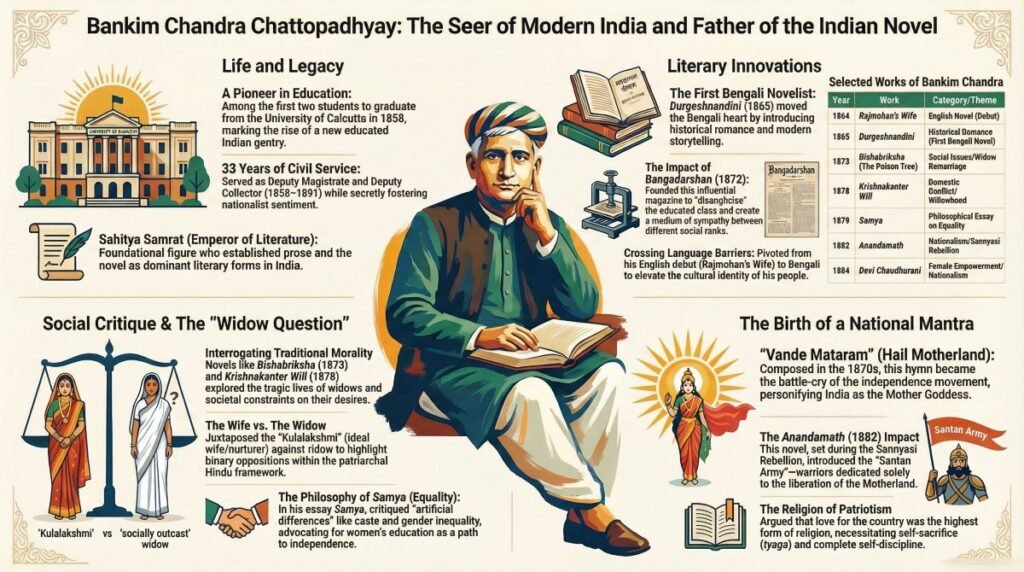
Bankim Chandra Chatterjee wrote a total of 14 major novels along with essays, philosophical works, and journalism. His books span genres from historical romance and social realism to political allegory and philosophical inquiry.
Complete Novels Table
| Novel Title | Year | Brief Description |
| Durgeshnandini | 1865 | First major Bengali novel; historical romance set in the Mughal era |
| Kapalkkundala | 1866 | Poetic romantic novel; considered one of his finest achievements |
| Mrinalini | 1869 | Historical novel; set during Bakhtiyar Khilji’s invasion of Bengal |
| Vishabriksha | 1873 | Social novel exploring marriage, morality and colonial Bengal |
| Indira | 1873 | Short romantic novel known for its lyrical prose style |
| Yugalanguriya | 1874 | Romantic novella; one of his earliest prose experiments |
| Chandrasekhar | 1875 | Historical and social novel set during British rule |
| Radharani | 1876 | Short romantic story with strong emotional depth |
| Krishnakanter Will | 1878 | Legal and social drama exploring inheritance and desire |
| Rajsimha | 1882 | Historical; Rajput resistance against Mughal Emperor Aurangzeb |
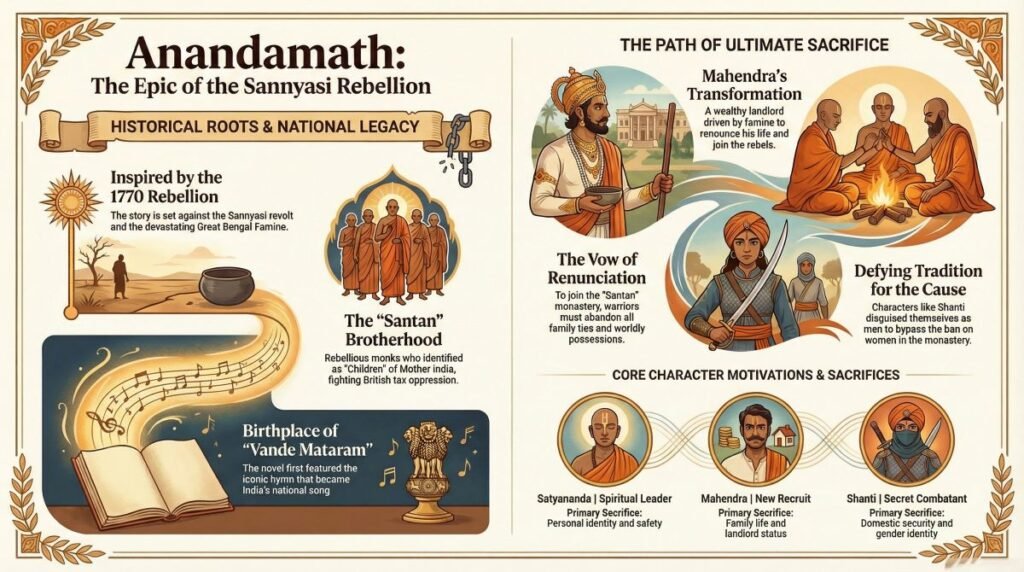
| Anandamath | 1882 | Most politically important; contains Vande Mataram; Sanyasi Rebellion |
| Debi Chaudhurani | 1884 | Strong female protagonist; social and political justice themes |
| Sitaram | 1887 | Final novel; explores conflict between power, duty and personal desire |
Non-Fiction and Other Major Works
- Lokarahasya (1874) – Satirical essay collection poking fun at contemporary Bengali society
- Kamalakanter Daptar – A beloved column written under the pen name Kamalakanta, mixing wit, philosophy and social commentary
- Dharmatattva – A systematic exploration of Hindu ethics, duty, and religious philosophy
- Krishnacharitra – A scholarly, rational reinterpretation of the life of Lord Krishna; one of his most controversial and important non-fiction works
- Samkhyasar – A philosophical treatise on the Samkhya school of Indian philosophy
- Bangadarshan Magazine (founded 1872) – The literary platform that published many of these works and influenced an entire generation of Bengali writers
Bankim Chandra Chattopadhyay or Chatterjee Wrote Vande Mataram: The Full Story
One of the most frequently searched questions online is: ‘Did Bankim Chandra Chattopadhyay or Chatterjee write Vande Mataram?’ The answer is unambiguous – both names refer to the same person, and Bankim Chandra Chattopadhyay (Chatterjee) wrote Vande Mataram.
The History of Vande Mataram
- Bankim Chandra first composed Vande Mataram in 1876 in Sanskrit mixed with Bengali
- It was inspired by his deep love for the Indian motherland, personified in the song as a divine goddess
- The song was first published in his novel Anandamath in 1882
- Nationalist leader Bal Gangadhar Tilak championed the song in the late 19th century
- Rabindranath Tagore set the song to music and performed it at the 1896 session of the Indian National Congress
- During India’s independence movement, Vande Mataram became one of the most powerful symbols of resistance against British rule
- Freedom fighters, including those who faced execution, would chant Vande Mataram before their deaths
- After independence in 1947, the first two stanzas were officially adopted as India’s national song in 1950
The meaning of Vande Mataram is ‘I salute thee, Mother.’ The song is a hymn to the motherland as a goddess – nurturing, powerful, and eternal. Its imagery draws from classical Sanskrit poetry and Hindu religious tradition, making it a deeply resonant cultural and spiritual statement.
Bankim Chandra Chatterjee Movies: His Works on Screen
Several of Bankim Chandra Chatterjee’s novels have been adapted into films over the decades, in both Bengali and Hindi cinema. His stories – with their rich characters, dramatic plots, and historical settings – translate naturally onto the screen.
Notable Film Adaptations
- Kapalkkundala – Adapted multiple times in Bengali cinema; the 1933 and 1969 versions are particularly well known
- Durgeshnandini – Filmed in Bengali; highly regarded for bringing his debut novel to a wider audience
- Anandamath – Adapted as a Hindi film in 1952; notable for featuring the song Vande Mataram prominently
- Debi Chaudhurani – Adapted in Bengali cinema; praised for its portrayal of a strong female lead
- Chandrasekhar – Adapted for screen and television; known for its blend of romance and historical drama
- Mrinalini – Filmed in Bengali; appreciated for its patriotic themes
- Krishnakanter Will – Adapted as a Bengali film; notable for its exploration of social and legal conflict
Beyond cinema, his works have been adapted into numerous television serials and theatrical productions, particularly in West Bengal, ensuring that new generations continue to engage with his stories and ideas.
Bankim Chandra Chatterjee Famous For: Top Contributions to Indian Literature and Culture
Why Is Bankim Chandra Chatterjee Famous?
- Pioneer of the Bengali Novel: He wrote Durgeshnandini (1865), the first major novel in the Bengali language, essentially creating this literary tradition from scratch
- Author of Vande Mataram: He composed India’s national song, which became the anthem of the independence movement and remains a symbol of national pride
- Father of Bengali Literature: Widely regarded as the architect of modern Bengali prose, his influence on Bengali writers – including Rabindranath Tagore – is immeasurable
- Social Reformer Through Literature: His novels tackled widow remarriage, women’s rights, caste discrimination, and colonial exploitation, decades before these became mainstream social debates
- Founder of Bangadarshan: The literary magazine he founded in 1872 became the most influential platform for Bengali intellectual and literary discourse in the 19th century
- Cultural Nationalist: Through his writing, he helped awaken Indian cultural pride and a sense of national identity at a time when colonial rule had suppressed Indian self-expression
- Philosophical Thinker: His non-fiction works, especially Krishnacharitra and Dharmatattva, represent serious scholarly contributions to Indian philosophical and religious thought
Bankim Chandra Chatterjee: Complete Life Timeline
| Year | Key Event |
| 1838 | Born on June 27 in Kanthalpara, Naihati, West Bengal |
| 1849 | First marriage (child marriage, as was common in the era) |
| 1856 | Enrolled at Presidency College, Calcutta |
| 1858 | Became one of the first two graduates of the University of Calcutta (BA) |
| 1858 | Joined Indian Civil Service as Deputy Collector and Deputy Magistrate |
| 1865 | Published Durgeshnandini – the first major Bengali novel |
| 1866 | Published Kapalkkundala, one of his most celebrated novels |
| 1872 | Founded Bangadarshan literary magazine – a landmark in Indian journalism |
| 1876 | Composed Vande Mataram – India’s future national song |
| 1882 | Published Anandamath – Vande Mataram appeared in print for the first time |
| 1891 | Retired from civil service after 33 years of distinguished service |
| 1894 | Died on April 8 in Calcutta at the age of 55 |
| 1896 | Vande Mataram sung at Indian National Congress session by Rabindranath Tagore |
| 1950 | Vande Mataram officially adopted as India’s national song after independence |
10 Lines on Bankim Chandra Chatterjee for Students
Here are 10 concise and accurate lines on Bankim Chandra Chatterjee, ideal for school essays, assignments, and quick reference:
- Bankim Chandra Chatterjee was born on June 27, 1838, in Naihati, West Bengal, India.
- His full name was Bankim Chandra Chattopadhyay – Chatterjee is the anglicised version of the same surname.
- He is called the father of the Bengali novel and is titled Sahitya Samrat, meaning Emperor of Literature.
- He wrote Vande Mataram in 1876, which is now India’s national song, officially adopted in 1950.
- He was one of the first two graduates of the University of Calcutta, earning his BA in 1858.
- His first novel, Durgeshnandini (1865), was the first major novel written in the Bengali language.
- He worked as a Deputy Collector under the British Indian government for over 33 years.
- He founded the influential literary magazine Bangadarshan in 1872.
- He wrote 14 major novels along with important philosophical, religious, and satirical works.
- He passed away on April 8, 1894, in Calcutta at the age of 55, leaving behind an immortal literary legacy.
Bankim Chandra Chatterjee Ka Jivan Parichay (Life Introduction)
Bankim Chandra Chatterjee ka jivan parichay is the story of a man who lived in two worlds simultaneously – the world of the colonial administrator and the world of the creative artist and nationalist thinker. Born in 1838 in a traditional Brahmin household, educated in the finest institutions of colonial India, he rose through the ranks of the civil service while writing novels and essays that stirred the consciousness of a subjugated people.
He was a man who believed in the power of culture and literature to uplift a nation. He saw the pen as a weapon – not of violence – but of awareness, dignity, and inspiration. His body of work challenged colonial narratives, celebrated Indian history and mythology, and gave Bengali and Indian literature a new sense of purpose and pride.
Core Pillars of His Life and Work
- Literature as Nationalism: He used his novels to awaken cultural pride and resistance to colonial rule
- Women in Literature: He created some of the most memorable and complex female characters in Indian literature – Kapalkkundala, Debi Chaudhurani, and others
- Historical Consciousness: His historical novels brought India’s Mughal-era and Rajput heritage alive for ordinary Bengali readers
- Social Commentary: He used satire and social realism to challenge conservative practices and advocate quietly for reform
- Religious Philosophy: In works like Dharmatattva and Krishnacharitra, he engaged seriously with Hindu religious thought in a modern, rational way
Bankim Chandra Chatterjee in Hindi: Why He Matters to All Indians
While Bankim Chandra wrote primarily in Bengali, his influence has crossed all linguistic boundaries in India. His most famous contribution – Vande Mataram – is a Sanskrit composition that resonates with every Indian, regardless of their mother tongue. In the Hindi-speaking world, he is remembered not just as a Bengali writer but as a national icon and a symbol of cultural resistance to colonialism.
His novels have been translated into Hindi, Urdu, Marathi, Tamil, Telugu, and most other major Indian languages, ensuring that his stories and ideas reach readers across the country. Schools and universities throughout India include his works in their curricula, making Bankim Chandra relevant not just to Bengalis but to all Indians who value literature, history, and patriotism.
Why Bankim Chandra’s Legacy Transcends Language
- Vande Mataram is sung by millions of Indians daily, across all languages and regions
- His novels have been translated into nearly every major Indian language
- His ideals of cultural nationalism influenced Indian leaders including Bal Gangadhar Tilak, Bipin Chandra Pal, and Lala Lajpat Rai
- Rabindranath Tagore, who later won the Nobel Prize in Literature, acknowledged Bankim Chandra as his greatest literary inspiration
- His portrait hangs in government offices, libraries, and cultural institutions across India – not just West Bengal
Bankim Chandra Chatterjee Born: Childhood in the Era of the Bengali Renaissance
Bankim Chandra Chatterjee was born on June 27, 1838, during one of the most intellectually charged periods in Indian history – the Bengali Renaissance. This era saw the emergence of reformers, thinkers, and artists who began questioning outdated social norms while embracing modern education and scientific thinking.
Growing up in this environment shaped Bankim’s worldview profoundly. He absorbed the classical Sanskrit tradition from his family background, Western philosophical thought from his education, and the social realities of colonial India from everyday experience. These three influences converged to create one of India’s most versatile and impactful writers – a man equally at home writing lyrical romantic prose and rigorous philosophical essays.
The Bengali Renaissance: Context of Bankim’s Birth and Growth
- The Bengali Renaissance (approximately 1815–1910) was a period of cultural, intellectual and social reform in Bengal
- Key figures of this era included Ram Mohan Roy, Ishwar Chandra Vidyasagar, Michael Madhusudan Dutt, and Rabindranath Tagore
- Bankim Chandra was a central pillar of this movement, contributing through literature what others contributed through social reform and education
- The era saw increased access to Western education for Indians, which created a new class of educated professionals who sought to reconcile Indian traditions with modern values
- Bankim’s work embodied this synthesis – drawing on Sanskrit epic tradition while also employing the modern novel form borrowed from Western literature
Bankim Chandra Chatterjee Death: End of an Extraordinary Era
Bankim Chandra Chatterjee died on April 8, 1894, in Calcutta. He was 55 years old. His passing was mourned deeply across Bengal and throughout the nationalist and literary circles of India.
Despite his relatively short life, the sheer volume and quality of his work was extraordinary. In his active writing years – roughly 1865 to 1887 – he produced 14 novels, founded an influential magazine, wrote philosophical treatises, and composed Vande Mataram. His health declined in his final years, and he passed away following a prolonged illness.
What He Left Behind
- 14 novels that transformed Bengali literature forever
- Vande Mataram – India’s national song, still sung by millions every day
- Bangadarshan magazine – a legacy that shaped Bengali intellectual life for decades
- A generation of inspired writers, including Rabindranath Tagore, who freely acknowledged Bankim’s foundational influence
- A model of the ‘writer as nationalist’ – using literature as a form of resistance and cultural pride under colonial rule
- A philosophical legacy through Dharmatattva and Krishnacharitra that continues to be studied in Indian universities
Rabindranath Tagore, who would go on to win the Nobel Prize in Literature in 1913, acknowledged his immense debt to Bankim Chandra. Tagore described Bankim as the person who taught him and his generation how to write Bengali prose with beauty, precision, and purpose.
Conclusion: The Enduring Legacy of Bankim Chandra Chatterjee
Bankim Chandra Chatterjee was more than a writer – he was a nation-builder, a cultural reformer, and a literary visionary. Through his novels, essays, and the immortal Vande Mataram, he helped awaken India’s sense of national identity at a time when the country was struggling under colonial rule.
His books remain as relevant today as they were in the 19th century – not just as historical artefacts but as living works of literature that speak to timeless truths about love, sacrifice, duty, and freedom. Whether you are a student looking for 10 lines on Bankim Chandra Chatterjee, a researcher exploring his biography and education, someone curious about the books he wrote, or simply a reader who wants to discover India’s greatest literary legacy – his life and work offer something profound and deeply inspiring.
Final Quick Summary
- Born: June 27, 1838 – Naihati, West Bengal
- Died: April 8, 1894 – Calcutta, West Bengal
- Real name: Bankim Chandra Chattopadhyay
- Title: Sahitya Samrat (Emperor of Literature)
- Greatest achievement: Author of Vande Mataram – India’s national song
- Literary legacy: 14 novels, founding of Bangadarshan, creation of the Bengali novel tradition
- Influence: Inspired Rabindranath Tagore, Indian nationalist leaders, and generations of readers
Bankim Chandra Chatterjee’s name may have two spellings (Bankim Chandra Chattopadhyay or Bankim Chandra Chatterjee), but his legacy speaks in one undivided voice – the voice of a man who loved his land, his language, and his people with every word he ever wrote.