A Complete Article Arun Joshi Biography PDF and PPT Slides Download (.PPTX), Covering Arun Joshi Biography, Novels in Chronological Order, The Foreigner, Books, Famous Works, Awards and Complete Legacy, The Strange Case of Billy Biswas, The Apprentice, The Last Labyrinth, The City and the River, Short Stories, Awards, Writing Style, and His Legacy in Indian Literature, In this article we will discuss everything about Arun Joshi – his biography in English, books in chronological order, famous works including The Foreigner, The Strange Case of Billy Biswas, The Apprentice, The Last Labyrinth, The City and the River, and The Survivor, his short stories, awards, writing style, his importance in Indian literature, his education, death, and his complete legacy as one of the most original and underappreciated novelists in the history of Indian writing in English.
Table of Contents
Arun Joshi is a name that occupies a unique and somewhat lonely position in the history of Indian literature in English. Writing in the 1960s, 1970s, and 1980s – in the same era as Anita Desai, R. K. Narayan, and Raja Rao – he produced a body of work that was strikingly different from all of them: darker, more existentially charged, more directly concerned with the spiritual crisis of modern India, and more willing to explore the psychological disintegration of the educated, westernised Indian male. He wrote only five novels and a handful of short stories before his early death in 1993 at the age of just 54. But those five novels are each distinctive, each deeply serious, and each deserving of far wider readership and critical attention than they have received. This comprehensive article covers all his novels, all the keywords his readers search for, and everything a student, researcher, or general reader needs to know about Arun Joshi and his writing.
Arun Joshi Biography Table (Biodata / Author Bio)
The table below provides every essential biographical fact about Arun Joshi:
| Biographical Detail | Information |
| Full Name | Arun Joshi |
| Date of Birth | 1939 |
| Born Place | Varanasi (Banaras), Uttar Pradesh, British India – one of the most ancient and spiritually significant cities in India; the city’s deeply Hindu atmosphere left a permanent imprint on Joshi’s sensibility and his literary treatment of Indian spirituality and its modern crisis |
| Date of Death | 1993 – he died at the age of 54, one of the most untimely deaths in the history of Indian writing in English; his death cut short a literary career that had been producing work of increasing ambition and depth |
| Age at Death | 54 years – he died relatively young, leaving a small but remarkable body of work |
| Nationality | Indian |
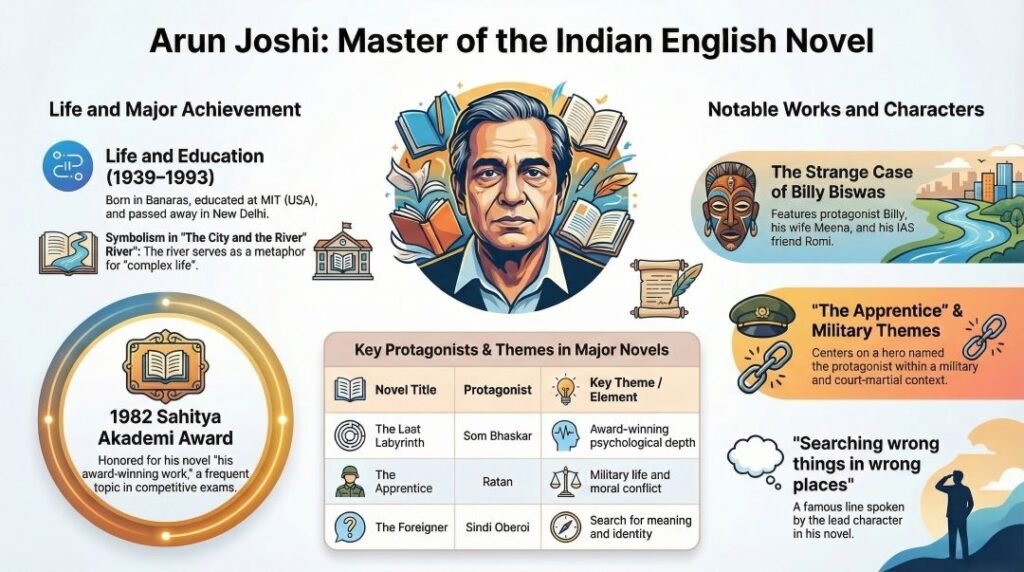
| Education | Arun Joshi received his early education in India before going abroad for higher studies. He studied in the United States – at MIT (Massachusetts Institute of Technology) and later at other American universities – earning degrees in engineering and business management. This experience of living between India and America, between an ancient culture and a fiercely modern one, became the central subject of his first and most celebrated novel, The Foreigner (1968). He returned to India to work in industry and business, eventually becoming a senior executive – a career trajectory very different from that of most Indian writers of his generation, most of whom were academics or journalists. |
| Career | Industrial executive and businessman – he worked at senior levels in Indian industry and business management while simultaneously writing his novels. This background gave him a perspective on modern India’s encounter with capitalism, industrialisation, and Western values that is unique among Indian novelists of his generation. |
| Famous Works | The Foreigner (1968); The Strange Case of Billy Biswas (1971); The Apprentice (1974); The Last Labyrinth (1981); The City and the River (1990); The Survivor (short stories) |
| First Novel | The Foreigner (1968) – his debut novel and, along with The Strange Case of Billy Biswas, his most celebrated and most widely studied work |
| Awards | Sahitya Akademi Award (1983) – India’s most prestigious literary honour, awarded for The Last Labyrinth (1981) |
| Why Important in Indian Literature | Arun Joshi is important in Indian literature for several reasons: he was the first major Indian novelist in English to directly engage with existentialism and the crisis of identity in modern India; he explored the psychological and spiritual disorientation of the westernised Indian middle class with a depth and honesty that had not been seen before; his novels The Foreigner and The Strange Case of Billy Biswas are landmarks of Indian writing in English; and his work as a whole represents one of the most serious engagements with the question of what it means to be an Indian in the modern world. |
| Writing Themes | Existential alienation; the identity crisis of the westernised Indian; the failure of materialism and modern values to provide meaning; the tension between Indian spirituality and Western rationalism; guilt, moral failure, and the search for redemption; the disintegration of the self under the pressures of modernity |
| Literary Influences | Albert Camus (existentialism and the absurd); Franz Kafka (alienation and bureaucratic dehumanisation); Fyodor Dostoevsky (psychological depth and moral crisis); and the Bhagavad Gita and Hindu philosophy (the Indian spiritual tradition as both problem and solution in his characters’ lives) |
Arun Joshi Biography PDF and PPT Slides Download (.PPTX)
Who Is Arun Joshi? What Is He Famous For?
Arun Joshi was an Indian novelist born in 1939 in Varanasi, Uttar Pradesh. He is famous as the author of five deeply serious and existentially charged novels – The Foreigner (1968), The Strange Case of Billy Biswas (1971), The Apprentice (1974), The Last Labyrinth (1981), and The City and the River (1990) – each of which explores, from a different angle, the central crisis of the educated, westernised Indian man in the modern world: the crisis of meaning, identity, and spiritual belonging.
He is famous above all for The Strange Case of Billy Biswas – a novel so unusual, so dark, and so unlike anything else in Indian literature that it has never quite been assimilated into the mainstream of Indian literary history; it remains a book that readers discover with a sense of shock and recognition, as though it has been waiting specifically for them. He is also famous for The Foreigner – his debut novel, which remains the most accessible and most widely studied of his works, and which established the central preoccupation of all his fiction: the figure of the Indian man who has been uprooted by education and travel from his cultural roots, and who cannot find his way home.
He is important in Indian literary history because he brought to Indian fiction in English a seriousness of philosophical and existential purpose that had not been seen before – a directness in confronting the crisis of modern Indian identity, without the comfort of either nationalist mythology or Western liberal optimism. He wrote as a man who had genuinely lived the crisis his characters inhabit, and that authenticity gives his work a power that continues to make readers uncomfortable and to reward serious attention.
He received the Sahitya Akademi Award in 1983 for The Last Labyrinth – India’s most prestigious literary honour – and died in 1993 at the age of 54, leaving behind a small body of work that deserves to be far more widely known than it currently is.
Arun Joshi Biography in English: Early Life, Born Place and Education
Arun Joshi was born in 1939 in Varanasi – the sacred city on the banks of the Ganges that has been one of the spiritual centres of Hindu civilisation for thousands of years. Varanasi is a city of temples and ghats, of ancient ritual and modern poverty, of intense religious life and vivid physical squalor – a city that embodies, perhaps more fully than any other place in India, both the depth of the Hindu spiritual tradition and the absolute distance of that tradition from the values and categories of the modern West. Growing up in Varanasi shaped Joshi’s sensibility in ways that are visible throughout his fiction: the sense of a deep spiritual inheritance that modern life has made inaccessible; the ache for transcendence in a world that no longer believes in it; the awareness of death and impermanence that pervades Hindu thought.
He received his early education in India before going abroad for higher studies in the United States, where he studied engineering and business management at MIT and other American institutions. His years in America – living between the ancient Hindu world of his childhood and the fiercely secular, technological world of 1950s and 1960s America – gave him the direct, lived experience of cultural displacement and existential disorientation that became the subject of The Foreigner. The protagonist of that novel, Sindi Oberoi, is in many ways a version of Joshi himself – an Indian student in America who has lost his cultural roots without finding new ones, who is alienated from both worlds, and who must find his own way to meaning.
On returning to India, Joshi pursued a career in business and industry – working as a senior executive rather than as an academic or journalist, which was the more typical career path for Indian writers of his generation. This experience of the Indian corporate world, with its moral compromises, its pressure to conform, and its spiritual emptiness, fed directly into The Apprentice – his most overtly Indian novel, and his most direct engagement with the question of what India asks of its citizens and what the cost of compliance is.
He died in 1993 at the age of 54 – a loss to Indian literature that has never been fully acknowledged or mourned in the way it deserves. At the time of his death he had published five novels, but there is reason to believe, from the increasing ambition and formal experimentation of his later work (particularly The City and the River), that he was still developing as a writer and that his best work might have been yet to come.
Arun Joshi Books: Complete List in Chronological Order
Arun Joshi published five novels and a collection of short stories over the course of his writing career. Here is his complete bibliography in chronological order:
| Year | Title | Summary / Detail |
| 1968 | The Foreigner | His debut novel and one of his two most celebrated works. The narrator and protagonist, Sindi Oberoi – a young man of Punjabi-Irish parentage – is studying at MIT in Cambridge, Massachusetts, and is, in his own words, a ‘foreigner everywhere’: not at home in America, not at home in India, and not at home in his own inner life. He forms relationships with an American woman, June, and an Indian student, Babu, and witnesses the tragic consequences of his own emotional detachment and inability to commit to anything or anyone. The novel is deeply influenced by Camus – in particular by The Stranger – and is the first major Indian novel in English to directly engage with existentialism. Its central question – how does a person find meaning and commitment in a world that has stripped them of their cultural and spiritual roots? – is the question that runs through all of Joshi’s subsequent fiction. |
| 1971 | The Strange Case of Billy Biswas | His most extraordinary novel – and in the view of many readers and critics, his finest achievement. Bimal Biswas, known as Billy, is an educated, westernised Delhi intellectual who becomes an anthropologist and eventually abandons his comfortable upper-middle-class life to disappear into a tribal community in the forests of central India, where he lives a completely different – primitive, physical, ritually rooted – life, takes a tribal wife, and ultimately dies in the jungle. The novel is told through the eyes of Romi Chatterjee, Billy’s university friend, who pieces together the story from fragments. The Strange Case of Billy Biswas is unlike any other novel in Indian literature – part mystery, part existential parable, part meditation on what modern India has lost in its rush towards westernisation. It remains a profoundly unsettling book. |
| 1974 | The Apprentice | His most explicitly Indian novel – and his most direct engagement with the moral crisis of the educated Indian professional. Ratan Rathor is a government official in Delhi who, in the opening pages, is waiting to confess his sins at a temple. He is polishing the shoes of worshippers as a form of penance – and as he does so, he reviews the history of his moral failure: his betrayal of his father’s principles, his collaboration with corruption, his gradual transformation from an honest young man into a complicit cog in the machinery of Indian bureaucratic corruption. The Apprentice is a novel of guilt, moral failure, and the slow erosion of integrity under the pressures of Indian social and professional life. Its tone is sombre and unsparing. It is considered one of the most honest portrayals of the moral compromises demanded by Indian bureaucratic and public life. |
| 1981 | The Last Labyrinth | The novel that won Joshi the Sahitya Akademi Award in 1983. Som Bhaskar, a successful industrialist, is a man who appears to have everything – wealth, position, a family – but who is spiritually empty and unable to find meaning in his material success. He becomes obsessed with Anuradha, a mysterious woman who seems to represent something he cannot name or possess – perhaps India itself, perhaps the spiritual reality that modernity has made inaccessible. The novel is structured around Som’s obsession and his gradual disintegration. It is Joshi’s most symbolist and most formally ambitious novel – closer in technique to the European novel of ideas than to anything in the Indian English tradition. The ‘labyrinth’ of the title refers both to the labyrinthine structure of the plot and to the spiritual maze in which the protagonist is lost. |
| 1990 | The City and the River | His final novel – published three years before his death – and his most formally experimental work. It is a large, ambitious novel set in an unnamed city (clearly Varanasi, his birthplace) on the banks of a great river. The novel uses a more symbolic and mythic structure than his earlier work, drawing on the traditions of Indian epic and allegory as well as on the conventions of the modern novel. A city dependent on a river for its life is threatened by forces – official, commercial, and political – that seek to destroy the river’s natural course. The novel is both a realistic portrait of a specific kind of Indian city and a philosophical meditation on the relationship between human civilisation and the natural world, between modernity and the ancient Indian inheritance. It is his most ambitious book, and its relative neglect since his death is one of the quiet injustices of Indian literary history. |
| Various | The Survivor (Short Stories) | Arun Joshi also published a collection of short stories – The Survivor – which, though less discussed than his novels, demonstrates the same preoccupations in a shorter form: alienation, moral failure, the crisis of meaning in modern Indian life, and the search for a form of authentic existence. The stories are less well-known than the novels and are not widely available, but they reward reading as extensions and variations on the themes of his major fiction. |

The Foreigner by Arun Joshi: Complete Analysis
The Foreigner (1968) is Arun Joshi’s debut novel – the first and most widely studied of his five novels, and the work that established him as a major new voice in Indian writing in English. Here is a complete reference and analysis:
| Aspect | Detail |
| Full Title | The Foreigner |
| Author | Arun Joshi |
| Published | 1968 |
| Genre | Existential literary fiction |
| Narrator / Protagonist | Sindi Oberoi – a young man of Punjabi-Irish parentage, studying at MIT in Cambridge, Massachusetts. He is neither fully Indian nor fully Western, and he experiences his mixed heritage not as richness but as rootlessness. |
| Central Concept: The Foreigner | Sindi describes himself as a ‘foreigner everywhere’ – in America, in India, in all social situations, and in his own inner life. He has learned detachment as a survival strategy: he refuses to commit to anything or anyone, because commitment requires a self, and he does not feel that he has one. |
| Key Relationships | June – an American woman who falls in love with Sindi and is hurt by his inability to commit; Babu – an Indian student friend whose tragedy is partly a consequence of Sindi’s emotional detachment; Anna, June’s roommate, who represents a different kind of American life |
| Central Themes | Existential alienation and the search for identity; the crisis of the westernised Indian; cultural displacement and rootlessness; the ethics of emotional detachment; the possibility and conditions of commitment; the relationship between personal integrity and social belonging |
| Existentialist Influence | The novel is deeply influenced by Albert Camus – particularly The Stranger (L’Etranger, 1942). Like Camus’s Meursault, Sindi Oberoi is a man who observes his own life with a detachment that troubles others and ultimately troubles himself. The difference is that Sindi is a specifically Indian figure: his alienation is rooted not just in a philosophical position but in the concrete historical experience of the westernised Indian cut off from his cultural roots. |
| The Bhagavad Gita | The Foreigner also engages seriously with the Bhagavad Gita – the central text of Hindu philosophy. The Gita’s concept of ‘nishkama karma’ (action without attachment to results) is invoked by Sindi as a philosophical justification for his detachment – but the novel questions whether this is a genuine spiritual achievement or a rationalisation of emotional cowardice. This tension between genuine spiritual detachment and mere emotional emptiness runs through all of Joshi’s fiction. |
| Plot Summary | Sindi Oberoi is studying in America, emotionally detached from all his relationships. He falls into an affair with June, an American woman who falls genuinely in love with him. He also befriends Babu, an Indian student who is struggling with his own identity. Sindi’s refusal to commit – to June, to Babu, to any course of action – has consequences he cannot escape. The novel ends with Sindi returning to India and beginning a process, however uncertain, of reconnection with his roots. |
| Significance in Indian Literature | The Foreigner was the first major Indian novel in English to directly engage with existentialism as a philosophical framework and to apply that framework to the specific situation of the westernised Indian. It opened a space in Indian fiction for a kind of writing that was philosophically serious, psychologically acute, and unafraid of the spiritual crisis of modern India – a space that Joshi continued to explore in all his subsequent novels. |
| Critical Reception | Well received by critics on publication; has remained in print and in the curriculum of Indian universities, where it is widely taught as an example of the existential strain in Indian writing in English. Frequently compared to Camus and to other existentialist fiction. Some critics have noted that its female characters are less fully realised than its male protagonist – a limitation of perspective that is more fully acknowledged in his later work. |
The Strange Case of Billy Biswas: Complete Analysis
The Strange Case of Billy Biswas (1971) is widely regarded as Arun Joshi’s finest and most original novel – a book so unlike anything else in Indian literature that it has never been comfortably assimilated into any critical category. It remains, for many readers, the most disturbing, the most searching, and the most permanently unsettling of his works.
| Aspect | Detail |
| Full Title | The Strange Case of Billy Biswas |
| Author | Arun Joshi |
| Published | 1971 |
| Genre | Literary fiction; existential parable; mystery; meditation on modern India |
| Narrator | Romi Chatterjee – a friend of Billy Biswas from their university days, who pieces together the story of Billy’s life and disappearance from fragments: conversations, letters, his own memories |
| Protagonist | Bimal Biswas – known as ‘Billy’ – an educated, westernised Delhi intellectual who becomes an anthropologist, marries into a respectable Delhi family, and then disappears into the tribal forests of central India |
| Billy’s Background | Billy Biswas is a product of Delhi’s educated English-speaking upper middle class – the class that runs modern India’s institutions. He is brilliant, attractive, socially adept, and deeply, secretly unhappy with everything his class has achieved and everything it values. He studies in America, returns to India, becomes a professor of anthropology, and begins fieldwork among the tribal communities of Madhya Pradesh. |
| The Disappearance | Billy’s disappearance is the central mystery of the novel. Having apparently been drawn, with increasing intensity, to the tribal world during his fieldwork, he eventually abandons his Delhi life entirely – his wife, his career, his social position – and goes to live permanently with a tribal community in the jungle. He takes a tribal wife. He lives a completely different life. He dies there. |
| What Does Billy’s Choice Mean? | Billy’s retreat from modern Delhi to tribal India is the novel’s central philosophical act – and its most contested interpretive question. It can be read as: a critique of the spiritual emptiness of westernised India; a search for the authentic human existence that modernity has destroyed; a form of madness or psychological disintegration; a romantic myth of the ‘primitive’ as an alternative to the corruptions of modernity; or an extreme, tragic version of the search for meaning that all Joshi’s protagonists undertake. The novel does not resolve this ambiguity – it presents Billy’s choice with equal sympathy and horror, leaving the reader to draw their own conclusions. |
| The Tribal World | Joshi’s portrayal of the tribal community Billy joins is not romanticised or sentimental – it is physical, ritually rooted, and deeply different from the world Billy has left. The tribal woman Bilasia, who becomes Billy’s wife, is one of the most fully realised female characters in Joshi’s fiction. |
| Central Themes | The spiritual emptiness of westernised modern India; the human need for rootedness, ritual, and community; the tension between reason and instinct; the limits of the modern project; the price of cultural uprooting; the possibility of a radically different way of being; guilt and the search for authentic existence |
| Why It Is Called ‘Strange’ | The word ‘strange’ in the title captures the novel’s essential quality – Billy’s case is strange because it cannot be explained by the normal categories of psychology, sociology, or literary convention. It is a case that does not fit any established narrative about what a person in his situation should do or be. The word also echoes the detachment and clinical tone of a medical case study – as though Romi, the narrator, is trying to understand and classify something that resists classification. |
| Critical Reception and Legacy | The Strange Case of Billy Biswas is the most discussed of Joshi’s novels in academic criticism. It has been read through the lenses of postcolonial theory (as a critique of the westernised Indian’s alienation from indigenous culture), of psychoanalysis (as a study of psychological disintegration), of primitivism (and its discontents), and of existentialism. It remains a book that rewards multiple readings and resists easy categorisation. |
The Apprentice by Arun Joshi: Summary and Analysis
The Apprentice (1974) is Arun Joshi’s third novel – his most explicitly Indian, his most socially engaged, and his most direct examination of the moral crisis of the educated Indian professional in the first decades of independence. It is, in many ways, his most accessible novel, and it has been widely taught in Indian universities since its publication.
| Aspect | Detail |
| Full Title | The Apprentice |
| Author | Arun Joshi |
| Published | 1974 |
| Genre | Literary fiction; confessional novel; moral parable |
| Structure | The novel is structured as an extended confession. The narrator, Ratan Rathor, is sitting in a temple in Delhi, polishing the shoes of worshippers as a form of penance, and reviewing the history of his moral failure. The shoe-polishing is both a literal act of penance and a powerful symbolic gesture – the proud, educated bureaucrat humbling himself before the common people he has failed. |
| Protagonist | Ratan Rathor – a government official in Delhi, the son of a respectable man of principle, who has gradually and almost imperceptibly corrupted himself through small moral compromises that accumulate, over the years, into a complete betrayal of everything his father stood for. |
| The Father | Ratan Rathor’s father is a key figure in the novel – a man of principle who served as a soldier and maintained his integrity in the face of pressure and temptation. He represents the values of an older India – honour, duty, self-sacrifice – that Ratan has betrayed. The novel is, among other things, a meditation on what the educated generation of post-independence India did with the inheritance of their fathers. |
| The Moral Fall | Ratan’s moral fall is not dramatic – it is gradual, incremental, almost imperceptible. He makes one small compromise, then another. He goes along with things he knows are wrong. He tells himself that everyone does it, that he has no choice, that the system cannot be changed from within. By the time he reaches the central act of his betrayal – which involves a contract, a bribe, and a decision that harms those least able to protect themselves – he has already ceased to be, in any meaningful sense, the man his father raised. |
| The Penance | The novel’s opening and closing – Ratan sitting in the temple, polishing shoes – frames the narrative as a confessional and a self-examination. Whether the penance is genuine, whether it can atone for what Ratan has done, whether the India that he has helped corrupt can be redeemed – these questions are left open. |
| Central Themes | Moral corruption and its incremental nature; the betrayal of principle under social and professional pressure; guilt and the possibility of redemption; the failure of post-independence India to live up to its founding values; the relationship between personal integrity and social systems; the Indian bureaucracy and its demands on the individual conscience |
| Setting | Delhi – the political capital of India, the city of government, bureaucracy, and power. Joshi knew this world from his own professional life as an industrial executive, and the novel’s portrayal of the Delhi professional world has the specificity and accuracy of insider knowledge. |
| Critical Reception | The Apprentice was widely praised on publication and has been taught in Indian universities as a key text in the study of the moral dimensions of post-independence Indian fiction. Critics have compared it to Fyodor Dostoevsky’s Crime and Punishment in its use of the confessional mode and its exploration of guilt. It remains one of the most honest and most uncomfortable portrayals of Indian bureaucratic life in all of Indian fiction. |
The Last Labyrinth by Arun Joshi: Summary and Analysis
The Last Labyrinth (1981) is Arun Joshi’s fourth novel – the work that won him the Sahitya Akademi Award in 1983 – and his most symbolist, most formally ambitious novel. It is also, in the view of many critics, his most difficult and his most rewarding work.
| Aspect | Detail |
| Full Title | The Last Labyrinth |
| Author | Arun Joshi |
| Published | 1981 |
| Award | Sahitya Akademi Award (1983) – India’s most prestigious literary honour; awarded for The Last Labyrinth |
| Genre | Literary fiction; symbolist novel; novel of ideas |
| Protagonist | Som Bhaskar – a successful Indian industrialist. He is wealthy, professionally accomplished, and spiritually hollow. He is a man who has won every material competition he has entered and found it completely unsatisfying. |
| Anuradha | The enigmatic woman with whom Som becomes obsessed. Anuradha is unlike any other woman Som has encountered – she seems to represent something he cannot name or possess, something that lies beyond the reach of his money and his will. Critics have interpreted Anuradha variously as a symbol of India, of the spiritual reality that modernity has suppressed, of the feminine principle that Som’s aggressive materialism has denied, and of the mystery of existence that cannot be solved by the methods of the market. |
| The Labyrinth | The ‘labyrinth’ of the title refers to multiple things simultaneously: the labyrinthine structure of the novel’s plot; the spiritual maze in which Som is trapped; the complexity of modern Indian society with its contradictions and dead ends; and the ancient symbol of the labyrinth as a place of both mystery and transformation. The novel suggests that the only way through the labyrinth is not to solve it but to change oneself. |
| Central Themes | The spiritual emptiness of materialism and industrial capitalism; the limits of the will and of rational control; the nature of obsession; the mystery of the feminine; the search for meaning beyond success; the relationship between modern India and its spiritual inheritance; the possibility of transformation |
| Narrative Technique | The Last Labyrinth is more formally innovative than Joshi’s earlier novels – it uses a more fragmented, non-linear structure, a more symbolic vocabulary, and a denser network of imagery than anything he had written before. This formal ambition reflects the increased complexity of the psychological and philosophical territory he is exploring. |
| Critical Reception | The award of the Sahitya Akademi Award confirmed the critical consensus that The Last Labyrinth represented a new level of achievement in Joshi’s career. Critics praised its ambition, its symbolic density, and its formal sophistication. Some found it obscure; others regarded its difficulty as inseparable from its depth. It remains the most discussed of his later novels. |
The City and the River by Arun Joshi: Summary and Analysis
The City and the River (1990) is Arun Joshi’s fifth and final novel – published three years before his death, it is his most formally experimental and most mythically ambitious work. It is also the least known and least discussed of his novels, partly because it was published late in his career and partly because it is the most demanding.
The novel is set in an unnamed Indian city – clearly modelled on Varanasi, Joshi’s birthplace – that has grown up on the banks of a great river. The city and the river are in a relationship of mutual dependence: the city needs the river for its life, its culture, its ritual, and its sense of identity; the river defines the city’s character and its connection to something larger and older than human history.
The novel’s conflict arises from forces – official, commercial, political – that seek to redirect and ultimately destroy the river’s natural course in the name of development and progress. The struggle to protect the river against these forces is both a realistic political narrative and a philosophical meditation on the relationship between modernity and the ancient Indian inheritance, between development and rootedness, and between the human will to control nature and the consequences of that control.
The City and the River is Joshi’s most explicitly mythic and allegorical work – it draws consciously on the traditions of Indian epic and on the symbolic power of the river in Hindu culture (the river is clearly an echo of the Ganges, the holiest river in Hinduism) to create a novel that operates simultaneously at the level of social realism and philosophical myth. This is an ambitious combination, and not every reader finds it entirely successful; but the novel’s scale and seriousness place it among the most interesting experiments in the history of Indian fiction in English.
The Survivor by Arun Joshi: Short Stories
The Survivor is Arun Joshi’s collection of short stories – less well known than his five novels, but sharing their central preoccupations and extending his fictional universe in interesting ways. The collection is difficult to obtain in its original edition, which has contributed to its relative neglect, but the stories themselves deserve to be read alongside the novels as part of the complete picture of Joshi’s literary achievement.
The stories in The Survivor engage with the same themes that animate Joshi’s novels: the alienation of the educated Indian, the crisis of meaning in modern life, the failure of material success to provide spiritual satisfaction, the moral compromises demanded by professional and social life, and the search for authentic existence. They demonstrate that Joshi was as accomplished a writer of short fiction as he was a novelist, and that the short story form suited his preference for concentrated, intense psychological and moral examination.
Among students and researchers searching for Arun Joshi’s short stories, The Survivor is the primary reference. Some of these stories have been anthologised in collections of Indian short fiction in English, which has given them a slightly wider readership than the collection itself has achieved.
Arun Joshi and Gutka: The Business Career
Among the searches associated with Arun Joshi, the term ‘gutka’ appears frequently – this refers to Arun Joshi’s career in business and industry, specifically his association with the tobacco and pan masala industry in India. After returning from his studies in the United States, Joshi worked as a senior executive in Indian industry, and at some point in his career he was associated with a company in the gutka (chewing tobacco/mouth freshener) business.
This detail of his biography is interesting for several reasons. First, it underlines the unusual nature of his position among Indian writers: unlike most Indian authors in English, who were academics, journalists, or civil servants, Joshi was a businessman and industrial executive. This gave him a perspective on the world of Indian business and commerce – its moral compromises, its pressures, its relationship to India’s broader social and political life – that is directly reflected in his fiction, particularly in The Last Labyrinth (whose protagonist Som Bhaskar is an industrialist) and The Apprentice.
Second, it adds a layer of biographical irony to his themes: a man who wrote so powerfully about the spiritual emptiness of materialism and the corruption of the modern Indian professional world was himself a participant in that world. This is not a contradiction – it is, if anything, the source of the authenticity and specificity of his portrayal of that world. He wrote about what he knew, and he knew it from the inside.
Arun Joshi and Soane: Notes on Biographical Details
Searches for ‘Arun Joshi Soane’ refer to a specific detail in the biographical record of Arun Joshi – the Soane River or Soane valley area in central India appears in some accounts of Joshi’s research and fieldwork background, possibly connected to the tribal regions of central India that form the setting for The Strange Case of Billy Biswas. The novel’s protagonist Billy Biswas conducts his anthropological fieldwork among tribal communities in central India, and the region around the Soane (Son) River – which flows through Madhya Pradesh and Bihar – has historically been home to several Adivasi (tribal) communities.
This geographical detail places The Strange Case of Billy Biswas in a specific regional and cultural context: the tribal heartland of central India, which represents – in Joshi’s symbolic geography – the alternative to the westernised, urban, middle-class India that his protagonists typically inhabit. The forests and rivers of central India, in Joshi’s fiction, are not simply a setting but a moral and spiritual landscape – a place where the values of modern India have not yet fully penetrated, and where a different, older way of being human remains possible.
Why Is Arun Joshi Important in Indian Literature?
Arun Joshi’s importance in Indian literature rests on several specific and substantial achievements:
- He was the first major Indian novelist in English to directly engage with existentialism as a philosophical framework and to apply it seriously to the situation of the modern Indian. Where his contemporaries were exploring social realism, the rural novel, the colonial legacy, and the nationalist project, Joshi was asking the existential question: how does a person find meaning in a world that has stripped them of their cultural and spiritual roots?
- He created in The Strange Case of Billy Biswas one of the most original and most permanently unsettling novels in all of Indian literature in English – a book that has no real equivalent in the tradition, and that continues to disturb and fascinate readers half a century after its publication.
- He engaged seriously with the spiritual crisis of modern India – the crisis that arises when a civilisation with a rich and complex spiritual tradition encounters modernity and finds its traditional resources inadequate for the challenges of the new world. This crisis is real and ongoing, and Joshi’s fiction addresses it with a depth and honesty that has not been surpassed in Indian fiction in English.
- He brought to Indian fiction in English a new kind of protagonist: the westernised Indian male who is neither a nationalist hero nor a social type, but an individual struggling with genuine philosophical and spiritual questions – questions about identity, meaning, commitment, and the possibility of authentic existence.
- He won the Sahitya Akademi Award – India’s most prestigious literary honour – for The Last Labyrinth, which placed him in the first rank of Indian writers in the official literary culture. But his importance goes beyond official recognition: he wrote books that matter, that disturb, and that reward the serious reader.
- He wrote about the world he actually inhabited – the world of Indian business, bureaucracy, and professional life – with an insider’s knowledge and an outsider’s critical eye. The moral landscapes of his fiction are not invented but lived.
Arun Joshi’s Writing Style and Prose Analysis
Arun Joshi’s writing style is distinctive among Indian novelists in English of his generation. Here is a complete analysis:
| Element | Detail |
| Prose Style Overall | Clean, spare, controlled – closer to Camus and Hemingway in its economy than to the more elaborate, allusive prose of contemporaries like Anita Desai or Raja Rao. Joshi writes with a deliberate plainness that is itself expressive of his themes: the stripping away of ornament, comfort, and false consolation. |
| Narrative Voice | His narrators are typically men in crisis – alienated, reflective, aware that something has gone badly wrong in their lives and trying to understand what it is. The narrative voice is confessional and analytical simultaneously. |
| Philosophical Depth | His novels are among the most philosophically serious in the Indian tradition – they engage directly with existentialism (Camus, Sartre), with Hindu philosophy (the Bhagavad Gita, Vedanta), and with the moral philosophy of Dostoevsky. This philosophical seriousness is always grounded in specific characters and situations, never abstract. |
| Symbolism | Joshi makes extensive use of symbolic landscapes and objects – the forest in The Strange Case of Billy Biswas; the temple and the shoe-polishing in The Apprentice; the labyrinth in The Last Labyrinth; the river in The City and the River. These symbols are never decorative but always structural – central to the meaning of the novel. |
| Characterisation | His protagonists are among the most psychologically complex in Indian fiction – men under extreme internal pressure, torn between the demands of their social world and the demands of their inner life. His female characters are less consistently realised but at their best (Bilasia in The Strange Case of Billy Biswas; Anuradha in The Last Labyrinth) are among the most memorable in Indian fiction. |
| The Confessional Mode | Several of his novels – particularly The Apprentice and The Foreigner – use a confessional narrative mode in which the protagonist reviews and judges his own life. This mode is appropriate to his thematic concerns: it places moral self-examination at the centre of the narrative and gives the reader direct access to the protagonist’s inner life. |
| Influence of Western and Indian Traditions | Joshi is unusual among Indian novelists in the directness with which he draws on both Western literary and philosophical traditions (Camus, Kafka, Dostoevsky, Sartre) and Indian spiritual traditions (the Bhagavad Gita, Vedanta, Hindu concepts of dharma and karma). He does not treat these traditions as mutually exclusive but as complementary perspectives on the same human crisis. |
Arun Joshi Awards
| Award | Year | For / Detail |
| Sahitya Akademi Award | 1983 | Awarded for The Last Labyrinth (1981) – India’s most prestigious literary honour, given by the Sahitya Akademi (India’s national academy of letters). The award represented official recognition of Joshi’s achievement and placed him in the first rank of Indian writers in English. |
Arun Joshi’s relatively small body of work – five novels over a career spanning just over two decades – means that his awards are fewer in number than those of more prolific writers. But the Sahitya Akademi Award is the highest literary honour India can bestow, and its award for The Last Labyrinth is a mark of the seriousness and significance with which his work was regarded by his contemporaries. His early death at 54 prevented the accumulation of further awards that his talent would certainly have merited.
Arun Joshi: Comparison with Other Indian Writers
Arun Joshi occupies a unique position in the landscape of Indian writing in English. It is useful to situate him in relation to his contemporaries and near-contemporaries:
| Comparison | Detail |
| Arun Joshi vs R. K. Narayan | Narayan’s fictional world is comic, rooted in the specific social landscape of south India, and fundamentally optimistic about human nature. Joshi’s world is existentially dark, rooted in the crisis of the westernised north Indian professional, and deeply pessimistic about the spiritual condition of modern India. They share a commitment to Indian characters and Indian social observation, but their sensibilities could hardly be more different. |
| Arun Joshi vs Anita Desai | Desai and Joshi share a concern with psychological complexity and inner states that distinguishes both of them from the social realists of their generation. But where Desai writes primarily about the inner lives of women, Joshi writes almost exclusively about men; where Desai’s prose is lyrical and image-rich, Joshi’s is spare and philosophical; where Desai’s characters are entrapped by social and familial structures, Joshi’s are trapped by their own existential condition. |
| Arun Joshi vs Salman Rushdie | Rushdie’s fiction – expansive, carnivalesque, postmodern – could hardly be more different from Joshi’s spare, confessional novels. But both are deeply concerned with the question of Indian identity in the modern world; where Rushdie explores that question through myth, magic, and history, Joshi explores it through the psychological and moral examination of individual conscience. |
| Arun Joshi vs Raja Rao | Raja Rao, like Joshi, is deeply interested in Indian philosophy and spirituality; but where Rao’s fiction is philosophical in a celebratory, affirmative way (his novel The Serpent and the Rope is a hymn to the Advaita Vedanta tradition), Joshi’s fiction is philosophical in a troubled, searching way – the philosophy is part of the problem as much as part of the solution. |
| Arun Joshi vs Jhumpa Lahiri | Both Joshi and Lahiri write about the experience of living between cultures – but where Lahiri writes about the first and second generations of Indian immigrants in America with warmth and specificity, Joshi writes about the returning Indian who has been transformed by his Western experience and cannot find his way back to an India that now feels foreign to him. |
What Is the First Novel of Arun Joshi?
The first novel of Arun Joshi is The Foreigner, published in 1968. It is the novel that introduced the central preoccupation of all his fiction: the figure of the educated, westernised Indian who is ‘a foreigner everywhere’ – cut off from his cultural roots by his Western education and experience, unable to find a new form of belonging in either the Indian or the Western world.
The Foreigner was published when Joshi was in his late twenties – a remarkably mature debut, philosophically sophisticated and stylistically assured. Its narrator, Sindi Oberoi, is studying at MIT and is in a state of fundamental alienation from his own life: he cannot commit to any person or any project, because commitment would require a self that he does not feel he possesses. The novel draws directly on Joshi’s own experience of studying in America and returning to India, and the authenticity of its existential diagnosis gives it a power that remains fully alive more than half a century after its publication.
The Foreigner is the most widely studied of Joshi’s novels in Indian universities – it appears in the curriculum of many English literature departments as a key text in the study of existentialism in Indian fiction and as an exemplar of the Indian novel’s engagement with the crisis of the westernised intellectual.
Arun Joshi Life Timeline
| Year | Key Event |
| 1939 | Born in Varanasi (Banaras), Uttar Pradesh – one of the most ancient and sacred cities in India; the deeply Hindu atmosphere of his birthplace shaped his sensibility and his lifelong preoccupation with Indian spirituality and its modern crisis |
| 1939-late 1950s | Early education in India; grows up in the years of late colonial rule and the early years of Indian independence – a period of enormous social and cultural change |
| Late 1950s / early 1960s | Goes to the United States for higher education; studies engineering and business management, possibly at MIT (Massachusetts Institute of Technology) and other American universities; the experience of living between India and America becomes the central subject of his first novel |
| Early-mid 1960s | Returns to India; pursues a career in business and industry; begins writing his first novel during this period; the experience of working in the Indian corporate and industrial world feeds directly into the moral landscapes of The Apprentice and The Last Labyrinth |
| 1968 | The Foreigner published – his debut novel; establishes him immediately as a significant new voice in Indian writing in English; the novel’s existential diagnosis of the westernised Indian’s crisis is both original and influential |
| 1971 | The Strange Case of Billy Biswas published – widely regarded as his finest novel; a completely original and deeply unsettling work that has no real equivalent in Indian literature; received with a mixture of admiration and puzzlement by critics |
| 1974 | The Apprentice published – his most explicitly Indian and most socially engaged novel; a confessional portrait of moral failure in the Indian bureaucratic and professional world; widely taught in Indian universities |
| 1981 | The Last Labyrinth published – his most formally ambitious novel; a symbolist work exploring the spiritual crisis of the successful Indian industrialist; represents a new level of achievement in his career |
| 1983 | Receives the Sahitya Akademi Award for The Last Labyrinth – India’s most prestigious literary honour; official recognition of his place in the first rank of Indian writers in English |
| 1990 | The City and the River published – his fifth and final novel; his most mythically ambitious work, set in an unnamed city on the banks of a great river; drawing on Indian epic tradition and on the symbolism of the sacred river |
| 1993 | Dies at the age of 54 – one of the most untimely deaths in the history of Indian writing in English; leaves behind five novels, a collection of short stories, and a literary legacy that has never been fully appreciated or celebrated |
| 1993-present | His work continues to be taught in Indian universities; The Foreigner and The Strange Case of Billy Biswas remain in print and continue to find new readers; critical scholarship on his work is growing, with increasing recognition of his unique importance in the history of Indian fiction in English |
10 Lines About Arun Joshi for Students
- Arun Joshi was an Indian novelist born in 1939 in Varanasi, Uttar Pradesh, and he died in 1993 at the age of 54.
- He studied in the United States – at MIT and other American institutions – and his experience of living between India and America became the central subject of his first novel, The Foreigner (1968).
- His five novels are: The Foreigner (1968), The Strange Case of Billy Biswas (1971), The Apprentice (1974), The Last Labyrinth (1981), and The City and the River (1990).
- He also published a collection of short stories titled The Survivor.
- He is famous for The Strange Case of Billy Biswas – his most original and most celebrated novel, in which a westernised Delhi intellectual abandons his modern life to join a tribal community in the forests of central India.
- Unlike most Indian writers of his generation, he was a businessman and industrial executive rather than an academic or journalist – this background gave his fiction a unique perspective on the moral world of Indian professional life.
- He was the first major Indian novelist in English to directly engage with existentialism – particularly the philosophy of Albert Camus – as a framework for understanding the situation of the modern Indian.
- He received the Sahitya Akademi Award in 1983 for The Last Labyrinth – India’s highest literary honour.
- His central themes are: existential alienation, the identity crisis of the westernised Indian, the spiritual emptiness of materialism, moral failure and its consequences, and the search for authentic existence.
- His early death at 54 cut short one of the most original careers in Indian literature in English, and his work deserves to be far more widely known than it currently is.
Arun Joshi Short Biography (Profile / Biodata)
Arun Joshi (born 1939, Varanasi, Uttar Pradesh; died 1993, age 54) was an Indian novelist and short story writer. He was educated in India and the United States, where he studied engineering and business management. He worked as a senior executive in Indian industry throughout his career. He published five novels: The Foreigner (1968), The Strange Case of Billy Biswas (1971), The Apprentice (1974), The Last Labyrinth (1981), and The City and the River (1990); and a short story collection, The Survivor. He received the Sahitya Akademi Award in 1983 for The Last Labyrinth. He is important in Indian literature as the first major novelist in English to engage directly with existentialism and as the author of The Strange Case of Billy Biswas – one of the most original and most unsettling novels in the Indian tradition. His central preoccupation throughout his career was the existential and spiritual crisis of the westernised Indian man in the modern world. He died at 54, leaving behind a small body of work of extraordinary quality and importance.
Also read: Jhumpa Lahiri Biography PDF and PPT Slides Download (.PPTX)
Conclusion: Arun Joshi’s Enduring Legacy
Arun Joshi died young and published little – five novels and a handful of short stories over a career of roughly twenty-five years. By the measures of literary productivity that the modern publishing world favours, this is a modest output. By the measures that actually matter – the originality, the seriousness, and the permanent human significance of the work – it is a major achievement.
The Strange Case of Billy Biswas remains what it was in 1971: a completely original work of fiction that has no equivalent in Indian literature, and that continues to disturb and fascinate every reader who discovers it. The Foreigner remains the most searching and the most philosophically serious treatment of the westernised Indian’s existential crisis in all of Indian fiction in English. The Apprentice remains one of the most honest and most uncomfortable portrayals of moral failure in Indian professional and public life. And The Last Labyrinth, for all its difficulty, offers rewards commensurate with the demands it makes.
Arun Joshi wrote about the crisis of modern India from the inside – as a man who had lived that crisis, who had been formed by it, and who had the literary intelligence and the philosophical seriousness to articulate it with a clarity and an honesty that his contemporaries did not quite match. That is not a minor achievement. It is the kind of achievement that keeps a writer’s work alive long after more fashionable names have faded.
He deserves to be read. He deserves to be taught more widely, discussed more fully, and recognised more clearly as the important and original writer he was. The quiet growth of academic and critical interest in his work in recent years suggests that this recognition is, slowly, beginning to come.