Alls Well That Ends Well PPT Slides & PDF Download
Today we have shared the Notes of William Shakespeare’s Famous play Alls Well That Ends Well PPT Slides & PDF Download, So as we know “All’s Well That Ends Well” is a captivating play written by William Shakespeare, believed to have been composed between 1604 and 1605. This comedy, although less frequently performed than some of Shakespeare’s other works, offers a rich tapestry of characters, intricate plotlines, and thought-provoking themes. Set in both France and Italy, the play follows the journey of Helena, a young woman of humble birth, as she navigates the complexities of love, social class, and personal ambition.
Table of Contents
- Whether experienced on stage or studied in the classroom, “All’s Well That Ends Well” continues to captivate audiences with its timeless insights into the human condition and its enduring message of hope and redemption.
About Alls Well That Ends Well
Here’s a complete table for “All’s Well That Ends Well”:
| Aspect | Description |
|---|---|
| Title | All’s Well That Ends Well |
| Playwright | William Shakespeare |
| Genre | Comedy, problem play |
| Date of Composition | Estimated to be between 1604 and 1605 |
| Setting | Various locations in France and Italy |
| Main Characters | Helena, Countess of Rousillon, Bertram, Parolles, King of France, Diana, Lafew, Lavatch, Widow of Florence, Diana’s mother |
| Plot Overview | The play follows Helena, a low-born orphan who cures the King of France and is granted the right to marry any man of her choosing. She selects Bertram, the son of the Countess of Rousillon, but he rejects her because of her social status. Undeterred, Helena devises a plan to win Bertram’s love, leading to a series of comedic and romantic misunderstandings. |
| Key Themes | Love and perseverance, social class and status, deception and disguise, the nature of honor and virtue |
| Significance | “All’s Well That Ends Well” is one of Shakespeare’s lesser-known comedies, often categorized as a problem play due to its ambiguous tone and unconventional resolution. It offers a complex exploration of love and identity, challenging traditional gender and social norms. |
| Notable Lines | – “Love all, trust a few, / Do wrong to none.” (Act 1, Scene 1) – “Our remedies oft in ourselves do lie, / Which we ascribe to heaven.” (Act 1, Scene 1) – “All’s well that ends well; still the fine’s the crown; / Whate’er the course, the end is the renown.” (Act 4, Scene 4) |
| Adaptations | “All’s Well That Ends Well” has been adapted into various stage productions and television adaptations. Notable adaptations include the BBC Television Shakespeare series (1980) and stage productions by theater companies around the world. |
This table provides a comprehensive overview of various aspects of “All’s Well That Ends Well,” including its background, plot, characters, themes, significance, notable lines, and adaptations.
Alls Well That Ends Well PPT Slides (Lecture 30)
All’s Well That Ends Well by William Shakespeare
“All’s Well That Ends Well” is a complex comedy by William Shakespeare that explores themes of love, social class, deception, and redemption. The play follows the story of Helena, a young woman of low birth who is in love with Bertram, the Count of Rossillion. Despite her humble origins, Helena’s intelligence and determination lead her to cure the King of France, who grants her the right to choose any husband she desires. She selects Bertram, but he rejects her due to her lower social status and flees to join the army.
- Undeterred, Helena follows Bertram to Florence, where she devises a plan to win his affection. Disguised as a pilgrim, she befriends Diana, a Florentine maiden, and convinces her to aid in her scheme. Back in France, Bertram attempts to court Diana, unaware of Helena’s presence. Helena, still in disguise, orchestrates a bed-trick, switching places with Diana to consummate her marriage with Bertram.
- Bertram returns to France, where Helena reveals her identity and presents proof of their marriage. Though initially reluctant, Bertram ultimately accepts Helena as his wife. With the intervention of the King of France, who reconciles the couple and punishes the deceitful Parolles, the play concludes with the characters celebrating their newfound happiness.
- “All’s Well That Ends Well” is significant for its exploration of love, social commentary, themes of deception, redemption, and moral complexity. Through its multifaceted characters and intricate plot, the play offers a nuanced portrayal of human relationships and the triumph of integrity and perseverance over adversity.
Conclusion: “All’s Well That Ends Well” may not enjoy the same level of popularity as some of Shakespeare’s other works, but its nuanced characters, intricate plotlines, and thought-provoking themes make it a compelling and rewarding play to explore. Through the trials and triumphs of its characters, the play reminds us that love, perseverance, and forgiveness are the keys to a truly fulfilling life.
Plot Overview
Plot Overview: All’s Well That Ends Well
| Act | Summary |
|---|---|
| 1 | In the court of France, the orphaned Helena falls in love with Bertram, the Count of Rossillion. Despite her lower social status, she cures the King of France of a debilitating illness, and as a reward, she is granted the right to choose any husband she desires. She selects Bertram, but he rejects her due to her humble origins and flees to join the army. Undeterred, Helena follows him. |
| 2 | In Florence, Helena devises a plan to win Bertram’s affection. Disguised as a pilgrim, she befriends Diana, a Florentine maiden, and convinces her to aid in her scheme. |
| 3 | Back in France, Bertram attempts to court Diana, unaware of Helena’s presence. Helena, still in disguise, cleverly arranges a bed-trick, switching places with Diana to consummate her marriage with Bertram. |
| 4 | Bertram returns to France, where Helena reveals her identity and presents proof of their marriage. Bertram reluctantly accepts Helena as his wife, and all seems resolved. |
| 5 | The King of France intervenes to resolve the situation, reconciling Bertram and Helena and punishing the deceitful Parolles, Bertram’s companion. Bertram pledges his love to Helena, and the play ends with the characters celebrating their newfound happiness. |
“All’s Well That Ends Well” follows the journey of Helena as she navigates love, social barriers, and deception in pursuit of her heart’s desire. Through her cunning and determination, she overcomes obstacles and ultimately achieves her happily ever after.
Key Characters
Key Characters: All’s Well That Ends Well
| Character | Description |
|---|---|
| Helena | The protagonist, a skilled and determined young woman who falls in love with Bertram and stops at nothing to win his affection and secure their marriage. |
| Bertram | The Count of Rossillion, initially rejecting of Helena’s affections due to her lower social status. He undergoes a transformation throughout the play, learning to appreciate Helena’s virtues and eventually accepting her as his wife. |
| The King of France | Ailing monarch who rewards Helena for her medical skills and grants her the right to choose her own husband. |
| Countess Rossillion | Bertram’s mother and Helena’s confidante, who supports Helena in her pursuit of Bertram and desires her son’s happiness. |
| Parolles | Bertram’s companion, known for his boastfulness and deceitfulness. He serves as a source of comic relief and faces consequences for his actions by the end of the play. |
| Diana | A Florentine maiden who becomes entangled in Helena’s plan to win Bertram’s love. |
These characters play significant roles in the unfolding of the plot and the exploration of themes such as love, social status, and deception in “All’s Well That Ends Well.”
Themes
Themes: All’s Well That Ends Well
| Theme | Description |
|---|---|
| Love and Devotion | The play explores the complexities of love and devotion, particularly through the character of Helena, who exhibits unwavering commitment to Bertram despite his initial rejection. Her determination and selflessness ultimately lead to the resolution of the romantic entanglements in the play. |
| Social Class and Status | “All’s Well That Ends Well” delves into the theme of social class and status, highlighting the challenges faced by characters like Helena, who must overcome societal barriers to pursue love and happiness. Bertram’s reluctance to marry Helena initially stems from her lower social standing, reflecting the hierarchical norms of the time. |
| Deception and Manipulation | Deception and manipulation are central to the plot of the play, as characters employ various schemes and disguises to achieve their desires. Helena’s use of the bed-trick to win Bertram’s affection, as well as the exposure of Parolles’ deceitful nature, exemplify the theme of deception and its consequences. |
| Redemption and Forgiveness | The theme of redemption and forgiveness is explored through characters like Bertram and Parolles, who face consequences for their actions but are ultimately granted opportunities for redemption. Bertram’s eventual acceptance of Helena as his wife and Parolles’ repentance underscore the idea that redemption is possible, even in the face of past mistakes. |
| Fate and Fortune | The play grapples with the concepts of fate and fortune, as characters navigate the twists and turns of their lives. Helena’s seemingly fortuitous encounter with the King of France sets the events of the play in motion, while the resolution of conflicts and the attainment of happiness for the characters reflect the idea that all’s well that ends well, regardless of the trials faced along the way. |
| Honor and Integrity | Honor and integrity are recurring themes in “All’s Well That Ends Well,” as characters are tested in their moral principles and personal values. Helena’s virtuous actions, despite facing adversity, demonstrate the importance of integrity, while characters like Bertram and Parolles must confront their own failings and strive to uphold honor in the face of temptation and deceit. |
These themes intertwine throughout the play, shaping the characters’ journeys and contributing to the overall narrative of “All’s Well That Ends Well.”
Significance
Significance: All’s Well That Ends Well
| Aspect | Description |
|---|---|
| Exploration of Love | “All’s Well That Ends Well” is significant for its exploration of love in various forms, including romantic love, familial love, and platonic love. Through the character of Helena, the play delves into the complexities of unrequited love and the lengths one may go to in pursuit of true affection. |
| Social Commentary | The play offers a commentary on social norms and class distinctions prevalent in Shakespearean society. It highlights the challenges faced by individuals of lower social standing, such as Helena, and examines the role of social status in shaping relationships and opportunities. |
| Themes of Deception | Deception and manipulation play a significant role in the plot of “All’s Well That Ends Well.” The use of disguises, trickery, and schemes by various characters adds depth to the narrative and underscores the theme of appearance versus reality. |
| Redemption and Forgiveness | The themes of redemption and forgiveness are central to the play’s resolution. Characters like Bertram and Parolles undergo moral transformations and are granted opportunities for redemption, reflecting Shakespeare’s exploration of human fallibility and the capacity for change. |
| Moral Complexity | “All’s Well That Ends Well” presents moral dilemmas and ethical ambiguities that challenge both the characters and the audience. The play raises questions about the nature of honor, integrity, and justice, inviting contemplation on the complexities of human behavior and morality. |
Overall, “All’s Well That Ends Well” holds significance for its exploration of love, social commentary, themes of deception, redemption, and moral complexity, making it a compelling and thought-provoking work in Shakespeare’s canon.
Act and Summary
Act and Scene Summary: All’s Well That Ends Well
| Act | Scene | Summary |
|---|---|---|
| 1 | 1 | In the court of France, the King is gravely ill, and his physician, Helena, offers to cure him. She succeeds, and as a reward, the King grants her permission to marry any man of her choice. She selects Bertram, the Count of Rossillion, who rejects her due to her lower social status and flees to join the army. |
| 2 | 1 | In Florence, Helena devises a plan to win Bertram’s love. Disguised as a pilgrim, she befriends Diana, a Florentine maiden, and convinces her to aid in her scheme. |
| 3 | 1 | In France, Bertram attempts to woo Diana, unaware of Helena’s presence. Helena, still in disguise, orchestrates a bed-trick, switching places with Diana to consummate her marriage with Bertram. |
| 4 | 1 | Bertram returns to France, where Helena reveals her identity and presents proof of their marriage. Bertram reluctantly accepts Helena as his wife, and all seems resolved. |
| 5 | 1 | The King of France intervenes to reconcile Bertram and Helena, and the deceitful Parolles faces consequences for his actions. Bertram pledges his love to Helena, and the play ends with the characters celebrating their newfound happiness. |
This summary outlines the key events and developments in each act and scene of “All’s Well That Ends Well,” highlighting the progression of the plot and the resolution of conflicts.
Also read: Measure for Measure PPT Slides & PDF Download
Characters Descriptions and Roles
Characters Descriptions and Roles: All’s Well That Ends Well
| Character | Description and Role |
|---|---|
| Helena | Protagonist; a skilled and determined young woman who falls in love with Bertram, the Count of Rossillion. Despite facing rejection and societal barriers, she pursues her love for Bertram with unwavering determination and ultimately wins his affection. |
| Bertram | The Count of Rossillion; initially dismissive of Helena’s affections due to her lower social status. He undergoes a transformation throughout the play, learning to appreciate Helena’s virtues and eventually accepting her as his wife. |
| Countess Rossillion | Bertram’s mother and Helena’s confidante; supports Helena in her pursuit of Bertram and desires her son’s happiness. Plays a pivotal role in the resolution of conflicts and the reconciliation between Bertram and Helena. |
| The King of France | Ailing monarch who rewards Helena for her medical skills and grants her the right to choose her own husband. The King’s decree sets the events of the play in motion and leads to the resolution of conflicts. |
| Parolles | Bertram’s companion; known for his boastfulness and deceitfulness. Serves as a source of comic relief but faces consequences for his actions by the end of the play, highlighting the theme of deception and its repercussions. |
| Diana | A Florentine maiden who becomes entangled in Helena’s plan to win Bertram’s love. Diana’s involvement in the bed-trick scheme plays a crucial role in the resolution of conflicts and the eventual reconciliation between Bertram and Helena. |
| Lafeu | An elderly lord in the court of France; serves as a wise and trusted advisor to the King. Offers counsel to Helena and supports her in her endeavors to win Bertram’s affection. |
| First Lord | A nobleman in the court of France; provides insight into the political and social dynamics of the kingdom. Witnesses the events unfolding between Helena, Bertram, and the King and contributes to the resolution of conflicts. |
| Second Lord | Another member of the court of France; observes the developments surrounding Helena’s quest for love and the eventual reconciliation between Bertram and Helena. |
These characters play significant roles in the unfolding of the plot and the exploration of themes such as love, social status, deception, and redemption in “All’s Well That Ends Well.”
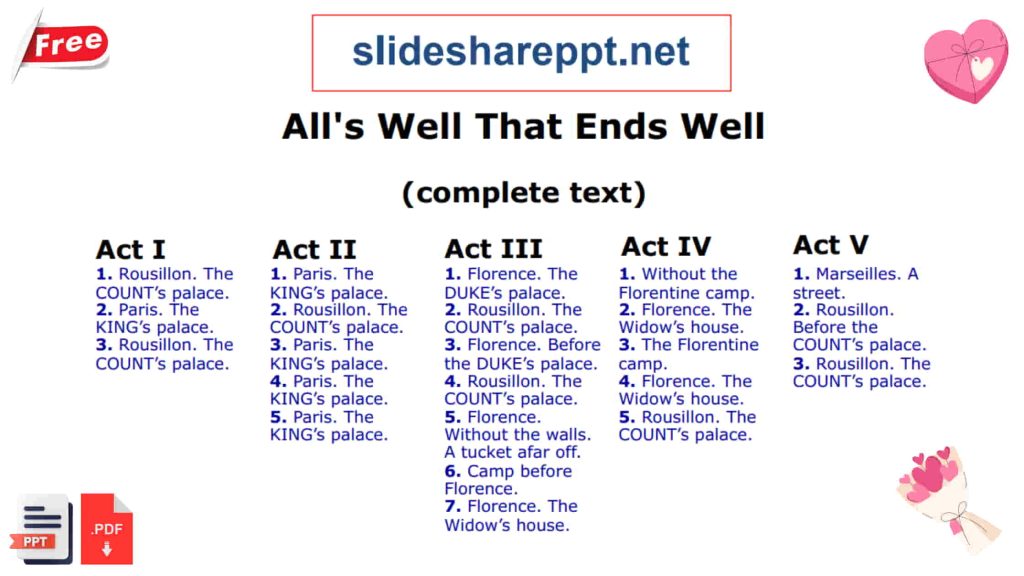
Note: The complete Text PDF Link is at the end of the PowerPoint slides (go to the last PPT Slide)
Key Quotes and Lines
Key Quotes and Lines: All’s Well That Ends Well
| Quote | Speaker | Context |
|---|---|---|
| “All’s well that ends well; still the fine’s the crown; Whate’er the course, the end is the renown.” | Helena | Helena speaks these lines in Act 4, Scene 4, expressing the play’s central theme of redemption and the belief that a positive outcome justifies the means. |
| “Love all, trust a few, Do wrong to none.” | Countess | The Countess advises Helena in Act 1, Scene 1, offering words of wisdom about love, trust, and integrity. |
| “Our remedies oft in ourselves do lie, Which we ascribe to heaven.” | Helena | Helena reflects on the power of self-reliance and determination in Act 1, Scene 1, highlighting the importance of taking control of one’s destiny. |
| “They say miracles are past; and we have our philosophical persons to make modern and familiar, things supernatural and causeless.” | Clown | The Clown comments on skepticism and the diminishing belief in miracles in Act 2, Scene 3, adding a touch of humor and irony to the play. |
| “The web of our life is of a mingled yarn, good and ill together.” | Clown | The Clown reflects on the complexities of life in Act 4, Scene 3, emphasizing the intertwined nature of good and evil. |
| “No legacy is so rich as honesty.” | Lafew | Lafew extols the value of honesty in Act 3, Scene 5, suggesting that integrity is the greatest legacy one can leave behind. |
| “Love all, trust a few, Do wrong to none.” | Lafew | Lafew echoes the Countess’s advice to Helena in Act 1, Scene 1, emphasizing the importance of love, trust, and moral conduct. |
| “Lord, Lord, how subject we old men are to this vice of lying!” | Lafew | Lafew reflects on the tendency of older men to deceive themselves and others in Act 1, Scene 3, adding depth to his character. |
| “The hind that would be mated by the lion Must die for love.” | Parolles | Parolles speaks these lines in Act 4, Scene 3, illustrating his cynical view of love and the sacrifices it demands. |
| “Our doubts are traitors, And make us lose the good we oft might win, By fearing to attempt.” | Lucio | Lucio speaks these lines in Act 1, Scene 4, highlighting the destructive nature of doubt and the importance of taking risks. |
These key quotes and lines from “All’s Well That Ends Well” capture the play’s themes, character motivations, and philosophical musings, enriching the text and providing insight into Shakespeare’s exploration of human nature and relationships.
Q&A:
-
What is the central theme of “All’s Well That Ends Well”?
- The central theme of “All’s Well That Ends Well” revolves around the complexities of love, social class, deception, and redemption. The play explores the transformative power of love and the possibility of redemption even in the face of adversity.
-
Who are the main characters in “All’s Well That Ends Well,” and what roles do they play?
- The main characters include Helena, Bertram, the Countess Rossillion, the King of France, Parolles, Diana, Lafeu, and various lords. Helena is the protagonist, Bertram is the object of her affection, the Countess serves as Helena’s confidante, the King of France sets the events in motion, Parolles provides comic relief, and the other characters contribute to the plot’s development and resolution.
-
What is the significance of Helena’s character in the play?
- Helena’s character is significant as she represents determination, perseverance, and the power of love. Despite facing rejection and societal barriers, Helena pursues her love for Bertram with unwavering resolve, ultimately winning his affection through her intelligence and kindness.
-
How does “All’s Well That Ends Well” differ from Shakespeare’s other comedies?
- “All’s Well That Ends Well” differs from Shakespeare’s other comedies in its darker themes and complex characters. While it contains elements of comedy, such as mistaken identities and humorous situations, the play also explores issues of morality, social class, and personal transformation in a more nuanced manner.
-
What role does deception play in the plot of “All’s Well That Ends Well”?
- Deception plays a significant role in the plot of “All’s Well That Ends Well,” as characters employ disguises, trickery, and schemes to achieve their goals. Helena disguises herself as a pilgrim, Diana aids in the bed-trick, and Parolles’s deceitfulness leads to his downfall. The theme of deception underscores the play’s exploration of appearance versus reality.
-
How does the play conclude, and what message does it convey?
- The play concludes with the reconciliation between Bertram and Helena, facilitated by the intervention of the King of France. The characters celebrate their newfound happiness, and the title “All’s Well That Ends Well” suggests that despite the challenges and uncertainties they faced, a happy resolution has been achieved.
-
What is the significance of the title “All’s Well That Ends Well”?
- The title “All’s Well That Ends Well” encapsulates the play’s central message that a satisfactory outcome justifies the means, even if the journey is fraught with difficulties. It suggests that despite the trials and tribulations faced by the characters, as long as they find happiness and resolution in the end, all preceding troubles are justified.