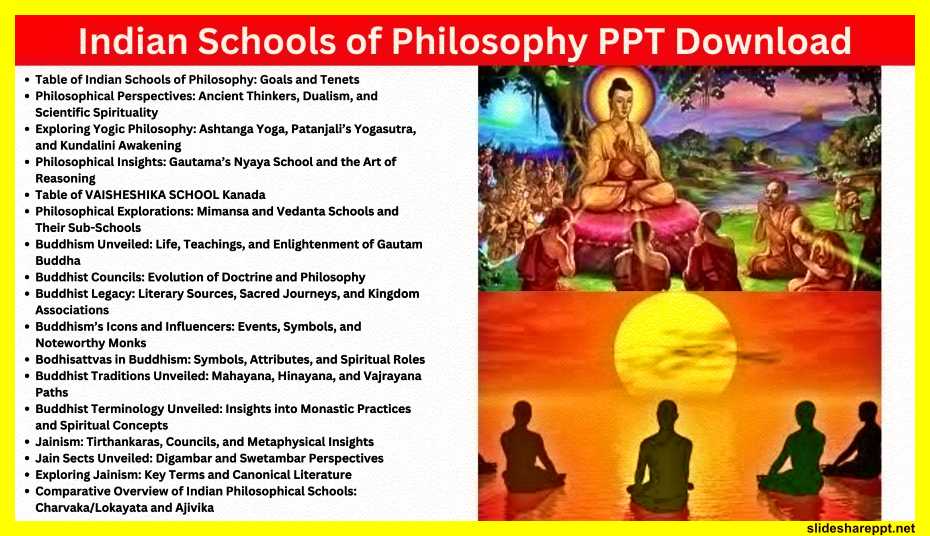
Indian Schools of Philosophy PPT Download
Today we will share the Complete Notes related to Indian Schools of Philosophy PPT Download and UPSC PDF Download, you can read these Notes in Almost All Languages, just by pressing the Google Translation Button (See upside right, without Scroll).
- India has been a cradle of diverse philosophical traditions, each offering unique perspectives on existence, morality, and the nature of reality. These schools of thought, rooted in ancient texts and the intellectual traditions of the Indian subcontinent, have played a significant role in shaping the country’s cultural and spiritual landscape. In this article, we explore some of the prominent Indian schools of philosophy that have flourished over the centuries.
Indian Schools of Philosophy
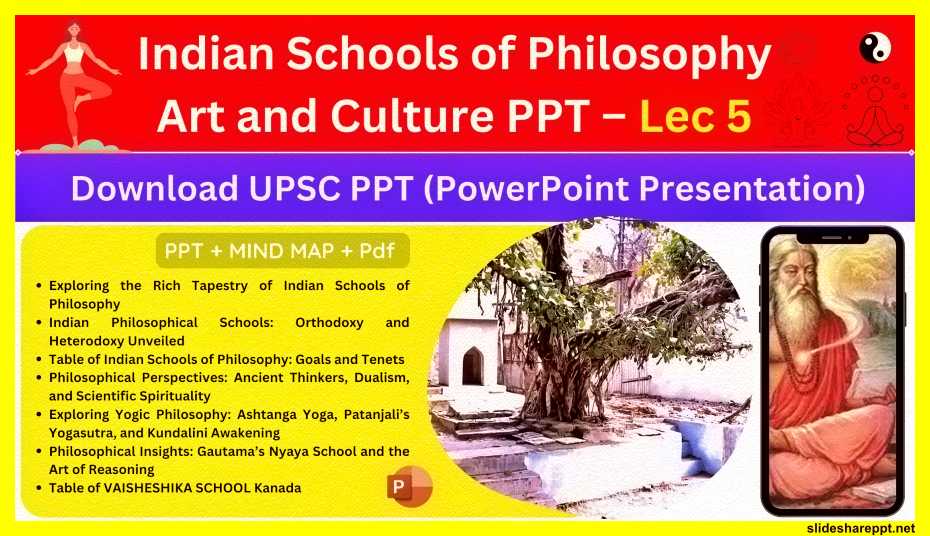
(PPT – Lec 5)
Note:-
- If you are viewing this PPT on your phone, please make it full screen and then view it. (Press: 3 dots in PPT, then Full Screen)
- If you have a problem while clicking on next, (Just tap) on the slide instead of clicking Next Botton.
- FOR A BETTER VIEW PRESS Ctrl + Shift + F ON A PC OR LAPTOP.
- Whatever is written in the PPT is different and whatever is written below is different.
UPSC Prelims PPT Bundle Product Details
(BUY ONLINE)
| Placement / Section | Details / Click To Action Text |
|---|---|
| Title | UPSC Prelims PPT Notes (BUNDLE) |
| Number of PPTs / Slides | 160+ PPTs |
| Delivery Method | Instant Access after Payment (Google Drive Folder) |
| Additional Info | Full UPSC Prelims Coverage, Study-Friendly PPT Format |
| Copyright / Ownership | Self-made Notes (slideshareppt.net) |
| Payment | Online Gateway – QR, CREDIT CARD, UPI etc… |
| Pricing / Purchase CTA |
Check Price & Buy (Redirects to Pricing Page) |
| Demo Link | View Sample Slides (Click to Open Demo) |
Exploring the Rich Tapestry of Indian Schools of Philosophy
India has been the cradle of diverse philosophical traditions that have flourished over thousands of years. The Indian subcontinent has been home to a multitude of philosophical schools, each offering unique perspectives on life, existence, and the nature of reality. These schools, collectively known as “darshanas,” have played a crucial role in shaping the intellectual and spiritual landscape of the region. In this article, we will delve into some prominent Indian schools of philosophy, each with its distinctive approach to understanding the world.
- Nyaya – The School of Logic: Nyaya, one of the six orthodox (astika) schools of Hindu philosophy, is characterized by its emphasis on logical reasoning and analysis. Founded by sage Gautama, Nyaya explores the nature of knowledge (epistemology) and the principles of valid inference. The Nyaya Sutras provide a systematic exposition of its doctrines, and the school has contributed significantly to Indian debates on logic and debate methodologies.
- Vaisheshika – The Atomistic School: Founded by sage Kanada, Vaisheshika delves into the nature of the physical world and the concept of atoms (anu). It posits that the universe is composed of discrete, indivisible particles and explores the interplay of these atoms to explain the diversity of existence. Vaisheshika and Nyaya are often studied together, as they share common ground on epistemology and logic.
- Samkhya – The Enumeration School: Attributed to the sage Kapila, Samkhya is one of the oldest philosophical systems in India. It provides a detailed analysis of the components of the material world and explores the relationship between the eternal principles of Purusha (consciousness) and Prakriti (matter). Samkhya is foundational to the development of yoga, and its concepts have influenced various streams of Hindu thought.
- Yoga – The Path to Liberation: Although often associated with physical postures and exercises in the modern world, Yoga, as a philosophical system, is rooted in the ancient Indian traditions. Sage Patanjali’s Yoga Sutras outline the path to spiritual realization through ethical and mental discipline. The eight limbs of yoga include moral precepts, physical postures, breath control, and meditation, aiming to achieve a state of self-realization and union with the divine.
- Mimamsa – The School of Rituals: Mimamsa, founded by sage Jaimini, focuses on the interpretation of Vedic rituals and sacrificial ceremonies. It emphasizes the importance of proper ritual performance as prescribed in the Vedas and debates the nature of dharma (duty/righteousness). Mimamsa contributed significantly to the development of Hindu orthopraxy and scriptural hermeneutics.
- Vedanta – The End of the Vedas: Vedanta represents the culmination of Vedic thought and is often considered the most influential of all Indian philosophical schools. It interprets the Upanishads, the culmination of Vedic literature, and explores the nature of ultimate reality (Brahman) and the individual soul (Atman). Vedanta encompasses various sub-schools, including Advaita (non-dualism), Vishishtadvaita (qualified non-dualism), and Dvaita (dualism), offering diverse perspectives on the relationship between the individual and the cosmic reality.
Conclusion:
- The Indian schools of philosophy form a rich tapestry that reflects the intellectual curiosity and spiritual inquiry of the ancient sages. While these schools may differ in their foundational principles and approaches, they collectively contribute to the philosophical heritage of India, fostering a tradition of contemplation, debate, and the relentless pursuit of truth.
Indian Philosophical Schools: Orthodoxy and Heterodoxy Unveiled
Here’s the information organized in Table:
Orthodox Schools:
| School | Goals | Key Texts, Distinctive Features |
|---|---|---|
| Vedanta | Moksha | Upanishads, Brahma Sutras, Bhagavad Gita; Non-dualism (Advaita), Dualism (Dvaita), Qualified Non-dualism (Vishishtadvaita) |
| Samkhya | Kaivalya | Samkhya Karika; Enumeration of fundamental principles, dualistic worldview |
| Yoga | Moksha | Yoga Sutras of Patanjali; Karma Yoga, Bhakti Yoga, Jnana Yoga, Raja Yoga |
| Nyaya | Dharma, Moksha | Nyaya Sutras; Logical reasoning, epistemology |
| Vaisheshika | Dharma, Moksha | Vaisheshika Sutras; Atomistic theory, theory of categories |
| Mimamsa | Dharma | Purva Mimamsa Sutras; Focus on rituals and religious duties |
Heterodox Schools:
| School | Goals | Key Texts, Distinctive Features |
|---|---|---|
| Buddhism | Nirvana | Tripitaka; Theravada, Mahayana, Vajrayana; Four Noble Truths, Eightfold Path |
| Jainism | Moksha | Jain Agamas, Tattvartha Sutra; Non-violence (Ahimsa), emphasis on ascetic practices |
| Charvaka | Materialistic pursuits | Charvaka Sutras (Not extant); Radical materialism, rejection of the supernatural |
| Ajivika | Niyati (Determinism) | Scarce, influenced by Jainism and Buddhism; Fatalism, denial of free will |
This layout ensures a clear presentation of the information with three distinct columns: School, Goals, and Key Texts/Distinctive Features.
Table of Indian Schools of Philosophy: Goals and Tenets
Here’s a complete table summarizing the Indian schools of philosophy along with their goals and categorization:
| School of Philosophy | Goals | Key Tenets/Features |
|---|---|---|
| ORTHODOX | ||
| 1. Sankhya | 1. Artha | Dualism: Purusha and Prakriti |
| 2. Yoga | 2. Dharma | Eightfold Path |
| 3. Nyaya | 3. Kama | Logic and epistemology |
| 4. Vaisheshika | 4. Moksha | Atomistic metaphysics |
| 5. Mimansa | Ritual exegesis of Vedas | |
| 6. Vedanta | Brahman-Atman unity, Upanishadic | |
| philosophy | ||
| HETERODOX | ||
| 1. Buddhism | 1. Dukkha | Four Noble Truths, Eightfold Path |
| 2. Jainism | 2. Dharma | Ahimsa, Anekantavada, Syadvada |
| 3. Charvaka | 3. Кama | Materialism, rejection of the afterlife |
| 4. Ajivika | 4. Moksha | Determinism, no self-control |
Note: The goals mentioned in the table are the classical goals of life (Purusharthas) in Hindu philosophy:
- Artha (material prosperity)
- Dharma (righteous duty)
- Kama (pleasure)
- Moksha (liberation)
Each school of philosophy has its own interpretation and approach towards these goals.
Philosophical Perspectives: Ancient Thinkers, Dualism, and Scientific Spirituality
Here’s a complete table:
| Category | School | Perspective/Characteristics |
|---|---|---|
| Oldest | Kapila Muni | Original – God not considered necessary |
| SANKHYA SCHOOL | New – God created the universe | |
| Scientific – Emphasis on empirical knowledge | ||
| Universe – Views on the creation of the universe | ||
| Spirituality – Focus on spiritual understanding | ||
| Materialistic – Primarily concerned with material aspects | ||
| Salvation – Liberation from the material world | ||
| 1. Pratyaksha – Direct perception as a valid source | ||
| 2. Anumana – Inference as a means of knowledge | ||
| 3. Shabda – Verbal testimony as a source | ||
| DVAITAVADA | Dualistic philosophy – 1. Purush (The eternal individual soul) | |
| 2. Prakriti (The eternal primal matter) |
Note: The table summarizes the information provided, highlighting the key aspects of each category and school of thought.
Exploring Yogic Philosophy: Ashtanga Yoga, Patanjali’s Yogasutra, and Kundalini Awakening
Here’s a complete table:
| School | Sub-School/Method | Philosophical Concepts |
|---|---|---|
| YOGA SCHOOL | Ashtanga Yoga | Dualism –
1. Body 2. Mind |
| Patanjali – Yogasutra | 1. Yama – Moral disciplines | |
| 2. Niyama – Observances | ||
| 3. Pratyahara – Withdrawal of the senses | ||
| 4. Dharna – Concentration | ||
| 5. Dhyana – Meditation | ||
| 6. Samadhi – State of meditative absorption | ||
| 7. Asana – Physical postures | ||
| 8. Pranayama – Control of breath | ||
| Kundalini Jagran – Awakening of the dormant spiritual energy |
Note: The table summarizes the information provided, highlighting the key components of the Yoga school, Patanjali’s Yogasutra, and the concept of Kundalini Jagran.
Philosophical Insights: Gautama’s Nyaya School and the Art of Reasoning
Here’s the information:
| Philosophical Aspect | Philosopher | Key Concepts |
|---|---|---|
| Reasoning/Logical Thinking | Gautama | – NYAYA SCHOOL |
| – 4 Pramana: | ||
| 1. Pratyaksha (Perception) | ||
| 2. Anumana (Inference) | ||
| 3. Upamana (Comparison) | ||
| 4. Shabda (Verbal testimony) | ||
| – Theory of Causation |
Table of VAISHESHIKA SCHOOL Kanada
Here’s a complete informative table:
| Philosophical School | Philosopher | Key Concepts |
|---|---|---|
| VAISHESHIKA SCHOOL | Kanada | Reality is the world |
| 5 Main Elements: | ||
| 1. Air | ||
| 2. Water | ||
| 3. Fire | ||
| 4. Earth | ||
| 5. Sky | ||
| Belief: | ||
| 1. God | ||
| 2. Karma |
This table provides an overview of the Vaisheshika school, its philosopher (Kanada), and the key concepts, including the belief in God and the elements that constitute reality.
Philosophical Explorations: Mimansa and Vedanta Schools and Their Sub-Schools
Here’s the information:
| Philosophical School | Sub-school | Key Concepts and Figures |
|---|---|---|
| MIMANSA SCHOOL | Purva Mimansa | Emphasis on Vedas |
| Reasoning, Interpretation, and Application | ||
| Key Figure: Jaimini | ||
| VEDANTA SCHOOL | Uttar Mimansa | Theory of Karma |
| Brahmasutra | ||
| Advaita | Knowledge of Self (Aham Brahmasmi) | |
| Key Figure: Shankaracharya | ||
| Vishishtadvaita | The qualified non-dualism | |
| Key Figure: Ramanujacharya | ||
| Dvaita | Theistic dualism | |
| Key Figure: Madhawacharya |
Buddhism Unveiled: Life, Teachings, and Enlightenment of Gautam Buddha
Here’s a complete informative table:
| Aspect | Details |
|---|---|
| Founder | Gautam Buddha |
| Birth | 563 BC |
| Place | Lumbini, Nepal |
| Father | Sudodhana |
| Mother | Mahamayadevi |
| Varna | Kshatriya |
| Clan | Shakya |
| Principality | Kapilavastu |
| Wife | Yashodhara |
| Son | Rahul |
| Four Signs | 1. Old man |
| 2. Sick man | |
| 3. Dead body | |
| 4. Monk | |
| Key Events in Buddha’s Life | Mahabhinishkraman (Great Renunciation) |
| 29 Years – Parivrajak (Wandering Ascetic) | |
| Enlightenment under the Bodhi tree | |
| Preaching of the 8-Fold Path | |
| First Sermon – Dhammachakrapravartana | |
| Mahaparinirvana at the age of 80 (483 BC) | |
| 8-Fold Path | 1. Right View |
| 2. Right Intention | |
| 3. Right Speech | |
| 4. Right Action | |
| 5. Right Livelihood | |
| 6. Right Effort | |
| 7. Right Mindfulness | |
| 8. Right Concentration | |
| Teaching Locations | Alara Kalam (Sankhya) |
| Uruvella (Niranjana River) | |
| Deer Park, Isipatana (First Sermon) | |
| Nirvana | Attained after 49 days of meditation |
| Dhammachakrapravartana (Turning the Wheel of Dharma) | |
| Magga (The Path) | Arya Satya (Noble Truths) |
| Dukkha (Suffering) | |
| Samudaya (Cause of Suffering) | |
| Nirodha (Cessation of Suffering) | |
| Magga (Path leading to the Cessation) |
This table provides a comprehensive overview of the key aspects related to the life, teachings, and events in the life of Gautam Buddha and Buddhism.
Buddhist Councils: Evolution of Doctrine and Philosophy
Here’s the information:
| Council | Year | Location |
|---|---|---|
| 1st Council | – | 483 BC |
| 2nd Council | – | 383 BC |
| 3rd Council | 250 BC | Pataliputra |
| 4th Council | 78 AD | Kundalvana, Kashmir |
| Key Figures | Canonical Texts | Philosophical Characteristics |
|---|---|---|
| Rajgriha, Ajatasatru, Mahakashyap | Suttapitaka (Teachings of Buddha), Divided into schools: Theravada, Mahasanghika, and others, Various Nikayas (collections of discourses) | – |
| Vaishali, Kalashok, Sabakami | Digha Nikaya, Majjhima Nikaya, Samyutta Nikaya, Anguttara Nikaya, Khuddaka Nikaya, Vinayapitaka (part of the Pali Canon), Metaphysical thoughts on the universe | – |
| Pataliputra, Ashoka, Mogaliputta Tissa | Theravada is considered original, Abhidhammapitaka, Lesser vehicle, Orthodox, No idol worship, Pali Canon | – |
| Kundalvana, Kashmir, Kanishka, Vasumitra, Ashvaghosha | Mahavibhasa (Commentary on Vinaya), Hinayana, Mahayana, Greater vehicle, Liberal, Idol worship, Sanskrit Canon, Various schools (Sautantrika, Sammittiya, etc.) | – |
Buddhist Legacy: Literary Sources, Sacred Journeys, and Kingdom Associations
Here’s the information:
| Literary Sources | Places Visited by Buddha | Kingdoms Associated with Buddha |
|---|---|---|
| Ceylonese Chronicles: Mahavamsa, Dipavamsa, Attakatha; Tibetan Chronicles: Divyavandana, Kalachakra; Milindapanho | Sarnath, Varanasi, Rajagriha, Vaishali, Sravasti, Pawapuri, Kushinagar | Kosala, Magadha, Vaishali, Champa, Kaushambi, Susumargiri, Vali |
| Trisiksha, Tripitaka (Three Baskets): Vinaya (Morality), Sutta (Meditation), Abhidhamma (Wisdom) | Cities: Sarnath, Varanasi, Rajagriha, Vaishali, Sravasti, Pawapuri, Kushinagar | Not specified in the provided information |
| Sarnath, Varanasi, Rajagriha, Vaishali, Sravasti, Pawapuri, Kushinagar | Monastic Centers: Sarnath, Rajagriha, Vaishali, Sravasti; Places of Enlightenment: Bodh Gaya, Sarnath | Kingdoms: Kosala, Magadha, Vaishali, Champa, Kaushambi, Susumargiri, Vali |
| Kosala, Magadha, Vaishali, Champa, Kaushambi, Susumargiri, Vali | Other Places: Kapilavastu, Lumbini, Kapilavastu, Shravasti, Jetavana, Nalanda; Final Resting Place: Kusinara | Not specified in the provided information |
| Jataka Tales, Nidankatha (1st connected Buddha story) | Sacred Places: Lumbini, Bodh Gaya, Sarnath, Kushinagar | Not specified in the provided information |
Buddhism’s Icons and Influencers: Events, Symbols, and Noteworthy Monks
Here’s a complete informative table:
| Event | Symbol |
|---|---|
| Avakranti | White elephant |
| Jati | Lotus, Bull |
| Mahabhinishkramana | Horse |
| Nirvana | Stupa, Bodhi tree |
| Sambodhi | Bodhi tree |
| Dharmachakrapravartana | Wheel |
| Mahaparinirvana | Stupa |
| Important Monks | Roles/Contributions |
|---|---|
| Ananda | Attendant, Treasurer of Dhamma |
| Sariputra | 1st of the Buddha’s 2 chief male disciples |
| Nagarjuna | Madhyamika school, Theory of Sunyavad, Mulamadhyamakakarika |
| Mahakassapa | President – 1st Council |
| Aniruddha | Right Mindfulness |
| Moggaliputta Tissa | Dhamma campaign |
| Asvaghosha | Wrote Buddhacharita, Sariputra Prakarna |
| Buddhaghosha | Wrote Visuddimagga |
| Dharmakirti | Contributed to the Buddhist logic, known as the Kant of India |
This table provides an overview of various events, symbols associated with Buddhism, and notable contributions or roles of important monks in the history of Buddhism.
Bodhisattvas in Buddhism: Symbols, Attributes, and Spiritual Roles
Here’s a complete informative table:
| Bodhisattva | Attributes/Associations |
|---|---|
| Maitreya | Future Buddha |
| Laughing Buddha | |
| Associated with Amitabha and the Lotus Sutra | |
| Ajitaboddhisatva | Symbolized by the Thunderbolt |
| Associated with the Ajanta Caves | |
| Va Trapani Amitabha | Represented as the Buddha of Heaven |
| Avalokiteshvara | Universal Bodhisattva |
| Also known as Padmapani | |
| Kind-hearted and associated with meditation | |
| Samantabhadra | Universal Bodhisattva |
| Sadaparibhuta | Embodies the never-disparaging spirit |
| Kshitigarbha | Guardian of children |
| Manjushri | Embodies understanding and Buddha’s knowledge |
| Akasagarbha | Embodies wisdom |
This table provides an overview of various Bodhisattvas along with their attributes and associations in Buddhist tradition.
Buddhist Traditions Unveiled: Mahayana, Hinayana, and Vajrayana Paths
Here’s the table:
| Major Schools of Buddhism | Mahayana | Hinayana (Theravada & Sarvastivada) |
|---|---|---|
| Salvation | Buddha, Bodhisattva | Individual salvation |
| Origin | Northern India, Kashmir | Sri Lanka |
| Spread | Central Asia, East Asia, Southeast Asia | Southeast Asia: Cambodia, Laos, Myanmar, Thailand, Sri Lanka |
| Language | Sanskrit | Pali |
| Sub-schools | Yogachara, Madhyamika | Sarvastivada, Theravadin, Sautantrika |
| Main Tenet | Great Vehicle | Lesser Vehicle |
| Monastic Focus | Boddhisattva-focused | Arhat-focused |
| Sites | – | Thotlakonda Buddhist Site in Andhra Pradesh, India |
| Prominent Figures | – | – |
| Major Schools of Buddhism | Vajrayana |
|---|---|
| Salvation | Magical powers, enlightened being |
| Origin | Developed in India (circa 900 CE) |
| Spread | Eastern India: Bengal, Bihar; Tibet |
| Language | Sanskrit |
| Sub-schools | – |
| Main Tenet | Vehicle of Thunderbolt |
| Monastic Focus | Emphasis on magical practices |
| Sites | – |
| Prominent Figures | Padmasambhava in Tibet |
Buddhist Terminology Unveiled: Insights into Monastic Practices and Spiritual Concepts
Here’s a complete informative table based on the provided information:
| Important Terms | Meaning/Description |
|---|---|
| PARIVRAJAKA | Ritual of ascetic vetting or wandering mendicancy |
| UPASAMPADA | Monastic ordination process |
| ARHAT | One who has attained enlightenment and liberation |
| AGRAHARIKA | A monk who is permitted to eat afternoon |
| POSADHA | Buddhist day of observance, assembly at the end of Vassa |
| NIRVANA | Liberation from the cycle of rebirth and suffering |
| Restoration of vows | Ritual to restore monastic vows |
| Renunciant | One who has renounced worldly life |
| UPASIKA | Laywoman or female lay follower |
| Lands | The areas or territories where Buddhism is practiced |
| Lay Follower | A follower of Buddhism who is not a monastic |
| Supreme Bliss | Ultimate happiness or enlightenment |
| PARAMITAS | Perfections, virtues cultivated on the path to enlightenment |
| ANATMAN | Denial of belief in an eternal, unchanging self |
| SRAMANA | A wandering ascetic or seeker of truth |
| SHEEL | Moral conduct, ethical behavior |
| Perfection | Attainment of the highest qualities and virtues |
| Denial of belief in | The rejection of the concept of an eternal, unchanging self |
| Seeker | One who is on a quest for spiritual truth and understanding |
| Layperson leaves home | A decision by a layperson to follow a monastic lifestyle |
| PAVARANA | Ritual of inviting criticism and feedback among monks |
| Assembly at the end of Vassa | Gathering of the monastic community at the end of the rainy season retreat |
| UPOSTHA | Buddhist Day of Observance, a time for reflection and restraint |
| VASSA | The three-month annual retreat observed by monastics |
This table provides an overview of various important terms in Buddhism along with their meanings or descriptions.
Jainism: Tirthankaras, Councils, and Metaphysical Insights
Tirthankaras, Birth Details, Renunciation, Key Events, Teachings/Philosophy
| Tirthankaras | Birth Details | Renunciation, Key Events | Teachings/Philosophy |
|---|---|---|---|
| 1st Rishabnath | Born: Kundagram, Vaishali | Left home at 30, Kevalya attained | Jina (Victor), Right Knowledge |
| 23rd Parsvnath | – | @ age 40 | – |
| 24th Mahavira | Born: Kundagram, Vaishali | Left home at 30, Jina attained | Ahimsa, Satya, Asatya, Aparigraha, Brahmacharya (Five Doctrines), Triratna (Right Knowledge, Right Action, Right Belief) |
Jainism, Historical Events, Doctrines and Teachings
| Jainism | Historical Events | Doctrines and Teachings |
|---|---|---|
| 1st Jain Council (299 BCE) | Location: Pataliputra, Attendees: Bindusara, Chandragupta Maurya, Sthulbhadra | – |
| – | ||
| 2nd Jain Council (512 AD) | Location: Valabhi, Gujarat, Attendees: Chalukyan rulers, Devardhi Ksema Shramana, Jain literature | Canonical Texts: Anga, Upanga, Prakirna, Chedab Sutra, Mulsutra, Bhagwati Sutra |
Metaphysical Thoughts
| Metaphysical Thoughts | Universe, Vedas, God, Rebirth |
|---|---|
| – | Universe: Jain cosmology describes the universe with six eternal substances (dravyas), Vedas: Not considered authoritative, God: Multiple gods but not a creator, Rebirth: Fundamental belief in the cycle of birth and death |
Jain Sects Unveiled: Digambar and Swetambar Perspectives
Here’s the information presented in a complete informative table:
Jain Sects, Vows, Angas, Major and Minor Subsects
| Jain Sects | Digambar | Swetambar |
|---|---|---|
| Vows | Follow all 5 vows | Follow 4 vows (except Brahmacharya) |
| Angas | Rejected 12 Angas | Accepted Angas |
| Views on Women | Women can’t achieve salvation | Women can achieve salvation |
| Major Subsects | 1. Mula Sangha: Acharya Kundakunda
2. Bisapantha: Support Dharma gurus + idol worship 3. Kashtha Sangha: Lohacharya; Agrawal Jains 4. Samaiyapantha: Amra Bhaunsa Godika; Jodhraj Godika |
1. Sthanakvasi: Lavaji; Oppose idol worship
2. Murtipujaka: Tirthankaras idol worship 3. Terapanth: Acharya Bhikshu; 13 religious principles |
| Minor Subsects | 1. Gumanapantha: Ft Gumani Rama; Prohibit lighting of candles in Jain temples
2. Totapantha: Bispanthi Terapanthi |
– |
This table provides an overview of the key differences between Digambar and Swetambar sects in Jainism, including their views on vows, Angas, the role of women, and major/minor subsects.
Exploring Jainism: Key Terms and Canonical Literature
Here’s the information presented in a table:
Jainism Terms and Jain Literature
| Jainism Terms | Meaning/Description |
|---|---|
| ASRAV | Inflow of karma |
| SAMVARA | Stoppage of an influx of material karmas |
| NIRJARA | Removal of accumulated karmas |
| SALLEKHANA | Voluntary fasting to death, also known as Santhara |
| KAIVALYA | Keval Jnana (Supreme Knowledge), ultimate liberation |
| Adinath | First Tirthankara in Jain tradition |
| Jain Literature | Description |
| Jain Agamas | Canonical texts in Prakrit, including
1. Agmas 2. Mulasutra 3. Upangas 4. Prakirnaka sutra 5. Chedasutra 6. Ulikasutra |
| Kalpasutra | Authored by Bhadrabahu, includes biographies |
| Non-Agam Literature | Explanation of Agam literature, available in Prakrit, Sanskrit, Apabhramsa, etc. |
| 14 Purvas | Knowledge of the universe |
| Mulasutra, Acharanga Sutra | Jain scriptures provide guidelines for monastic life |
This table provides an overview of important terms in Jainism and key aspects of Jain literature, including Agamas, Kalpasutra, non-Agam literature, and specific texts like Mulasutra and Acharanga Sutra.
Comparative Overview of Indian Philosophical Schools: Charvaka/Lokayata and Ajivika
Here’s the information presented in a table:
| Philosophical School | Key Figures | Associated Texts, Philosophical Perspective, Relation to Buddhism |
|---|---|---|
| Charvaka/Lokayata School | Charvaka (Founder), Brihaspati | Brihadaranyaka Upanishad, Materialism, Not directly related to Buddhism |
| Ajivika School | Makkhali Gosala (Founder) | Niyati (Doctrine), Fatalism and Determinism, Close association with Buddhism |
This table maintains clarity by organizing the information into columns: the philosophical school, key figures, associated texts, philosophical perspective, and relation to Buddhism.
In conclusion,
- The Indian schools of philosophy represent a rich tapestry of thought, contributing to humanity’s understanding of life, consciousness, and the pursuit of higher ideals. The dialogue and interactions between these diverse traditions have not only shaped the cultural heritage of India but have also provided profound insights that resonate with seekers of wisdom around the world.
Also Read: Indian Puppetry, Theatre, Martial Arts, Sci & Tech UPSC PPTs