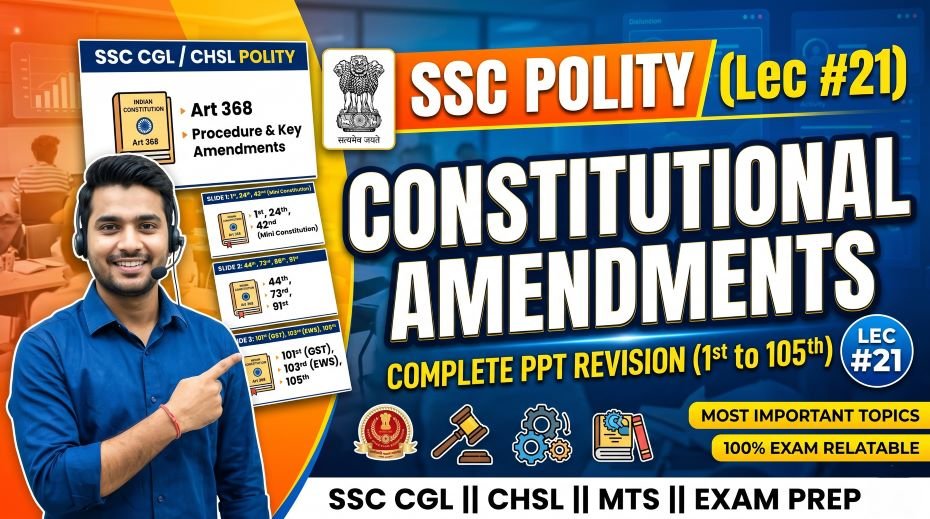
This article covers SSC Polity Constitutional Amendment PPT Slides (LEC #22) – Constitutional Amendment (संवैधानिक संशोधन), part of the Complete Foundation Batch PPT Series at slideshareppt.net. Constitutional Amendments are one of the highest-frequency topics in SSC CGL, CHSL, CPO, and MTS exams. Questions are asked on specific amendment numbers and their provisions, the three methods of amendment, the Basic Structure Doctrine, landmark cases (Kesavananda Bharati, Minerva Mills, Golak Nath), and key amendments like the 42nd, 44th, 52nd, 61st, 73rd, 74th, 86th, 101st, 103rd, and 106th.
PPT Details
| Field | Details |
| PPT Title | SSC Polity Constitutional Amendment PPT Slides (LEC #22) |
| Subject | Polity – Constitutional Amendment (संवैधानिक संशोधन) |
| Series | Complete Foundation Batch for All SSC and Other Exams (PPT Series) |
| Total Slides | 104 PPT Slides |
| File Size | 25 MB |
| Serial Number | #78 |
| Lecture | LEC #22 |
| Format | PowerPoint (.pptx) + PDF |
| Target Exams | SSC CGL, SSC CHSL, SSC MTS, SSC CPO, SSC GD, SSC Steno |
| Website | slideshareppt.net |
SSC Polity Constitutional Amendment PPT Slides (LEC #22)
Note: Above is PPT in GOOGLE SLIDES (HTML AND IFRAME COMBINATION) and if you wish to download the Complete SSC series (PPT slides), Simply visit this redirect page – REDIRECT PAGE.
1. Constitutional Amendment – Introduction
- The Constitution of India provides for its own amendment under Article 368 (Part XX)
- The Indian Constitution is neither purely rigid (like USA) nor purely flexible (like UK) – it is partly rigid and partly flexible
- Parliament has the power to amend the Constitution but cannot destroy its Basic Structure (Kesavananda Bharati Case 1973)
- Total Constitutional Amendments: 106 (as of 2024)
- Amendment procedure borrowed from: South Africa (for provisions requiring state ratification)
- Article 368: Power of Parliament to amend the Constitution and procedure therefor
2. Methods of Constitutional Amendment – Article 368
| Method | How Amended | Examples of Provisions | Key Point |
| Simple Majority (not covered by Article 368) | By Parliament by ordinary legislative process – simple majority of members present and voting | Admission of new states (Art 2, 3); creation/abolition of Legislative Councils (Art 169); 5th and 6th Schedules; citizenship; delimitation of constituencies; salaries of MPs; quorum | These are NOT constitutional amendments under Article 368; cannot be challenged as CA; states have no role |
| Special Majority – Article 368(2) | 2/3 of members present and voting in each House PLUS majority of total membership of each House | Fundamental Rights; Directive Principles; most other constitutional provisions; amendment of Article 368 itself | Both Houses must independently pass; no joint sitting for constitutional amendments |
| Special Majority + State Ratification – Article 368(2) proviso | Special majority in Parliament PLUS ratification by legislatures of not less than 1/2 of the states | Election of President (Art 54, 55); extent of executive power of Union and States; SC and HCs; distribution of legislative powers (7th Schedule); representation of states in Parliament; Art 368 itself | Most rigid method; at least 14 states (out of 28) must ratify; no time limit for ratification |
Provisions Requiring State Ratification
- Election of President (Articles 54, 55)
- Extent of executive power of Union and States (Articles 73, 162)
- High Courts in Union Territories (Article 241)
- Judiciary – SC and HCs (Articles 124–147, 214–231, 241)
- Distribution of legislative powers between Centre and States (Chapter I of Part XI)
- 7th Schedule (Three Lists)
- Representation of States in Parliament
- Article 368 itself
3. Procedure Under Article 368
- Bill can be introduced in either House of Parliament (Lok Sabha or Rajya Sabha)
- No special recommendation of President needed to introduce Constitutional Amendment Bill
- EXCEPTION: Bills affecting states must be referred to state legislatures for ratification AFTER passage by Parliament
- Bill cannot be passed in joint sitting of both Houses – unlike ordinary bills; if one House rejects, the CA bill fails
- After passing both Houses, sent to President for assent
- After 24th Amendment 1971: President must give assent to Constitutional Amendment Bill (cannot withhold)
- After state ratification (where required): President gives assent; amendment comes into force
4. Basic Structure Doctrine – Kesavananda Bharati Case 1973
The Basic Structure Doctrine is the most important constitutional principle in India. It holds that Parliament can amend any part of the Constitution under Article 368, but cannot alter, abrogate, or destroy the ‘basic structure’ or ‘basic features’ of the Constitution.
Elements of Basic Structure
| Element of Basic Structure | Case / Authority |
| Supremacy of the Constitution | Kesavananda Bharati Case 1973 |
| Republican and democratic form of government | Kesavananda Bharati Case 1973 |
| Secular character of the Constitution | S.R. Bommai Case 1994 |
| Separation of powers | Kesavananda Bharati Case 1973 |
| Federal character of the Constitution | Kesavananda Bharati Case 1973 |
| Unity and integrity of the Nation | Kesavananda Bharati Case 1973 |
| Judicial Review | Kesavananda Bharati Case 1973; Indira Gandhi v. Raj Narain 1975 |
| Free and fair elections | Indira Gandhi v. Raj Narain 1975 |
| Independence of the judiciary | S.P. Gupta Case 1982; Second Judges Case 1993 |
| Fundamental Rights (core) | Kesavananda Bharati Case 1973 |
| Rule of Law | Kesavananda Bharati Case 1973 |
| Balance between FRs and DPSPs | Minerva Mills Case 1980 |
| Parliamentary system of government | Indira Gandhi v. Raj Narain 1975 |
| Limited power of Parliament to amend Constitution | Kesavananda Bharati Case 1973 |
| Principle of equality | Indira Gandhi v. Raj Narain 1975 |
How the Doctrine Developed
- Shankari Prasad (1951): Parliament can amend FRs – constitutional amendment is not ‘law’ under Art 13
- Golak Nath (1967): Parliament CANNOT amend FRs – constitutional amendment IS ‘law’ under Art 13
- 24th Amendment (1971): Parliament passed law to explicitly override Golak Nath
- Kesavananda Bharati (1973): 13-judge bench; overruled Golak Nath; Parliament CAN amend FRs but CANNOT destroy Basic Structure
- Minerva Mills (1980): Balance between FRs and DPSPs is Basic Structure; struck down extended Art 31C
5. Landmark Supreme Court Cases on Constitutional Amendment
| Case | Year | Key Holding on Amendment Power |
| Shankari Prasad v. Union of India | 1951 | Parliament CAN amend Fundamental Rights under Article 368; ‘law’ in Art 13 does not include constitutional amendments |
| Sajjan Singh v. State of Rajasthan | 1965 | Reaffirmed Shankari Prasad; Parliament has plenary power to amend the Constitution |
| Golak Nath v. State of Punjab | 1967 | Parliament CANNOT amend Fundamental Rights; constitutional amendment is ‘law’ under Art 13; Fundamental Rights are immutable |
| Kesavananda Bharati v. State of Kerala | 1973 | Landmark 13-judge bench; overruled Golak Nath; Parliament CAN amend FRs BUT cannot destroy Basic Structure; established Basic Structure Doctrine |
| Indira Gandhi v. Raj Narain | 1975 | Free and fair elections, rule of law, judicial review are parts of Basic Structure; struck down 39th Amendment which removed election disputes from court jurisdiction |
| Minerva Mills v. Union of India | 1980 | Balance between FRs and DPSPs is Basic Structure; struck down extended Art 31C (42nd Amendment); Parliament cannot give unlimited primacy to DPSPs over FRs |
| Waman Rao v. Union of India | 1981 | Acts placed in 9th Schedule before 24 April 1973 (Kesavananda) are protected; those added after can be reviewed |
| S.R. Bommai v. Union of India | 1994 | Secularism is Basic Structure; Art 356 subject to judicial review |
| I.R. Coelho v. State of Tamil Nadu | 2007 | 9th Schedule laws added after 24 April 1973 are subject to judicial review if they violate FRs that are part of Basic Structure |
| Supreme Court Advocates-on-Record Association v. Union of India (NJAC Case) | 2015 | Struck down 99th Amendment and NJAC Act; independence of judiciary is Basic Structure |
6. All Major Constitutional Amendments – Complete Reference Table
| Amendment | Year | Key Provisions / Changes |
| 1st Amendment | 1951 | Added 9th Schedule (protect land reform laws from judicial review); added Arts 15(4), 19(2), 31A, 31B; restricted freedom of speech |
| 4th Amendment | 1955 | Clarified that ‘compensation’ for property acquisition is not justiciable |
| 7th Amendment | 1956 | Reorganised states on linguistic basis; abolished Part A, B, C, D classification; extended jurisdiction of HCs |
| 13th Amendment | 1962 | Added Article 371A – special provisions for Nagaland |
| 14th Amendment | 1962 | Admitted Pondicherry (Puducherry) as UT; Parliament can legislate for UTs |
| 17th Amendment | 1964 | Broadened definition of ‘estate’ for 9th Schedule protection; amended Art 31A |
| 21st Amendment | 1967 | Added Sindhi to 8th Schedule – 15th language |
| 24th Amendment | 1971 | Affirmed Parliament’s power to amend ANY part of Constitution including FRs; amended Arts 13 and 368 |
| 25th Amendment | 1971 | Added Art 31C – laws implementing Art 39(b)(c) shielded from Art 14/19; replaced ‘compensation’ with ‘amount’ |
| 26th Amendment | 1971 | Abolished privy purses and privileges of former Rulers of Princely States |
| 31st Amendment | 1973 | Increased elected strength of Lok Sabha from 525 to 543 |
| 32nd Amendment | 1973 | Added Art 371D and 371E for Andhra Pradesh |
| 36th Amendment | 1975 | Made Sikkim the 22nd state of India; added Art 371F |
| 38th Amendment | 1975 | Made President’s satisfaction in proclaiming Emergency final and non-justiciable (later reversed by 44th Amendment) |
| 39th Amendment | 1975 | Disputes relating to election of President, VP, PM, Speaker placed outside jurisdiction of courts |
| 40th Amendment | 1976 | Validation of certain Central Acts placed in 9th Schedule |
| 42nd Amendment | 1976 | Most comprehensive amendment – ‘Mini Constitution’; added Fundamental Duties (Art 51A), added ‘Socialist’ and ‘Secular’ to Preamble, added ‘Integrity’, extended duration of LS and SLAs during emergency, curtailed judicial review, gave DPSPs precedence over FRs |
| 44th Amendment | 1978 | Reversed 38th, 39th, 42nd amendments’ excesses; changed ‘internal disturbance’ to ‘armed rebellion’; deleted Right to Property from FRs (Art 300A); made Arts 20, 21 non-suspendable; restored judicial review |
| 52nd Amendment | 1985 | Added 10th Schedule – Anti-Defection Law |
| 53rd Amendment | 1986 | Added Art 371G – special provisions for Mizoram |
| 55th Amendment | 1986 | Added Art 371H – special provisions for Arunachal Pradesh |
| 56th Amendment | 1987 | Added Art 371I – Goa Legislative Assembly minimum strength 30; Goa became 25th state |
| 61st Amendment | 1988 | Reduced voting age from 21 to 18 years (Art 326) |
| 65th Amendment | 1990 | Established National Commission for Scheduled Castes and Scheduled Tribes (Art 338) |
| 69th Amendment | 1991 | Added Art 239AA – gave Delhi special status as NCT with legislature |
| 71st Amendment | 1992 | Added Konkani, Manipuri, Nepali to 8th Schedule – 18 languages |
| 73rd Amendment | 1992 | Added Part IX and 11th Schedule – Constitutional status to Panchayati Raj |
| 74th Amendment | 1992 | Added Part IX-A and 12th Schedule – Constitutional status to Urban Local Bodies |
| 76th Amendment | 1994 | Added Tamil Nadu Reservation Act to 9th Schedule – Tamil Nadu’s 69% reservation |
| 84th Amendment | 2001 | Extended freezing of LS and state assembly seats till 2026 (based on 1971 census) |
| 86th Amendment | 2002 | Added Art 21A – Right to Education; amended Art 45 and 51A |
| 87th Amendment | 2003 | Delimitation of constituencies based on 2001 census (not 1991) |
| 91st Amendment | 2003 | Capped size of CoM at 15% of LS strength; strengthened Anti-Defection Law |
| 92nd Amendment | 2003 | Added Bodo, Dogri, Maithili, Santali to 8th Schedule – 22 languages |
| 93rd Amendment | 2005 | Added Art 15(5) – reservation in private unaided educational institutions for SCs, STs, OBCs |
| 97th Amendment | 2011 | Added Part IX-B – Co-operative Societies; added Art 43B as DPSP |
| 98th Amendment | 2012 | Added Art 371J – special provisions for Hyderabad-Karnataka region |
| 99th Amendment | 2014 | Created NJAC for judicial appointments – struck down by SC in 2015 |
| 100th Amendment | 2015 | Territorial exchange agreement with Bangladesh – exchange of enclaves |
| 101st Amendment | 2016 | Introduced GST; added Art 246A and Art 279A (GST Council) |
| 102nd Amendment | 2018 | Gave constitutional status to National Commission for Backward Classes; added Arts 338B, 342A |
| 103rd Amendment | 2019 | 10% EWS (Economically Weaker Sections) reservation in education and employment (Art 15(6), 16(6)) |
| 104th Amendment | 2020 | Removed reservation for Anglo-Indians in LS and state assemblies; deleted Arts 331 and 333 |
| 105th Amendment | 2021 | Restored states’ power to identify OBCs for their own lists; amended Art 342A |
| 106th Amendment | 2023 | 33% reservation for women in Lok Sabha and State Assemblies (effective after delimitation) |
7. Most Important Amendments for SSC Exams – Detailed Notes
1st Amendment (1951) – First and Foundational
- Added 9th Schedule to protect land reform laws from judicial review
- Added Article 15(4) – special provisions for backward classes
- Added Articles 31A and 31B – property acquisition laws protected
- Added restrictions to Article 19(2) – reasonable restrictions on free speech
24th Amendment (1971) – Overturning Golak Nath
- Affirmed that Parliament has power to amend any part of Constitution including FRs
- Amended Article 368 to state explicitly that Parliament can amend the Constitution
- Amended Article 13 to clarify that constitutional amendments are NOT ‘law’ for Art 13 purposes
- Made President’s assent mandatory for Constitutional Amendment Bills
42nd Amendment (1976) – ‘Mini Constitution’
- Most comprehensive and controversial amendment; passed during the Emergency period
- Added ‘Socialist’, ‘Secular’, and ‘Integrity’ to the Preamble
- Added Fundamental Duties (Article 51A) – 10 duties
- Added Articles 43A (worker participation) and 48A (environment protection) as DPSPs
- Extended the duration of Lok Sabha and state assemblies to 6 years (later reversed by 44th Amendment)
- Curtailed judicial review; made DPSPs override FRs (Art 31C extended to all DPSPs)
- Many provisions later struck down by Supreme Court in Minerva Mills Case (1980)
44th Amendment (1978) – Restoring Democratic Safeguards
- Passed by Janata government after end of Emergency; reversed excesses of 38th, 39th, 42nd Amendments
- Changed ‘internal disturbance’ to ‘armed rebellion’ in Article 352
- Required written Cabinet recommendation before President proclaims National Emergency
- Deleted Right to Property from Fundamental Rights; made it a legal right under Article 300A
- Restored Lok Sabha’s term to 5 years (reversed 42nd Amendment’s 6-year extension)
- Made Articles 20 and 21 non-suspendable even during National Emergency
- Restored judiciary’s power of judicial review over emergency proclamations
52nd Amendment (1985) – Anti-Defection Law
- Added the 10th Schedule to the Constitution
- Provides for disqualification of MPs and MLAs who defect from their party
- Decision on disqualification: Speaker (LS/Vidhan Sabha) or Chairman (RS/Vidhan Parishad)
- Exception: merger of 2/3 of party members is not defection
- 91st Amendment (2003) removed the split (1/3) provision – only merger (2/3) allowed now
73rd and 74th Amendments (1992) – Local Self Government
- 73rd: Added Part IX and 11th Schedule; Panchayati Raj constitutional status; 29 subjects
- 74th: Added Part IX-A and 12th Schedule; Municipalities constitutional status; 18 subjects
- Both effective from 1993; gave third tier of government constitutional recognition
86th Amendment (2002) – Right to Education
- Added Article 21A – Right to Education for children aged 6–14 years (made FR)
- Amended Article 45 (DPSP) – now directs care for children below 6 years
- Added Article 51A(k) – Fundamental Duty to provide education to children aged 6–14
101st Amendment (2016) – GST
- Introduced Goods and Services Tax (GST) – biggest tax reform since independence
- Added Article 246A – both Parliament and State Legislatures can make laws on GST
- Added Article 279A – GST Council (Finance Ministers of Centre + all States)
- Subsumed Central and State taxes into one unified indirect tax
106th Amendment (2023) – Women’s Reservation
- Provides 33% reservation for women in Lok Sabha and state legislative assemblies
- Also provides reservation within the 33% for women from SC/ST communities
- Will come into effect after next delimitation (expected post-2026 census)
- Rajya Sabha and state legislative councils are NOT covered under this amendment
also read: SSC Polity Emergency Provisions PPT Slides (LEC #21)
8. Quick Revision Fact Table – Constitutional Amendments
| Fact | Detail |
| Amendment provision | Article 368 – Part XX of the Constitution |
| Total amendments (as of 2024) | 106 Constitutional Amendments |
| First Constitutional Amendment | 1951 – 9th Schedule; Art 15(4); restriction on Art 19(2) |
| Most recent amendment (as of 2024) | 106th Amendment (2023) – Women’s Reservation (33% in LS and state assemblies) |
| Amendment borrowed from | South Africa (procedure for certain provisions) |
| Methods of amendment | 3 methods: Simple majority; Special majority; Special majority + State ratification |
| Special majority definition | 2/3 of members present and voting AND majority of total membership of each House |
| State ratification – how many states | At least 1/2 of all states (currently 14 out of 28) |
| No joint sitting for CA Bills | Constitutional Amendment Bills cannot be passed in joint sitting of Parliament |
| Basic Structure Doctrine | Established by Kesavananda Bharati Case 1973 (13-judge bench) |
| 42nd Amendment | 1976 – ‘Mini Constitution’; most comprehensive amendment; added Preamble words, Fundamental Duties |
| 44th Amendment | 1978 – most important safeguard amendment; reversed excesses of Emergency period |
| Right to Property removed from FRs | 44th Amendment 1978; now under Art 300A as legal right |
| Anti-Defection Law added | 52nd Amendment 1985 – 10th Schedule |
| GST amendment | 101st Amendment 2016 – GST; Art 246A and Art 279A added |
| Women’s reservation | 106th Amendment 2023 – 33% reservation in LS and state assemblies; effective after next delimitation |
| EWS reservation | 103rd Amendment 2019 – 10% reservation for EWS |
| Golak Nath overruled by | Kesavananda Bharati Case 1973 (13-judge bench) |
| 24th Amendment purpose | To overturn Golak Nath; Parliament can amend any part of Constitution including FRs |
| Article 13(2) and amendments | Shankari Prasad (1951) held CA not ‘law’ under Art 13; Golak Nath (1967) reversed; Kesavananda (1973) final position – CA can touch FRs but not basic structure |
9. Key Takeaways for SSC Exams
- Article 368 – Part XX – Amendment of Constitution; 3 methods: simple, special, special+state ratification
- Special majority: 2/3 of members present+voting AND majority of total membership of each House
- State ratification needed for: President’s election, 7th Schedule, distribution of powers, SC/HC provisions
- No joint sitting for Constitutional Amendment Bills – both Houses must independently pass
- Kesavananda Bharati 1973 (13-judge bench) – Basic Structure Doctrine established
- Golak Nath 1967 overruled by Kesavananda Bharati 1973; 24th Amendment (1971) enacted to overcome Golak Nath
- Minerva Mills 1980 – balance between FRs and DPSPs is basic structure; extended Art 31C struck down
- 42nd Amendment 1976 – ‘Mini Constitution’; Preamble words added; Fundamental Duties added
- 44th Amendment 1978 – most important safeguard; ‘armed rebellion’; Arts 20&21 non-suspendable
- 52nd Amendment 1985 – Anti-Defection Law (10th Schedule)
- 61st Amendment 1988 – voting age reduced from 21 to 18
- 86th Amendment 2002 – Right to Education (Art 21A)
- 101st Amendment 2016 – GST; Art 246A, Art 279A
- 103rd Amendment 2019 – 10% EWS reservation
- 106th Amendment 2023 – 33% women’s reservation in LS and state assemblies
- Total amendments as of 2024: 106.