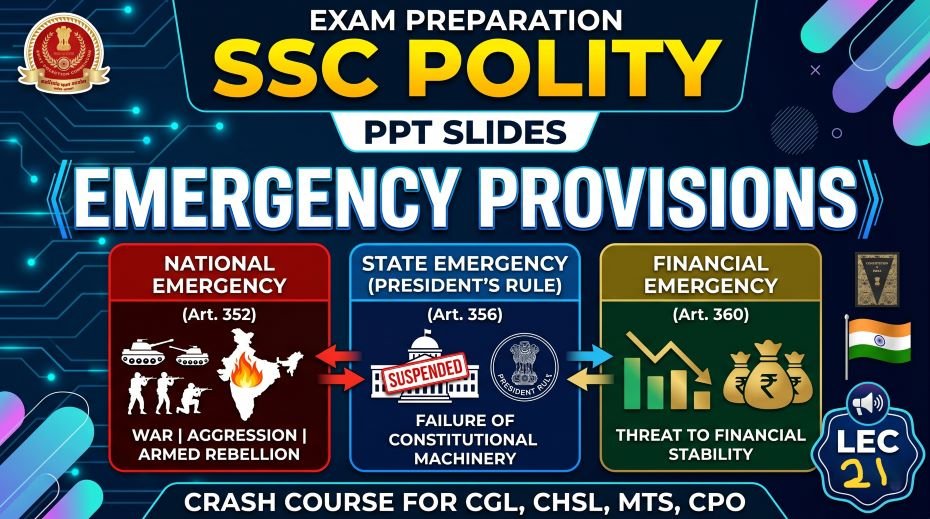
This article covers SSC Polity LEC #21 – Emergency Provisions (आपातकालीन प्रावधान), part of the Complete Foundation Batch PPT Series at slideshareppt.net. Emergency Provisions (Part XVIII, Articles 352–360) are among the most important topics for SSC CGL, CHSL, CPO, and MTS exams. Questions are asked on all three types of emergencies, the 44th Amendment, Articles 358 and 359, historical emergencies, S.R. Bommai Case, and what happens to Fundamental Rights during emergencies.
Note: Above is PPT in GOOGLE SLIDES (HTML AND IFRAME COMBINATION) and if you wish to download the Complete SSC series (PPT slides), Simply visit this redirect page – REDIRECT PAGE.
1. Emergency Provisions – Introduction
Part XVIII of the Constitution (Articles 352–360) contains Emergency Provisions
Emergency provisions convert India’s federal structure into a unitary one during crises
Three types of Emergency: (1) National Emergency (Art 352), (2) President’s Rule / State Emergency (Art 356), (3) Financial Emergency (Art 360)
Emergency provisions are considered necessary to protect the Constitution and national integrity during extreme situations
However, they can also be misused – the 1975 Emergency is India’s darkest constitutional chapter
44th Amendment 1978 added safeguards to prevent misuse of emergency powers
2. Three Types of Emergency – Complete Comparison Table
Feature
National Emergency (Art 352)
President’s Rule (Art 356)
Financial Emergency (Art 360)
Grounds
War, external aggression, armed rebellion
Failure of constitutional machinery in a state; Governor’s report OR President’s own satisfaction
Financial stability or credit of India or any state or any part is threatened
Proclaimed by
President on written advice of Union Cabinet
President
President
Cabinet recommendation
Written recommendation of Cabinet mandatory (44th Amendment 1978)
Not required – President can act on Governor’s report or own satisfaction
Not required explicitly
Parliamentary approval
Both Houses; special majority (2/3 members present+voting AND majority of total membership); within 1 month
Both Houses; simple majority; within 2 months
Both Houses; simple majority; within 2 months
Duration
6 months at a time; renewed by Parliament
6 months at a time; maximum 3 years
No maximum limit; continues as long as Parliament approves
Can LS disapprove?
Yes – Lok Sabha can pass resolution by simple majority to revoke; special sitting can be called by 1/10 of LS members
No specific provision for LS revocation
No specific provision
Effect on states
Centre can legislate on State List; Art 19 suspended; President’s Rule may follow
State administration taken over by Centre; legislature suspended/dissolved
Centre can direct states to reduce salaries; reserve money bills for President
Effect on FR
Art 19 auto-suspended during war/external aggression (Art 358); President can suspend other FRs by order (Art 359) EXCEPT Arts 20 & 21
Fundamental Rights NOT suspended
Fundamental Rights NOT suspended
Maximum duration
No limit (renewed every 6 months with parliamentary approval)
3 years (6 months at a time; beyond 1 year needs additional conditions)
No limit (renewed with parliamentary approval)
Historical use
3 times: 1962, 1971, 1975
Multiple times (50+ times)
Never imposed
3. National Emergency – Article 352 (Most Important for SSC)
Feature
Details
Constitutional Article
Article 352
Grounds
War; External Aggression; Armed Rebellion (changed from ‘Internal Disturbance’ by 44th Amendment 1978)
Who proclaims
President of India
Pre-condition
Written recommendation of Union Cabinet (44th Amendment 1978; earlier only PM’s advice was required)
Parliamentary approval
Both Houses must approve within 1 month by: 2/3 of members present and voting AND majority of total membership of each House (special majority)
Duration of each approval
6 months; Parliament must renew every 6 months with same special majority
Can Parliament revoke?
Yes – Lok Sabha can pass a resolution by simple majority to revoke National Emergency (not Rajya Sabha alone)
Special Lok Sabha sitting
If 1/10 of LS members give written notice to Speaker (or President if LS not in session), a special sitting must be called within 14 days to consider revocation
Effect on Article 19
Article 19 (6 freedoms) automatically suspended during emergency due to war/external aggression (Article 358); NOT during armed rebellion emergency
Effect on other FRs
President can suspend enforcement of other FRs by order under Article 359, EXCEPT Articles 20 and 21 (which can NEVER be suspended)
Effect on Centre-State relations
Parliament can legislate on State List subjects; Centre can give executive directions to states on any matter
Effect on tenure of LS
Lok Sabha’s term can be extended by Parliament by one year at a time during emergency
Rajya Sabha role
Rajya Sabha cannot be dissolved – it is permanent; must also approve emergency proclamation
Grounds for National Emergency – Article 352
War – armed conflict between India and another country
External Aggression – attack by a foreign power without formal declaration of war
Armed Rebellion – internal armed uprising (word changed from ‘internal disturbance’ by 44th Amendment 1978)
‘Imminent danger’ of war, external aggression, or armed rebellion is also sufficient to proclaim emergency – President need not wait for actual occurrence
Effect of National Emergency on Centre-State Relations
Parliament can make laws on subjects in the State List (Article 353)
Centre can give executive directions to states on any matter (not just matters in Union List)
President can modify provisions relating to distribution of revenues between Centre and states (Article 354)
Lok Sabha’s term can be extended by Parliament one year at a time (Article 83)
State Legislative Assembly’s term can also be extended one year at a time
4. President’s Rule – Article 356
Feature
Details
Constitutional Article
Article 356
Common name
President’s Rule / Central Rule / Governor’s Rule / State Emergency
Grounds
Governor’s report that state’s government cannot be carried on in accordance with constitutional provisions; OR President’s own satisfaction
Article 355 connection
Article 355 imposes duty on Centre to ensure state governments are carried on per Constitution – this is the basis for Art 356
Parliamentary approval
Both Houses by simple majority; within 2 months of proclamation
Duration
Maximum 3 years; each renewal for 6 months requires fresh parliamentary approval
Beyond 1 year condition
After 1 year of President’s Rule: extension needs (i) National Emergency in operation in whole India or part of state, AND (ii) Election Commission certifies elections cannot be held in the state
Effect on state
State legislature dissolved or suspended (at President’s discretion); Governor administers state on behalf of President; Parliament legislates for state
State legislature dissolution
President may dissolve state legislature or keep it under suspended animation
Revival of state government
If President’s Rule revoked, suspended legislature can be reactivated
First imposition
PEPSU (Patiala and East Punjab States Union) in 1951 – first state to have President’s Rule
Most frequent imposition
Uttar Pradesh (10+ times)
S.R. Bommai Case 1994
(i) President’s Rule subject to judicial review; (ii) State assembly not to be dissolved until Parliament approves; (iii) Floor test should be conducted before President’s Rule; (iv) Secularism is basic structure – communal governments can face Art 356
44th Amendment 1978 safeguards
President’s Rule proclamation must be approved by Parliament before President can dissolve state assembly
Safeguards Against Misuse of Article 356
Safeguard
Details
Parliamentary approval required
Both Houses must approve within 2 months; prevents indefinite imposition without legislative sanction
Maximum 3-year limit
President’s Rule cannot last beyond 3 years even with repeated parliamentary renewals
Beyond 1 year – special conditions
Extension beyond 1 year needs National Emergency operating + EC certification that elections cannot be held
Subject to judicial review
S.R. Bommai Case 1994 – courts can examine if imposition was constitutionally valid
Floor test before imposition
S.R. Bommai Case – Governor must allow ruling party to prove majority before recommending President’s Rule
Assembly not dissolved immediately
44th Amendment – assembly not dissolved until Parliament approves the proclamation; prevents irreversible step
Lok Sabha revocation power
Simple majority in Lok Sabha can revoke the President’s Rule proclamation
Grounds narrowed by courts
Courts can check if the grounds mentioned by Governor are relevant and reasonable
5. Articles 358 and 359 – Effect on Fundamental Rights
Article
Name
Application
What It Does
Limitations
Article 358
Suspension of Article 19 during emergencies
ONLY during emergencies due to War or External Aggression (NOT armed rebellion)
Article 19 (6 freedoms) automatically suspended – State can make laws and take executive action abridging these rights
Automatic restoration when emergency ends; does not suspend right to move courts for other FR violations
Article 359
Suspension of enforcement of other FRs
During any National Emergency (war, external aggression, OR armed rebellion)
President can issue order suspending right to move any court for enforcement of specified FRs (other than Arts 20 and 21)
Articles 20 and 21 can NEVER be suspended even by Article 359 order; suspension is not automatic – needs Presidential Order
Most Important Points for SSC Exams
Articles 20 and 21 can NEVER be suspended – not even during National Emergency
Article 19 is suspended automatically during emergency due to war or external aggression (Art 358) – NOT for armed rebellion emergency
For other FRs: President must issue a specific order under Art 359 to suspend enforcement
Art 359 suspension: suspends the RIGHT TO MOVE A COURT – not the Fundamental Right itself
Article 32 (right to move SC) and Article 226 (right to move HC) can be suspended under Art 359
But Art 32 itself CANNOT be suspended during President’s Rule (Art 356) – only under Art 359 during National Emergency
6. Financial Emergency – Article 360
Grounds: President is satisfied that the financial stability or credit of India, or of any part of its territory, is threatened
Proclaimed by President; approved by both Houses by simple majority within 2 months
No maximum duration – continues as long as Parliament approves every 6 months
Effect: (1) Centre can direct states to reduce salaries of all persons serving in connection with affairs of a state; (2) Reserve money bills and financial bills of states for President’s consideration; (3) Can reduce salaries of persons serving in connection with Union affairs, including judges of SC and HCs
Financial Emergency has NEVER been proclaimed in India’s history (as of 2024)
Financial Emergency borrowed from the US Constitution
7. Key Constitutional Amendments on Emergency Provisions
Amendment
Year
Change to Emergency Provisions
38th Amendment
1975
Made President’s satisfaction in proclaiming emergency final and non-justiciable (done during Emergency; later undone)
42nd Amendment
1976
Extended emergency; made amendments to weaken safeguards; called ‘Mini-Constitution’
44th Amendment
1978
Most important: (1) Changed ‘internal disturbance’ to ‘armed rebellion’ in Art 352; (2) Made written Cabinet recommendation mandatory; (3) Made both Art 20 and 21 non-suspendable under Art 359; (4) Made President’s Rule subject to judicial review; (5) Special session provision for revoking emergency; (6) Restored safeguards undone by 38th and 42nd Amendments
44th Amendment 1978 – Most Important for SSC
Passed by the Janata government after the end of the 1975–77 Emergency
Purpose: to prevent misuse of emergency powers as happened during 1975 Emergency
Changed ‘internal disturbance’ to ‘armed rebellion’ in Article 352 – narrower and harder to invoke
Written recommendation of Cabinet mandatory – President cannot declare emergency on PM’s advice alone
Provision for special LS sitting: 1/10 of LS members can force a special meeting within 14 days to discuss revocation
Articles 20 and 21 made absolutely non-suspendable – even Presidential Order under Art 359 cannot touch them
Restored judicial review of emergency proclamation – President’s satisfaction is not final and absolute
8. History of Emergency Proclamations in India
Emergency
Date Proclaimed
Grounds
PM
Revoked On
Key Events
1st National Emergency
26 Oct 1962
External Aggression – China attacked (Sino-Indian War)
Jawaharlal Nehru
10 Jan 1968
Revoked 6 years after end of actual war; overlapped with 2nd emergency
Article 355: It shall be the duty of the Union to protect every State against external aggression and internal disturbance and to ensure that the Government of every State is carried on in accordance with the provisions of this Constitution
Article 355 is the enabling provision for Article 356 – President’s Rule is justified under Article 355
S.R. Bommai Case held that Art 355 does not give Centre unlimited power to dismiss state governments
Article 355 is also the basis for Centre’s power to deploy central forces in a state
10. Sarkaria Commission and Punchhi Commission on Emergency Provisions
Sarkaria Commission (1988)
Article 356 should be used as a last resort; all alternative measures must be exhausted before imposition
Governor must give state government an opportunity to meet the challenge
Centre should warn the state government before imposing President’s Rule
The President should take advice of the Governor with caution as Governor may be partisan
Punchhi Commission (2010)
Article 355 and 356 should be amended
Localized emergency should be possible – impose President’s Rule on parts of a state rather than whole state
‘Provisions of this Constitution’ in Art 355 should be defined more precisely
Governor should not act on political considerations while recommending President’s Rule