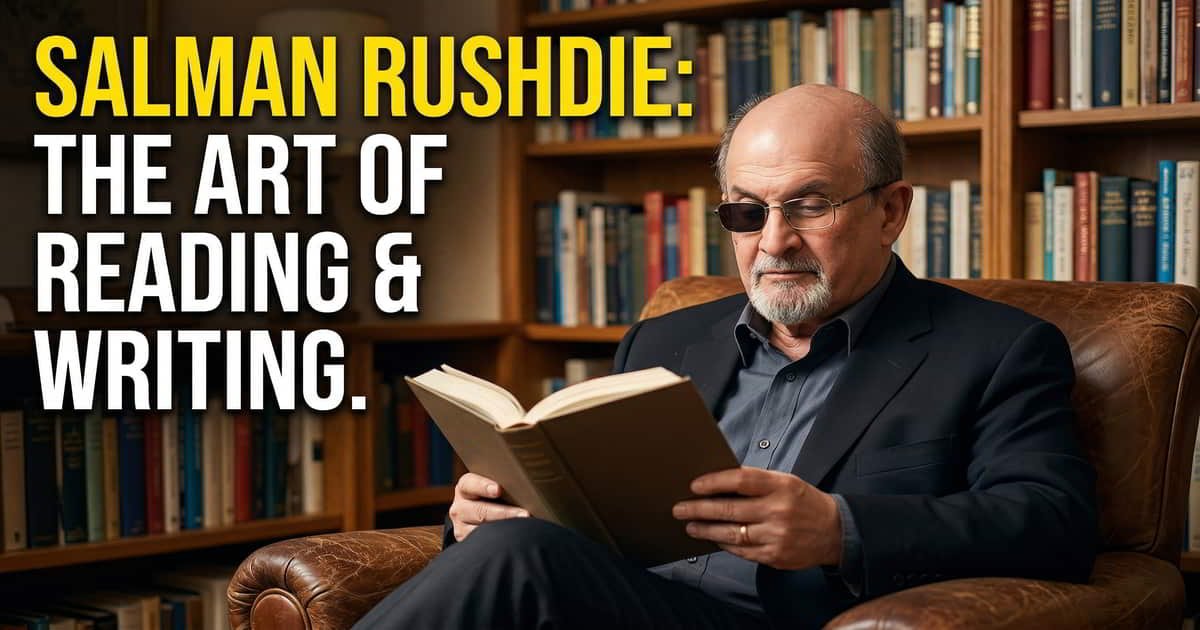
In this article we will discuss everything about Salman Rushdie, Salman Rushdie Biography PDF and PPT Slides Download, his biography in English and Hindi, all books in chronological order and in order of reading, most famous book, books in 2025, Midnight’s Children, The Satanic Verses, Grimus, Shame, The Moor’s Last Sigh, The Ground Beneath Her Feet, Fury, Shalimar the Clown, The Enchantress of Florence, Two Years Eight Months and Twenty-Eight Nights, The Golden House, Quichotte, Victory City, and Knife; his spouse and wives (Marianne Wiggins, Padma Lakshmi, Rachel Eliza Griffiths); his religion and whether he is Muslim; the fatwa; the August 2022 attack and his eye injury; his net worth; why he is so famous; and his complete legacy as one of the greatest and most controversial writers of the twentieth and twenty-first centuries.
Salman Rushdie is a writer whose name, even now, decades after the events that made it globally famous, carries a charge of controversy, danger, and literary magnificence. He is the author of Midnight’s Children – the Booker Prize-winning novel that transformed the possibilities of the Indian novel and that was named the Best of the Booker (the best novel to have won the Booker Prize) not once but twice, in 1993 and 2008. He is the author of The Satanic Verses – the novel that in 1989 prompted Ayatollah Khomeini to issue a fatwa calling for his death, forcing him into years of hiding and making him the most visible symbol of the conflict between artistic freedom and religious authority in the modern world. And he is the author of a body of work spanning more than four decades and fourteen novels that makes him, by any honest accounting, one of the most important and most original literary voices of his generation.
In August 2022, at a literary festival in Chautauqua, New York, he was stabbed on stage by an assailant; he lost the sight of one eye and suffered serious injuries to his hand and elsewhere. He survived. He wrote about the attack in his 2024 memoir Knife: Meditations After an Attempted Murder. He is alive, writing, and unbowed.
Salman Rushdie Biography Table (Biodata / Author Profile)
| Biographical Detail | Information |
| Full Name | Ahmed Salman Rushdie – he uses Salman Rushdie professionally; he was born Ahmed Salman Rushdie and the first name Ahmed (a common Muslim name) is rarely used |
| Date of Birth / Born | June 19, 1947 |
| Born In Which Country | India – specifically Bombay (now Mumbai), Maharashtra; he was born in Bombay just two months before Indian independence on August 15, 1947; his birth in Bombay, and the fact that he was born into the generation that saw India become independent, is directly relevant to his literary career and to Midnight’s Children |
| Born Place | Bombay (Mumbai), Maharashtra, India – the great port city of the west coast of India, which has been one of the most cosmopolitan and most literary cities in the subcontinent; the Bombay of Rushdie’s childhood is lovingly and vividly rendered in Midnight’s Children and in several of his other novels |
| Is Salman Rushdie Alive? | Yes – Salman Rushdie is alive as of 2025. He survived the stabbing attack of August 12, 2022, at the Chautauqua Institution in New York. He lost the sight of one eye and suffered other serious injuries, but he recovered and continued writing. His memoir Knife: Meditations After an Attempted Murder (2024) is a direct account of the attack and his recovery. He lives in New York City. |
| Nationality | British-Indian (he was born in India, educated in Britain, and became a British citizen; he later moved to the United States and has lived in New York City since 2000) |
| Religion | Salman Rushdie was born into a Muslim family – his parents were Muslim, and he was raised with an awareness of the Islamic tradition. However, he has described himself at various points in his life as an atheist or as someone who does not practise any religion. He has said that he is not a Muslim in any practising or believing sense. His relationship with Islam is complex – he has engaged extensively with Islamic history, culture, and theology in his fiction, but he does not identify as a Muslim believer. This complexity is at the heart of the controversy surrounding The Satanic Verses. |
| Is Salman Rushdie Muslim? | No – Salman Rushdie does not consider himself a Muslim. He was born into a Muslim family and has extensive knowledge of Islamic culture and tradition, but he identifies as a secular, non-believing person. He has described himself as someone who was ‘raised Muslim’ but who does not practise or believe. In the early years of the fatwa (1989-1990), there was a brief and controversial period when he made statements suggesting a return to Islam, but he subsequently retracted these and reaffirmed his secular identity. |
| Father | Anis Ahmed Rushdie – a Cambridge-educated businessman in Bombay; he was a man of literary interests and a lover of the Urdu and Persian poetic tradition; he changed the family surname from ‘Rushd’ to ‘Rushdie’ in honour of the medieval Arab philosopher Ibn Rushd (Averroes), whose commitment to reason and to the reconciliation of faith and philosophy he admired. This intellectual genealogy – the choice of Ibn Rushd as a family patron – is itself an indication of the intellectual atmosphere in which Salman Rushdie was raised. |
| Mother | Negin Bhatt – his mother; the searches for ‘Negin Bhatt’ in connection with Rushdie reflect the curiosity about his family background; she was his mother and her name occasionally appears in biographical accounts of his life |
| Spouse / Wives | Salman Rushdie has been married four times. First wife: Clarissa Luard (married 1976, divorced 1987) – a literary agent; their son Zafar Rushdie was born in 1979. Second wife: Marianne Wiggins (married 1988, divorced 1993) – an American novelist; they married just before the fatwa was issued; the marriage did not survive the years of hiding. Third wife: Elizabeth West (married 1997, divorced 2004) – a literary agent; their son Milan Rushdie was born in 1997. Fourth wife: Padma Lakshmi (married 2004, divorced 2007) – the Indian-American television personality, model, and author. He subsequently had a long relationship with Rachel Eliza Griffiths – an American poet and novelist – whom he eventually married. Searches for ‘Salman Rushdie spouse’, ‘Salman Rushdie wife’, ‘Padma Lakshmi’, and ‘Rachel Eliza Griffiths’ all reflect this history of marriages. |
| Padma Lakshmi | Padma Lakshmi is an Indian-American television personality, author, and activist – best known as the host of Top Chef. She was married to Salman Rushdie from 2004 to 2007. Their marriage was widely covered in the media, partly because of the difference in their ages (Lakshmi is considerably younger than Rushdie) and partly because of the contrast between their public profiles. Lakshmi has spoken publicly about the marriage and its end in her own memoir. |
| Rachel Eliza Griffiths | Rachel Eliza Griffiths is an American poet and novelist – the author of several poetry collections and the novel Promise (2023). She has been in a relationship with Salman Rushdie for several years and they are understood to be married. She was present at the Chautauqua attack in August 2022 and is mentioned in his memoir Knife. She represents a new chapter in his personal and literary life. |
| Marianne Wiggins | Marianne Wiggins is an American novelist – the author of several well-regarded works of fiction. She was Rushdie’s second wife, marrying him in 1988, just before the fatwa was issued. The marriage lasted through some of the most difficult years of the fatwa period but did not survive the extraordinary pressures of life in hiding. |
| Education | Cathedral and John Connon School, Bombay (primary and secondary); Rugby School, Warwickshire, England (secondary boarding school); King’s College, Cambridge (BA in History) – his Cambridge education, studying History, gave him both the historical knowledge and the intellectual framework that would shape Midnight’s Children and his subsequent historical fiction |
| Net Worth | Salman Rushdie’s net worth is estimated at approximately 15-20 million US dollars as of 2024-2025 – derived from decades of royalties from his many novels (particularly Midnight’s Children and The Satanic Verses, which continue to sell in large numbers worldwide), from advances for new books, from speaking fees, and from the various adaptations and translations of his work. These are estimates; precise figures are not publicly available. |
| Most Famous Book | Midnight’s Children (1981) – winner of the Booker Prize (1981), the Booker of Bookers (1993 – the best Booker winner in the prize’s first 25 years), and the Best of the Booker (2008 – the best Booker winner in 40 years); universally regarded as his masterpiece and as one of the great novels of the twentieth century |
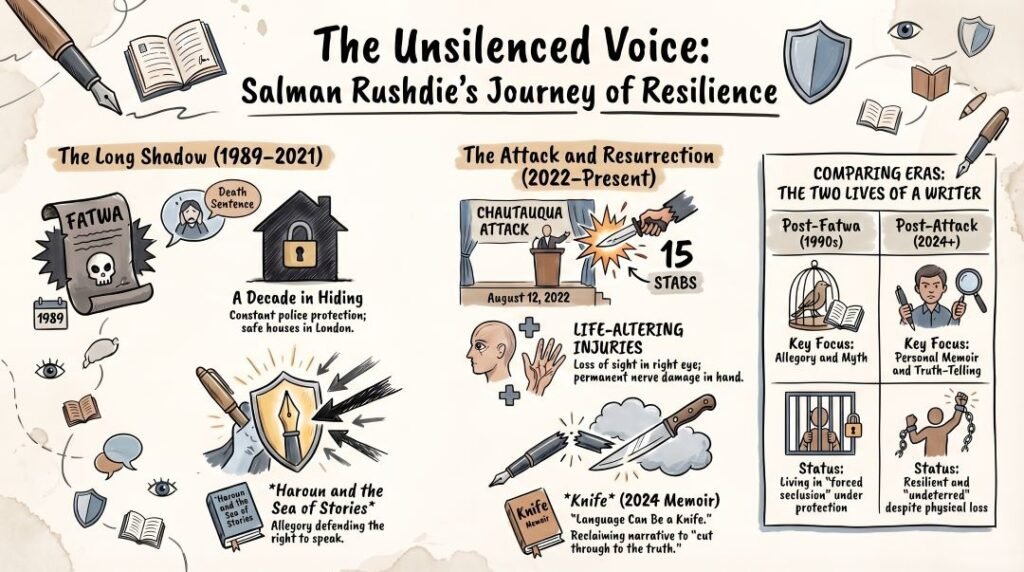
| The Fatwa | The fatwa was a religious ruling issued by Ayatollah Ruhollah Khomeini of Iran on February 14, 1989, calling for the death of Salman Rushdie on the grounds that The Satanic Verses (1988) was blasphemous to Islam. The fatwa led Rushdie to go into hiding under British police protection for approximately a decade; it resulted in the murder of the novel’s Japanese translator Hitoshi Igarashi, the serious wounding of its Italian and Norwegian translators, and numerous other deaths and injuries connected to protests against the book. The fatwa has never been formally lifted, though Iran officially distanced itself from it in 1998. |
| The 2022 Attack | On August 12, 2022, at the Chautauqua Institution in Chautauqua, New York, Salman Rushdie was stabbed on stage by Hadi Matar, a 24-year-old man of Lebanese descent, just as he was about to give a lecture. He was stabbed approximately twelve times. He lost the sight of one eye, suffered damage to his hand (with nerve injury affecting his fingers), and sustained other serious injuries to his chest and neck. He was airlifted to hospital and required surgery. He recovered over subsequent months. His memoir Knife: Meditations After an Attempted Murder (2024) is a direct account of the attack, his recovery, and his reflections on what happened. The attacker was arrested and charged; he pleaded not guilty. |
| Salman Rushdie Eye | The references to ‘Salman Rushdie eye’ in searches reflect the loss of sight in one eye that resulted from the August 2022 stabbing attack at Chautauqua, New York. The eye injury was one of the most serious of the wounds he sustained in the attack. He has spoken publicly about the loss of sight and about learning to live with it. |
| Movies / Films | Several of Rushdie’s novels have been adapted for film or television: Midnight’s Children was adapted as a film directed by Deepa Mehta (2012), with a screenplay by Rushdie himself; The Satanic Verses has not been officially adapted for film; other adaptations and dramatisations have appeared. He also appeared as himself in Bridget Jones’s Diary (2001). |
| Awards | Booker Prize (1981, for Midnight’s Children); Booker of Bookers (1993); Best of the Booker (2008); Whitbread Novel Award (1988, for The Satanic Verses – he declined this award); James Tait Black Memorial Prize; European Union’s Aristeion Prize for Literature; PEN/Pinter Prize; Knighthood (2007 – appointed Knight Bachelor for services to literature); numerous honorary doctorates |
| Autobiography | Rushdie has written two autobiographical works: Joseph Anton: A Memoir (2012) – his account of the years he spent in hiding under the fatwa, written in the third person (the title refers to the pseudonym he used during hiding, derived from Joseph Conrad and Anton Chekhov); and Knife: Meditations After an Attempted Murder (2024) – his account of the 2022 stabbing attack and his recovery. Both are important literary documents as well as personal memoirs. |
Salman Rushdie Biography PDF and PPT Slides Download (.PPTX)
Why Is Salman Rushdie So Famous?
The question ‘Why is Salman Rushdie so famous?’ has two distinct answers, and both are important. He is famous, first, because of Midnight’s Children – a novel that transformed the possibilities of the Indian novel and of the postcolonial novel more broadly, that won the Booker Prize in 1981, and that was subsequently named the best Booker Prize winner of its first 25 years and then of its first 40 years. That alone would make him one of the most celebrated writers of his generation.
He is famous, second, because of the fatwa – the 1989 ruling by Ayatollah Khomeini calling for his death in response to The Satanic Verses, which forced him into years of hiding and made him the most visible symbol in the world of the conflict between artistic freedom and religious authority. The fatwa made Salman Rushdie famous in a way that no literary achievement alone could have achieved – it made him a global news story, a political symbol, and a cause around which the question of free expression was debated in virtually every country in the world.
But the most honest answer to the question ‘why is Salman Rushdie so famous?’ combines both elements: he is famous because he is a great writer, and because that greatness brought him into a conflict with power – religious, political, and cultural – that tested the most fundamental questions about what it means to write freely in a world where writing can get you killed.
What Happened to Salman Rushdie and Why?
There are two major ‘what happened’ questions about Salman Rushdie: the fatwa of 1989 and the stabbing attack of 2022.
What happened with The Satanic Verses and the fatwa: The Satanic Verses was published in September 1988. The novel contains several passages that were considered deeply offensive by many Muslims – most controversially, dream sequences in which the Prophet Mohammed is depicted in ways that many Muslims found blasphemous, and in which the wives of the Prophet are reimagined as prostitutes. Protests began in India (the book was banned there), spread to Pakistan and other Muslim-majority countries, and eventually led to violent demonstrations in which people were killed. On February 14, 1989 – Valentine’s Day – Ayatollah Khomeini issued a fatwa declaring Rushdie an apostate and calling on Muslims to kill him. A large bounty was offered for his death. Rushdie was taken into hiding by the British government, protected by police, and lived under the pseudonym Joseph Anton for approximately a decade. He eventually resumed a more normal life in the late 1990s, though the fatwa was never formally lifted.
What happened in 2022: On August 12, 2022, Rushdie was stabbed on stage at the Chautauqua Institution in New York. The attacker, Hadi Matar, rushed the stage and stabbed Rushdie approximately twelve times in the seconds before he was restrained. Rushdie lost the sight of one eye, suffered nerve damage to his hand, and sustained other serious injuries. He was flown to hospital and underwent surgery. He survived and recovered over subsequent months, returning to writing and public life. The attack was widely condemned as an act of terrorism and as a direct consequence of the culture of intimidation created by the fatwa.
What Is the Fatwa on Salman Rushdie?
The fatwa on Salman Rushdie was a religious ruling – a fatwa (Arabic: legal opinion or decree issued by an Islamic authority) – issued by Ayatollah Ruhollah Khomeini, the Supreme Leader of Iran, on February 14, 1989. The fatwa declared Salman Rushdie an apostate and called on Muslims worldwide to kill him and anyone else involved in the publication of The Satanic Verses, on the grounds that the novel was blasphemous to Islam.
The specific passages of The Satanic Verses that generated the most outrage were the dream sequences narrated by a character named Gibreel Farishta, in which the founding of Islam is depicted in ways that many Muslims found deeply offensive: the Prophet’s companions are portrayed as fallible and sometimes corrupt human beings; one sequence involves prostitutes taking the names and attributes of the Prophet’s wives. Rushdie argued that these passages were clearly marked as dreams and as fiction, and that the novel was a work of imagination exploring the contested territory between faith and doubt – not an act of deliberate blasphemy.
The consequences of the fatwa were immediate and severe. Rushdie’s Japanese translator Hitoshi Igarashi was murdered in 1991. His Italian translator Ettore Capriolo was stabbed and seriously wounded. His Norwegian publisher William Nygaard was shot and seriously wounded. There were fire-bombings of bookshops selling the novel in several countries. Dozens of people were killed in protests against the book in various countries. Rushdie himself was taken into hiding under British government protection and lived under a pseudonym for approximately a decade.
Iran officially distanced itself from the fatwa in 1998, stating that it would not encourage its implementation. However, the fatwa was never formally lifted, and the bounty on Rushdie’s head – which has been increased several times over the years by Iranian religious foundations – remained in place. The 2022 attack is widely understood as the direct consequence of the culture of intimidation that the fatwa created.
Salman Rushdie Biography in English: Early Life, Born Country and Education
Salman Rushdie was born Ahmed Salman Rushdie on June 19, 1947, in Bombay (now Mumbai), India – just two months before Indian independence on August 15, 1947. This timing – being born into the generation that witnessed the birth of independent India – is not merely a biographical coincidence; it is the central fact of his most important novel. Midnight’s Children opens with a child born at the exact moment of Indian independence, and the novel is fundamentally a meditation on what it means to be of the generation that inherited the promise and the trauma of that extraordinary historical event.
He was born into a middle-class Muslim family. His father, Anis Ahmed Rushdie, was a Cambridge-educated businessman who had been born a Muslim and who had a deep love of literature – particularly of the Urdu and Persian poetic tradition. He changed the family surname to ‘Rushdie’ in honour of Ibn Rushd (Averroes), the medieval Arab philosopher who argued for the compatibility of reason and faith. This intellectual heritage – a family named after a philosopher of reason who challenged orthodoxy – is perhaps the most revealing biographical fact about Salman Rushdie.
He attended Cathedral and John Connon School in Bombay – one of the city’s most prestigious schools – before being sent to England at the age of thirteen, to Rugby School in Warwickshire, one of England’s most famous boarding schools. The experience of arriving in England as an Indian boy, of navigating the English class system and the social world of a major public school, shaped his understanding of the relationship between India and England that runs through Midnight’s Children and much of his subsequent fiction.
From Rugby he went to King’s College, Cambridge, where he studied History – taking his BA degree in 1968. His Cambridge education gave him both the historical knowledge and the analytical framework that would shape his major historical novels. He graduated at the height of the student revolution of 1968, a moment of global political upheaval that permanently shaped the intellectual and political sensibility of his generation.
After Cambridge he worked briefly as an actor and then began a career in advertising in London – working as a copywriter for advertising agencies while writing his first novel, Grimus, in his spare time. The advertising career was commercially successful (he worked on memorable campaigns) and gave him a direct engagement with the popular culture of 1970s London that would feed into his fiction. Grimus was published in 1975; Midnight’s Children, which made him famous, in 1981.
Salman Rushdie All Books: Complete List in Order
Salman Rushdie has published fourteen novels, three collections of short stories, two collections of essays, two autobiographical works, and several children’s books. Here is his complete bibliography in chronological order:
| Year | Title | Type / Summary |
| 1975 | Grimus | His debut novel – a science fiction / fantasy work drawing on the Persian Sufi poem The Conference of the Birds by Farid ud-Din Attar; the story of Flapping Eagle, a Native American man who achieves immortality and travels to a mysterious island. Not commercially successful on publication, and often regarded as the most ‘minor’ of his works; but it demonstrates from the beginning the hallmarks of his style: multilayered intertextuality, mythic scope, and a restless formal imagination. |
| 1981 | Midnight’s Children | His masterpiece and most famous novel – winner of the Booker Prize (1981), Booker of Bookers (1993), and Best of the Booker (2008). The story of Saleem Sinai, born at the exact moment of Indian independence on August 15, 1947, who is telepathically connected to all the other children born in the first hour of independence – 1,001 children, each with a supernatural gift. The novel uses Saleem’s life as a mirror of India’s post-independence history, from 1947 through Partition, the wars with China and Pakistan, the Emergency (1975-77), and beyond. Written in a style that combines the oral tradition of Indian storytelling with the formal innovations of Western modernism and the playful energy of magical realism. One of the great novels of the twentieth century. |
| 1983 | Shame | A novel set in a fictional country that closely resembles Pakistan – a satirical portrait of Pakistani politics, specifically of the parallel careers of figures resembling Zulfikar Ali Bhutto and Muhammad Zia-ul-Haq. The novel explores the relationship between shame, honour, and the violent political culture of Pakistan, and introduces the concept of ‘shamelessness’ as a form of resistance. Shortlisted for the Booker Prize. Banned in Pakistan. |
| 1988 | The Satanic Verses | The novel at the centre of the fatwa controversy – a magical realist novel in which two Indian actors, Gibreel Farishta and Saladin Chamcha, survive a plane explosion and fall to earth, transformed by the experience. The novel interweaves their story with dream sequences set at the founding of Islam and with explorations of immigration, identity, and the relationship between the sacred and the profane in the modern world. It won the Whitbread Novel Award (which Rushdie declined, feeling it inappropriate given the controversy). One of the most contested and one of the most significant novels of the twentieth century. |
| 1990 | Haroun and the Sea of Stories | A children’s novel – written for his son Zafar during the early years of the fatwa, partly as a way of communicating with his child during the years of hiding and difficulty; an allegorical fantasy about storytelling and the battle between Story and Silence. One of his most beloved works and one of the most accessible. Also read by adults as an allegory of the fatwa and the importance of free expression. |
| 1994 | East, West | A short story collection – nine stories arranged in three groups: East (set in India and Pakistan), West (set in England and America), and East, West (stories about the encounter between the two). The collection is one of his most accessible and most widely taught works; the stories demonstrate his gifts as a short story writer alongside his novelistic career. |
| 1995 | The Moor’s Last Sigh | A novel set partly in Bombay and partly in Spain – the story of Moraes Zogoiby (the Moor), the son of a spice-merchant family, who ages at twice the normal rate and who narrates the history of his extraordinary family across generations. The novel is both a portrait of Bombay’s cosmopolitan, multi-religious culture and a meditation on the end of that culture under Hindu nationalist pressure. Also an extended meditation on art and creation. Shortlisted for the Booker Prize. |
| 1999 | The Ground Beneath Her Feet | A novel that retells the myth of Orpheus and Eurydice in the context of the global rock music industry – the story of two lovers, Ormus Cama and Vina Apsara, and the photographer Rai who loves them both. A meditation on music, celebrity, love, and the alternative histories that run parallel to our own. One of his more experimental works. The U2 song of the same name features lyrics by Rushdie. |
| 2001 | Fury | A novel set in New York City – the story of Malik Solanka, a British academic and toy designer who flees his family and reinvents himself in New York. The novel captures the frenzied energy of New York at the turn of the millennium, just before September 11. Less well-received than some of his other work, but significant as his first novel set primarily in America. |
| 2005 | Shalimar the Clown | A novel set partly in Kashmir and partly in Los Angeles – the story of Max Ophuls, a former American ambassador who is assassinated by his former driver Shalimar, a Kashmiri acrobat whose world has been destroyed by the conflict in Kashmir. One of his most directly political novels – an exploration of the destruction of Kashmir’s syncretic, multi-religious culture by violence and extremism. Widely regarded as one of his finest works of this period. |
| 2008 | The Enchantress of Florence | A historical novel set partly in the court of the Mughal Emperor Akbar in 16th-century India and partly in Florence during the same period – exploring the connections between the two great civilisations of the Renaissance era. A novel about the relationship between storytelling, power, and truth. One of his most formally ambitious and most historically grounded works. |
| 2010 | Luka and the Fire of Life | A sequel to Haroun and the Sea of Stories – the story of Luka, Haroun’s younger brother, who must enter the World of Magic to steal the Fire of Life and save his father’s life. Another children’s novel with adult resonances; like Haroun, it is about the power and the necessity of story. |
| 2015 | Two Years Eight Months and Twenty-Eight Nights | A novel whose title (2 years, 8 months, and 28 nights = 1,001 nights) signals its relationship to the Arabian Nights tradition. The story of a philosopher of reason (modelled on Ibn Rushd / Averroes) and the war between jinns in the modern world – a comic, fantastical, allegorical novel about reason versus irrationality, light versus darkness. One of his most explicitly allegorical works. |
| 2017 | The Golden House | A novel set in New York City – the story of the Golden family, mysterious wealthy immigrants from India who settle in a Greenwich Village garden apartment complex, as observed by their young neighbour Rene. A portrait of America in the age of Barack Obama and the rise of a fictional villain clearly modelled on Donald Trump. One of his more explicitly political novels about contemporary America. |
| 2019 | Quichotte | A novel loosely based on Cervantes’ Don Quixote – the story of an aging Indian-American travelling salesman who becomes obsessed with a television star and sets out on a road trip across America with his imaginary son. The novel also follows the story of its author – a fictional Indian-American thriller writer whose creation Quichotte takes on a life of its own. Shortlisted for the Booker Prize (2019). |
| 2023 | Victory City | A novel set in medieval India – the story of Pampa Kampana, a woman granted divine gifts who founds the great empire of Bisnaga (based on the historical Vijayanagara Empire) and guides it through two hundred and fifty years of history. A meditation on storytelling, power, and the relationship between the creative imagination and historical reality. Written partly during his recovery from the 2022 attack. |
| 2024 | Knife: Meditations After an Attempted Murder | His memoir about the August 2022 stabbing attack at Chautauqua, New York – a direct, personal account of the attack, his injuries (including the loss of sight in one eye), his recovery, his relationship with Rachel Eliza Griffiths, and his reflections on the meaning of the attack, the fatwa, and the continuing relevance of the questions The Satanic Verses raised. One of the most important literary memoirs of recent years. |
| 2012 | Joseph Anton: A Memoir | His memoir of the years he spent in hiding under the fatwa (1989-1998) – written in the third person, under the pseudonym Joseph Anton (derived from Joseph Conrad and Anton Chekhov) that he used during hiding. A detailed, candid, and deeply personal account of what it meant to live under a death sentence – the fear, the isolation, the loss of normal life, the impact on his family and his marriages, and the extraordinary effort of will required to continue writing. One of the most important autobiographical accounts of the relationship between artistic freedom and political power in the modern era. |
Midnight’s Children: Complete Analysis
Midnight’s Children (1981) is Salman Rushdie’s masterpiece – the novel that made him famous, that transformed the possibilities of the postcolonial novel, and that is universally regarded as one of the great novels of the twentieth century. It won the Booker Prize in 1981 and was subsequently named the best Booker Prize winner of the prize’s first 25 years (1993) and then of the first 40 years (2008) – a double recognition that places it in a category of its own in the history of the prize.
| Aspect | Detail |
| Full Title | Midnight’s Children |
| Author | Salman Rushdie |
| Published | 1981 (Jonathan Cape, UK) |
| Awards | Booker Prize (1981); Booker of Bookers (1993 – best Booker winner in the prize’s first 25 years); Best of the Booker (2008 – best Booker winner in 40 years); James Tait Black Memorial Prize for Fiction |
| Protagonist | Saleem Sinai – born at the exact midnight of Indian independence (August 15, 1947) in a Bombay hospital; given supernatural powers of telepathic connection to all the ‘midnight’s children’ (the 1,001 children born in the first hour of independence); his life becomes a mirror of India’s post-independence history |
| The Midnight’s Children | The 1,001 children born in the first hour of Indian independence, each endowed with a supernatural gift proportional to their closeness to the exact midnight moment; Saleem, born at the stroke of midnight, has the most powerful gift – telepathic connection to all the others; Shiva, born seconds after Saleem (and switched with him in the hospital) has the gift of war |
| The Plot | Saleem narrates the history of his family across three generations (beginning with his grandfather Aadam Aziz in Kashmir) and then his own life from his birth in 1947 through the wars of 1965 and 1971, the Emergency (1975-77), and its aftermath. The novel follows Saleem’s understanding that his life is mysteriously connected to the life of the nation – that what happens to India happens to him, and vice versa. The narrative is unreliable – Saleem is an imperfect narrator who admits to errors and misrememberings – and the novel continually draws attention to the act of storytelling itself. |
| Midnight’s Children Summary | Saleem Sinai, born at midnight on August 14-15, 1947 – the moment of Indian independence – narrates the history of his family and of India from his grandfather’s youth in Kashmir in the 1910s through his own life in Bombay, Pakistan, and Bangladesh up to 1977. His telepathic gift allows him to convene and communicate with the other midnight’s children – a parliament of gifted individuals who represent the promise of independent India. But as India’s history darkens – the wars, the Emergency, the authoritarian suppression of democratic promise – the midnight’s children and their gifts are systematically destroyed. The novel is simultaneously a family saga, a national history, and a meditation on memory, storytelling, and the relationship between the individual life and the life of a nation. |
| Style and Technique | Midnight’s Children is written in a style that combines the oral tradition of Indian storytelling (the narrator constantly digresses, qualifies, promises more to come, appeals directly to the reader) with the formal innovations of Western modernism (unreliable narrator, self-conscious metafiction, non-linear structure) and the playful exuberance of magical realism (the supernatural gifts of the midnight’s children, the pickle factory as a metaphor for memory, the physical deterioration of Saleem’s body as a mirror of India’s). The style is both distinctively Indian and distinctively innovative – it creates a new literary language for the Indian experience. |
| The Most Famous Salman Rushdie Book | Midnight’s Children is the most famous Salman Rushdie book – the answer to the search question ‘what is the most famous Salman Rushdie book?’ or ‘Salman Rushdie most famous book’. It is his most celebrated, most studied, and most universally acknowledged masterpiece. |
| Which Book Should I Read First? | Most readers and critics recommend starting with Midnight’s Children – it is his most celebrated work, the most accessible entry point into his major fiction, and the novel that most fully demonstrates his gifts as a storyteller, a historical thinker, and a literary innovator. After Midnight’s Children, Shame, The Moor’s Last Sigh, and Shalimar the Clown are excellent next choices. |
| Film Adaptation | Midnight’s Children was adapted as a film directed by Deepa Mehta (2012), with a screenplay written by Rushdie himself from his novel. The film received mixed reviews but was respected for its ambition and for the quality of Rushdie’s own screenplay adaptation. |
| Legacy | Midnight’s Children is one of the most important novels of the second half of the twentieth century – it transformed the possibilities of the Indian novel, of the postcolonial novel, and of the English novel itself; it opened the door for a generation of South Asian writers who followed; and it remains as vital and as rewarding as it was when it was published in 1981 |
The Satanic Verses: Complete Analysis
The Satanic Verses (1988) is Salman Rushdie’s fourth novel and the most controversial literary work published in the English language in the twentieth century. It is also, by the judgment of many critics and readers, one of the finest and most ambitious novels of its generation – a work of extraordinary imaginative scope, philosophical depth, and formal innovation that deserves to be read as literature rather than as a political incident.
| Aspect | Detail |
| Full Title | The Satanic Verses |
| Author | Salman Rushdie |
| Published | 1988 (Viking, UK) |
| Award | Whitbread Novel Award (1988) – which Rushdie declined, feeling it inappropriate to receive an award while the book was generating violent controversy |
| Central Characters | Gibreel Farishta – a Bollywood superstar who has lost his faith; Saladin Chamcha – an Indian immigrant in England who has entirely reinvented himself as an English voice actor. Both survive a terrorist bomb on a plane over the English Channel, falling to earth and transforming – Gibreel into an angelic figure, Saladin into a demonic one. |
| The Satanic Verses Summary | Gibreel Farishta and Saladin Chamcha, the only survivors of a bomb explosion on an aircraft over the English Channel, fall to earth singing – Gibreel transforming, during the fall, into a figure of divine light; Saladin transforming into a figure with hooves, horns, and a tail. The novel follows their separate trajectories after this extraordinary origin – Gibreel into a series of prophetic dreams that form the novel’s most controversial sections; Saladin into a series of misadventures in a racist London that physically transforms immigrants. The novel asks: what does it mean to be an immigrant? What does it mean to lose your faith? What is the relationship between the sacred and the profane? Who gets to define blasphemy? |
| The Controversial Passages | The passages that generated the most controversy are the ‘Mahound’ sections – dream sequences narrated by Gibreel Farishta in which he dreams of the founding of a religion called Submission (clearly Islam) by a prophet called Mahound (a historical European name for Mohammed). In these sections, the prophet’s companions are portrayed as fallible human beings; a brothel scene has prostitutes adopting the names and identities of the prophet’s wives; a suggestion is made (the ‘satanic verses’ of the title) that some of the revelation may have been dictated by Satan rather than God. Rushdie has always insisted that these passages are clearly framed as the dreams of a psychologically disturbed character, not as statements of fact about the historical Mohammed. |
| The Title | The ‘satanic verses’ refers to a controversial episode in early Islamic history in which, according to some early sources (which mainstream Islamic tradition regards as unreliable), the Prophet Mohammed briefly accepted a revelation from Satan acknowledging the existence of pre-Islamic deities, before withdrawing it as a satanic deception. Rushdie’s use of this episode as the title of his novel is itself one of the things that generated the most outrage. |
| Literary Significance | The Satanic Verses is one of the most ambitious and most formally innovative novels of its period – it engages with the experience of immigration, the experience of religious doubt, the relationship between the individual and their cultural inheritance, and the nature of revelation and story. It is a novel that deserves to be read – and that is read, by millions of people worldwide who have approached it with open minds. |
| The Fatwa’s Impact on Literature | The fatwa on The Satanic Verses was one of the most significant events in the history of literary freedom – it made the question of whether a writer has the right to engage imaginatively with religious subjects a matter of life and death, and it demonstrated that the forces of religious intolerance could reach across borders and across decades. Its consequences – for Rushdie, for his translators and publishers, and for the culture of literary freedom – are still being felt. |
Salman Rushdie’s Other Major Works
Shame (1983)
Shame is Rushdie’s third novel – a satirical portrait of Pakistani politics, set in a fictional country called ‘Peccavistan’ that closely resembles Pakistan. The novel traces the parallel careers of two political families – the Harappas (based on Zulfikar Ali Bhutto and his daughter Benazir) and the Hyders (based on General Zia-ul-Haq) – and the central figure of Sufiya Zinobia, a child of one family who embodies the ‘shame’ of the title in a literal, terrible form. The novel is both a brilliant piece of political satire and a philosophical exploration of the relationship between shame, honour, violence, and repression. Shortlisted for the Booker Prize and banned in Pakistan.
The Moor’s Last Sigh (1995)
The Moor’s Last Sigh is one of Rushdie’s finest later novels – a vast, comic, tragic, intertextually rich narrative set partly in Bombay and partly in Spain. The narrator, Moraes Zogoiby (the Moor), ages at twice the normal rate and narrates the history of his extraordinary family – of Jewish-Portuguese and South Indian heritage – across four generations in Bombay’s spice trade, art world, and political life. The novel is simultaneously a meditation on Bombay’s cosmopolitan, multi-religious culture and its destruction by Hindu nationalism, and an extended allegory about the relationship between art, power, and the possibility of paradise (the ‘last sigh’ of the title refers to the sigh of Boabdil, the last Moorish king of Granada, as he looked back at the city he had lost).
Shalimar the Clown (2005)
Shalimar the Clown is widely regarded as one of Rushdie’s finest novels of his middle period – a dark, lyrical, politically serious work about the destruction of Kashmir’s syncretic, multi-religious culture. The novel begins in Los Angeles, where a former American ambassador, Max Ophuls, is assassinated by his driver Shalimar – a Kashmiri acrobat and entertainer. The novel then moves back in time to show how Shalimar became an assassin: the destruction of the Kashmiri village he grew up in, the violence inflicted on his community, the transformation of a man of grace and beauty into an instrument of revenge. One of the most direct and most moving explorations of the human cost of political violence in Rushdie’s work.
Victory City (2023)
Victory City is Rushdie’s most recent novel as of 2025 – published in 2023, partly written during his recovery from the 2022 attack. The novel is set in medieval India and tells the story of Pampa Kampana, a woman blessed by the goddess Parvati with a divine gift who founds and guides the great empire of Bisnaga (based on the historical Vijayanagara Empire) through two hundred and fifty years of history. The novel is both a dazzling feat of historical imagination and a meditation on storytelling, power, and the relationship between the creative word and the world it calls into being.
Knife: Meditations After an Attempted Murder (2024)
Knife is Rushdie’s most recent book – a memoir published in 2024 about the August 2022 stabbing attack at Chautauqua, New York. In it, he describes the attack itself (which he did not see coming), his injuries, his time in hospital, his recovery, his relationship with Rachel Eliza Griffiths, and his reflections on the meaning of what happened. He also imagines a conversation with his would-be assassin – a literary device that is both audacious and deeply human. The memoir is one of the most remarkable literary responses to personal violence available in contemporary literature – a work that refuses self-pity, refuses despair, and insists on the importance of continued engagement with life and with writing.
Salman Rushdie Religion and Is He Muslim?
Salman Rushdie was born into a Muslim family – his parents were Muslim, and he grew up with a knowledge of and exposure to Islamic culture, history, and theology that has deeply shaped all his fiction. However, he does not consider himself a Muslim in any believing or practising sense, and has described himself as a secular, non-believing person for most of his adult life.
His relationship with Islam is one of the most complex aspects of his literary and personal identity. He has extensive, deep knowledge of Islamic history, theology, and culture – visible in everything from The Satanic Verses (which engages with the founding of Islam with a scholar’s knowledge and a novelist’s imagination) to Two Years Eight Months and Twenty-Eight Nights (which draws on the figure of Ibn Rushd and the medieval Islamic philosophical tradition). But this knowledge is the knowledge of a secular intellectual, not of a believer.
In the early years of the fatwa – specifically in late 1989 and early 1990 – Rushdie made a series of public statements expressing sympathy for Islam and suggesting a possible return to the faith; he even briefly stated that he had converted. These statements were widely regarded as being made under extreme duress and were subsequently retracted. Rushdie himself has said that these statements were a mistake and did not represent his genuine convictions.
The question ‘Is Salman Rushdie Muslim?’ can be answered clearly: he was born into a Muslim family, has deep knowledge of Islamic culture and tradition, but does not identify as a Muslim believer and considers himself a secular person.
Salman Rushdie Spouse: All 4 Marriages
| Marriage | Detail |
| First Marriage: Clarissa Luard (1976-1987) | Clarissa Luard was a literary agent whom Rushdie married in 1976. Their son Zafar Rushdie was born in 1979. The marriage lasted eleven years and ended in divorce in 1987, just before the publication of The Satanic Verses. Zafar Rushdie – Salman Rushdie’s elder son – has spoken publicly about the impact of the fatwa on his childhood and his relationship with his father. |
| Second Marriage: Marianne Wiggins (1988-1993) | Marianne Wiggins is an American novelist – the author of John Dollar (1989) and several other well-regarded works of fiction. She and Rushdie married in January 1988, nine months before The Satanic Verses was published. When the fatwa was issued in February 1989, Wiggins was with Rushdie and initially went into hiding with him. However, the extraordinary pressures of life under the fatwa – the constant moves, the police protection, the isolation – proved too much for the marriage, and they divorced in 1993. |
| Third Marriage: Elizabeth West (1997-2004) | Elizabeth West is a British literary agent. She and Rushdie married in 1997, when he was beginning to emerge more fully from hiding. Their son Milan Rushdie was born in 1997. The marriage lasted until 2004. |
| Fourth Marriage: Padma Lakshmi (2004-2007) | Padma Lakshmi is an Indian-American television personality, author, and activist – best known as the host of Top Chef. She and Rushdie married in 2004; the marriage attracted considerable media attention because of their very different public profiles and the difference in their ages. They divorced in 2007. Lakshmi has spoken publicly about the marriage in her memoir Love, Loss and What We Ate. |
| Current Relationship: Rachel Eliza Griffiths | Rachel Eliza Griffiths is an American poet and novelist – the author of several poetry collections and the debut novel Promise (2023). She and Rushdie have been in a relationship for several years and are understood to be married. She was present at the Chautauqua attack in August 2022 and is a central presence in his memoir Knife. Their relationship represents a new chapter in his personal and creative life. |
Salman Rushdie Net Worth
Salman Rushdie’s net worth is estimated at approximately 15-20 million US dollars as of 2024-2025. This estimate is based on his decades of royalties from novels that continue to sell worldwide – particularly Midnight’s Children (which has sold millions of copies in dozens of languages) and The Satanic Verses – from advance payments for new books (he has commanded very large advances from publishers), from speaking fees (he commands among the highest speaking fees available to any literary figure), and from the proceeds of various adaptations and translations of his work.
These figures are estimates – Rushdie does not publicly disclose his finances – and they should be treated as approximate. What is clear is that he is among the wealthiest literary novelists in the world, and that his financial success reflects both the scale of his readership and the enduring commercial appeal of his major works.
Salman Rushdie’s Writing Style
| Element | Detail |
| Magical Realism | Rushdie is the most important practitioner of magical realism in Indian and South Asian literature – a mode in which fantastic and supernatural elements are presented as a natural part of everyday reality, without comment or explanation. His magical realism is not borrowed from Latin American models but is rooted in the oral storytelling traditions of South Asia, in the Thousand and One Nights, and in the traditions of Indian folk and popular culture. |
| The Oral Tradition | His narratives are deeply influenced by the oral storytelling tradition – the voice of a narrator who digresses, qualifies, promises more to come, addresses the reader directly, and is conscious of the act of storytelling itself. This voice is distinctively Indian – it draws on the tradition of the public storyteller, the kathakali performer, the griot – and it gives his fiction a quality of immediacy and intimacy that formal, distanced narration cannot achieve. |
| Intertextuality | His novels are among the most intertextually dense in modern literature – they are full of allusions, parodies, and echoes of literary, historical, and cultural sources from across the world; Indian, Islamic, European, American; sacred, literary, and popular. This density rewards the reader who brings wide knowledge to the text but does not exclude the reader who does not. |
| Historical Vision | He is one of the great historical novelists of his generation – his ability to render entire historical periods (the independence era in Midnight’s Children; the founding of Islam in The Satanic Verses; the Mughal court in The Enchantress of Florence; medieval India in Victory City) with vividness, authority, and imaginative power places him in the tradition of the great historical novelists. |
| Language | His prose is one of the most exuberant, most inventive, and most pleasurable in contemporary literature – full of wordplay, neologism, multilingual puns, and the creative mixing of registers from the formal to the colloquial. Like the best comic and satirical writers, he takes genuine pleasure in language itself – in what words can do, what they can sound like, what meanings they can carry. |
| Political Engagement | His work is always politically engaged – it is never art for art’s sake; it cares about the world and about what human beings do to each other with power. But this engagement is always expressed through the full resources of literary art, never reduced to propaganda or polemic. |
Salman Rushdie Awards: Complete List
| Award | Year | For / Detail |
| Booker Prize | 1981 | For Midnight’s Children – one of the most celebrated Booker wins in the prize’s history |
| Booker of Bookers | 1993 | For Midnight’s Children – named the best novel to have won the Booker Prize in its first 25 years |
| Best of the Booker | 2008 | For Midnight’s Children – named the best Booker winner in 40 years |
| James Tait Black Memorial Prize | 1981 | For Midnight’s Children |
| Whitbread Novel Award | 1988 | For The Satanic Verses – declined by Rushdie |
| European Union Aristeion Prize for Literature | 1996 | For The Moor’s Last Sigh |
| PEN/Pinter Prize | 2014 | Lifetime recognition for international courage in literature |
| Knight Bachelor (Knighthood) | 2007 | Appointed by Queen Elizabeth II for services to literature – the knighthood generated significant controversy in Pakistan and other Muslim-majority countries, with protests and government statements of condemnation |
| Booker Prize shortlist | 1983, 1995, 2019 | Shortlisted for Shame (1983), The Moor’s Last Sigh (1995), and Quichotte (2019) |
Salman Rushdie Life Timeline
| Year | Key Event |
| 1947 | Born on June 19 in Bombay (now Mumbai), India – two months before Indian independence; into a Muslim family; father Anis Ahmed Rushdie named the family in honour of Ibn Rushd (Averroes) |
| 1954 | Sent to England for schooling – attends Rugby School, Warwickshire; begins the cross-cultural experience that will shape all his fiction |
| 1965 | Enters King’s College, Cambridge – studies History; graduates 1968; the year of the global student revolution |
| 1968-1975 | Works as an actor briefly; then as a copywriter in advertising in London; begins writing Grimus in his spare time |
| 1975 | Grimus published – debut novel; commercially unsuccessful but demonstrates his formal ambitions |
| 1976 | Marries Clarissa Luard (first wife) |
| 1979 | Son Zafar Rushdie born |
| 1981 | Midnight’s Children published – wins the Booker Prize; immediately recognised as a landmark of world literature; transforms Rushdie’s life and the landscape of Indian writing in English |
| 1983 | Shame published – shortlisted for the Booker Prize; banned in Pakistan |
| 1987 | Divorces Clarissa Luard |
| 1988 | Marries Marianne Wiggins (second wife); The Satanic Verses published – controversies begin immediately; protests in India, Pakistan, and elsewhere |
| 1989 | February 14: Ayatollah Khomeini issues the fatwa calling for Rushdie’s death; Rushdie goes into hiding under British police protection; assumes the pseudonym Joseph Anton; the extraordinary period of hiding begins |
| 1989-1998 | Lives under police protection; moves constantly between safe houses; his marriage to Marianne Wiggins collapses under the pressure (they divorce 1993); continues to write; publishes Haroun and the Sea of Stories (1990), East West (1994), The Moor’s Last Sigh (1995), The Ground Beneath Her Feet (1999) |
| 1991 | Hitoshi Igarashi, his Japanese translator, is murdered; Italian translator Ettore Capriolo seriously wounded |
| 1997 | Marries Elizabeth West (third wife); son Milan born |
| 1998 | Iran officially distances itself from the fatwa; Rushdie begins to emerge more fully from hiding |
| 2000 | Moves to New York City; begins his life as an American-based writer |
| 2004 | Divorces Elizabeth West; marries Padma Lakshmi (fourth wife) |
| 2007 | Divorces Padma Lakshmi; receives Knighthood from Queen Elizabeth II – the knighthood triggers protests in Pakistan and diplomatic fallout |
| 2008 | Midnight’s Children named Best of the Booker – the best Booker winner in 40 years |
| 2012 | Joseph Anton: A Memoir published – his account of the fatwa years; Midnight’s Children adapted as a film by Deepa Mehta |
| 2014 | Receives PEN/Pinter Prize for international courage in literature |
| 2019 | Quichotte published – shortlisted for the Booker Prize |
| 2022 | August 12: Stabbed on stage at Chautauqua Institution, New York, by Hadi Matar; loses sight of one eye; suffers serious injuries; airlifted to hospital; survives; begins recovery with Rachel Eliza Griffiths |
| 2023 | Victory City published – his fourteenth novel; written partly during recovery from the attack |
| 2024 | Knife: Meditations After an Attempted Murder published – his memoir of the 2022 attack and his recovery; continues to live and write in New York |
| 2025 | Alive, writing, and engaged – one of the most significant literary figures in the world |
10 Lines About Salman Rushdie for Students
- Salman Rushdie was born Ahmed Salman Rushdie on June 19, 1947, in Bombay (Mumbai), India – two months before Indian independence; he is a British-Indian novelist who has lived in New York City since 2000.
- He is alive as of 2025 – he survived the stabbing attack of August 12, 2022, at the Chautauqua Institution in New York, losing the sight of one eye; he continues to write and to engage with public life.
- His most famous novel is Midnight’s Children (1981) – winner of the Booker Prize (1981), the Booker of Bookers (1993), and the Best of the Booker (2008); universally regarded as one of the great novels of the twentieth century.
- In 1989, Ayatollah Khomeini issued a fatwa calling for his death in response to The Satanic Verses (1988) – the novel that many Muslims found blasphemous; the fatwa forced him into years of hiding under British police protection.
- He was educated at Rugby School and King’s College, Cambridge (History), and worked as an advertising copywriter before becoming a full-time novelist.
- He has been married four times: to Clarissa Luard (1976-1987); Marianne Wiggins (1988-1993); Elizabeth West (1997-2004); and Padma Lakshmi (2004-2007); he is currently with Rachel Eliza Griffiths.
- He is not a Muslim in any believing or practising sense – though he was born into a Muslim family and has extensive knowledge of Islamic culture and tradition; he considers himself a secular person.
- His major works include Midnight’s Children (1981); Shame (1983); The Satanic Verses (1988); The Moor’s Last Sigh (1995); Shalimar the Clown (2005); The Enchantress of Florence (2008); Victory City (2023); and his memoirs Joseph Anton (2012) and Knife (2024).
- He received a Knighthood from Queen Elizabeth II in 2007 for services to literature – the knighthood triggered protests in Pakistan and several other Muslim-majority countries.
- He is one of the most important and most original literary voices of the past fifty years – a writer whose work has permanently changed the landscape of the novel and whose life has permanently changed the landscape of the debate about artistic freedom.
Salman Rushdie Short Biography (Profile / Biodata)
Salman Rushdie (full name: Ahmed Salman Rushdie; born June 19, 1947, Bombay/Mumbai, India; alive as of 2025) is a British-Indian novelist. Born into a Muslim family; father Anis Ahmed Rushdie named family after philosopher Ibn Rushd. Educated at Rugby School and King’s College, Cambridge (History, 1968). Worked as advertising copywriter before becoming a full-time novelist. Married four times: Clarissa Luard (1976-1987, son Zafar); Marianne Wiggins (1988-1993); Elizabeth West (1997-2004, son Milan); Padma Lakshmi (2004-2007); current partner/wife: Rachel Eliza Griffiths. Religion: secular, non-believing (born Muslim, does not practise). Major works: Grimus (1975); Midnight’s Children (1981, Booker Prize); Shame (1983); The Satanic Verses (1988); Haroun and the Sea of Stories (1990); The Moor’s Last Sigh (1995); Shalimar the Clown (2005); The Enchantress of Florence (2008); Victory City (2023); Knife (memoir, 2024); Joseph Anton (memoir, 2012). Knighthood (2007). Survived stabbing attack at Chautauqua, New York, August 12, 2022; lost sight of one eye. Net worth estimated at approximately 15-20 million USD. Lives in New York City.
ALSO READ: Manohar Malgonkar Biography PDF and PPT Slides Download
Conclusion: Salman Rushdie’s Enduring Legacy
Salman Rushdie has been, for more than forty years, one of the most important, most controversial, and most genuinely significant literary presences in the world. He has written some of the great novels of his age – Midnight’s Children, The Satanic Verses, Shame, The Moor’s Last Sigh, Shalimar the Clown – and he has done so under conditions of personal danger and public controversy that would have silenced most writers. He has not been silenced.
The fatwa was an attempt to stop a book and to kill its author. The book is still being read. The author is still alive and still writing. In August 2022, a man tried to kill him on a stage in New York. He survived, and the book he wrote about it – Knife – is one of the most remarkable literary meditations on violence, survival, and the continuing importance of the written word available in any language.
His legacy in Indian literature is fundamental – Midnight’s Children opened the door for an entire generation of South Asian writers, and the influence of its language, its style, and its vision can be found in writers as different as Arundhati Roy, Vikram Seth, Kiran Desai, Aravind Adiga, and Amitav Ghosh. His legacy in world literature is equally important – he demonstrated that the postcolonial world had stories to tell that the Western literary tradition could not tell for itself, and he told them with a magnificence and an energy that placed him permanently in the first rank of world literature.
He is alive, writing, and unbowed. That, in itself, is one of the most important literary facts of our time.