Today we will discuss about the List of Nobel Prize Winners in English Literature PDF or Complete List of Nobel Prize Winners in English Literature (1901-2025) with PDF, PPT, Table and Infographic, their is a saying “Literature is the most agreeable way of ignoring life.” by Fernando Pessoa, Every October, the world holds its breath. A single phone call from Stockholm can transform a writer’s life overnight – and change how the world reads their work forever. The Nobel Prize in Literature is the most prestigious literary honor on Earth, awarded since 1901 by the Swedish Academy to authors who have produced, in the words of Alfred Nobel himself, “the most outstanding work in an ideal direction.”
In this article, we’ve compiled the complete, updated list of , along with key details, memorable quotes, and resources you can use in PDF and PPT format for study, teaching, or personal enrichment. Whether you’re a student preparing for a competitive exam, a teacher building a classroom presentation, or simply a reader who loves the craft of writing – you’re in the right place.
What Is the Nobel Prize in Literature?
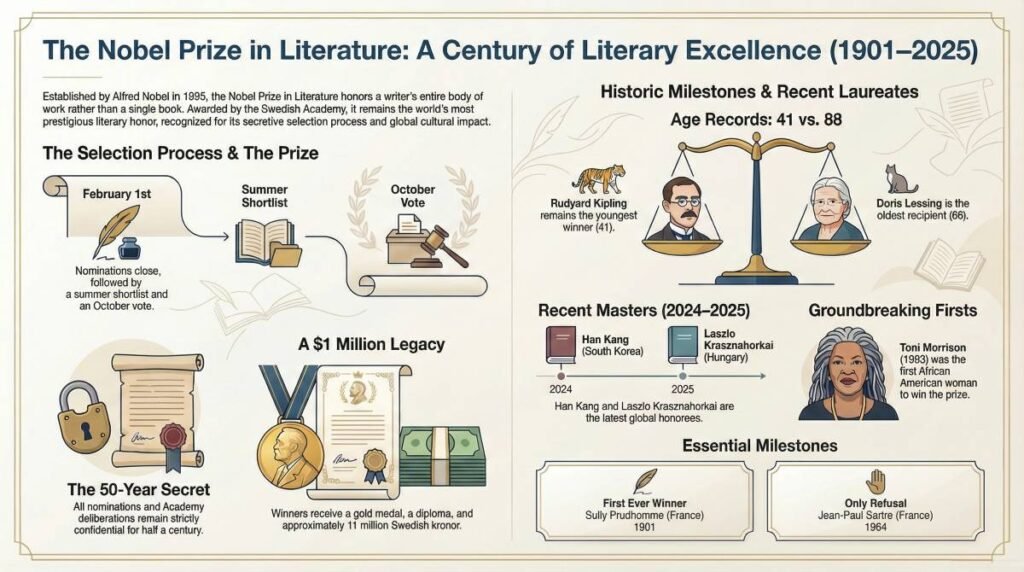
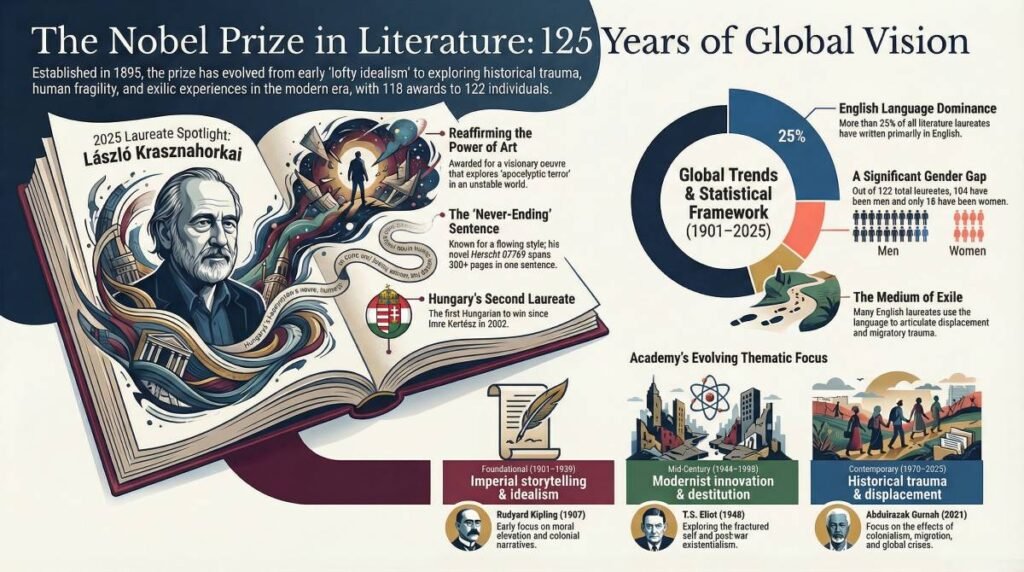
The Nobel Prize in Literature is awarded annually by the Swedish Academy in Stockholm, Sweden. It was established by Swedish inventor Alfred Nobel through his will in 1895, and the first prize was given out in 1901. The award recognizes a writer – be it a novelist, poet, playwright, or essayist – who has made a lasting contribution to world literature.
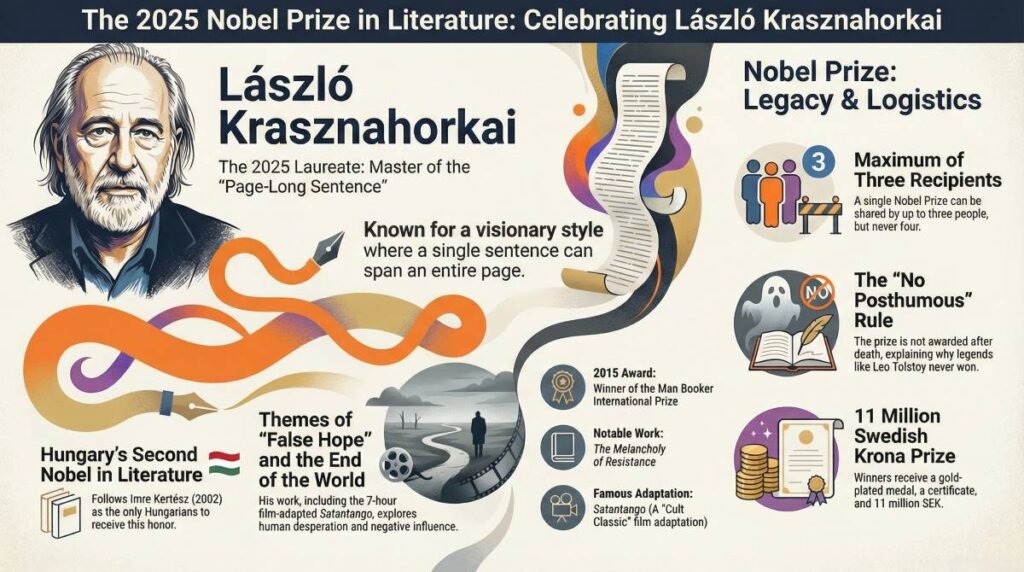
The prize comes with a gold medal, a diploma, and a significant cash award (currently around 11 million Swedish kronor, roughly $1 million USD). More importantly, it comes with global recognition, skyrocketing book sales, and an assured place in literary history.
What makes this award particularly fascinating is that it doesn’t just reward one book. It honors an entire body of work – the sum total of a writer’s creative output and their impact on human thought and culture.
List Of Nobel Prize Winners in English Literature PDF | PPT SLIDES
How Are Nobel Laureates in Literature Selected?
The selection process is deliberate, secretive, and takes nearly a year. Here’s how it works in plain language: The Swedish Academy, made up of 18 permanent members (called “The Eighteen”), sends out nomination forms to qualified nominators around the world every autumn. Nominations are submitted by February 1st each year. From hundreds of nominations, the Academy’s Nobel Committee shortlists candidates over the spring and summer. By autumn, the full Academy votes on the winner, and the announcement is made in October. The award ceremony takes place on December 10th – the anniversary of Alfred Nobel’s death. One important note: nominations remain confidential for 50 years, which is part of what makes the annual announcement so exciting and unpredictable.
Complete List of Nobel Prize Winners in English Literature (1901-2025)
Below is the comprehensive list of all Nobel Prize winners. English-language winners are highlighted in gold. Writers of other languages are also included for completeness, as many are widely studied in English translation.
* Denotes primary English-language writers or writers widely recognized in English literary tradition.
| Year | Laureate | Country | Language | Known For |
| 1901 | Sully Prudhomme | France | French | Poetry, Stances et Poemes |
| 1902 | Theodor Mommsen | Germany | German | Roman History |
| 1903 | Bjornstjerne Bjornson | Norway | Norwegian | Synnove Solbakken |
| 1904 | Frederic Mistral | France | Occitan | Miреio |
| 1904 | Jose Echegaray | Spain | Spanish | Drama |
| 1905 | Henryk Sienkiewicz | Poland | Polish | Quo Vadis |
| 1906 | Giosue Carducci | Italy | Italian | Poetry |
| 1907 | Rudyard Kipling | United Kingdom | English | The Jungle Book, Kim |
| 1908 | Rudolf Eucken | Germany | German | Philosophy |
| 1909 | Selma Lagerlof | Sweden | Swedish | The Wonderful Adventures of Nils |
| 1910 | Paul Heyse | Germany | German | Novellas |
| 1911 | Maurice Maeterlinck | Belgium | French | The Blue Bird |
| 1912 | Gerhart Hauptmann | Germany | German | Drama |
| 1913 | Rabindranath Tagore | India | Bengali/English | Gitanjali |
| 1914 | Not awarded | – | – | – |
| 1915 | Romain Rolland | France | French | Jean-Christophe |
| 1916 | Verner von Heidenstam | Sweden | Swedish | The Tree of the Folkungs |
| 1917 | Karl Adolph Gjellerup | Denmark | Danish | Poetry, Fiction |
| 1917 | Henrik Pontoppidan | Denmark | Danish | Lucky Per |
| 1918 | Not awarded | – | – | – |
| 1919 | Carl Spitteler | Switzerland | German | Olympian Spring |
| 1920 | Knut Hamsun | Norway | Norwegian | Hunger |
| 1921 | Anatole France | France | French | Penguin Island |
| 1922 | Jacinto Benavente | Spain | Spanish | Drama |
| 1923 | W.B. Yeats | Ireland | English | The Tower, Irish mythology |
| 1924 | Wladyslaw Reymont | Poland | Polish | The Peasants |
| 1925 | George Bernard Shaw | Ireland/UK | English | Pygmalion, Man and Superman |
| 1926 | Grazia Deledda | Italy | Italian | Reeds in the Wind |
| 1927 | Henri Bergson | France | French | Philosophy |
| 1928 | Sigrid Undset | Norway | Norwegian | Kristin Lavransdatter |
| 1929 | Thomas Mann | Germany | German | The Magic Mountain |
| 1930 | Sinclair Lewis | USA | English | Main Street, Babbitt |
| 1931 | Erik Axel Karlfeldt | Sweden | Swedish | Poetry |
| 1932 | John Galsworthy | UK | English | The Forsyte Saga |
| 1933 | Ivan Bunin | Russia | Russian | The Village |
| 1934 | Luigi Pirandello | Italy | Italian | Six Characters in Search of an Author |
| 1935 | Not awarded | – | – | – |
| 1936 | Eugene O’Neill | USA | English | Long Day’s Journey Into Night |
| 1937 | Roger Martin du Gard | France | French | The Thibaults |
| 1938 | Pearl S. Buck | USA | English | The Good Earth |
| 1939 | Frans Eemil Sillanpaa | Finland | Finnish | Meek Heritage |
| 1940-43 | Not awarded | – | – | – |
| 1944 | Johannes V. Jensen | Denmark | Danish | The Long Journey |
| 1945 | Gabriela Mistral | Chile | Spanish | Poetry |
| 1946 | Hermann Hesse | Germany/Switzerland | German | Steppenwolf, Siddhartha |
| 1947 | Andre Gide | France | French | The Immoralist |
| 1948 | T.S. Eliot | UK/USA | English | The Waste Land, Four Quartets |
| 1949 | William Faulkner | USA | English | The Sound and the Fury |
| 1950 | Bertrand Russell | UK | English | A History of Western Philosophy |
| 1951 | Par Lagerkvist | Sweden | Swedish | Barabbas |
| 1952 | Francois Mauriac | France | French | Therese Desqueyroux |
| 1953 | Winston Churchill | UK | English | The Second World War |
| 1954 | Ernest Hemingway | USA | English | The Old Man and the Sea, A Farewell to Arms |
| 1955 | Halldor Laxness | Iceland | Icelandic | Independent People |
| 1956 | Juan Ramon Jimenez | Spain | Spanish | Poetry |
| 1957 | Albert Camus | France | French | The Stranger, The Plague |
| 1958 | Boris Pasternak | Soviet Union | Russian | Doctor Zhivago |
| 1959 | Salvatore Quasimodo | Italy | Italian | Poetry |
| 1960 | Saint-John Perse | France | French | Poetry |
| 1961 | Ivo Andric | Yugoslavia | Serbo-Croatian | The Bridge on the Drina |
| 1962 | John Steinbeck | USA | English | Of Mice and Men, The Grapes of Wrath |
| 1963 | Giorgos Seferis | Greece | Greek | Poetry |
| 1964 | Jean-Paul Sartre | France | French | Nausea (Declined the prize) |
| 1965 | Mikhail Sholokhov | Soviet Union | Russian | And Quiet Flows the Don |
| 1966 | Shmuel Agnon | Israel | Hebrew | A Guest for the Night |
| 1966 | Nelly Sachs | Germany/Sweden | German | Poetry |
| 1967 | Miguel Angel Asturias | Guatemala | Spanish | El Senor Presidente |
| 1968 | Yasunari Kawabata | Japan | Japanese | Snow Country |
| 1969 | Samuel Beckett | Ireland | English/French | Waiting for Godot, Endgame |
| 1970 | Aleksandr Solzhenitsyn | Soviet Union | Russian | One Day in the Life of Ivan Denisovich |
| 1971 | Pablo Neruda | Chile | Spanish | Twenty Love Poems |
| 1972 | Heinrich Boll | Germany | German | The Lost Honor of Katharina Blum |
| 1973 | Patrick White | Australia | English | Voss, The Tree of Man |
| 1974 | Eyvind Johnson | Sweden | Swedish | Historical novels |
| 1974 | Harry Martinson | Sweden | Swedish | Aniara |
| 1975 | Eugenio Montale | Italy | Italian | Poetry |
| 1976 | Saul Bellow | USA/Canada | English | Herzog, Henderson the Rain King |
| 1977 | Vicente Aleixandre | Spain | Spanish | Poetry |
| 1978 | Isaac Bashevis Singer | USA | Yiddish | The Magician of Lublin |
| 1979 | Odysseas Elytis | Greece | Greek | Poetry |
| 1980 | Czeslaw Milosz | Poland/USA | Polish | The Captive Mind |
| 1981 | Elias Canetti | Bulgaria/UK | German | Crowds and Power |
| 1982 | Gabriel Garcia Marquez | Colombia | Spanish | One Hundred Years of Solitude |
| 1983 | William Golding | UK | English | Lord of the Flies |
| 1984 | Jaroslav Seifert | Czech Republic | Czech | Poetry |
| 1985 | Claude Simon | France | French | The Flanders Road |
| 1986 | Wole Soyinka | Nigeria | English | Death and the King’s Horseman |
| 1987 | Joseph Brodsky | USA/Russia | Russian/English | Poetry |
| 1988 | Naguib Mahfouz | Egypt | Arabic | Cairo Trilogy |
| 1989 | Camilo Jose Cela | Spain | Spanish | The Family of Pascual Duarte |
| 1990 | Octavio Paz | Mexico | Spanish | The Labyrinth of Solitude |
| 1991 | Nadine Gordimer | South Africa | English | Burger’s Daughter |
| 1992 | Derek Walcott | Saint Lucia | English | Omeros |
| 1993 | Toni Morrison | USA | English | Beloved, Song of Solomon |
| 1994 | Kenzaburo Oe | Japan | Japanese | A Personal Matter |
| 1995 | Seamus Heaney | Ireland | English | Death of a Naturalist |
| 1996 | Wislawa Szymborska | Poland | Polish | Poetry |
| 1997 | Dario Fo | Italy | Italian | Accidental Death of an Anarchist |
| 1998 | Jose Saramago | Portugal | Portuguese | Blindness |
| 1999 | Gunter Grass | Germany | German | The Tin Drum |
| 2000 | Gao Xingjian | China/France | Chinese | Soul Mountain |
| 2001 | V.S. Naipaul | UK/Trinidad | English | A House for Mr Biswas |
| 2002 | Imre Kertesz | Hungary | Hungarian | Fatelessness |
| 2003 | J.M. Coetzee | South Africa/Australia | English | Disgrace, Waiting for the Barbarians |
| 2004 | Elfriede Jelinek | Austria | German | The Piano Teacher |
| 2005 | Harold Pinter | UK | English | The Birthday Party, Betrayal |
| 2006 | Orhan Pamuk | Turkey | Turkish | My Name Is Red |
| 2007 | Doris Lessing | UK | English | The Golden Notebook |
| 2008 | Jean-Marie G. Le Clezio | France/Mauritius | French | The Interrogation |
| 2009 | Herta Muller | Germany/Romania | German | The Land of Green Plums |
| 2010 | Mario Vargas Llosa | Peru | Spanish | The Feast of the Goat |
| 2011 | Tomas Transtromer | Sweden | Swedish | Poetry |
| 2012 | Mo Yan | China | Chinese | Red Sorghum |
| 2013 | Alice Munro | Canada | English | Short stories, Lives of Girls and Women |
| 2014 | Patrick Modiano | France | French | Missing Person |
| 2015 | Svetlana Alexievich | Belarus | Russian | Voices from Chernobyl |
| 2016 | Bob Dylan | USA | English | Blowin’ in the Wind, Highway 61 Revisited |
| 2017 | Kazuo Ishiguro | UK/Japan | English | The Remains of the Day, Never Let Me Go |
| 2018 | Olga Tokarczuk | Poland | Polish | Flights, The Books of Jacob (awarded 2019) |
| 2019 | Peter Handke | Austria | German | Offending the Audience |
| 2020 | Louise Gluck | USA | English | The Wild Iris, Averno |
| 2021 | Abdulrazak Gurnah | UK/Tanzania | English | Paradise, Desertion |
| 2022 | Annie Ernaux | France | French | The Years |
| 2023 | Jon Fosse | Norway | Norwegian/Nynorsk | Septology |
| 2024 | Han Kang | South Korea | Korean | The Vegetarian, Human Acts |
| 2025 | Laszlo Krasznahorkai | Hungary | Hungarian | Satantango, The Melancholy of Resistance |
Notable English-Language Winners – A Closer Look
Let’s take a more personal look at some of the most celebrated English-language winners and what made their work stand out.
Rudyard Kipling (1907) – The Youngest English Winner
When Kipling won at age 41, he became the first English-language writer to receive the Nobel Prize – and the youngest winner at the time. Born in Bombay in 1865, he wrote some of the most beloved stories in the English language. The Jungle Book gave us Mowgli and the idea that nature can be both nurturing and cruel. Kim remains one of the finest novels ever written about colonial India.
W.B. Yeats (1923) – The Poet of Irish Identity
William Butler Yeats didn’t just write poems – he helped build a national identity. His work wove together Irish mythology, mysticism, and political passion into some of the most quoted lines in the English language. Phrases like “Things fall apart; the centre cannot hold” from The Second Coming feel as urgent today as they did in 1919. Yeats was also a playwright, a senator, and a co-founder of the Abbey Theatre in Dublin.
Ernest Hemingway (1954) – Short Sentences, Deep Oceans
Hemingway changed how people wrote prose. His iceberg theory – the idea that the dignity of a story’s movement comes from the seven-eighths of it that you don’t see – influenced generations of writers. His classics – The Old Man and the Sea, A Farewell to Arms, The Sun Also Rises – remain staples of high school and university syllabi worldwide.
Toni Morrison (1993) – The Voice of a Nation’s Pain
Toni Morrison was the first African American woman to win the Nobel Prize in Literature. Her novels – particularly Beloved, Song of Solomon, and The Bluest Eye – excavated the trauma of slavery and its aftermath with a lyrical power that was both devastating and redemptive.
Seamus Heaney (1995) – Digging with Words
The Irish poet Seamus Heaney was often called “the greatest poet working in English” long before Stockholm came calling. His collection Death of a Naturalist opened with a poem called “Digging,” in which he watches his father dig in a garden and realizes his own tool is the pen. His Nobel lecture, Crediting Poetry, is required reading for anyone interested in what literature can do in the face of violence and history.
Bob Dylan (2016) – The Songwriter Who Split the World
When Bob Dylan was named the 2016 Nobel Laureate, it sparked one of the most spirited debates in the prize’s history. The Swedish Academy cited his creation of “new poetic expressions within the great American song tradition.” Whether you love or hate the choice, it forced a global conversation about what literature actually is.
Kazuo Ishiguro (2017) – The Quiet Earthquake
Ishiguro’s novels seem calm on the surface, but they devastate. The Remains of the Day is about an English butler who only realizes – too late – that he wasted his life in service to a morally compromised man. Never Let Me Go is a science fiction novel about cloned children that somehow becomes the most tender book about mortality you’ll ever read.
Han Kang (2024) – The Poet of Historical Wounds
Han Kang became the first South Korean author and the first Asian woman to win the Nobel Prize. Her prose sits at the intersection of the political and the deeply personal. The Vegetarian follows a woman’s quiet rebellion, while Human Acts confronts the trauma of the 1980 Gwangju Uprising with devastating clarity.
Laszlo Krasznahorkai (2025) – The Architect of Apocalyptic Prose
The 2025 Nobel Prize in Literature was awarded to Laszlo Krasznahorkai, the Hungarian master of long, labyrinthine sentences and relentlessly dark literary worlds. The Swedish Academy recognized his work for its “visionary oeuvre that, in the midst of apocalyptic terror, reaffirms the power of art.”
Born in 1954 in Gyula, Hungary, Krasznahorkai is widely considered one of the most important living writers in European literature. His key works include:
• Satantango (1985) – A claustrophobic masterpiece about villagers in a decaying collective farm, later adapted into a legendary 7-hour film by director Bela Tarr.
• The Melancholy of Resistance (1989) – A darkly comic exploration of a small Hungarian town gripped by collective fear and paranoia.
• War and War (1999) – A fractured, obsessive narrative about a man trying to preserve a manuscript across centuries and continents.
• Baron Wenckheim’s Homecoming (2016) – A Booker International Prize-winning novel that blends tragedy, farce, and apocalyptic vision.
EXAM NOTE: Laszlo Krasznahorkai (Hungary, 2025) is the most current Nobel Prize in Literature entry and is highly likely to appear in 2026 competitive exams.
First-Ever & Record-Breaking Nobel Laureates
Here are some fascinating milestones worth knowing – great for trivia, exam prep, or a compelling PPT slide:
- Most recent winner (2025): Laszlo Krasznahorkai (Hungary) – “visionary oeuvre that reaffirms the power of art amidst apocalyptic terror”
- First-ever winner: Sully Prudhomme (France), 1901
- First English-language winner: Rudyard Kipling (UK), 1907
- First American winner: Sinclair Lewis, 1930
- First African winner: Wole Soyinka (Nigeria), 1986
- First African American woman winner: Toni Morrison (USA), 1993
- First musician to win: Bob Dylan (USA), 2016
- Youngest winner ever: Rudyard Kipling, age 41 (1907)
- Oldest winner: Doris Lessing, age 88 (2007)
- Only Prime Minister to win: Winston Churchill, 1953
- Only person to decline the prize: Jean-Paul Sartre (France), 1964
- Years with no award: 1914, 1918, 1935, 1940, 1941, 1942, 1943
Also read: List of Pulitzer Prize Winners in English Literature PDF PPT
Frequently Asked Questions (FAQs)
Q1: Who was the first Nobel Prize winner in English Literature?
Rudyard Kipling of the United Kingdom was the first Nobel Prize winner who wrote primarily in English, winning in 1907 for his work including The Jungle Book and Kim.
Q2: Has any Indian won the Nobel Prize in Literature?
Yes. Rabindranath Tagore won in 1913, making him the first Asian Nobel Laureate in Literature and the only Indian to date. Though he primarily wrote in Bengali, he also translated much of his work into English – including Gitanjali, the collection that impressed the Nobel Committee.
Q3: Who is the most recent Nobel Prize winner in Literature?
As of 2025, the most recent winner is Laszlo Krasznahorkai of Hungary. The Swedish Academy awarded him the prize for his “visionary oeuvre that, in the midst of apocalyptic terror, reaffirms the power of art.” Prior to him, the 2024 winner was Han Kang of South Korea, the first South Korean and first Asian woman to receive the honour.
Q4: How many Americans have won the Nobel Prize in Literature?
Americans who have won include: Sinclair Lewis (1930), Eugene O’Neill (1936), Pearl S. Buck (1938), T.S. Eliot (1948), William Faulkner (1949), Ernest Hemingway (1954), John Steinbeck (1962), Saul Bellow (1976), Isaac Bashevis Singer (1978), Joseph Brodsky (1987), Toni Morrison (1993), Bob Dylan (2016), and Louise Gluck (2020).
Q5: Is the Nobel Prize in Literature awarded every year?
Not always. There have been several years when no prize was awarded – particularly during World War I and World War II. In 2018, the prize was postponed due to a controversy within the Swedish Academy; both 2018 and 2019 prizes were awarded in 2019.
Q6: Why didn’t Jean-Paul Sartre accept the Nobel Prize?
The French existentialist philosopher and writer Jean-Paul Sartre declined the 1964 Nobel Prize, stating that he did not wish to be transformed by such recognition. He believed accepting institutional honors would compromise his intellectual independence. He remains the only person to voluntarily decline the Nobel Prize in Literature.
Q7: Who is the youngest Nobel Prize winner in Literature?
Rudyard Kipling, who won at age 41 in 1907, is the youngest recipient in the history of the Nobel Prize in Literature.
Q8: Did any Nobel Laureate write both poetry and prose?
Many did, but Rabindranath Tagore stands out as particularly versatile – he was a poet, novelist, short story writer, playwright, composer, and visual artist. Seamus Heaney also wrote essays and literary criticism alongside his poetry. T.S. Eliot was a poet, playwright, and literary critic.
Why This List Matters Beyond the Classroom
When you look at this list as a whole – 125 names spanning 12 decades – you see the story of world literature itself. You see how the prize slowly expanded its geographical lens, first centered almost entirely on Europe, then gradually reaching Africa, Asia, Latin America, and the Caribbean.
You see a prize that initially overlooked women (fewer than 20 women have won in over 120 years), then began recognizing voices like Toni Morrison, Alice Munro, and Doris Lessing. You see a prize that wrestled with what “literature” even means – a debate that Bob Dylan’s win made impossible to avoid.
And you see, in each name on this list, a human being who sat alone with language and made something that outlasted them. That’s the real story behind every Nobel Prize in Literature. The Swedish Academy doesn’t just give a prize – it makes an argument about what words are for.
Final Thoughts
Whether you’re building a study guide, creating a classroom presentation, preparing for a government exam, or simply satisfying your curiosity, this complete list of Nobel Prize winners in English Literature is your starting point. Bookmark it, save it as a PDF, adapt it into a PowerPoint – and more importantly, pick up one of these books.
Because the real prize isn’t in Stockholm. It’s on the page.