Today we will discuss about the List of Pulitzer Prize Winners in English Literature PDF PPT and give you info with PDF, PPT and Infographic and Explore the complete list of Pulitzer Prize winners in English literature – from fiction and poetry to drama and biography. A detailed, expert guide covering over 100 years of America’s most prestigious literary award, with author backgrounds, winning works, and what made each one extraordinary.
America’s Greatest Literary Honour
If you have ever browsed the fiction shelves of a bookstore, you have almost certainly noticed those gold or green stickers on book covers that announce ‘Pulitzer Prize Winner.’ That small circular seal is one of the most powerful endorsements in the English-speaking literary world – a marker that tells readers, publishers, libraries, and booksellers alike that this particular work has been judged, by a panel of distinguished experts, to represent the finest American writing of its year.
But what exactly is the Pulitzer Prize? Why does it carry such extraordinary weight? Who has won it, and why do some of those winners remain household names decades later while others have faded from the cultural conversation? And what does the full sweep of Pulitzer history tell us about how American literature and intellectual life have evolved over more than a century?
This comprehensive guide answers all of those questions and more. We cover the complete history of the Pulitzer Prize in literature – spanning its founding in 1917, the controversies that have shaped it, and the remarkable writers who have won it across every major category: Fiction, Poetry, Drama, Biography and Autobiography, History, and General Nonfiction. Whether you are a student researching for a paper, a book lover building your reading list, a librarian answering patron questions, or simply someone who finds the intersection of literature and cultural history irresistible, this is the most thorough English-language guide to Pulitzer Prize winners you will find.
What Is the Pulitzer Prize? History, Origins, and Significance
The Founding Vision of Joseph Pulitzer
The Pulitzer Prize owes its existence to one of the most complex and consequential figures in the history of American journalism: Joseph Pulitzer. Born in Hungary in 1847, Pulitzer emigrated to the United States during the Civil War, found his calling in journalism, and built a newspaper empire that included the St. Louis Post-Dispatch and the New York World. By the time of his death in 1911, he was one of the wealthiest and most influential media figures in American history – but also one who had reflected deeply on what journalism and literature owed to society and what society owed to its writers.
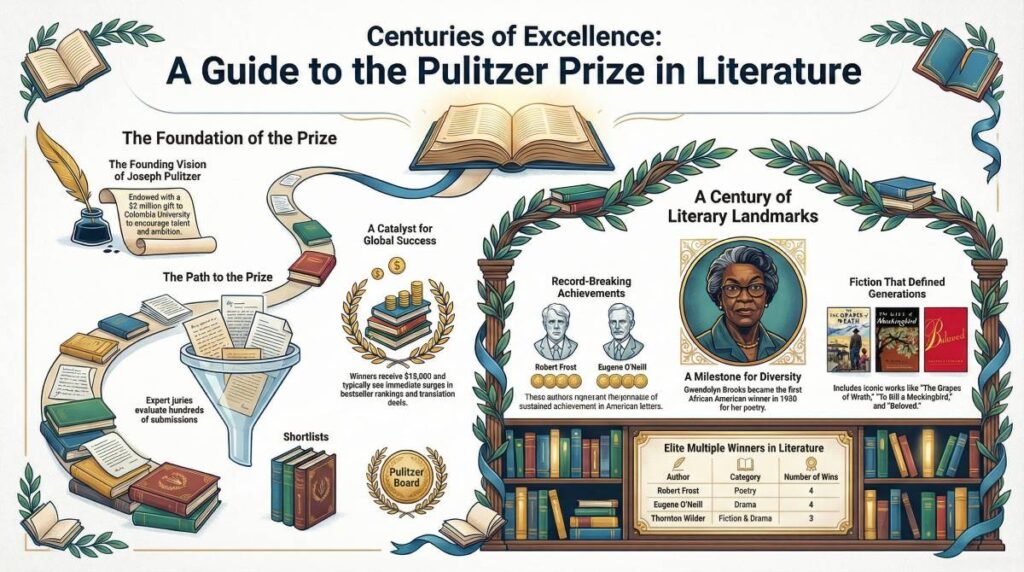
In his will, Pulitzer left two million dollars to Columbia University with specific instructions to establish a graduate school of journalism and to fund annual prizes for distinguished achievement in journalism, letters, and music. The prizes, he directed, should serve to raise the standards of American journalism and literature and to encourage writers of talent and ambition. The first Pulitzer Prizes were awarded in 1917, five years after his death – and in the more than a century since, they have grown from a modestly publicised annual ceremony into the most closely watched literary prizes in the United States.
How the Pulitzer Prize Works
The Pulitzer Prize is administered by Columbia University in New York City. Each year, hundreds of books, plays, and works of journalism are submitted for consideration across the various prize categories. These submissions are evaluated by juries of distinguished experts – novelists, poets, critics, academics, and journalists – who read the submitted works and produce a shortlist of finalists. The jury recommendations are then passed to the Pulitzer Prize Board, an independent body of editors, academics, and journalists, which makes the final award decisions.
In the literature categories, prizes are currently awarded in six areas: Fiction, Poetry, Drama, Biography or Autobiography, History, and General Nonfiction. The cash prize for each award is $15,000 – a modest sum by the standards of literary prizes globally, but one that is accompanied by the kind of public recognition and sales impact that no amount of money alone could purchase. Winning the Pulitzer Prize for Fiction, in particular, typically propels a book onto bestseller lists, secures foreign rights deals in dozens of countries, and can transform a writer’s career overnight.
Why the Pulitzer Prize Matters
The Pulitzer Prize matters because it is old, because it is American, and because it has consistently rewarded work of genuine literary ambition rather than purely commercial appeal. Unlike bestseller lists, which measure what people are buying, the Pulitzer Prize is intended to measure what is worth reading – work that illuminates the human condition, that uses language with precision and beauty, that tells truths about American life and the wider world that other forms of expression cannot reach.
It has not always got it right. There have been controversial decisions, overlooked masterpieces, and the occasional winner that history has judged harshly. But taken as a whole, the Pulitzer Prize record is an extraordinary document of American literary culture – a century-long conversation about what stories matter, whose voices deserve amplification, and what literature can and should do.
List Of Pulitzer Prize Winners in English Literature PDF | PPT SLIDES
Pulitzer Prize for Fiction: Complete List of Notable Winners
The Pulitzer Prize for Fiction – known as the Prize for the Novel until 1948 – is the most celebrated of all the Pulitzer literary awards. First awarded in 1918, it has recognised some of the most enduring works in the English language. What follows is a comprehensive guide to the most significant winners, organised by era, with context about each work and its lasting significance.
The Early Era: 1918 to 1940
The earliest Pulitzer fiction prizes reflect both the strengths and the limitations of early 20th-century American literary culture. The prize went to works that were widely popular and critically respected in their day, though later generations have sometimes reassessed their lasting value.
Ernest Poole – His Family (1918)
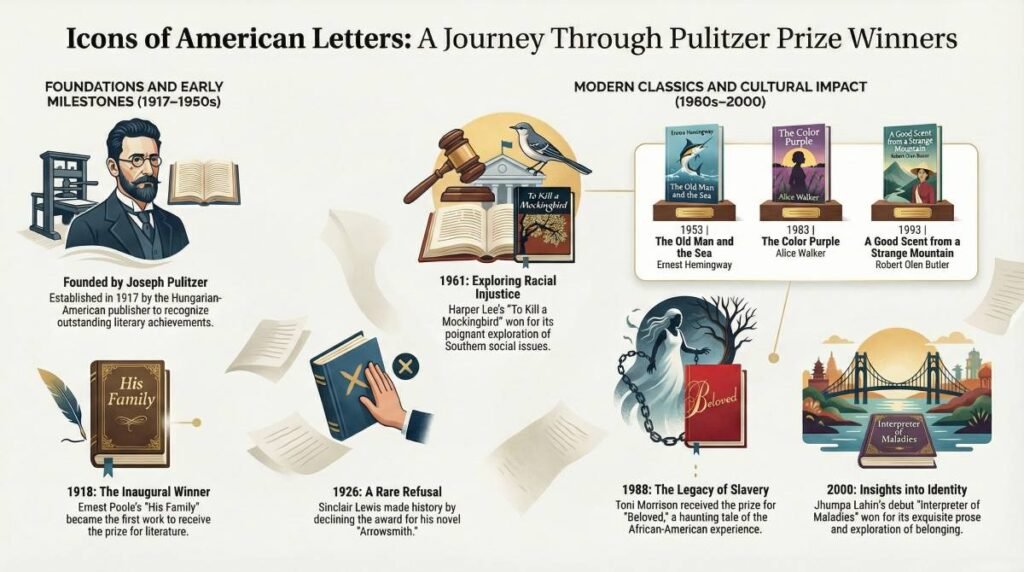
The very first Pulitzer Prize for the Novel went to Ernest Poole for His Family, a multigenerational story of a New York widower navigating relationships with his three very different daughters in an era of rapid social change. Poole was one of the most prominent American novelists of his day, though his work has largely faded from the contemporary canon. His Family is significant historically as the inaugural winner of what would become America’s most prestigious literary prize.
Booth Tarkington – The Magnificent Ambersons (1919) and Alice Adams (1922)
Booth Tarkington is one of only three authors to have won the Pulitzer Prize for Fiction twice. His 1919 win for The Magnificent Ambersons – a richly detailed portrait of a Midwestern aristocratic family’s decline in the face of industrialisation and the automobile age – earned him his first prize. He won again in 1922 for Alice Adams, a quietly devastating character study of a young woman from a struggling middle-class family desperately trying to maintain social appearances. Orson Welles adapted The Magnificent Ambersons into a celebrated 1942 film. Tarkington’s social realism and his precise observation of American class anxiety give his work a durability that outlasts many of his contemporaries.
Willa Cather – One of Ours (1923)
Willa Cather’s win for One of Ours remains one of the more debated early Pulitzer decisions. The novel follows Claude Wheeler, a Nebraska farm boy who finds purpose and meaning only after enlisting in the First World War – a premise that critics including Ernest Hemingway and Edmund Wilson found sentimentalised and inauthentic. Cather’s other works – particularly My Antonia, Death Comes for the Archbishop, and O Pioneers! – are widely considered superior. Nevertheless, the prize drew significant attention to one of the 20th century’s most distinctive literary voices, and Cather’s place in the American canon is unquestioned.
Edith Wharton – The Age of Innocence (1921)
Edith Wharton became the first woman to win the Pulitzer Prize for Fiction when The Age of Innocence was awarded the prize in 1921. The novel is a masterpiece of social observation – a precisely rendered portrait of upper-class New York society in the 1870s, seen through the eyes of Newland Archer, a lawyer who finds himself torn between duty and desire when the unconventional Countess Olenska returns to the city of her birth. Wharton’s prose is exquisitely controlled, her irony surgical, and her understanding of how social structures both protect and suffocate individuals has lost none of its power. The Age of Innocence is consistently ranked among the greatest American novels ever written.
Sinclair Lewis – Arrowsmith (1926)
Sinclair Lewis became the first American to win the Nobel Prize in Literature in 1930, but he first declined the Pulitzer Prize for Arrowsmith in 1926 – one of the few acts of prize refusal in Pulitzer history. Lewis objected to the prize’s stated preference for works that presented ‘the wholesome atmosphere of American life,’ arguing that this criterion rewarded mediocrity and timidity. His protest was a significant moment in American literary culture, forcing a reassessment of what prize committees were actually measuring. Arrowsmith itself is a magnificent novel – a sweeping portrait of a young idealistic doctor navigating the compromises and corruptions of American medicine and scientific research.
Thornton Wilder – The Bridge of San Luis Rey (1928)
Thornton Wilder’s The Bridge of San Luis Rey won the first of his three Pulitzer Prizes – a record he shares with no other author. The novel asks a deceptively simple question: when five people die in the collapse of a rope bridge in 18th-century Peru, is their deaths an act of divine providence or mere chance? The story unfolds through the investigations of a Franciscan friar who dedicates his life to answering this question. Short, elegant, and philosophically profound, The Bridge of San Luis Rey has never gone out of print since its publication in 1927 and remains one of the most quietly perfect novels in the American tradition.
Pearl S. Buck – The Good Earth (1932)
Pearl S. Buck’s The Good Earth won the Pulitzer Prize in 1932 and contributed significantly to her receiving the Nobel Prize in Literature in 1938 – making her the first American woman to win the Nobel for Literature. The Good Earth tells the story of Wang Lung, a Chinese peasant farmer, and follows his rise from poverty to prosperity across a life defined by the land, family, and fortune. At a time when most Americans knew almost nothing about China or Chinese culture, Buck’s novel introduced an entire civilisation to a mass readership with compassion, detail, and dignity. It remains one of the bestselling American novels of all time and was a cultural phenomenon of extraordinary reach.
The Mid-Century Era: 1940 to 1970
The middle decades of the 20th century produced some of the Pulitzer Prize’s most celebrated and enduring winners, as American literature confronted the Second World War, the Civil Rights movement, the Cold War, and the dramatic social transformations of the 1950s and 1960s.
John Steinbeck – The Grapes of Wrath (1940)
John Steinbeck’s The Grapes of Wrath is, by almost any measure, one of the greatest American novels of the 20th century, and its Pulitzer Prize win in 1940 remains one of the most unambiguously correct decisions in the prize’s history. The novel follows the Joad family – Oklahoma sharecroppers dispossessed by the Dust Bowl and the mechanisation of agriculture – as they migrate to California in search of a promised land that turns out to be a brutal exploitation economy. Steinbeck’s prose burns with moral outrage and compassion in equal measure. The Grapes of Wrath was banned in multiple US states, denounced by California growers as Communist propaganda, and praised by Eleanor Roosevelt as an essential document of American suffering. It was a direct contributing factor to the New Deal agricultural relief programmes and remains one of the most politically consequential novels in American literary history. Steinbeck later won the Nobel Prize in Literature in 1962.
Ellen Glasgow – In This Our Life (1942)
Ellen Glasgow received the 1942 Pulitzer Prize for In This Our Life, a novel about the decline of an old Virginia family that drew on themes she had explored throughout a long and distinguished career. Glasgow is credited with being among the first southern writers to bring realism and social criticism to the romantic traditions of Southern literature, paving the way for later writers including William Faulkner, Flannery O’Connor, and Carson McCullers.
Upton Sinclair – Dragon’s Teeth (1943)
Upton Sinclair, whose earlier novel The Jungle had exposed the horrors of the American meatpacking industry and led directly to food safety legislation in 1906, won the 1943 Pulitzer for Dragon’s Teeth – the third novel in his Lanny Budd series. Set in Europe during the rise of Adolf Hitler, Dragon’s Teeth is a gripping historical novel that captures the slide of Germany into fascism with remarkable clarity and urgency, written at a moment when the outcome of the Second World War was still deeply uncertain.
Robert Penn Warren – All the King’s Men (1947)
All the King’s Men is one of the towering achievements of American political fiction. Robert Penn Warren’s novel tells the story of Willie Stark – a charismatic, populist Southern politician who rises from poverty to power through a combination of genuine reformist instinct and increasingly cynical manipulation – as seen through the eyes of his aide Jack Burden. The novel is widely understood as a fictionalised portrait of Louisiana Governor Huey Long, but its themes – the corruption of idealism, the seductiveness of power, the complicity of those who serve the powerful – are universal and timeless. All the King’s Men won the 1947 Pulitzer Prize and was adapted twice for film. Penn Warren would later become the first official US Poet Laureate and would win Pulitzer Prizes for poetry as well.
James Michener – Tales of the South Pacific (1948)
James Michener’s debut collection Tales of the South Pacific won the 1948 Pulitzer Prize and inspired the legendary Rodgers and Hammerstein musical South Pacific. Michener’s interconnected stories of American servicemen and local populations on Pacific islands during the Second World War brought an entire theatre of the war to vivid life for American readers who had little direct connection to it. The win launched one of the most commercially successful literary careers in American history – Michener went on to write massive, multi-generational historical novels about places including Hawaii, Poland, Texas, Alaska, and the Caribbean that sold millions of copies worldwide.
Ernest Hemingway – The Old Man and the Sea (1953)
By the time Ernest Hemingway won the Pulitzer Prize for The Old Man and the Sea in 1953, many critics had written off his career as past its peak. The novella – the story of an ageing Cuban fisherman, Santiago, who battles a magnificent marlin alone at sea for three days and nights – silenced them comprehensively. Spare, precise, and profoundly moving, The Old Man and the Sea is Hemingway’s prose style at its most distilled and his humanist themes at their most luminous. The novel contributed directly to his being awarded the Nobel Prize in Literature the following year in 1954. It remains one of the most widely read works in the American literary canon and is taught in schools and universities around the world.
William Faulkner – A Fable (1955)
William Faulkner’s A Fable won the 1955 Pulitzer Prize – a somewhat belated official recognition of a writer who had already won the Nobel Prize in Literature in 1950 and was widely acknowledged as one of the greatest novelists in the English language. A Fable is an ambitious and demanding allegorical novel set during the First World War, in which a French corporal who inspires a mutiny of soldiers on both sides is clearly identified as a Christ-figure. While not considered among Faulkner’s finest works – The Sound and the Fury, As I Lay Dying, and Absalom, Absalom! are generally rated higher – A Fable demonstrates the scope of Faulkner’s literary ambition.
Harper Lee – To Kill a Mockingbird (1961)
Harper Lee’s To Kill a Mockingbird is not just a Pulitzer Prize winner – it is one of the most beloved and widely read novels in the history of the English language. Published in 1960, the novel tells the story of young Scout Finch growing up in the fictional town of Maycomb, Alabama, during the 1930s, as her father Atticus Finch – a lawyer of quiet courage and profound moral integrity – defends a Black man named Tom Robinson falsely accused of raping a white woman. The novel addresses racial injustice, class, and the loss of childhood innocence with a warmth, humour, and moral clarity that have made it essential reading for generations of readers worldwide. To Kill a Mockingbird won the Pulitzer Prize in 1961 and was adapted into an Academy Award-winning film in 1962 starring Gregory Peck. It has sold over 45 million copies and is consistently voted one of the most influential books ever written in English.
Katherine Anne Porter – The Collected Stories (1966)
Katherine Anne Porter won the 1966 Pulitzer Prize – along with the National Book Award – for The Collected Stories, cementing her reputation as one of the supreme American short story writers of the 20th century. Porter’s stories are characterised by psychological precision, precise prose, and a profound understanding of the interior lives of women navigating the constraints of Southern society, gender expectations, and personal identity. Her novella Pale Horse, Pale Rider is widely considered among the finest works of American short fiction.
The Modern Era: 1970 to 2000
The final three decades of the 20th century saw the Pulitzer Prize for Fiction begin to reflect a broader and more diverse America, with wins for writers who brought previously marginalised voices and experiences to the centre of American literary culture.
N. Scott Momaday – House Made of Dawn (1969)
N. Scott Momaday’s House Made of Dawn won the 1969 Pulitzer Prize – a landmark moment in American literary history as the first novel by a Native American writer to receive the prize. The novel follows Abel, a young Kiowa man who returns to his reservation after serving in the Second World War, profoundly damaged by the experience and unable to reconcile his Native American heritage with the world he has been forced into. Momaday’s prose is lyrical and rooted in oral storytelling traditions, and the novel’s win is widely credited with igniting the Native American literary renaissance of the 1970s, opening doors for writers including Leslie Marmon Silko, James Welch, and Louise Erdrich.
Saul Bellow – Humboldt’s Gift (1976)
Saul Bellow was one of the dominant figures in American literature throughout the second half of the 20th century, winning the Nobel Prize in Literature in 1976 – the same year his Pulitzer Prize for Humboldt’s Gift was awarded. The novel is a semi-autobiographical meditation on art, ambition, friendship, and mortality, centred on the relationship between Charlie Citrine, a successful writer in comfortable middle age, and the memory of his brilliant, self-destructive friend Von Humboldt Fleisher – a thinly veiled portrait of the poet Delmore Schwartz. Humboldt’s Gift is rich, comic, digressive, and philosophically dense – everything Bellow’s prose at its best invariably was.
Norman Mailer – The Executioner’s Song (1980)
Norman Mailer won the Pulitzer Prize for The Executioner’s Song in 1980 – a massive, extraordinary work that blurs the boundary between journalism and fiction. The book reconstructs, in meticulous detail drawn from hundreds of interviews and documents, the life, crimes, trial, and execution of Gary Gilmore, the first person executed in the United States after the Supreme Court reinstated the death penalty in 1976. Mailer called the work a ‘true life novel’ – it reads like a novel but is grounded entirely in documented fact. It is arguably the finest example of narrative nonfiction ever to win the Pulitzer Prize for Fiction and remains essential reading for anyone interested in the intersection of crime, justice, media, and American culture.
John Updike – Rabbit is Rich (1982) and Rabbit at Rest (1991)
John Updike is one of only three writers to have won the Pulitzer Prize for Fiction twice. He won for Rabbit is Rich in 1982 and for Rabbit at Rest in 1991 – the third and fourth volumes respectively of his celebrated Rabbit tetralogy, following the life of Harry ‘Rabbit’ Angstrom, a former high school basketball star navigating middle-class American life from the 1950s to the 1980s. The Rabbit novels are among the most sustained achievements in American literature – a decades-long portrait of one ordinary man that serves simultaneously as a social history of postwar America. Updike’s prose is sensuous, precise, and endlessly observant, and his ability to find the metaphysical in the mundane gives the series a depth that outlasts any individual volume.
Alice Walker – The Color Purple (1983)
Alice Walker’s The Color Purple won both the Pulitzer Prize and the National Book Award in 1983, making Walker the first Black woman to win the Pulitzer Prize for Fiction. The novel is told entirely through letters – from Celie, a young Black woman in rural Georgia in the early 20th century, to God, and later to and from her sister Nettie who has gone to Africa as a missionary. The Color Purple is a novel about survival, self-discovery, and the resilience of the human spirit in the face of sexual violence, racial oppression, and poverty. It was adapted into a celebrated 1985 film directed by Steven Spielberg and a 2005 Broadway musical. Walker’s win was a watershed moment in the recognition of Black women’s voices in American literary culture.
Larry McMurtry – Lonesome Dove (1986)
Larry McMurtry’s Lonesome Dove is one of the greatest American epic novels of the 20th century – a sweeping, character-driven masterpiece of the Western genre that transcends genre entirely. The novel follows former Texas Rangers Augustus McCrae and Woodrow Call as they undertake a cattle drive from the Rio Grande to the Montana territory in the 1870s. What sets Lonesome Dove apart from most Western fiction is its emotional intelligence, its willingness to subvert genre conventions, and its extraordinarily vivid gallery of characters. McMurtry won the 1986 Pulitzer Prize for it, and the subsequent 1989 television miniseries adaptation became one of the highest-rated television events in American history.
Toni Morrison – Beloved (1988)
Toni Morrison’s Beloved is, by widespread critical consensus, one of the greatest novels written in the English language in the 20th century. The novel is inspired by the true story of Margaret Garner, an enslaved woman who escaped from a Kentucky plantation in 1856 and, upon being recaptured, killed her infant daughter rather than see her returned to slavery. Morrison builds from this historical foundation a devastating, supernatural, and profoundly humane meditation on the nature of slavery’s psychological damage – what Morrison herself called ‘the unspeakable things unspoken’ at the heart of African American history.
Beloved won the 1988 Pulitzer Prize and, five years later, played a central role in Morrison being awarded the Nobel Prize in Literature in 1993 – making her the first Black woman to receive that distinction. The novel initially failed to win the National Book Award, prompting 48 Black writers and scholars to sign an open letter of protest in The New York Times Book Review – an act that drew enormous public attention to both the novel and the question of whose stories the literary establishment was willing to honour. Beloved is taught in universities and schools across the world and is on virtually every list of the greatest American novels ever written.
E. Annie Proulx – The Shipping News (1994)
E. Annie Proulx’s The Shipping News won the Pulitzer Prize in 1994, along with the National Book Award. The novel follows Quoyle, a hapless, self-doubting journalist who moves with his two daughters and aunt to Newfoundland after a series of catastrophic personal failures and slowly, painfully, finds his footing in the harsh but richly human landscape of the North Atlantic coast. Proulx’s prose style is utterly distinctive – spare, percussive, and full of unexpected imagery – and her portrait of a remote Canadian coastal community is among the most vivid pieces of place-writing in contemporary American literature.
Carol Shields – The Stone Diaries (1995)
Carol Shields won the 1995 Pulitzer Prize for The Stone Diaries, a formally innovative novel that presents itself as the autobiography of Daisy Goodwill Flett – a woman whose life spans most of the 20th century – while quietly revealing the ways in which women’s lives are systematically overlooked, misrepresented, and ultimately inaccessible even to themselves. Shields uses unconventional narrative devices including photographs, lists, and shifting perspectives to create a meditation on memory, identity, and the extraordinary ordinariness of most human lives. The Stone Diaries is one of the finest Canadian novels ever written and its Pulitzer win – Shields was born in the United States but lived most of her adult life in Canada – remains one of the prize’s most thoughtful decisions.
Philip Roth – American Pastoral (1998)
Philip Roth won the first of his multiple Pulitzer Prize nominations and wins with American Pastoral in 1998, considered by many critics to be his masterpiece. The novel follows the Swede Levov – a Jewish American sports hero and successful businessman who appears to embody the promise of postwar American prosperity – as his perfect life is destroyed when his daughter becomes a domestic terrorist during the Vietnam era. American Pastoral is a shattering examination of the American Dream’s fragility, the generation gap of the 1960s, and the impossibility of protecting the people we love from history. It is written with the fierce, sustained intelligence that characterises Roth’s very best work and is the first volume of what is known as the American Trilogy.
The Contemporary Era: 2000 to Present
The first quarter of the 21st century has seen the Pulitzer Prize for Fiction embrace an increasingly diverse range of voices, forms, and subjects, reflecting both the changing demographics of American literature and an evolving understanding of whose stories deserve to be at the centre of the national conversation.
Michael Chabon – The Amazing Adventures of Kavalier and Clay (2001)
Michael Chabon’s The Amazing Adventures of Kavalier and Clay won the Pulitzer Prize in 2001 and immediately established itself as one of the great American novels of the new century. The novel follows two cousins – Joe Kavalier, a Jewish refugee from Nazi-occupied Prague, and Sammy Clay, a Brooklyn dreamer – as they create a comic book superhero called The Escapist in New York City during the late 1930s and 1940s. Chabon weaves together the real history of the American comic book industry with themes of Jewish identity, escape (both physical and imaginative), creativity, love, and loss into a narrative of sweeping ambition and infectious energy. The novel is both a love letter to popular culture and a serious exploration of what art means to people living through catastrophe.
Richard Russo – Empire Falls (2002)
Richard Russo’s Empire Falls won the 2002 Pulitzer Prize and is one of the finest working-class American novels of the modern era. Set in the dying mill town of Empire Falls, Maine, the novel centres on Miles Roby – manager of the local diner, dreamer, and essentially good man slowly being ground down by circumstance, family dysfunction, and the weight of a town’s decline. Russo writes with extraordinary warmth, comic precision, and social intelligence about the communities and people that much of literary fiction tends to overlook, and Empire Falls is his most fully realised achievement.
Jeffrey Eugenides – Middlesex (2003)
Jeffrey Eugenides’ Middlesex won the 2003 Pulitzer Prize and is one of the most formally ambitious American novels of the century so far. Narrated by Cal Stephanides – an intersex person raised as a girl who discovers his true biology in adolescence – the novel spans three generations of a Greek American family from Smyrna in the 1920s through Detroit in the 1970s. Eugenides explores questions of identity, genetics, immigration, and what it means to be American with wit, compassion, and genuine narrative drive. Middlesex is that rare thing: an intellectually serious novel that is also genuinely pleasurable to read.
Edward P. Jones – The Known World (2004)
Edward P. Jones’ The Known World won the 2004 Pulitzer Prize and is one of the most original and morally complex American historical novels of recent decades. The novel explores the largely forgotten historical reality of Black slaveholders in antebellum Virginia – specifically the plantation of Henry Townsend, a former slave who has himself purchased slaves. Jones uses a fractured, non-linear narrative structure to create a portrait of an entire community’s moral universe that refuses easy judgement or simple redemption narratives. The Known World won the Pulitzer over strong competition and was immediately recognised as a work of extraordinary ambition and achievement.
Marilynne Robinson – Gilead (2005)
Marilynne Robinson’s Gilead won the 2005 Pulitzer Prize and is one of the most spiritually profound and quietly beautiful American novels of the modern era. The novel is structured as a long letter written by John Ames – an elderly Congregationalist minister in the small Iowa town of Gilead – to his young son, who will be too young to remember his father when he dies. It is a meditation on faith, doubt, mortality, memory, fatherhood, and the grace of ordinary life, written in a prose style of crystalline clarity and deep emotional intelligence. Gilead is one of those rare novels that seems to slow time as you read it and leaves you different – quieter, more attentive – when you finish.
Geraldine Brooks – March (2006)
Geraldine Brooks won the 2006 Pulitzer Prize for March – a novel that retells the story of Little Women from the perspective of the absent father, Robert March, as he serves as a chaplain in the Union Army during the Civil War. Brooks, an Australian-American author, uses the familiar architecture of Louisa May Alcott’s beloved novel to explore the moral ambiguities of the war, the experience of enslaved people, and the gap between idealism and the brutal reality of armed conflict with historical intelligence and literary skill.
Cormac McCarthy – The Road (2007)
Cormac McCarthy’s The Road won the 2007 Pulitzer Prize and stands as one of the most harrowing and paradoxically tender novels of the century. Set in a post-apocalyptic America where an unnamed catastrophe has left the landscape grey with ash and virtually all life extinct, the novel follows a man and his young son as they walk south toward the coast, scavenging for food and evading other survivors who have turned to cannibalism. In McCarthy’s characteristically spare, biblical prose, The Road becomes a meditation on parenthood, love, and the question of whether human goodness can survive in a world stripped of everything that civilisation has constructed. It is one of the most emotionally overwhelming reading experiences in contemporary fiction.
Junot Diaz – The Brief Wondrous Life of Oscar Wao (2008)
Junot Diaz’s The Brief Wondrous Life of Oscar Wao won the 2008 Pulitzer Prize and announced the arrival of one of the most distinctive voices in contemporary American fiction. The novel tells the story of Oscar de Leon – an overweight, socially isolated Dominican American nerd from New Jersey who is obsessed with science fiction and fantasy and desperately wants to fall in love – and his family’s multigenerational struggle with what Diaz calls the ‘fukú,’ a curse brought to the Dominican Republic by Christopher Columbus and sustained by the Trujillo dictatorship. Written in a breathless, code-switching prose that moves between English, Spanish, footnotes, and pop culture references, the novel is formally exhilarating and emotionally devastating in equal measure.
Elizabeth Strout – Olive Kitteridge (2009)
Elizabeth Strout’s Olive Kitteridge won the 2009 Pulitzer Prize – a collection of interconnected short stories, each of which stands independently but together form a complete portrait of a small Maine coastal town and the cantankerous, difficult, fiercely intelligent woman whose presence threads through them all. Olive Kitteridge is a masterclass in the short story form and in the creation of a literary character who is both deeply flawed and profoundly human. The book was adapted into a celebrated 2014 HBO miniseries starring Frances McDormand, who won an Emmy for her portrayal of Olive.
Paul Harding – Tinkers (2010)
Paul Harding’s Tinkers is one of the most unusual Pulitzer Prize winners in the award’s history. A debut novel initially rejected by dozens of publishers before being accepted by a small independent press, Tinkers is a compressed, meditative work of fewer than 200 pages that follows an old man on his deathbed as he experiences the unravelling of his memories and his consciousness. It is not a plot-driven novel in any conventional sense – it is a work of prose poetry as much as fiction, exploring the nature of time, consciousness, and the strange textures of ordinary lives. Its Pulitzer win was a genuine surprise to the literary world and a reminder that the prize at its best rewards genuine literary distinction rather than commercial potential or narrative accessibility.
Jennifer Egan – A Visit from the Goon Squad (2011)
Jennifer Egan’s A Visit from the Goon Squad is one of the most formally inventive American novels of the 21st century and its 2011 Pulitzer Prize win was one of the more thrilling decisions of recent decades. The novel – or collection of interconnected stories, depending on how you define the terms – follows a group of characters connected to the music industry across several decades, moving backwards and forwards in time, shifting narrative perspectives, and including one memorably extraordinary chapter told entirely in PowerPoint slides. The Goon Squad of the title is time, and the novel is a deeply affecting meditation on youth, age, loss, music, and the ways that people and the cultures they inhabit change beyond recognition while somehow remaining themselves.
Anthony Doerr – All the Light We Cannot See (2015)
Anthony Doerr’s All the Light We Cannot See spent 260 weeks on the New York Times bestseller list before winning the 2015 Pulitzer Prize – a combination of sustained popular and critical success that is rare for literary fiction. The novel tells parallel stories of Marie-Laure, a blind French girl living in occupied Saint-Malo during the Second World War, and Werner, a German orphan who becomes a radio expert and is conscripted into the Wehrmacht. Doerr writes with extraordinary descriptive precision and emotional generosity, and the novel’s meditation on what it means to see – literally and metaphorically – gives it a thematic depth that transcends its historical setting. The novel was adapted into a highly successful 2023 Netflix miniseries.
Viet Thanh Nguyen – The Sympathizer (2016)
Viet Thanh Nguyen’s The Sympathizer won the 2016 Pulitzer Prize and is one of the most politically and formally sophisticated American novels of the century. Narrated by an unnamed communist spy working within the South Vietnamese government in the final days before the fall of Saigon in 1975, the novel is a brilliantly bitter, darkly comic examination of the Vietnam War from the perspective of those who are almost never heard in American cultural representations of that conflict. Nguyen grew up as a Vietnamese refugee in the United States and brings to the novel an insider-outsider perspective on American identity, imperialism, and the violence done by cultural representation that is as rigorous as it is enraging.
Colson Whitehead – The Underground Railroad (2017) and The Nickel Boys (2020)
Colson Whitehead became only the fourth writer in Pulitzer Prize history to win the Fiction prize twice, with The Underground Railroad in 2017 and The Nickel Boys in 2020. The Underground Railroad imagines the historical network that helped enslaved people escape to freedom as a literal subterranean railway system and follows Cora, a young enslaved woman, as she flees a Georgia plantation and passes through a series of alternative American histories. The novel is simultaneously a work of speculative fiction, a historical novel, and a profound moral reckoning with the foundational violence of American history.
The Nickel Boys, by contrast, is realist and restrained – a devastating account of two boys sent to a brutal Florida reform school in the 1960s, inspired by the real Dozier School for Boys, where hundreds of children were subjected to abuse, exploitation, and in many cases murder. The Nickel Boys won the Pulitzer Prize and the Kirkus Prize and has been adapted into a critically acclaimed film released in 2024. Together, Whitehead’s two Pulitzer wins represent one of the most significant achievements in contemporary American fiction.
Richard Powers – The Overstory (2019)
Richard Powers’ The Overstory won the 2019 Pulitzer Prize and is one of the most ambitious and challenging American novels of recent years – a sweeping, structurally innovative work whose multiple storylines are all connected by trees and by the human struggle to understand what trees mean, what they do, and why their destruction matters. Powers draws on the latest science of plant consciousness and forest ecology to create a novel that asks fundamental questions about the relationship between human beings and the natural world. The Overstory is not an easy read – it demands patience and attention – but it is a genuinely important work that has been credited with changing how many readers think about forests and environmental activism.
Joshua Cohen – The Netanyahus (2022)
Joshua Cohen’s The Netanyahus won the 2022 Pulitzer Prize for a novel that is bracingly unusual in the recent Pulitzer canon – a short, wickedly comic academic novel about the visit of Benzion Netanyahu (father of Israeli Prime Minister Benjamin Netanyahu) to a fictional American university in the 1960s to interview for a position in the history department. Cohen draws on a true story recounted to him by the literary critic Harold Bloom and uses it as a vehicle for sharp, irreverent comedy about Jewish American identity, academic culture, Zionism, and the strange intersections of private life and world history.
Hernan Diaz – Trust (2023)
Hernan Diaz’s Trust won the 2023 Pulitzer Prize for one of the most formally inventive American novels in years. The novel presents four interconnected narratives, each of which tells a version of the same story about a wealthy New York couple in the early 20th century – a novel-within-a-novel structure that gradually reveals how stories about wealth, power, and women’s lives are constructed, distorted, and suppressed. Trust is an elegant, intellectually ambitious work that rewards close reading and raises important questions about who gets to tell which stories and whose version of events achieves the status of official history.

Pulitzer Prize for Poetry: Complete List of Notable Winners
The Pulitzer Prize for Poetry was first awarded in 1922 and has recognised some of the most important voices in American literary history. Poetry prizes attract less general public attention than fiction prizes, but the Pulitzer’s poetry winners represent an extraordinary record of American verse across more than a century.
Foundational and Mid-Century Winners
Edwin Arlington Robinson – Three-Time Winner (1922, 1925, 1928)
Edwin Arlington Robinson was the first major winner of the Pulitzer Prize for Poetry, winning three times – for Collected Poems in 1922, The Man Who Died Twice in 1925, and Tristram in 1928. Robinson is best known for his short dramatic monologues about the inhabitants of the fictional Tilbury Town – including the famous Richard Cory and Miniver Cheevy – which capture the quiet desperation of small-town American lives with compassion and psychological precision. Though his reputation has somewhat faded since his mid-20th century peak, Robinson is a foundational figure in American poetry.
Robert Frost – Four-Time Winner (1924, 1931, 1937, 1943)
Robert Frost won the Pulitzer Prize for Poetry four times – for New Hampshire in 1924, Collected Poems in 1931, A Further Range in 1937, and A Witness Tree in 1943 – a record that has never been equalled or approached. Frost is one of the most beloved and widely read poets in the English language, celebrated for poems that use the landscapes and people of rural New England as vehicles for profound meditations on nature, solitude, human relationships, and the difficult choices that define a life. The Road Not Taken, Stopping by Woods on a Snowy Evening, Mending Wall, and After Apple-Picking are among the most memorised and quoted poems in the English-speaking world. Frost’s apparent accessibility is deceptive – beneath the plain-spoken imagery and rural settings are poems of considerable philosophical complexity and emotional ambiguity.
Carl Sandburg – Two-Time Winner (1919, 1951)
Carl Sandburg won the Pulitzer Prize for Poetry for Corn Huskers in 1919 and for Complete Poems in 1951, establishing himself across three decades as one of the defining voices of American verse. Sandburg wrote in free verse about the industrial cities, working people, and democratic energies of America – his Chicago Poems, with their famous apostrophe to the city as ‘Hog Butcher for the World,’ remain among the most energetic and democratic expressions of American urban experience in 20th-century poetry. Sandburg also won a Pulitzer Prize for his multi-volume biography of Abraham Lincoln.
Archibald MacLeish – Two-Time Winner (1933, 1953)
Archibald MacLeish won the Pulitzer Prize for Poetry twice and also won the Pulitzer Prize for Drama – one of the very few figures to have won Pulitzer Prizes in multiple categories. His 1933 win for Conquistador, an epic poem about Hernán Cortés’s conquest of Mexico, demonstrated his ambition and technical skill. His later career as a public intellectual, Librarian of Congress, and speechwriter for Franklin D. Roosevelt gave his voice an unusual authority in mid-century American cultural life.
Gwendolyn Brooks – Pulitzer Prize for Annie Allen (1950)
Gwendolyn Brooks became the first African American to win the Pulitzer Prize in any category when Annie Allen received the poetry prize in 1950. Annie Allen is a sequence of poems following a young Black woman growing up in Chicago from childhood through womanhood – written in a technically virtuosic style that draws on sonnet forms, ballads, and the rhythms of Black vernacular speech simultaneously. Brooks’s win was a milestone in American literary history that opened doors for subsequent generations of Black writers. She was later named Poet Laureate of Illinois and Consultant in Poetry to the Library of Congress.
Elizabeth Bishop – Pulitzer Prize for Poems: North and South (1956)
Elizabeth Bishop’s Pulitzer Prize for her combined volume Poems: North and South in 1956 recognised one of the most precise and quietly powerful voices in 20th-century American poetry. Bishop wrote slowly and published rarely – her Complete Poems fills fewer than 250 pages – but almost every poem she wrote is perfect. Her verse is characterised by meticulous observation of the visual world, emotional restraint that makes the moments of feeling all the more powerful, and a relationship to geography – Brazil, Nova Scotia, New England – that gives her poems an unusually concrete, rooted sense of place. Poets including Seamus Heaney, John Ashbery, and Robert Lowell have named her as one of the most important influences on their own work.
W.S. Merwin – Two-Time Winner (1971, 2009)
W.S. Merwin won the Pulitzer Prize for Poetry twice – for The Carrier of Ladders in 1971 and The Shadow of Sirius in 2009 – a span of 38 years between wins that is remarkable in the history of the prize. Merwin’s poetry evolved dramatically across his long career, from formally structured early work to increasingly spare, unpunctuated verse that seems to remove the conventional scaffolding of poetry to leave only the essential movements of consciousness and perception. He was deeply engaged with environmental issues and spent the latter part of his life in Hawaii, creating a celebrated palm tree garden.
Sylvia Plath – Pulitzer Prize for The Collected Poems (1982, Posthumous)
Sylvia Plath was awarded the Pulitzer Prize posthumously in 1982 for The Collected Poems, nineteen years after her death by suicide in 1963 at the age of 30. Plath is one of the most widely read and intensely debated poets in the English language – celebrated for the confessional directness, psychological intensity, and dazzling imagery of her late poems in Ariel, many of which were written in the final months of her life. Poems including Daddy, Lady Lazarus, and Ariel itself are among the most anthologised works in 20th-century poetry. The relationship between Plath’s life and her poetry has been the subject of enormous critical and biographical attention, and her influence on subsequent generations of poets – particularly women writing about mental illness, domestic life, and female experience – has been immeasurable.
Mary Oliver – Pulitzer Prize for American Primitive (1984)
Mary Oliver won the 1984 Pulitzer Prize for American Primitive, a collection rooted in the natural world of Ohio and Cape Cod – the grasshoppers, herons, wild geese, ponds, and forests that Oliver observed with the same patient attention she brought to every walk she took in the natural world. Oliver is one of the best-loved American poets of the 20th century, celebrated for verses that find spiritual depth in precise natural observation and that ask, with great clarity and gentleness, how we should live. The Summer Day – ending with its famous question ‘What is it you plan to do with your one wild and precious life?’ – is one of the most quoted poems in contemporary American culture.
Sharon Olds won the 2013 Pulitzer Prize for Stag’s Leap, a collection documenting the dissolution of her marriage with raw emotional directness and formal precision. Olds has been one of the most influential and controversial voices in American poetry since the publication of Satan Says in 1980 – celebrated for her unflinching examination of the body, sexuality, family relationships, and the intersection of the personal and political, and criticised by some for what they regard as exhibitionist confession. Stag’s Leap is considered her finest collection – a sustained act of literary courage that transforms personal devastation into poetry of lasting significance.
Tracy K. Smith – Pulitzer Prize for Life on Mars (2012)
Tracy K. Smith won the 2012 Pulitzer Prize for Life on Mars, a collection that uses the imagery and iconography of outer space – David Bowie, NASA, the Hubble telescope, the possibility of other worlds – as a vehicle for meditations on grief, beauty, the nature of consciousness, and what it means to exist in a vast and indifferent universe. Smith was subsequently appointed United States Poet Laureate in 2017 and used the platform to bring poetry to rural and underserved communities across the country.
Forrest Gander – Pulitzer Prize for Be With (2019)
Forrest Gander’s Be With won the 2019 Pulitzer Prize for Poetry – a collection centred on the death of his wife, the poet C.D. Wright, and the grief that followed. Gander is a poet of great formal range and philosophical depth, drawing on his training in geology and his extensive knowledge of Spanish and Latin American poetry, and Be With is his most personal and emotionally direct work – an exploration of loss, language, and the limits of what poetry can say about the people we have loved and lost.
Pulitzer Prize for Drama: Complete List of Notable Winners
The Pulitzer Prize for Drama was first awarded in 1918 and has recognised some of the greatest achievements in American theatre. The drama prize has occasionally been controversial – Eugene O’Neill, Tennessee Williams, and Arthur Miller all had complex relationships with the Pulitzer – but its history is nonetheless a record of the most significant American plays of the past century.
Eugene O’Neill – Four-Time Winner (1920, 1922, 1928, 1957)
Eugene O’Neill is the most decorated playwright in Pulitzer Prize history, winning the Drama prize four times: for Beyond the Horizon in 1920, Anna Christie in 1922, Strange Interlude in 1928, and the posthumously awarded Long Day’s Journey into Night in 1957. O’Neill is widely regarded as the father of American drama – the playwright who brought European theatrical modernism to the American stage and established the serious American play as a legitimate art form. Long Day’s Journey into Night, written in 1941 and 1942 but not produced until after his death, is his masterpiece: a devastating four-hour autobiographical play about a single day in the life of the Tyrone family – father, mother, and two sons – in which decades of addiction, failure, resentment, and love are laid bare with pitiless honesty. It is one of the greatest plays ever written in English.
Thornton Wilder – Our Town (1938) and The Skin of Our Teeth (1943)
Thornton Wilder won the Pulitzer Prize for Drama twice – for Our Town in 1938 and The Skin of Our Teeth in 1943 – adding to his earlier fiction prize for The Bridge of San Luis Rey to make him one of the most decorated writers in Pulitzer history. Our Town is one of the most produced plays in American theatre history – a deceptively simple story of everyday life in the fictional small town of Grover’s Corners, New Hampshire, told by a Stage Manager narrator in a deliberately bare, set-less staging that forces audiences to imagine what is described rather than observe it. Its final act, in which Emily Webb returns from the dead to relive a day from her childhood, is one of the most emotionally powerful passages in American drama. The Skin of Our Teeth is a more formally experimental work – an absurdist comedy about the Antrobus family who have survived every catastrophe in human history and will probably survive the next one too.
Tennessee Williams – A Streetcar Named Desire (1948) and Cat on a Hot Tin Roof (1955)
Tennessee Williams won the Pulitzer Prize for Drama twice – for A Streetcar Named Desire in 1948 and Cat on a Hot Tin Roof in 1955. Williams is one of the towering figures in American theatrical history, and these two plays represent his greatest achievements. A Streetcar Named Desire follows Blanche DuBois, a fading Southern belle who arrives at her sister’s home in New Orleans and comes into devastating collision with her sister’s husband, Stanley Kowalski. Cat on a Hot Tin Roof centres on the Pollitt family gathered at the bedside of a dying patriarch, Big Daddy, as hidden truths about sexuality, failure, and family loyalty surface with increasing violence. Both plays are American classics that remain among the most frequently performed works in the English-speaking theatre.
Arthur Miller – Death of a Salesman (1949)
Arthur Miller’s Death of a Salesman won the 1949 Pulitzer Prize for Drama and is one of the most universally recognised and endlessly produced American plays ever written. The play follows Willy Loman – an ageing travelling salesman whose belief in the American Dream and his own importance has curdled, over decades of failure, into delusion – across the last days of his life. Miller uses memory, hallucination, and the realistic present simultaneously to create a formal structure that mirrors Willy’s deteriorating consciousness. Death of a Salesman is one of the most searing indictments of American capitalism and the destructive mythology of success ever put on stage, and its central figure of the ordinary man broken by a system that promises everything and delivers nothing has become one of the defining images of 20th-century American culture.
Edward Albee – A Delicate Balance (1967), Seascape (1975), and Three Tall Women (1994)
Edward Albee is one of only two playwrights to have won the Pulitzer Prize for Drama three times, for A Delicate Balance in 1967, Seascape in 1975, and Three Tall Women in 1994. His earlier play Who’s Afraid of Virginia Woolf? – perhaps the most famous American play of the 1960s, and certainly one of the most verbally violent and emotionally shattering – was controversially denied the Pulitzer Prize in 1963 when the Pulitzer Board overruled the jury’s recommendation, leading two members of the jury to resign in protest. Albee’s later wins can be seen in part as belated recognition of his extraordinary contribution to American drama.
Sam Shepard – Buried Child (1979)
Sam Shepard won the 1979 Pulitzer Prize for Drama for Buried Child – a Gothic, surrealist portrait of a dysfunctional Midwestern farm family that is one of the defining works of postmodern American theatre. Shepard’s plays draw on American mythology – the frontier, the family farm, rock and roll, the open road, the violence beneath the surface of ordinary American life – and present it through a fractured, dreamlike dramatic lens that owes as much to Samuel Beckett as to realistic American theatre. Shepard was also a successful actor and screenwriter, most notably for Paris, Texas, but his plays are his most enduring legacy.
August Wilson – Fences (1987) and The Piano Lesson (1990)
August Wilson won the Pulitzer Prize for Drama twice – for Fences in 1987 and The Piano Lesson in 1990 – in the course of completing his extraordinary Pittsburgh Cycle: ten plays, each set in a different decade of the 20th century, collectively tracing the African American experience from the Great Migration through to the 1990s. Fences is his most celebrated individual work – the story of Troy Maxson, a former Negro League baseball player and garbage collector in 1950s Pittsburgh, and the slowly intensifying conflict between his fierce, frustrated ego and the family he is simultaneously trying to provide for and destroying. The Piano Lesson is a more supernatural work, centred on a family dispute over a carved piano that embodies the history of slavery and family sacrifice. Wilson is widely considered the greatest American playwright of the 20th century’s second half.
Tony Kushner – Angels in America: Millennium Approaches (1993)
Tony Kushner’s Angels in America: Millennium Approaches won the 1993 Pulitzer Prize for Drama and is one of the most ambitious and significant works in American theatrical history. The play – subtitled A Gay Fantasia on National Themes – is set in New York in the mid-1980s at the height of the AIDS crisis and weaves together the personal stories of characters including a young gay man dying of AIDS, his Mormon companion, and the real-life historical figure of Roy Cohn (who was simultaneously a closeted gay man dying of AIDS and one of the most viciously homophobic political operatives in American history) with supernatural visitations, political commentary, and a theatrical ambition that few other American plays have approached. Angels in America is a landmark in gay literature, in American drama, and in theatre’s engagement with political crisis.
Lynn Nottage – Ruined (2009) and Sweat (2017)
Lynn Nottage is one of the most significant American playwrights of the 21st century and one of only two people to have won the Pulitzer Prize for Drama twice. She won for Ruined in 2009 – a play set in a bar in the Democratic Republic of Congo that examines the sexual violence inflicted on women during wartime with painful directness and unflinching compassion – and for Sweat in 2017, a play about the deindustrialisation of an American steel town in Reading, Pennsylvania, and the friendships, racial tensions, and economic desperation that it either creates or exposes. Both plays demonstrate Nottage’s commitment to bringing marginalised voices and overlooked communities to the centre of American theatrical culture.
Pulitzer Prize for Biography or Autobiography: Notable Winners
The Pulitzer Prize for Biography or Autobiography has been awarded since 1917 and has recognised some of the finest works of life writing in the English language. Here are the most significant winners across the prize’s history.
Carl Sandburg – Abraham Lincoln: The Prairie Years and The War Years (1940)
Carl Sandburg’s six-volume biography of Abraham Lincoln, of which The Prairie Years and The War Years formed the core, won the 1940 Pulitzer Prize for Biography and is one of the most sustained achievements in American biographical writing. Sandburg brought a poet’s sensibility to the life of the nation’s most beloved president, combining meticulous research with evocative prose that captured Lincoln’s voice, character, and historical moment with extraordinary immediacy.
Robert A. Caro – The Power Broker (1975) and Master of the Senate (2003)
Robert A. Caro is widely considered the greatest American biographer of the 20th and early 21st century. He won his first Pulitzer Prize for The Power Broker in 1975 – a monumental study of New York urban planner Robert Moses that is simultaneously a biography, a history of New York City, and a profound meditation on the nature of political power. His ongoing multi-volume biography of Lyndon B. Johnson won him a second Pulitzer for the third volume, Master of the Senate, in 2003. Caro’s work is distinguished by the decades of research he invests in each volume – he has been working on the Johnson biography since 1976 and the fifth and final volume is still awaited.
David McCullough – Truman (1993) and John Adams (2002)
David McCullough won the Pulitzer Prize for Biography twice – for Truman in 1993 and John Adams in 2002. McCullough was the pre-eminent American popular historian of his generation, celebrated for narrative biographies that made history accessible and engaging to general readers without sacrificing scholarly rigour. Both Truman and John Adams were massive commercial successes that introduced millions of Americans to presidents they thought they already knew and revealed unexpected depths of character and complexity.
Ron Chernow – Washington: A Life (2011)
Ron Chernow won the 2011 Pulitzer Prize for Biography for Washington: A Life, a comprehensive and psychologically nuanced portrait of George Washington that brought modern biographical methods and sensibilities to the life of America’s first president. Chernow had previously written celebrated biographies of Alexander Hamilton and Ulysses Grant, and his Washington is the fullest account of the founding generation’s most imposing figure. His Hamilton biography later inspired Lin-Manuel Miranda’s landmark Broadway musical.
Pulitzer Prize for General Nonfiction: Notable Winners
The Pulitzer Prize for General Nonfiction was established in 1962 and has recognised the finest works of factual writing across history, science, culture, and journalism that do not fit neatly into the biography or history categories.
Barbara Tuchman – The Guns of August (1963) and Stilwell and the American Experience in China (1972)
Barbara Tuchman won the Pulitzer Prize for Nonfiction twice – for The Guns of August in 1963 and Stilwell and the American Experience in China in 1972. The Guns of August is her masterpiece: a narrative history of the opening weeks of the First World War that is simultaneously scrupulously researched and written with the pace and tension of the finest thriller fiction. President Kennedy cited it as a key influence on his thinking during the Cuban Missile Crisis, reportedly distributing copies to his Cabinet advisors.
Annie Dillard – Pilgrim at Tinker Creek (1975)
Annie Dillard won the 1975 Pulitzer Prize for Nonfiction for Pilgrim at Tinker Creek – a book that is simultaneously a work of natural history, philosophy, and mysticism, based on Dillard’s year of intensely attentive observation of the natural world around her home in Virginia’s Roanoke Valley. Written in a prose style of remarkable beauty and intellectual rigour, Pilgrim at Tinker Creek asks fundamental questions about how to see the world, what it means to be alive, and what relationship human consciousness has to the non-human natural world. It has never gone out of print since its publication in 1974 and remains one of the essential works of American nature writing.
Jonathan Schell – The Fate of the Earth (1982)
Jonathan Schell won the 1982 Pulitzer Prize for Nonfiction for The Fate of the Earth, a work of moral and scientific argument about nuclear war and the existential threat it poses to all life on Earth that had an enormous influence on the anti-nuclear movement of the 1980s. Originally published as a series of essays in The New Yorker, The Fate of the Earth combined scientific analysis of nuclear winter with philosophical argument about humanity’s responsibility to preserve the conditions for continued human existence.
Susan Sontag – On Photography (1977) and Illness as Metaphor
Susan Sontag, one of the most influential American public intellectuals of the 20th century, did not win a Pulitzer Prize for her individual works despite being widely celebrated for essays including On Photography, Illness as Metaphor, and Against Interpretation. Her influence on American nonfiction prose and cultural criticism has nonetheless been profound and pervasive, and her work represents a benchmark against which much subsequent Pulitzer-winning nonfiction has been measured.
John McPhee – Annals of the Former World (1999)
John McPhee won the 1999 Pulitzer Prize for Nonfiction for Annals of the Former World – a compilation of four books about the geology of North America written across 20 years. McPhee is the greatest practitioner of long-form nonfiction in American literary history, a writer who brings the patience, structure, and prose artistry of the finest novelist to journalism and factual writing. His ability to make the deep geology of a continent legible to general readers – and to find in it stories of extraordinary human and scientific drama – represents one of the supreme achievements in the history of American nonfiction.
Elizabeth Kolbert – The Sixth Extinction (2015)
Elizabeth Kolbert won the 2015 Pulitzer Prize for Nonfiction for The Sixth Extinction: An Unnatural History, a work of science journalism that examines the ongoing mass extinction of species caused by human activity. Kolbert, a staff writer at The New Yorker, combines on-the-ground reporting from locations around the world – coral reefs, rainforests, ice sheets, and scientific laboratories – with a clear, unsentimental account of the science that makes the case that we are living through the sixth great mass extinction in the history of life on Earth. The Sixth Extinction is one of the most important works of environmental nonfiction of the 21st century.
Matthew Desmond – Evicted (2017)
Matthew Desmond won the 2017 Pulitzer Prize for Nonfiction for Evicted: Poverty and Profit in the American City, a work of immersive ethnographic journalism based on two years Desmond spent living in low-income communities in Milwaukee, Wisconsin. The book follows eight families on the edge of eviction and shows, with painful documentary precision, how the private rental market in American cities systematically extracts wealth from the poorest residents while providing them with inadequate, unsafe housing and leaving them perpetually one crisis away from homelessness. Evicted is one of the most important works of American social journalism of the 21st century and has influenced policy debates about housing, poverty, and economic inequality across the country.
Controversial Pulitzer Prize Decisions: When the Prize Got It Wrong
No literary prize is beyond criticism, and the Pulitzer has had its share of decisions that history has judged harshly – or that provoked immediate controversy at the time.
The most notorious case involves Sinclair Lewis, whose novel Main Street was recommended for the 1921 prize by the jury but denied it by the Pulitzer Board, which awarded the prize instead to Edith Wharton’s The Age of Innocence. Lewis’s later refusal of the prize for Arrowsmith in 1926 was in part an expression of his continuing contempt for what he saw as the prize’s conservatism. The jury’s recommendation of The Sun Also Rises and other Hemingway novels over several years before he was finally awarded the prize also attracted criticism.
John Steinbeck won the prize for The Grapes of Wrath in 1940 but his later Nobel Prize-winning work was never recognised by the Pulitzer. F. Scott Fitzgerald never won a Pulitzer Prize – The Great Gatsby, now widely considered the greatest American novel of the 20th century, was not even nominated when published in 1925. James Joyce was ineligible as an Irish writer, but his influence on American fiction and the absence of any formal recognition of that influence from American prizes is a reminder of the prize’s nationalist scope. Vladimir Nabokov’s Lolita and Pale Fire, Flannery O’Connor’s Complete Stories, and Ralph Ellison’s Invisible Man are among the masterworks of American literature that never received Pulitzer recognition.
The 1963 Drama controversy – when the Pulitzer Board overruled the jury’s recommendation of Edward Albee’s Who’s Afraid of Virginia Woolf? because it was considered too shocking – led to two jury members resigning in protest and is widely regarded as one of the prize’s worst decisions. The prize was not awarded in the Drama category that year.
Pulitzer Prize vs Nobel Prize: Key Differences Explained
Two of the most prestigious awards in the world are the Pulitzer Prize and the Nobel Prize. While both honor excellence and outstanding contributions, they differ significantly in scope, purpose, eligibility, and global recognition.
The Pulitzer Prize mainly recognizes achievements in journalism, literature, and music within the United States. In contrast, the Nobel Prize is an international award honoring extraordinary contributions in fields like Physics, Chemistry, Medicine, Literature, Peace, and Economic Sciences. Let’s Understanding their differences helps students preparing for competitive exams.
Table of Difference Between Pulitzer Prize and Nobel Prize
| Basis of Comparison | Pulitzer Prize | Nobel Prize |
|---|---|---|
| Established By | Joseph Pulitzer | Alfred Nobel |
| Year Started | 1917 | 1901 |
| Country of Origin | United States | Sweden (Peace Prize awarded in Norway) |
| Purpose | Honors excellence in journalism, literature, and music | Honors outstanding global contributions to humanity |
| Main Fields | Journalism, Fiction, Drama, History, Poetry, Music | Physics, Chemistry, Medicine, Literature, Peace, Economic Sciences |
| International or National | Mainly U.S.-focused | International |
| Awarding Body | Columbia University | Swedish Academy, Royal Swedish Academy of Sciences, Norwegian Nobel Committee |
| Prize Components | Certificate + Cash award (approx. $15,000) | Medal + Diploma + Large Cash Prize (varies yearly, usually millions of SEK) |
| Famous Winners | Ernest Hemingway, Harper Lee | Albert Einstein, Mother Teresa |
| Prestige Level | Highly prestigious in journalism and literature | One of the highest honors in the world |
Table: List Of Pulitzer Prize Winners in English Literature – Fiction / Novel (1918–2024)
A comprehensive reference table covering all major Pulitzer Prize categories from 1917 to 2024. Use these tables to quickly find winners by year, author, and title across Fiction, Poetry, Drama, Biography, and Nonfiction.
| Year | Author | Title | Notable For / Why It Matters |
| 1918 | Ernest Poole | His Family | First-ever Pulitzer Prize for the Novel |
| 1919 | Booth Tarkington | The Magnificent Ambersons | Midwestern aristocratic family’s decline; later adapted by Orson Welles |
| 1921 | Edith Wharton | The Age of Innocence | First woman to win the Pulitzer Prize for Fiction |
| 1922 | Booth Tarkington | Alice Adams | Tarkington’s second win; rare two-time winner |
| 1923 | Willa Cather | One of Ours | Nebraska farm boy’s journey through WWI |
| 1924 | Margaret Wilson | The Able McLaughlins | Scottish immigrant settlers in the American frontier |
| 1925 | Edna Ferber | So Big | Chicago farming community and a woman’s resilience |
| 1926 | Sinclair Lewis | Arrowsmith | Lewis famously declined this prize in protest |
| 1927 | Louis Bromfield | Early Autumn | New England family saga; generation conflict |
| 1928 | Thornton Wilder | The Bridge of San Luis Rey | Philosophical exploration of fate vs. divine providence |
| 1929 | Julia Peterkin | Scarlet Sister Mary | First Pulitzer win for a novel about Black Southern life |
| 1930 | Oliver La Farge | Laughing Boy | Navajo life and culture; Native American experience |
| 1931 | Margaret Ayer Barnes | Years of Grace | Chicago family saga across generations |
| 1932 | Pearl S. Buck | The Good Earth | Led to Buck winning the Nobel Prize in 1938 |
| 1933 | T.S. Stribling | The Store | Alabama small-town life and racial tension |
| 1934 | Caroline Miller | Lamb in His Bosom | Georgia frontier life in the early 19th century |
| 1935 | Josephine Winslow Johnson | Now in November | Missouri farm family during the Great Depression |
| 1936 | Harold L. Davis | Honey in the Horn | Oregon pioneers and the American West |
| 1937 | Margaret Mitchell | Gone with the Wind | Best-selling American novel; Academy Award-winning film |
| 1938 | John Phillips Marquand | The Late George Apley | Satirical portrait of Boston Brahmin society |
| 1939 | Marjorie Kinnan Rawlings | The Yearling | Florida boy and his pet deer; classic coming-of-age story |
| 1940 | John Steinbeck | The Grapes of Wrath | Dust Bowl migration; influenced New Deal policy; later won Nobel Prize |
| 1942 | Ellen Glasgow | In This Our Life | Decline of an old Virginia family |
| 1943 | Upton Sinclair | Dragon’s Teeth | Rise of Nazi Germany; third in Lanny Budd series |
| 1944 | Martin Flavin | Journey in the Dark | American businessman’s life from 1890 to WWII |
| 1945 | John Hersey | A Bell for Adano | American occupation of a Sicilian town in WWII |
| 1947 | Robert Penn Warren | All the King’s Men | Political masterpiece; inspired by Huey Long |
| 1948 | James Michener | Tales of the South Pacific | Inspired the Rodgers & Hammerstein musical South Pacific |
| 1949 | James Gould Cozzens | Guard of Honor | WWII Air Force base; racial integration tensions |
| 1950 | A.B. Guthrie Jr. | The Way West | Oregon Trail pioneer epic |
| 1951 | Conrad Richter | The Town | Ohio frontier trilogy conclusion |
| 1952 | Herman Wouk | The Caine Mutiny | WWII naval thriller; Broadway and film adaptations |
| 1953 | Ernest Hemingway | The Old Man and the Sea | Led directly to Hemingway’s 1954 Nobel Prize |
| 1955 | William Faulkner | A Fable | WWI allegorical novel; Faulkner had won Nobel Prize in 1950 |
| 1956 | MacKinlay Kantor | Andersonville | Civil War Confederate prison camp |
| 1958 | James Agee | A Death in the Family | Posthumously awarded; autobiographical novel about loss |
| 1959 | Robert Lewis Taylor | The Travels of Jaimie McPheeters | Missouri boy’s journey to California Gold Rush |
| 1960 | Allen Drury | Advise and Consent | US Senate political thriller |
| 1961 | Harper Lee | To Kill a Mockingbird | 45+ million copies sold; one of the most beloved novels in English |
| 1962 | Edwin O’Connor | The Edge of Sadness | Irish-American Catholic priest in New England |
| 1963 | William Faulkner | The Reivers | Posthumously published; Faulkner’s final novel |
| 1965 | Shirley Ann Grau | The Keepers of the House | Southern family and racial injustice across generations |
| 1966 | Katherine Anne Porter | The Collected Stories | Also won National Book Award the same year |
| 1967 | Bernard Malamud | The Fixer | Jewish handyman unjustly accused in Tsarist Russia |
| 1968 | William Styron | The Confessions of Nat Turner | Controversial fictional account of 1831 slave rebellion |
| 1969 | N. Scott Momaday | House Made of Dawn | First Native American writer to win the Pulitzer Prize for Fiction |
| 1970 | Jean Stafford | Collected Stories | Masterful short fiction spanning decades |
| 1972 | Wallace Stegner | Angle of Repose | Multi-generational Western family saga |
| 1973 | Eudora Welty | The Optimist’s Daughter | Southern family conflict around a father’s death |
| 1975 | Michael Shaara | The Killer Angels | Battle of Gettysburg; inspired the film Gettysburg |
| 1976 | Saul Bellow | Humboldt’s Gift | Same year Bellow won the Nobel Prize in Literature |
| 1978 | James Alan McPherson | Elbow Room | First African American to win the Pulitzer Prize for Fiction |
| 1979 | John Cheever | The Stories of John Cheever | Celebrated portrait of American suburban life |
| 1980 | Norman Mailer | The Executioner’s Song | True-life novel about Gary Gilmore’s execution |
| 1981 | John Kennedy Toole | A Confederacy of Dunces | Posthumously published after author’s suicide; comic masterpiece |
| 1982 | John Updike | Rabbit is Rich | Third volume of the celebrated Rabbit tetralogy |
| 1983 | Alice Walker | The Color Purple | First Black woman to win the Pulitzer Prize for Fiction |
| 1984 | William Kennedy | Ironweed | Third of Kennedy’s Albany Cycle novels |
| 1985 | Alison Lurie | Foreign Affairs | Two American academics in London; satire of cultural difference |
| 1986 | Larry McMurtry | Lonesome Dove | Epic Western cattle drive; classic of American literature |
| 1987 | Peter Taylor | A Summons to Memphis | Southern family called back to confront aging father |
| 1988 | Toni Morrison | Beloved | Masterpiece of American literature; contributed to 1993 Nobel Prize |
| 1989 | Anne Tyler | Breathing Lessons | One day in the life of a Maryland couple |
| 1990 | Oscar Hijuelos | The Mambo Kings Play Songs of Love | First Latino author to win the Pulitzer Prize for Fiction |
| 1991 | John Updike | Rabbit at Rest | Fourth and final Rabbit novel; Updike’s second Pulitzer |
| 1992 | Jane Smiley | A Thousand Acres | King Lear retelling set on an Iowa farm |
| 1993 | Robert Olen Butler | A Good Scent from a Strange Mountain | Vietnamese refugees in America after the war |
| 1994 | E. Annie Proulx | The Shipping News | Also won National Book Award; set in Newfoundland |
| 1995 | Carol Shields | The Stone Diaries | Formally innovative biography of an ordinary woman’s life |
| 1996 | Richard Ford | Independence Day | Second volume of the Frank Bascombe trilogy |
| 1997 | Steven Millhauser | Martin Dressler: The Tale of an American Dreamer | Gilded Age New York and the nature of ambition |
| 1998 | Philip Roth | American Pastoral | The American Dream’s destruction during the Vietnam era |
| 1999 | Michael Cunningham | The Hours | Three women’s lives connected by Virginia Woolf’s Mrs Dalloway |
| 2000 | Jhumpa Lahiri | Interpreter of Maladies | Debut story collection; Indian-American immigrant experience |
| 2001 | Michael Chabon | The Amazing Adventures of Kavalier and Clay | Comic book creators in WWII-era New York |
| 2002 | Richard Russo | Empire Falls | Working-class life in a dying Maine mill town |
| 2003 | Jeffrey Eugenides | Middlesex | Intersex narrator’s multigenerational Greek-American family saga |
| 2004 | Edward P. Jones | The Known World | Black slaveholders in antebellum Virginia |
| 2005 | Marilynne Robinson | Gilead | Dying minister’s letter to his young son; meditation on faith |
| 2006 | Geraldine Brooks | March | Little Women retold from the absent father’s perspective |
| 2007 | Cormac McCarthy | The Road | Father and son in post-apocalyptic America; devastating and tender |
| 2008 | Junot Diaz | The Brief Wondrous Life of Oscar Wao | Dominican-American life and the legacy of the Trujillo dictatorship |
| 2009 | Elizabeth Strout | Olive Kitteridge | Interconnected stories of a Maine coastal town; adapted by HBO |
| 2010 | Paul Harding | Tinkers | Debut novel; man on deathbed relives memories; prose poetry |
| 2011 | Jennifer Egan | A Visit from the Goon Squad | Music industry across decades; includes PowerPoint chapter |
| 2012 | No Award Given | — | Pulitzer Board found no Fiction entry met the standard |
| 2013 | Adam Johnson | The Orphan Master’s Son | Life inside North Korea; espionage and identity |
| 2014 | Donna Tartt | The Goldfinch | Orphaned boy and a stolen Dutch masterpiece |
| 2015 | Anthony Doerr | All the Light We Cannot See | 260 weeks on NYT bestseller list; WWII France and Germany |
| 2016 | Viet Thanh Nguyen | The Sympathizer | Vietnam War from the perspective of a Communist spy |
| 2017 | Colson Whitehead | The Underground Railroad | Literal underground railway; speculative slavery narrative |
| 2018 | Andrew Sean Greer | Less | Comic novel about a gay novelist travelling the world |
| 2019 | Richard Powers | The Overstory | Ambitious novel about trees and environmental activism |
| 2020 | Colson Whitehead | The Nickel Boys | Brutal Florida reform school; Whitehead’s second Pulitzer win |
| 2021 | Louise Erdrich | The Night Watchman | Based on Erdrich’s grandfather’s fight against Native American termination policy |
| 2022 | Joshua Cohen | The Netanyahus | Benzion Netanyahu’s academic job interview in 1960s America |
| 2023 | Hernan Diaz | Trust | Four narratives about wealth and power in early 20th-century New York |
| 2024 | Julie Otsuka | The Swimmers | Japanese-American swimmer with dementia; fragmented prose |
Note: The most celebrated Pulitzer literary category. Known as the ‘Prize for the Novel’ until 1948.
Pulitzer Prize 2025 – Literature Winners (Summary Table)
| Category | Winner | Work | Key Focus / Significance |
|---|---|---|---|
| Fiction | Percival Everett | James | Reimagining of Adventures of Huckleberry Finn from the enslaved character’s perspective; powerful reinterpretation of American classic. |
| Drama | Branden Jacobs-Jenkins | Purpose | Explores race, family legacy, and identity in contemporary America. |
| History | Edda L. Fields-Black | Combee: Harriet Tubman, the Combahee River Raid, and Black Freedom During the Civil War | Detailed account of Harriet Tubman’s leadership in the 1863 Combahee River Raid during the Civil War. |
| Biography / Memoir | Alexandra Fuller | Fi: A Memoir of My Son | A deeply personal memoir about grief, motherhood, and resilience. |
| Poetry | Danez Smith | Bluff | Lyrical exploration of race, queerness, violence, and survival in modern America. |
About the Prize
- Organized by Columbia University
- Established in 1917
- Prize Money: $15,000 (most categories)
- Recognizes excellence in journalism, literature, drama, and music
FAQ:
What year was the first Pulitzer Prize awarded?
The first Pulitzer Prizes were awarded in 1917, five years after the death of Joseph Pulitzer, who endowed the prizes in his 1904 will. The first Pulitzer Prize for the Novel (later renamed Fiction) was awarded in 1918. The first Prize for Poetry was awarded in 1922, and the first Prize for Drama was awarded in 1918.
Who has won the most Pulitzer Prizes for Literature?
Robert Frost holds the record for the most Pulitzer Prizes for Poetry with four wins. Eugene O’Neill holds the record for Drama with four wins. Thornton Wilder won Pulitzer Prizes in three different categories – Fiction, Drama, and Drama again. John Updike and Colson Whitehead are among the few writers to win the Fiction prize twice.
Can non-American writers win the Pulitzer Prize?
The Pulitzer Prize is restricted to American citizens and American institutions – it is explicitly designed to recognise American achievement in letters, journalism, and the arts. However, works by non-American citizens who are permanent US residents have occasionally been considered, and the Pulitzer Board has sometimes interpreted eligibility broadly. Carol Shields, who was American-born but spent most of her career in Canada, won the Fiction prize in 1995. Generally, though, the prize is understood to be specifically American in its scope.
What is the difference between the Pulitzer Prize and the National Book Award?
Both the Pulitzer Prize and the National Book Award are major American literary prizes, but they differ in important ways. The Pulitzer Prize is administered by Columbia University, is restricted to American citizens, and covers journalism and music in addition to literature. The National Book Award is administered by the National Book Foundation and covers five categories including Fiction, Nonfiction, Poetry, Translated Literature, and Young People’s Literature. The two prizes frequently overlap in their recognition of the same works – Elizabeth Strout’s Olive Kitteridge won the Pulitzer; E. Annie Proulx’s The Shipping News won both – but they have their own distinct characters and constituencies.
Has the Pulitzer Prize ever been declined?
Yes. Sinclair Lewis famously declined the Pulitzer Prize for Arrowsmith in 1926, writing a public letter criticising the prize’s criteria. More recently, news organisations have declined Pulitzer journalism prizes on ethical grounds. In fiction, no major author has declined the prize in recent decades, though there have been cases of authors publicly expressing ambivalence about the prize culture in general.
What is the prize money for a Pulitzer Prize?
The cash award for a Pulitzer Prize in the literature categories is currently $15,000. The Pulitzer Prize Board increased the award from $10,000 to $15,000 in 2017 to mark the prize’s centenary. While modest by the standards of international literary prizes – the Nobel Prize carries a cash award of approximately $1 million – the Pulitzer’s monetary value is far less important than its cultural impact, which typically results in dramatically increased book sales, translation deals, and lasting critical reputation.
Also read: List of Booker Prize Winners in English Literature PDF, PPT
Conclusion: What the Pulitzer Prize Tells Us About American Literature
Looking at the full sweep of the Pulitzer Prize in literature – more than a century of Fiction, Poetry, Drama, Biography, and Nonfiction winners – what you see is not a perfect record, but a remarkable one. A record of a society engaged in an ongoing, sometimes contentious, but always serious conversation with itself about what its writers are saying, what they should be saying, and what the English language is capable of expressing about the human condition.
The Pulitzer Prize has not always been ahead of its time. It missed Fitzgerald. It was slow to recognise women, Black writers, and writers from marginalised communities. It has occasionally rewarded competence over genius and commercial popularity over genuine literary daring. The prize committee is human, which means it is fallible.
But look at the list of winners: The Grapes of Wrath. Beloved. To Kill a Mockingbird. Death of a Salesman. A Streetcar Named Desire. All the King’s Men. The Road. Angels in America. The Color Purple. Long Day’s Journey into Night. These are not just prize winners – they are among the most important works in the English language, works that have changed how millions of people understand themselves, their country, and the human condition. And they won the Pulitzer Prize.
Whether you are building a reading list of the greatest American literature ever written, exploring the history of American cultural life, researching a thesis, or simply trying to find your next favourite book, the Pulitzer Prize winners are among the most reliable guides you will find. Read the winners. Disagree with the decisions. Form your own view of what literature is for and what it can do. That ongoing argument – between prizes and readers, between the literary establishment and the wider culture, between the works that are honoured and the ones that are overlooked – is itself a form of literary culture, and it is as alive and necessary today as it was when Joseph Pulitzer first imagined it more than a century ago.